
Method Statement – Hot-Applied Rubberized Asphalt Waterproofing Membrane for Protected Roof Decks/Podiums – Method Statement
AI-assisted method statement with matching ITP, PDF download, and Excel export.
More than a static template
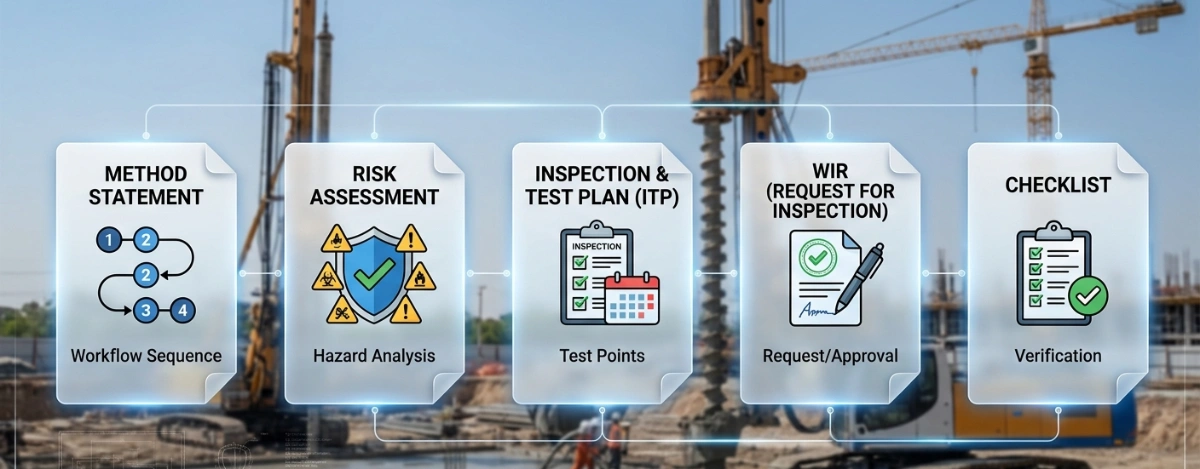
Unlike a downloadable Word or PDF template, this method statement is an AI-assisted editable starting point connected directly to a matching Inspection and Test Plan. Every section is structured, project-adaptable, and ready to export.
- AI-assisted drafting — Customize every section with AI for your specific project scope.
- Linked ITP — A matching inspection and test plan is generated alongside the method statement.
- Multiple export formats — Download as a formatted PDF or editable Excel spreadsheet.
- Editable starting point, not a final document — Review, verify, and adjust all content against your project requirements before use.
Static template vs. Quollnet workflow
| Feature | Static template | Quollnet |
|---|---|---|
| Project-specific content | Manual fill-in required | AI-assisted customization |
| Linked ITP | Separate document, no link | Matching ITP included |
| Export formats | Usually PDF only | PDF and Excel |
| Structured sections | Free-form layout | 13 standardized sections |
| Saved to your account | Local file only | Cloud-saved, reusable |
| Content accuracy | You verify everything | AI-assisted, you still verify |
| Cost | Often free but time-intensive | Free to customize and download |
What you can customize
When you save this method statement to your account, every section becomes editable. The following 13 sections are included:
- Scope — Defines the activity and its boundaries.
- References — Standards, specifications, and drawings.
- Responsibilities — Roles and accountabilities.
- Resources — Labour, plant, and equipment summary.
- Materials — Materials and compliance requirements.
- Equipment — Tools and equipment details.
- Prerequisites — Hold points and pre-conditions.
- Method sequence — Step-by-step construction sequence.
- Safety controls — HSE risk controls and PPE.
- Environmental controls — Environmental mitigation measures.
- QA/QC — Quality inspection and test requirements.
- ITP — Inspection and Test Plan table (has its own page).
- Attachments — Referenced drawings and documentation.
Why this method statement is used
This method statement is used to define and communicate the approved procedure for carrying out method statement – hot-applied rubberized asphalt waterproofing membrane for protected roof decks/podiums on site. It ensures the work is planned in advance, the correct resources and controls are in place, and all personnel understand responsibilities, sequence, quality requirements, and safety controls before work begins. It aligns site execution with the documented scope and acceptance expectations.
Who uses this method statement
This method statement is used by contractors, site supervisors, project engineers, QA/QC engineers, HSE officers, consultants, and client representatives. It serves as a shared reference for planning, execution, supervision, inspection, and approval of the activity on site.
When it is prepared and submitted
The method statement is prepared before the work activity starts and submitted as part of the pre-construction documentation package for review and approval.
Who reviews or approves it
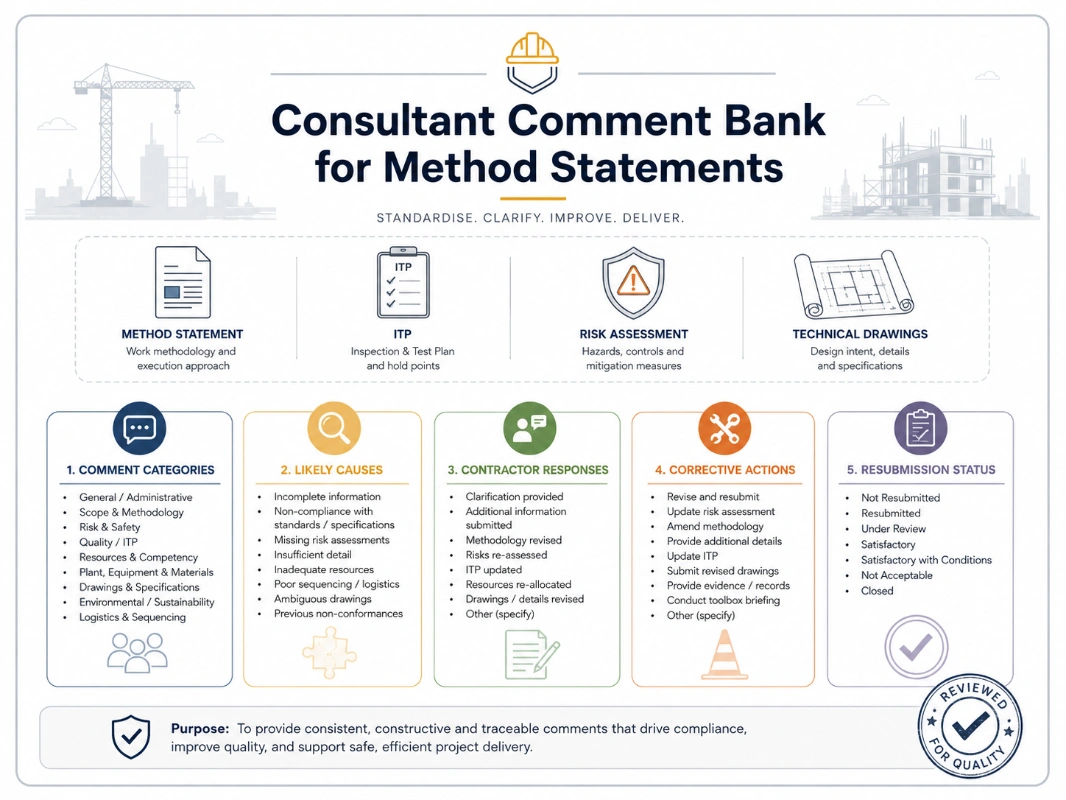
The method statement is usually submitted to the client representative, consultant, resident engineer, or project management consultant for review and approval before the work commences.
Important approval note
This method statement is an AI-assisted editable starting point, not a pre-approved document. Before use on any project, all content must be reviewed and approved by the relevant parties (superintendent, principal contractor, or client representative) in accordance with your contract and project quality plan.
For example: if your specification requires a departure from a referenced standard, that departure must be documented and approved separately — this method statement will not capture that automatically. Always verify against your applicable drawings, specifications, and regulatory requirements.
Method statement content
Scope
Overview
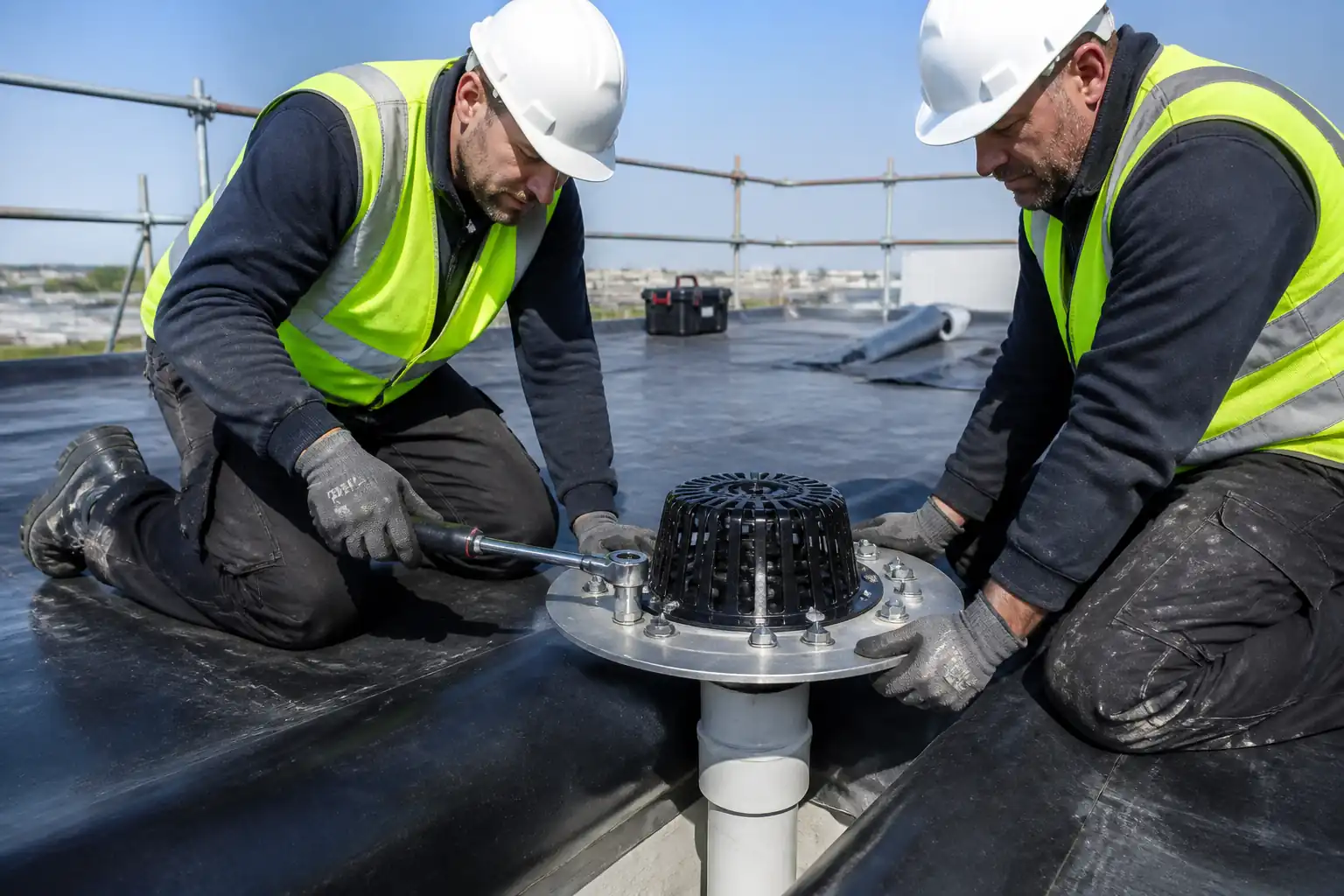
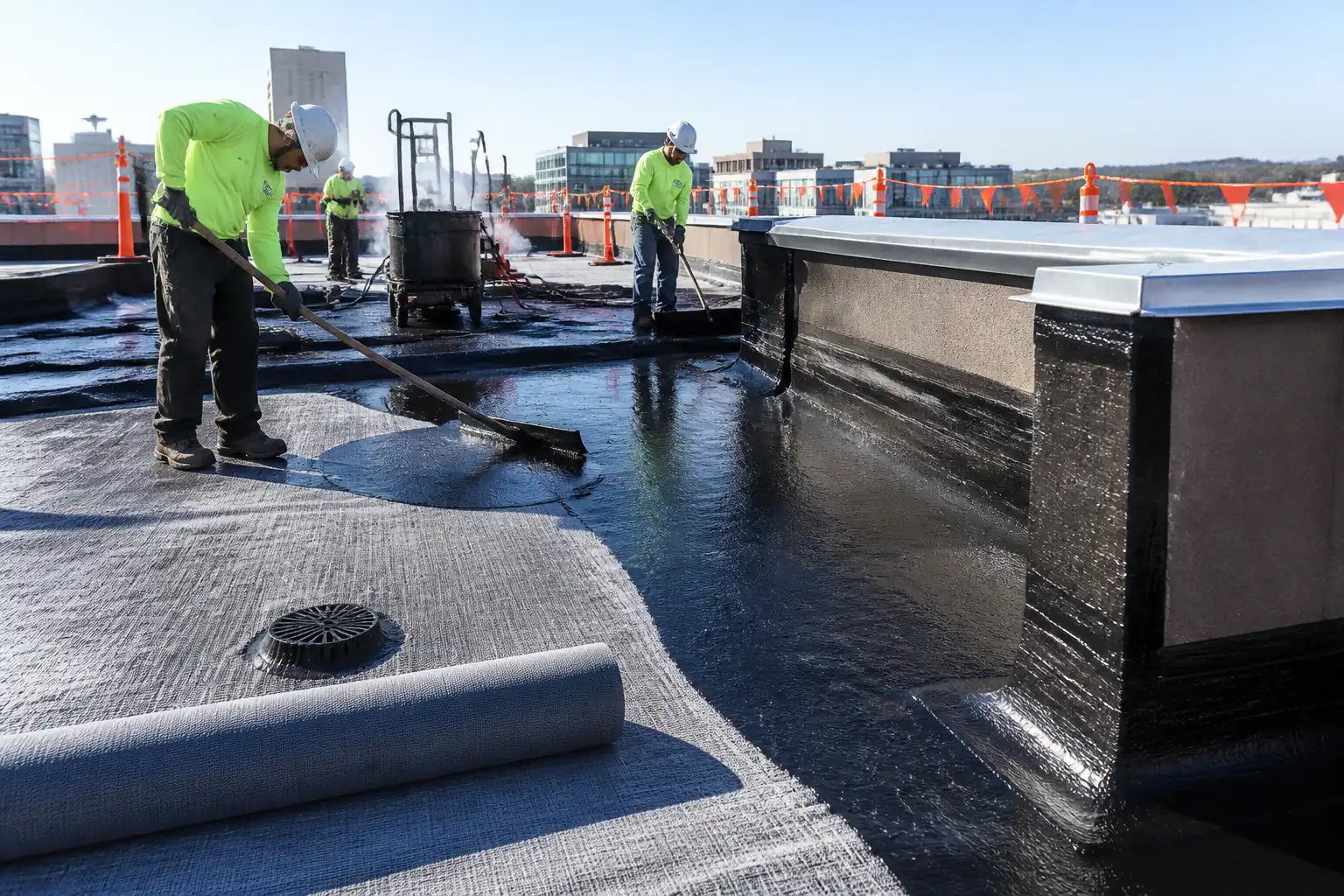
This method statement covers the complete installation of a hot-applied rubberized asphalt waterproofing system on concrete podium slabs and protected membrane roofs (PMR). It includes substrate preparation, priming, kettle operations and temperature monitoring, reinforcement fabric embedding, detailing of penetrations and terminations, full-field membrane application to the specified thickness, integrity testing (flood and/or electronic), installation of protection/drainage/insulation layers, and quality control documentation.
Key Objectives
- Achieve a continuous, fully bonded waterproofing membrane to the specified thickness without pinholes, blisters, or discontinuities.
- Execute safe hot works with strict control of kettle temperature, melt handling, and fire prevention measures.
- Provide robust detailing at drains, upstands, joints, and penetrations.
- Validate watertightness by flood testing and/or electronic leak detection before covering.
Exclusions
- Structural concrete works and slope formation except minor patching/fillets required for waterproofing.
- Permanent finishes above the protection/insulation unless noted.
Interfaces
- Civil/structural concrete, MEP penetrations, roof drainage hardware, insulation/paver/ballast systems, and landscaping build-ups.
Typical System Build-Up [Verify per project specifications]
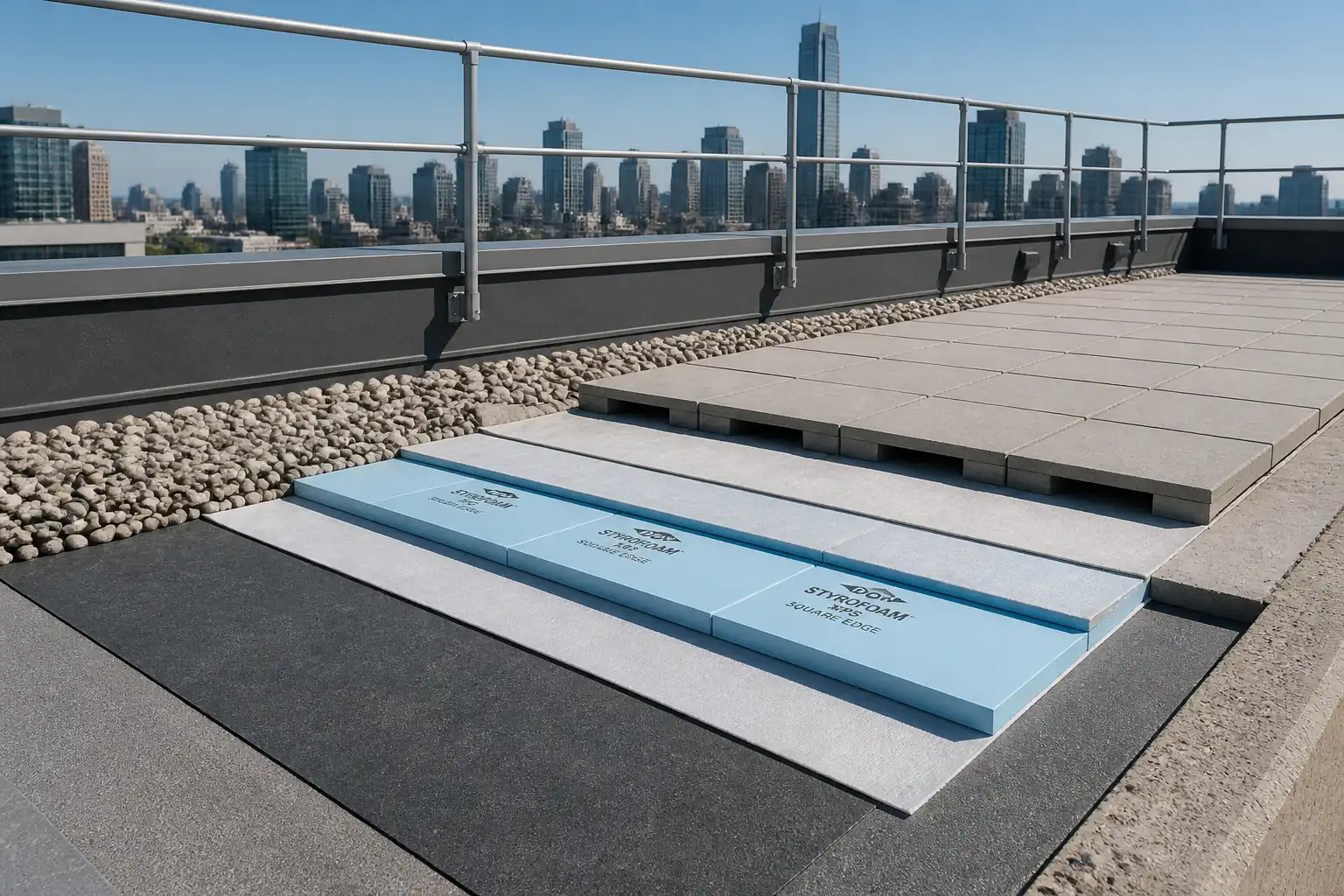
- Prepared concrete substrate → compatible primer → hot-applied rubberized asphalt base coat → embedded reinforcement fabric → hot-applied rubberized asphalt top coat (total nominal thickness 4–6 mm) → protection board/drainage composite → insulation (PMR, if specified) → filter fabric → ballast/pavers/screed as applicable.
References
| Document Type | Reference / Number | Revision | Notes |
|---|---|---|---|
| Standard | ACI 301; ACI 117 | For substrate quality and tolerances [Verify per project specifications]. | |
| Guideline | ICRI 310.2R | Target CSP 3–5 for hot-applied membranes (manufacturer-dependent). | |
| ASTM | ASTM D4263 | 24-hour plastic sheet test indicative of surface moisture. | |
| ASTM | ASTM C1583 | Typical min bond >1.0–1.5 MPa for coating/waterproofing [Verify per project specifications]. | |
| ASTM | ASTM D5957 | Typical 24 h water ponding at 25–50 mm head. | |
| ASTM | ASTM D7877 | Electronic integrity testing as alternate/adjunct to flood testing. | |
| NFPA | NFPA 51B | Hot work permit, fire watch, and controls. | |
| Regulatory | 29 CFR 1926; ISO 45001 (as applicable) | ||
| Manual | System-specific (e.g., HRAM datasheet) | Project-specific governing requirements. | |
| ASTM | ASTM D6114 | Use only if system utilizes asphalt-rubber binder. Otherwise follow manufacturer’s binder spec. |
Responsibilities
| Role | Responsibility | Name / Party |
|---|---|---|
| PM | Approvals, resources, interfacing trades, and progress reporting. | Main Contractor |
| Supervisor | Verifies substrate readiness, detailing, and adherence to system requirements. | Waterproofing Subcontractor |
| QC | ITP execution, hold/witness points, thickness checks, kettle log audits. | Main Contractor |
| HSE | Hot work permits, fire watch, PPE, emergency plan, environmental controls. | Main Contractor |
| Operator | Temperature control, loading, agitation, safe transfer, recordkeeping. | Waterproofing Subcontractor |
| Tech Rep | Attend pre-start meeting and key inspections; issue site visit reports. | Manufacturer |
| Engineer | Approve substrate, test results, and final sign-off. | Employer/Consultant |
Resources
| Resource Type | Description | Quantity | Remarks |
|---|---|---|---|
| Labor | 3–8 applicators for heating, spreading, embedding fabric, and detailing. | As required | |
| Labor | Dedicated trained operative during hot works and 60 minutes after. | 1 or more per hot area | |
| Labor | Support for temporary power/gas hookups to kettle. | As required |
Materials
| Material | Specification / Grade | Quantity | Remarks |
|---|---|---|---|
| HRAM | As per BOQ | ||
| Primer | As required | ||
| Scrim fabric | As required | ||
| Protection board/geotextile | As required | ||
| Drainage board | As required | ||
| XPS | As required | ||
| Sealant, term bars | As required | ||
| Mortar | As required |
Equipment
| Equipment | Capacity / Type | Quantity | Inspection Required |
|---|---|---|---|
| Kettle | 500–1500 L [Verify] | 1+ | Yes |
| As required | Yes | ||
| 2+ | Yes | ||
| 2 | Yes | ||
| As required | Yes | ||
| As required | Yes | ||
| As required |
Prerequisites
Submittals and Approvals
- Approved method statement, ITP, shop drawings, product data sheets, MSDS/SDS, and manufacturer approvals.
- Hot Work Permit system in place per NFPA 51B and project HSE plan.
Site and Substrate Readiness
- Concrete cured sufficiently per manufacturer (often 28 days) and structurally sound [Verify per project specifications].
- Surface profile CSP 3–5 (ICRI 310.2R) via shot blasting/grinding; free of laitance, curing compounds, oils, and contaminants.
- Moisture: Pass ASTM D4263 (no condensation/darkening); if required, verify RH per manufacturer (typ. ≤75–85% RH in slab) [Verify].
- Pull-off strength: ≥1.0–1.5 MPa average (ASTM C1583) where specified [Verify].
- Slope: Minimum 1:80 toward drains unless otherwise designed [Verify].
- Upstand/termination height: ≥150 mm above finished surface where feasible [Verify].
- All penetrations, drains, scuppers, terminations, and metalwork installed and fixed.
Weather and Environmental
- Ambient and substrate temperature within manufacturer’s limits (typ. ≥5°C and rising; ≤40°C). No precipitation; wind conditions suitable to control fumes/overspray.
Calibrations and Tools
- Current calibration certificates for thermometers and gauges. Kettle safety devices tested and logged.
Briefings
- Task-specific risk assessments and toolbox talks conducted. Fire watch assigned. Emergency plan briefed.
Method Sequence
| Step | Activity | Description | Responsibility | Inspection / Hold Point |
|---|---|---|---|---|
| 1 | Mobilization & Hot Work Setup | Establish kettle location downwind and away from air intakes; set spill trays and barricades; connect fuel/power by competent persons; place fire extinguishers and spill kits. | Site Engineer; HSE; Kettle Operator | Pre-start HSE inspection; PTW issued |
| 2 | Substrate Survey & Repairs | Check levels, soundness; mark defects; perform crack/joint routing and repairs; install 45° cementitious fillets (25–50 mm) at inside corners; patch voids with non-shrink mortar. | Site Engineer; QC | Substrate readiness check |
| 3 | Cleaning | Vacuum dust (HEPA), solvent-free degreasing where needed; ensure dust-free surface before priming. | Waterproofing Crew | Visual cleanliness |
| 4 | Moisture Verification | Conduct ASTM D4263 plastic sheet test (24 h) at representative areas. If required by spec, perform RH testing or calcium chloride per manufacturer. | QC | Hold point |
| 5 | Priming | Apply compatible primer by roller/spray at 0.25–0.5 L/m². Allow to dry to tack-free per datasheet (typically 30–120 min). | Applicators | Primer coverage check |
| 6 | Kettle Charging & Temperature Control | Load HRAM gradually; keep lid closed; maintain melt temp typically 175–205°C; stir/agitate as required. Verify with immersion thermometer and IR at point-of-application. | Kettle Operator | Temperature log review |
| 7 | Pre-Detailing – Joints/Cracks/Corners | Pre-strip cracks, cold joints, and re-entrant corners with hot membrane (~2–3 mm) and embed 150–200 mm wide fabric; apply second pass to saturate. Form additional plies at expansion joints as specified. | Applicators | Detail inspection |
| 8 | Drain and Penetration Detailing | At drains: apply membrane onto primed bowl, embed reinforcement, extend 200–300 mm; install clamping rings. At penetrations: collar with pre-formed reinforcement, double embedment, seal at term bars. | Applicators | Hold/witness point |
| 9 | Base Coat Application | Pour/spread hot membrane to ~2–3 mm using squeegee/mop. Work in lanes; maintain wet edge; avoid entrapped air. | Applicators | In-process QC |
| 10 | Embed Full Reinforcement Fabric | Roll out fabric into hot base coat; avoid wrinkles; overlap 75–100 mm; stagger laps; immediately wet-out. | Applicators | QC check |
| 11 | Top Coat Application | Apply additional hot membrane to achieve total specified thickness (typ. 4–6 mm). | Applicators | In-process QC |
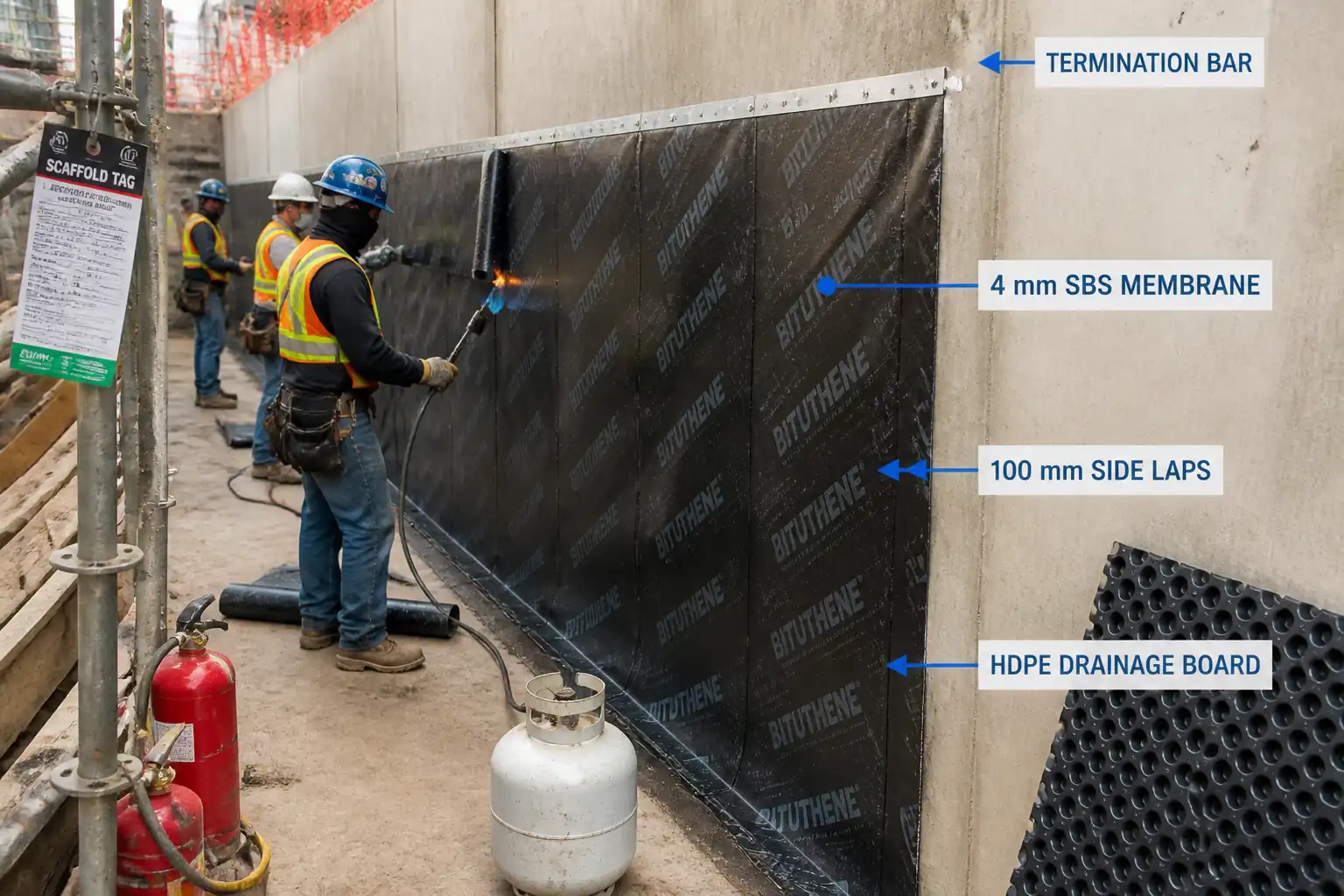
| 12 | Terminations and Upstands | Terminate into reglet or with termination bars and sealant; extend upstands to ≥150 mm above finished level where practicable. | Applicators | QC and Engineer witness |
| 13 | Cure/Set Period Before Testing | Allow membrane to cool/set per datasheet (typically 24 h) before integrity testing. | Supervisor | Time/condition check |
| 14 | Flood Test (if specified) | Create temporary bunds; pond with clean water to 25–50 mm head for ≥24 h; inspect below for leaks; mark and repair defects. | QC; Engineer | Hold point |
| 15 | Electronic Leak Detection (alternate/adjunct) | Low-voltage vector mapping or high-voltage holiday test per ASTM D7877 when feasible and safe. | Specialist Tester | Witness point |
| 16 | Protection Layer Installation | Install protection board or geotextile over membrane; tape/seal laps as required; install drainage composite toward outlets with laps shingled to flow. | Applicators | QC check |
| 17 | PMR Insulation and Overburden | Place XPS with staggered joints; install filter fabric; place ballast or pavers/screed as per drawings. Maintain free drainage to outlets. | Main Contractor; Waterproofing Subcontractor | Witness point |
| 18 | Closeout | Remove temporary bunds; clean area; compile QA dossier (kettle logs, WFT logs, test reports, approvals); update as-builts. | PM; QC | Final inspection |
Safety Controls
Task-Specific Hazards and Controls
1) Hazard: Hot bitumen/HRAM handling (burns, splashes)
- Likely consequence: Serious burns, eye injury
- Engineering/procedural control: Kettle with lid/guards and over-temp cut-out; slow charging; no water contamination; use splash shields; controlled transfer; keep pathway clear; buddy system.
- Required PPE: Heat-resistant gauntlets, long-sleeve FR clothing, face shield over safety goggles, heat-resistant apron, safety boots.
- Collective preventive measure: Physical barriers and designated hot material routes; keep non-essential personnel out; spill/first aid kits staged.
- Inspection/permit/supervision: Hot Work Permit; pre-use kettle checklist; competent kettle operator; HSE inspections.
2) Hazard: Fire/ignition from hot works and fuel
- Likely consequence: Fire spread, property damage, injury
- Engineering/procedural control: NFPA 51B-compliant PTW; remove combustibles within 10 m or cover with FR blankets; maintain extinguishers; no smoking; check gas hose integrity and regulators.
- Required PPE: FR clothing, gloves, eye/face protection.
- Collective preventive measure: Fire watch during works and 60 min after completion; establish exclusion zone and signage.
- Inspection/permit/supervision: PTW; daily hose/leak checks; equipment serviced and tagged; fire watch log.
3) Hazard: Fumes and odors (bitumen fumes, VOCs from primer)
- Likely consequence: Respiratory/eye irritation, nuisance complaints
- Engineering/procedural control: Use low-odor primers where possible; work downwind; avoid air intakes (close/redirect temporarily); local extraction at kettle; limit temperature to spec to reduce fume.
- Required PPE: Safety goggles, half-mask respirator with organic vapor cartridges when required [Verify per project HSE plan and local regulations], nitrile gloves for primer.
- Collective preventive measure: Perimeter monitoring if sensitive neighbors; odor management plan.
- Inspection/permit/supervision: HSE monitoring; SDS review; toolbox talks.
4) Hazard: Slips/trips on hot membrane and hoses
- Likely consequence: Falls, contact burns
- Engineering/procedural control: Maintain housekeeping; route hoses to edges; anti-slip mats at access points; restrict traffic on fresh membrane.
- Required PPE: Slip-resistant boots.
- Collective preventive measure: Barricades and lookouts.
- Inspection/permit/supervision: Daily HSE walkdowns; supervisor oversight.
5) Hazard: Working at height/roof edges
- Likely consequence: Falls from height
- Engineering/procedural control: Edge protection/guardrails; travel restraint or fall arrest; controlled access zones; safe access/egress points.
- Required PPE: Full body harness with lanyard if guardrails absent; hard hats.
- Collective preventive measure: Temporary guardrails and warning lines 2 m from edges.
- Inspection/permit/supervision: Work-at-height permit where required; equipment inspection tags; competent supervision.
6) Hazard: Manual handling of materials and boards
- Likely consequence: Musculoskeletal injuries
- Engineering/procedural control: Team lifts; trolleys; mechanical aids for pallets; break down loads.
- Required PPE: Gloves, safety boots.
- Collective preventive measure: Staging areas near point of use; housekeeping.
- Inspection/permit/supervision: Manual handling training; supervision spot checks.
7) Hazard: Confined or poorly ventilated upstands/plant areas
- Likely consequence: Fume build-up, hypoxia
- Engineering/procedural control: Enhance ventilation; monitor atmospheres if indicated; restrict heating inside enclosures.
- Required PPE: Respiratory protection as assessed.
- Collective preventive measure: Ventilation fans; access control.
- Inspection/permit/supervision: Confined space assessment where applicable [Verify per project HSE plan and local regulations].
8) Hazard: Environmental exposure of open drains during flood test
- Likely consequence: Water ingress to occupied spaces or contamination
- Engineering/procedural control: Pre-check of drains and downpipes; isolate vulnerable spaces; use potable/clean water; controlled discharge through sediment socks.
- Required PPE: Standard site PPE.
- Collective preventive measure: Temporary bunding and monitoring.
- Inspection/permit/supervision: Permit/notification to building operations; continuous monitoring during test.
Environmental Controls
Controls and Good Practice
- Odor and Emissions: Position kettle downwind; maintain melt temperature within manufacturer limits to minimize fumes; consider low-odor primer; avoid operations during inversion weather conditions near sensitive receptors.
- Spill Prevention: Secondary containment under kettle and drums; drip trays at transfer points; spill kits available; immediate cleanup of drips; prohibit discharge to drains.
- Noise and Vibration: Use well-maintained equipment; limit noisy surface prep to permitted hours; provide hearing protection where required.
- Water Management: Use clean water for flood testing; protect roof outlets to control discharge; filter through sediment control before release; do not flood test where leakage may damage active areas without protections.
- Waste Management: Segregate empty containers; dispose of HRAM scraps and contaminated materials per local regulations; recycle metal packaging where possible.
- Dust Control: During grinding/shot blasting use HEPA vacuums; damp down if allowed and safe (not near hot works).
- Energy and Fuel: Shut kettle during long breaks; maintain burners for efficient combustion; store LPG/diesel per code.
- Wildlife and Public Interface: Prevent odors drifts to public areas; post notices where required; respond to complaints via site manager.
- Verification: Environmental inspections by HSE; records of waste transfers and water discharge approvals [Verify per project HSE plan and local regulations].
QA/QC
Inspection and Test Strategy
- Hold Points: Substrate readiness (moisture/repairs), drain/penetration detailing, total membrane thickness, integrity testing (flood/ELD), covering with protection layers.
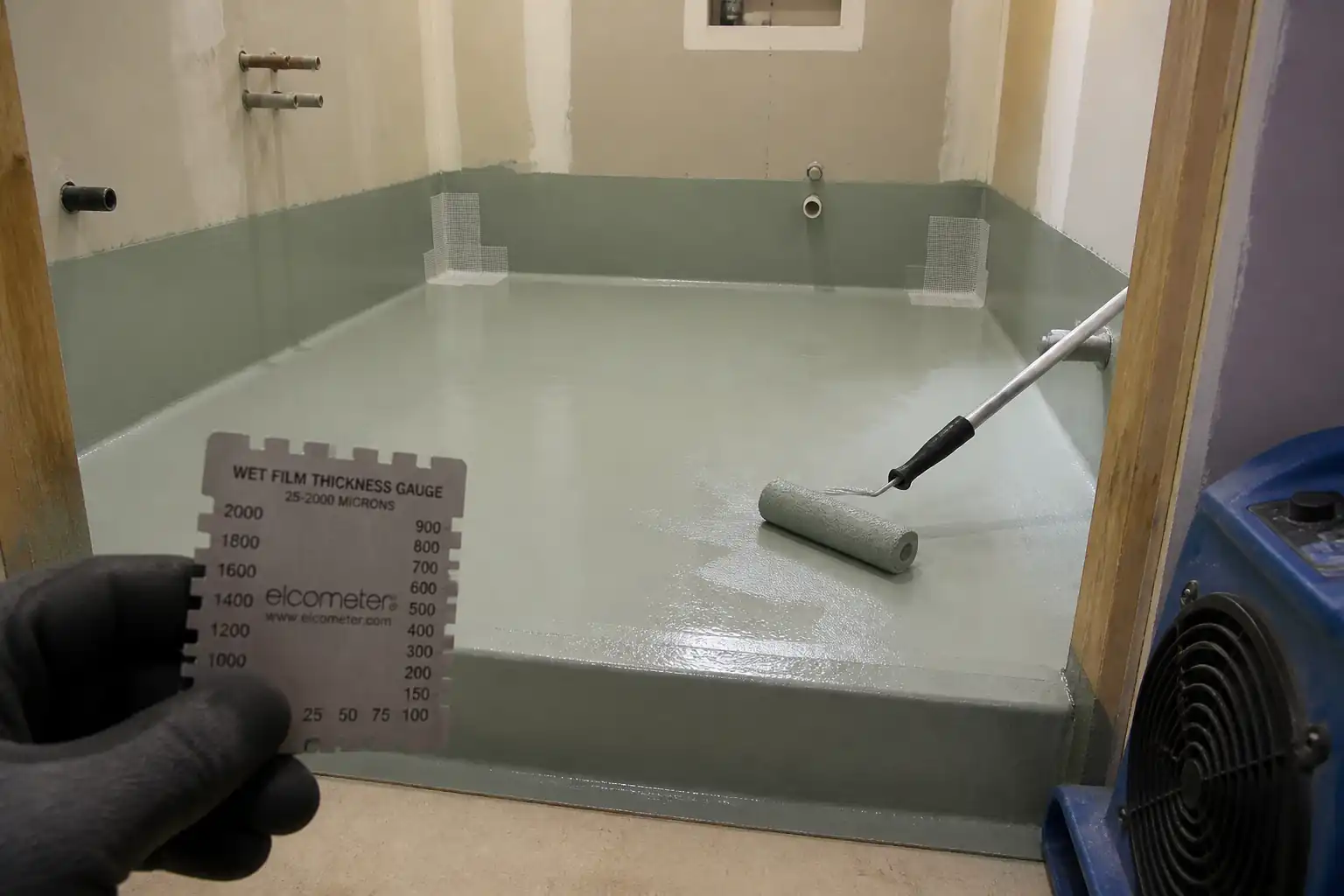
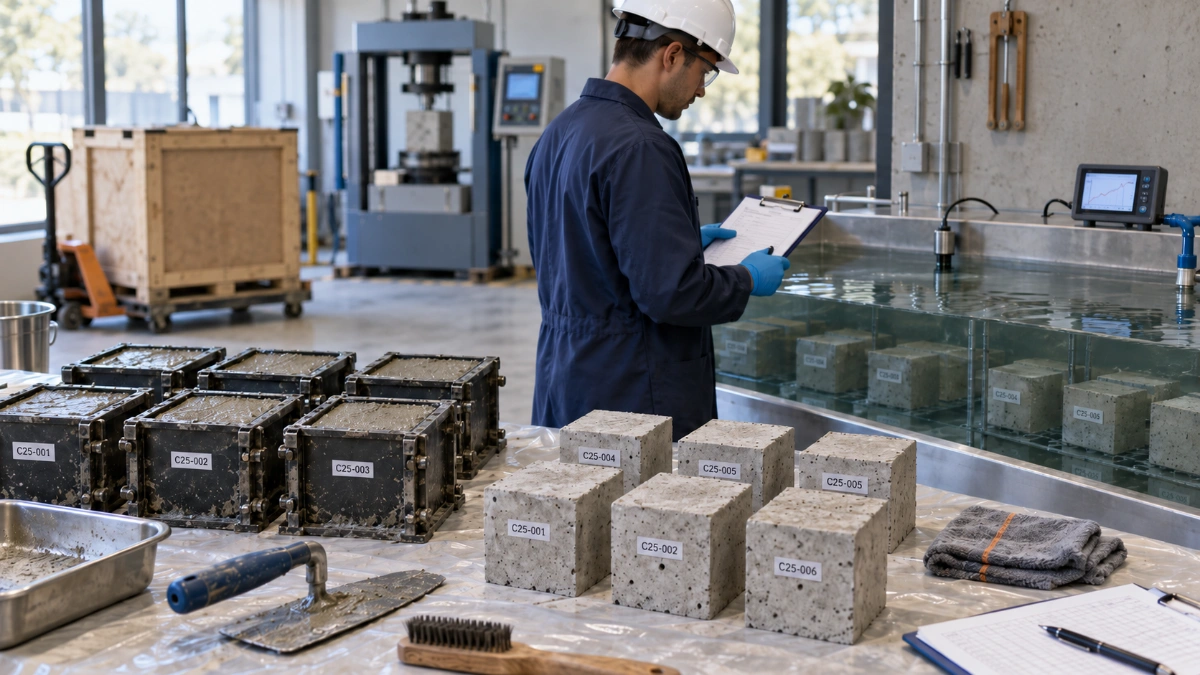
- In-Process Checks: Kettle temperature every 15–30 minutes; primer coverage; wet film thickness each 20–30 m² and at each pass; reinforcement lap/embedding; termination details and sealant.
- Acceptance Criteria:
- Substrate: Sound, clean, dry, CSP 3–5; moisture tests passed; repairs cured.
- Thickness: Total membrane thickness within ±10% of specified (typ. 4–6 mm) [Verify]. No holidays, blisters, or pinholes.
- Details: Laps ≥75 mm; full embedment; drains clamped/sealed; terminations continuous.
- Testing: Flood test per ASTM D5957 for ≥24 h at 25–50 mm head with zero leakage; or ELD per ASTM D7877 with no defects.
- Records: Kettle temperature log; WFT/thickness log; primer coverage; detail checklists; moisture test reports; flood/ELD reports; photographic records; approvals and NCR/CAR if applicable.
- Calibration: Thermometers and gauges calibrated within previous 12 months (or per project), with certificates in QA file.
- Nonconformance: Mark, investigate, and repair leaks or thin areas; re-test repaired zones before covering.
- Manufacturer Involvement: Secure attendance at start-up and critical stages; obtain conformance letter where specified.
Attachments
Included/Referenced Attachments
- Kettle temperature log sheet (template)
- Substrate readiness checklist
- Detail sketches: drains, penetrations, inside/outside corners, terminations
- Wet film thickness check sheet
- Flood test method statement excerpt per ASTM D5957
- Hot Work Permit template (NFPA 51B compliant)
- Calibration certificates (thermometers, gauges)
- MSDS/SDS for HRAM, primer, sealants
- Manufacturer’s installation manual and technical bulletins
This content is a read-only public reference. Download or customize to get an editable version.
ITP preview
The first inspection activities from the linked ITP for Method Statement – Hot-Applied Rubberized Asphalt Waterproofing Membrane for Protected Roof Decks/Podiums:
| Activity | Inspection / Test | Acceptance Criteria | Responsibility | Record |
|---|---|---|---|---|
| Substrate condition and moisture | ASTM D4263; pull-off if specified | Clean, dry, CSP 3–5; moisture within limits; pull-off ≥1.0–1.5 MPa if required [Verify]. | QC / Engineer (Hold) | Substrate checklist; test reports |
| Primer application | Spot measure rate vs area | Uniform coverage 0.25–0.5 L/m²; tack-free before membrane [Verify]. | QC / Supervisor | Primer log; photos |
| Kettle temperature control | Immersion + IR every 15–30 min | Within manufacturer window (typ. 175–205°C); no overheating. | QC / Kettle Operator | Kettle temp log; calibration certs |
Showing 3 of 10 inspection activities. View full ITP →
Related Inspection and Test Plan
An Inspection and Test Plan (ITP) is available for Method Statement – Hot-Applied Rubberized Asphalt Waterproofing Membrane for Protected Roof Decks/Podiums. The ITP defines the inspection activities, acceptance criteria, hold and witness points, responsible parties, and records required to verify the work described in this method statement.
View the Method Statement – Hot-Applied Rubberized Asphalt Waterproofing Membrane for Protected Roof Decks/Podiums ITP →Frequently asked questions
Continue with related Quollnet resources connected to this method statement.