
Method Statement – Heavy-Duty Polyethylene (HDPE) Vapor Barrier Installation Below Concrete Slab-on-Grade – Method Statement
AI-assisted method statement with matching ITP, PDF download, and Excel export.
More than a static template
Unlike a downloadable Word or PDF template, this method statement is an AI-assisted editable starting point connected directly to a matching Inspection and Test Plan. Every section is structured, project-adaptable, and ready to export.
- AI-assisted drafting — Customize every section with AI for your specific project scope.
- Linked ITP — A matching inspection and test plan is generated alongside the method statement.
- Multiple export formats — Download as a formatted PDF or editable Excel spreadsheet.
- Editable starting point, not a final document — Review, verify, and adjust all content against your project requirements before use.
Static template vs. Quollnet workflow
| Feature | Static template | Quollnet |
|---|---|---|
| Project-specific content | Manual fill-in required | AI-assisted customization |
| Linked ITP | Separate document, no link | Matching ITP included |
| Export formats | Usually PDF only | PDF and Excel |
| Structured sections | Free-form layout | 13 standardized sections |
| Saved to your account | Local file only | Cloud-saved, reusable |
| Content accuracy | You verify everything | AI-assisted, you still verify |
| Cost | Often free but time-intensive | Free to customize and download |
What you can customize
When you save this method statement to your account, every section becomes editable. The following 13 sections are included:
- Scope — Defines the activity and its boundaries.
- References — Standards, specifications, and drawings.
- Responsibilities — Roles and accountabilities.
- Resources — Labour, plant, and equipment summary.
- Materials — Materials and compliance requirements.
- Equipment — Tools and equipment details.
- Prerequisites — Hold points and pre-conditions.
- Method sequence — Step-by-step construction sequence.
- Safety controls — HSE risk controls and PPE.
- Environmental controls — Environmental mitigation measures.
- QA/QC — Quality inspection and test requirements.
- ITP — Inspection and Test Plan table (has its own page).
- Attachments — Referenced drawings and documentation.
Why this method statement is used
This method statement is used to define and communicate the approved procedure for carrying out method statement – heavy-duty polyethylene (hdpe) vapor barrier installation below concrete slab-on-grade on site. It ensures the work is planned in advance, the correct resources and controls are in place, and all personnel understand responsibilities, sequence, quality requirements, and safety controls before work begins. It aligns site execution with the documented scope and acceptance expectations.
Who uses this method statement
This method statement is used by contractors, site supervisors, project engineers, QA/QC engineers, HSE officers, consultants, and client representatives. It serves as a shared reference for planning, execution, supervision, inspection, and approval of the activity on site.
When it is prepared and submitted
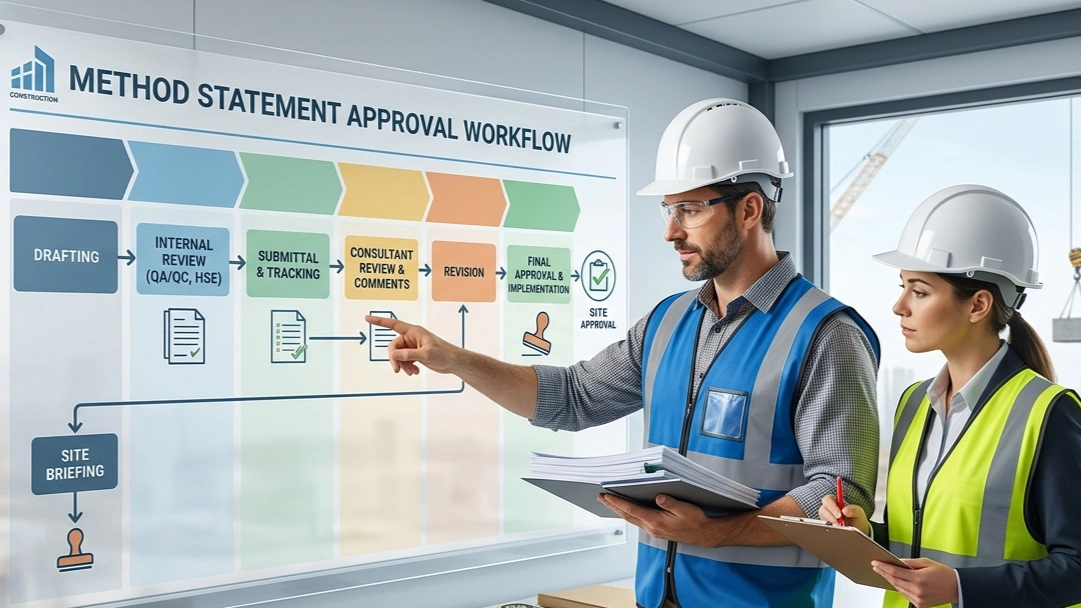
The method statement is prepared before the work activity starts and submitted as part of the pre-construction documentation package for review and approval.
Who reviews or approves it
The method statement is usually submitted to the client representative, consultant, resident engineer, or project management consultant for review and approval before the work commences.
Important approval note
This method statement is an AI-assisted editable starting point, not a pre-approved document. Before use on any project, all content must be reviewed and approved by the relevant parties (superintendent, principal contractor, or client representative) in accordance with your contract and project quality plan.
For example: if your specification requires a departure from a referenced standard, that departure must be documented and approved separately — this method statement will not capture that automatically. Always verify against your applicable drawings, specifications, and regulatory requirements.
Method statement content
Scope
Overview
This method statement covers procurement, handling, installation, inspection, testing, protection, and documentation for heavy-duty polyethylene (HDPE) vapor barrier below slab-on-grade foundations, including:
- Sand bed/blinding for leveling beneath the barrier.
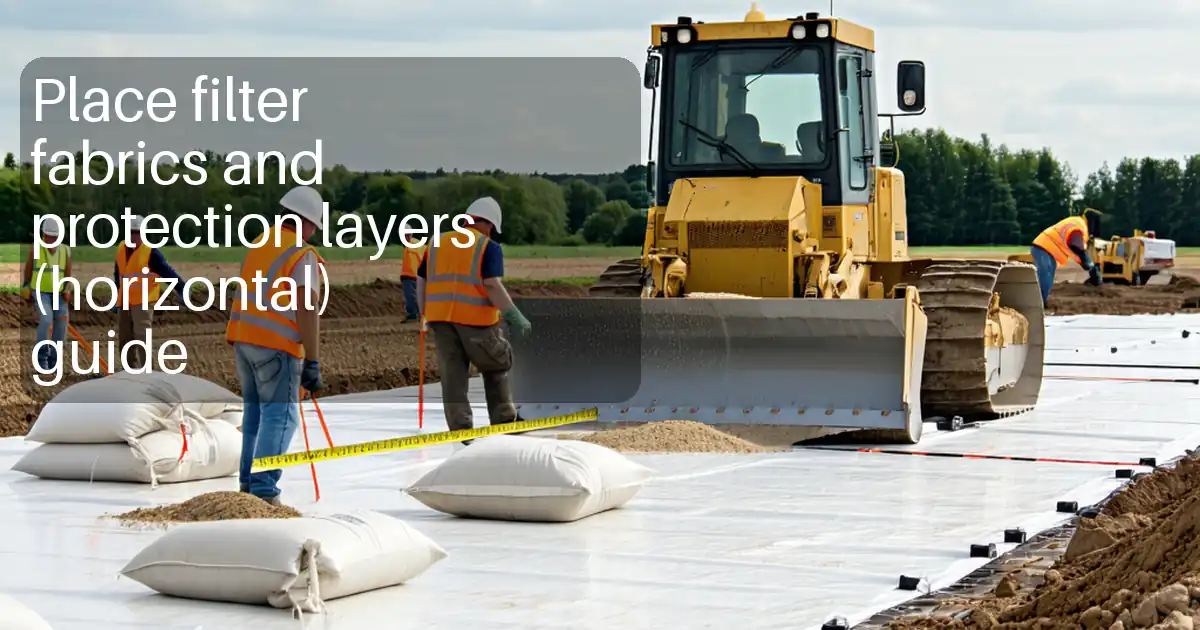
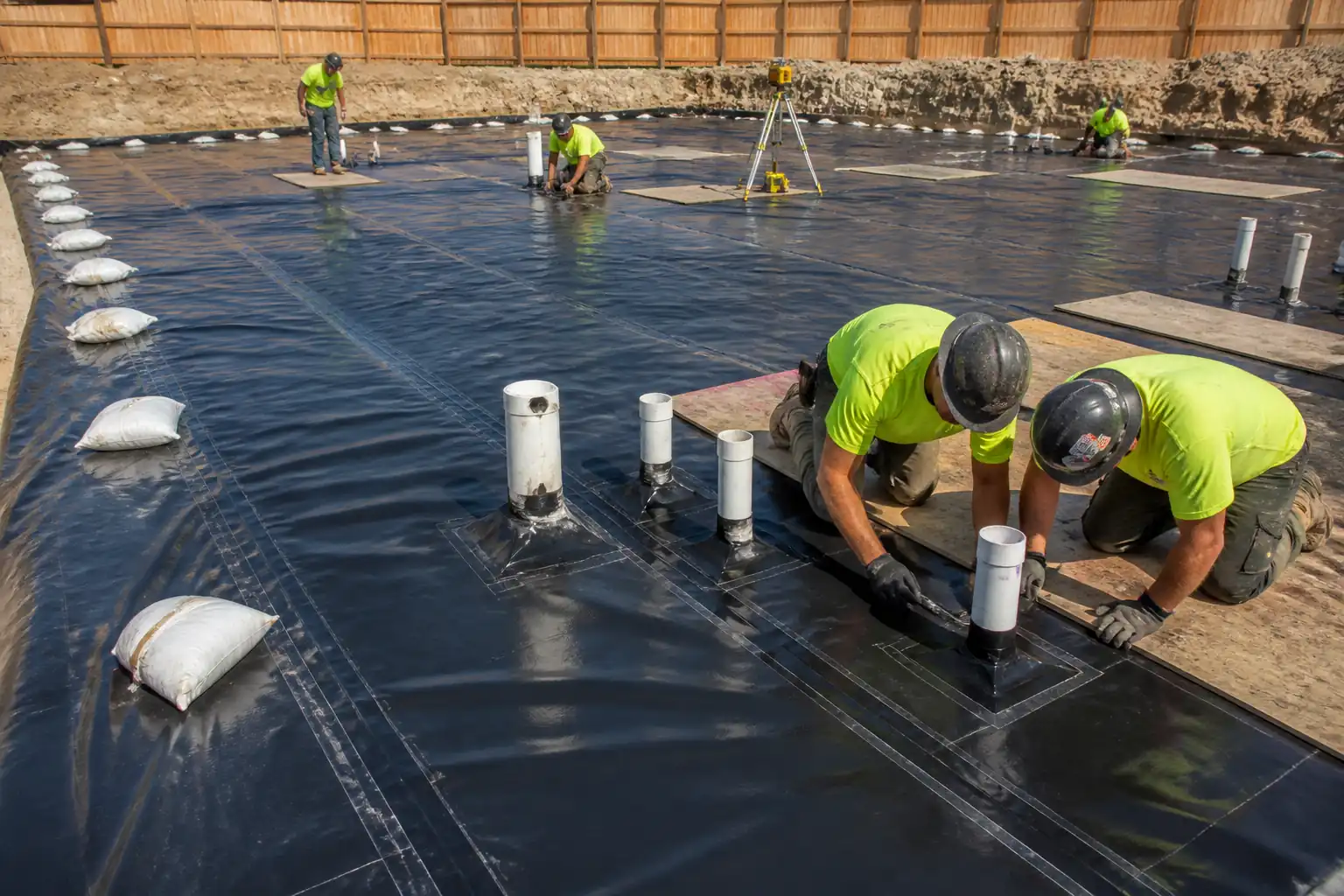
- Placement of continuous HDPE sheets, taped seams, and perimeter upturns.
- Detailing and sealing around service penetrations and slab edges.
- Inspection for damage, repair of punctures/tears, and ongoing protection during reinforcement placement up to concrete pour.
Objectives
- Achieve a continuous, durable, and vapor-tight barrier in accordance with ASTM E1643 and project specifications.
- Prevent upward moisture transmission into slabs, especially where moisture-sensitive flooring or coatings are planned.
Exclusions/Assumptions
- No sand or blotter layer above the vapor barrier unless specifically required. [Verify per project specifications and ACI 302.1R]
- Subgrade earthworks and deep utility installations by others; acceptance by this method prior to barrier installation.
References
| Document Type | Reference / Number | Revision | Notes |
|---|---|---|---|
| Standard | ASTM E1643 | Primary installation practice reference | |
| Standard | ASTM E1745 | Material performance class and properties | |
| Guide | ACI 302.1R | ||
| Guide | ACI 302.2R | ||
| Standards | ASTM D1709, ASTM D882, ASTM E96 | Verification via manufacturer data | |
| Standard | ISO 9001 | ||
| Standard | BS EN 13984 | Use where EU standards govern [Verify per project] |
Responsibilities
| Role | Responsibility | Name / Party |
|---|---|---|
| PM | Project Manager | Contractor |
| Engineer | Site Engineer | Contractor |
| QA/QC | QA/QC Engineer | Contractor |
| HSE | HSE Officer | Contractor |
| Surveyor | Surveyor | Contractor |
| Foreman | Foreman | Contractor |
| Supplier | Supplier | Vendor |
| Engineer | Engineer | Employer |
Resources
| Resource Type | Description | Quantity | Remarks |
|---|---|---|---|
| Manpower | HDPE vapor barrier installers (2–6 persons depending on area) | As scheduled | |
| Manpower | Support, cleaning, ballast placement, traffic control boards | As required | |
| Manpower | ITP checks, photos, records | 1 | |
| Manpower | Permit, risk monitoring, TBT | 1 (shared) |
Materials
| Material | Specification / Grade | Quantity | Remarks |
|---|---|---|---|
| HDPE | As per BOQ + 5% waste | ||
| As required | |||
| As required | |||
| As required | |||
| Sand | As required | ||
| As required |
Equipment
| Equipment | Capacity / Type | Quantity | Inspection Required |
|---|---|---|---|
| Laser level | 1 set | Yes | |
| Plate compactor | 1 | Yes | |
| Roller | 1–2 | No | |
| Knives | As needed | No | |
| Brooms | As needed | No | |
| Sandbags | As required | No | |
| Buggies | As needed | No |
Prerequisites
- Approved method statement, ITP, and material submittals (MIR with ASTM E1745 Class and thickness).
- Subgrade works complete, trimmed, compacted, and accepted; utilities/MEP sleeves and termite treatment (if specified) completed and signed off.
- Area dry and clean; no standing water; weather suitable. Wind speed within safe handling limits for large sheets [Verify per project HSE plan].
- Benchmarks and level control established and verified by Surveyor.
- Permits to work and task-specific risk assessment/JSAs approved. Toolbox talk conducted for crew.
- Coordination with reinforcement team for access/protection plan and chair types with base plates.
- Storage area for rolls established on pallets, covered from UV; check manufacturer’s max UV exposure window (typically ≤60 days) [Verify].
Method Sequence
| Step | Activity | Description | Responsibility | Inspection / Hold Point |
|---|---|---|---|---|
| MS-01 | Pre-start briefing and checks | Conduct toolbox talk, review drawings/details, confirm hold/witness points, ensure permits in place. | HSE Officer / Site Engineer | Documented TBT and permit check |
| MS-02 | Subgrade acceptance | Inspect subgrade for levelness, compaction, cleanliness. Proof-roll where specified; correct soft spots. | Site Engineer | IR to Engineer |
| MS-03 | Sand blinding/leveling (below barrier) | Place 10–25 mm clean fine sand to remove irregularities; lightly compact or screed to tolerance. | Foreman / Surveyor | Level checks |
| MS-04 | Vapor barrier layout | Plan roll layout to minimize seams; unroll HDPE over sand blinding; relax wrinkles by sun warming or careful re-laying. | Foreman | Visual |
| MS-05 | Seams and overlaps | Lap adjacent sheets minimum 150 mm (preferred 300 mm at high-risk areas). Clean/lap area, apply compatible tape centrally, roll with 15–30 kg roller. | Installers | QC inspection |
| MS-06 | Perimeter upturn and terminations | Turn barrier up vertical sides of grade beams/walls to finished slab height; seal to concrete/vertical substrate with tape/mastic and termination bar if required. | Installers | QC inspection |
| MS-07 | Penetration detailing | For each pipe/duct: clean, cut tight X-slit; fit preformed boot or field-fabricated collar; seal with mastic and tape; stainless band clamp if specified. | Installers | QC + Engineer witness (as scheduled) |
| MS-08 | Puncture inspection and repairs | 100% visual survey; mark and patch holes/tears with same HDPE; clean, apply patch extending ≥150 mm beyond damage; tape/roll. | QA/QC Engineer | Hold point prior to rebar placement |
| MS-09 | Protection and access control | Lay protection boards/walkways; restrict traffic; use rebar chairs with base plates ≥100×100 mm; no dragging steel across sheet. | Foreman | HSE/QA walkdown |
| MS-10 | Reinforcement placement coordination | Place rebar carefully on chairs with sand plates; maintain access boards; correct any incidental damage immediately with patches. | Rebar Foreman | Joint inspection |
| MS-11 | Pre-pour final inspection | Final check of seams, penetrations, perimeter, protection; remove debris; confirm no sand above barrier unless specified. | QA/QC + Engineer | Hold point |
| MS-12 | Concrete placement interface | Maintain integrity during pour; no trafficking directly on sheet; stop-work to repair if damage exposed before pour resumes. | Site Engineer | Surveillance |
Health, Safety, and Environment – Safety Controls
Task-specific hazards and controls
1) Hazard: Slips/trips on plastic sheet surfaces
- Likely consequence: Sprains, falls, sheet damage
- Engineering/procedural control: Keep sheet dry/clean; install walk boards; limit access to essential crew; no running
- PPE: Safety boots with non-aggressive soles, gloves
- Collective preventive measure: Walkway boards and barriered access routes
- Inspection/permit/supervision: Daily HSE walkdown; Foreman to enforce access plan
2) Hazard: Knife/cutting injuries during detailing
- Likely consequence: Lacerations
- Engineering/procedural control: Use guarded safety knives; cut on sacrificial boards; cut away from body; trained personnel only
- PPE: Cut-resistant gloves, long sleeves
- Collective preventive measure: Issue safe cutting kit and training
- Inspection/permit/supervision: Toolbox briefing on cutting; Foreman spot checks
3) Hazard: Manual handling of rolls (25–50 kg typical)
- Likely consequence: Strains, back injuries
- Engineering/procedural control: Team lifts or mechanical aids; store near point of use; limit carry distance
- PPE: Gloves, safety footwear
- Collective preventive measure: Use trolleys/buggies with low ground pressure
- Inspection/permit/supervision: Manual handling training; HSE observation cards
4) Hazard: Rebar chair puncture or impalement risk
- Likely consequence: Foot injury, barrier damage
- Engineering/procedural control: Use chairs with sand/base plates; cap protruding rebar; install boards before steel placement
- PPE: Safety boots, gloves, eye protection
- Collective preventive measure: Universal rebar caps and protected access lanes
- Inspection/permit/supervision: Pre-task check; QA/HSE verification before rebar works
5) Hazard: Wind uplift of large sheets
- Likely consequence: Loss of control, trips, sheet tearing
- Engineering/procedural control: Stage unrolling to manageable lengths; ballast edges/seams with sandbags; cease work above safe wind threshold [Verify per project HSE plan]
- PPE: Hard hats, gloves, eye protection
- Collective preventive measure: Wind monitoring and work-stoppage criteria
- Inspection/permit/supervision: Supervisor to monitor weather; stop-work authority defined
6) Hazard: Exposure to heat/sun during placement
- Likely consequence: Heat stress, dehydration
- Engineering/procedural control: Work early shifts; provide shade and hydration; rest breaks per heat index
- PPE: Lightweight high-vis clothing, sunscreen
- Collective preventive measure: Heat stress plan and buddy system
- Inspection/permit/supervision: HSE to monitor WBGT/heat index [Verify per local regulations]
7) Hazard: Vehicle/buggy interaction in slab area
- Likely consequence: Struck-by, run-over, barrier damage
- Engineering/procedural control: Segregate routes; banksman control; speed limits; use low-pressure tires and boards over barrier
- PPE: High-vis vests, safety boots, helmets
- Collective preventive measure: Physical barriers and signage
- Inspection/permit/supervision: Traffic management plan; spot checks
8) Hazard: Confined/partially enclosed building areas (if within structure)
- Likely consequence: Poor lighting, trip hazards
- Engineering/procedural control: Task lighting; housekeeping; clear egress
- PPE: Headlamps as needed, hard hats
- Collective preventive measure: Temporary lighting circuits
- Inspection/permit/supervision: HSE lighting checks
Note: All controls to be verified per project HSE plan and local regulations.
Environmental Controls
- Material storage: Keep HDPE rolls on pallets, covered; prevent UV degradation and wind dispersal.
- Waste minimization: Optimize roll cuts; segregate clean HDPE offcuts for recycling where available; dispose per local regulations.
- Dust control: Lightly dampen subgrade/sand if dusty; avoid water ponding; use brooms rather than compressed air where feasible.
- Spill control: Store mastic/sealant with trays; keep SDS on site; avoid solvent release.
- Noise: Limit compactor use to permitted hours; maintain equipment.
- Stormwater protection: Prevent sand migration into drains; silt traps around discharge points; keep area graded to avoid runoff under sheets.
- Housekeeping: Remove offcuts, tape backings, and sharp debris immediately to prevent punctures and environmental littering.
- Compliance: Verify local environmental permits and waste streams per project EMP.
Quality Assurance / Quality Control
Submittals
- MIR for HDPE barrier with manufacturer’s data: ASTM E1745 Class, thickness, permeance (ASTM E96), tensile (ASTM D882), puncture/impact (ASTM D1709), UV exposure limits, tape/mastic compatibility statements.
- Method statement and ITP approvals prior to works.
Controls and Tolerances
- Subgrade acceptance: Compaction, cleanliness, levelness within ±15 mm unless specified otherwise. [Verify]
- Sand blinding: 10–25 mm thickness; smooth surface; deviation ≤10 mm over 3 m straightedge. [Verify]
- Overlaps: Minimum 150 mm; tape width 75–100 mm; seams fully bonded, no fish-mouths.
- Penetration/perimeter details: 360° vapor-tight; patch/boot extensions ≥150 mm beyond cut edges.
- Repairs: Patches from same material; surfaces cleaned/dry; roll to consolidate; no loose edges.
- Exposure: Limit UV exposure per manufacturer (typ. ≤60 days) before concrete placement. [Verify]
Inspection and Records
- 100% visual inspection of entire area prior to rebar and prior to pour (Hold Points).
- Field adhesion check for tape per manufacturer: hand peel at 180° should resist removal without film deformation [Verify].
- Records: MIR, IRs, checklists, photos (including seams and penetrations), as-built marked-up drawings, repair logs, training/TBT logs, calibration certificates.
Nonconformance and Corrective Action
- Record any damage or noncompliance in NCR; repair per procedure; re-inspect and document acceptance before proceeding.
Training & Competency
- Installers trained on ASTM E1643 practices and manufacturer instructions; cutting tool safety; protection protocols during rebar placement.
Attachments
- Manufacturer technical data sheets and SDS for HDPE sheet, tape, and mastic.
- Approved shop drawings showing seam layout, perimeter terminations, and penetration details.
- Inspection checklists: Subgrade, Sand Blinding, Seams/Terminations, Penetrations, Repairs, Pre-Pour.
- Repair detail sketches for punctures/tears and large openings.
- Training/toolbox talk records on ASTM E1643 installation practices and cutting safety.
- As-built markups showing penetration locations and seam runs.
This content is a read-only public reference. Download or customize to get an editable version.
ITP preview
The first inspection activities from the linked ITP for Method Statement – Heavy-Duty Polyethylene (HDPE) Vapor Barrier Installation Below Concrete Slab-on-Grade:
| Activity | Inspection / Test | Acceptance Criteria | Responsibility | Record |
|---|---|---|---|---|
| Material receipt – HDPE rolls, tape, mastic | Check COA/COC vs ASTM E1745 Class and thickness | Material matches approved submittal; Class A where specified; no damage | QA/QC Engineer | MIR; COA; delivery notes |
| Subgrade acceptance | Visual; level survey; density tests if specified | Compaction ≥95% MDD; level ±15 mm; dry/clean [Verify] | Site Engineer / QA/QC | IR; density & survey reports |
| Sand blinding installation | 3 m straightedge, spot levels | Thickness 10–25 mm; deviation ≤10 mm; smooth, free of sharp particles | Site Engineer / Surveyor | Checklist; survey sheet |
Showing 3 of 8 inspection activities. View full ITP →
Related Inspection and Test Plan
An Inspection and Test Plan (ITP) is available for Method Statement – Heavy-Duty Polyethylene (HDPE) Vapor Barrier Installation Below Concrete Slab-on-Grade. The ITP defines the inspection activities, acceptance criteria, hold and witness points, responsible parties, and records required to verify the work described in this method statement.
View the Method Statement – Heavy-Duty Polyethylene (HDPE) Vapor Barrier Installation Below Concrete Slab-on-Grade ITP →Frequently asked questions
Continue with related Quollnet resources connected to this method statement.