
Method Statement: Installation of Continuous Vapor Control Layers and Air-Barrier Membranes – Method Statement
AI-assisted method statement with matching ITP, PDF download, and Excel export.
More than a static template
Unlike a downloadable Word or PDF template, this method statement is an AI-assisted editable starting point connected directly to a matching Inspection and Test Plan. Every section is structured, project-adaptable, and ready to export.
- AI-assisted drafting — Customize every section with AI for your specific project scope.
- Linked ITP — A matching inspection and test plan is generated alongside the method statement.
- Multiple export formats — Download as a formatted PDF or editable Excel spreadsheet.
- Editable starting point, not a final document — Review, verify, and adjust all content against your project requirements before use.
Static template vs. Quollnet workflow
| Feature | Static template | Quollnet |
|---|---|---|
| Project-specific content | Manual fill-in required | AI-assisted customization |
| Linked ITP | Separate document, no link | Matching ITP included |
| Export formats | Usually PDF only | PDF and Excel |
| Structured sections | Free-form layout | 13 standardized sections |
| Saved to your account | Local file only | Cloud-saved, reusable |
| Content accuracy | You verify everything | AI-assisted, you still verify |
| Cost | Often free but time-intensive | Free to customize and download |
What you can customize
When you save this method statement to your account, every section becomes editable. The following 13 sections are included:
- Scope — Defines the activity and its boundaries.
- References — Standards, specifications, and drawings.
- Responsibilities — Roles and accountabilities.
- Resources — Labour, plant, and equipment summary.
- Materials — Materials and compliance requirements.
- Equipment — Tools and equipment details.
- Prerequisites — Hold points and pre-conditions.
- Method sequence — Step-by-step construction sequence.
- Safety controls — HSE risk controls and PPE.
- Environmental controls — Environmental mitigation measures.
- QA/QC — Quality inspection and test requirements.
- ITP — Inspection and Test Plan table (has its own page).
- Attachments — Referenced drawings and documentation.
Why this method statement is used
This method statement is used to define and communicate the approved procedure for carrying out method statement: installation of continuous vapor control layers and air-barrier membranes on site. It ensures the work is planned in advance, the correct resources and controls are in place, and all personnel understand responsibilities, sequence, quality requirements, and safety controls before work begins. It aligns site execution with the documented scope and acceptance expectations.
Who uses this method statement
This method statement is used by contractors, site supervisors, project engineers, QA/QC engineers, HSE officers, consultants, and client representatives. It serves as a shared reference for planning, execution, supervision, inspection, and approval of the activity on site.
When it is prepared and submitted
The method statement is prepared before the work activity starts and submitted as part of the pre-construction documentation package for review and approval.
Who reviews or approves it
The method statement is usually submitted to the client representative, consultant, resident engineer, or project management consultant for review and approval before the work commences.
Important approval note
This method statement is an AI-assisted editable starting point, not a pre-approved document. Before use on any project, all content must be reviewed and approved by the relevant parties (superintendent, principal contractor, or client representative) in accordance with your contract and project quality plan.
For example: if your specification requires a departure from a referenced standard, that departure must be documented and approved separately — this method statement will not capture that automatically. Always verify against your applicable drawings, specifications, and regulatory requirements.
Method statement content
Scope
Work Included
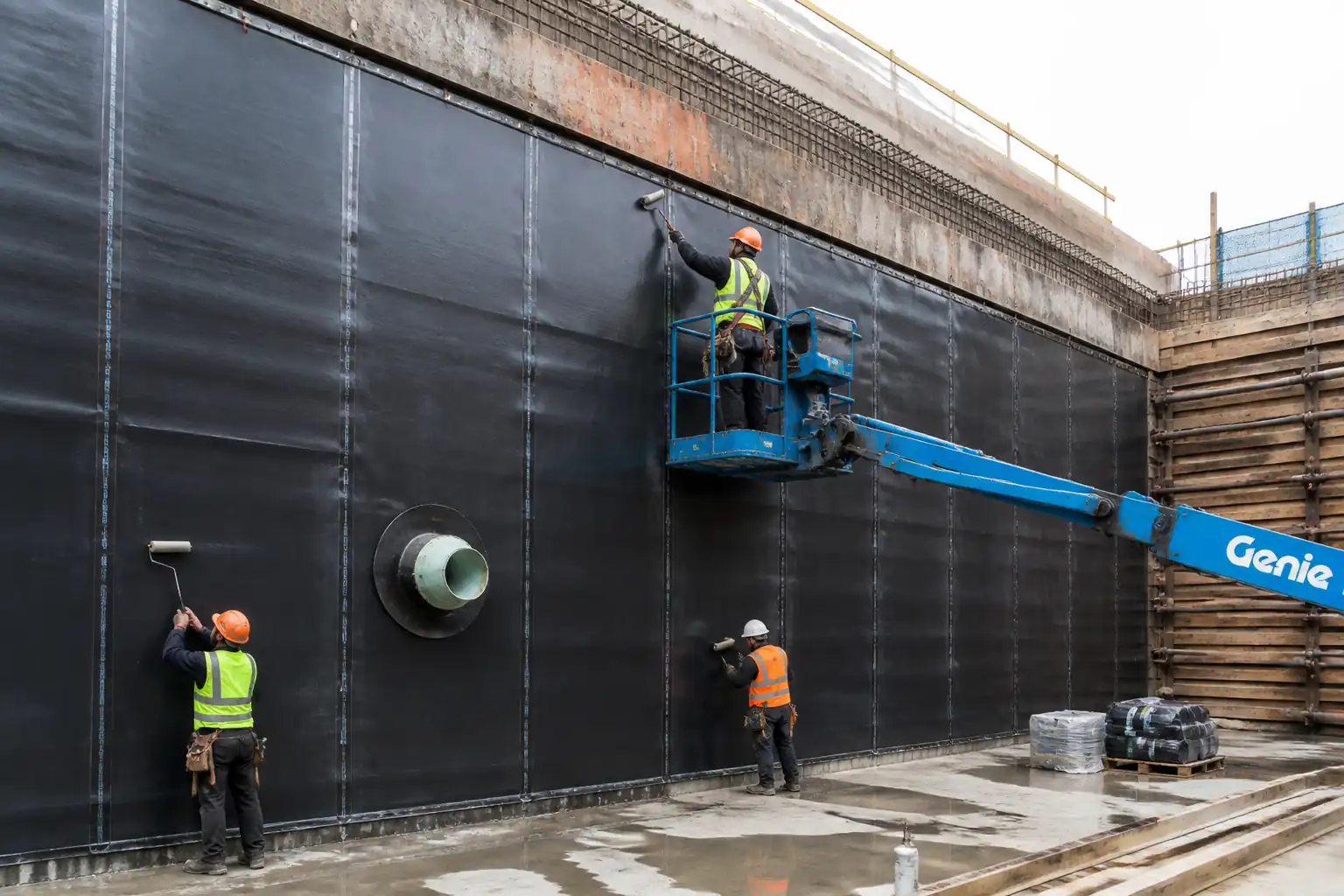
- Supply, installation, and QA/QC of internal vapor control layers (VCL) and air-barrier (AB) membranes to internal walls and associated junctions within conditioned spaces.
- Sheet layout and fixing on internal walls (masonry, concrete, metal/wood studs) including continuity across interfaces (floors, soffits, columns, partitions).
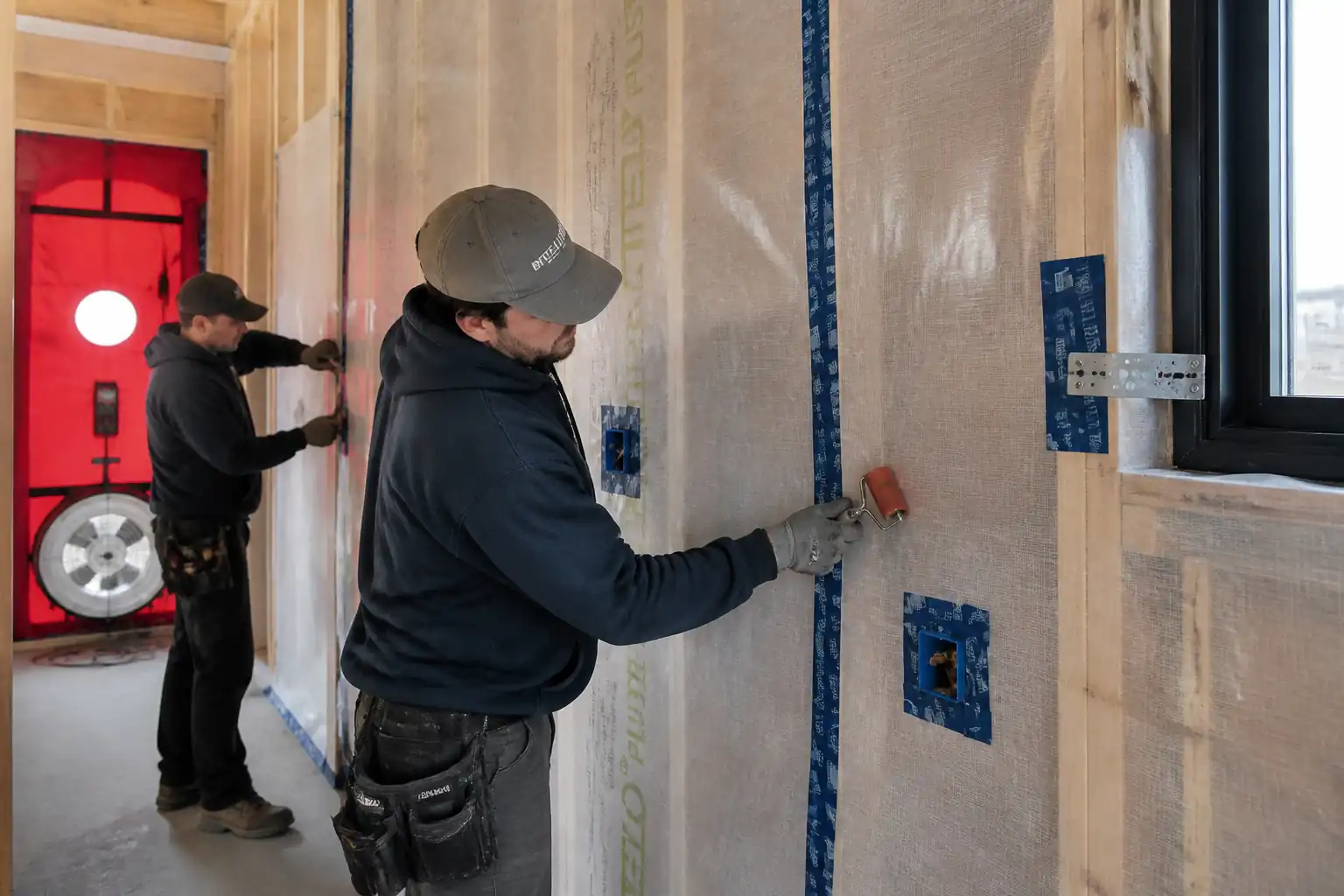
- Lap joint sealing with specified compatible tapes and primers; pressure rolling.
- Airtight detailing and sealing around window brackets/frames and electrical boxes, including sleeves/gaskets and compatible sealants/tapes.
- Intermediate and final whole-building/zone air-tightness testing (blower door) and targeted leak-finding.
- Repairs to damaged membranes and documentation of as-built airtight layer.
Exclusions
- External weatherproof membranes and liquid-applied barriers.
- Structural works, window installation itself, and firestopping design (coordination only).
- Thermal insulation installation except where required for access to airtight layer.
Locations
- Internal perimeter walls, partitions forming the air control boundary, and all penetrations within the airtight layer. Exact extents per approved drawings. [Verify per project specifications].
Performance Targets
- Air-tightness: n50 target ≤ 3.0 ach @ 50 Pa (typical building code) or ≤ 0.6–1.0 ach for high-performance buildings. [Verify per project specifications].
- Vapor control: Sd or permeance per hygrothermal design and BS 5250 / ISO 12572 analysis. [Verify per project specifications].
Hold Points
- H1: Substrate approval prior to membrane installation.
- H2: First-of-kind lap and penetration detail mock-up approval.
- H3: Intermediate blower door test prior to closing cavities/linings.
- H4: Final blower door test prior to Practical Completion.
References
| Document Type | Reference / Number | Revision | Notes |
|---|---|---|---|
| Standard | ISO 9972 | ||
| Standard | ASTM E779 | Use as alternative where specified. | |
| Standard | ASTM E2178 | ||
| Standard | ASTM E2357 | ||
| Standard | BS 5250 | 2021 | |
| Standard | EN 12114 | ||
| Standard | EN 13984 | ||
| Standard | ISO 12572 / ASTM E96 | ||
| Standard | EN 13501-1 | Fire class of membranes/tapes as specified. [Verify per project specifications]. | |
| Manufacturer | Approved Submittals |
Responsibilities
| Role | Responsibility | Name / Party |
|---|---|---|
| PM | Ensure submittals/ITP approved, hold/witness points scheduled. | Main Contractor |
| Engineer | Verify substrates and details; coordinate with MEP/windows. | Main Contractor |
| QA/QC | Witness hold points; manage NCRs and corrective actions. | Main Contractor |
| HSE | Toolbox talks, permits, inspections, incident reporting. | Main Contractor |
| Installer | Install per approved system; provide daily QA photos and field adhesion checks. | Subcontractor |
| 3rd Party | Calibrated test equipment; ISO/ASTM compliant procedures. | Approved Lab |
| Supplier Rep | Confirm compatibility, site support for first-of-kind details. | Manufacturer |
Resources
| Resource Type | Description | Quantity | Remarks |
|---|---|---|---|
| Manpower | Leads installation team and coordinates with Site Engineer. | 1 per work front [Verify per project] | |
| Manpower | Cutting, placing, fixing, taping, detailing around penetrations. | 3–6 per work front [Verify per project] | |
| Manpower | In-process inspection and field adhesion checks. | 1 shared | |
| Manpower | Sets up, runs, and documents tests. | 1–2 |
Materials
| Material | Specification / Grade | Quantity | Remarks |
|---|---|---|---|
| Membrane | Roll width ≥ 1.5 m; thickness per system | As per drawings + 5% waste | |
| Tape | Service temp -10 to +80 °C | As required | |
| Primer | Flash-off per TDS | As required | |
| Accessories | Sized to service OD | As required | |
| Sealant | Cure per TDS | As required |
Equipment
| Equipment | Capacity / Type | Quantity | Inspection Required |
|---|---|---|---|
| Roller | 1 per installer | ||
| Hand tools | Set per team | ||
| Meter | 1 set | ||
| Fan + manometer | Up to 10,000 m³/h [Verify] | 1 set | |
| Diagnostic tools | As required | ||
| Access | As required |
Prerequisites
- Approved shop drawings indicating airtightness line continuity and junction details.
- Approved material submittals (DoP/CoC, TDS, SDS, compatibility statements for membranes, tapes, primers, gaskets, sealants).
- Coordination completed with MEP and window installer; penetrations and bracket positions set out.
- Substrates complete, structurally sound, clean, and dry.
- Timber moisture content ≤ 16%.
- Concrete/masonry: surface dry; internal RH ≤ 75% at test depth. [Verify per project specifications].
- Remove loose material; fill voids > 5 mm; grind protrusions > 3 mm.
- Ambient conditions: > +5 °C and < 35 °C; RH < 80% (unless product allows otherwise). [Verify per TDS].
- Temporary weather-tight enclosure in place to prevent condensation.
- HSE documentation: Task Risk Assessment/JSA, COSHH/SDS, permits to work (WAH, hot works if used), toolbox talk completed.
- Hold Points scheduled with QA/QC and Testing Agency.
Method Sequence
| Step | Activity | Description | Responsibility | Inspection / Hold Point |
|---|---|---|---|---|
| 1 | Material receipt and storage | Inspect deliveries, verify quantities and batch numbers, store horizontally in dry area at 5–30 °C, protect from UV and damage. | Storekeeper / QA/QC | Visual; document check |
| 2 | Substrate preparation | Clean surfaces by vacuum; remove dust/grease. Fill voids > 5 mm; grind protrusions > 3 mm. Verify dryness and integrity of fixings/studs/frames. | Installer / Site Engineer | Hold Point H1 |
| 3 | Priming (where required) | Apply primer to porous/mineral surfaces per TDS using brush/roller. Allow flash-off to tack-dry (typ. 20–60 min). Coverage 150–250 g/m². | Installer | In-process |
| 4 | Setting out | Mark airtightness line, lap zones, and penetrations. Plan roll orientation to minimize joints and avoid T-joints clustering. | Installer / Site Engineer | In-process |
| 5 | Membrane placement and fixing | Unroll membrane vertically or horizontally; pre-fix with double-sided tape within lap zones. Where stapling to studs, space staples ≤ 150 mm c/c within lap zone only; cover staple line with sealing tape. | Installer | In-process |
| 6 | Lap joint sealing | Overlap sheets min 100 mm (vertical) and 100–150 mm (horizontal) [Verify]. Apply single-sided tape centered on lap (width ≥ 60 mm). Consolidate with pressure roller (20–30 N). | Installer | Witness by QA/QC at H2 (first-of-kind) |
| 7 | Perimeter and interface sealing | Terminate membrane to floors/soffits/columns/windows using compatible tapes or airtight sealant beads on primed surfaces; provide mechanical support where needed (e.g., batten). | Installer | In-process |
| 8 | Window bracket detailing | Wrap membrane to frame/reveal. For brackets/anchors, install pre-cut split tape or butyl patch around bracket, ensuring ≥ 25 mm bond on all sides. Layer tapes shingle-fashion to shed air flow. Seal any bolt penetrations with gaskets or butyl. | Installer | In-process; spot checks by QA/QC |
| 9 | Electrical boxes and services | Prefer airtight service cavity. Where boxes penetrate membrane: cut minimal X-slit; fit airtight box or EPDM collar sized to conduit; tape flange to membrane with ≥ 100 mm patches each side; seal conduits with gaskets or putty. Maintain fire rating separately [Verify]. | Installer / MEP | In-process; Handover walk with MEP |
| 10 | Repairs to damage | Clean/dry area; apply patch extending ≥ 100 mm beyond tear all around; tape edges; roll pressure. For holes at fasteners, apply spot patches ≥ 50 mm all around. | Installer | In-process |
| 11 | Intermediate blower door test | Seal intentional openings per ISO 9972 Method B (construction stage). Install fan, establish baseline, test at 50 Pa (pressurization and/or depressurization). Perform leak-finding with smoke/IR and mark defects. | Testing Agency / QA/QC | Hold Point H3 (Witness) |
| 12 | Remediation of leaks | Seal identified leaks using compatible tapes/sealants; re-test locally using fan/door or ducted zone testing if required. | Installer / Testing Agency | In-process |
| 13 | Final closure and protection | Protect membranes with linings (e.g., gypsum board) without compromising seals. Avoid screws through critical seals unless allowed by design. | Drywall Trade / Installer | In-process |
| 14 | Final blower door test | Test per ISO 9972 Method A (as-built). All intentional openings in normal-use configuration. Record flow-pressure curve and n50. | Testing Agency | Hold Point H4 (Witness) |
Health, Safety and Environment (HSE) – Safety Controls
Task-Specific Hazards and Controls
- Hazard: Work at height on internal walls/soffits.
- Likely consequence: Fall leading to serious injury.
- Engineering/procedural control: Use podium steps/tower scaffold/MEWP; maintain three points of contact; forbid standing on buckets; install edge protection. Ladders only for short-duration, light tasks with pre-use check.
- Required PPE: Hard hat, non-slip safety footwear, fall-arrest harness when in MEWP, gloves.
- Collective measure: Proper access platforms with guardrails; exclusion zone below.
-
Inspection/permit/supervision: Pre-use inspection; WAH permit where applicable; supervisor sign-off. [Verify per project HSE plan and local regulations]
-
Hazard: Knife and cutting tool injuries.
- Likely consequence: Lacerations.
- Engineering/procedural control: Use safety knives with auto-retract; cut on mats; blade disposal in sharps container; cut away from body.
- PPE: Cut-resistant gloves (EN 388), long sleeves, safety glasses.
- Collective measure: Tool control and training.
-
Inspection/permit/supervision: Toolbox talk; spot audits.
-
Hazard: Solvent/VOC exposure from primers/sealants.
- Likely consequence: Respiratory/skin irritation, dizziness, fire risk.
- Engineering/procedural control: Select low-VOC products; ensure cross-ventilation; prohibit ignition sources; follow SDS flash-off times; decanting controls.
- PPE: Nitrile gloves, safety goggles, FR clothing if hot works nearby; half-mask respirator with A1P2 filters if ventilation is inadequate [Verify].
- Collective measure: Local exhaust/forced ventilation where required; flammables storage cabinet.
-
Inspection/permit/supervision: COSHH assessment; hot work permit if heat guns used; H2S/LEL monitoring not typically required unless specified.
-
Hazard: Manual handling of rolls and equipment.
- Likely consequence: Strains and sprains.
- Engineering/procedural control: Team lifts; use trolleys; store at waist height; rotate tasks.
- PPE: Safety footwear, gloves.
- Collective measure: Mechanical aids available on floor.
-
Inspection/permit/supervision: Manual handling training; supervisor oversight.
-
Hazard: Electrical hazards at live boxes during detailing.
- Likely consequence: Electric shock/burns.
- Engineering/procedural control: Isolate circuits; lockout/tagout where feasible; verify dead; use insulated tools.
- PPE: Insulated gloves (rated), eye protection.
- Collective measure: Temporary covers on live boards.
-
Inspection/permit/supervision: Permit-to-work for electrical isolation; competent person to test/verify.
-
Hazard: Pressurization during blower door tests.
- Likely consequence: Doors slamming; objects displaced; discomfort.
- Engineering/procedural control: Secure internal doors or prop open where method allows; brief all personnel; remove loose films; control access.
- PPE: Basic PPE; hearing protection if fan noise > 80 dB.
- Collective measure: Barrier and signage at test zone; spotter at entry.
-
Inspection/permit/supervision: Testing procedure/RA reviewed; coordinator present.
-
Hazard: Dust and silica during substrate grinding.
- Likely consequence: Respiratory irritation; long-term disease.
- Engineering/procedural control: Use HEPA vacuums; wet methods where safe; limit duration.
- PPE: FFP2/FFP3 mask, goggles.
- Collective measure: Enclosure/containment as needed.
-
Inspection/permit/supervision: COSHH assessment; equipment PAT/inspection.
-
Hazard: Fire compartment breaches at boxes/penetrations.
- Likely consequence: Loss of fire integrity, smoke spread.
- Engineering/procedural control: Coordinate with firestopping trade; reinstate fire seals using approved systems; do not substitute materials.
- PPE: Standard PPE.
- Collective measure: Tagged firestop records.
- Inspection/permit/supervision: Firestop ITP; third-party certification where required.
Environmental Controls
- VOC Emissions:
- Control: Use low-VOC primers/sealants; ensure ventilation during and after application; schedule high-VOC works off-hours if required.
-
Monitoring: Spot checks for ventilation rates; SDS limits observed. [Verify per project HSE plan and local regulations]
-
Waste Management:
- Control: Segregate membrane offcuts, backing papers, and cores; recycle where facilities exist; dispose adhesives/solvents as hazardous waste per SDS.
-
Records: Waste transfer notes; quantities logged.
-
Dust and Particulates:
- Control: HEPA vacuum extraction on grinding; local containment; damp wipe of residues.
-
Monitoring: Visual checks; complaint logs.
-
Noise:
- Control: Maintain blower door and vacuums; schedule noisy prep works within permitted hours; provide hearing protection if needed.
-
Monitoring: Spot dB readings where required.
-
Material Efficiency:
- Control: Optimize roll layout; use pre-cut accessories for penetrations to reduce waste; keep offcuts for small patches.
-
Monitoring: Waste KPIs versus installed area.
-
Spill Prevention:
- Control: Secondary containment for primers/sealants; spill kits at point of use; immediate cleanup of drips on finished floors.
- Monitoring: Spill log and close-out actions.
Quality Assurance / Quality Control
Submittals and Approvals
- Manufacturer DoP/CoC, CE/UKCA marks, EN 13984 compliance (VCL), ASTM E2178/E2357 evidence for air-barrier performance.
- Compatibility letter covering membranes, tapes, primers, sealants, gaskets.
- Shop drawings of airtight line and junction details.
In-Process Controls
- Substrate ITR at Hold Point H1 with moisture/RH readings recorded.
- First-of-kind mock-up of lap and penetration detail at H2 approved by QA/QC and Manufacturer Rep (where specified).
- Visual inspection: 100% of laps, perimeters, and penetrations for continuity and defects.
Field Adhesion Checks
- Perform tape peel checks once per 200 m of lap or per room (whichever yields greater frequency). After ≥ 24 h cure, conduct hand peel at 180°. Acceptance: ≥ 1 N/mm peel or cohesive failure within tape; no adhesive transfer to dusty substrate. [Verify per project specifications].
- Record batch numbers used at each area; maintain traceability map.
Testing and Acceptance
- Intermediate blower door test (ISO 9972 Method B) before closing linings; target n50 ≤ project requirement. Leak-finding with smoke/IR and remediation.
- Final blower door test (ISO 9972 Method A) at completion; acceptance when n50 ≤ project target and all NCRs closed.
Defect Management
- NCR raised for: missed seals, fishmouths > 20 mm, laps < 100 mm, incompatibility, adhesion failure, damaged membranes. Correct and re-inspect prior to concealment.
Records
- MIRs, ITRs, calibration certificates, peel test logs, photo records (before/after), as-built airtightness drawings, blower door reports, NCR/CAR logs.
Attachments
- Approved shop drawings and details for airtight layer continuity (DWG/PDF).
- Manufacturer technical data sheets (membranes, tapes, primers, gaskets, sealants) and compatibility letter.
- SDS for all chemical products.
- Example field adhesion (peel) test template.
- Example blower door test method statement and sample report.
- As-built airtightness redline drawings and photo register.
- Toolbox talk: Knife safety; VOC/primer handling; blower door briefing.
This content is a read-only public reference. Download or customize to get an editable version.
ITP preview
The first inspection activities from the linked ITP for Method Statement: Installation of Continuous Vapor Control Layers and Air-Barrier Membranes:
| Activity | Inspection / Test | Acceptance Criteria | Responsibility | Record |
|---|---|---|---|---|
| Material delivery and approval | Verify CE/DoP/CoC; batch numbers; SDS/TDS present | Materials as per approved submittals; undamaged packaging | QA/QC Engineer | MIR; delivery notes |
| Substrate inspection (H1) | Visual; timber MC; concrete RH | Clean, sound, dry; MC ≤ 16%; RH ≤ 75% [Verify] | Site Engineer / QA/QC | ITR; moisture logs |
| Primer application (if used) | Check coverage and tack | Uniform film; within open time; adequate ventilation | Installer / QA/QC | ITR; daily report |
Showing 3 of 11 inspection activities. View full ITP →
Related Inspection and Test Plan
An Inspection and Test Plan (ITP) is available for Method Statement: Installation of Continuous Vapor Control Layers and Air-Barrier Membranes. The ITP defines the inspection activities, acceptance criteria, hold and witness points, responsible parties, and records required to verify the work described in this method statement.
View the Method Statement: Installation of Continuous Vapor Control Layers and Air-Barrier Membranes ITP →Frequently asked questions
Continue with related Quollnet resources connected to this method statement.