
Method Statement: Construction Material Delivery Coordination and Handling – Method Statement
AI-assisted method statement with matching ITP, PDF download, and Excel export.
More than a static template
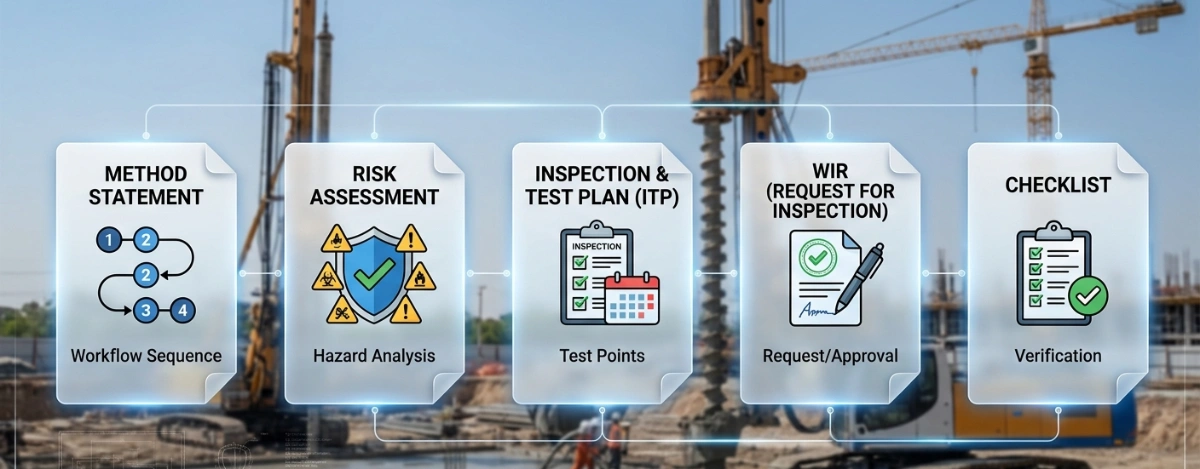
Unlike a downloadable Word or PDF template, this method statement is an AI-assisted editable starting point connected directly to a matching Inspection and Test Plan. Every section is structured, project-adaptable, and ready to export.
- AI-assisted drafting — Customize every section with AI for your specific project scope.
- Linked ITP — A matching inspection and test plan is generated alongside the method statement.
- Multiple export formats — Download as a formatted PDF or editable Excel spreadsheet.
- Editable starting point, not a final document — Review, verify, and adjust all content against your project requirements before use.
Static template vs. Quollnet workflow
| Feature | Static template | Quollnet |
|---|---|---|
| Project-specific content | Manual fill-in required | AI-assisted customization |
| Linked ITP | Separate document, no link | Matching ITP included |
| Export formats | Usually PDF only | PDF and Excel |
| Structured sections | Free-form layout | 13 standardized sections |
| Saved to your account | Local file only | Cloud-saved, reusable |
| Content accuracy | You verify everything | AI-assisted, you still verify |
| Cost | Often free but time-intensive | Free to customize and download |
What you can customize
When you save this method statement to your account, every section becomes editable. The following 13 sections are included:
- Scope — Defines the activity and its boundaries.
- References — Standards, specifications, and drawings.
- Responsibilities — Roles and accountabilities.
- Resources — Labour, plant, and equipment summary.
- Materials — Materials and compliance requirements.
- Equipment — Tools and equipment details.
- Prerequisites — Hold points and pre-conditions.
- Method sequence — Step-by-step construction sequence.
- Safety controls — HSE risk controls and PPE.
- Environmental controls — Environmental mitigation measures.
- QA/QC — Quality inspection and test requirements.
- ITP — Inspection and Test Plan table (has its own page).
- Attachments — Referenced drawings and documentation.
Why this method statement is used
This method statement is used to define and communicate the approved procedure for carrying out method statement: construction material delivery coordination and handling on site. It ensures the work is planned in advance, the correct resources and controls are in place, and all personnel understand responsibilities, sequence, quality requirements, and safety controls before work begins. It aligns site execution with the documented scope and acceptance expectations.
Who uses this method statement
This method statement is used by contractors, site supervisors, project engineers, QA/QC engineers, HSE officers, consultants, and client representatives. It serves as a shared reference for planning, execution, supervision, inspection, and approval of the activity on site.
When it is prepared and submitted
The method statement is prepared before the work activity starts and submitted as part of the pre-construction documentation package for review and approval.
Who reviews or approves it
The method statement is usually submitted to the client representative, consultant, resident engineer, or project management consultant for review and approval before the work commences.
Important approval note
This method statement is an AI-assisted editable starting point, not a pre-approved document. Before use on any project, all content must be reviewed and approved by the relevant parties (superintendent, principal contractor, or client representative) in accordance with your contract and project quality plan.
For example: if your specification requires a departure from a referenced standard, that departure must be documented and approved separately — this method statement will not capture that automatically. Always verify against your applicable drawings, specifications, and regulatory requirements.
Method statement content
Scope
Work Covered
- Planning, coordinating, and controlling all construction material deliveries to site, including booking systems, access routing, gate control, and traffic sequencing.
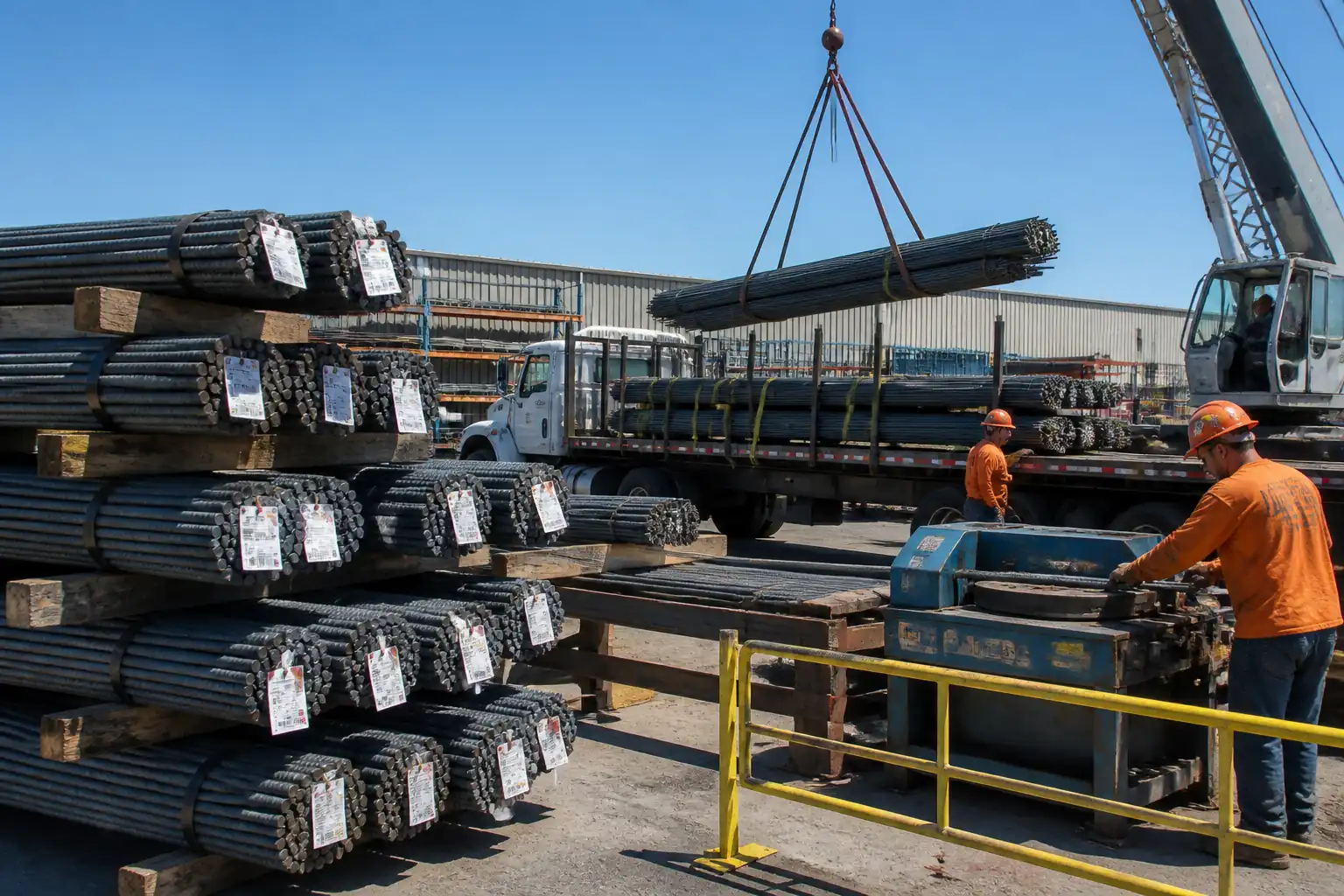
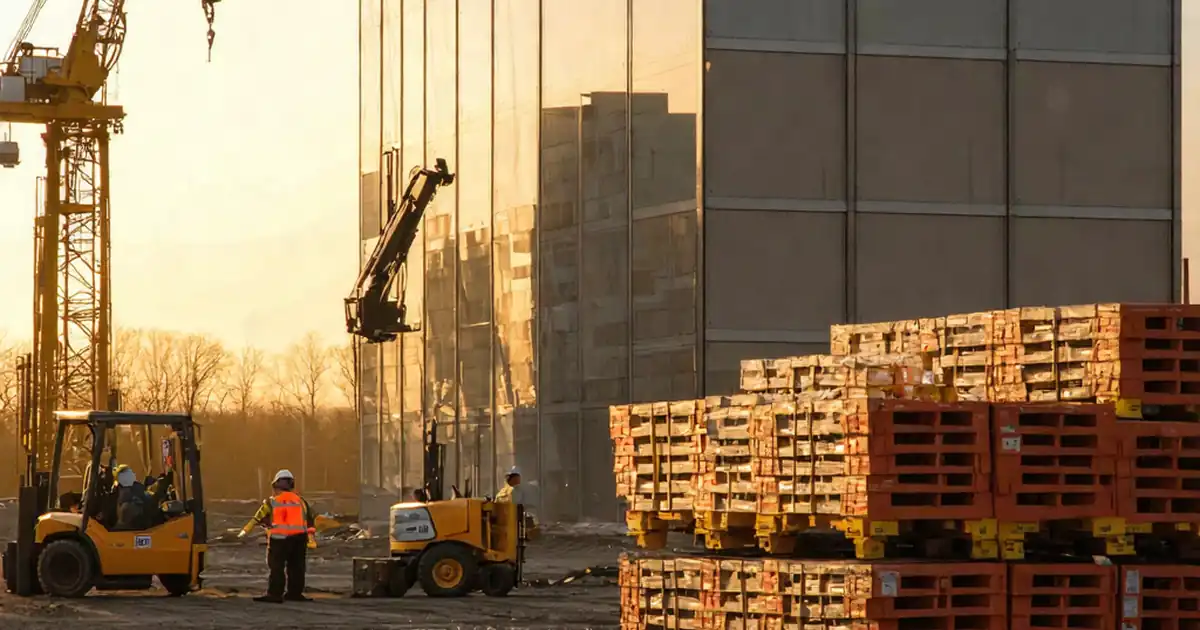
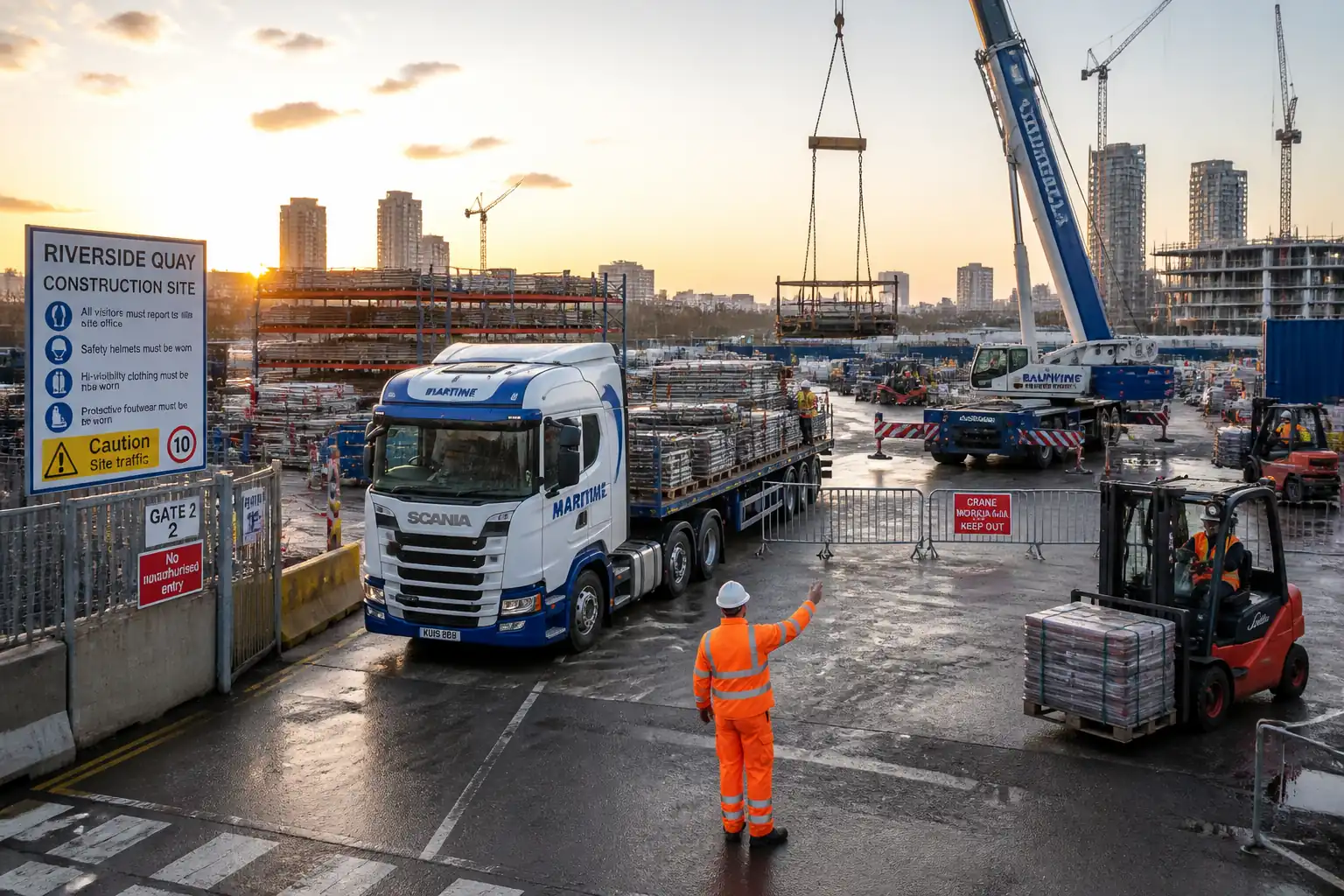
- Set-up and management of unloading zones, interface with cranes/telehandlers/forklifts, exclusion zones, and lifting accessories.
- Goods receiving inspections, quantity verification, document checks, and QA/QC controls.
- Allocation of laydown and storage locations (indoor/outdoor), preservation measures, and hazardous materials segregation.
- Records management: Delivery Log, Goods Received Note (GRN), Material Inspection Report (MIR), Nonconformance Reports (NCR), lifting plans, and equipment checklists.
- Environmental and HSE controls specific to delivery, unloading, lifting, and storage operations.
Exclusions
- Fabrication or installation QA/QC of materials after storage (covered under separate method statements).
References
| Document Type | Reference / Number | Revision | Notes |
|---|---|---|---|
| Standard | ISO 9001:2015 | ||
| Standard | ISO 45001:2018 | ||
| Standard | ISO 14001:2015 | ||
| Standard | BS 7121-1 | Equivalent standards: ASME B30 series [Verify per project]. | |
| Standard | ASME B30.9; BS EN 13155; BS EN 13414 | Use applicable local equivalent (e.g., LOLER/PUWER in UK). | |
| Standard | BS EN 12195 | ||
| Standard | BS 5975 | Or local temporary works code [Verify per project]. | |
| Standard | ISO 2859-1; ANSI/ASQ Z1.4 |
Responsibilities
| Role | Responsibility | Name / Party |
|---|---|---|
| LM | Logistics Manager (LM) | Main Contractor |
| HSEO | HSE Manager/Officer (HSEO) | Main Contractor |
| AP/CS | Appointed Person (AP) / Crane Supervisor (CS) | Main Contractor |
| GS/TM | Gate Security (GS) / Traffic Marshal (TM) | Main Contractor |
| QA/SK | QA/QC Engineer (QA) / Storekeeper (SK) | Main Contractor |
| RS/Operators | Rigger/Slinger (RS) / Equipment Operators | Main Contractor / Specialist |
| Supplier | Supplier / Subcontractor | Supplier |
Resources
| Resource Type | Description | Quantity | Remarks |
|---|---|---|---|
| Personnel | Coordination and approvals | 1 | |
| Personnel | Vehicle movement control and reversing assistance | As per traffic plan [Verify] | |
| Personnel | Lift planning and supervision | 1 per active crane | |
| Personnel | Rigging and signalling | Min. 2 per lift [Verify] | |
| Personnel | Plant operation with valid license/certification | As required | |
| Personnel | Receiving inspection and stock control | 1 each per shift [Verify] | |
| Personnel | HSE inspections, permits, briefings | 1 per active zone [Verify] |
Materials (for handling/preservation)
| Material | Specification / Grade | Quantity | Remarks |
|---|---|---|---|
| Timber Dunnage | Typical 100x100 mm [Verify] | As required | |
| Covers | Waterproof tarps; PE shrink film [Verify] | As required | |
| Lashings | LC rating ≥ required [Verify] | As required | |
| Labelling | Outdoor-rated adhesive tags [Verify] | As required | |
| Spill response | Oil-only and universal kits | Per zone [Verify] |
Equipment
| Equipment | Capacity / Type | Quantity | Inspection Required |
|---|---|---|---|
| Crane | Rated per lift plan [Verify] | As planned | |
| FL/Telehandler | ≥ 125% of typical pallet mass factor of safety [Verify] | As required | |
| Rigging Gear | Per lift plan [Verify] | As required | |
| Mats/Plates | Sized per TWD [Verify] | As required | |
| Barriers/Signage | Per traffic plan | ||
| Anemometer etc. | 1 set per zone [Verify] |
Prerequisites
- Approved Site Logistics Plan (SLP) showing access routes, holding areas, one-way systems, pedestrian segregation, unloading zones, crane radii, and laydown/storage areas.
- Risk Assessment & Method Statement (RAMS) approved; Permits-to-Work (PTW) as required [Verify per project HSE plan and local regulations].
- Delivery Booking System operational with agreed notice period (e.g., 24–72 hours) and slot duration (e.g., 30–60 minutes) [Verify per project specifications].
- Lift Plans approved for any crane interface; temporary works checks for ground bearing pressures and outrigger mats (BS 5975 principles).
- Gate control procedures briefed to suppliers: required documents, PPE, arrival windows, and restrictions (vehicle size/weight/ADR).
- Equipment inspections current: cranes, forklifts, telehandlers, rigging gear; operator licenses verified.
- Storage areas prepared: surfaces level, signed, fire routes clear, segregation for hazardous/temperature- or humidity-sensitive items; rack load limits posted [Verify].
- Emergency arrangements briefed: spill response, fire points, first aid, emergency egress routes.
- Tool-box talk (TBT) completed daily for unloading crews and traffic marshals.
- Utility scans and overhead services review near unloading zones; exclusion distances defined [Verify per project HSE plan].
Method Sequence
| Step | Activity | Description | Responsibility | Inspection / Hold Point |
|---|---|---|---|---|
| 1 | Pre-planning and scheduling | Finalize SLP and monthly/weekly look-ahead delivery schedule integrated with construction priorities and crane utilization. | LM | Document review |
| 2 | Delivery booking | Suppliers submit pre-advice: PO number, material type, quantity, dims, weight, CoG if applicable, vehicle type, offloading method, required plant, ADR status, and documents. Slot confirmed with unique ID. | LM / Supplier | Booking system check |
| 3 | Pre-arrival verification | Cross-check PO/MAR status, inspection hold points, required certificates (e.g., EN 10204 3.1) and special storage needs. | QA/SK | Document check |
| 4 | Gate entry control | Gate Security verifies booking ID, driver induction status, PPE, vehicle compliance (dims/weight), and load restraint per EN 12195. Early arrivals diverted to holding area. | GS/TM | Visual & checklist |
| 5 | Traffic sequencing and escort | Vehicle escorted to unloading zone per one-way system, speed limit (e.g., ≤10 km/h [Verify]) and pedestrian segregation. | TM | Observation |
| 6 | Unloading zone preparation | Set barriers, signage, exclusion zone; verify ground bearing/plates; check wind conditions; confirm plant availability and certification. | CS/HSEO/LM | Area readiness check |
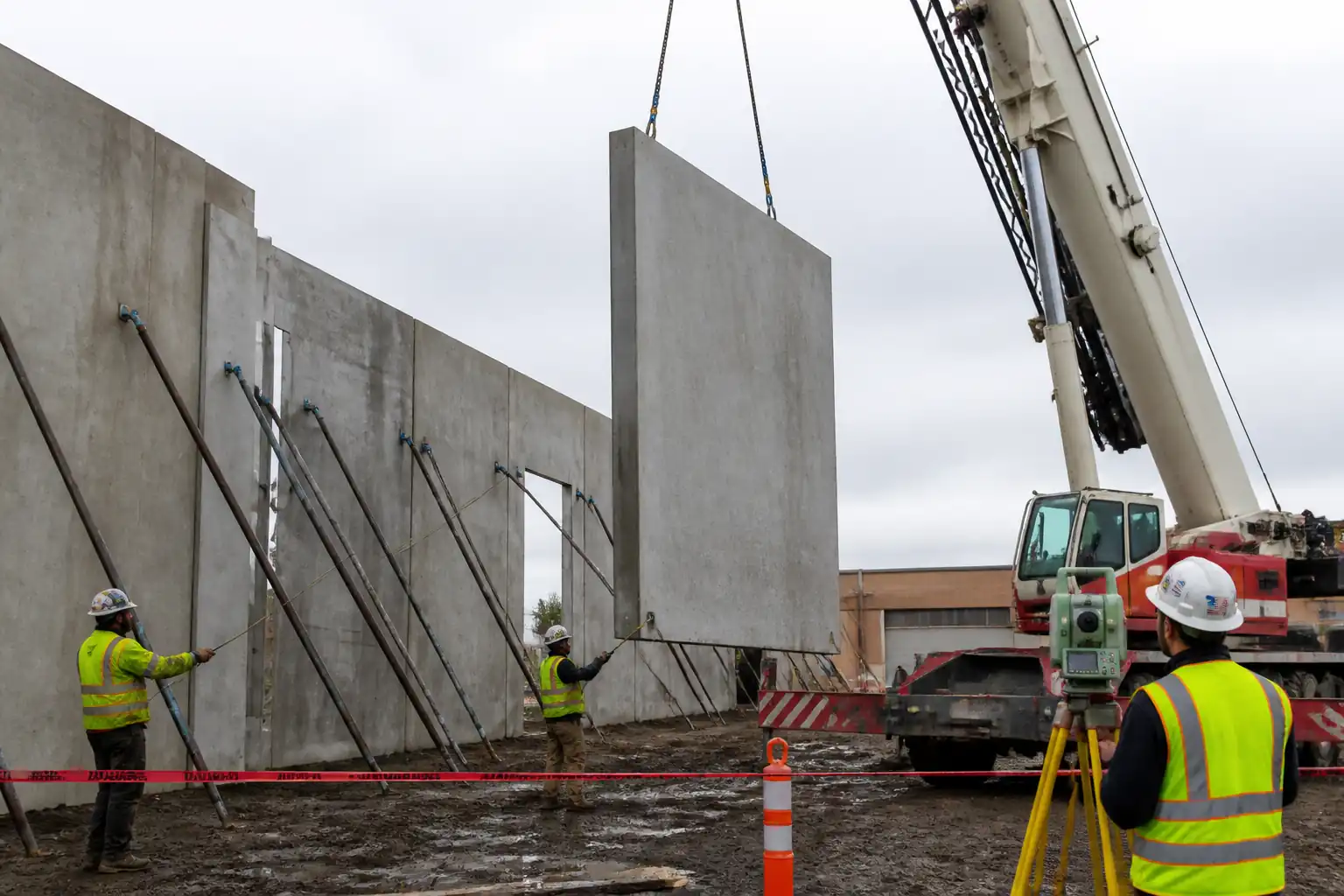
| 7 | Crane/plant interface briefing | CS leads TBT covering lift plan, roles, comms, tag lines, pinch points, escape routes, and stop signals. | CS | Brief attendance |
| 8 | Pre-use equipment checks | Operators complete daily checks on crane/forklift/telehandler; Riggers check slings/shackles per color code and WLL. | Operators/RS | Checklist review |
| 9 | Vehicle positioning | Position vehicle square to unloading area on level surface; apply brakes/chocks; establish exclusion zone and banksman control. | TM/Operator | Visual |
| 10 | Load inspection prior to release | Check for transit damage, water ingress, correct labelling, no load shift; photograph as-found. | QA/SK | Visual & photo |
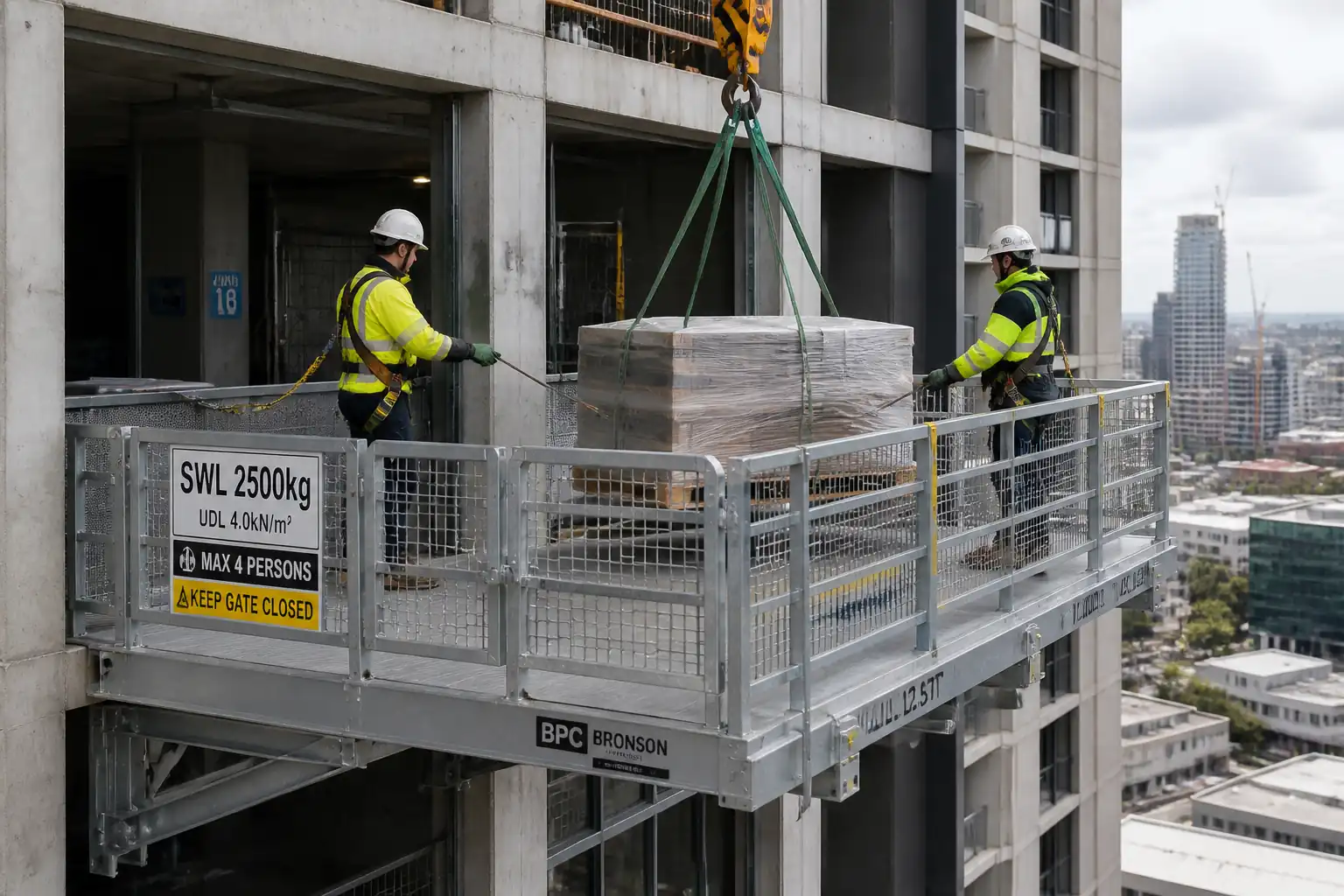
| 11 | Rigging and unloading | Attach rigging as per lift plan; maintain tag lines; lift slowly to prove balance; control swing; place onto dunnage/racks. | RS/Operator/CS | Witness by CS |
| 12 | Forklift/telehandler offload (if used) | Insert forks fully; use fork extensions if needed; respect rated capacity vs load center; travel with load low. | Operator | Operator check |
| 13 | Quantity verification | Count items vs delivery note/PO; weigh if applicable; reconcile shortages/overages immediately. | SK/QA | Count/measure |
| 14 | Receiving inspection (quality) | Visual and documentation check; sample per ISO 2859-1 Level II, typical AQL 2.5% if bulk items [Verify]; verify certificates (EN 10204 3.1), DoP/CoC, MSDS as applicable. | QA | Sampling/document review |
| 15 | Quarantine nonconforming goods | Tag and move to segregated area; issue NCR; notify supplier for disposition. | QA/SK | Verification |
| 16 | Storage allocation and preservation | Move accepted goods to assigned zone; apply labels (PO, MIR, batch, location); apply covers/desiccants as needed; stacking heights per manufacturer/PS. | SK/LM | Store check |
| 17 | Hazardous materials management | Segregate flammables/chemicals; store upright cylinders; bund liquids; maintain ventilation and SDS access. | HSEO/SK | HSE inspection |
| 18 | Housekeeping and demobilization | Remove waste/packaging to segregated skips; remove barriers when safe; update delivery and equipment logs. | LM/TM/SK | Final area check |
| 19 | Record close-out | Complete GRN/MIR, file certificates, photos, and update material traceability in DMS. | SK/QA/Doc Control | Records review |
| 20 | Weekly audit and KPI review | Audit delivery performance, demurrage, near-misses, and NCRs; adjust sequencing/slots as needed. | LM/HSEO/QA | Audit |
Safety Controls (HSE)
Principal Hazards and Controls
1) Vehicle–pedestrian interface
- Hazard: Moving trucks/plant near walkways.
- Consequence: Serious injury/fatality.
- Engineering/Procedural Control: One-way routing; physical barriers; designated pedestrian walkways; banksman control for all reversing; speed limit ≤10 km/h [Verify]; high-visibility signage and lighting.
- Required PPE: Hi-vis vest, safety boots, hard hat, gloves.
- Collective Preventive Measure: Pedestrian exclusion zones around unloading; barriered crossings only.
- Inspection/Permit/Supervision: Daily traffic inspection by TM; site access permit; HSEO spot checks.
2) Crane overload or instability
- Hazard: Exceeding crane capacity/poor ground.
- Consequence: Tip-over, dropped load.
- Engineering/Procedural Control: Approved lift plan; load chart check incl. rigging; anemometer monitoring; outrigger mats sized to keep bearing pressure ≤ ground capacity [Verify]; no lifting in high winds (typ. limit 9–12 m/s) [Verify].
- PPE: Hard hat with chin strap, gloves, safety boots, hi-vis, eye protection.
- Collective Measure: Exclusion zone radius ≥ predicted fall radius; tethered tools if working overhead.
- Inspection/Permit/Supervision: CS supervises; crane daily checks; permit-to-lift if required [Verify per project HSE plan].
3) Unsecured or shifting loads
- Hazard: Load movement on release or during lift.
- Consequence: Crush injuries, drops.
- Control: Verify securing per EN 12195 before releasing; prove-lift 100–200 mm; use tag lines; center of gravity identified; rigging by certified slinger.
- PPE: Gloves, eye protection, safety boots.
- Collective: Exclusion zone; no body in pinch/sling line of fire.
- Inspection/Permit/Supervision: RS pre-use inspection; lifting accessory color code current.
4) Working at height on vehicle bed
- Hazard: Falls from trailer during tarpaulin/rigging.
- Consequence: Fractures, head injury.
- Control: Use mobile steps or work platforms with guardrails; avoid climbing on loads; use extendable tools for tarps; fall restraint if unavoidable [Verify].
- PPE: Helmet with chin strap, non-slip boots.
- Collective: Edge protection/temporary platforms.
- Inspection/Permit/Supervision: Work at Height permit; supervisor oversight.
5) Manual handling and musculoskeletal strain
- Hazard: Lifting heavy/awkward items, dunnage, straps.
- Consequence: Strain/sprain injuries.
- Control: Use mechanical aids; team lifts; follow weight limits; rotate tasks.
- PPE: Gloves, supportive footwear.
- Collective: Mechanical handling policy; trolleys/pallet jacks.
- Inspection/Permit/Supervision: HSEO ergonomic checks; TBT.
6) Overhead/underground services
- Hazard: Contact with power lines or buried utilities near zones.
- Consequence: Electrocution, service strikes.
- Control: Utility plans and permits; maintain minimum approach distances to overhead lines (e.g., ≥3 m LV; ≥6 m HV) [Verify per local regulations]; spotters.
- PPE: Dielectric gloves if required, standard PPE.
- Collective: Physical barriers/goalposts; exclusion zones.
- Inspection/Permit/Supervision: Permit to dig/operate; HSEO check.
7) Adverse weather
- Hazard: High wind, rain, lightning reducing stability/visibility.
- Consequence: Slips, lifting hazards.
- Control: Weather monitoring; suspend lifting above wind threshold; grit for ice; lightning stop-work protocol.
- PPE: Weather-appropriate PPE.
- Collective: Canopies, non-slip mats.
- Inspection/Permit/Supervision: Supervisor decision log; anemometer readings.
8) Plant–plant collision
- Hazard: Forklifts, telehandlers, trucks in confined zones.
- Consequence: Injury/damage.
- Control: Segregated travel lanes; spotters; radio comms; blue/red spot lighting on plant.
- PPE: Hi-vis, boots, helmet.
- Collective: Physical barriers; parking bays.
- Inspection/Permit/Supervision: Daily plant coordination meeting; TM oversight.
9) Chemical exposure (hazmat deliveries)
- Hazard: Spills, vapors from adhesives/solvents.
- Consequence: Burns, inhalation risks, fire.
- Control: SDS review; bunded storage; no ignition sources; ventilation; spill kits ready; ADR compliance.
- PPE: Chemical-resistant gloves, goggles, coveralls as per SDS.
- Collective: Dedicated hazmat zone with signage and eyewash.
- Inspection/Permit/Supervision: Hazmat permit; periodic HSEO inspections.
[Verify per project HSE plan and local regulations].
Environmental Controls
- Noise: Schedule deliveries during permitted hours; use broadband reversing alarms; shut down idling plant; measure noise if near receptors [Verify].
- Air quality/emissions: No-idling policy; maintain plant; cover dusty loads; use water mist for dusty materials.
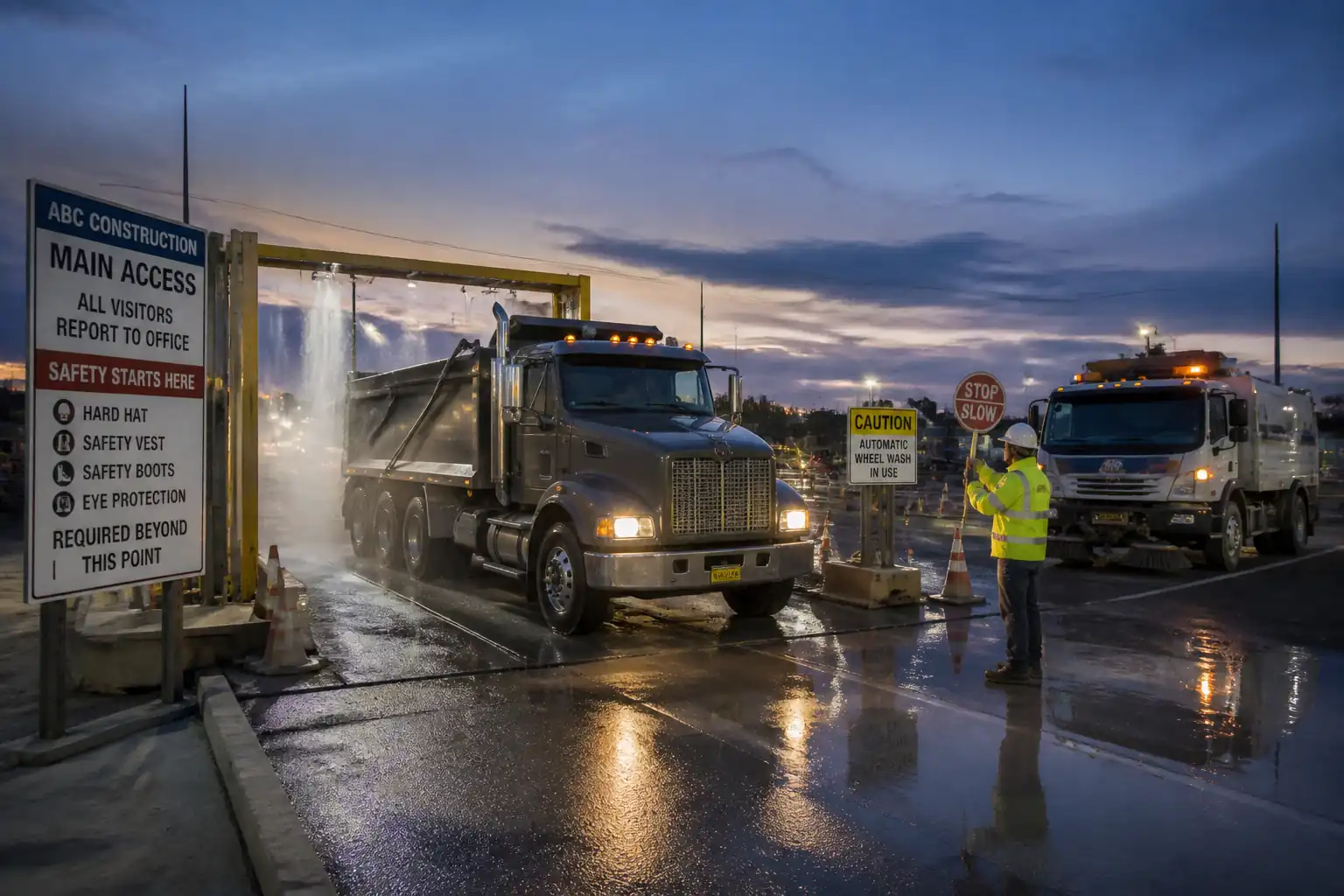
- Mud and track-out: Wheel-wash or rumble grids at exit; road sweeper on-call; sheeting of loads.
- Spills and contaminated runoff: Spill kits at unloading; drip trays under parked plant; isolate storm drains; dispose absorbents as hazardous waste where applicable.
- Waste segregation: Separate pallets, plastics, metals, cardboard; returnable packaging program where possible; maintain waste transfer notes.
- Light pollution: Aim temporary lighting away from residences; use cut-off fixtures; timers as feasible.
- Wildlife and vegetation: Protect adjacent green areas with barriers; no storage within root protection zones [Verify].
- Water protection: No storage of chemicals within [≥15 m] of watercourses unless bunded; maintain MSDS and emergency response numbers on noticeboards [Verify].
- Material preservation to avoid waste: Weatherproof covers, desiccants for hygroscopic goods; FIFO inventory to prevent expiry.
- Environmental monitoring and reporting: Log any spills, noise complaints, and corrective actions; maintain ISO 14001 records.
QA/QC
Receiving Inspection Controls
- Document verification (100%): Delivery Note, PO, Material Approval/Submission status, Certificates (EN 10204 3.1 where applicable), DoP/CoC, SDS for chemicals, calibration certs for supplier pre-shipment tests as required [Verify].
- Visual inspection (100%): Damage, corrosion, moisture ingress, correct identification/markings, packaging integrity.
- Dimensional/quantity checks: Item count, key dimensions vs drawings/specs for critical items; weigh check if contractual.
- Sampling (where bulk): ISO 2859-1 Level II, typical AQL 2.5% unless project specifies otherwise [Verify per project specifications].
- Traceability: Label with PO, MIR, batch/heat number, and storage location. Maintain linkage to as-built where relevant.
- Acceptance criteria: Conformance to approved submittals, project specifications, and standards cited on PO. No damages beyond allowable cosmetic limits [Verify].
- Nonconformance: Immediate quarantine, red-tag, NCR within 24 hours, RCA and disposition (repair/replace/use-as-is) approved by Engineer [Verify workflow].
Records and Control of Information
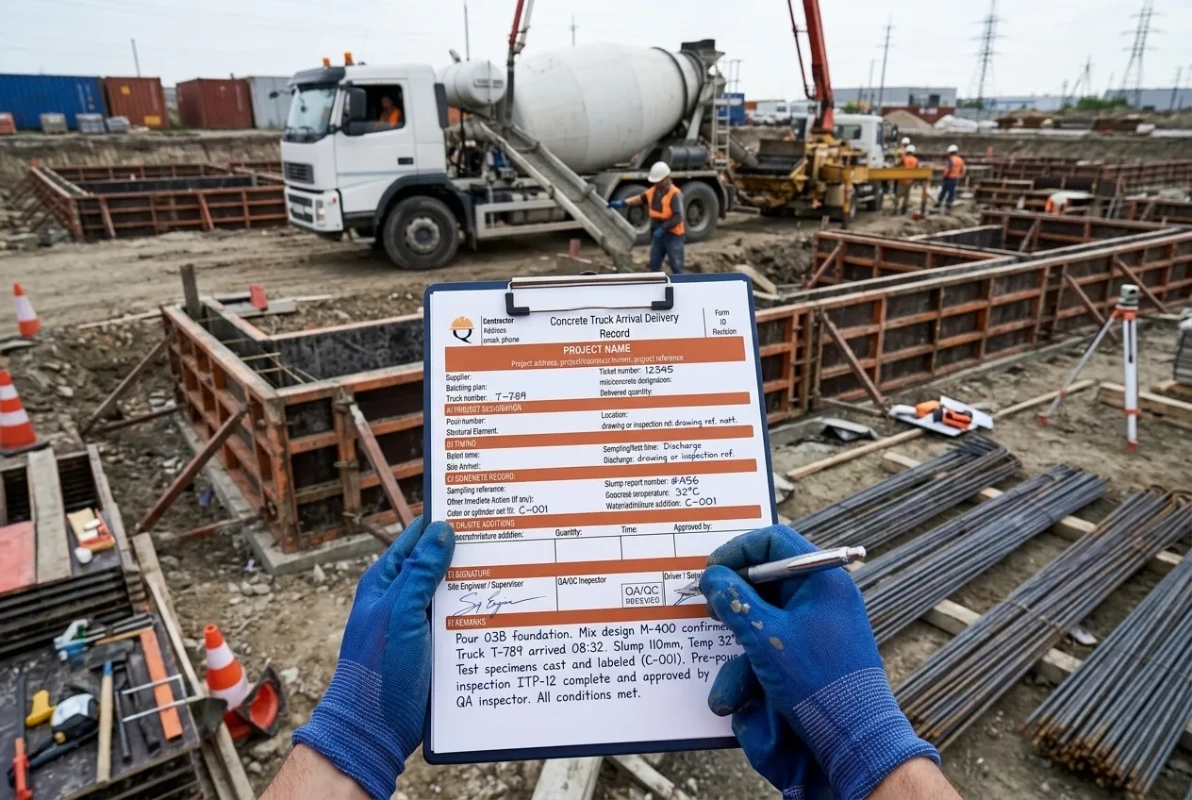
- Records: Booking logs, Gate checklists, Pre-use equipment checklists, Lift plans and permits, MIR, GRN, Photo logs, NCR/CAR, Training/induction logs.
- Retention: Maintain per contract (typ. ≥10 years for structural materials) [Verify].
- Calibration: Verify currency for measuring equipment (anemometers, scales) with calibration stickers/certificates.
- Audits: Weekly logistics audits; monthly QA reviews of receiving processes with action tracking.
Interfaces
- Coordinate with Construction, Planning, Crane Operations, Temporary Works Coordinator, and HSE for changes in sequencing or site layout. Update SLP and communicate via daily briefings.
Attachments
- Site Logistics Plan (latest revision)
- Traffic and Pedestrian Management Plan
- Typical Lift Plan templates (crane and telehandler)
- Pre-Use Checklists (crane, forklift/telehandler, rigging accessories)
- Receiving Inspection Checklist and Sampling Plan Template
- Quarantine/Red-Tag Form and NCR Template
- Standard Signage Set (site speed, routes, exclusion zone)
- Emergency Response Plan and Spill Response Procedure
- Hazardous Materials Register and SDS folder
- Example Laydown Area Layout with Rack Load Limits
This content is a read-only public reference. Download or customize to get an editable version.
ITP preview
The first inspection activities from the linked ITP for Method Statement: Construction Material Delivery Coordination and Handling:
| Activity | Inspection / Test | Acceptance Criteria | Responsibility | Record |
|---|---|---|---|---|
| Logistics Plan approval | Approval check | SLP approved and issued for construction (IFC) | LM/PM | Approved SLP in DMS |
| Supplier/driver induction | Induction record | 100% inducted before entry | LM/GS | Induction Log/Badges |
| Delivery booking approval | Booking ID | Valid slot assigned within delivery window [Verify] | LM | Booking System Export |
Showing 3 of 20 inspection activities. View full ITP →
Related Inspection and Test Plan
An Inspection and Test Plan (ITP) is available for Method Statement: Construction Material Delivery Coordination and Handling. The ITP defines the inspection activities, acceptance criteria, hold and witness points, responsible parties, and records required to verify the work described in this method statement.
View the Method Statement: Construction Material Delivery Coordination and Handling ITP →Frequently asked questions
Continue with related Quollnet resources connected to this method statement.