
Inspection and Test Plan for Method Statement: Off-site Fabrication, Transport, Delivery, Unloading and Storage of Structural Steel Reinforcement
AI-assisted inspection and test plan connected to a method statement, with PDF and Excel export.
More than a static template
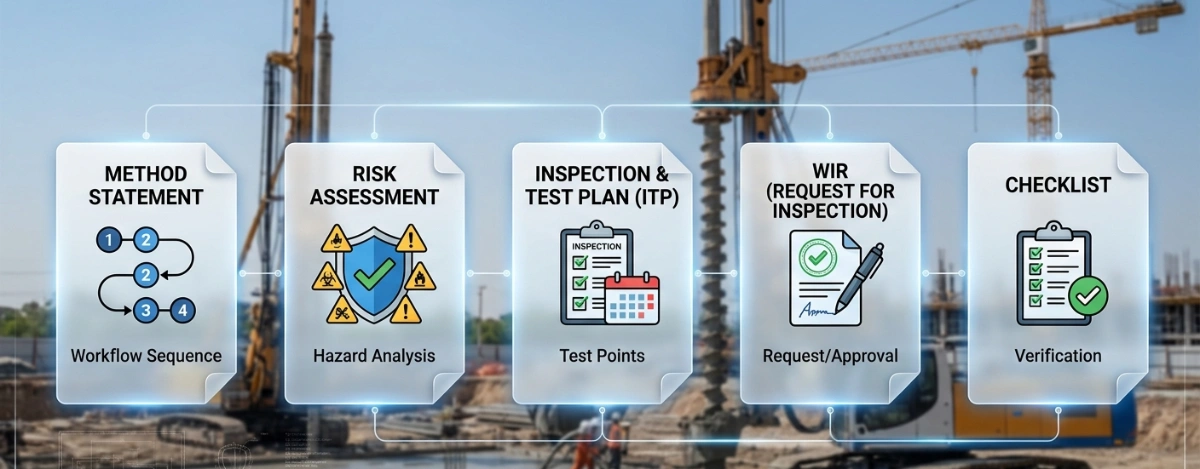
Unlike a downloadable Word or PDF template, this ITP is an AI-assisted editable starting point directly connected to its method statement. Every inspection activity, hold point, and acceptance criterion is structured and ready to adapt to your project.
- AI-assisted customization — Tailor inspection activities and acceptance criteria to your specific project scope.
- Linked method statement — This ITP is connected to the corresponding method statement describing the work sequence.
- Multiple export formats — Download as a formatted PDF or editable Excel spreadsheet.
- Editable starting point, not a final document — Review and verify all content against your project specifications and standards before use.
What you can customize
When you save this ITP to your account, every inspection row becomes editable. You can add, remove, or modify:
- Inspection activity — Description of what is being inspected.
- Inspection type — Hold point (H), Witness point (W), Review (R), or Monitor (M).
- Responsibility — Contractor, subcontractor, engineer, or client.
- Frequency — How often the inspection occurs.
- Acceptance criteria — Referenced standard or specification requirement.
- Records — Forms, test reports, or checklists required as evidence.
Why this ITP is used
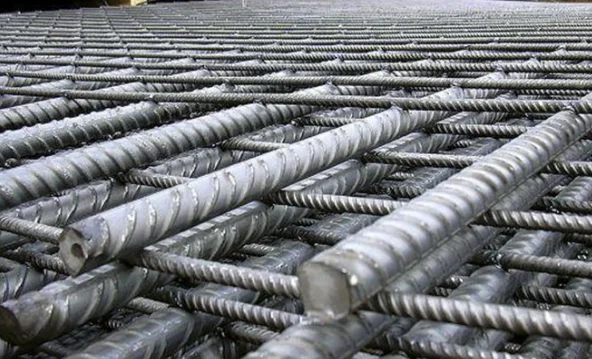
To ensure reinforcing steel meets specification and remains fully traceable and undamaged from mill to site.
Who uses this inspection and test plan
Contractor QA/QC, Fabricator QC, Logistics Supervisor, Site Engineer, and Client/Engineer for hold/witness points.
When this ITP is prepared and submitted
From procurement through fabrication, dispatch, delivery, receiving inspection, and storage until handover to installation crews.
Who receives or approves this ITP
Engineer/Client Representative for review, hold/witness participation, and approval.
Inspection scope
Covers supplier approval, receiving inspection, independent testing, dimensional checks, coupler works, tagging, transport, and site receiving/storage.
Typical hold, witness, and review points
First-off bar per mark (witness/hold as specified), independent testing (witness), coupler works test (witness), site receiving inspection (witness).
Typical inspection records
Supplier approvals, mill certs, test reports, BBS, bundle registers, load plans, delivery notes, receiving reports, storage checklists, torque logs, NCRs.
Important approval note
This ITP is an AI-assisted editable starting point, not a pre-approved document. Before use on any project, all inspection activities, hold points, and acceptance criteria must be reviewed and approved by the relevant parties (superintendent, principal contractor, or client representative) in accordance with your contract and project quality plan.
Always verify acceptance criteria against your applicable drawings, specifications, and regulatory requirements. Hold points must be confirmed with the relevant authority before work proceeds past that point.
Inspection and test plan
| Activity | Inspection / Test | Acceptance Criteria | Responsibility | Record |
|---|---|---|---|---|
| Supplier Approval | Document review/audit | Approved supplier list entry; QMS evidence; capacity and calibration program verified. | Contractor QA/QC; Engineer | Supplier approval form, audit report |
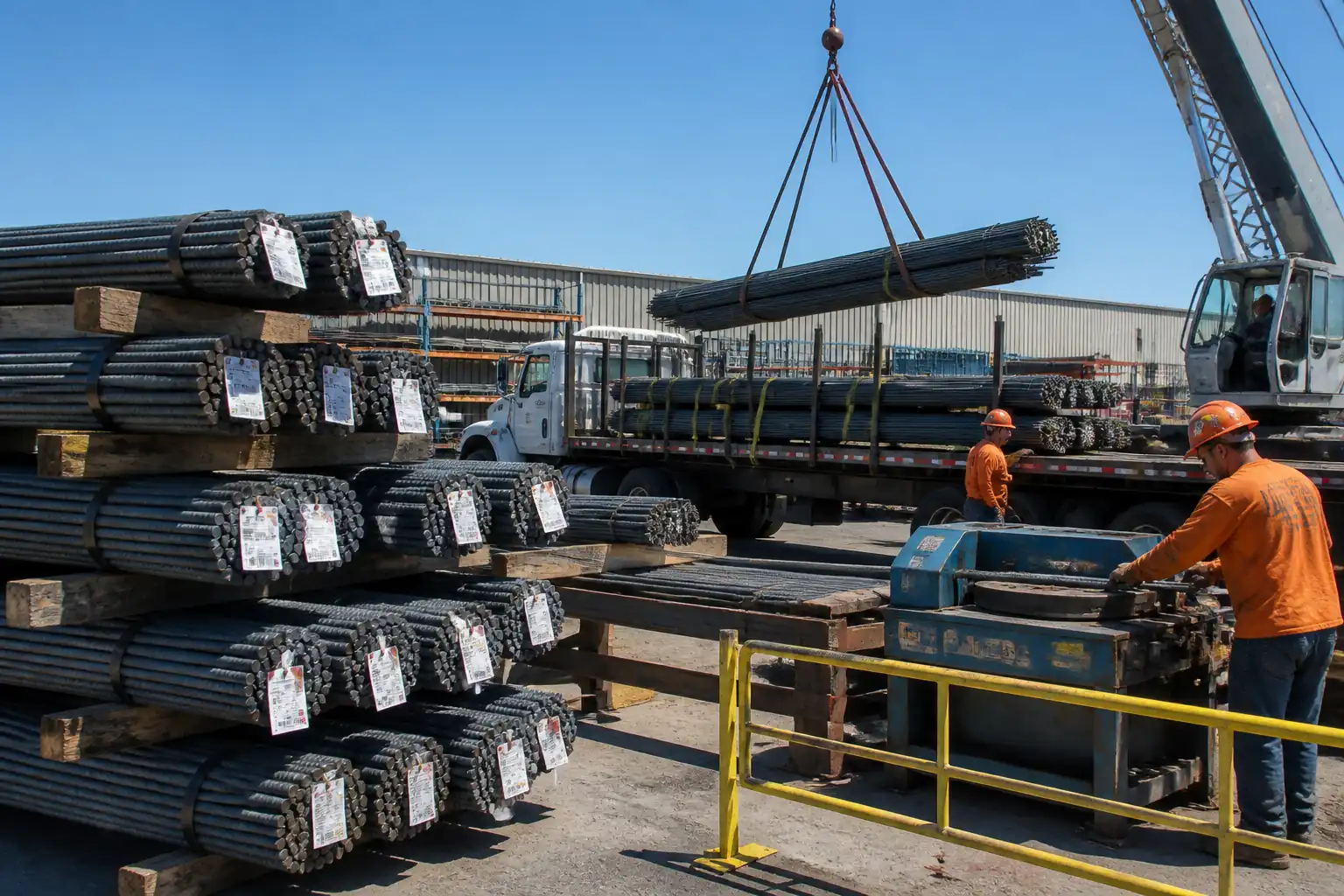
| Material Receiving at Yard | Visual, tag/heat verification, weighbridge | Grade/diameter/heat match PO and certs; no significant damage/corrosion; tags present. | Fabricator QC; Contractor QA | GRN, Receiving checklist, photos |
| Mill Certificate and Independent Testing | Mechanical (ASTM A370/ISO 15630-1); Chemical (ASTM A751) | Meets specified standard (e.g., BS 4449 B500B or ASTM A615/A706). Frequency ≥1 set per heat/diameter [Verify]. | Contractor QA/QC; 3rd-party lab; Engineer (witness) | Mill certs; Lab test reports; Sampling map |
| First-off Bar Check per Bar Mark | Dimensional check vs BBS | Within BS 8666 tolerances; correct bend radii; correct shape code. | Fabricator QC; Engineer (witness if required) | First-off check sheet, template record |
| In-Process Dimensional Inspection | Random checks | ≥10% per bar mark compliant; non-conforming bars segregated/reworked. | Fabricator QC | In-process QC reports |
| Mechanical Coupler Works | Thread gauge; torque; sample tensile per ISO 15835 | Threads within gauge; torque per manufacturer; tensile test: bar break outside splice (Class A) [Verify]. | Splice Technician; QC; Engineer (witness tests) | Splice log; torque records; test reports |
| Bundle Tagging and Traceability | Tag/ID verification | Unique bundle ID; data fields complete (bar mark, dia, length, qty, weight, heat, cert no.). | Storekeeper; QC | Bundle register; tag printouts |
| Pre-Dispatch Load Check | Load plan vs actual; EN 12195-1 calc | Restraint capacity ≥ code requirement; gear serviceable; documentation pack complete. | Loading Supervisor; QC | Load checklist; photos; calc sheet |
| Site Receiving Inspection | Tag/heat verification; dimensional spot checks; coating checks | Matches delivery docs and BBS; epoxy DFT ≥175 µm avg (if applicable) [Verify]; damage within allowable; NCR if not. | Site QC; Engineer (witness) | Receiving report; DFT log; photos |
| Site Storage Audit | Visual; tag/segregation check | Elevated ≥150 mm; covered as required; tags visible; no mix-ups. | Site QC | Storage checklist; map |
This table is a read-only public reference. Download the PDF or Excel version, or customize this ITP to edit it for your project.
Frequently asked questions
Related method statement
This Inspection and Test Plan is associated with the Method Statement: Off-site Fabrication, Transport, Delivery, Unloading and Storage of Structural Steel Reinforcement method statement, which describes the step-by-step construction sequence, resources, materials, equipment, safety controls, and environmental controls for this activity.
View the Method Statement: Off-site Fabrication, Transport, Delivery, Unloading and Storage of Structural Steel Reinforcement method statement →Continue with related inspection, method statement, article, and checklist resources.