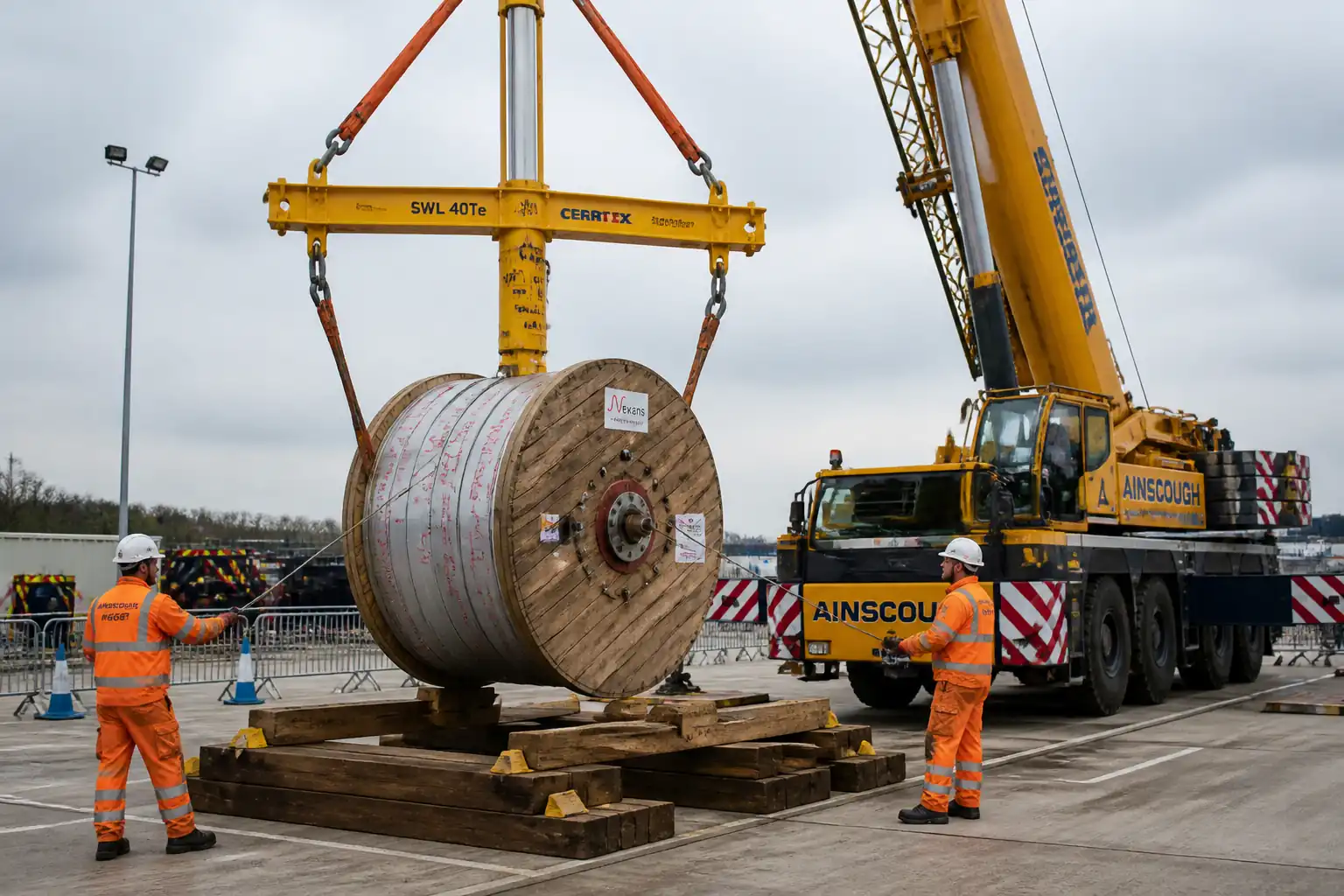

Method Statement: High‑Voltage Cable Drum Delivery, Unloading, and Yard Storage – Method Statement
AI-assisted method statement with matching ITP, PDF download, and Excel export.
More than a static template
Unlike a downloadable Word or PDF template, this method statement is an AI-assisted editable starting point connected directly to a matching Inspection and Test Plan. Every section is structured, project-adaptable, and ready to export.
- AI-assisted drafting — Customize every section with AI for your specific project scope.
- Linked ITP — A matching inspection and test plan is generated alongside the method statement.
- Multiple export formats — Download as a formatted PDF or editable Excel spreadsheet.
- Editable starting point, not a final document — Review, verify, and adjust all content against your project requirements before use.
Static template vs. Quollnet workflow
| Feature | Static template | Quollnet |
|---|---|---|
| Project-specific content | Manual fill-in required | AI-assisted customization |
| Linked ITP | Separate document, no link | Matching ITP included |
| Export formats | Usually PDF only | PDF and Excel |
| Structured sections | Free-form layout | 13 standardized sections |
| Saved to your account | Local file only | Cloud-saved, reusable |
| Content accuracy | You verify everything | AI-assisted, you still verify |
| Cost | Often free but time-intensive | Free to customize and download |
What you can customize
When you save this method statement to your account, every section becomes editable. The following 13 sections are included:
- Scope — Defines the activity and its boundaries.
- References — Standards, specifications, and drawings.
- Responsibilities — Roles and accountabilities.
- Resources — Labour, plant, and equipment summary.
- Materials — Materials and compliance requirements.
- Equipment — Tools and equipment details.
- Prerequisites — Hold points and pre-conditions.
- Method sequence — Step-by-step construction sequence.
- Safety controls — HSE risk controls and PPE.
- Environmental controls — Environmental mitigation measures.
- QA/QC — Quality inspection and test requirements.
- ITP — Inspection and Test Plan table (has its own page).
- Attachments — Referenced drawings and documentation.
Why this method statement is used
This method statement is used to define and communicate the approved procedure for carrying out method statement: high‑voltage cable drum delivery, unloading, and yard storage on site. It ensures the work is planned in advance, the correct resources and controls are in place, and all personnel understand responsibilities, sequence, quality requirements, and safety controls before work begins. It aligns site execution with the documented scope and acceptance expectations.
Who uses this method statement
This method statement is used by contractors, site supervisors, project engineers, QA/QC engineers, HSE officers, consultants, and client representatives. It serves as a shared reference for planning, execution, supervision, inspection, and approval of the activity on site.
When it is prepared and submitted
The method statement is prepared before the work activity starts and submitted as part of the pre-construction documentation package for review and approval.
Who reviews or approves it
The method statement is usually submitted to the client representative, consultant, resident engineer, or project management consultant for review and approval before the work commences.
Important approval note
This method statement is an AI-assisted editable starting point, not a pre-approved document. Before use on any project, all content must be reviewed and approved by the relevant parties (superintendent, principal contractor, or client representative) in accordance with your contract and project quality plan.
For example: if your specification requires a departure from a referenced standard, that departure must be documented and approved separately — this method statement will not capture that automatically. Always verify against your applicable drawings, specifications, and regulatory requirements.
Method statement content
Scope
Work scope
- Receipt, inspection, and documentation of incoming high-voltage (HV) cable drums at site laydown/yard.
- Drum condition verification: flange/disk, barrel/core, chocks, bolts, labels, tilt/shock indicators, and end-cap seal integrity to prevent water ingress.
- Unloading from trailers using heavy axle lifting shafts (through-barrel lifting) with spreader beam and certified lifting accessories; optional controlled short-distance rolling where permitted.
- Transfer to and placement within storage bays on level prepared ground with sleepers and rolling-prevention wedge blocks; weather protection and periodic inspections.
- Nonconformance handling, quarantine, and remedial actions for compromised seals or mechanical damage [Verify per project specifications].
Exclusions
- Cable electrical testing beyond basic storage checks (type/routine tests per manufacturer).
- Drum re-spooling, repair of severely damaged drums, or cable jointing/termination.
- Public road transport logistics outside site boundary.
Deliverables
- Approved Lift Plan and Lifting Permit.
- Drum Receipt & Inspection Reports with geo-tagged photos.
- Storage Bay Layout Plan and Register.
- Nonconformance Reports (NCR) where applicable.
- ITP records and close-out dossier.
References
| Document Type | Reference / Number | Revision | Notes |
|---|---|---|---|
| IEC 60840 | Power cables with extruded insulation and their accessories for rated voltages 30 kV (Um = 36 kV) to 150 kV (Um = 170 kV) — General requirements [For HV cables as applicable]. | ||
| IEC 62067 | Power cables with extruded insulation and their accessories for rated voltages above 150 kV (Um = 170 kV) up to 500 kV (Um = 550 kV). | ||
| IEC 60228 | Conductors of insulated cables — cross-sectional areas and classes (for verification of delivered cable data). | ||
| IEC 60502-2 | Power cables with extruded insulation and their accessories for rated voltages from 6 kV (Um = 7.2 kV) up to 30 kV (Um = 36 kV) — if MV drums are also stored. | ||
| ASME B30.9 / B30.26 / B30.20 | Slings, rigging hardware, and below-the-hook lifting devices — inspection and use requirements. | ||
| BS 7121 (series) | Safe use of cranes — planning of lifting operations and execution [Verify per local regulations]. | ||
| ISO 9927-1 | Cranes — Inspections — General. | ||
| ISO 45001 | Occupational health and safety management systems [Verify per project HSE plan]. | ||
| ISO 14001 | Environmental management systems [Verify per project EMS]. | ||
| Manufacturer’s Cable and Drum Handling Manual | Project-specific instructions supersede generic guidance where stated. | ||
| Project Specifications and Approved Lift Plan | Prevail where stricter than this method [Verify per project specifications]. |
Responsibilities
| Role | Responsibility | Name / Party |
|---|---|---|
| Project/Construction Manager | Overall delivery of scope, resources, approvals, and interfaces. | Contractor |
| Appointed Person / Lifting Engineer | Lift planning, selection of lifting method/gear, ground bearing checks, permits, and supervision level per risk. | Contractor |
| Lifting Supervisor | On-site control of lifting operations, toolbox talk, execution to plan, stop-work authority. | Contractor |
| Crane Operator / Forklift Operator | Operate equipment within rated capacity and conditions; conduct daily checks and follow signals. | Contractor |
| Riggers / Banksman | Rigging per plan, tag line control, exclusion zones, signaling, load balance checks. | Contractor |
| Stores / Logistics Lead | Yard layout, storage bay readiness, drum register, periodic storage inspections. | Contractor |
| QA/QC Inspector | Witness/verify inspections per ITP, documentation, NCR issuance and closure. | Contractor |
| HSE Officer | Task risk assessments, permits, auditing HSE controls, monitoring weather/wind limits. | Contractor |
| Supplier/Manufacturer Representative (as required) | Technical advice on handling/sealing; attendance for first-of-kind unloading. | Supplier |
| Engineer/Employer’s Representative | Review/approve method, witness hold points as specified. | Engineer |
Resources
| Resource Type | Description | Quantity | Remarks |
|---|---|---|---|
| Personnel | 1 (per lift) | ||
| Personnel | 1 (per lift) | ||
| Personnel | 2–4 [Verify per load size] | ||
| Personnel | 1 | ||
| Personnel | 1 | ||
| Personnel | 1 | ||
| Personnel | 1 | ||
| Personnel | 1 | ||
| Personnel | 1 |
Materials
| Material | Specification / Grade | Quantity | Remarks |
|---|---|---|---|
| Timber sleepers (hardwood or structural softwood) | Min 100 mm thickness, width 150–250 mm, length ≥ drum flange width + 300 mm [Verify] | As per bay layout | |
| Rolling-prevention wedge blocks (hardwood) | Section ≥ 100×100 mm, length 300–500 mm, chamfered contact face; anti-slip matting beneath [Verify] | Min 2 per side of each drum | |
| Breathable weatherproof covers | UV-resistant woven tarpaulin or vented cable drum covers; no fully airtight plastic wrap | 1 per drum | |
| End-cap sealing kits | Heat-shrink or mechanical sealing caps with butyl mastic; compatible with sheath material [Verify] | As required for remediation | |
| Desiccant sachets | Silica gel, 0.25–1.0 kg per drum depending on drum volume [Verify per manufacturer] | As required | |
| Moisture indicator cards / plugs | Visible humidity indicator 10–60% RH range [Verify] | 1 per end if specified | |
| Identification and quarantine tags | Weatherproof, unique ID, barcode/QR optional | As required |
Equipment
| Equipment | Capacity / Type | Quantity | Inspection Required |
|---|---|---|---|
| Mobile crane | Adequate for radius/load | ||
| Spreader beam | As per lift plan | ||
| Heavy axle lifting shaft (through-barrel) | As specified | ||
| Slings (wire/chain/synthetic) & shackles | As required | ||
| Tag lines | |||
| Forklift (for shaft handling only) | Adequate for task | ||
| Measuring tools | |||
| Hand tools / torque wrench | |||
| Weather monitoring | |||
| Barriers and signage |
Prerequisites
Approvals and documentation
- Approved Method Statement and Lift Plan; task-specific Risk Assessment; Lifting Permit to Work.
- Manufacturer drum/cable data sheets with gross mass, dimensions, rolling direction, and sealing instructions.
- Certificates: crane, spreader beam, lifting shaft, slings, shackles — in-date third-party inspections.
Site readiness
- Laydown/storage bay prepared: compacted level surface (slope ≤ 1:60) with drainage; bearing capacity verified for crane outriggers and drum loads [Verify per geotechnical report].
- Exclusion zone and traffic route established with banksman control; truck standing area level and stable.
- Weather: forecast reviewed; wind limit for lift as per crane manual; suspend lifts typically when sustained wind > 9 m/s or gusts > 13 m/s [Verify per crane OEM].
Personnel and briefings
- Competent Appointed Person/Lifting Supervisor in attendance.
- Toolbox talk covering hazards: roll-away, pinch/crush zones, suspended loads, seal integrity, and emergency stop signals.
Utilities and environment
- Lighting adequate for dawn/dusk operations.
- Spill kits available for plant hydraulic leaks; waste receptacles for packaging.
Hold/witness planning
- Notify Engineer for first-of-kind drum unloading and inspection witness as per ITP.
Method Sequence
| Step | Activity | Description | Responsibility | Inspection / Hold Point |
|---|---|---|---|---|
| 1 | Pre-delivery and documentation review | Confirm drum list, sizes, masses, and handling/sealing instructions. Verify lifting gear certificates and Lift Plan match actual drum weights and trailer access. | Appointed Person / QA-QC | Document check |
| 2 | Vehicle reception and stabilization | Position trailer in designated bay, apply trailer brakes and wheel chocks, set exclusion zone with barriers and banksman. | Lifting Supervisor | Visual |
| 3 | Initial drum identification and labeling | Verify drum ID vs packing list, confirm rolling direction arrows and label legibility. Affix site ID and storage bay code. | Storekeeper / QA-QC | Visual |
| 4 | Drum condition inspection (on trailer) | Inspect flanges, barrel, bolts, hubs, and spacers. Check tilt/shock indicators. Look for cracks, splits, delamination, excessive warp, or loose/missing bolts. | QA-QC / Lifting Supervisor | Visual + measurement |
| 5 | End-cap seal integrity check (both ends) | Confirm factory end caps intact without punctures/cuts; verify sealing tapes/mastic continuity; check moisture indicators (if present); listen/feel for cap looseness. | QA-QC | Visual/tactile |
| 6 | Rigging preparation | Select heavy axle lifting shaft sized to barrel core; install retaining collars. Connect twin slings to shaft lifting points via shackles and to spreader beam; fit tag lines. | Riggers / Lifting Supervisor | Pre-use inspection |
| 7 | Unlashing sequence and temporary chocking on trailer | Install wedge blocks against the drum on trailer bed before removing transport lashings to prevent roll-away. | Riggers | Visual |
| 8 | Shaft insertion and test lift | Insert lifting shaft through the drum barrel using forklift or manual rollers ensuring centralization. Apply slight hoist to 100–200 mm for test lift; check balance and rigging set. | Crane Operator / Riggers | Functional |
| 9 | Hoisting, slewing, and landing on sleepers | Lift clear, slew to storage bay with tag line control, and land onto two parallel sleepers under both flanges. Keep personnel clear of underside. | Crane Operator / Banksman | Operational |
| 10 | Positioning and wedge-block installation | Align axis horizontal within tolerance; install wedge blocks tight to both flanges, both sides, with anti-slip mats. Confirm no ground contact by cable or barrel. | Riggers / Storekeeper | Measurement |
| 11 | Weather protection and sealing verification | Cover drum with breathable cover; ensure airflow at base; verify end caps remain sealed after handling; add moisture indicators/caps if specified. | Storekeeper / QA-QC | Visual |
| 12 | Controlled short-distance rolling (if required) | For repositioning ≤ 10 m on level ground (≤ 1% gradient), roll only in arrow direction with two tag lines and chocks moved in leapfrog method. Do not roll on uneven/soft ground. | Lifting Supervisor / Riggers | Operational |
| 13 | Periodic storage inspection | Weekly: check wedges, sleepers, covers, seals, settlement, and labels. Monthly: check flange condition and rotate drum by ~90° in arrow direction for long-term storage (>3 months) [Verify]. | Storekeeper / QA-QC | Visual/measurement |
| 14 | Nonconformance and remediation | If seal compromised or damage outside limits: tag and quarantine; notify Engineer and Supplier; implement resealing, drying (per OEM), or replacement actions. | QA-QC | Review |
Health, Safety, and Environment — Safety Controls
Principal task-specific hazards and controls
- Hazard: Uncontrolled drum roll-away on trailer or yard.
- Likely consequence: Crush injuries, property damage.
- Engineering/procedural control: Install wedge blocks before removing lashings; maintain level ground; banksman control; no body parts in line of fire.
- Required PPE: Safety boots with toe protection, gloves (cut-resistant), hard hat, hi-vis vest.
- Collective measure: Physical chocks, barriers, and wheel chocks on vehicles.
-
Inspection/permit/supervision: Lifting Permit; Lifting Supervisor to verify chocks in place before unlashing.
-
Hazard: Suspended load strike from crane movement or load swing.
- Likely consequence: Serious injury/fatality.
- Engineering/procedural control: Use tag lines; keep exclusion zone (radius ≥ drum diameter + 2 m); maintain clear communications; follow lift plan.
- PPE: Hard hat with chin strap (windy conditions), eye protection, gloves, safety footwear.
- Collective measure: Barriers/tape and a dedicated banksman.
-
Inspection/permit/supervision: BS 7121 compliant Lift Plan; pre-lift briefing; wind monitoring; stop-lift threshold per OEM [Verify per project HSE plan and local regulations].
-
Hazard: Rigging failure (undersized shaft/slings/shackles).
- Likely consequence: Load drop.
- Engineering/procedural control: Select gear with WLL ≥ factored load; pre-use inspection; use spreader beam; correct sling angles; no knots.
- PPE: Gloves, eye protection, safety boots.
- Collective measure: Color-coded inspected slings; secondary restraint during test lift where practicable.
-
Inspection/permit/supervision: Third-party certificates; daily checks per ASME B30.9; Lifting Supervisor sign-off.
-
Hazard: Pinch/crush between drum flanges and sleepers/wedges.
- Likely consequence: Hand injuries.
- Engineering/procedural control: Use push/pull tools; position from sides; never place hands under suspended drum.
- PPE: Impact-rated gloves.
- Collective measure: Exclusion of non-essential personnel.
-
Inspection/permit/supervision: Supervisor to control final set-down.
-
Hazard: High wind during lift.
- Likely consequence: Loss of control/slew overshoot.
- Engineering/procedural control: Suspend lifts above OEM wind limits; use anemometer; reduce sail area of covers during lift.
- PPE: As standard.
- Collective measure: Weather hold; secure covers before lift.
-
Inspection/permit/supervision: Record wind readings; AP to authorize resume.
-
Hazard: End-cap removal/compromised seal exposing conductor end.
- Likely consequence: Moisture ingress, asset damage.
- Engineering/procedural control: Prohibit cap removal; if compromised, quarantine and reseal per OEM within 2 h; use desiccant as directed.
- PPE: Gloves, eye protection when using heat-shrink.
- Collective measure: Quarantine zone with signage.
-
Inspection/permit/supervision: QA-QC verification; NCR process.
-
Hazard: Plant-pedestrian interaction in yard.
- Likely consequence: Struck-by incidents.
- Engineering/procedural control: One-way traffic, speed limits, spotters, reversing alarms, designated walkways.
- PPE: Hi-vis vests, safety boots.
- Collective measure: Physical segregation and signage.
-
Inspection/permit/supervision: Daily traffic inspection; banksman mandatory for reversing.
-
Hazard: Manual handling during wedge placement.
- Likely consequence: Strains/sprains.
- Engineering/procedural control: Use mechanical aids, team lift, keep weights < 25 kg per person [Verify per local guidance].
- PPE: Gloves, back support if prescribed.
- Collective measure: Pre-staged wedges near point of use.
-
Inspection/permit/supervision: HSE Officer to monitor technique.
-
Hazard: Noise and pinch from crane/forklift operations.
- Likely consequence: Hearing loss, minor injuries.
- Engineering/procedural control: Maintain equipment, avoid pinch points, restrict unnecessary presence.
- PPE: Hearing protection when > 80 dB(A) [Verify], gloves.
- Collective measure: Noise signage.
- Inspection/permit/supervision: HSE spot checks.
[All controls to be verified per project HSE plan and local regulations.]
Environmental Controls
- Ground protection: Prepare level, drained surface; avoid storage in flood-prone/ponding areas. Keep drums off ground on sleepers.
- Stormwater management: Do not allow silt or debris to enter drains; maintain clean routes; covers secured to prevent windblown debris.
- Spill prevention: Place drip trays under stationary hydraulic equipment where risk exists; spill kits within 25 m; report and clean spills immediately.
- Noise and hours: Plan unloading during approved hours; maintain equipment to minimize noise; use broadband alarms where feasible [Verify per local requirements].
- Waste management: Segregate packaging, broken wedges, and damaged covers; dispose/recycle per project waste plan.
- Material protection: Use breathable covers to prevent UV and heat buildup while avoiding condensation; inspect after storms.
- Dust control: If yard preparation generates dust, use water misting; avoid over-watering near drums to prevent standing water near end caps.
- Carbon reduction: Minimize idling; coordinate deliveries to reduce double-handling.
- Wildlife and vegetation: Keep laydown within approved footprint; no chemical herbicides without approval.
QA/QC
Inspection and testing
- 100% incoming inspection of each drum: identification, flange/barrel condition, hardware, end-cap seals, indicators; photo record.
- Measurement checks: flange out-of-plane warp and rim dents per acceptance limits [Verify per project/manufacturer].
- Lifting gear verification: certificates current; pre-use checklists completed for crane, spreader, shaft, slings, shackles.
- Weather: wind readings recorded at start and as conditions change during lift.
- Storage inspections: weekly general check; monthly detailed check and rotation logged for long-term storage (>3 months) [Verify].
Records and traceability
- Drum Register with unique IDs, delivery notes, inspection reports, photos, and storage bay mapping.
- Lifting logs with operator, date/time, wind, equipment IDs.
- NCRs with disposition (repair/reseal/return/replace) and Engineer approvals.
Calibration and certificates
- Calibrated anemometer; torque wrenches where used; rigging certificates in-date.
Acceptance summary
- Drums only accepted into storage if within mechanical damage tolerances and with intact end-cap seals; otherwise quarantined pending disposition.
[All quantitative criteria to be verified against project specifications and manufacturer handling manuals.]
Attachments
- Lift Plan and Lifting Permit (approved).
- Drum Receipt & Inspection Checklist (with sample photos).
- Seal Integrity Checklist and Resealing Work Instruction.
- Rigging Configuration Sketch (spreader beam and lifting shaft).
- Storage Bay Layout Drawing and Drum Register Template.
- Certificates of Thorough Examination for crane, spreader, shaft, slings, shackles.
- Toolbox Talk Briefing Sheet (HV drum handling).
- Example NCR form and issue/closure workflow.
This content is a read-only public reference. Download or customize to get an editable version.
ITP preview
The first inspection activities from the linked ITP for Method Statement: High‑Voltage Cable Drum Delivery, Unloading, and Yard Storage:
| Activity | Inspection / Test | Acceptance Criteria | Responsibility | Record |
|---|---|---|---|---|
| Pre-delivery document verification | Review delivery note, cable/drum data sheets, lifting certificates, and Lift Plan | Documents complete, valid, and consistent; WLLs adequate with safety factors [Verify] | QA/QC / Appointed Person | Pre-delivery checklist |
| Yard readiness check | Inspect storage bay level, sleepers, wedges, drainage, and exclusion setup | Slope ≤ 1:60; sleepers and wedges available; traffic control in place | Lifting Supervisor / QA/QC | Yard readiness form |
| Drum identification and labeling | Match drum ID to packing list; apply site ID and bay code | 100% match; labels legible and weatherproof | Storekeeper / QA/QC | Drum register |
Showing 3 of 11 inspection activities. View full ITP →
Related Inspection and Test Plan
An Inspection and Test Plan (ITP) is available for Method Statement: High‑Voltage Cable Drum Delivery, Unloading, and Yard Storage. The ITP defines the inspection activities, acceptance criteria, hold and witness points, responsible parties, and records required to verify the work described in this method statement.
View the Method Statement: High‑Voltage Cable Drum Delivery, Unloading, and Yard Storage ITP →