
Method Statement: Off-site Fabrication, Transport, Delivery, Unloading and Storage of Structural Steel Reinforcement – Method Statement
AI-assisted method statement with matching ITP, PDF download, and Excel export.
More than a static template
Unlike a downloadable Word or PDF template, this method statement is an AI-assisted editable starting point connected directly to a matching Inspection and Test Plan. Every section is structured, project-adaptable, and ready to export.
- AI-assisted drafting — Customize every section with AI for your specific project scope.
- Linked ITP — A matching inspection and test plan is generated alongside the method statement.
- Multiple export formats — Download as a formatted PDF or editable Excel spreadsheet.
- Editable starting point, not a final document — Review, verify, and adjust all content against your project requirements before use.
Static template vs. Quollnet workflow
| Feature | Static template | Quollnet |
|---|---|---|
| Project-specific content | Manual fill-in required | AI-assisted customization |
| Linked ITP | Separate document, no link | Matching ITP included |
| Export formats | Usually PDF only | PDF and Excel |
| Structured sections | Free-form layout | 13 standardized sections |
| Saved to your account | Local file only | Cloud-saved, reusable |
| Content accuracy | You verify everything | AI-assisted, you still verify |
| Cost | Often free but time-intensive | Free to customize and download |
What you can customize
When you save this method statement to your account, every section becomes editable. The following 13 sections are included:
- Scope — Defines the activity and its boundaries.
- References — Standards, specifications, and drawings.
- Responsibilities — Roles and accountabilities.
- Resources — Labour, plant, and equipment summary.
- Materials — Materials and compliance requirements.
- Equipment — Tools and equipment details.
- Prerequisites — Hold points and pre-conditions.
- Method sequence — Step-by-step construction sequence.
- Safety controls — HSE risk controls and PPE.
- Environmental controls — Environmental mitigation measures.
- QA/QC — Quality inspection and test requirements.
- ITP — Inspection and Test Plan table (has its own page).
- Attachments — Referenced drawings and documentation.
Why this method statement is used
This method statement is used to define and communicate the approved procedure for carrying out method statement: off-site fabrication, transport, delivery, unloading and storage of structural steel reinforcement on site. It ensures the work is planned in advance, the correct resources and controls are in place, and all personnel understand responsibilities, sequence, quality requirements, and safety controls before work begins. It aligns site execution with the documented scope and acceptance expectations.
Who uses this method statement
This method statement is used by contractors, site supervisors, project engineers, QA/QC engineers, HSE officers, consultants, and client representatives. It serves as a shared reference for planning, execution, supervision, inspection, and approval of the activity on site.
When it is prepared and submitted
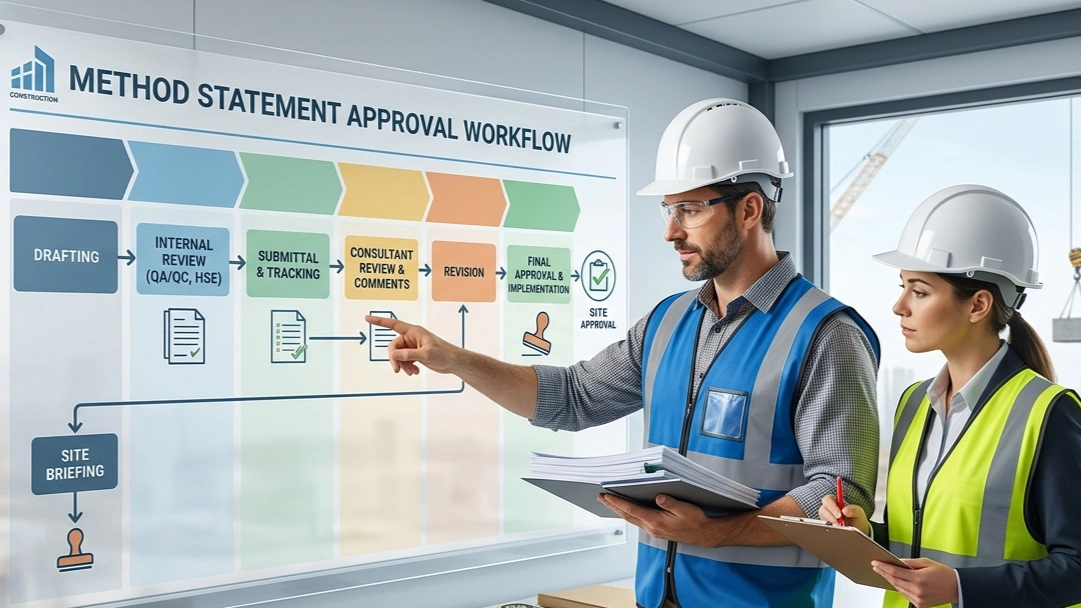
The method statement is prepared before the work activity starts and submitted as part of the pre-construction documentation package for review and approval.
Who reviews or approves it
The method statement is usually submitted to the client representative, consultant, resident engineer, or project management consultant for review and approval before the work commences.
Important approval note
This method statement is an AI-assisted editable starting point, not a pre-approved document. Before use on any project, all content must be reviewed and approved by the relevant parties (superintendent, principal contractor, or client representative) in accordance with your contract and project quality plan.
For example: if your specification requires a departure from a referenced standard, that departure must be documented and approved separately — this method statement will not capture that automatically. Always verify against your applicable drawings, specifications, and regulatory requirements.
Method statement content
Scope
Overview
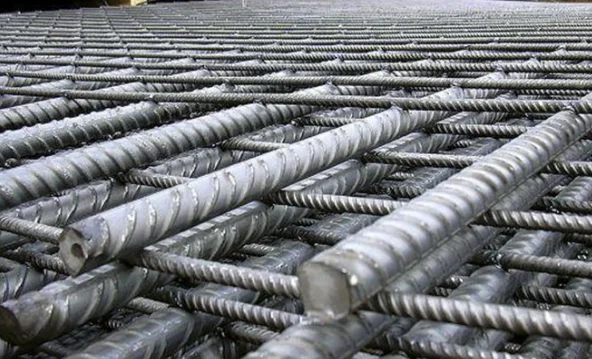
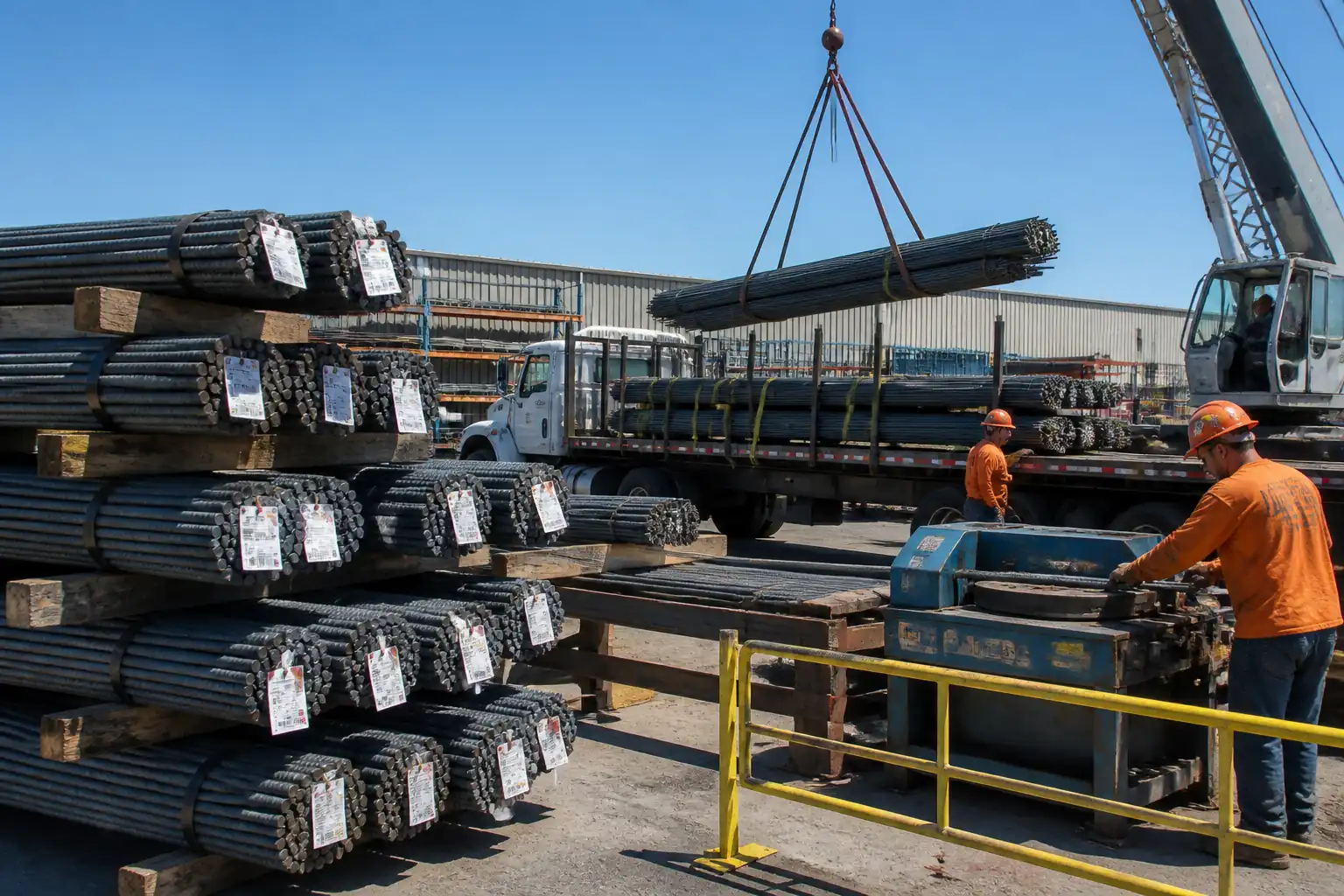
This method statement defines the off-site fabrication, inspection, identification, transport, delivery, unloading, receiving inspection, and storage/traceability of reinforcing steel (rebar) and associated mechanical couplers for concrete works.
Included
- Supplier approval and procurement controls.
- Mill certificate verification and independent testing regime.
- Preparation and approval of bar bending schedules (BBS) per approved design/shop drawings.
- Off-site cutting, bending, threading/upsetting for mechanical couplers.
- Bundle formation, tagging/barcoding, and full traceability to heat numbers and BBS bar marks.
- Transport load planning, load restraint per EN 12195-1, and delivery documentation.
- Site receiving inspection, safe unloading, and compliant storage with traceability.
- QA/QC records, ITP with hold/witness points, NCR handling.
Exclusions
- In-situ fixing/installation of reinforcement in forms (covered by separate method).
- On-site rework other than minor tag replacement or segregation.
Constraints/Assumptions
- All dimensions, bar grades, ductility class, coatings, and coupler systems per project specifications. Where values are not provided, typical benchmarks are stated and marked [Verify per project specifications].
- Applicable local transport regulations, permits, and axle/load limits to be observed [Verify per local regulations].
References
| Document Type | Reference / Number | Revision | Notes |
|---|---|---|---|
| Contract Docs | |||
| Standard | BS 4449:2005+A3 (or latest) [Verify] | Typical grade B500B/B500C [Verify per project]. | |
| Standard | BS 8666:2020 [Verify] | Defines bar shapes, tolerances, bending former diameters [Verify per spec]. | |
| Standard | EN 10080 or ISO 6935 [Verify] | ||
| Standard | ASTM A615/A615M, ASTM A706/A706M [Verify] | Use when project specifies ASTM route. | |
| Standard | ASTM A370; ASTM A751 [Verify] | ||
| Standard | ASTM A775/A775M; ASTM A767/A767M [Verify] | If coated bars are specified. | |
| Standard | ISO 15835-1/-2 [Verify] | Acceptance typically Class A (bar break away from splice) [Verify]. | |
| Standard | EN 12195-1:2010 (or latest) [Verify] | Used to size straps/chains and number of lashings. | |
| Standard | ASME B30.5, B30.9, B30.26; ISO 9927; ISO 12480 [Verify] | Or applicable local lifting regulations [Verify]. | |
| Standard | ISO 9001, ISO 14001, ISO 45001 [Verify] | ||
| Regulation | [Verify per local regulations] |
Responsibilities
| Role | Responsibility | Name / Party |
|---|---|---|
| Project Manager | Ensure method statement, ITP, and material submittals are approved prior to works. | Contractor |
| QA/QC Manager | Review mill certs; arrange independent tests; manage NCRs; control records. | Contractor |
| Supervisor | Ensure machines calibrated; operators competent; output meets BBS tolerances. | Fabricator |
| Coordinator | Vehicle selection, load plans, EN 12195-1 restraint calc, permits, route & delivery slots. | Fabricator/Contractor |
| Lifting Supervisor | Lift plan, equipment selection, exclusion zones, toolbox talks. | Contractor |
| Storekeeper | Maintain heat/bar-mark segregation; update inventory; preserve tags. | Fabricator/Contractor |
| HSE | Risk assessments, method safety review, inductions, monitoring. | Contractor/Fabricator |
| Laboratory | Conduct mechanical/chemical tests to relevant standards. | Third Party |
| Engineer | Review submittals; witness tests/inspections as per ITP. | Engineer/Client |
Resources
| Resource Type | Description | Quantity | Remarks |
|---|---|---|---|
| Personnel | Cut/bend/stirrup operations | 4–8 per shift [Verify] | |
| Personnel | Threading/upsetting and coupler assembly | 1–2 per shift [Verify] | |
| Personnel | Dimensional checks, tag verification | 1 per shift [Verify] | |
| Personnel | Transport and site unloading | As scheduled | |
| Personnel | Slinging and load control | 2–3 per lift [Verify] |
Materials
| Material | Specification / Grade | Quantity | Remarks |
|---|---|---|---|
| Rebar, deformed | BS 4449 B500B/B500C or ASTM A615 Gr 60/75 or ASTM A706 [Verify] | ||
| Couplers | ISO 15835-compliant; project-approved type [Verify] | ||
| Annealed steel wire | 1.2–1.6 mm dia [Verify] | ||
| PVC/Poly tags | UV and moisture resistant; unique ID printed | ||
| Timber/rubber | Timber 75×75 mm min [Verify] | ||
| Breathable tarpaulins | UV-resistant, secured against wind uplift |
Equipment
| Equipment | Capacity / Type | Quantity | Inspection Required |
|---|---|---|---|
| Rebar shear up to 40 mm dia [Verify] | 1+ | Calibration cert valid [Verify] | |
| Rebar bender | 1+ | Calibration cert valid [Verify] | |
| Threading machine | As required | Calibration records [Verify] | |
| Calibrated torque wrench | 2 | Calibration within 6 months [Verify] | |
| Measuring devices | Set | Calibration where applicable [Verify] | |
| MHE | Forklift 5 t; Crane 10–25 t [Verify] | Daily checks; statutory inspection valid [Verify] | |
| 12–13.6 m flatbed [Verify] | As per schedule | Roadworthiness and permits [Verify] | |
| Grade 80 chains or 50 mm straps (LC ≥ 2,500 daN) [Verify] | Sets per truck | Pre-use inspection | |
| Certified lifting accessories | As required | Color-coded, within inspection date [Verify] |
Prerequisites
- Approved Method Statement, ITP, and Material Submittals (rebar grade, coating, couplers).
- Approved IFC drawings and BBS (BS 8666 format with bar marks, shapes, lengths, bending radii).
- Fabricator qualification: ISO 9001-certified (or equivalent) QMS; evidence of capacity and calibration program.
- Third-party laboratory nomination and approval for mechanical/chemical testing.
- Coupler system approval: type-test certificates per ISO 15835 and manufacturer’s installation procedure.
- Yard layout prepared: segregation by diameter/heat/mark; tagged storage racks; weather protection plan.
- HSE risk assessments for yard operations, transport, and site interface approved [Verify per project HSE plan and local regulations].
- Lifting plans and permits for site unloading; traffic management plan; agreed delivery slots and access routes.
- Pre-approved traceability protocol: unique bundle IDs linked to heat numbers, BBS marks, and delivery notes.
- Calibrations in date for cutting/bending machines, torque wrenches, scales, and gauges.
- Designation of site storage area: firm level base, drainage, and covers; storage plan approved by Engineer.
Method Sequence
| Step | Activity | Description | Responsibility | Inspection / Hold Point |
|---|---|---|---|---|
| 1 | Pre-Production Approvals | Submit and obtain approvals for MS, ITP, material submittals, BBS, coupler systems. | Contractor PM / QA | Review/Approval |
| 2 | Supplier Qualification & Procurement | Place orders on approved mills/fabricators with specified grade/ductility/coating; require mill certificates per heat and per diameter. | Procurement / QA | Supplier audit (if required) |
| 3 | Receipt at Fabrication Yard | Check delivery note vs PO; verify diameter, grade, heat numbers, and color codes. Record weighbridge weight. Quarantine non-conforming deliveries. | Storekeeper / QC | Receiving inspection |
| 4 | Independent Testing (as required) | Select samples per heat and diameter for mechanical (yield/UTS/elongation/bend) and chemical tests. | QA/QC | Witness (Engineer, if specified) |
| 5 | Yard Storage and Segregation | Stack on timber dunnage ≥150 mm above ground; segregate by diameter, heat, and bar mark; maintain weather covers for coated bars; prevent contamination and deformation. | Storekeeper | Daily storage check |
| 6 | Cutting to Length | Program machines from approved BBS; verify machine calibration. Deburr as needed. Control ejection zone. | Fabrication Supervisor | In-process QC |
| 7 | Bending/Forming | Bend bars using correct former diameters; avoid re-bending unless approved by Engineer and standard permits. Use templates for complex shapes. | Fabrication Supervisor | In-process QC |
| 8 | Mechanical Coupler Preparation | Thread/upset ends as per system; clean threads; assemble sample joints; verify with GO/NO-GO gauges; apply protective caps. | Splice Technician / QC | Surveillance; possible witness |
| 9 | Dimensional QA vs Approved BBS | Randomly verify formed bars using templates; check lengths, bends, hook dimensions, and bar marks. | QC Inspector | Hold (if specified) |
| 10 | Bundle Formation and Tagging | Form bundles per bar mark and heat; apply weatherproof tag and barcode/QR linking to BBS mark, diameter, length, quantity, weight, heat number, cast date, mill cert no., coupler type (if any). Secure with steel/plastic straps and edge protectors. | Storekeeper / QC | Visual check |
| 11 | Pre-Dispatch Documentation Pack | Compile delivery note, bundle list, mill certs, test reports, EN 12195-1 load plan, driver instructions, and SDS for coatings (if any). | Logistics / QA | Document review |
| 12 | Truck Loading and Restraint | Place dunnage aligned; stack low and even; prevent overhang beyond vehicle limits; apply lashings per EN 12195-1 using chains/straps with rated LC; use edge protectors and friction mats; check headboard contact for forward restraint; flag/mark any allowable overhang per local code. | Loading Supervisor | Pre-dispatch check |
| 13 | Transport to Site | Use approved route and timings; comply with speed limits; monitor weather; stop to re-check lashings after 30 min of travel [Verify]. | Driver / Haulier | Journey management |
| 14 | Site Access and Unloading | Attend induction; position in designated bay; set exclusion zone; lift with approved slings/spreaders; no standing on load; use taglines; place bundles on prepared dunnage. | Lifting Supervisor / Riggers | Permit to Lift; pre-lift |
| 15 | Receiving Inspection at Site | Verify delivery note vs bundle tags; check heat numbers and BBS marks; spot-check dimensions (≥2 bars per mark [Verify]); check coating integrity if coated; record any damage. | Site QC / Engineer | Witness (Engineer as per ITP) |
| 16 | Site Storage and Traceability | Store by bar mark and heat; elevate ≥150 mm on dunnage; cover against rain/sun (breathable covers); maintain clear aisle; update storage map; keep coupler/thread caps fitted; segregate epoxy-coated bars from black steel and from chains. | Storekeeper / Site QC | Daily storage audit |
| 17 | Nonconformance Handling | Quarantine non-conforming materials; raise NCR; agree disposition (rework, repair, reject); update traceability records; inform Engineer. | QA/QC | Hold (release by QA) |
| 18 | Records and Handover | Compile full dossier: approvals, mill certs, test reports, BBS, bundle register, load plans, delivery and receiving reports, storage logs, NCRs, calibration certificates. | QA/QC | Final QA review |
Health, Safety and Environment (HSE) – Task-Specific Safety Controls
Principal Hazards and Controls (Fabrication Yard, Transport, and Site Interface)
1) Hazard: Entanglement/crush at cutting and bending machines
- Consequence: Amputation, crush injuries
- Engineering/Procedural Control: Fixed guards and interlocks; ejection shields; designated ejection zones; lockout/tagout for jams and maintenance; only trained operators; clear SOPs with photos.
- Required PPE: Cut-resistant gloves, safety glasses/face shield, long sleeves, safety boots, hearing protection.
- Collective Measures: Physical barriers and floor markings around machines; emergency stop accessible; housekeeping.
- Inspection/Permit/Supervision: Daily machine checklist; periodic maintenance; LOTO permits for maintenance; supervisor sign-off.
2) Hazard: Flying swarf and thread-cutting hazards during coupler preparation
- Consequence: Eye injury, lacerations
- Engineering/Procedural Control: Swarf guards, chip collection, correct speed/feed; use GO/NO-GO gauges, never hand-feed near dies.
- PPE: Safety goggles/face shield, gloves.
- Collective Measures: Screens around machines; swarf bins with lids.
- Inspection/Permit/Supervision: Tool condition checks; gauge calibration records.
3) Hazard: Manual handling and pinch points (bundling and tagging)
- Consequence: Strains, crush fingers
- Engineering/Procedural Control: Use mechanical aids (forklifts, hoists); team lifts; use tag applicators to avoid hands under straps.
- PPE: Gloves, safety boots.
- Collective Measures: Training in safe lifting; job rotation.
- Inspection/Permit/Supervision: Supervisor monitors technique; incident/NM reporting.
4) Hazard: Vehicle movements in yard/site
- Consequence: Struck-by incidents
- Engineering/Procedural Control: Traffic management plan; one-way systems; spotters/banksmen; reversing alarms; speed limits.
- PPE: High-visibility vest, safety boots, helmet.
- Collective Measures: Barriers, signage, designated pedestrian routes.
- Inspection/Permit/Supervision: Daily traffic route inspection; banksman competence; site access permit.
5) Hazard: Lifting/unloading failure (slings/chains or crane)
- Consequence: Load drop, fatality
- Engineering/Procedural Control: Appointed Person lift plan; choose certified lifting accessories with SWL ≥ load; use taglines; forbid personnel under suspended loads; use spreader beams to avoid bundle damage.
- PPE: Helmets with chin strap, gloves, safety boots, eye protection.
- Collective Measures: Exclusion zone; radio comms; wind monitoring.
- Inspection/Permit/Supervision: Permit to Lift; pre-use inspection of crane and accessories; statutory inspections in date; lifting supervisor present.
6) Hazard: Working at height on truck beds
- Consequence: Falls, fractures
- Engineering/Procedural Control: Avoid climbing on loads; use mobile steps/platforms with handrails; use long-handled tools to reach lashings.
- PPE: Non-slip footwear; where unavoidable, fall-arrest per site rules.
- Collective Measures: Edge protection on platforms.
- Inspection/Permit/Supervision: Work-at-Height permit when applicable [Verify per project HSE plan and local regulations].
7) Hazard: Sharp edges and bar ends
- Consequence: Cuts, puncture wounds
- Engineering/Procedural Control: Deburr where needed; use end caps in pedestrian areas; use edge protectors.
- PPE: Cut-resistant gloves, long sleeves.
- Collective Measures: Storage orientation to minimize protrusions; capped ends in access areas.
- Inspection/Permit/Supervision: Routine HSE inspections.
8) Hazard: Noise exposure (>85 dB near shears/benders)
- Consequence: Hearing loss
- Engineering/Procedural Control: Noise mapping; reduce exposure time; equipment maintenance.
- PPE: Ear defenders/plugs.
- Collective Measures: Acoustic barriers where feasible.
- Inspection/Permit/Supervision: Dosimetry and periodic audiometry [Verify].
9) Hazard: Road transport load shift/overturning
- Consequence: Collision, injury, spillage
- Engineering/Procedural Control: EN 12195-1-compliant restraint; route assessment; re-tension check after 30 min; avoid excessive CoG height; comply with overhang/escort rules.
- PPE: Driver PPE for securing; high-vis.
- Collective Measures: Secure loading bays; wheel chocks during loading.
- Inspection/Permit/Supervision: Vehicle pre-trip inspection; load check records; transport permits in vehicle.
10) Hazard: Weather (wind/rain) during lifting/transport
- Consequence: Loss of control, slip
- Engineering/Procedural Control: Monitor forecast; suspend lifts above manufacturer wind limits (typical 9–12 m/s for mobile cranes) [Verify]; non-slip mats in rain.
- PPE: Weather-appropriate PPE.
- Collective Measures: Gritting/water removal on access ways.
- Inspection/Permit/Supervision: Supervisor stop-work authority.
Environmental Controls
- Steel Offcuts and Swarf: Segregate for 100% recycling; provide labeled bins; no mixing with general waste. Maintain records of recycled tonnage.
- Packaging Waste (straps, pallets, plastic): Segregated collection; avoid windblown litter; compact straps with cutters; recycle where facilities exist.
- Oils and Lubricants: Secondary containment under machines; spill kits at points of use; immediate spill response; waste oils collected by licensed vendor; no discharge to drains.
- Noise: Limit cutting/bending and truck movements to agreed hours; use acoustic measures where near receptors; monitor as required.
- Water and Run-off: Keep storage off the ground; locate away from drains; use silt socks or drip trays if rust fines present; no washing of coated bars in open drains.
- Air Emissions: Maintain vehicles/equipment; avoid unnecessary idling; journey planning to minimize trips.
- Coated Bars Handling: Prevent coating damage; repair epoxy with manufacturer kits in controlled area; collect sanding debris for disposal per SDS.
- Housekeeping: Routine sweeping; no abrasive blasting on open ground; keep yards clean to prevent metal particle migration.
- Compliance: Follow project CEMP and local environmental regulations [Verify per project HSE plan and local regulations].
Quality Assurance and Quality Control
QA/QC Plan
- Document Control: Maintain traceability from mill certificate to heat number to bundle ID to BBS mark and final pour location (where applicable).
- Sampling and Testing:
- Mechanical/Chemical: Minimum 1 set per heat per diameter (yield, UTS, elongation, bend; chemistry as required) to ASTM A370/ISO 15630-1 and ASTM A751 [Verify per project specifications].
- Coatings: Epoxy DFT check (ASTM A775), typical min average ≥175 µm; holiday testing per manufacturer; coating damage repair logged [Verify].
- Couplers: Works tests per ISO 15835; installation torque verification per lot/shift; sample tensile test frequency typically 1 per 100 splices or per crew/day [Verify].
- Dimensional Inspection: At least 10% per bar mark; verify against BS 8666 tolerances (length, angles, hooks, radii). Templating for complex shapes.
- Equipment Calibration: Shear/bender counters, torque wrenches, scales, gauges—valid calibration certificates; verification checks at start of shift.
- ITP Hold/Witness Points: Receiving of stock (surveillance), independent testing (witness), dimensional check of first-off per bar mark (hold/witness as specified), pre-dispatch load check (surveillance), site receiving inspection (witness), NCR closure (hold if critical).
- Nonconformities: Quarantine tagged with red “HOLD”; NCR raised; root cause analysis; corrective action; retesting if required; disposition approved by Engineer.
- Records: Approval letters, BBS, supplier approvals, mill certs, test reports, bundle register, load restraint calculations, delivery notes, receiving inspection, storage logs, lifting permits, calibration certs, NCRs.
- Benchmarks/Tolerances: Apply project-specified tolerances; where absent use BS 8666/BS 4449 or ASTM equivalents [Verify].
- Acceptance: Conformity to standards and project specification; full traceability; documentation complete.
Attachments
- Sample: Approved Bar Bending Schedule (BBS) with shape codes per BS 8666.
- Sample: Mill Certificates and Independent Test Reports (mechanical/chemical) by heat and diameter.
- Template: Receiving Inspection Checklist (Yard and Site).
- Template: Bundle Tag Format (fields: Bundle ID, Bar Mark, Dia, Length, Qty, Weight, Heat No., Mill Cert No., Coupler Type, Cast Date, PO No., QR/Barcode).
- Template: Splice Log and Torque Verification Sheet.
- Template: Load Restraint Calculation Sheet (EN 12195-1) and Pre-Dispatch Checklist.
- Plan: Yard Storage Layout and Site Storage Map.
- Plan: Lifting Plan and Permit to Lift (site unloading).
- Registers: Calibration Register; NCR Register; Delivery and Receiving Registers.
- Safety: HIRA for Yard Ops, Transport, and Site Unloading; Toolbox Talk briefs.
This content is a read-only public reference. Download or customize to get an editable version.
ITP preview
The first inspection activities from the linked ITP for Method Statement: Off-site Fabrication, Transport, Delivery, Unloading and Storage of Structural Steel Reinforcement:
| Activity | Inspection / Test | Acceptance Criteria | Responsibility | Record |
|---|---|---|---|---|
| Supplier Approval | Document review/audit | Approved supplier list entry; QMS evidence; capacity and calibration program verified. | Contractor QA/QC; Engineer | Supplier approval form, audit report |
| Material Receiving at Yard | Visual, tag/heat verification, weighbridge | Grade/diameter/heat match PO and certs; no significant damage/corrosion; tags present. | Fabricator QC; Contractor QA | GRN, Receiving checklist, photos |
| Mill Certificate and Independent Testing | Mechanical (ASTM A370/ISO 15630-1); Chemical (ASTM A751) | Meets specified standard (e.g., BS 4449 B500B or ASTM A615/A706). Frequency ≥1 set per heat/diameter [Verify]. | Contractor QA/QC; 3rd-party lab; Engineer (witness) | Mill certs; Lab test reports; Sampling map |
Showing 3 of 10 inspection activities. View full ITP →
Related Inspection and Test Plan
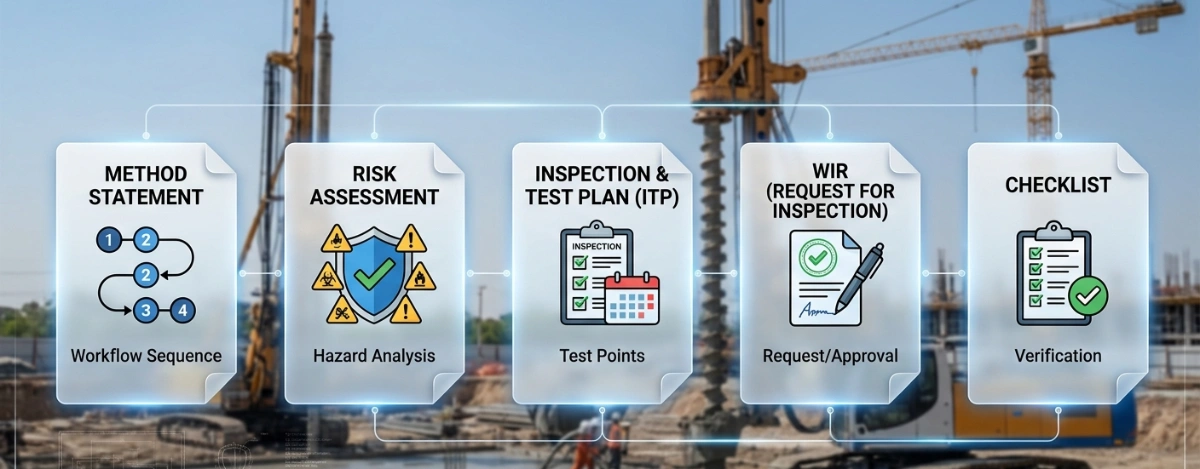
An Inspection and Test Plan (ITP) is available for Method Statement: Off-site Fabrication, Transport, Delivery, Unloading and Storage of Structural Steel Reinforcement. The ITP defines the inspection activities, acceptance criteria, hold and witness points, responsible parties, and records required to verify the work described in this method statement.
View the Method Statement: Off-site Fabrication, Transport, Delivery, Unloading and Storage of Structural Steel Reinforcement ITP →Frequently asked questions
Continue with related Quollnet resources connected to this method statement.