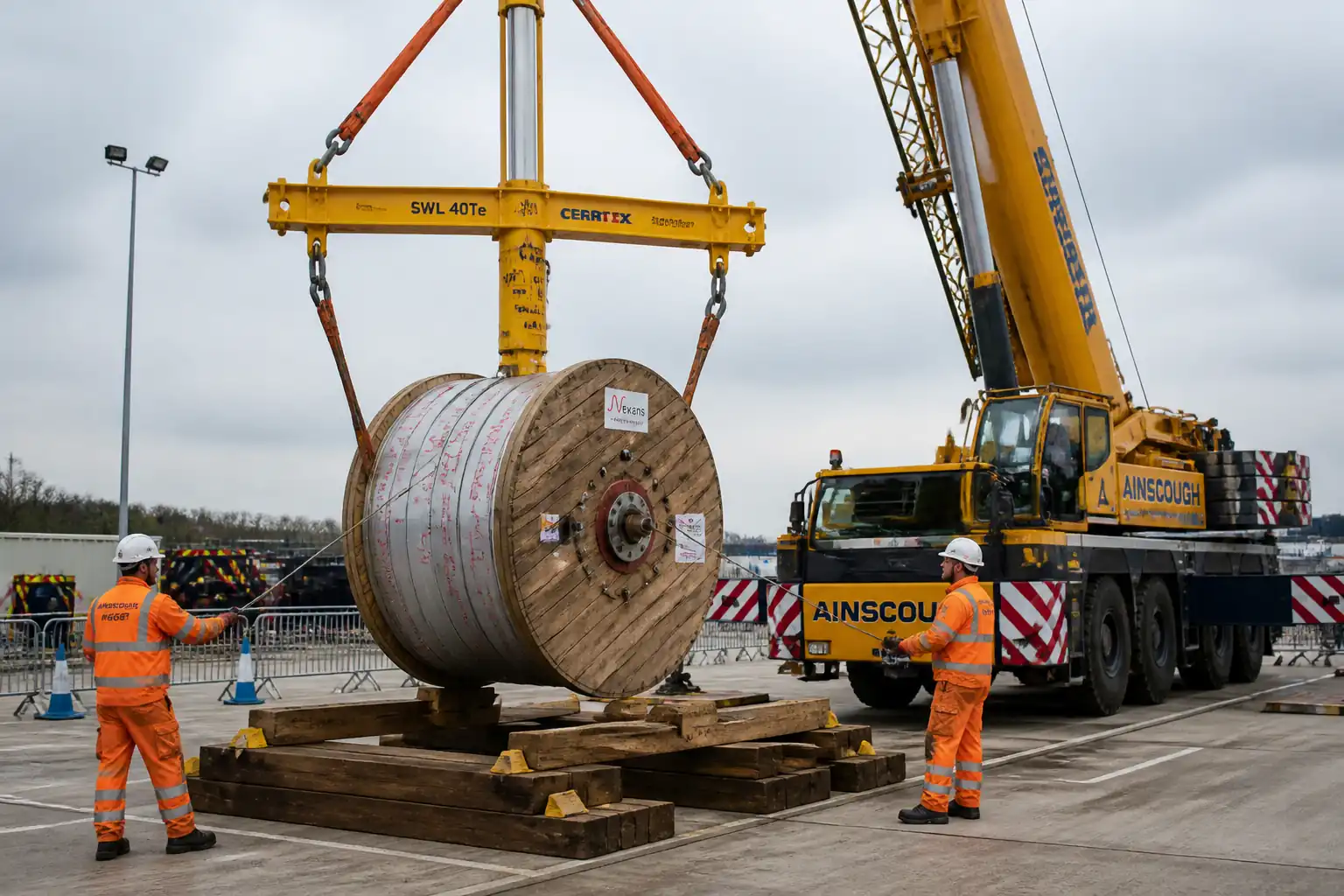

Inspection and Test Plan for Method Statement: High‑Voltage Cable Drum Delivery, Unloading, and Yard Storage
AI-assisted inspection and test plan connected to a method statement, with PDF and Excel export.
More than a static template
Unlike a downloadable Word or PDF template, this ITP is an AI-assisted editable starting point directly connected to its method statement. Every inspection activity, hold point, and acceptance criterion is structured and ready to adapt to your project.
- AI-assisted customization — Tailor inspection activities and acceptance criteria to your specific project scope.
- Linked method statement — This ITP is connected to the corresponding method statement describing the work sequence.
- Multiple export formats — Download as a formatted PDF or editable Excel spreadsheet.
- Editable starting point, not a final document — Review and verify all content against your project specifications and standards before use.
What you can customize
When you save this ITP to your account, every inspection row becomes editable. You can add, remove, or modify:
- Inspection activity — Description of what is being inspected.
- Inspection type — Hold point (H), Witness point (W), Review (R), or Monitor (M).
- Responsibility — Contractor, subcontractor, engineer, or client.
- Frequency — How often the inspection occurs.
- Acceptance criteria — Referenced standard or specification requirement.
- Records — Forms, test reports, or checklists required as evidence.
Why this ITP is used
To ensure all drums are safely received, unloaded, and stored without damage or moisture ingress, in compliance with standards and OEM guidance.
Who uses this inspection and test plan
Lifting team, QA/QC, Storekeeper, HSE, and the Engineer/Employer’s Representative for witnessing and approvals.
When this ITP is prepared and submitted
At delivery, during unloading, at placement into storage, and during periodic storage inspections until installation.
Who receives or approves this ITP
The ITP is usually submitted to the client representative, consultant, resident engineer, or project management consultant for review and approval before the related work activity starts.
Inspection scope
Document verification, mechanical condition of drums, seal integrity, rigging checks, controlled lifts and landings, storage placement, protection, and periodic inspections.
Typical hold, witness, and review points
First-of-kind drum inspection and unloading; nonconformance disposition and release from quarantine as required by Engineer.
Typical inspection records
Checklists, inspection reports with photos, lifting logs, storage registers, NCRs, and calibration/certification documents.
Important approval note
This ITP is an AI-assisted editable starting point, not a pre-approved document. Before use on any project, all inspection activities, hold points, and acceptance criteria must be reviewed and approved by the relevant parties (superintendent, principal contractor, or client representative) in accordance with your contract and project quality plan.
Always verify acceptance criteria against your applicable drawings, specifications, and regulatory requirements. Hold points must be confirmed with the relevant authority before work proceeds past that point.
Inspection and test plan
| Activity | Inspection / Test | Acceptance Criteria | Responsibility | Record |
|---|---|---|---|---|
| Pre-delivery document verification | Review delivery note, cable/drum data sheets, lifting certificates, and Lift Plan | Documents complete, valid, and consistent; WLLs adequate with safety factors [Verify] | QA/QC / Appointed Person | Pre-delivery checklist |
| Yard readiness check | Inspect storage bay level, sleepers, wedges, drainage, and exclusion setup | Slope ≤ 1:60; sleepers and wedges available; traffic control in place | Lifting Supervisor / QA/QC | Yard readiness form |
| Drum identification and labeling | Match drum ID to packing list; apply site ID and bay code | 100% match; labels legible and weatherproof | Storekeeper / QA/QC | Drum register |
| Drum mechanical condition inspection (on trailer) | Visual/measurement of flanges, rim dents, warp, bolts, barrel/core | No through-cracks; no missing bolts; warp ≤ 1% of D or 10 mm; rim dents ≤ 5% t or 10 mm [Verify] | QA/QC | Drum inspection report with photos |
| End-cap seal integrity check | Visual/tactile check; moisture indicator (if fitted) | Caps intact; seals continuous; no moisture evidence; reseal protocol enacted within 2 h if compromised | QA/QC | Seal checklist; NCR if required |
| Rigging pre-use inspection | Check crane, spreader, shaft, slings, shackles; configuration vs plan | Certificates in date; gear defect-free; WLL ≥ factored load; sling angle ≥ 60° [Verify] | Lifting Supervisor / Riggers | Rigging checklist; certificates |
| Test lift and unloading | Controlled 100–200 mm test lift; monitor balance/swing; land on sleepers | Balanced; no flange contact; within wind limits; exclusion zone enforced | Crane Operator / Banksman / QA-QC | Lifting log; photos |
| Placement and chocking in storage bay | Level check; wedge seating; label visibility | Axis horizontal within ±1°; ≥ 2 wedges per side; sleepers fully bearing | Storekeeper / QA/QC | Storage placement record |
| Weather protection verification | Cover installed and secured; ventilation maintained | Breathable cover fitted; no sharp edges; no water traps | Storekeeper / QA/QC | Storage checklist |
| Periodic storage inspection | Weekly visual; monthly detailed; rotation logged if >3 months | Supports stable; seals intact; no deterioration; rotations recorded | Storekeeper / QA/QC | Periodic inspection log |
| Nonconformance control | Issue NCR; agree disposition; verify closure | Disposition approved by Engineer/Supplier; corrective actions completed | QA/QC | NCR and closure report |
This table is a read-only public reference. Download the PDF or Excel version, or customize this ITP to edit it for your project.
Frequently asked questions
Related method statement
This Inspection and Test Plan is associated with the Method Statement: High‑Voltage Cable Drum Delivery, Unloading, and Yard Storage method statement, which describes the step-by-step construction sequence, resources, materials, equipment, safety controls, and environmental controls for this activity.
View the Method Statement: High‑Voltage Cable Drum Delivery, Unloading, and Yard Storage method statement →