
Method Statement: Chlorination and Disinfection of New Potable Water Mains – Method Statement
AI-assisted method statement with matching ITP, PDF download, and Excel export.
More than a static template
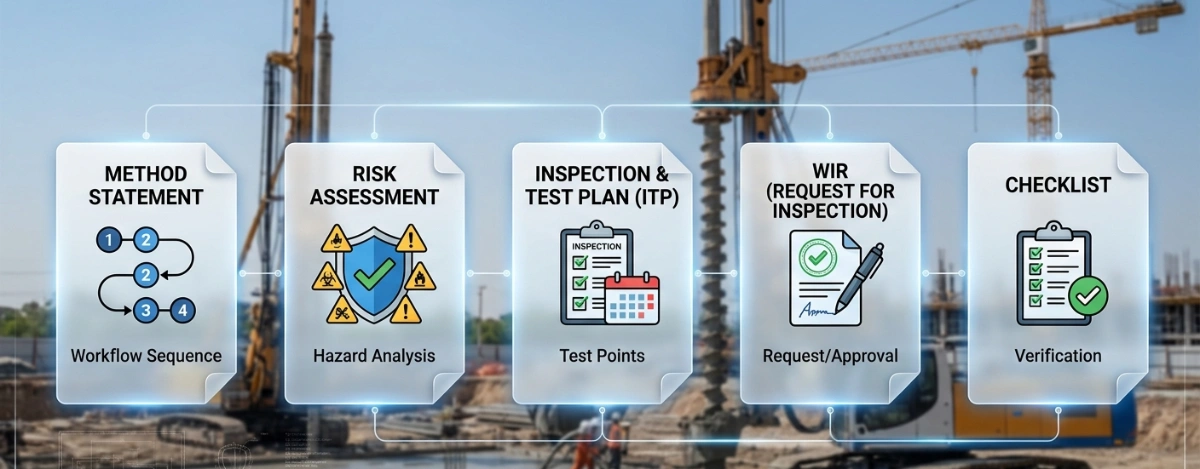
Unlike a downloadable Word or PDF template, this method statement is an AI-assisted editable starting point connected directly to a matching Inspection and Test Plan. Every section is structured, project-adaptable, and ready to export.
- AI-assisted drafting — Customize every section with AI for your specific project scope.
- Linked ITP — A matching inspection and test plan is generated alongside the method statement.
- Multiple export formats — Download as a formatted PDF or editable Excel spreadsheet.
- Editable starting point, not a final document — Review, verify, and adjust all content against your project requirements before use.
Static template vs. Quollnet workflow
| Feature | Static template | Quollnet |
|---|---|---|
| Project-specific content | Manual fill-in required | AI-assisted customization |
| Linked ITP | Separate document, no link | Matching ITP included |
| Export formats | Usually PDF only | PDF and Excel |
| Structured sections | Free-form layout | 13 standardized sections |
| Saved to your account | Local file only | Cloud-saved, reusable |
| Content accuracy | You verify everything | AI-assisted, you still verify |
| Cost | Often free but time-intensive | Free to customize and download |
What you can customize
When you save this method statement to your account, every section becomes editable. The following 13 sections are included:
- Scope — Defines the activity and its boundaries.
- References — Standards, specifications, and drawings.
- Responsibilities — Roles and accountabilities.
- Resources — Labour, plant, and equipment summary.
- Materials — Materials and compliance requirements.
- Equipment — Tools and equipment details.
- Prerequisites — Hold points and pre-conditions.
- Method sequence — Step-by-step construction sequence.
- Safety controls — HSE risk controls and PPE.
- Environmental controls — Environmental mitigation measures.
- QA/QC — Quality inspection and test requirements.
- ITP — Inspection and Test Plan table (has its own page).
- Attachments — Referenced drawings and documentation.
Why this method statement is used
This method statement is used to define and communicate the approved procedure for carrying out method statement: chlorination and disinfection of new potable water mains on site. It ensures the work is planned in advance, the correct resources and controls are in place, and all personnel understand responsibilities, sequence, quality requirements, and safety controls before work begins. It aligns site execution with the documented scope and acceptance expectations.
Who uses this method statement
This method statement is used by contractors, site supervisors, project engineers, QA/QC engineers, HSE officers, consultants, and client representatives. It serves as a shared reference for planning, execution, supervision, inspection, and approval of the activity on site.
When it is prepared and submitted
The method statement is prepared before the work activity starts and submitted as part of the pre-construction documentation package for review and approval.
Who reviews or approves it
The method statement is usually submitted to the client representative, consultant, resident engineer, or project management consultant for review and approval before the work commences.
Important approval note
This method statement is an AI-assisted editable starting point, not a pre-approved document. Before use on any project, all content must be reviewed and approved by the relevant parties (superintendent, principal contractor, or client representative) in accordance with your contract and project quality plan.
For example: if your specification requires a departure from a referenced standard, that departure must be documented and approved separately — this method statement will not capture that automatically. Always verify against your applicable drawings, specifications, and regulatory requirements.
Method statement content
Scope
Overview
This method statement covers the complete procedure to disinfect newly installed potable water mains prior to connection to the live distribution network. It includes preparatory verifications, dosing calculations, application of disinfectant (continuous-feed method as primary approach), contact time control, free chlorine residual measurements, high-velocity flushing, dechlorination of discharge, bacteriological sampling and analysis, acceptance criteria, and documentation.
Included Activities
- Verification of main readiness (pressure testing, cleanliness, isolation and backflow prevention).
- Calculation of pipeline volume and disinfectant dosage.
- Chlorination by continuous feed (primary), with guidance on slug or tablet methods where specifically required. [Verify per project specifications]
- Contact time management and residual chlorine monitoring.
- Controlled initial discharge and dechlorination.
- High-velocity flushing and stabilization to target network residual.
- Bacteriological sampling, transport, analysis, and acceptance.
- Documentation and approvals prior to tie-in to live network.
Exclusions
- Pipe laying and hydrostatic pressure testing (performed under separate method statements but verified as prerequisites here).
- Permanent tie-in works (separate method; localized swabbing/disinfection at connection point is included here).
References
| Document Type | Reference / Number | Revision | Notes |
|---|---|---|---|
| AWWA C651 – Disinfecting Water Mains | Primary international guidance for disinfecting newly constructed potable water mains. [Verify latest edition] | ||
| BS EN 805 – Water supply requirements for systems and components outside buildings | General requirements for water supply systems including testing, disinfection, and commissioning. [Verify applicable clauses] | ||
| ISO 7393-2 – Water quality—Determination of free chlorine and total chlorine—Colorimetric DPD method | Method for measuring free/total chlorine residuals on site and in laboratory. | ||
| ISO 19458 – Water quality—Sampling for microbiological analysis | Sampling strategy, sample handling, and transport for microbiological tests. | ||
| ISO 9308-1 – Water quality—Enumeration of Escherichia coli and coliform bacteria—Membrane filtration method for waters with low bacterial background flora | Accept/Reject criteria for bacteriological clearance (0 CFU/100 mL for E. coli and coliform). [Verify with authority] | ||
| ISO 6222 – Water quality—Enumeration of culturable microorganisms—Colony count by inoculation in a nutrient agar culture medium | Heterotrophic plate count (HPC) reference. [Verify acceptance limit per authority] | ||
| APHA Standard Methods for the Examination of Water and Wastewater, Method 4500-Cl G (DPD Colorimetric) | Alternative reference method for chlorine residual testing. | ||
| Project Specifications and Water Authority Requirements | Overrides typical values; defines specific doses, contact time, sampling number/locations, and acceptance. [Verify per project specifications] |
Responsibilities
| Role | Responsibility | Name / Party |
|---|---|---|
| Project Manager | Project Manager | Contractor |
| Engineer | Site/Commissioning Engineer | Contractor |
| QA/QC | QA/QC Engineer | Contractor |
| HSE | HSE Manager / Officer | Contractor |
| Technician | Chlorination Specialist / Technician | Contractor |
| Laboratory | Licensed Laboratory | Third Party |
| Authority/Engineer | Water Authority / Engineer’s Representative | Client |
Resources (Crew)
| Resource Type | Description | Quantity | Remarks |
|---|---|---|---|
| Personnel | 1 | Leads field execution and documentation. | |
| Personnel | 2 | Dosing, testing, monitoring. | |
| Personnel | 2 | Temporary connections, backflow device installation, hydrant/blow-off setup. | |
| Personnel | 1 | HSE compliance, permits, monitoring. | |
| Personnel | 2-3 | Hose handling, valve operation, housekeeping. |
Materials
| Material | Specification / Grade | Quantity | Remarks |
|---|---|---|---|
| Sodium hypochlorite (NaOCl) solution | Typically 10–12.5% w/w available chlorine [Verify per project specifications] | As calculated | |
| Sodium thiosulfate (Na2S2O3) or ascorbic acid | Granular or solution, food/technical grade suitable for potable systems | As required | |
| Sterile microbiological sample bottles | ISO 19458 compliant, 250–500 mL, sodium thiosulfate-dosed | Per sampling plan | |
| Field test reagents and standards | ISO 7393-2 DPD; 0–5 mg/L and 0–10 mg/L ranges | Consumables |
Equipment
| Equipment | Capacity / Type | Quantity | Inspection Required |
|---|---|---|---|
| Chemical dosing pump (sodium hypochlorite compatible) | 0–20 L/h or as required [Verify] | 1 | Yes |
| Temporary fill assembly with backflow prevention | Sized per required flow [Verify] | 1 | Yes |
| Flow meter | 0–50 L/s range [Verify] | 1 | Yes |
| Portable chlorine residual meter | 0–10 mg/L, resolution 0.01 mg/L | 1 | Yes |
| Portable pH meter | pH 0–14, ±0.1 accuracy | 1 | Yes |
| Turbidity meter | 0–10 NTU, ±0.1 NTU | 1 | Yes |
| Flushing and discharge setup | To safely discharge ≥ design flushing flow | As required | Yes |
| Survey tools / GIS | 1 |
Prerequisites
- Hydrostatic pressure test passed, no leakage, and witnessed/approved. Record: Pressure Test Certificate. [Verify per project specifications]
- Pipeline mechanically cleaned (pig/swab if specified), gross debris removed; initial flush with potable water completed.
- All new mains isolated from live network with physical air gaps or closed, locked valves and end caps/blinds installed at tie-in points.
- Approved method statement, risk assessment, and permits to work in place (including chemical handling and discharge permits). [Verify per project HSE plan and local regulations]
- Calibrations for chlorine, pH, turbidity meters within validity; certificates available.
- Backflow prevention device installed and tested on temporary fill line.
- Water Authority notified; inspection/witness schedule agreed.
- Discharge point identified; dechlorination method and receiving body acceptance confirmed (target ≤0.1 mg/L total residual chlorine at discharge). [Verify per authority/permit]
- Traffic and public interface plan for flushing locations.
- Weather and lighting suitable; spill response kit available.
- Sampling plan finalized (locations: extremities, dead-ends, representative points; number of sets typically 2 on consecutive days [Verify per authority]).
Method Sequence
| Step | Activity | Description | Responsibility | Inspection / Hold Point |
|---|---|---|---|---|
| 1 | Confirm readiness and isolate main | Verify test certificates, cleanliness, valve alignment, and end caps. Install and test backflow prevention on fill line. Erect signage and barriers at hydrants/blow-offs. | Commissioning Engineer | Pre-start checklist; Authority hold point if required |
| 2 | Calculate pipeline volume | Determine internal volume V = Σ(π × (ID/2)^2 × length) for each pipe size/segment including appurtenances. Confirm IDs from as-builts/manufacturer data. | Commissioning Engineer | Independent check by QA/QC |
| 3 | Select target dose and contact time | Adopt method per spec. Typical benchmarks (AWWA C651): Continuous-feed initial free chlorine 25–50 mg/L with 24 h contact; or 50 mg/L for 8–12 h; or slug method ~100 mg/L for ≥3 h. Choose based on project/authority. [Verify per project specifications] | Project Manager/Authority | Hold point for Authority approval |
| 4 | Compute chemical requirement | Required chlorine mass (g) = V(L) × C_target(mg/L) ÷ 1000. Required NaOCl volume (L) = [V × C_target] ÷ [1000 × (Avail_Cl_fraction × solution_density kg/L × 1000 g/kg)]. Example factors: 12% w/w, density ≈1.20 kg/L ⇒ available chlorine ≈144 g/L. Include safety factor ≤10% max. [Verify] | Commissioning Engineer | QA/QC check |
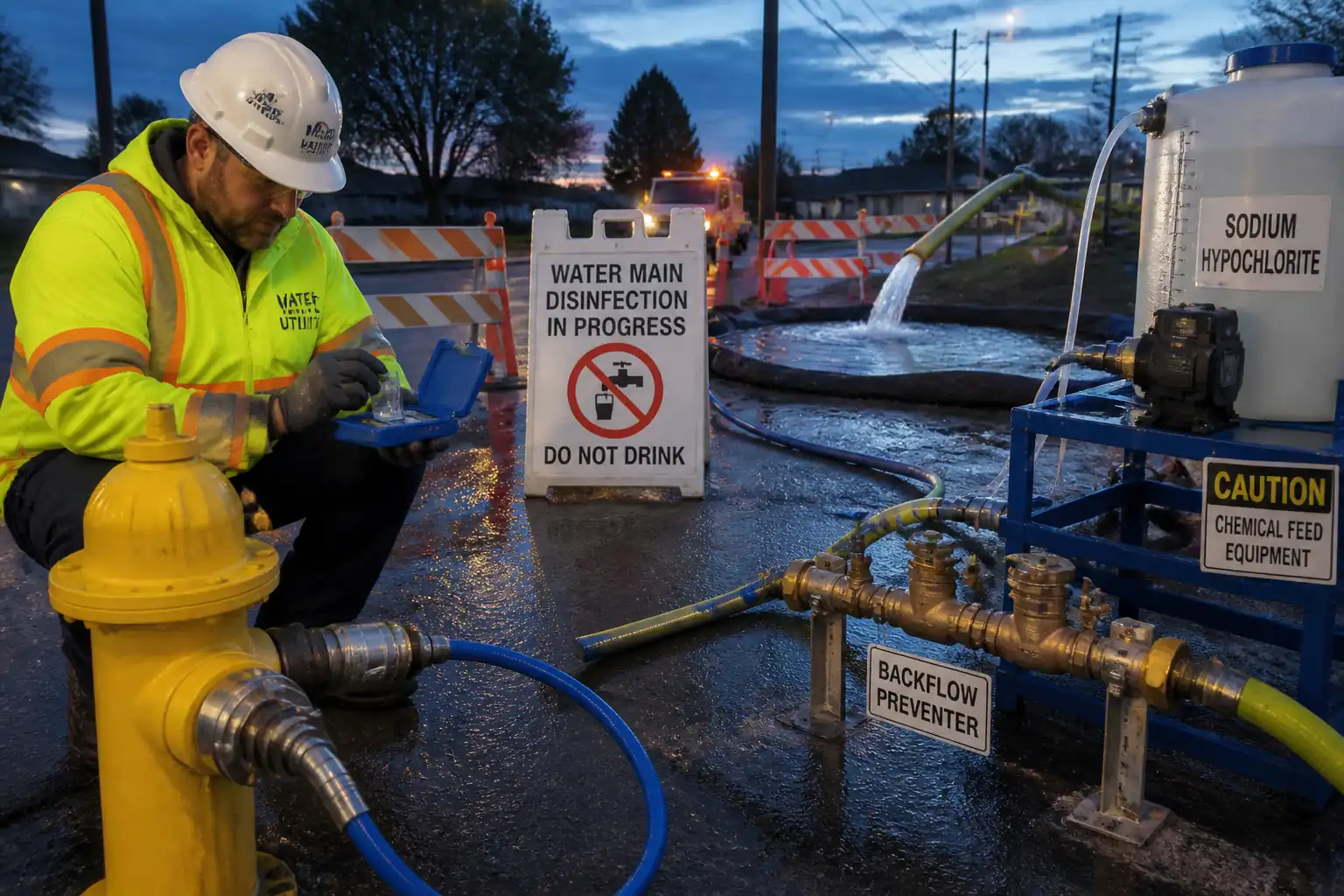
| 5 | Set up dosing and fill | Connect temporary fill to potable source with RPZ/DCVA. Start filling main while injecting NaOCl solution via dosing pump to achieve target initial residual at downstream sampling taps. Vent air; operate valves to ensure full penetration to extremities. | Chlorination Technician | Witness point |
| 6 | Contact time monitoring | Isolate main to hold disinfectant. Maintain contact time per approved plan. Measure free chlorine using DPD at minimum: start, every 200–300 m, at all dead ends, and at least every 60 minutes during first 3 hours, then every 2–4 hours. Record pH and temperature. | Chlorination Technician | Routine checks; Engineer review |
| 7 | Initial discharge and dechlorination | Discharge chlorinated water to designated point through diffuser/neutralization system. Apply sodium thiosulfate/ascorbic acid as needed. Confirm total residual chlorine at discharge ≤0.1 mg/L and pH within 6.5–8.5. | Chlorination Technician | Environmental permit check; HSE supervision |
| 8 | High-velocity flushing and stabilization | Flush with potable water to achieve velocity ≥1.0–1.5 m/s [Verify]. Compute Q = v × A. Continue until turbidity <1.0 NTU (target ≤0.5), water is clear, and free chlorine stabilizes to network residual (typically 0.2–1.0 mg/L) without taste/odor issues. | Commissioning Engineer | Witness point at start and completion |
| 9 | Bacteriological sampling | Collect samples at extremities, dead-ends, and representative mid-points after stabilization. Use sterile thiosulfate-dosed bottles; flame/cleanse taps; run to clear; avoid aerators. Maintain chain-of-custody; store at 2–8°C; deliver to lab within ≤6 hours [Verify]. | QA/QC Engineer / Lab Courier | Witness by Authority if required |
| 10 | Assessment and re-disinfection (if needed) | If any sample fails, identify cause (stagnation, intrusion, inadequate contact) and repeat disinfection: re-flush or re-chlorinate per authority direction. Investigate for ingress/defects. | Project Manager/Engineer | Review NCR/CAR |
| 11 | Approval to connect and tie-in hygiene | Submit complete dossier. Upon approval, disinfect tie-in components (1% NaOCl swab/spray), maintain positive pressure/flush during cut-in as permitted. Avoid contamination during connection. | Project Manager / Commissioning Engineer | Authority hold point before tie-in |
| 12 | Demobilize and handover | Remove temporary works, restore site, close permits, and submit as-built quality records and chemical usage log. | Project Manager | Final inspection |
Safety Controls (Task-Specific)
Key Hazards and Controls
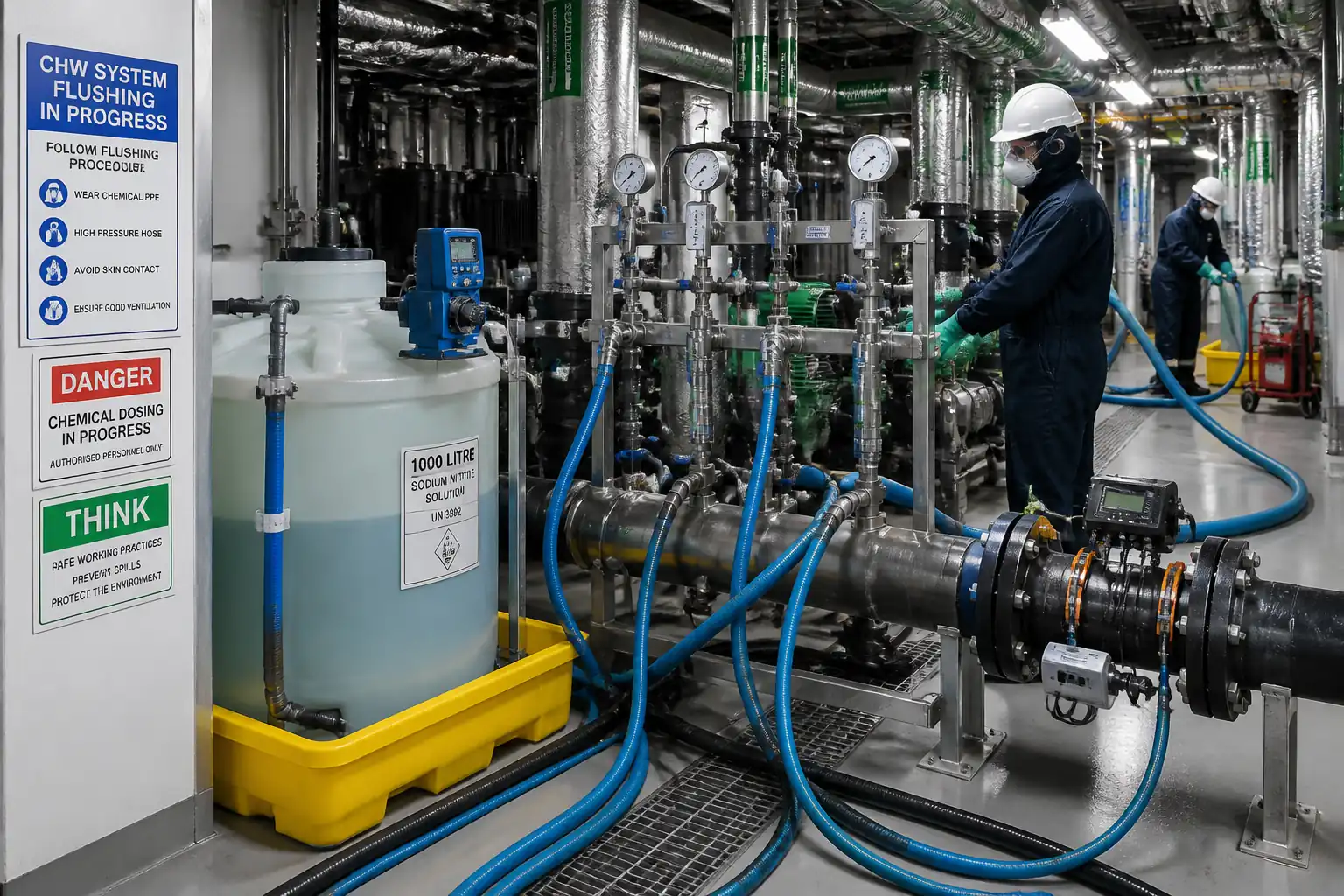
- Chemical exposure (sodium hypochlorite)
- Consequence: Skin/eye burns, respiratory irritation, chlorine gas release if mixed with acids.
- Engineering/procedural control: Use closed transfer, dilution in well-ventilated area; never mix with acids/ammonia; eyewash/shower within 10 m; SDS on site; decant using pumps/funnels only.
- Required PPE: Chemical goggles + face shield, chemical-resistant gloves (nitrile/neoprene), acid-alkali apron, long sleeves, safety boots.
- Collective measure: Spill containment trays; dedicated chemical handling zone with signage.
-
Inspection/permit/supervision: Chemical handling permit; HSE officer present; container labels/expiry verified. [Verify per project HSE plan and local regulations]
-
Pressurized water release during flushing
- Consequence: Impact injuries, hose whip, flooding.
- Control: Secure hoses with restraints and clamps; staged valve opening; verify discharge capacity; keep public clear with barriers.
- PPE: Hard hat, eye protection, gloves, safety boots, high-vis.
- Collective: Barriers and exclusion zones at hydrants/blow-offs; jet deflectors/diffusers.
-
Inspection/permit: Pre-flush line walk; toolbox talk; supervisor control of valves.
-
Confined spaces (valve chambers, pits)
- Consequence: Asphyxiation, toxic exposure, falls.
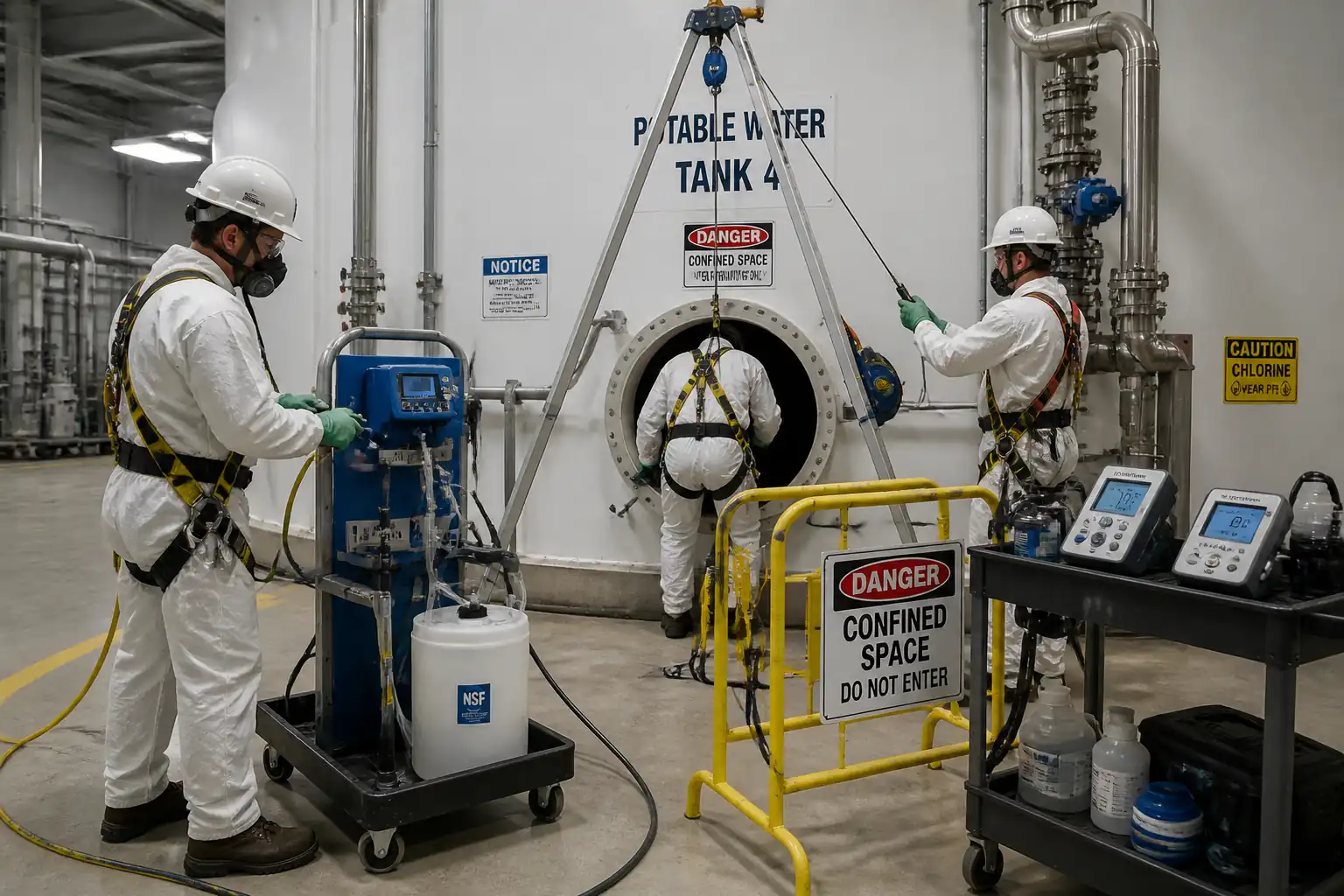
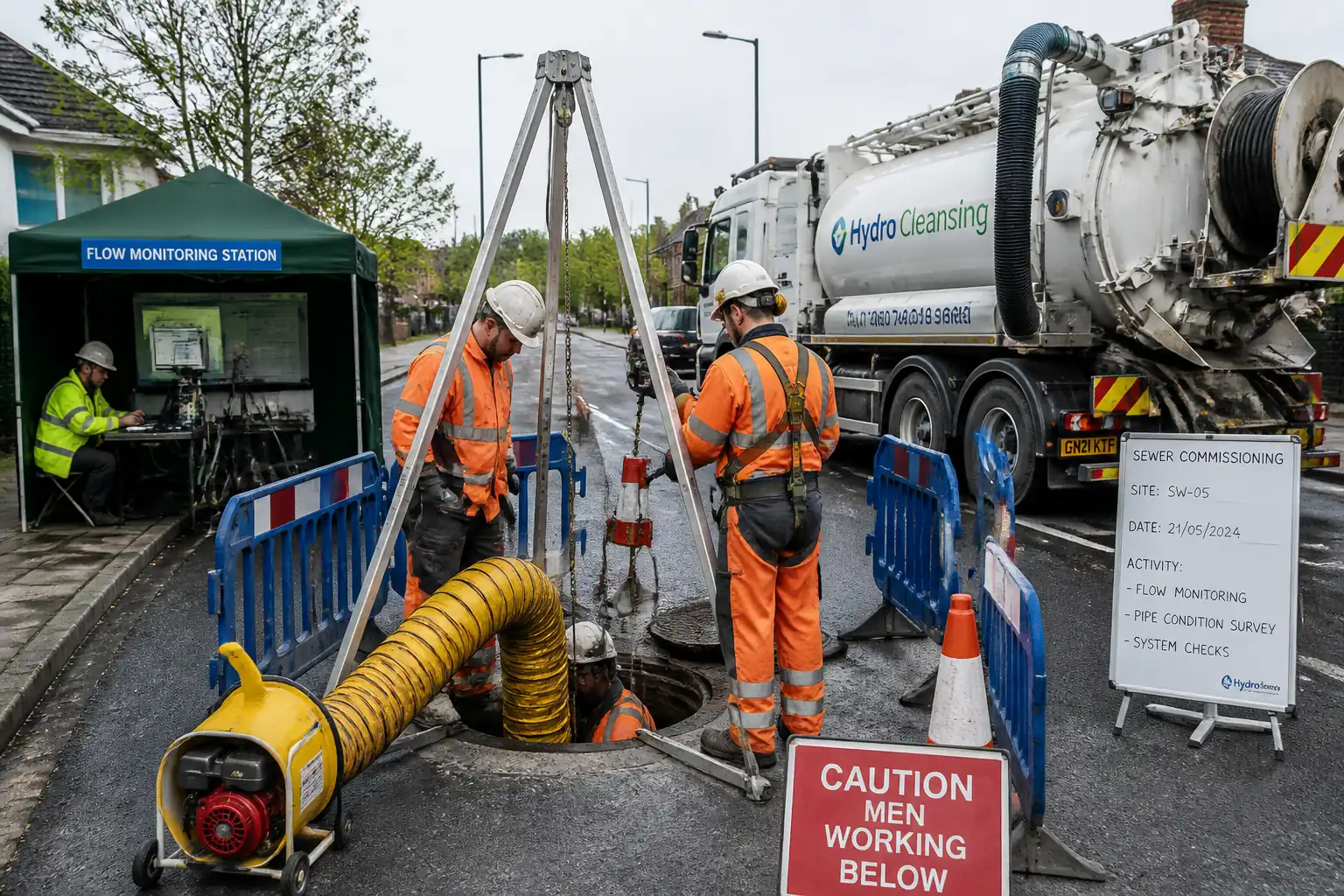
- Control: Avoid entry where possible; if entry required, treat as confined space with gas testing, ventilation, entry permit, standby/rescue.
- PPE: Gas detector, harness where required, helmet, gloves.
- Collective: Tripod/winch and rescue plan.
-
Inspection/permit: Confined space permit; competent entry supervisor.
-
Traffic interface at hydrants/discharge points
- Consequence: Vehicle-person collision.
- Control: Traffic Management Plan, cones/signs per local code, spotters.
- PPE: High-vis clothing class per road category, safety boots, helmet.
- Collective: Barriers, lighting for night work.
-
Inspection/permit: Approved TMP; daily inspection by Supervisor.
-
Environmental harm from chlorinated discharge
- Consequence: Aquatic toxicity, vegetation damage, regulatory breach.
- Control: Mandatory dechlorination, on-line TRC monitoring at discharge, neutralization tank/diffuser use.
- PPE: As standard plus chemical gloves for handling thiosulfate.
- Collective: Secondary containment; spill kits.
-
Inspection/permit: Discharge permit; environmental monitoring log.
-
Manual handling of chemical containers
- Consequence: Strains, dropped containers/spills.
- Control: Use trolleys; team lift; observe weight limits (<25 kg single lift [Verify]).
- PPE: Gloves, boots.
- Collective: Mechanical aids on vehicle.
-
Inspection/permit: Manual handling briefing.
-
Slips, trips, falls on wet surfaces
- Consequence: Injuries.
- Control: Keep routes clear; anti-slip mats; immediate housekeeping of spills.
- PPE: Slip-resistant boots.
- Collective: Barricade wet areas.
-
Inspection/permit: Supervisor inspections, housekeeping checklist.
-
Measurement chemicals/reagents
- Consequence: Minor chemical exposure; ingestion risk.
- Control: Use single-use DPD reagents; avoid mouth pipetting; wash stations.
- PPE: Gloves, goggles.
- Collective: Reagent waste container.
-
Inspection/permit: SDS availability; lab waste procedures.
-
COVID/biological hygiene at sampling
- Consequence: Illness transmission, sample contamination.
- Control: Hand hygiene, alcohol wipe taps, use sterile technique; avoid touching bottle rims.
- PPE: Gloves, mask as required by plan.
- Collective: Sanitizing kits.
- Inspection/permit: HSE monitoring; training records.
Environmental Controls
- Dechlorination: Neutralize all chlorinated effluent to ≤0.1 mg/L total residual chlorine before discharge to storm drains, waterways, or soil. Verify with on-site TRC testing at discharge point. [Verify per permit]
- Discharge management: Use diffusers/energy dissipation to prevent erosion and turbidity; route to approved points with sediment control (silt socks, sand bags) if necessary.
- Spill prevention: Secondary containment for chemical drums; keep drains protected (drain covers); spill kits with sodium thiosulfate for hypochlorite spills; report and record any spill per incident procedure.
- Waste management: Collect empty chemical containers for return or disposal per supplier/MSDS; segregate reagent sachets as lab waste.
- Water conservation: Optimize flushing by calculating flow and velocity; avoid unnecessary over-flushing; schedule to minimize service demand impacts.
- Noise and nuisance: Limit operations to permitted hours; use silencers on discharge where practicable; inform nearby stakeholders when hydrant flows are visible/audible.
- Documentation: Maintain Environmental Monitoring Log (TRC, pH, turbidity, flow rates, volumes). [Verify per project HSE plan and local regulations]
Quality Assurance / Quality Control
- Calibrations: Verify calibration status of chlorine meters, pH meters, turbidity meters (certificates within validity). Perform daily field verification with standards where applicable.
- Chemical verification: Obtain Certificates of Analysis for sodium hypochlorite (available chlorine %, trace metals) and sodium thiosulfate. Record batch numbers and expiry dates.
- Dosage calculation: Independent check by QA/QC; retain signed calculation sheets.
- Monitoring records: Maintain time-stamped logs for residual chlorine, pH, temperature, turbidity, flow, valve positions, and contact time start/finish.
- Sampling QA: Use sterile thiosulfate-dosed bottles; trip blanks and field duplicates at ≥10% of locations [Verify]; maintain chain-of-custody.
- Laboratory: Accredited to ISO/IEC 17025 for relevant methods or as accepted by Authority. Analysis per ISO 9308-1 and ISO 6222.
- Acceptance criteria (typical benchmarks; verify per project):
- End-of-contact free chlorine: ≥10–25 mg/L depending on method.
- Discharge TRC: ≤0.1 mg/L.
- Post-flush turbidity: <1.0 NTU (target ≤0.5 NTU).
- Network residual at sampling: 0.2–1.0 mg/L free chlorine.
- Microbiology: E. coli = 0 CFU/100 mL; coliforms = 0 CFU/100 mL; HPC within authority limit (e.g., ≤100–500 CFU/mL). [Verify]
- Records for handover: Method approvals, permits, calibration certs, COAs, logs, sampling plans, lab reports, photos, and Authority approval to connect.
Attachments
- Example dosage/volume calculation template (with density and available chlorine factors).
- SDS and COAs for sodium hypochlorite and sodium thiosulfate.
- Calibration certificates for field instruments.
- Sampling plan with locations, maps, and number of sets.
- Environmental discharge permit/approval and dechlorination method sheet.
- Pre-start checklist; monitoring log sheets (chlorine/pH/turbidity/flow/time); chain-of-custody form.
- Risk assessment and method statement approvals; Authority correspondence.
- As-built drawings of the new main including diameters, lengths, and appurtenances.
- Tie-in hygiene procedure and checklists.
This content is a read-only public reference. Download or customize to get an editable version.
ITP preview
The first inspection activities from the linked ITP for Method Statement: Chlorination and Disinfection of New Potable Water Mains:
| Activity | Inspection / Test | Acceptance Criteria | Responsibility | Record |
|---|---|---|---|---|
| Prerequisite verification | Check hydrostatic test certificate, cleanliness, isolation/backflow prevention | Certificates available and valid; physical isolation confirmed | QA/QC Engineer | Pre-Start Checklist; Test Certificate |
| Dosage calculation approval | Volume and chemical calculation | Signed-off calculation; inputs traceable to COA | Commissioning Engineer / QA/QC | Dosage Calculation Sheet |
| Instrument calibration check | Verification with standard solutions | Within instrument tolerance; certificates current | QA/QC Engineer | Calibration Certificates; Daily Check Log |
Showing 3 of 10 inspection activities. View full ITP →
Related Inspection and Test Plan
An Inspection and Test Plan (ITP) is available for Method Statement: Chlorination and Disinfection of New Potable Water Mains. The ITP defines the inspection activities, acceptance criteria, hold and witness points, responsible parties, and records required to verify the work described in this method statement.
View the Method Statement: Chlorination and Disinfection of New Potable Water Mains ITP →Frequently asked questions
Continue with related Quollnet resources connected to this method statement.