
Method Statement: Hydrostatic Pressure Testing of Water Mains – Method Statement
AI-assisted method statement with matching ITP, PDF download, and Excel export.
More than a static template
Unlike a downloadable Word or PDF template, this method statement is an AI-assisted editable starting point connected directly to a matching Inspection and Test Plan. Every section is structured, project-adaptable, and ready to export.
- AI-assisted drafting — Customize every section with AI for your specific project scope.
- Linked ITP — A matching inspection and test plan is generated alongside the method statement.
- Multiple export formats — Download as a formatted PDF or editable Excel spreadsheet.
- Editable starting point, not a final document — Review, verify, and adjust all content against your project requirements before use.
Static template vs. Quollnet workflow
| Feature | Static template | Quollnet |
|---|---|---|
| Project-specific content | Manual fill-in required | AI-assisted customization |
| Linked ITP | Separate document, no link | Matching ITP included |
| Export formats | Usually PDF only | PDF and Excel |
| Structured sections | Free-form layout | 13 standardized sections |
| Saved to your account | Local file only | Cloud-saved, reusable |
| Content accuracy | You verify everything | AI-assisted, you still verify |
| Cost | Often free but time-intensive | Free to customize and download |
What you can customize
When you save this method statement to your account, every section becomes editable. The following 13 sections are included:
- Scope — Defines the activity and its boundaries.
- References — Standards, specifications, and drawings.
- Responsibilities — Roles and accountabilities.
- Resources — Labour, plant, and equipment summary.
- Materials — Materials and compliance requirements.
- Equipment — Tools and equipment details.
- Prerequisites — Hold points and pre-conditions.
- Method sequence — Step-by-step construction sequence.
- Safety controls — HSE risk controls and PPE.
- Environmental controls — Environmental mitigation measures.
- QA/QC — Quality inspection and test requirements.
- ITP — Inspection and Test Plan table (has its own page).
- Attachments — Referenced drawings and documentation.
Why this method statement is used
This method statement is used to define and communicate the approved procedure for carrying out method statement: hydrostatic pressure testing of water mains on site. It ensures the work is planned in advance, the correct resources and controls are in place, and all personnel understand responsibilities, sequence, quality requirements, and safety controls before work begins. It aligns site execution with the documented scope and acceptance expectations.
Who uses this method statement
This method statement is used by contractors, site supervisors, project engineers, QA/QC engineers, HSE officers, consultants, and client representatives. It serves as a shared reference for planning, execution, supervision, inspection, and approval of the activity on site.
When it is prepared and submitted
The method statement is prepared before the work activity starts and submitted as part of the pre-construction documentation package for review and approval.
Who reviews or approves it
The method statement is usually submitted to the client representative, consultant, resident engineer, or project management consultant for review and approval before the work commences.
Important approval note
This method statement is an AI-assisted editable starting point, not a pre-approved document. Before use on any project, all content must be reviewed and approved by the relevant parties (superintendent, principal contractor, or client representative) in accordance with your contract and project quality plan.
For example: if your specification requires a departure from a referenced standard, that departure must be documented and approved separately — this method statement will not capture that automatically. Always verify against your applicable drawings, specifications, and regulatory requirements.
Method statement content
Scope
Purpose
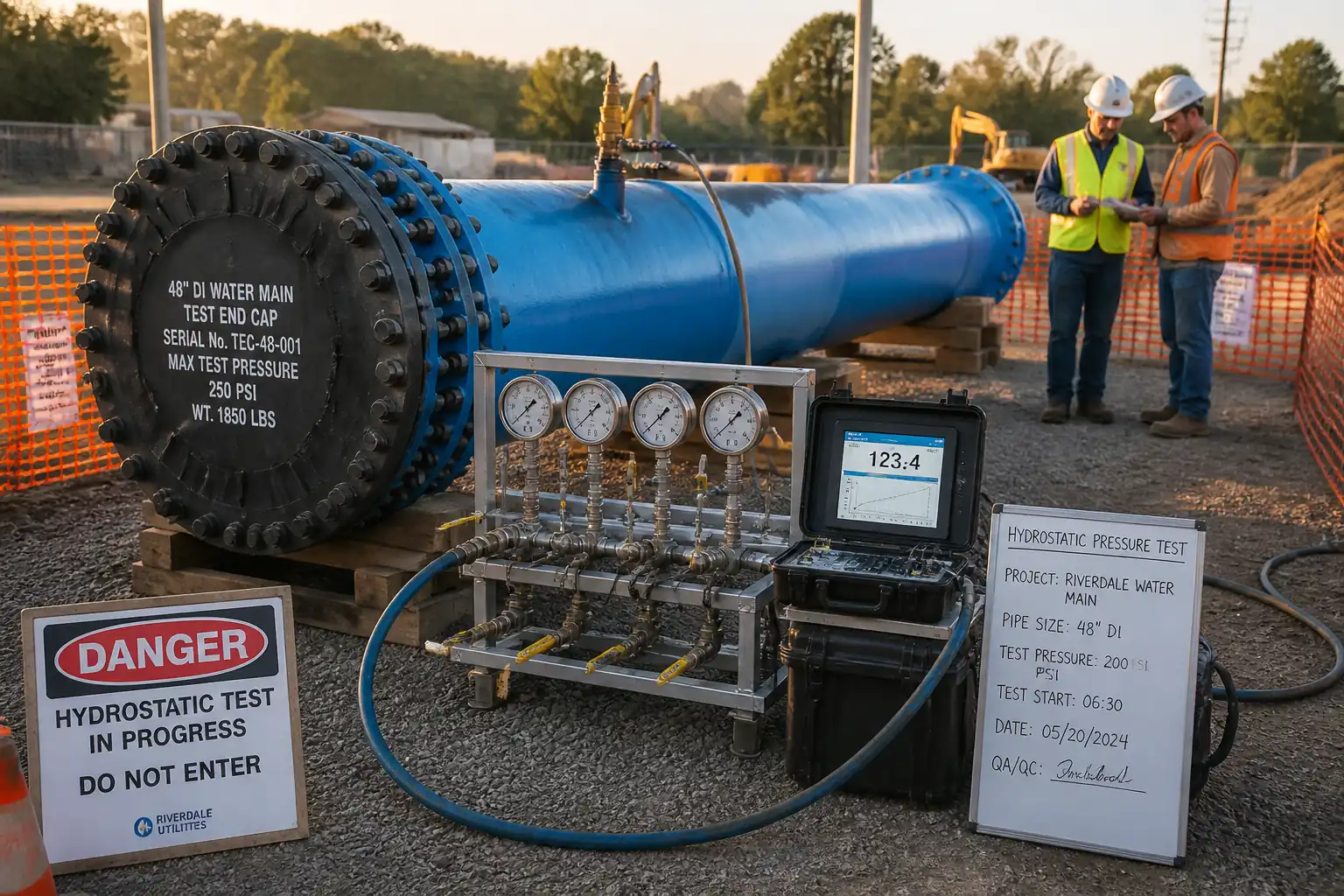
To define the procedure for hydrostatic pressure testing of newly installed water mains, including: controlled filling, air removal, staged pressurisation, pressure holding period, leakage measurement and calculation, data-logger recording, acceptance criteria, and Engineer hold/witness points.
Applicability
- Pipe materials: Ductile Iron (DI), Steel, PVC-U/OPVC, PE/HDPE. [Verify per project specifications]
- Diameters: DN100–DN2000+ [Verify per project specifications]
- Test sections: typically up to 1.0–1.5 km per section, depending on pipe class, restraint, and available water/energy. [Verify per project specifications]
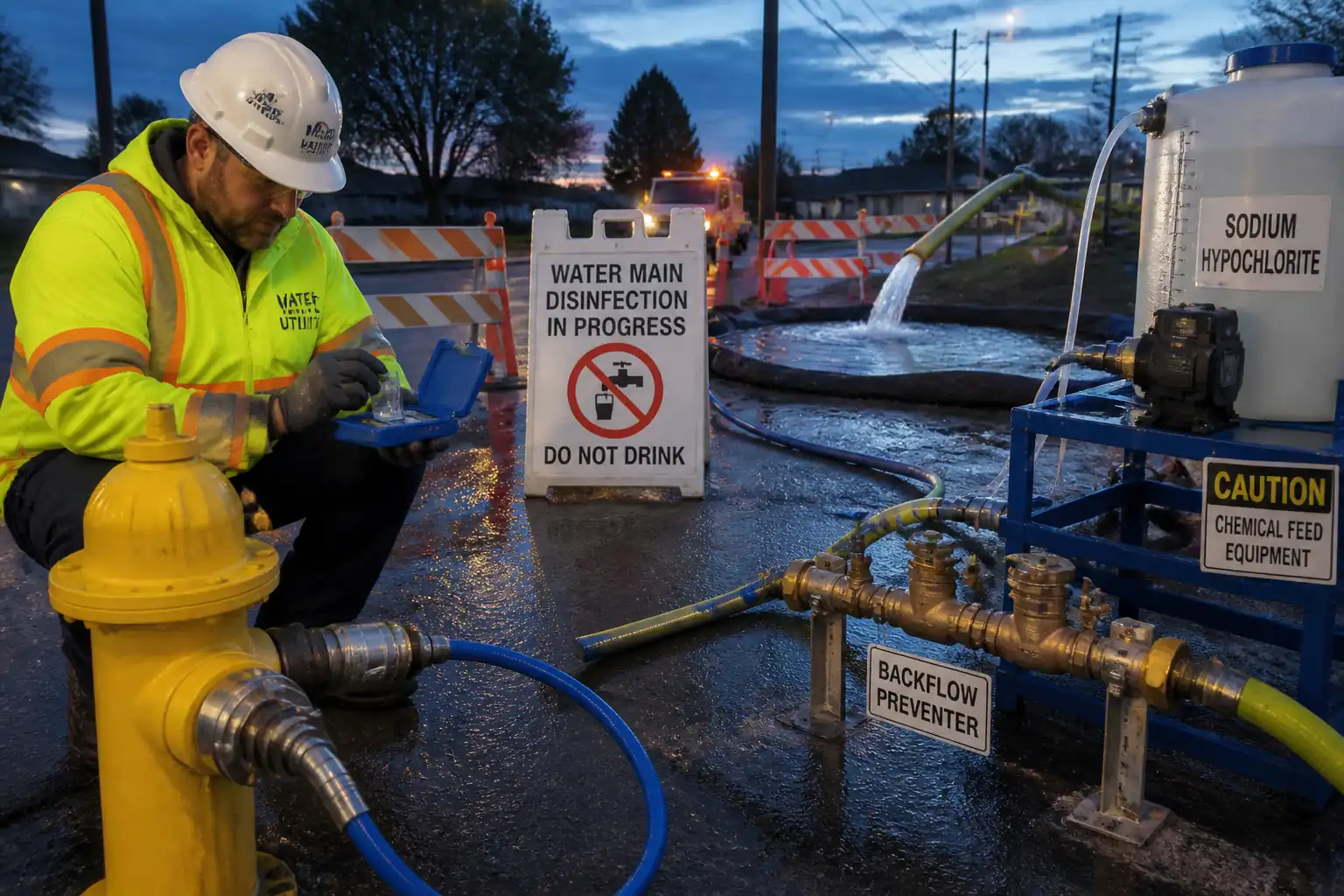
- Exclusions: This method does not cover final disinfection (AWWA C651/EN 805 hygiene) beyond necessary controls for test water handling.
Objectives
- Demonstrate pipeline structural integrity and tightness at specified test pressure.
- Confirm absence of visible leaks and that measured leakage is within allowable limits per governing standard and pipe material.
References
| Document Type | Reference / Number | Revision | Notes |
|---|---|---|---|
| Standard | AWWA C600 (latest) [Verify edition] | Allowable leakage formula and test procedures for DI. | |
| Standard | AWWA C605 (latest) [Verify edition] | PVC typically requires no detectable leakage during test period. | |
| Standard/Guideline | AWWA C906; PPI TR-46 [Verify per project] | Includes guidance for viscoelastic stabilization before tightness verification. | |
| Standard | EN 805 (latest) [Verify edition] | Strength and tightness test framework; acceptance parameters. | |
| Standard | ASME B40.100; ISO/IEC 17025 | Class 0.25–0.5% FS recommended; certificates traceable to national standards. | |
| Specification | Overrides where more stringent. | ||
| Regulation | [Verify per project HSE plan and local regulations] | Permits-to-Work, water discharge consents, traffic management. |
Responsibilities
| Role | Responsibility | Name / Party |
|---|---|---|
| PM | Approval/Resourcing | Contractor |
| CM | Coordination | Contractor |
| Supervisor | Execution/Technical Control | Contractor |
| QA/QC | Quality Control | Contractor |
| HSE | HSE Oversight | Contractor |
| Engineer | Hold/Witness/Acceptance | Employer/Engineer |
| Survey | Verification | Contractor |
Resources (Manpower)
| Resource Type | Description | Quantity | Remarks |
|---|---|---|---|
| Manpower | Leads test crew | 1 | |
| Manpower | Operates fill/pressure pump and manifolds | 2 | |
| Manpower | Install test ends, blinds, air valves, restraints | 4 | |
| Manpower | HSE controls and PTW | 1 | |
| Manpower | Inspection and records | 1 | |
| Manpower | Assist with heavy test heads and hose handling | 2 |
Materials & Consumables
| Material | Specification / Grade | Quantity | Remarks |
|---|---|---|---|
| Water | Meets potable supply quality [Verify] | As required | |
| Valves | PN equal/greater than test pressure | As required | |
| Steel/DI | Pressure rating ≥ 1.5 × test pressure [Verify] | Per test end | |
| PTFE | Potable-water compatible | As required | |
| Dechlorination chemical | Per authority discharge limits [Verify] | As required |
Equipment & Instruments
| Equipment | Capacity / Type | Quantity | Inspection Required |
|---|---|---|---|
| Pump | As calculated | 1 | Yes |
| Pump | As required | 1 | Yes |
| 2–3 | Yes | ||
| 1 set | Yes | ||
| 1 | Yes | ||
| Set | Yes | ||
| As required | Yes |
Prerequisites
- Approvals: Approved method statement, ITP, risk assessment, and permit-to-work. WIR for test section submitted to Engineer.
- Completion status: Pipe laying, jointing, and appurtenances in test section complete; thrust/anchor blocks cast and cured to ≥ 75% of design strength or minimum 3–7 days as specified [Verify per project specifications]. Backfill to at least 300 mm over the crown except at exposed joints/fittings for leak checks [Verify].
- Sectioning: Test ends installed with rated caps/blinds; all connections isolated; all valves in correct positions; temporary air-release valves at all local high points; bulkheads and caps fully restrained.
- Survey check: Confirm elevations to set test pressure at highest point; compute required test pressure at pump manifold accounting for static head.
- Utilities and access: Confirm safe access/egress; exclusion/barricade zones defined; equipment pads stable; traffic management in place if near roadways.
- Water source and discharge: Confirm clean water availability; discharge consent/route and treatment (dechlorination if applicable) approved.
- Instrumentation: Calibration certificates (≤6 months old or per QA plan) for gauges, transducers, flow meters; logger time synchronised.
- Weather: Avoid large diurnal temperature swings where practical; plan test in early morning/evening to reduce temperature-driven volume changes.
- Emergency plan: Burst/ejection response, isolation points, spill control, first aid, communication plan.
- Briefing: Toolbox talk covering high-pressure hazards, roles, and hold points. PPE issued and checked.
- Documentation: Pre-test checklist completed and submitted to Engineer for review prior to HP1 hold point.
Method Sequence
| Step | Activity | Description | Responsibility | Inspection / Hold Point |
|---|---|---|---|---|
| 1 | Pre-Test Inspection (HP1 – Hold Point, Engineer witness) | Verify test section completion, restraints, valve status, air valves installed, instrumentation calibrated/installed, water source/discharge approved, barricades in place. | Testing Supervisor / QA-QC / Engineer | Visual and document check |
| 2 | Initial Flushing/Cleaning | Flush from low point to achieve velocity ≥ 1.0 m/s until water runs clear and free of debris; use swabbing/pigging if specified. | Testing Supervisor | Visual clarity check; record flow/time |
| 3 | Controlled Filling & Air Removal | Fill from lowest point at ≤ 1 m/s; progressively vent air at all high points; keep vents open until steady water flow without spurting/air; tap and tilt appurtenances to release trapped air where safe. | Testing Supervisor | Monitor air valves and bleed points |
| 4 | Stabilisation/Soak | After filling and de-airing, raise to ~50% of target test pressure and hold 30–60 min; then to ~75% hold 30–60 min to seat gaskets/supports. For PE, allow additional creep/stabilisation 1–3 hours per PPI TR-46. [Verify per project specifications]. | Testing Supervisor | Data logger trend; check for weeps |
| 5 | Establish Test Pressure (HP2 – Witness) | Increase pressure gradually to specified test pressure at highest point of the section. Typical benchmark: 1.25 × maximum operating pressure (MOP) at highest point, minimum 10 bar (150 psi) for DI/steel; PVC/PE per manufacturer/standard. [Verify per project specifications]. Record exact setpoint and static head corrections. | Testing Supervisor | Engineer witness |
| 6 | Official Hold Period and Leakage Measurement | Start official hold (typically 2 hours for AWWA DI/steel; PVC often 2 hours with zero makeup; PE per PPI TR-46 stepped method). Maintain constant pressure by adding make-up water via calibrated device. Record total make-up volume at defined intervals (e.g., every 15 min) and continuously log pressure and temperature. Minimise temperature variation and vibration. | Testing Supervisor | Continuous monitoring |
| 7 | Post-Test Checks | After hold, isolate pumps; inspect full length for damp patches, exposed joints, fittings, chambers. Mark and document any defects. | Testing Supervisor | Walkdown |
| 8 | Depressurisation & Draining | Reduce pressure slowly via controlled bleed to avoid water hammer; drain to approved discharge point with flow control and dechlorination if required; protect receiving environment from erosion/siltation. | Testing Supervisor/HSE | Monitor discharge |
| 9 | Demobilisation & Restoration | Remove temporary valves, caps, manifolds; reinstate permanent appurtenances; restore backfill and surfaces; remove barricades after area is safe. | Construction Manager | Final check |
| 10 | Documentation & Acceptance (HP3 – Hold Point) | Compile and submit test report including pressure/temperature logs, make-up volumes, leakage calculations, calibration certificates, checklists, and signed witness sheets. Seek Engineer acceptance. | QA/QC Engineer | Engineer review |
Health, Safety and Environment (HSE) – Task-Specific Safety Controls
Principal Hazards and Controls
1) High-pressure water and component failure/ejection
- Consequence: Severe injury/fatality from plug/cap ejection or hose burst.
- Engineering/Procedural Control: Design and install mechanical restraints rated to thrust at test pressure; relief valve set at 1.1 × test pressure; exclude personnel from line-of-fire and 1.5 × pipe diameter danger arc at ends; staged pressurisation; pressure rise limited to ≤ 1 bar/min after 50% setpoint. Conduct inspections before increasing pressure.
- PPE: Hard hat, safety goggles/face shield, gloves, safety boots.
- Collective Measure: Barricades and signage; designated exclusion zones; remote monitoring where possible.
- Inspection/Permit: PTW for pressure testing; pre-use inspection of restraints, hoses, gauges; Engineer witness at HP1/HP2. [Verify per project HSE plan and local regulations]
2) Air entrapment leading to pressure surge
- Consequence: Water hammer, pipe/joint failure.
- Control: Comprehensive venting plan; open high-point air valves during fill; limit fill velocity ≤ 1 m/s; monitor data logger for spikes; do not isolate vents until steady water flow.
- PPE: As above.
- Collective: Supervisory control of vents; communication protocol during vent closure.
- Inspection/Permit: Supervisor sign-off of air removal checklist.
3) Working in/near open trenches and chambers
- Consequence: Falls, entrapment, drowning risk during fill/drain.
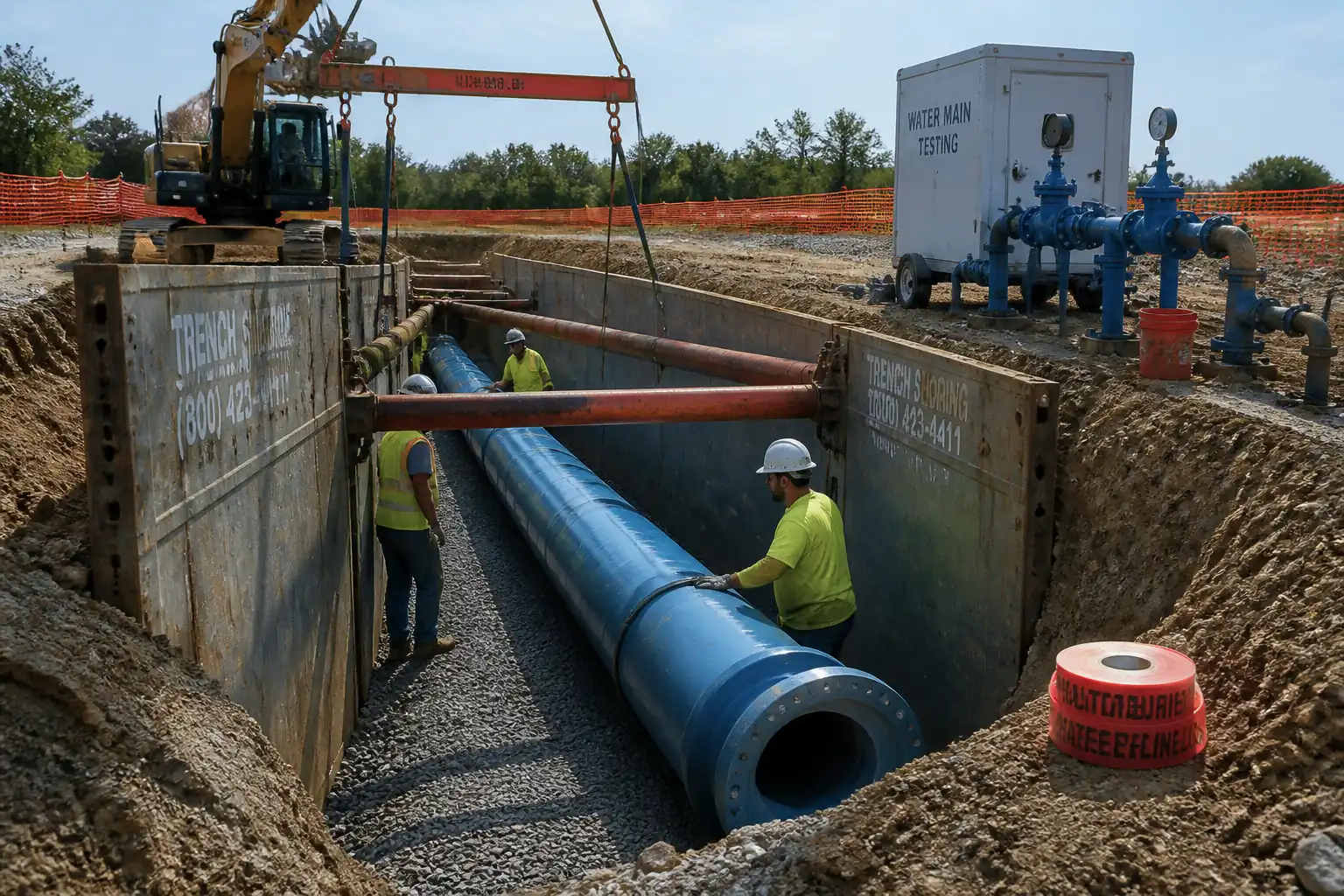
- Control: Edge protection, trench boxes/shoring; safe access ladders; never work in trench during pressurisation; water level control during drain-down.
- PPE: Helmet, hi-vis, boots; fall protection if required.
- Collective: Barricading/lighting; attendant/spotter.
- Inspection/Permit: Confined Space/PTW if entering chambers; daily excavation inspection.
4) Manual handling and lifting of test heads and hoses
- Consequence: Crush/strain injuries.
- Control: Use mechanical lifting with certified slings; plan lifts; use banksman; keep hands clear of pinch points.
- PPE: Gloves, boots.
- Collective: Exclusion during lifts.
- Inspection/Permit: Lifting plan and equipment certification.
5) Electrical and fuel hazards from pumps/generators
- Consequence: Shock, fire, fumes.
- Control: RCD-protected supplies; earth bonding; cable management; spill kits; fire extinguishers; ventilation for combustion engines.
- PPE: Gloves, eye protection, hearing protection.
- Collective: No smoking/hot works near fuel.
- Inspection/Permit: Electrical inspection; hot work permit if applicable.
6) Noise and vibration
- Consequence: Hearing damage, nuisance.
- Control: Maintain equipment; install acoustic screens if required; limit exposure time.
- PPE: Hearing protection (ear defenders/plugs).
- Collective: Schedule noisy works daytime; monitoring if required.
- Inspection/Permit: Noise assessment.
7) Environmental discharge
- Consequence: Flooding, erosion, chlorine release, siltation.
- Control: Approved discharge route; throttle valves/energy dissipation; silt socks/settlement tanks; dechlorination if water is chlorinated; flow rate limited to permitted value.
- PPE: Gloves, boots; eye protection.
- Collective: Bunding and slope protection.
- Inspection/Permit: Discharge consent; environmental inspection records.
8) Traffic interface
- Consequence: Struck-by incidents.
- Control: Traffic management plan; barriers; signage; spotters.
- PPE: Hi-vis, helmet.
- Collective: Segregated plant/pedestrian routes.
- Inspection/Permit: Traffic permit/approval.
Environmental Controls
- Water sourcing: Use metered potable supply or approved non-potable where permissible; avoid over-abstraction; record volumes.
- Discharge control: Obtain written approval; avoid discharge to sensitive receptors; use energy dissipaters and silt control. If water contains residual chlorine (e.g., post-disinfection), neutralise to below authority limit (typical <0.5 mg/L) using sodium thiosulfate or equivalent. [Verify per project requirements]
- Erosion/sediment: Use geotextile filters, stilling basins, or tanks; inspect receiving area for scour.
- Spills/leaks: Secondary containment for pumps/generators; spill kits on site; refuelling on impermeable surface.
- Noise/air: Maintain equipment; avoid night-time testing unless permitted; monitor as required.
- Waste: Collect and dispose of used swabs/pigs and consumables per waste plan.
- Documentation: Keep discharge logs, volumes, residual chlorine readings (if applicable), and environmental inspection checklists.
Quality Assurance and Quality Control
Test Pressure
- Set test pressure at the highest point of the test section as specified. Typical benchmark for DI/steel: 1.25 × MOP; minimum 10 bar (150 psi). PVC/PE as per AWWA C605/C906 or manufacturer. [Verify per project specifications]
Instrumentation and Data
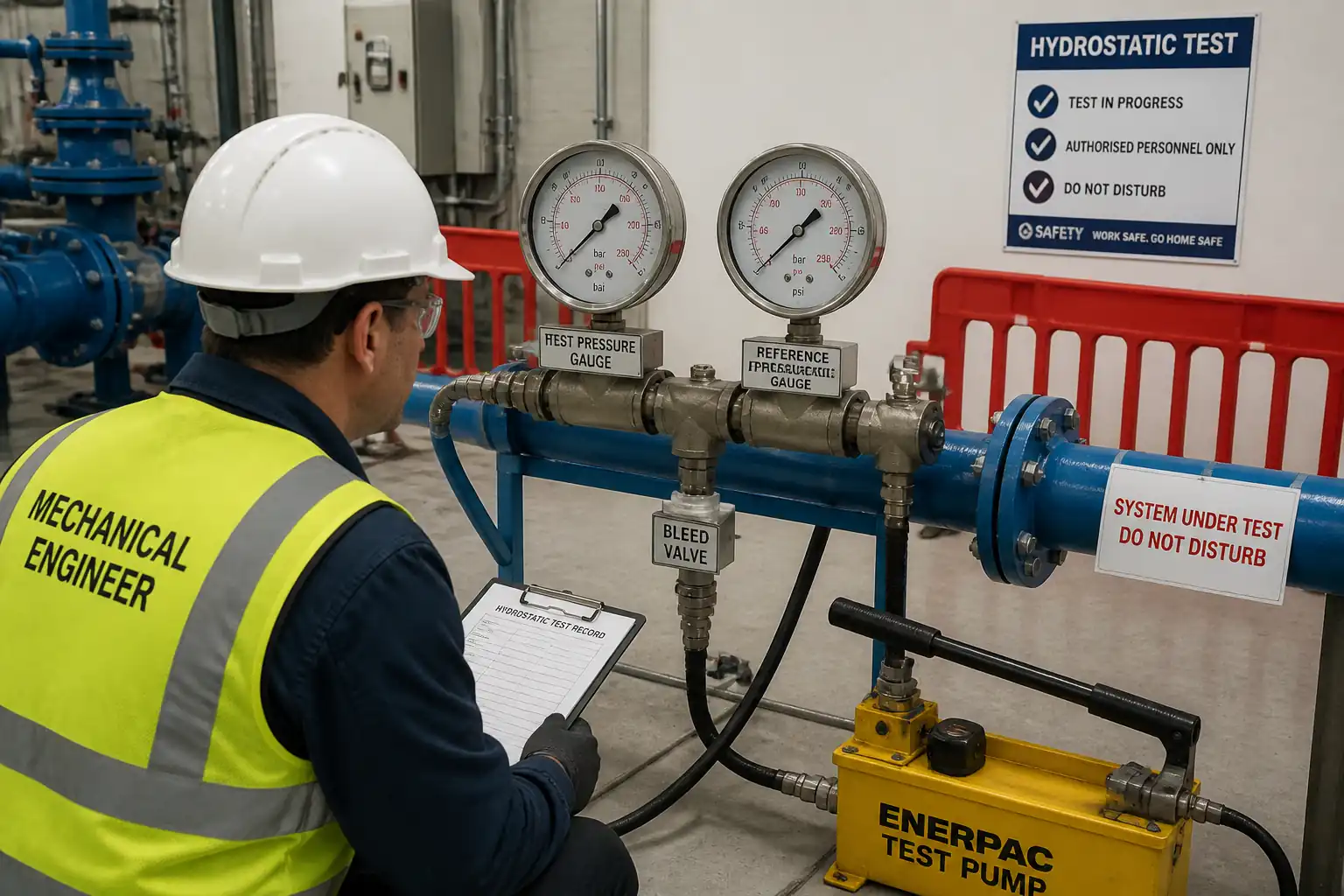
- Gauges: Two independent gauges (one at manifold, one remote) class 0.25–0.5% FS; range 1.5–2 × test pressure; valid calibration (≤6 months or per QA plan).
- Transducer/logger: Accuracy ≤ ±0.25% FS; sampling every 15–60 seconds during hold; temperature logged at minimum 5–10 min intervals. Time-synchronised.
- Data records: Export raw data (CSV) and plotted curves; include time, pressure, temperature. Identify any operator interventions (make-up volumes/time).
Leakage Measurement & Allowable Leakage
- Measurement: During the official hold, maintain constant pressure by adding water through a calibrated device. Sum all make-up volumes (Vm).
- Visual: No visible leaks allowed at any time.
- Allowable Leakage – AWWA approach (DI/Steel):
- US customary formula per AWWA C600: L_allow (gal/h) = (S_ft × D_in × sqrt(P_psi)) / 133,200. Where S_ft = pipe length tested in feet; D_in = nominal diameter in inches; P_psi = average test pressure during hold in psi. [Verify per project specifications]
- Acceptance: Vm_rate ≤ L_allow and no visible leaks. If exceeded, locate and repair; re-test.
- PVC (AWWA C605): Zero detectable leakage (no make-up water) during the hold period unless project spec states otherwise. [Verify]
- PE/HDPE (AWWA C906 / PPI TR-46): Follow expansion–relaxation method; after stabilisation, acceptance is typically zero leakage with pressure rebound within specified limits. [Verify per project specifications]
- EN 805 alternative: If EN 805 governs, perform strength and tightness tests per standard; acceptance based on pressure loss and allowable water loss criteria defined therein. [Verify per project specifications]
Temperature/Elastic Effects
- Minimise temperature variation; note that temperature drop can mimic leakage (additional make-up). Record ambient/water temperature to contextualise data. Where specified, apply temperature correction method per governing standard/authority.
Nonconformance
- If acceptance not achieved: depressurise safely, locate leak (sectionalisation, acoustic survey, visual at exposed joints), repair, and repeat full test after curing. Record NCR and corrective action.
Deliverables
- Signed checklists, HP1/HP2/HP3 witness sheets, calibration certificates, pressure/temperature logs, make-up volume sheet, leakage calculation sheet, site sketches/photos, acceptance certificate.
Attachments
- Pre-Test Checklist (HP1)
- Instrumentation Calibration Certificates (gauges, transducers, flow meters)
- Pressure Test Calculation Sheet (including static head corrections and allowable leakage formula reference)
- Data Logger Raw Files (CSV) and Plots (PDF)
- Make-up Water Log Sheet
- Flushing and Air Removal Checklist
- Discharge Permit and Environmental Logs
- NCR/Corrective Action Forms (if applicable)
- Test Certificate Template with HP2/HP3 Witness Signatures
This content is a read-only public reference. Download or customize to get an editable version.
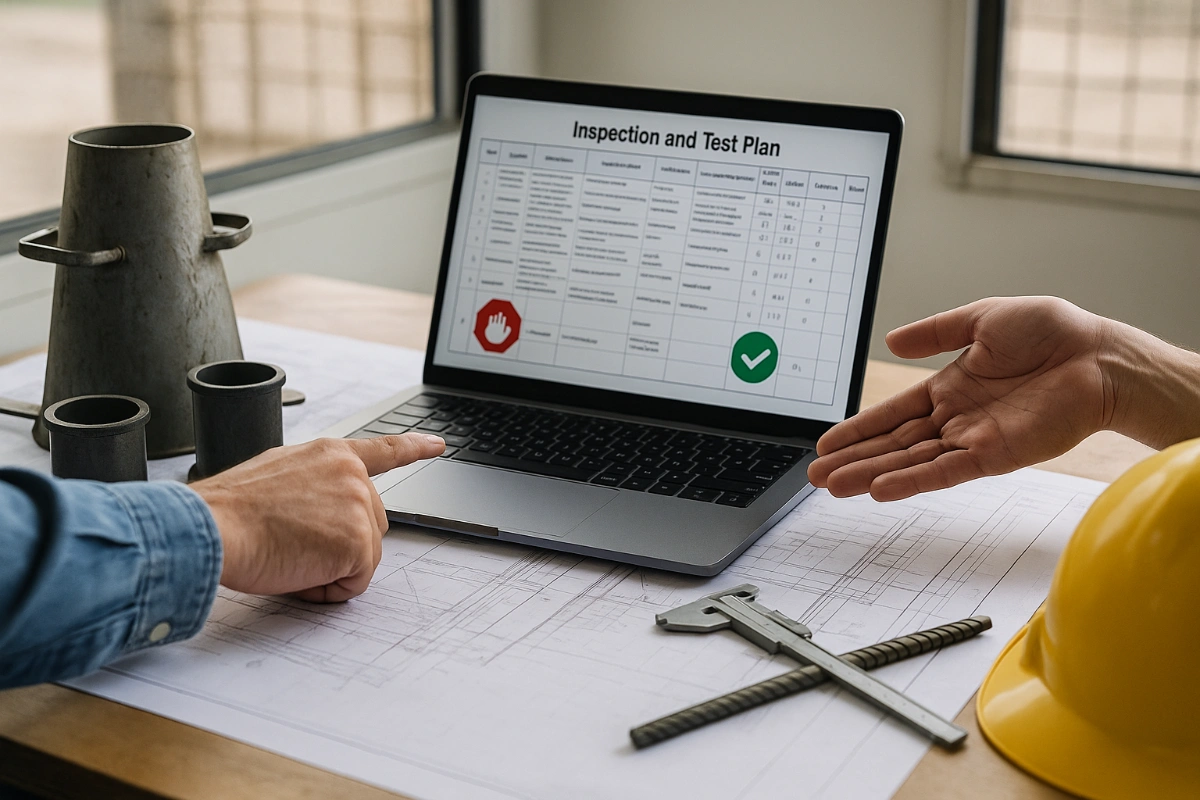
ITP preview
The first inspection activities from the linked ITP for Method Statement: Hydrostatic Pressure Testing of Water Mains:
| Activity | Inspection / Test | Acceptance Criteria | Responsibility | Record |
|---|---|---|---|---|
| Test package review and approvals | Method/ITP approved; calibrations in date; permits in place | All documents approved prior to site works | QA/QC Engineer / Engineer | Approved MS/ITP; calibration certs; PTW; WIR |
| Pre-test site inspection (HP1 – Hold Point) | Restraints, test ends, air valves, valves status, backfill, barricades, discharge plan | Conformity with prerequisites; HP1 signed by Engineer | Testing Supervisor / Engineer | HP1 checklist; photos |
| Flushing and air removal verification | Achieved flushing velocity; air expulsion at high points | Clear water; no air observed at vents | Testing Supervisor / QA/QC | Flushing log; air removal checklist |
Showing 3 of 9 inspection activities. View full ITP →
Related Inspection and Test Plan
An Inspection and Test Plan (ITP) is available for Method Statement: Hydrostatic Pressure Testing of Water Mains. The ITP defines the inspection activities, acceptance criteria, hold and witness points, responsible parties, and records required to verify the work described in this method statement.
View the Method Statement: Hydrostatic Pressure Testing of Water Mains ITP →Frequently asked questions
Continue with related Quollnet resources connected to this method statement.