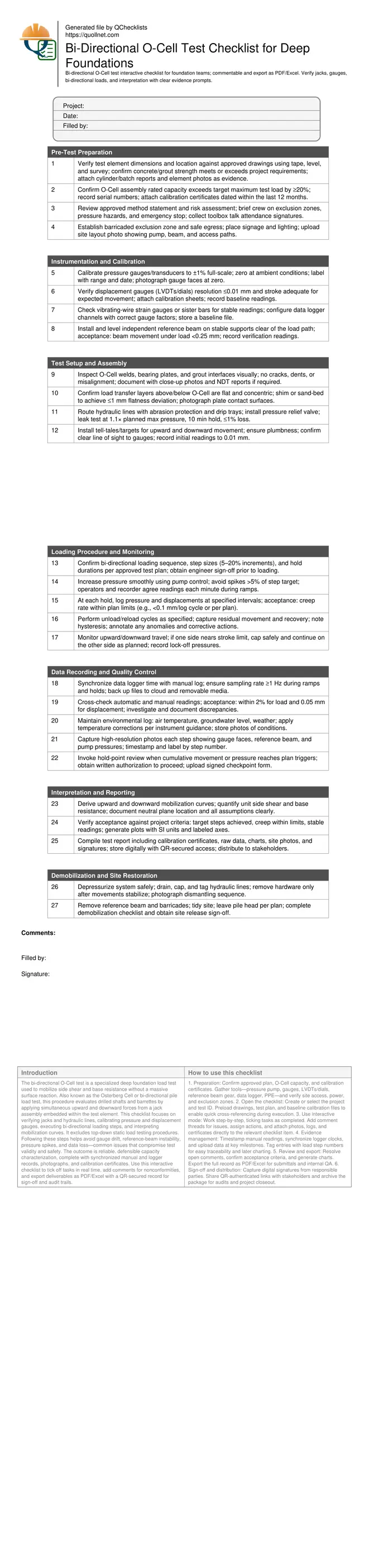
Bi-Directional O-Cell Test Checklist for Deep Foundations
Definition: The bi-directional O-Cell test checklist guides geotechnical teams through O-Cell verification, instrumentation calibration, controlled bi-directional loading, and result interpretation for drilled shafts and barrettes, excluding top-down static load testing.
- Verify jacks, gauges, lines, and reference beams before loading.
- Apply bi-directional steps, hold criteria, and creep acceptance limits.
- Capture synchronized readings, photos, and certificates for traceable evidence.
- Interactive, commentable, export to PDF/Excel, with QR code sign-off.
The bi-directional O-Cell test is a specialized deep foundation load test used to mobilize side shear and base resistance without a massive surface reaction. Also known as the Osterberg Cell or bi-directional pile load test, this procedure evaluates drilled shafts and barrettes by applying simultaneous upward and downward forces from a jack assembly embedded within the test element. This checklist focuses on verifying jacks and hydraulic lines, calibrating pressure and displacement gauges, executing bi-directional loading steps, and interpreting mobilization curves. It excludes top-down static load testing procedures. Following these steps helps avoid gauge drift, reference-beam instability, pressure spikes, and data loss—common issues that compromise test validity and safety. The outcome is reliable, defensible capacity characterization, complete with synchronized manual and logger records, photographs, and calibration certificates. Use this interactive checklist to tick off tasks in real time, add comments for nonconformities, and export deliverables as PDF/Excel with a QR-secured record for sign-off and audit trails.
- Comprehensive field workflow covering pre-test preparation, instrumentation calibration, reaction independence, controlled bi-directional loading, and robust data quality controls. Clear acceptance cues, hold criteria, and evidence prompts ensure repeatable, traceable results suitable for design verification and risk mitigation on drilled shafts and barrettes.
- Interactive online checklist with tick, comment, and export features secured by QR code. It supports attaching photos, calibration certificates, and logger files, enabling rapid reviews, transparent issue resolution, and auditable sign-offs aligned with approved project specifications and authority requirements.
- Actionable interpretation guidance to separate upward and downward mobilization, quantify unit side shear and base resistance, and document assumptions. The structured report package includes tables, charts, and site photos, delivering defensible outcomes that streamline approvals and inform construction decisions without top-down testing.
Pre-Test Preparation
Instrumentation and Calibration
Test Setup and Assembly
Loading Procedure and Monitoring
Data Recording and Quality Control
Interpretation and Reporting
Demobilization and Site Restoration
Set up for reliable bi-directional loading and reaction independence
Successful O-Cell testing hinges on reaction independence and stable instrumentation. Place the reference beam on supports that do not share the test element’s load path, then verify any beam deflection under applied pressure is negligible. Inspect O-Cell welds, bearing plates, and load transfer surfaces; a flat, concentric assembly reduces eccentricities that distort mobilization curves. Calibrate pressure devices and displacement gauges at the test ranges and confirm resolution to at least 0.01 mm for movements. Hydraulic lines require protection, pressure relief, and a leak test above maximum planned pressure to avoid sudden pressure drops and safety hazards. Finally, mark a clear exclusion zone and brief the crew on emergency stops, communications, and step timing. These habits prevent measurement drift, alignment errors, and unplanned shutdowns that compromise data quality and schedule.
- Reference beam independent of load path and movement verified.
- Flat, concentric bearing plates reduce eccentricity effects.
- Gauge resolution ≤0.01 mm across expected movements.
- Hydraulic lines protected and leak-tested above maximum.
- Crew briefed; exclusion zone and emergency stops defined.
Executing steps, holds, and quality controls in the field
Adopt a stepwise loading plan with increments typically ranging from 5% to 20% of the maximum test load, holding at each step to observe creep and stabilization. Increase pressure smoothly to avoid spikes and confirm readings at fixed intervals using synchronized manual logs and data loggers. Set acceptance thresholds for deviations between manual and automatic readings and a creep limit that signals stability. Collect environmental data—temperature, groundwater, weather—to support corrections and context for reviewers. Photo-document every step, including gauge faces and reference beam indicators, to create a traceable visual record. Invoke a hold-point review when plan triggers are reached to confirm safety, data integrity, and continuation criteria before proceeding.
- Smooth ramps; avoid load spikes over 5%.
- Hold durations support creep evaluation.
- Manual and logger data cross-checked within limits.
- Environmental conditions logged for context.
- Photograph gauges and beam at each step.
Interpreting upward/downward response and reporting defensible results
Interpretation separates upward and downward mobilization to quantify unit side shear and base resistance. Identify the neutral plane where movements diverge and confirm that assumptions—such as contact conditions and layer thicknesses—are transparent. Build clear load–movement plots with SI units and labeled axes, noting any unload/reload hysteresis. Acceptance typically includes achieving planned load steps, stable holds, and creep within limits set by the approved project specifications and authority requirements. Package the findings with calibration certificates, raw files, photos, and signed logs so reviewers can retrace decisions. This transparent approach reduces rework, accelerates approvals, and supports design refinement without invoking top-down test procedures.
- Separate upward and downward mobilization curves.
- State assumptions for contact and layer properties.
- Use labeled SI plots and tables.
- Confirm acceptance against approved criteria.
- Attach raw data, photos, and certificates.
How to Use This Bi-Directional O-Cell Test Checklist
- Preparation: Confirm approved plan, O-Cell capacity, and calibration certificates. Gather tools—pressure pump, gauges, LVDTs/dials, reference beam gear, data logger, PPE—and verify site access, power, and exclusion zones.
- Open the checklist: Create or select the project and test ID. Preload drawings, test plan, and baseline calibration files to enable quick cross-referencing during execution.
- Use interactive mode: Work step-by-step, ticking tasks as completed. Add comment threads for issues, assign actions, and attach photos, logs, and certificates directly to the relevant checklist item.
- Evidence management: Timestamp manual readings, synchronize logger clocks, and upload data at key milestones. Tag entries with load step numbers for easy traceability and later charting.
- Review and export: Resolve open comments, confirm acceptance criteria, and generate charts. Export the full record as PDF/Excel for submittals and internal QA.
- Sign-off and distribution: Capture digital signatures from responsible parties. Share QR-authenticated links with stakeholders and archive the package for audits and project closeout.
Call to Action
- Start Checklist Tick off tasks, leave comments on items or the whole form, and export your completed report to PDF or Excel—with a built-in QR code for authenticity.
- Download Excel - Bi-Directional O-Cell Test Checklist
- Download PDF - Bi-Directional O-Cell Test Checklist
- View Image - Bi-Directional O-Cell Test Checklist
Cite & Embed
“Bi-Directional O-Cell Test Checklist by Quollnet”
with a link to
this source page.

FAQ
Question: What advantages does the bi-directional O-Cell test offer on constrained sites?
Question: How do I select the correct O-Cell capacity and stroke?
Question: What hold durations and acceptance cues should I use during loading?
Question: What if one side reaches its movement limit before the other?
Question: Can O-Cells and gauges be reused after a test?
Related Articles
Broader reading and guidance connected to this checklist topic.


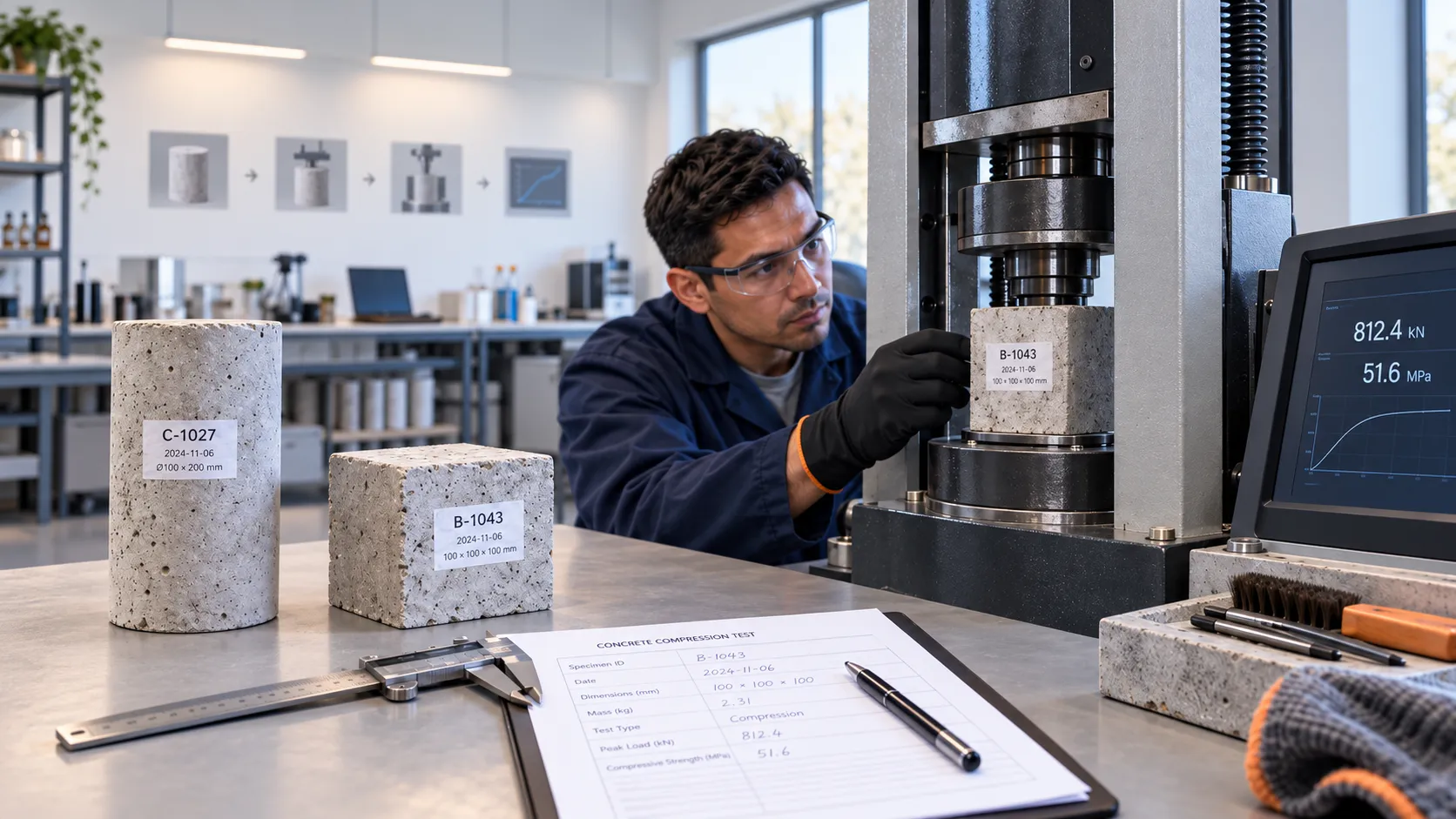
How To Perform a Concrete Compressive Strength Test: Cubes & Cylinders

Improper Concrete Specimen Curing: Impact On Cube & Cylinder Test Strength
Related Checklists
Keep the workflow moving with nearby templates chosen from similar checklist content.