
Method Statement: Chemical Containment Bund Construction and Integrity Testing – Method Statement
AI-assisted method statement with matching ITP, PDF download, and Excel export.
More than a static template
Unlike a downloadable Word or PDF template, this method statement is an AI-assisted editable starting point connected directly to a matching Inspection and Test Plan. Every section is structured, project-adaptable, and ready to export.
- AI-assisted drafting — Customize every section with AI for your specific project scope.
- Linked ITP — A matching inspection and test plan is generated alongside the method statement.
- Multiple export formats — Download as a formatted PDF or editable Excel spreadsheet.
- Editable starting point, not a final document — Review, verify, and adjust all content against your project requirements before use.
Static template vs. Quollnet workflow
| Feature | Static template | Quollnet |
|---|---|---|
| Project-specific content | Manual fill-in required | AI-assisted customization |
| Linked ITP | Separate document, no link | Matching ITP included |
| Export formats | Usually PDF only | PDF and Excel |
| Structured sections | Free-form layout | 13 standardized sections |
| Saved to your account | Local file only | Cloud-saved, reusable |
| Content accuracy | You verify everything | AI-assisted, you still verify |
| Cost | Often free but time-intensive | Free to customize and download |
What you can customize
When you save this method statement to your account, every section becomes editable. The following 13 sections are included:
- Scope — Defines the activity and its boundaries.
- References — Standards, specifications, and drawings.
- Responsibilities — Roles and accountabilities.
- Resources — Labour, plant, and equipment summary.
- Materials — Materials and compliance requirements.
- Equipment — Tools and equipment details.
- Prerequisites — Hold points and pre-conditions.
- Method sequence — Step-by-step construction sequence.
- Safety controls — HSE risk controls and PPE.
- Environmental controls — Environmental mitigation measures.
- QA/QC — Quality inspection and test requirements.
- ITP — Inspection and Test Plan table (has its own page).
- Attachments — Referenced drawings and documentation.
Why this method statement is used
This method statement is used to define and communicate the approved procedure for carrying out method statement: chemical containment bund construction and integrity testing on site. It ensures the work is planned in advance, the correct resources and controls are in place, and all personnel understand responsibilities, sequence, quality requirements, and safety controls before work begins. It aligns site execution with the documented scope and acceptance expectations.
Who uses this method statement
This method statement is used by contractors, site supervisors, project engineers, QA/QC engineers, HSE officers, consultants, and client representatives. It serves as a shared reference for planning, execution, supervision, inspection, and approval of the activity on site.
When it is prepared and submitted
The method statement is prepared before the work activity starts and submitted as part of the pre-construction documentation package for review and approval.
Who reviews or approves it
The method statement is usually submitted to the client representative, consultant, resident engineer, or project management consultant for review and approval before the work commences.
Important approval note
This method statement is an AI-assisted editable starting point, not a pre-approved document. Before use on any project, all content must be reviewed and approved by the relevant parties (superintendent, principal contractor, or client representative) in accordance with your contract and project quality plan.
For example: if your specification requires a departure from a referenced standard, that departure must be documented and approved separately — this method statement will not capture that automatically. Always verify against your applicable drawings, specifications, and regulatory requirements.
Method statement content
Scope
Purpose
This method statement describes the construction and testing of a reinforced concrete chemical containment bund, including subgrade preparation, concrete base and walls, construction joints and waterstops, chemical-resistant lining, penetration sealing, drainage isolation, hydrostatic leak testing, QA/QC inspections, HSE measures, and documentation.
Extent of Works
- Set-out and excavation/formation trimming for bund footprint.
- Sub-base and blinding concrete (if required) and earthing details [Verify per project drawings].
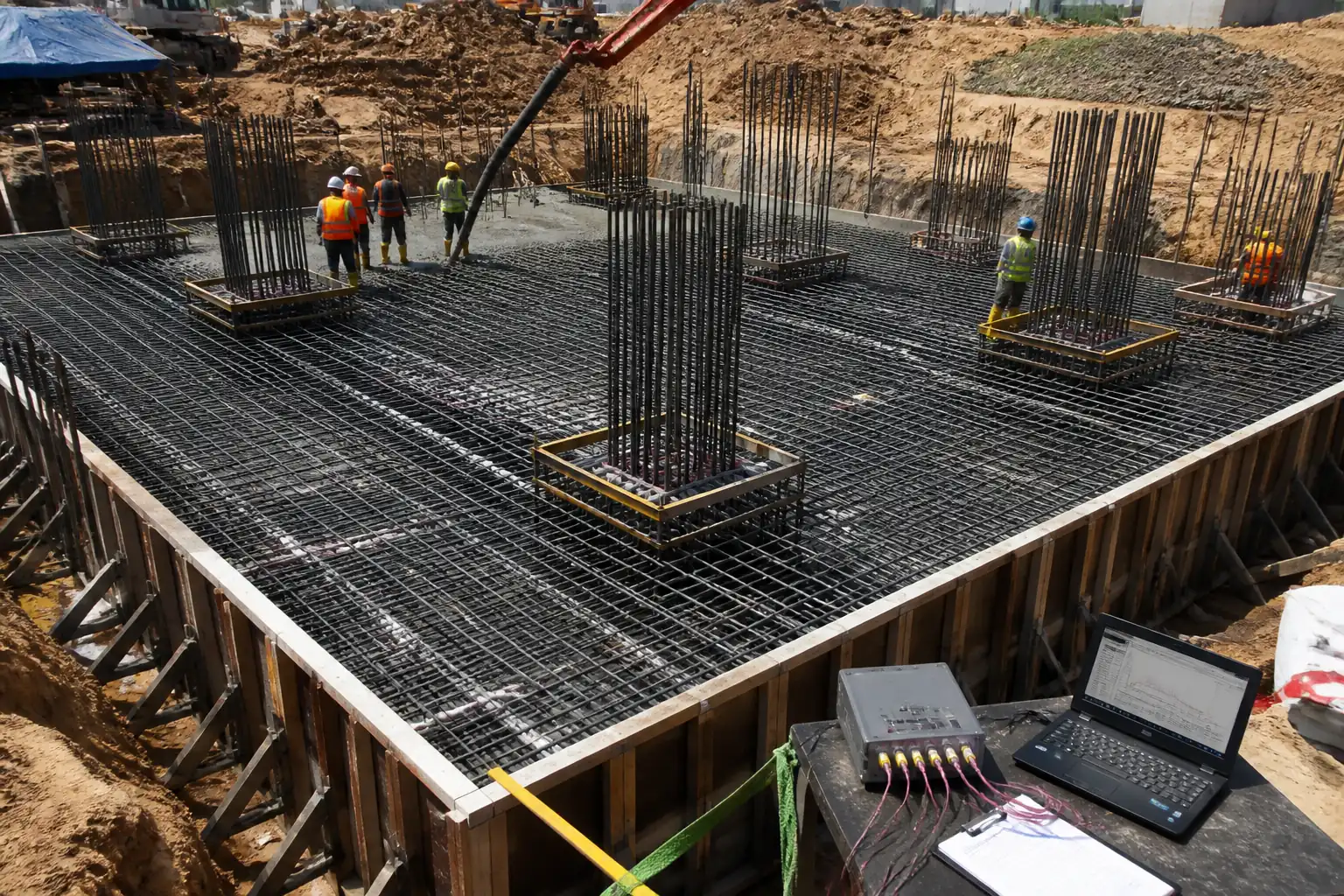
- Reinforcement, formwork, embeds, pipe sleeves/penetrations, kicker.
- Concrete base slab and wall pours with construction joints and centrally placed waterstops.
- Surface preparation of concrete and application of chemical-resistant lining to walls and base.
- Joint sealants and termination/edge details, including coves and fillets.
- Sealing of pipe penetrations via mechanical seals and compatible sealants.
- Installation of isolated drainage/sump and valve locking arrangements (normally closed, non-return to site drains).
- Controlled leak (hydrostatic) testing and rectification if required.
- Final cleaning, demobilization, as-built documentation, and handover.
Exclusions
- Tank installation and process mechanical works outside the bund unless noted.
- Electrical and instrumentation beyond earthing provisions.
- Fireproofing or blast protection not specified in project documents.
Key Performance Objectives
- Achieve liquid-tight containment compatible with specified stored chemicals.
- Provide bund capacity as required by regulations and project specification (typical: 110% of largest tank or 25% of total volume, whichever is greater) [Verify per project specifications and regulations].
- Confirm containment integrity via leak testing and coating holiday testing.
References
| Document Type | Reference / Number | Revision | Notes |
|---|---|---|---|
| ACI 318, ACI 301, ACI 350 | |||
| EN 1992-3; BS 8007 (legacy) | |||
| ASTM; ACI 308R | |||
| SSPC/NACE; ICRI 310.2R | |||
| ASTM; SSPC-PA 9 | |||
| ASTM C920 | |||
| ISO 45001; Local Regulations |
Responsibilities
| Role | Responsibility | Name / Party |
|---|---|---|
| PM | Approve MS/ITP, ensure budget and schedule | Contractor |
| CM | Ensure sequencing, access, lifts, permits | Contractor |
| QA/QC | Manage ITP, inspections, tests, NCRs, calibrations | Contractor |
| HSE | Risk assessments, method enforcement, permits, monitoring | Contractor |
| SE | Survey controls, dimensions, tolerances, as-builts | Contractor |
| Foreman | Safe assembly, cover blocks, bar schedules | Contractor |
| Supervisor | Conform to manufacturer’s datasheets; environmental control; testing coordination | Approved Applicator |
| TPI | Witness hold points and critical tests | Independent |
Resources
| Resource Type | Description | Quantity | Remarks |
|---|---|---|---|
| Labour | Formwork carpenters, steel fixers, concrete crew, coating applicators, general operatives | As scheduled | |
| Survey | Surveyor and assistant with calibrated instruments | 1 team | |
| HSE | HSE officer and standby first aider | 1 each |
Materials
| Material | Specification / Grade | Quantity | Remarks |
|---|---|---|---|
| Concrete | As per drawings | ||
| Waterstop | As required | ||
| Sealant | As required | ||
| Lining | As required | ||
| Mechanical seal | Per penetration | ||
| Blinding/Sub-base | As required |
Equipment
| Equipment | Capacity / Type | Quantity | Inspection Required |
|---|---|---|---|
| Total station, level | 1 set | ||
| Formwork, vibrators | As required | ||
| Mixers, pump | As required | ||
| Blaster, grinder | As required | ||
| QA instruments | 1 set | ||
| Leak test kit | 1 set |
Prerequisites
- Approved method statement, ITP, and shop drawings.
- Confirm bund capacity and freeboard per regulations [Verify per project specifications].
- Permits: excavation (if applicable), confined space (for internal works), abrasive blasting/surface prep, work at height, hot work if any grinding produces sparks [Verify per project HSE plan and local regulations].
- Materials submittals approved: concrete mix design, waterstops, lining system, joint sealants, penetration seals.
- Manufacturer approvals: coating applicator qualifications and product datasheets/SDS.
- Calibrated instruments available (survey, QA gauges, holiday detector, adhesion tester, hygrometer).
- Mock-up/panel trials for surface preparation and lining (if specified) with agreed acceptance benchmarks.
- Weather constraints for lining: substrate ≥3°C above dew point; RH ≤85% (typ.); substrate moisture within manufacturer limits; wind shielding for dust control [Verify per manufacturer].
- Ensure drains are physically isolated/blinded; temporary plugs and lock-out/tag-out of any valves.
- Emergency plan and spill response kit available.
- Coordination with adjacent operations; exclusion zones established.
Method Sequence
| Step | Activity | Description | Responsibility | Inspection / Hold Point |
|---|---|---|---|---|
| 1 | Survey & Set-out | Establish control points and set-out bund footprint, walls, penetrations, sump and high-point/low-point for falls (target 1–2% fall to sump) [Verify per drawings]. | Site Engineer | Dimensional check |
| 2 | Subgrade/Sub-base Preparation | Trim formation; compact sub-base to ≥95% MDD; place 50–75 mm blinding concrete if specified. | Foreman/SE | Compaction & level |
| 3 | Formwork & Reinforcement (Base) | Install formwork; fix reinforcement with correct cover blocks (50–75 mm). Provide kicker 100–150 mm for walls. | Foreman/SE | Pre-pour inspection |
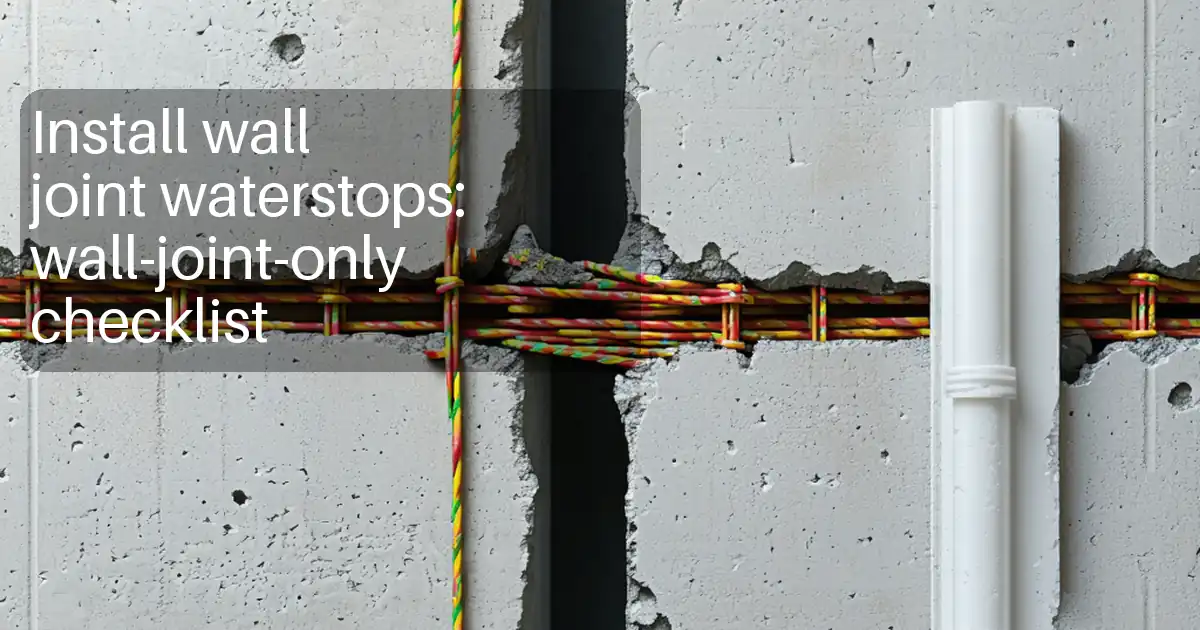
| 4 | Waterstops & Embeds | Fix centrally located PVC/TPV waterstop in wall-base joint; fix sleeves/inserts; brace to prevent displacement. | Foreman/QA-QC | Waterstop fixation |
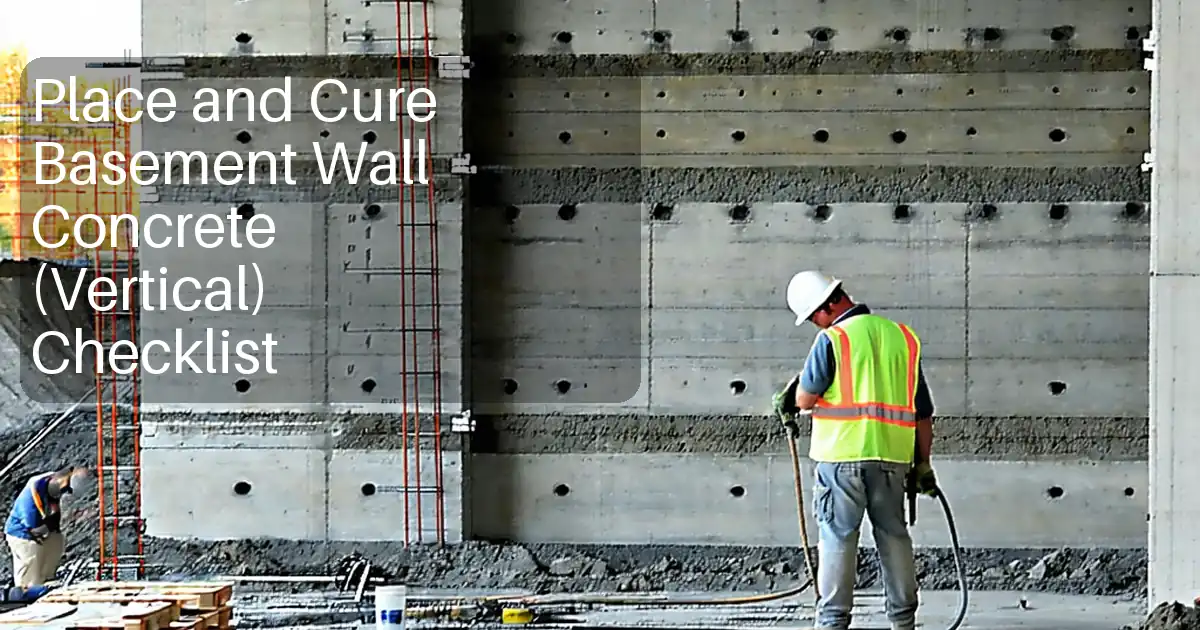
| 5 | Concrete Placement—Base Slab | Place concrete; internal vibration at 300 mm spacing; avoid segregation; finish to required slope to sump; construct surface suitable for coating (closed but not burnished). | Concrete Supervisor | Concrete QA |
| 6 | Curing—Base | Wet cure or compatible curing compound for ≥7 days; protect from traffic. | Concrete Supervisor | Curing check |
| 7 | Wall Formwork & Reinforcement | Erect forms; fix steel; ensure penetrations sleeved; ensure construction joints treated and waterstops placed. | Foreman/SE | Pre-pour inspection |
| 8 | Concrete Placement—Walls | Pour walls in lifts suitable to avoid cold joints; vibrate adequately; finish internal faces smooth (CSP achievable by light abrasion). Chamfer/cove corners where required. | Concrete Supervisor | Concrete QA |
| 9 | Curing—Walls | Maintain curing for ≥7 days; protect from early loading. | Concrete Supervisor | Curing check |
| 10 | Concrete Inspection & Repairs | After curing, inspect surfaces; repair bugholes/voids with epoxy mortar; grind fins; achieve target CSP by mechanical prep (shot blast/grind). | QA-QC/Coating Supv. | Surface profile |
| 11 | Moisture & Environmental Checks | Perform ASTM D4263 (24 h plastic sheet) or ASTM F2170 (in-situ RH) as specified; verify dew point spread ≥3°C; RH ≤85% (typ.). | QA-QC | Environmental |
| 12 | Primer/Stripe Coat | Apply primer and stripe coat to edges/re-entrant corners/around penetrations as per datasheet; broadcast if required for intercoat adhesion. | Coating Supv. | WFT/coverage |
| 13 | Base Coats & Final Coat | Apply successive coats to achieve total DFT 1.5–2.0 mm [Verify]; maintain recoat windows; form 50 mm radius coves at wall-floor junction. | Coating Supv. | DFT/continuity |
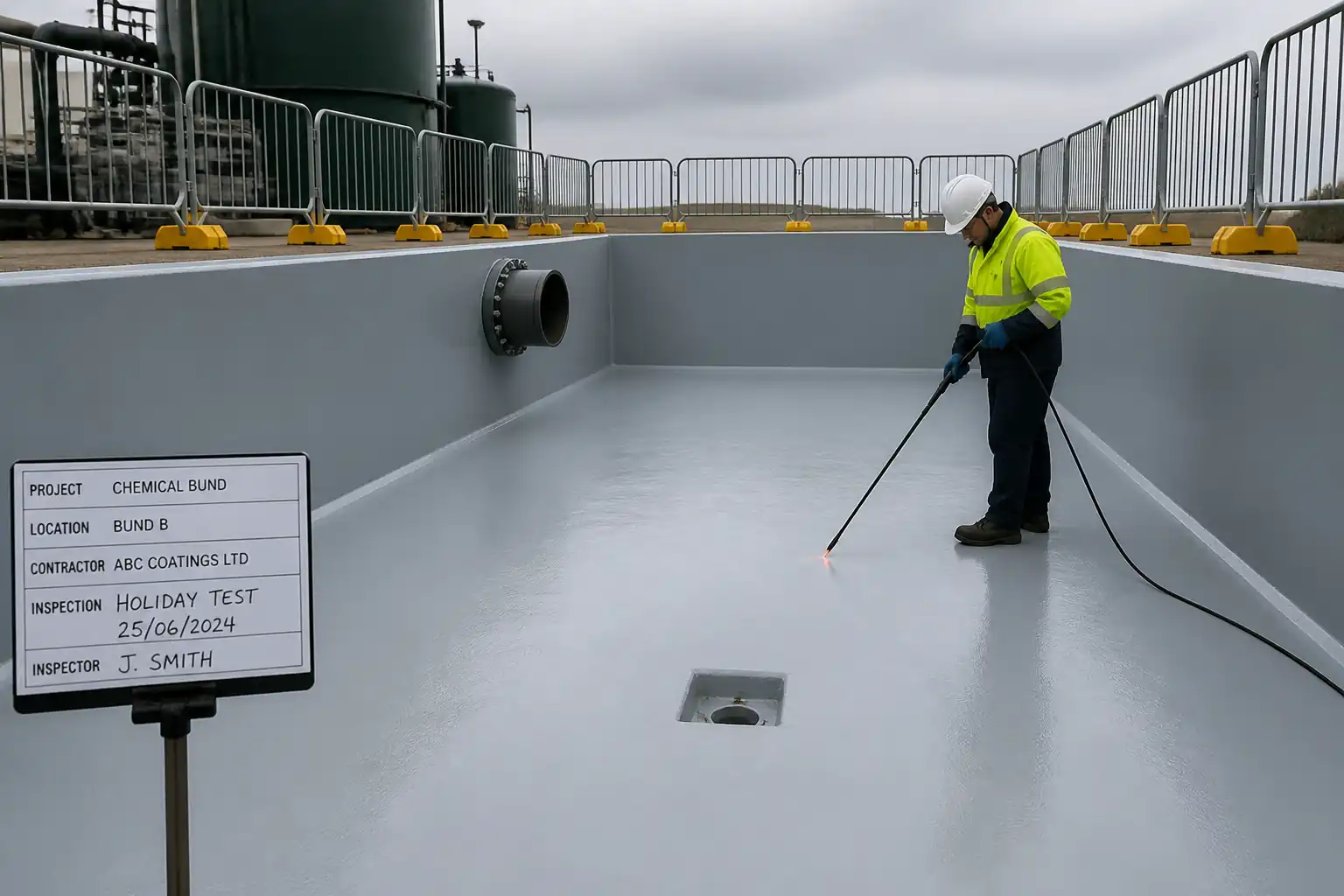
| 14 | Holiday (Continuity) Testing | After full cure, high-voltage spark test lining per ASTM D4787; set voltage per manufacturer (typ. 6–10 kV for 1.5–2.0 mm); repair defects and retest. | QA-QC/Coating Supv. | Holiday test |
| 15 | Joint Sealing & Penetration Seals | Install joint sealants (ASTM C920) and mechanical modular seals at penetrations; torque per manufacturer; apply chemical-resistant fillets as needed. | Foreman/Coating Supv. | Visual, torque |
| 16 | Drainage Isolation & Lock-out | Install blind flanges or lockable normally-closed valves; fit spill sump pump to IBC for controlled disposal; tag and record. | MEP/Foreman | Functional check |
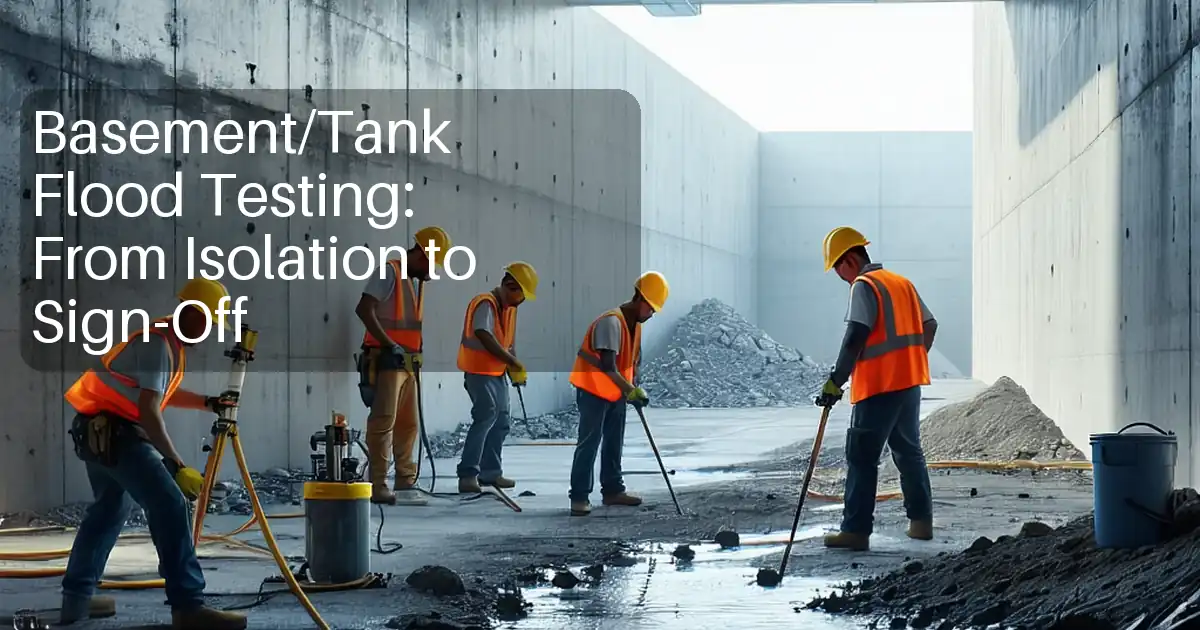
| 17 | Hydrostatic Leak Test | Flood bund with clean dyed water to design test level (≥50 mm below top of wall); allow 24 h soak; then monitor 24–48 h. Correct for evaporation using pan method or cover. | QA-QC/SE | Level monitoring |
| 18 | Drain/Disposal of Test Water | Pump out to approved container; treat/neutralize per environmental plan; do not discharge to storm/sanitary unless permitted. | HSE/SE | Disposal verification |
| 19 | Final Cleaning & Handover | Remove temporary works, restore area, submit as-builts, O&M, warranties, QA dossier. | PM/QA-QC | Final inspection |
Safety Controls
Task-Specific HSE Risk Controls
1) Hazard: Underground utility strike during excavation/penetration installation
- Consequence: Electrocution, gas leak, service outage
- Control: Utility survey and permits; use calibrated cable/pipe locator; hand-dig within 1 m of services
- PPE: Dielectric gloves when required, safety boots, eye protection
- Collective Measure: Exclusion zone, banksman
- Inspection/Permit/Supervision: Excavation permit; supervision by Site Engineer; daily permit revalidation [Verify per project HSE plan and local regulations]
2) Hazard: Formwork instability/collapse
- Consequence: Crush injuries, structural failure
- Control: Engineered formwork design; adequate ties/bracing; pre-pour checklist; do not remove forms until specified strength attained
- PPE: Hard hat, safety boots, gloves
- Collective Measure: Barricade pour area; controlled pour rate
- Inspection/Permit/Supervision: Formwork inspection by competent person; hold-point sign-off before pouring
3) Hazard: Rebar impalement
- Consequence: Serious puncture injuries
- Control: Cap all exposed vertical bars with rebar caps; organize steel to minimize projections
- PPE: Gloves, long sleeves
- Collective Measure: Edge protection, housekeeping
- Inspection/Permit/Supervision: Daily HSE inspections; closeout of observations
4) Hazard: Concrete pumping/placement
- Consequence: Hose whip, splash burns (alkaline), struck-by
- Control: Trained pump operator; secure hose; communication plan; washout in designated lined area
- PPE: Eye/face shield, alkali-resistant gloves, long sleeves
- Collective Measure: Exclusion zone around boom; tag lines
- Inspection/Permit/Supervision: Pre-use plant checks; lifting/plant certificates
5) Hazard: Working at height on bund walls during coating
- Consequence: Falls
- Control: Mobile scaffold/tower with guardrails or MEWP; maintain 3-point contact; tie-off as required
- PPE: Full-body harness and lanyard when applicable
- Collective Measure: Edge protection, fall arrest systems
- Inspection/Permit/Supervision: Work-at-height permit; daily scaffold/MEWP inspection
6) Hazard: Dust and silica during grinding/shot blasting
- Consequence: Respiratory disease, eye injury
- Control: Wet methods or HEPA extraction; tools with shrouds; minimize dry sweeping
- PPE: Tight-fitting respirator (P2/P3), goggles, gloves
- Collective Measure: Local exhaust ventilation; designated cutting zone
- Inspection/Permit/Supervision: Air monitoring as required; equipment maintenance logs
7) Hazard: Solvent/amine exposure from coatings; confined space within bund
- Consequence: Respiratory irritation, sensitization, CNS effects; asphyxiation risk
- Control: Use 100% solids products where possible; forced ventilation achieving ≥6 ACH; continuous gas monitoring; limit personnel; strict control of ignition sources
- PPE: Chemical-resistant gloves (nitrile), coveralls, goggles; half/full-face respirator with appropriate cartridges if required by SDS
- Collective Measure: Ventilation fans, access/egress ladders
- Inspection/Permit/Supervision: Confined space permit; pre-entry gas tests (O2 19.5–23.5%, LEL <10%, toxins below OEL); standby attendant; rescue plan
8) Hazard: High-voltage holiday testing
- Consequence: Electric shock, burns
- Control: Only trained personnel; dry surfaces; insulated handles; equipment earth return verified; no contact with metallic items
- PPE: Electrically rated gloves, dry footwear, eye protection
- Collective Measure: Barricade and signage during testing
- Inspection/Permit/Supervision: Equipment calibration/inspection; activity-specific permit where required
9) Hazard: Manual handling of coatings and waterstop rolls
- Consequence: Strain injuries
- Control: Team lifting; trolleys; weight limits
- PPE: Gloves, safety boots
- Collective Measure: Mechanical aids
- Inspection/Permit/Supervision: Toolbox talk; supervision
10) Hazard: Drowning/entrapment during leak test
- Consequence: Drowning, slips
- Control: Do not work alone; life buoy available; non-slip access; maintain water level below wall top; emergency plan
- PPE: Non-slip boots, life jacket if required
- Collective Measure: Barriers; rescue equipment on standby
- Inspection/Permit/Supervision: Confined space controls; supervisor present during filling/draining
11) Hazard: Chemical spill during test water disposal or coating mixing
- Consequence: Environmental contamination, chemical burns
- Control: Bunded mixing area; spill kits; use funnels; label waste
- PPE: Chemical gloves, goggles, apron
- Collective Measure: Secondary containment
- Inspection/Permit/Supervision: Waste management plan; HSE oversight
[Verify per project HSE plan and local regulations].
Environmental Controls
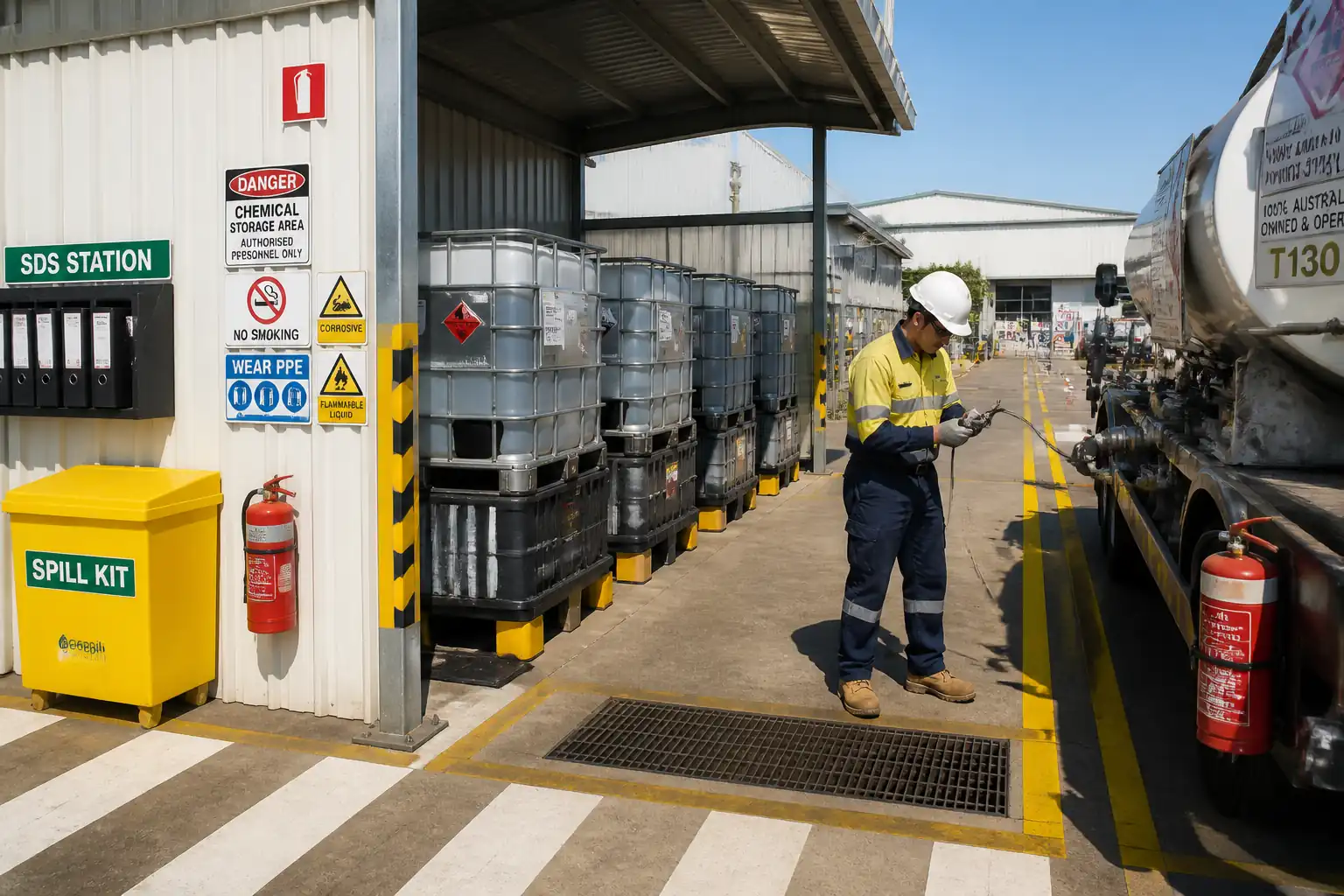
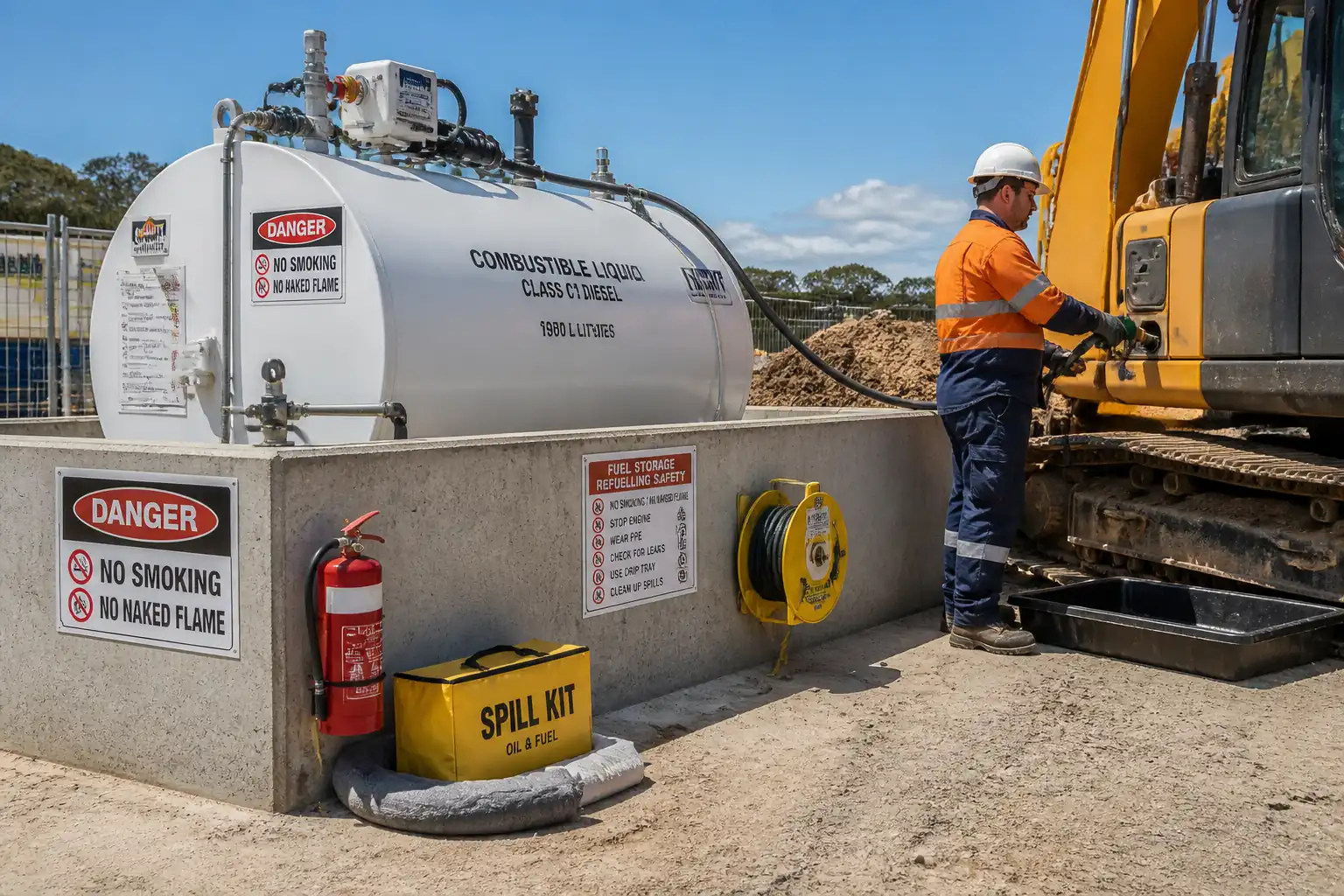
- Spill Prevention: Keep absorbent granules, pads, and neutralizer on site; bund mixing station for coatings with drip trays and lids for containers.
- Concrete Washout: Designated lined/watertight washout pit; no discharge to ground/surface water; remove and dispose of hardened waste to approved facility.
- Dust/Noise: Use HEPA extraction during grinding; schedule noisy works within allowed hours; noise barriers as needed; maintain equipment to reduce noise.
- Waste Management: Segregate hazardous coating waste and contaminated PPE; store in labeled, closed containers; arrange licensed disposal with manifests.
- Water Protection: Prevent any connection of bund drains to storm/sanitary; leak-test water collected, treated/neutralized if contaminated; discharge only under permit.
- Material Selection: Prefer low-VOC, 100% solids linings; avoid solvent-rich primers if feasible and compatible.
- Wildlife/Soil: Protect adjacent soil with geotextile/impervious sheeting during handling; immediate cleanup of spills.
- Energy/Carbon: Optimize batch sizes to minimize coating waste; plan pours to reduce rework; consider SCMs in concrete if permitted.
- Monitoring: Daily environmental checklist; record any incidents and corrective actions.
QA/QC
QA/QC Controls
- Submittals: Approvals for mix design, waterstops, lining system (including chemical resistance chart), joint sealant, penetration seals, equipment calibration certificates.
- Pre-Pour Inspections: Formwork stability, rebar size/spacing/cover, waterstop placement and splices, embeds and sleeves, cleanliness (no debris or standing water).
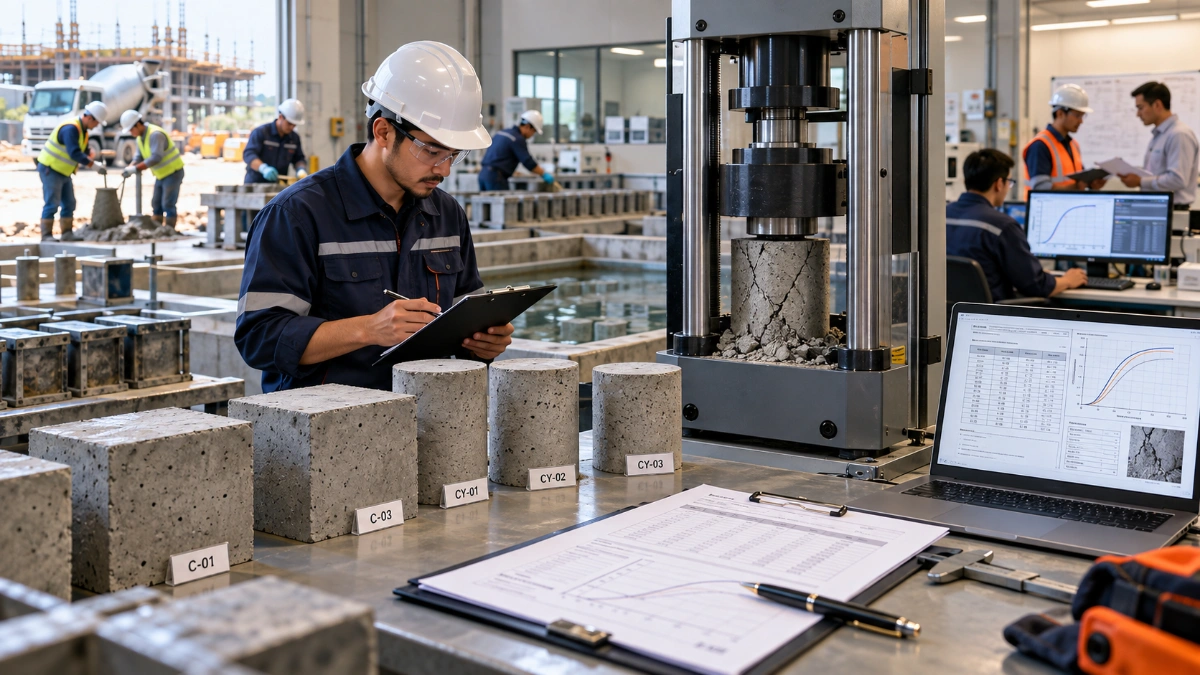
- Concrete Testing: Sampling per ASTM C172; slump (ASTM C143); temperature; air (ASTM C231, if air-entrained); density (ASTM C138); compressive strength cylinders (ASTM C31/C39) at specified ages; acceptance per project specs.
- Surface Preparation: Achieve ICRI CSP 3–5; verify laitance removal; record equipment, passes, and profiles.
- Moisture/Environmental: ASTM D4263 plastic sheet (24 h, no darkening) or ASTM F2170 in-situ RH (≤75–85% per system) [Verify]; substrate temp ≥3°C above dew point; RH ≤85% unless product allows otherwise.
- Coating Application: Record batch/lot, mix ratios, pot life, WFT/DFT per coat, environmental conditions, recoat intervals; use SSPC-PA 9 for DFT sampling frequency on concrete.
- Adhesion Testing: ASTM D7234 pull-off on representative areas (e.g., 3 tests/250 m², minimum 6 per bund) [Verify frequency]; acceptance: ≥1.5–2.0 MPa depending on service (immersion typically ≥2.0 MPa) [Verify per manufacturer/spec]. Cohesive failure in substrate preferred.
- Holiday Testing: 100% of lined area per ASTM D4787; voltage set to manufacturer guidance for total DFT (typ. 6–10 kV for 1.5–2.0 mm) [Verify]. Zero holidays accepted.
- Joints & Penetrations: Visual continuity; sealant tooling; modular seal torque values per datasheet; leak checks at interfaces.
- Leak (Hydrostatic) Test: Pre-test hold point, fill, soak 24 h, monitor 24–48 h; evaporation correction; acceptance: no visible damp patches or leaks; corrected level drop ≤1 mm/24 h [Verify]. Record ambient conditions and pan readings.
- Records & Traceability: Material batch numbers, delivery tickets, test reports, inspection checklists, photographs, as-builts, calibration certificates, training records.
- Nonconformance: Log NCRs; implement corrective action (e.g., injection, patch/overcoat, re-test); close-out prior to handover.
Attachments
- Drawings: Bund GA, reinforcement detailing, joint/waterstop details, penetration details, sump arrangement.
- Manufacturer Datasheets and SDS: Lining system, primers, sealants, waterstops, mechanical seals.
- Checklists: Pre-pour checklist; coating application/DFT log; holiday test checklist; leak test checklist.
- Certificates: Calibration certificates for QA instruments; concrete plant compliance; personnel qualifications for coating applicators.
- Records: Concrete test reports; adhesion test reports; holiday test report; moisture test logs; environmental monitoring logs; waste transfer notes; LOTO logs; as-built survey and redlines.
- Risk Assessments and Permits: Excavation permit, confined space permit, abrasive blasting permit, work at height permit, hot work permit (if applicable).
This content is a read-only public reference. Download or customize to get an editable version.
ITP preview
The first inspection activities from the linked ITP for Method Statement: Chemical Containment Bund Construction and Integrity Testing:
| Activity | Inspection / Test | Acceptance Criteria | Responsibility | Record |
|---|---|---|---|---|
| Material approvals | Review of datasheets, certificates, SDS, compatibility statements | Engineer approval prior to use | QA/QC Engineer / Consultant | Submittal approval, MDR |
| Subgrade/sub-base readiness | Levels and compaction tests | Level ±10 mm; compaction ≥95% MDD [Verify] | QA/QC / Site Engineer | Survey + compaction reports |
| Pre-pour (base) | Formwork, rebar, cover, waterstops, cleanliness | Conforms to drawings/spec; waterstop centered; forms stable | QA/QC / Engineer | Pre-pour checklist |
Showing 3 of 18 inspection activities. View full ITP →
Related Inspection and Test Plan
An Inspection and Test Plan (ITP) is available for Method Statement: Chemical Containment Bund Construction and Integrity Testing. The ITP defines the inspection activities, acceptance criteria, hold and witness points, responsible parties, and records required to verify the work described in this method statement.
View the Method Statement: Chemical Containment Bund Construction and Integrity Testing ITP →Frequently asked questions
Continue with related Quollnet resources connected to this method statement.