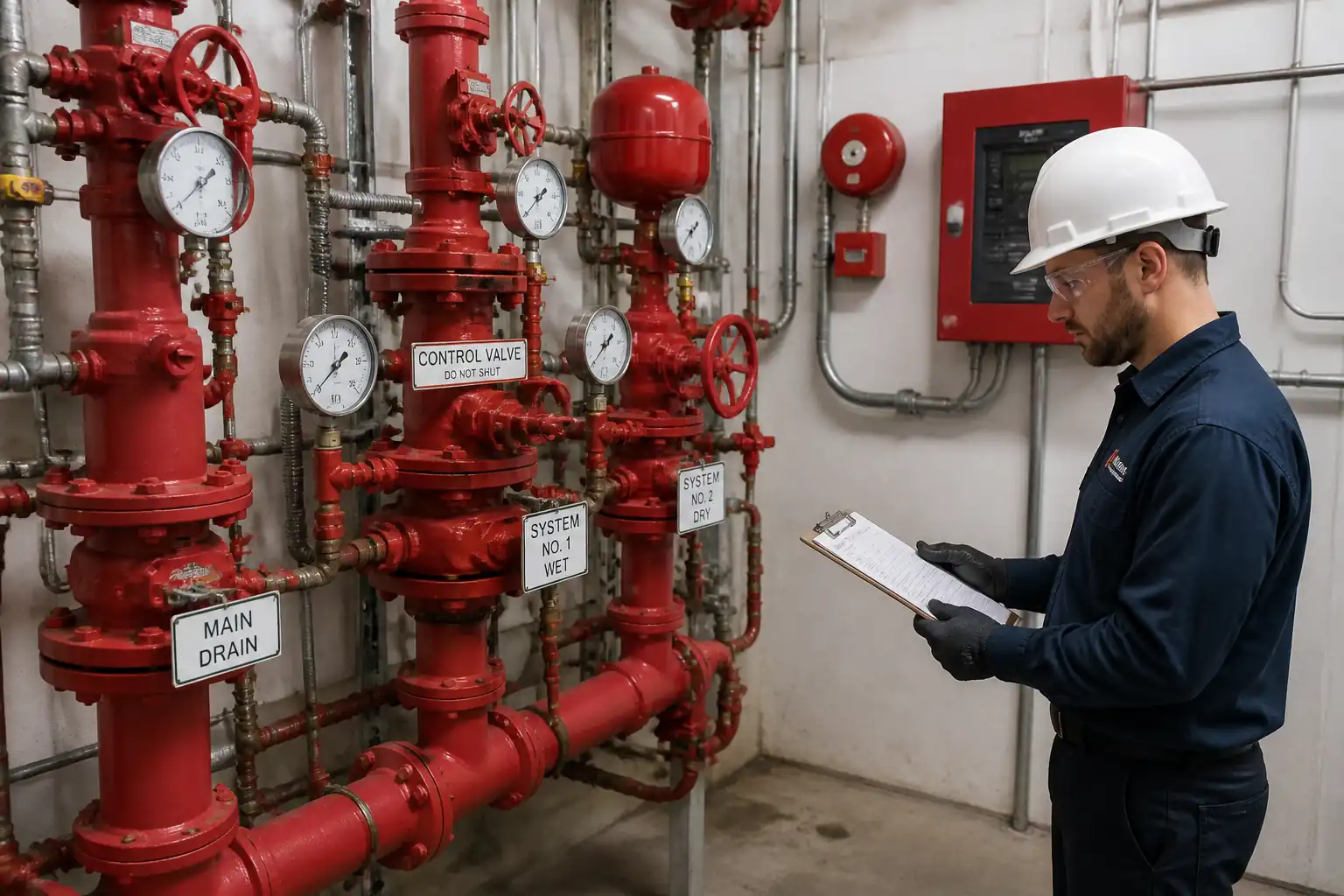

Inspection and Test Plan for Method Statement: Pre-Commissioning and Testing of Wet, Dry, and Pre-Action Sprinkler Systems
AI-assisted inspection and test plan connected to a method statement, with PDF and Excel export.
More than a static template
Unlike a downloadable Word or PDF template, this ITP is an AI-assisted editable starting point directly connected to its method statement. Every inspection activity, hold point, and acceptance criterion is structured and ready to adapt to your project.
- AI-assisted customization — Tailor inspection activities and acceptance criteria to your specific project scope.
- Linked method statement — This ITP is connected to the corresponding method statement describing the work sequence.
- Multiple export formats — Download as a formatted PDF or editable Excel spreadsheet.
- Editable starting point, not a final document — Review and verify all content against your project specifications and standards before use.
What you can customize
When you save this ITP to your account, every inspection row becomes editable. You can add, remove, or modify:
- Inspection activity — Description of what is being inspected.
- Inspection type — Hold point (H), Witness point (W), Review (R), or Monitor (M).
- Responsibility — Contractor, subcontractor, engineer, or client.
- Frequency — How often the inspection occurs.
- Acceptance criteria — Referenced standard or specification requirement.
- Records — Forms, test reports, or checklists required as evidence.
Why this ITP is used
To verify system integrity and performance meet NFPA/BS EN and project design prior to handover.
Who uses this inspection and test plan
QA/QC inspectors, sprinkler specialists, fire alarm engineers, Client/Engineer, and AHJ.
When this ITP is prepared and submitted
After installation is complete and prerequisites are met, prior to occupancy and handover.
Who receives or approves this ITP
Client/Engineer and, where required, AHJ/Insurer for witnessing and approval.
Inspection scope
Covers pre-test verification, hydrostatic pressure tests, waterflow alarms, supervisory signals, dry/pre-action trip timing, and main drain baseline.
Typical hold, witness, and review points
Hold: Hydrostatic test; Dry and Pre-action trip tests. Witness: Waterflow alarms, supervisory signals, main drain tests.
Typical inspection records
Pre-test checklist, hydrostatic test forms, alarm/trip records, main drain sheets, calibration certificates, photos/videos, sign-offs.
Important approval note
This ITP is an AI-assisted editable starting point, not a pre-approved document. Before use on any project, all inspection activities, hold points, and acceptance criteria must be reviewed and approved by the relevant parties (superintendent, principal contractor, or client representative) in accordance with your contract and project quality plan.
Always verify acceptance criteria against your applicable drawings, specifications, and regulatory requirements. Hold points must be confirmed with the relevant authority before work proceeds past that point.
Inspection and test plan
| Activity | Inspection / Test | Acceptance Criteria | Responsibility | Record |
|---|---|---|---|---|
| Pre-test walkdown | System completeness verification | All components installed, labeled; valves in required positions; defects closed. | QA/QC Inspector / Sprinkler Supervisor | Pre-test checklist signed by parties |
| Instrumentation verification | Calibration and range check | Gauges/loggers within calibration; range suitable for test pressures/time. | QA/QC Inspector | Calibration certificates, instrument list |
| Hydrostatic test setup | Filling/venting verification | Air expelled; two gauges installed; relief valve present. | Sprinkler Supervisor / QA/QC | Setup verification sheet |
| Hydrostatic pressure test (wet/pre-action piping) | Pressure hold for 2 h at 200 psi or 50 psi above max working pressure | No visible leaks; stable pressure allowing for temperature; no make-up water. | Sprinkler Supervisor / QA/QC / Engineer | Hydro test record with signatures |
| Optional pneumatic leak check | Leak survey ≤40 psi | No observable leaks; pressure trend stable [Verify per project]. | Sprinkler Supervisor / QA/QC | Pneumatic test record |
| Waterflow alarm (wet system) | Open ITC, record alarm times | Local and remote alarms within 90 s; correct zoning/addressing. | Sprinkler Supervisor / FA Engineer / Engineer | Alarm trip test sheet; FACP log |
| Supervisory signals | Tamper/low-high air/water level signals | Correct supervisory/trouble annunciation; resets OK. | FA Engineer / QA/QC | Supervisory test record |
| Main drain test | Flow static/residual pressures per riser | Values consistent with design baseline; abnormal results investigated and cleared; pump auto-start verified if applicable. | Sprinkler Supervisor / QA/QC / Engineer | Main drain test sheet |
| Dry pipe valve settings | Setpoint verification vs OEM | Air/water settings, accelerators, priming water within OEM/design. | Sprinkler Supervisor / QA/QC | Valve setting sheet |
| Dry system trip and delivery | Timed trip and water delivery at remote ITC | Meets NFPA 13 performance and design calculation; benchmark ≤60 s typical unless otherwise justified [Verify per project]. | Sprinkler Supervisor / FA Engineer / Engineer/AHJ | Dry trip test sheet; time logs |
| Pre-action interlock test | Detection-actuation- valve open-water delivery | Interlock logic per approved cause-and-effect; delivery time within design/NFPA guidance. | FA Engineer / Sprinkler Supervisor / Engineer | Pre-action trip test records; FACP logs |
| Restoration to service | Post-test status check | All valves normal, alarms cleared, tamper seals in place; impairment removed. | Sprinkler Supervisor / QA/QC | Restoration checklist signed |
This table is a read-only public reference. Download the PDF or Excel version, or customize this ITP to edit it for your project.
Frequently asked questions
Related method statement
This Inspection and Test Plan is associated with the Method Statement: Pre-Commissioning and Testing of Wet, Dry, and Pre-Action Sprinkler Systems method statement, which describes the step-by-step construction sequence, resources, materials, equipment, safety controls, and environmental controls for this activity.
View the Method Statement: Pre-Commissioning and Testing of Wet, Dry, and Pre-Action Sprinkler Systems method statement →