Concrete Compressive Strength Acceptance Criteria: ACI 318-25 vs EN 206
Concrete compressive-strength acceptance criteria are not simply “every cube or cylinder must be above the specified strength.” Acceptance depends on what the governing code and project specification define as a strength test, which specimen type is required, the governing test age, and whether the criterion applies to an individual test, a sequence of tests, or statistical conformity. Under ACI CODE-318-25, for example, standard-cured strength is evaluated using both a three-test running average and a limit on how far any individual strength test may fall below f′c.
- Do not compare one specimen directly with the specification until you know what constitutes one strength test.
- Use the correct specimen basis. Cube and cylinder strengths are not automatically interchangeable.
- Use the specified acceptance age. A 7-day result is normally trend information unless the project makes it an acceptance criterion.
- Use the governing code and project specification together. ACI and EN/BS systems do not use one universal acceptance formula.
- A low result can trigger investigation without automatically proving that the in-place concrete is deficient.
Key takeaway: Under ACI CODE-318-25, one low cylinder result does not automatically mean the concrete or structure has failed. Acceptance is applied to the defined strength test and requires both the three-test running-average criterion and the individual-strength-test lower limit.

Why one low cube or cylinder does not always mean the concrete has failed
The laboratory reports a measured compressive strength. The contract, code and specification determine whether that measured result is acceptable.
Those are different questions. A laboratory may report two cylinder strengths from one sample, for example, while the governing code defines the strength test as the average of the required companion specimens. A project may then evaluate that strength test together with previous tests rather than treating each cylinder as an independent pass/fail event.
Before deciding that concrete has failed, confirm four things:
- What is one strength test? One specimen, an average of companion specimens, or another defined set?
- What strength value governs? Specified cylinder strength, cube strength, characteristic strength class, or another project-defined value?
- At what age? Commonly 28 days, but the project may specify another age.
- Which acceptance system applies? ACI, EN/BS, another national code, or project-specific criteria?
Individual specimen, strength test and acceptance series are not the same thing
| Term | What it means | Why it matters |
|---|---|---|
| Specimen result | Strength from one cube or cylinder. | May be only one component of the contractual strength test. |
| Strength test | The result defined by the governing procedure from specimens made from the same sample and tested at the specified age. | This is often the unit used for acceptance. |
| Acceptance series | A sequence or statistical evaluation of strength tests. | Some codes assess both the current test and the trend of consecutive tests. |
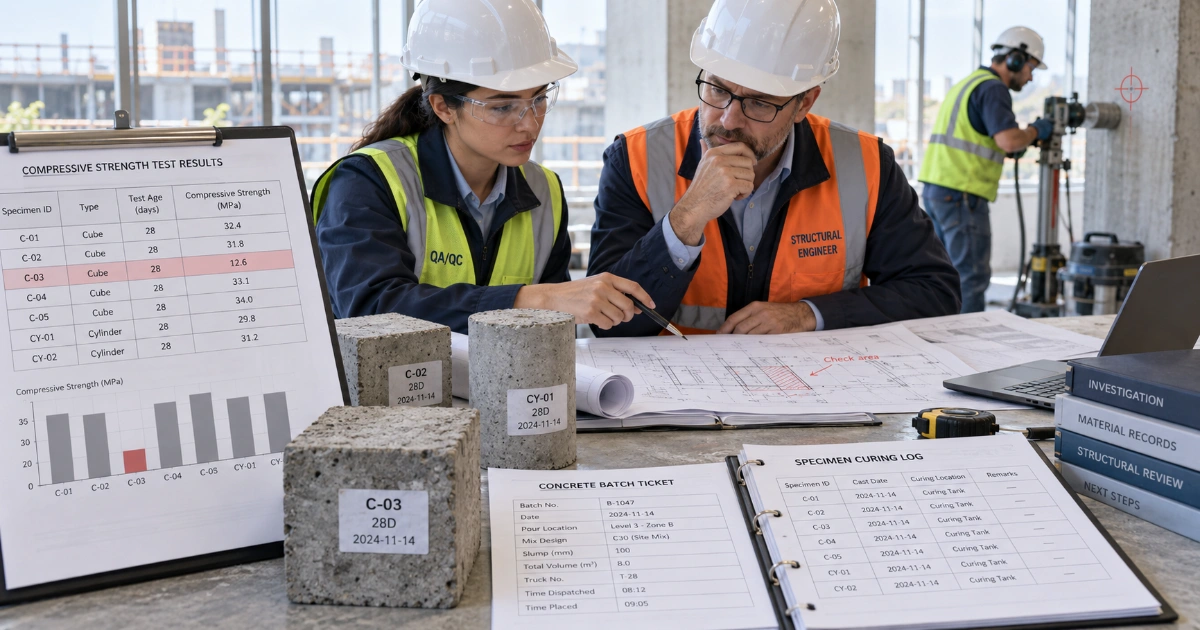
This distinction is one of the most important parts of concrete QA/QC. Treating every specimen as a separate contractual pass/fail result can create false nonconformances; ignoring an abnormal specimen can also hide a testing or concrete problem.
What counts as one ACI 318-25 strength test?
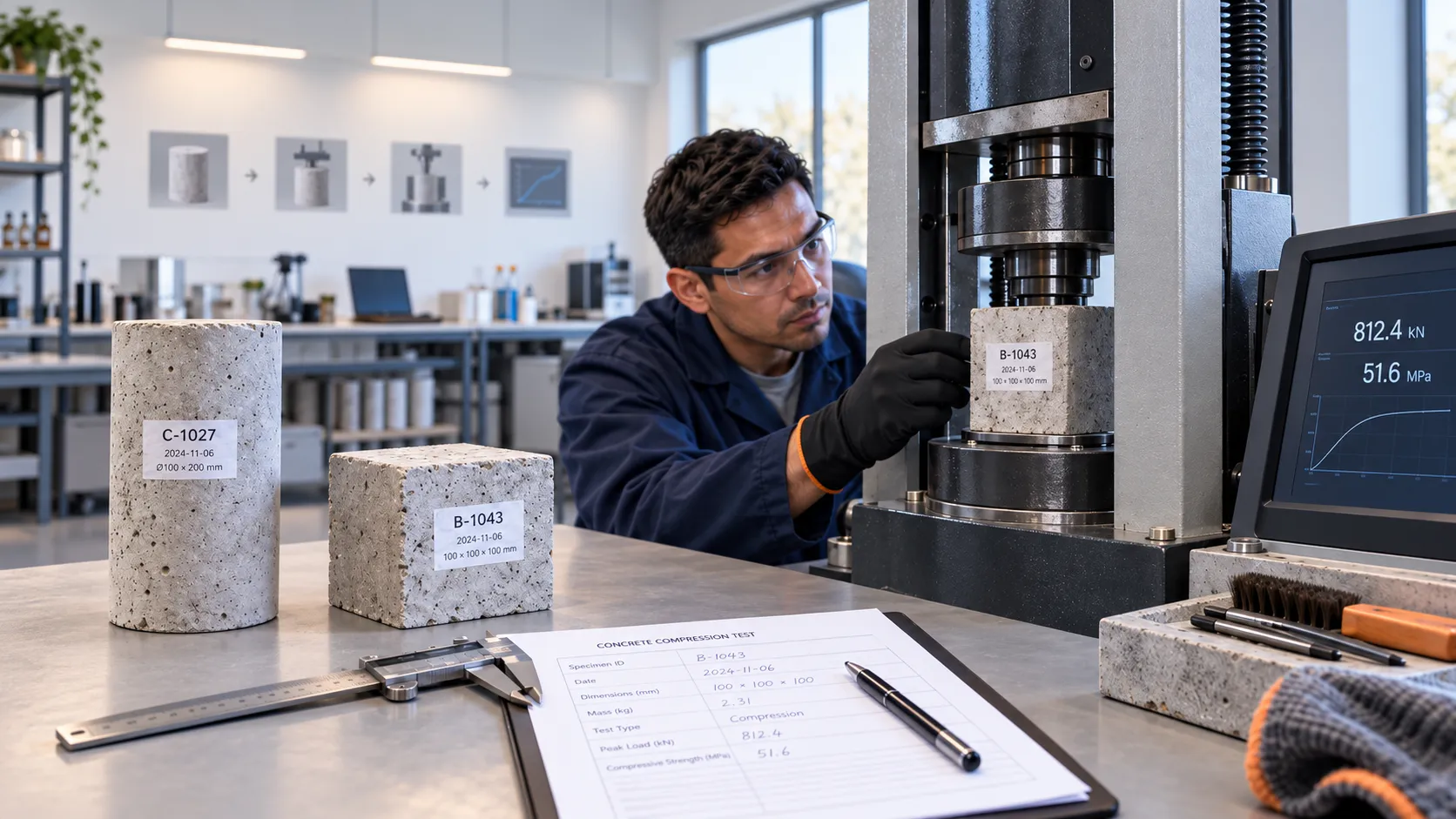
ACI CODE-318-25 Section 26.12.1.1(a) defines a strength test for standard-cured cylinders as the average compressive strength of at least two 4 × 8 in. (100 × 200 mm) cylinders or at least two 6 × 12 in. (150 × 300 mm) cylinders made from the same concrete sample, standard-cured in accordance with ASTM C31/C31M and tested in accordance with ASTM C39/C39M at 28 days or at the test age designated for f′c.
ACI 318-19 required at least three 4 × 8 in. cylinders for a strength test. ACI 318-25 now permits at least two cylinders for either the 4 × 8 in. or 6 × 12 in. size. This is worth checking because older project procedures and habits may still reflect the previous edition.
This means a single 4 × 8 in. break should not normally be treated as the complete ACI 318-25 strength test when the project is using the current code definition.
ACI CODE-318-25 acceptance criteria for standard-cured concrete specimens
ACI CODE-318-25 Section 26.12.3.1 provides the acceptance criteria for standard-cured specimens used to assess the strength level of a concrete mixture.
- Every average of any three consecutive strength tests must equal or exceed the specified compressive strength, f′c.
- No individual strength test may fall below f′c by more than 500 psi (3.5 MPa) when f′c is 5000 psi (35 MPa) or less; when f′c exceeds 5000 psi, no strength test may fall below f′c by more than 0.10f′c.
These two conditions do different jobs. The three-test average checks the ongoing strength level of production. The individual-test limit prevents an unusually low result from being hidden by stronger neighboring results.
For quick site use, the ACI individual-strength-test lower limit can be written as:
\[f_{\text{test,min}}=\begin{cases}f'_c-3.5\text{ MPa}, & f'_c \le 35\text{ MPa} \\0.90f'_c, & f'_c > 35\text{ MPa}\end{cases}\]This equation is only a compact restatement of the ACI criterion; it does not replace the governing code or project specification.
Example: specified strength 30 MPa
If f′c = 30 MPa, the three-test running average must be at least 30 MPa. In addition, no individual strength test may be more than 3.5 MPa below f′c, so an individual strength test below 26.5 MPa would fail that ACI individual-test criterion.
This does not mean every individual cylinder must individually exceed 30 MPa. The first question is how the strength test itself is defined and calculated.
Example: specified strength 50 MPa
For f′c above 35 MPa, the individual-test limit is based on 10% of f′c. With f′c = 50 MPa, an individual strength test should therefore not fall more than 5 MPa below the specified strength under this ACI criterion.
These are ACI CODE-318-25 criteria for standard-cured specimens. Do not transfer them automatically to field-cured specimens, EN/BS conformity assessment, precast production rules, shotcrete or a project that specifies a different acceptance procedure.
Standard-cured specimens and field-cured specimens serve different purposes
One frequent source of error is applying the standard-cured acceptance rule to field-cured cylinders. ACI commentary distinguishes them: field-cured specimens are used for construction decisions and to evaluate the effectiveness of curing and protection, while the standard-cured strength-test criteria are used to judge the strength level of the concrete mixture.
That distinction matters because a field-cured cylinder experiences a different temperature and moisture history and is not necessarily equivalent to the concrete inside the structural member.
If the question is whether specimen curing was representative or whether a documented curing deviation affected the result, see Improper Concrete Specimen Curing: Impact on Cube & Cylinder Test Strength.
How EN/BS concrete strength acceptance differs from ACI
Under the EN/BS route, concrete conformity is not evaluated by simply importing the ACI three-test rule. The current European concrete framework is split between BS EN 206-1:2026, which covers performance requirements, factory production control and assessment criteria for individual values, and BS EN 206-2:2026, which covers conformity assessment and certification.
EN/BS projects may also rely on national provisions, project specifications and the strength classes used by the structural design standard. In the UK, the current BS 8500 series provides complementary national guidance and requirements. The practical result is that the QA/QC engineer must identify the exact conformity procedure and adopted editions applicable to the project rather than assuming that one ACI threshold or one internet table applies internationally.
| Issue | ACI route | EN/BS route |
|---|---|---|
| Strength basis | Typically specified cylinder strength f′c. | Characteristic strength class may define cylinder and cube strengths within the code system. |
| Acceptance framework | ACI CODE-318 plus referenced ASTM test practices and project documents. | BS EN 206 conformity framework plus project/national requirements and referenced testing standards. |
| Can criteria be mixed? | No. Use the adopted ACI/project basis. | No. Use the adopted EN/BS/project basis. |
Specified strength, characteristic strength and measured strength are different concepts
Another common mistake is treating every strength value on a drawing, mix submittal or test certificate as though it means the same thing.
- Specified compressive strength is the design/project value against which a code's acceptance procedure may be applied.
- Characteristic strength is a statistical strength definition used by many standards and strength-class systems.
- Measured specimen strength is the laboratory result from a particular cube or cylinder.
- Required average strength for mixture proportioning is normally higher than the specified or characteristic strength so that routine production variability does not cause frequent noncompliance.
The acceptance system links these concepts. They should not be collapsed into a simple rule that every measured specimen must be above the design strength.
What test age governs acceptance?
The governing acceptance age is the age defined by the project documents and applicable standard. Twenty-eight days is common, but it is not universal.
A 7-day result is often used as an early indicator of strength development. It should not be turned into an acceptance rule by assuming that every concrete must achieve 70% of its 28-day strength by day 7.
For that distinction, see 7-Day vs 28-Day Concrete Strength: What the Results Actually Mean.
Cube and cylinder acceptance values must stay on the correct strength basis
Cube and cylinder strengths from the same concrete can differ because specimen geometry and platen restraint influence the measured result. A project that specifies cylinder strength should therefore not be checked against a cube result by applying an informal 0.8 or 0.85 multiplier after the test.
Likewise, code-defined paired cube and cylinder strength classes do not establish one universal conversion factor for every measured result.
See Concrete Cube vs Cylinder Strength: Why the 0.8 Rule Can Mislead before converting between specimen systems.
The compression test must be valid before acceptance criteria are applied
Acceptance mathematics cannot rescue a bad test. Before using a result for contractual acceptance, verify that sampling, specimen preparation, curing, test age, dimensions, end condition, loading and calculation were performed under the required procedure.
ASTM C39/C39M states that measured compressive strength depends on specimen size and shape, sampling, molding and fabrication, and age, temperature and moisture conditions during curing. It is therefore important to separate a genuine low-strength result from an abnormal specimen or test.
For the detailed procedure, see How to Perform a Concrete Compressive Strength Test: Cubes & Cylinders.
What should happen when an ACI 318-25 acceptance criterion is not met?
A failed acceptance criterion is a trigger for action; it is not permission to invent a new calculation after the fact. ACI 318-25 distinguishes between a production-strength trend problem and the more serious individual lower-limit breach.
| ACI result | Immediate meaning | Typical next action |
|---|---|---|
| Three-test running average below f′c | The strength level of production is not satisfying the acceptance requirement. | Take steps to increase subsequent strength-test results and follow the project nonconformance/corrective-action procedure. |
| Individual strength test below the ACI lower limit | The low-strength test must be investigated under the ACI low-strength provisions. | Verify the test and traceability, then proceed with the investigation directed by the responsible design/project professionals. Core testing may form part of that investigation. |
Start by confirming specimen identity, test age, cylinder set, curing, laboratory records and the affected pour. If the individual lower-limit criterion is breached, ACI CODE-318-25 Section 26.12.7 provides the low-strength investigation pathway.
When drilled cores are used, they are obtained and tested in accordance with ASTM C42/C42M. Under the ACI 318-25 core adequacy criterion, concrete represented by three cores is considered structurally adequate when the average of the three cores is at least 85% of f′c and no individual core is below 75% of f′c.
First confirm that the governing ACI acceptance criterion was actually breached and that the original strength test is valid. Core locations, quantity, drilling constraints and interpretation should be defined as part of the engineering investigation.
For the full investigation sequence after a low result, see Low Concrete Compressive Strength: What to Do Before You Reject the Concrete.
Do not average away a genuinely low result
A running-average criterion does not mean that any low result can be ignored. Acceptance systems commonly combine a statistical average requirement with a lower limit on individual tests precisely to stop strong neighboring results from masking an abnormally weak test.
The correct workflow is to apply all applicable criteria in the order required by the governing standard. Do not create extra averaging groups, omit inconvenient tests or change the sampling sequence after results become known.
Common acceptance mistakes on construction projects
- Comparing one cylinder directly with f′c without checking how one strength test is defined.
- Treating one low specimen as automatic rejection when the specification evaluates a test set or statistical series.
- Ignoring an individual-test lower limit because the running average is acceptable.
- Using ACI criteria on an EN/BS project without contractual basis.
- Using a cube result against a cylinder requirement with an assumed conversion factor.
- Using 7-day strength as a universal pass/fail criterion.
- Applying standard-cured acceptance criteria to field-cured specimens.
- Changing the acceptance rule after the result is known.
- Ignoring a specimen or laboratory deviation because the numerical result happens to pass.
Practical acceptance workflow
Identify governing code/specification → confirm specimen type and strength basis → confirm what constitutes one strength test → confirm acceptance age → verify test validity → apply every required acceptance criterion → record compliant result or open the required investigation/nonconformance pathway.
References
ACI CODE-318-25 – Building Code for Structural Concrete
ASTM C39/C39M-26 – Standard Test Method for Compressive Strength of Cylindrical Concrete Specimens
BS EN 206-2:2026 – Concrete: Conformity assessment and certification
BS 8500-1:2023 – Concrete: Complementary British Standard to BS EN 206