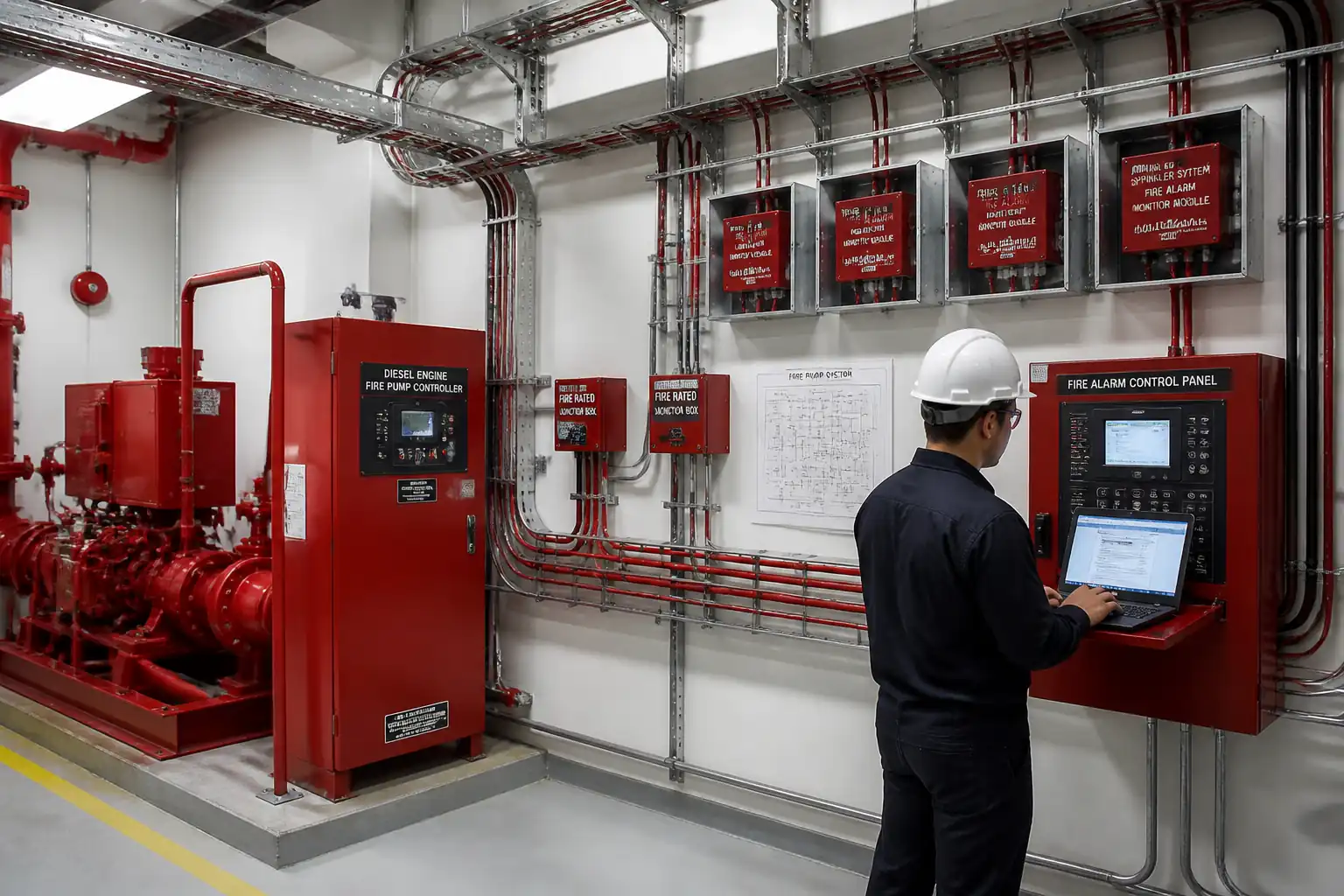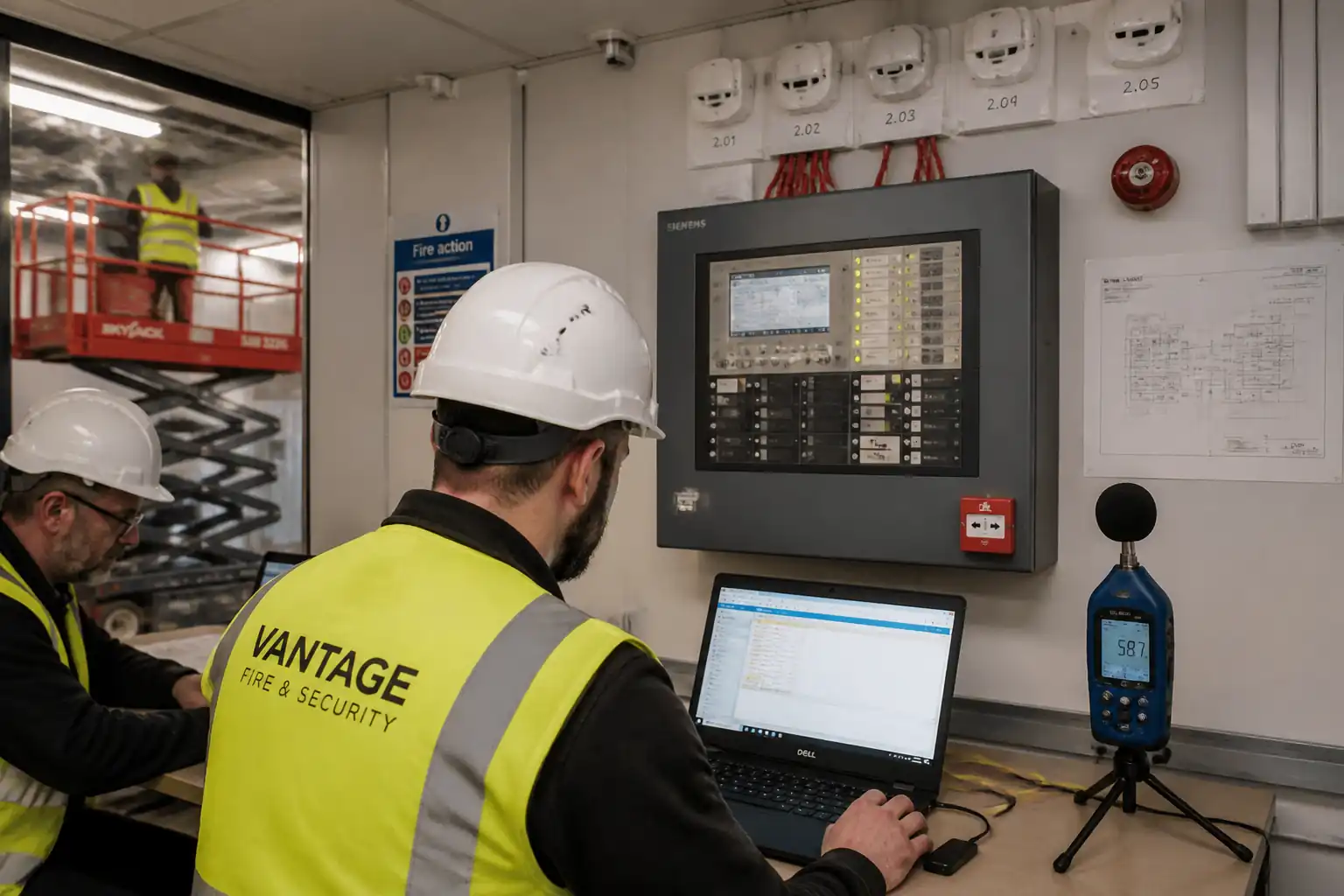

Method Statement: Final Testing and Commissioning of Fire Alarm System – Method Statement
AI-assisted method statement with matching ITP, PDF download, and Excel export.
More than a static template
Unlike a downloadable Word or PDF template, this method statement is an AI-assisted editable starting point connected directly to a matching Inspection and Test Plan. Every section is structured, project-adaptable, and ready to export.
- AI-assisted drafting — Customize every section with AI for your specific project scope.
- Linked ITP — A matching inspection and test plan is generated alongside the method statement.
- Multiple export formats — Download as a formatted PDF or editable Excel spreadsheet.
- Editable starting point, not a final document — Review, verify, and adjust all content against your project requirements before use.
Static template vs. Quollnet workflow
| Feature | Static template | Quollnet |
|---|---|---|
| Project-specific content | Manual fill-in required | AI-assisted customization |
| Linked ITP | Separate document, no link | Matching ITP included |
| Export formats | Usually PDF only | PDF and Excel |
| Structured sections | Free-form layout | 13 standardized sections |
| Saved to your account | Local file only | Cloud-saved, reusable |
| Content accuracy | You verify everything | AI-assisted, you still verify |
| Cost | Often free but time-intensive | Free to customize and download |
What you can customize
When you save this method statement to your account, every section becomes editable. The following 13 sections are included:
- Scope — Defines the activity and its boundaries.
- References — Standards, specifications, and drawings.
- Responsibilities — Roles and accountabilities.
- Resources — Labour, plant, and equipment summary.
- Materials — Materials and compliance requirements.
- Equipment — Tools and equipment details.
- Prerequisites — Hold points and pre-conditions.
- Method sequence — Step-by-step construction sequence.
- Safety controls — HSE risk controls and PPE.
- Environmental controls — Environmental mitigation measures.
- QA/QC — Quality inspection and test requirements.
- ITP — Inspection and Test Plan table (has its own page).
- Attachments — Referenced drawings and documentation.
Why this method statement is used
This method statement is used to define and communicate the approved procedure for carrying out method statement: final testing and commissioning of fire alarm system on site. It ensures the work is planned in advance, the correct resources and controls are in place, and all personnel understand responsibilities, sequence, quality requirements, and safety controls before work begins. It aligns site execution with the documented scope and acceptance expectations.
Who uses this method statement
This method statement is used by contractors, site supervisors, project engineers, QA/QC engineers, HSE officers, consultants, and client representatives. It serves as a shared reference for planning, execution, supervision, inspection, and approval of the activity on site.
When it is prepared and submitted
The method statement is prepared before the work activity starts and submitted as part of the pre-construction documentation package for review and approval.
Who reviews or approves it
The method statement is usually submitted to the client representative, consultant, resident engineer, or project management consultant for review and approval before the work commences.
Important approval note
This method statement is an AI-assisted editable starting point, not a pre-approved document. Before use on any project, all content must be reviewed and approved by the relevant parties (superintendent, principal contractor, or client representative) in accordance with your contract and project quality plan.
For example: if your specification requires a departure from a referenced standard, that departure must be documented and approved separately — this method statement will not capture that automatically. Always verify against your applicable drawings, specifications, and regulatory requirements.
Method statement content
Scope
Scope of Works
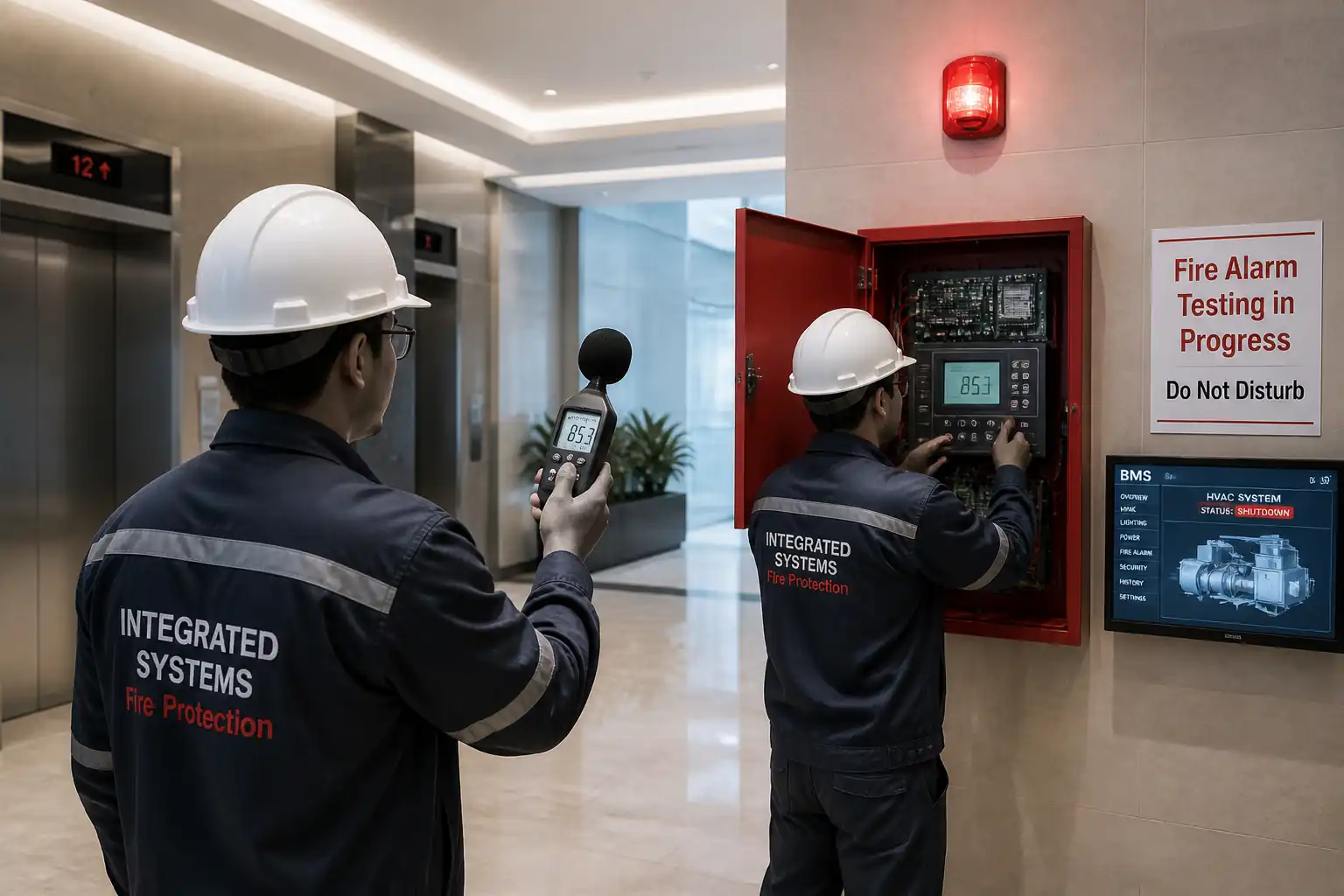
- Final Testing and Commissioning (T&C) of the addressable fire detection and alarm system (FDAS), including: control and indicating equipment (CIE), field devices (smoke, heat, multi-sensor detectors, manual call points, interfaces, modules), notification appliances (sounders, beacons, speakers), fire telephones/warden intercoms (if applicable), graphic workstation, networked/peer-to-peer panels, and all integrated interfaces (HVAC shutdown/smoke control, dampers, lifts/elevators recall, access control door release, fire pump and sprinkler monitoring, gas suppression, generators, BMS/monitoring station).
- 100% device functional testing and labelling verification, complete Cause-and-Effect (C&E) testing, panel functionality, fault/alarm routing, audibility, and (if applicable) voice alarm intelligibility.
- Fault simulation (open, short, ground/earth) and isolator operation checks.
- Power supply verification including battery sizing, charger operation, and autonomy checks.
- Witnessing by Consultant/Authority (e.g., Civil Defense/Fire Marshal) as required by contract.
- Snag listing, rectification, retesting, issuance of test certificates, training of operations staff, submission of as-built/O&M and handover records.
- Exclusions: Installation works, pre-termination IR testing before device connection (performed during pre-commissioning), third-party OEM start-up of non-FA systems except as interface verification. Any hot works are excluded.
Note: Where project-specific criteria are required but not provided, recognized benchmarks or typical ranges are stated with the tag [Verify per project specifications].
References
| Document Type | Reference / Number | Revision | Notes |
|---|---|---|---|
| Standard | NFPA 72 (latest adopted edition) [Verify edition] | ||
| Standard | BS 5839-1:2017+A2:2020 [Verify edition] | BS 5839-8 for voice alarm where applicable | |
| Standard | EN 54 series; ISO 7240 series [Verify applicable parts] | ||
| Standard | IEC 61672-1 Class 1 or Class 2 SLM | For audibility and intelligibility measurements | |
| Standard | IEC 60364-6; BS 7671 [Verify jurisdiction] | Used for general verification principles where applicable | |
| Manual | Approved OEM manuals (project-specific) | Shall be at latest firmware/software release approved for project | |
| Contract Docs | Project Contract and IFC/Approved Shop Drawings | Governing documents [Verify per project] | |
| Authority Requirements | Civil Defense/Fire Marshal procedures [Verify jurisdiction] |
Responsibilities
| Role | Responsibility | Name / Party |
|---|---|---|
| PM | Ensure approvals, schedule witnessing, allocate budget and manpower | Main Contractor |
| CxM | Plan T&C, coordinate disciplines, approve checklists, manage defects/closure | Main Contractor |
| FA Engineer | Execute tests, verify C&E, rectify snags, produce test certificates | Specialist Subcontractor |
| QA/QC | Witness internal tests, compile records, coordinate Consultant inspections | Main Contractor |
| HSE | Issue permits, monitor PPE and controls, manage impairment procedures | Main Contractor |
| Technicians | Assist tests, isolation/LOTO, cabling checks | Specialist Subcontractor |
| OEM Rep | Attend key tests, validate programming per OEM | Vendor |
| Consultant/Authority | Attend notified tests, review results, issue comments/approvals | Employer/Authority |
| Doc Control | Compile T&C dossier, O&M, as-builts, certificates | Main Contractor |
Resources
| Resource Type | Description | Quantity | Remarks |
|---|---|---|---|
| Manpower | Commissioning Manager + Fire Alarm Engineer + 2–6 technicians [Verify] | 1 team | |
| Manpower | HSE Officer for site + First Aider | As per HSE Plan | |
| Manpower | Licensed MEWP/lift operator | As required |
Materials
| Material | Specification / Grade | Quantity | Remarks |
|---|---|---|---|
| Aerosol | Per OEM | Sufficient for 100% devices | |
| Heat tester | Per OEM | 1–2 sets | |
| Plastic/metal | Per zone | ||
| Various | EN 54/UL listed | As per contract spares | |
| Battery | NFPA/BS compliant | As per panel design | |
| Signage | As required |
Equipment
| Equipment | Capacity / Type | Quantity | Inspection Required |
|---|---|---|---|
| Laptop | 1 | ||
| DMM | 1–2 | ||
| IR Tester | 1 | ||
| Analyzer | 1 | ||
| SLM | 1 | ||
| As needed | |||
| MEWP/Ladders | As required | ||
| Radios | Per team | ||
| LOTO | As required |
Prerequisites
Documentation and Approvals
- Approved shop drawings, panel schedules, device addressing lists, Cause-and-Effect (C&E) matrix, network topology, and as-built markups.
- Approved Method Statement and ITP for T&C; Risk Assessment/Job Hazard Analysis.
- Manufacturer O&M manuals and programming tools available; latest approved firmware/software.
- All installation works complete, visually inspected, and pre-functional tests done (continuity, polarity, correct terminations, device mounting/height/location, labeling).
- Calibrated instruments and valid certificates (SLM, multimeter, acoustic calibrator, gas/heat testers).
Permits and Notifications
- Permit-to-Work (PTW) issued; impairment plan for fire alarm during testing; fire watch and temporary measures arranged if required.
- Stakeholder notification plan issued: building occupants, security, facility management, and Authority/Consultant. Signage to indicate testing in progress.
Site Conditions
- Permanent power available and stable; UPS/batteries installed/connected.
- Access provisions (keys, access platforms) arranged; ceilings closed or coordinated for re-access.
- Third-party systems ready for interface testing (HVAC, smoke control, dampers, lifts, access control, sprinklers/pumps, gas suppression, generators, BMS).
Method Sequence
| Step | Activity | Description | Responsibility | Inspection / Hold Point |
|---|---|---|---|---|
| 1 | Pre-Commissioning Verification | Review approved C&E, point list, drawings; verify installation completion, labels, terminations, and device cleanliness. | FA Engineer / QA-QC | Surveillance |
| 2 | System Energization & Panel Health | Power up panels; verify mains input, charger output, battery connection and voltage; clear historical events; set time/date; verify network health. | FA Engineer | Witness (Internal) |
| 3 | Loop Integrity & Address Verification | Run loop analyzer; confirm each address, type, location text; check isolator spacing/operation readiness; verify mapping to zones/graphics. | FA Engineer | Witness (Internal) |
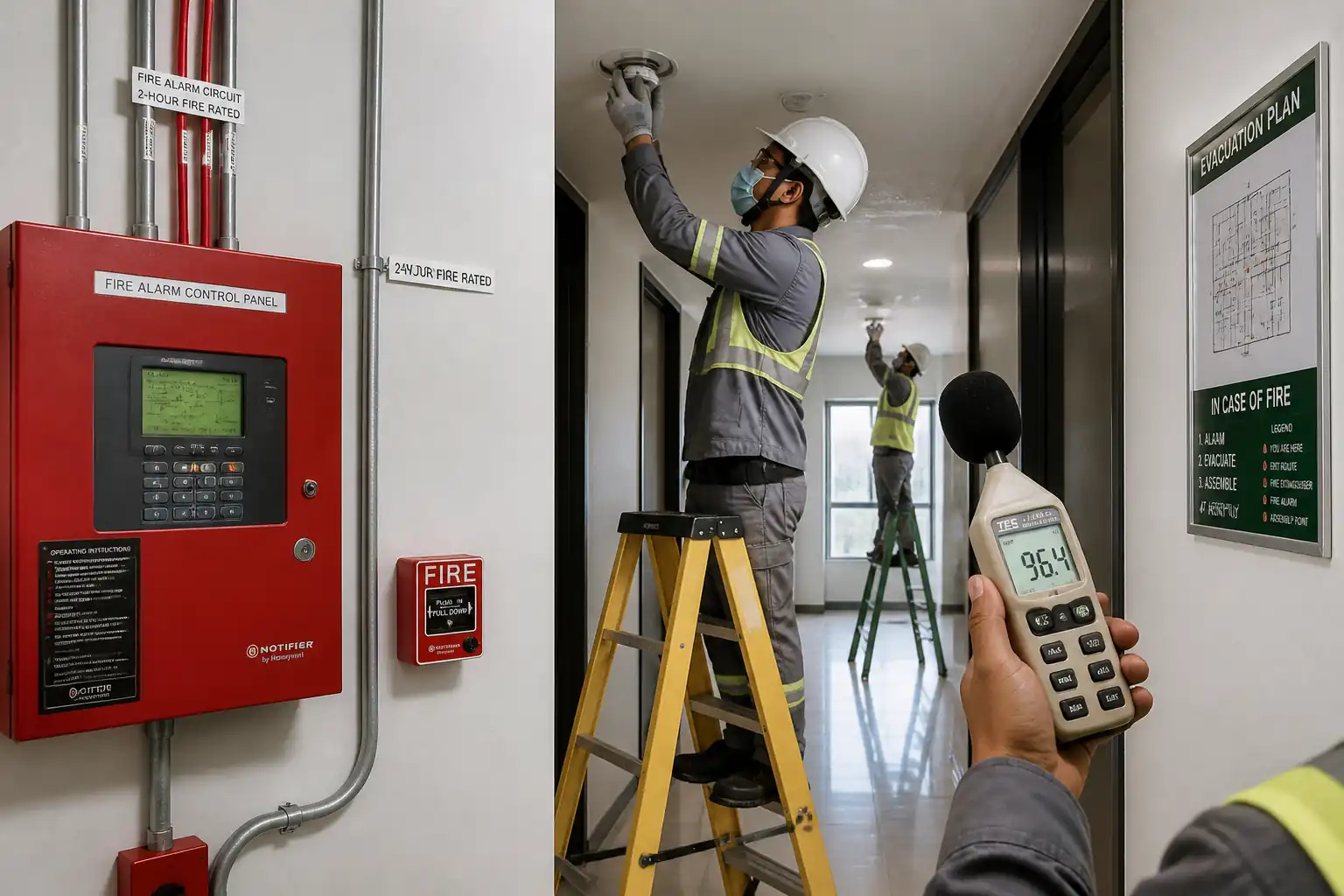
| 4 | Device Functional Testing – Detectors | Activate each detector with approved tester (smoke/heat as applicable). Observe LED, panel event, location text, and programmed outputs. | FA Engineer + Technician | WITNESS (Consultant optional) |
| 5 | Device Functional Testing – Manual Call Points (MCP) | Activate each MCP using test key/element; verify panel alarm, location text, and outputs. | Technician under FA Engineer | WITNESS (Consultant optional) |
| 6 | Notification Devices – Sounders/Beacons | Activate alarm per zone/area; measure sound levels using SLM at representative locations; verify beacon visibility. | FA Engineer | WITNESS (Consultant) |
| 7 | Voice Alarm/EVCS (if applicable) | Test message activation, zoning, emergency microphone, and measure STI-PA where specified. | FA Engineer + Audio Specialist | WITNESS (Consultant) |
| 8 | Fault Simulation & Isolation | Introduce open, short, and earth/ground faults on each loop; operate isolators; verify panel fault annunciation, location, and auto-recovery. | FA Engineer | WITNESS (Consultant optional) |
| 9 | Interface Testing – Sprinkler/Fire Pump | Stimulate sprinkler flow switch via test connection; confirm alarm at panel within allowed retard; verify pump start and status feedback (where applicable). | FA Engineer + Fire Protection Team | HOLD (Consultant/Authority) |
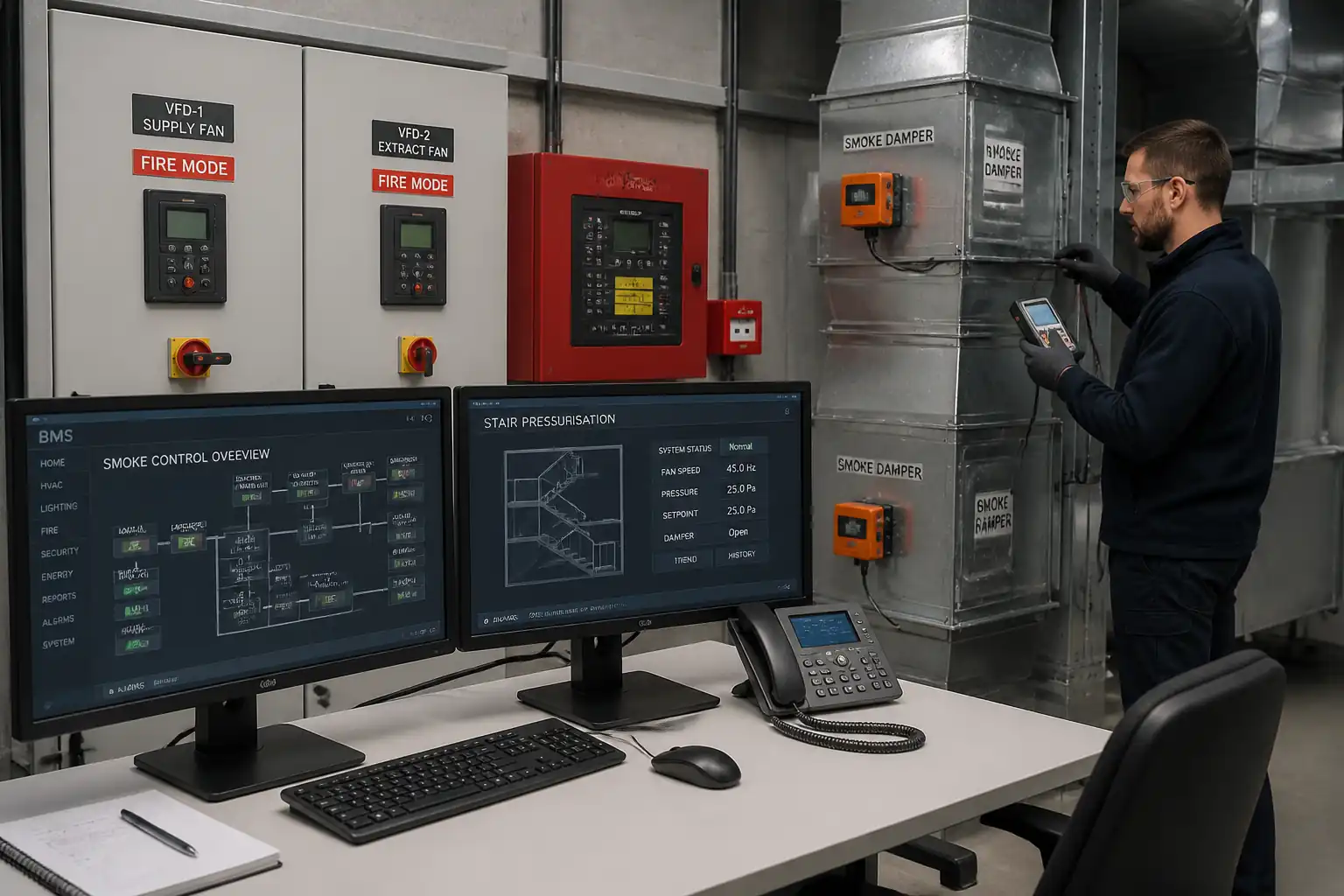
| 10 | Interface Testing – HVAC/Smoke Control/Dampers | Trigger programmed events; verify AHU shutdown, smoke control fan start/stop, damper closure/opening with end-switch feedback. | FA Engineer + MEP Controls | HOLD (Consultant) |
| 11 | Interface Testing – Lifts/Elevators | Initiate alarm by floor/zone; verify Phase I recall, shunt trip (if required), lobby indications, and fireman’s service per local code. | FA Engineer + Lift Contractor | HOLD (Consultant/Authority) |
| 12 | Interface Testing – Access Control/Doors | Trigger alarm; confirm fail-safe door release, magnetic hold-open release, and re-lock logic post-reset. | FA Engineer + Security Vendor | Witness (Consultant) |
| 13 | Interface Testing – Gas Suppression (if any) | Verify cross-zone detection, pre-discharge alarms, abort/hold, discharge signal, and post-discharge controls. | FA Engineer + Gas System Vendor | HOLD (Consultant/Authority) |
| 14 | Graphics/BMS/Monitoring Station | Verify event types, locations, and acknowledgments propagate to graphics/BMS/ARC; test network redundancy. | FA Engineer + BMS Vendor | Witness (Consultant) |
| 15 | Power Supply & Battery Autonomy | Verify charger float/boost; calculate battery capacity vs load; perform mains-fail test and timed alarm run per code. | FA Engineer | WITNESS (Consultant) |
| 16 | Cause-and-Effect (C&E) Verification – 100% | Walk through each C&E scenario; record outputs, delays, priorities, resets, and latching behavior. | Commissioning Manager + FA Engineer | HOLD (Consultant/Authority) |
| 17 | Defects/Snag Rectification & Retest | Log non-conformances; correct programming/wiring/device issues; perform targeted retests. | FA Engineer + QA/QC | Surveillance / WITNESS (as needed) |
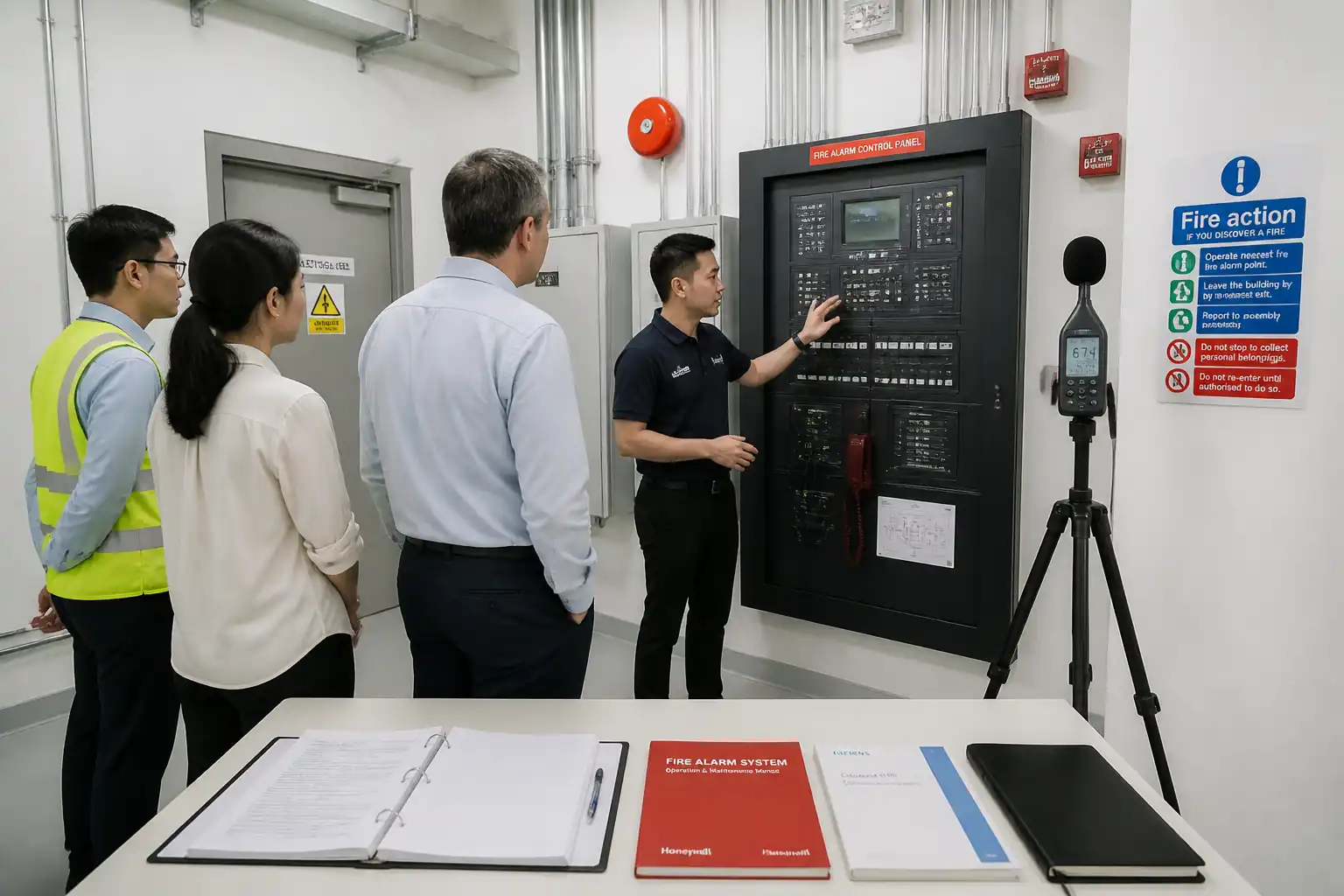
| 18 | Training of End-User/Facility Team | Deliver classroom and hands-on training for panel operation, emergency procedures, daily checks, and logbook use. | FA Engineer + OEM Rep | Witness (Client) |
| 19 | Final Documentation & Handover | Compile T&C dossier: certificates, calibrated readings, as-builts, C&E, panel configuration backups, warranties, spares, logbooks, and Authority approvals. | Document Controller + Commissioning Manager | HOLD (Consultant/Client) |
Health, Safety, and Environment (HSE) – Safety Controls
Task-Specific Hazards and Controls
- Hazard: Working at height (ladders/MEWP) to reach ceiling devices.
- Likely consequence: Falls leading to serious injury.
- Engineering/procedural control: Use inspected EN 131 ladders or certified MEWP; 3-point contact; prohibit overreach; set MEWP on firm ground; barricade area; use spotter.
- Required PPE: Hard hat with chin strap, safety shoes, fall arrest (MEWP per anchor), gloves.
- Collective preventive measure: Edge protection, MEWP guardrails, exclusion zones.
-
Inspection/permit/supervision: Pre-use ladder/MEWP checks, valid LOLER certificate [Verify], PTW for MEWP; supervisor sign-off.
-
Hazard: Live low-voltage circuits and batteries.
- Likely consequence: Electric shock, arcing, burns.
- Engineering/procedural control: De-energize circuits before re-termination; apply LOTO; use insulated tools; cover exposed terminals; observe OEM polarity.
- Required PPE: Insulated gloves, eye protection.
- Collective preventive measure: Barriers at panels, lockable covers.
-
Inspection/permit/supervision: Electrical PTW; LOTO log; competent person supervision.
-
Hazard: High sound levels during alarm tests.
- Likely consequence: Temporary or permanent hearing damage.
- Engineering/procedural control: Pre-notify occupants; limit test duration; stagger zones; monitor dB(A); schedule off-peak.
- Required PPE: Ear defenders/earplugs for test team.
- Collective preventive measure: Area notices, temporary hearing protection stations.
-
Inspection/permit/supervision: HSE monitoring; keep dB logs.
-
Hazard: Use of aerosol smoke and heat testers.
- Likely consequence: Respiratory irritation, flammability risk (depending on product), hot-surface burns.
- Engineering/procedural control: Use OEM-approved, non-flammable aerosols where available; ventilate post-test; follow safe distance/time; avoid spraying near open flames.
- Required PPE: Safety glasses, gloves, disposable masks if required.
- Collective preventive measure: Local ventilation and spill kits.
-
Inspection/permit/supervision: COSHH/MSDS review; canister expiry check.
-
Hazard: Interface testing triggers plant movement (fans/dampers/lifts).
- Likely consequence: Crush/entrapment, unexpected equipment start.
- Engineering/procedural control: Coordinate lock-out of mechanical hazards where needed; barricade moving equipment zones; clear communication on radios.
- Required PPE: Hard hat, gloves, high-vis vest.
- Collective preventive measure: Interlock verification before entry, signage and barriers.
-
Inspection/permit/supervision: PTW for mechanical systems; vendor supervision.
-
Hazard: Impairment of fire alarm during testing.
- Likely consequence: Reduced life safety.
- Engineering/procedural control: Implement impairment plan; temporary fire watch; portable extinguishers available; minimize impairment window; record start/stop times.
- Required PPE: Standard site PPE.
- Collective preventive measure: Building-wide notices, dedicated fire watch personnel.
-
Inspection/permit/supervision: Impairment permit; coordinate with security/FM; [Verify per project HSE plan and local regulations].
-
Hazard: Strobe lighting may induce seizures for photosensitive individuals.
- Likely consequence: Health incident.
- Engineering/procedural control: Advance warnings; allow opt-out from areas; minimize exposure time.
- Required PPE: N/A.
- Collective preventive measure: Signage at entrances.
- Inspection/permit/supervision: HSE monitoring and first-aid readiness.
Environmental Controls
Environmental Risk Controls
- Aerosol emissions: Use OEM-approved low-VOC, non-flammable test aerosols where possible; avoid overuse; ventilate areas; store/transport per MSDS; return empty cans for proper recycling.
- Battery handling/disposal: Handle lead-acid batteries carefully; avoid shorting; collect and dispose/recycle via licensed waste handler; spill kit for electrolyte leaks.
- Noise: Schedule loud tests off-peak; limit duration; doors/windows closed to reduce community noise.
- Dust/smoke perception: Inform occupants that visible test smoke may trigger nuisance; protect sensitive equipment with covers where necessary and remove immediately after.
- Energy use: Optimize test sequences to reduce prolonged plant runs; shut down test setups promptly when complete.
- Documentation: Keep environmental records and waste transfer notes. [Verify per project HSE plan and local regulations].
Quality Assurance / Quality Control
QA/QC Controls
- Instruments: All test equipment shall have valid calibration certificates (≤12 months unless otherwise specified). Acoustic calibrator used before/after SLM surveys with readings documented.
- Testing coverage: 100% of detectors, MCPs, interfaces, notification devices, and C&E scenarios tested. Sampling is not permitted for life-safety acceptance unless approved by the Authority/Consultant in writing.
- Labels and documentation: Each point ID shall match drawings and panel text. Deviations logged and corrected with as-built updates.
- Measurements and tolerances: Audibility per governing code (BS 5839-1 or NFPA 72). Voice intelligibility STI target typically ≥0.5 [Verify]. Waterflow retard ≤90 s typical [Verify]. Panel/loop fault indication and recovery per OEM/standard [Verify]. IR for unterminated cables ≥2 MΩ at 250 V DC typical [Verify].
- Software configuration control: Maintain version control; back up panel databases before and after final acceptance; store with T&C dossier.
- NCR/Snag control: Use standardized snag forms with category/severity; close all Category A/B prior to acceptance; obtain Consultant sign-off for any residual minor items.
- Records: Use controlled forms for each test type; include device IDs, timestamps, testers’ names/signatures, witness signatures, instrument serials, and calibration due dates.
- Training and O&M: Provide user manuals, quick-reference guides, and training attendance certificates.
- Handover readiness: No standing faults; all disablements/isolations cleared; logbook initiated; spare parts and keys handed over.
Acceptance Criteria Summary [Verify per project specifications]
- 100% device and interface functionality proven per approved C&E.
- Audibility and, if applicable, intelligibility meet code/contract.
- Power supply autonomy compliant with code-calculated capacity.
- Consultant/Authority witness approvals received; all snags closed.
- Complete T&C dossier submitted and accepted.
Attachments
Attachments (to be included in T&C Dossier)
- Approved Cause-and-Effect Matrix (signed).
- Device Address/Location Schedule and As-Built Drawings (PDF + native formats).
- Panel Configuration Backups and Version Report.
- Pre-Commissioning and Commissioning Checklists (completed and signed).
- Audibility and Intelligibility Survey Reports with SLM/Calibrator certificates.
- Interface Test Certificates (Sprinkler/Fire Pump, HVAC/Smoke Control, Dampers, Lifts, Access Control, Gas Suppression, BMS/ARC).
- Power/Battery Calculation and Test Reports.
- Fault/Isolation Test Logs.
- Snag/Defect List and Closure Report.
- Training Materials, Agenda, and Attendance Sheets.
- Manufacturer O&M Manuals, Warranties, and Spare Parts List.
- Authority/Consultant Witness and Approval Certificates.
- Fire Alarm Logbook initialized with first entries.
This content is a read-only public reference. Download or customize to get an editable version.
ITP preview
The first inspection activities from the linked ITP for Method Statement: Final Testing and Commissioning of Fire Alarm System:
| Activity | Inspection / Test | Acceptance Criteria | Responsibility | Record |
|---|---|---|---|---|
| Documentation Review | Verify approvals: drawings, C&E, point list, OEM manuals, calibration certs | All documents approved/current; instruments in calibration | QA/QC Engineer | ITP Check Record |
| Visual Inspection & Labeling | Device location/height/labels; accessibility | Conforms to drawings and code; labels legible and durable | QA/QC Engineer | Visual Inspection Checklist |
| Panel Power-Up and Health | Panel self-tests; charger/battery voltage; event log clear | Panel in normal; no faults; correct time/date | FA Engineer | Panel Start-up Sheet |
Showing 3 of 19 inspection activities. View full ITP →
Related Inspection and Test Plan
An Inspection and Test Plan (ITP) is available for Method Statement: Final Testing and Commissioning of Fire Alarm System. The ITP defines the inspection activities, acceptance criteria, hold and witness points, responsible parties, and records required to verify the work described in this method statement.
View the Method Statement: Final Testing and Commissioning of Fire Alarm System ITP →Frequently asked questions
Continue with related Quollnet resources connected to this method statement.