
Inspection and Test Plan for Method Statement: Fire Alarm Cause-and-Effect Testing and Integrated Life-Safety Interface Verification
AI-assisted inspection and test plan connected to a method statement, with PDF and Excel export.
More than a static template
Unlike a downloadable Word or PDF template, this ITP is an AI-assisted editable starting point directly connected to its method statement. Every inspection activity, hold point, and acceptance criterion is structured and ready to adapt to your project.
- AI-assisted customization — Tailor inspection activities and acceptance criteria to your specific project scope.
- Linked method statement — This ITP is connected to the corresponding method statement describing the work sequence.
- Multiple export formats — Download as a formatted PDF or editable Excel spreadsheet.
- Editable starting point, not a final document — Review and verify all content against your project specifications and standards before use.
What you can customize
When you save this ITP to your account, every inspection row becomes editable. You can add, remove, or modify:
- Inspection activity — Description of what is being inspected.
- Inspection type — Hold point (H), Witness point (W), Review (R), or Monitor (M).
- Responsibility — Contractor, subcontractor, engineer, or client.
- Frequency — How often the inspection occurs.
- Acceptance criteria — Referenced standard or specification requirement.
- Records — Forms, test reports, or checklists required as evidence.
Why this ITP is used
To provide structured, auditable verification that the fire alarm system and all programmed effects function correctly and meet code and project requirements.
Who uses this inspection and test plan
Commissioning managers, fire alarm specialists, BMS and elevator vendors, Consultants/Client, and the AHJ.
When this ITP is prepared and submitted
During commissioning prior to handover and as part of regulatory acceptance testing.
Who receives or approves this ITP
Consultant/Client and AHJ as required.
Inspection scope
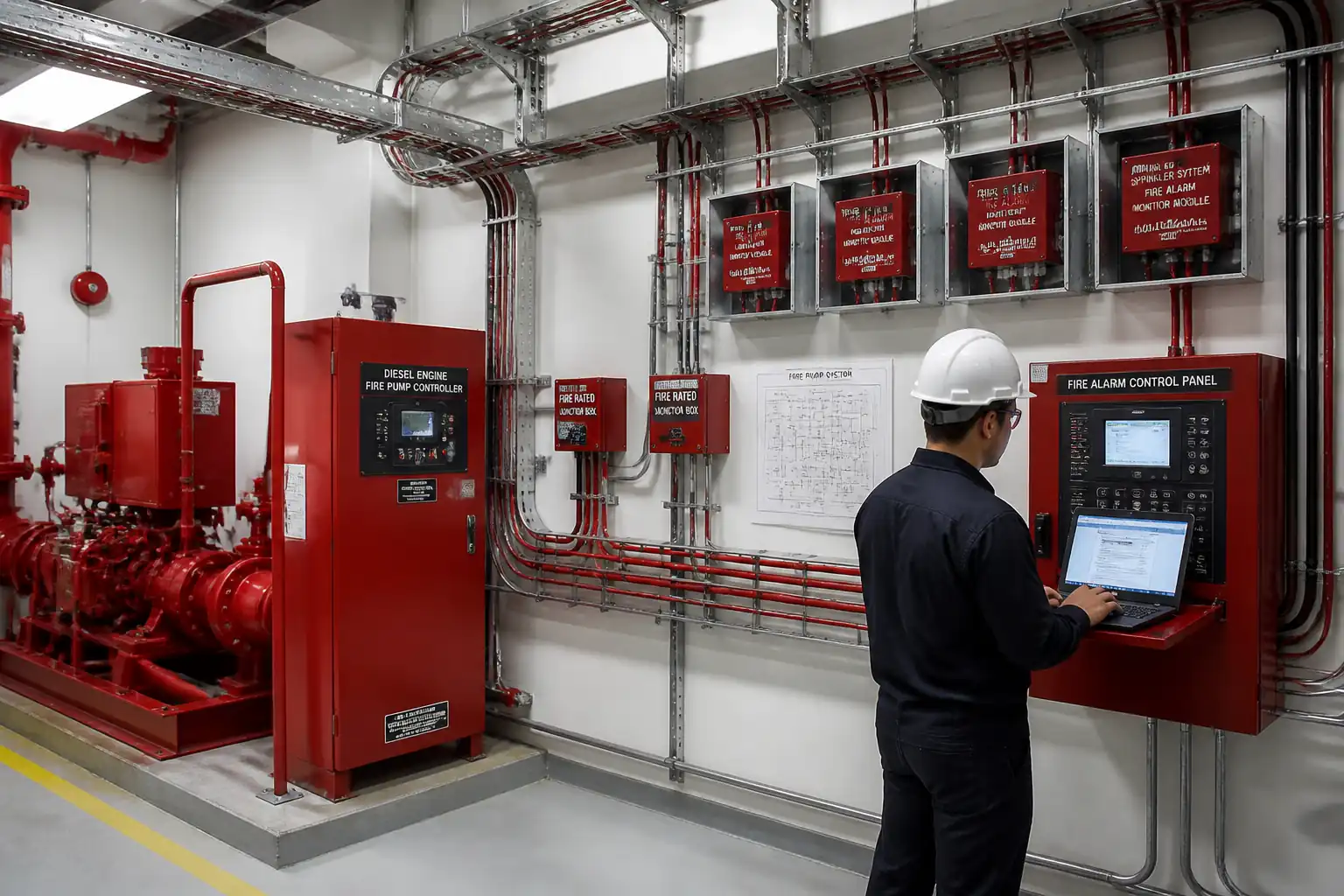
Documentation checks, 100% device tests, notification performance, HVAC/shutdown, smoke control, elevator recall, door releases, firefighting system monitoring, remote signaling, and integrated scenarios.
Typical hold, witness, and review points
Hold: Pre-test approvals and final sign-off. Witness: Device tests, interfaces, and integrated scenarios.
Typical inspection records
Pre-test checklist, test sheets, SLM logs, BMS trends, lift forms, ARC receipts, NCR log, retest sheets, final certificate.
Important approval note
This ITP is an AI-assisted editable starting point, not a pre-approved document. Before use on any project, all inspection activities, hold points, and acceptance criteria must be reviewed and approved by the relevant parties (superintendent, principal contractor, or client representative) in accordance with your contract and project quality plan.
Always verify acceptance criteria against your applicable drawings, specifications, and regulatory requirements. Hold points must be confirmed with the relevant authority before work proceeds past that point.
Inspection and test plan
| Activity | Inspection / Test | Acceptance Criteria | Responsibility | Record |
|---|---|---|---|---|
| Pre-test Documentation & Approvals | Check approved C&E matrix, drawings, permits, calibration certs | All approvals current; instruments in calibration; permits active | Commissioning Manager | Pre-test checklist; approvals register |
| Panel Health & Configuration Backup | Panel shows normal; print/save current configuration and device list | No faults/isolations beyond planned; config archived | Fire Alarm Engineer | Panel printouts; config file backup |
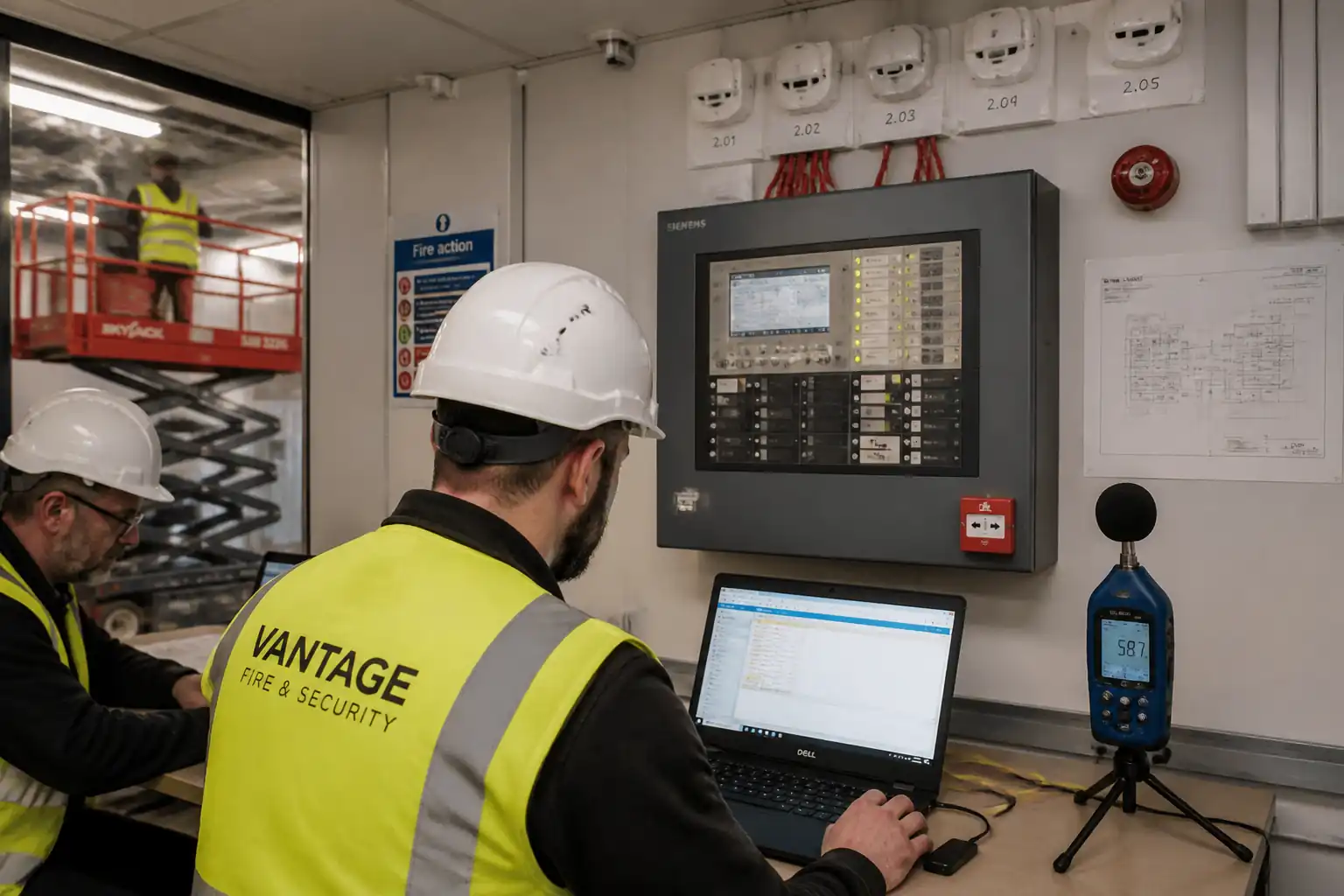
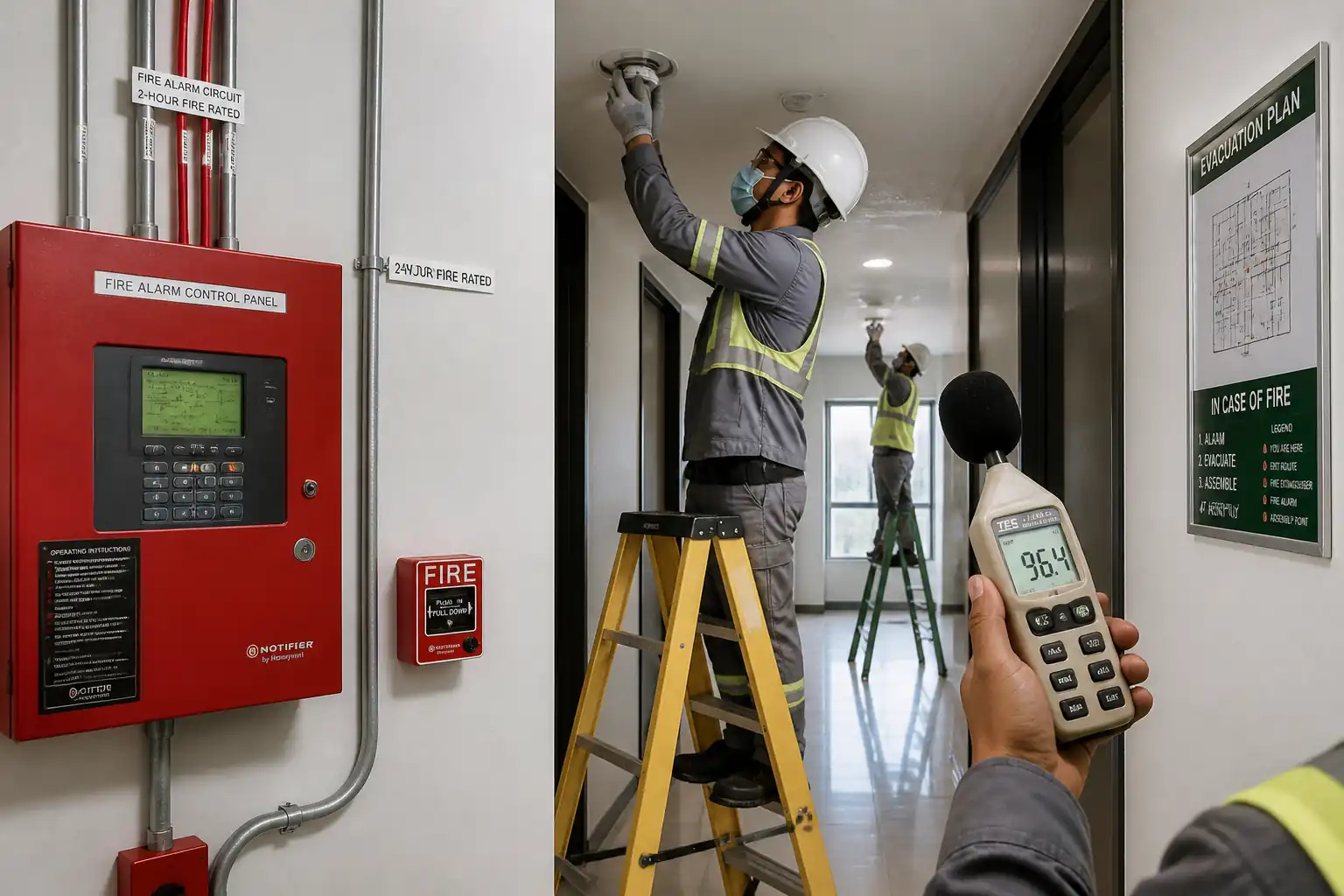
| Initiating Devices Functional Test (100%) | Stimulate MCPs, smoke/heat/beam/aspirating/duct detectors | Correct event type and location displayed; event within typical ≤10 s [Verify]; panel resets cleanly | Fire Alarm Engineer | Device test sheets; event logs |
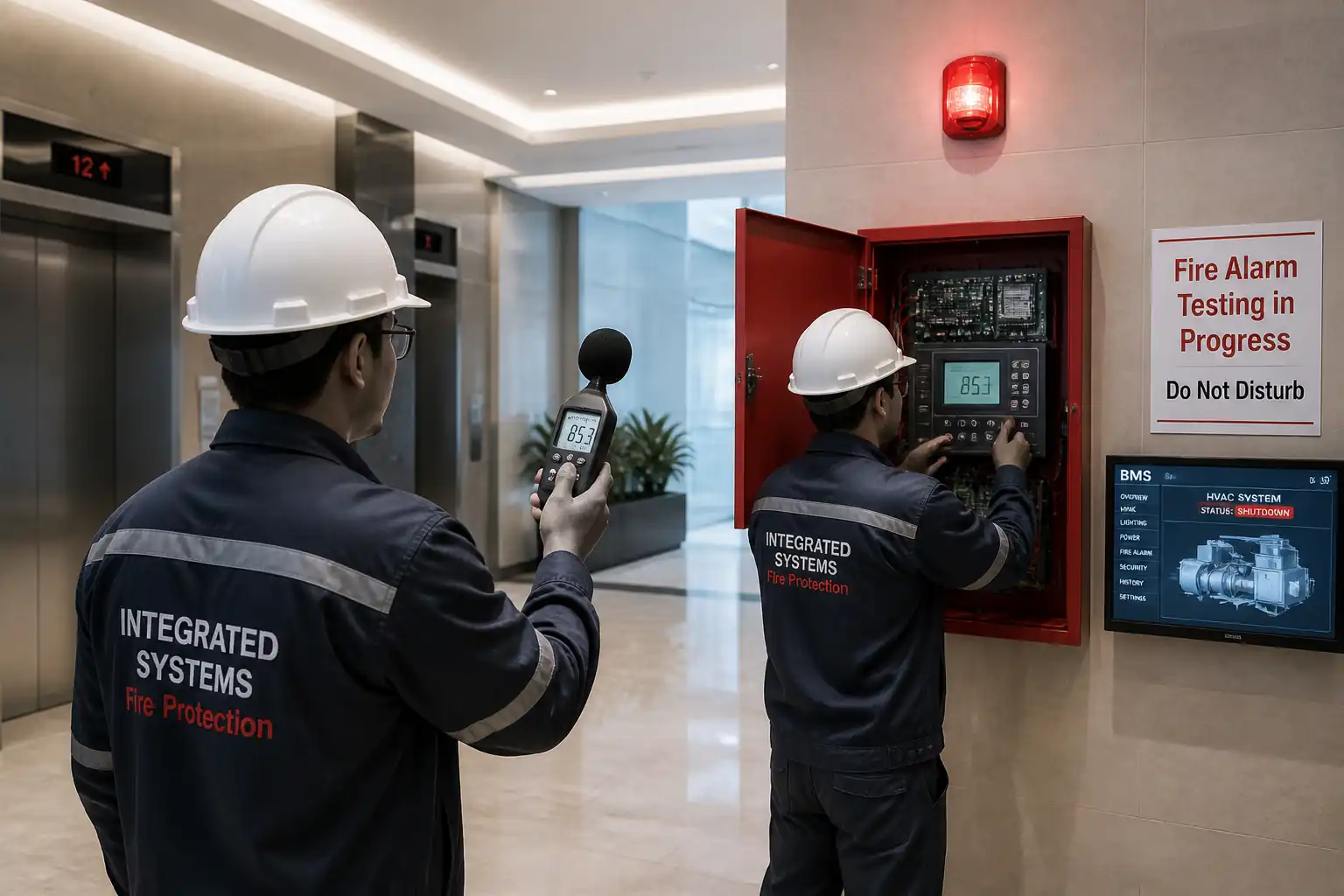
| Notification Appliances Performance | Measure dB(A) at representative points; verify strobe operation/sync | ≥65 dB(A) or ≥5 dB above ambient (general); ≥75 dB(A) at bed-head (sleeping) [Verify]; strobes per EN 54-23/NFPA 72 | Fire Alarm Engineer | SLM logs; checklist |
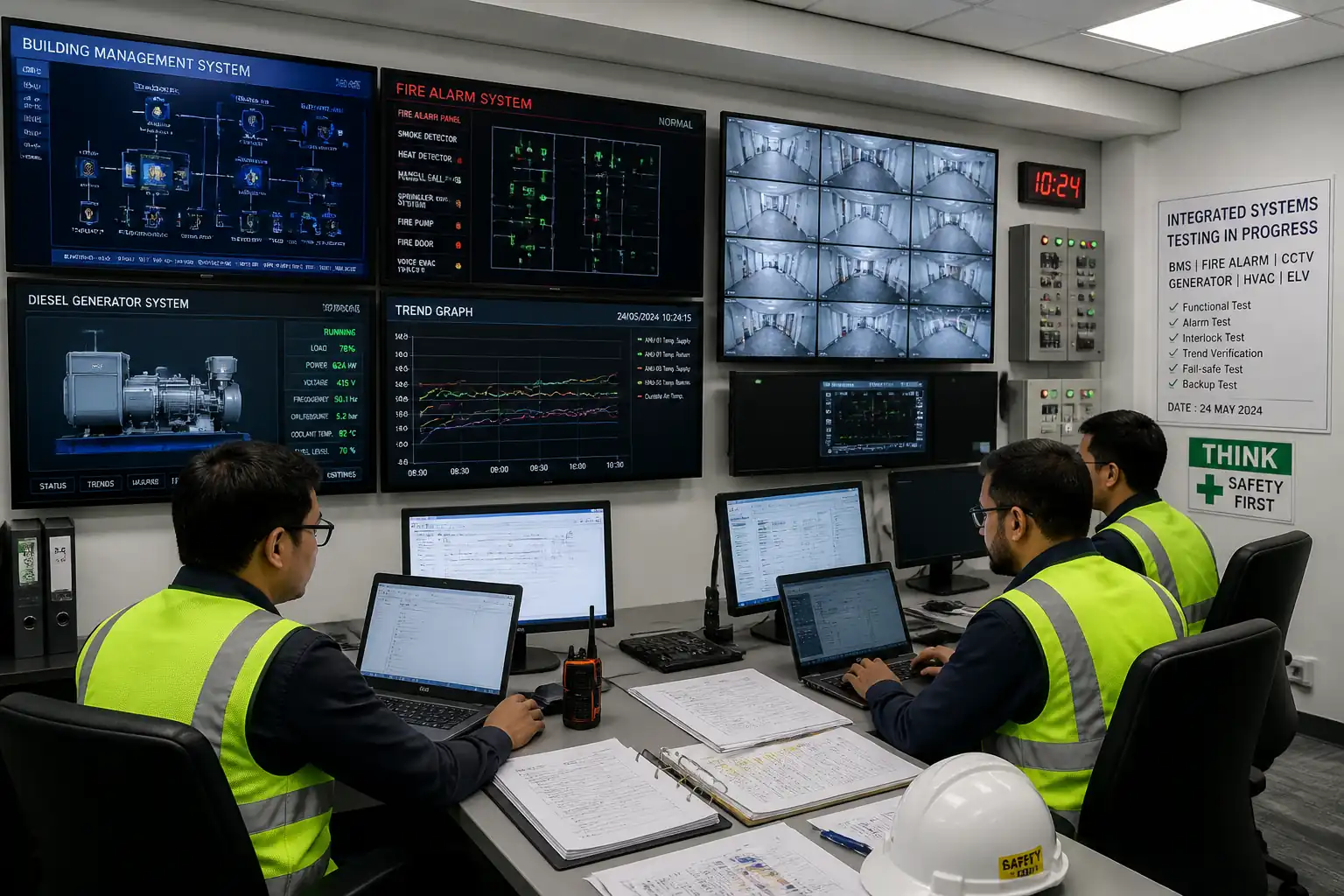
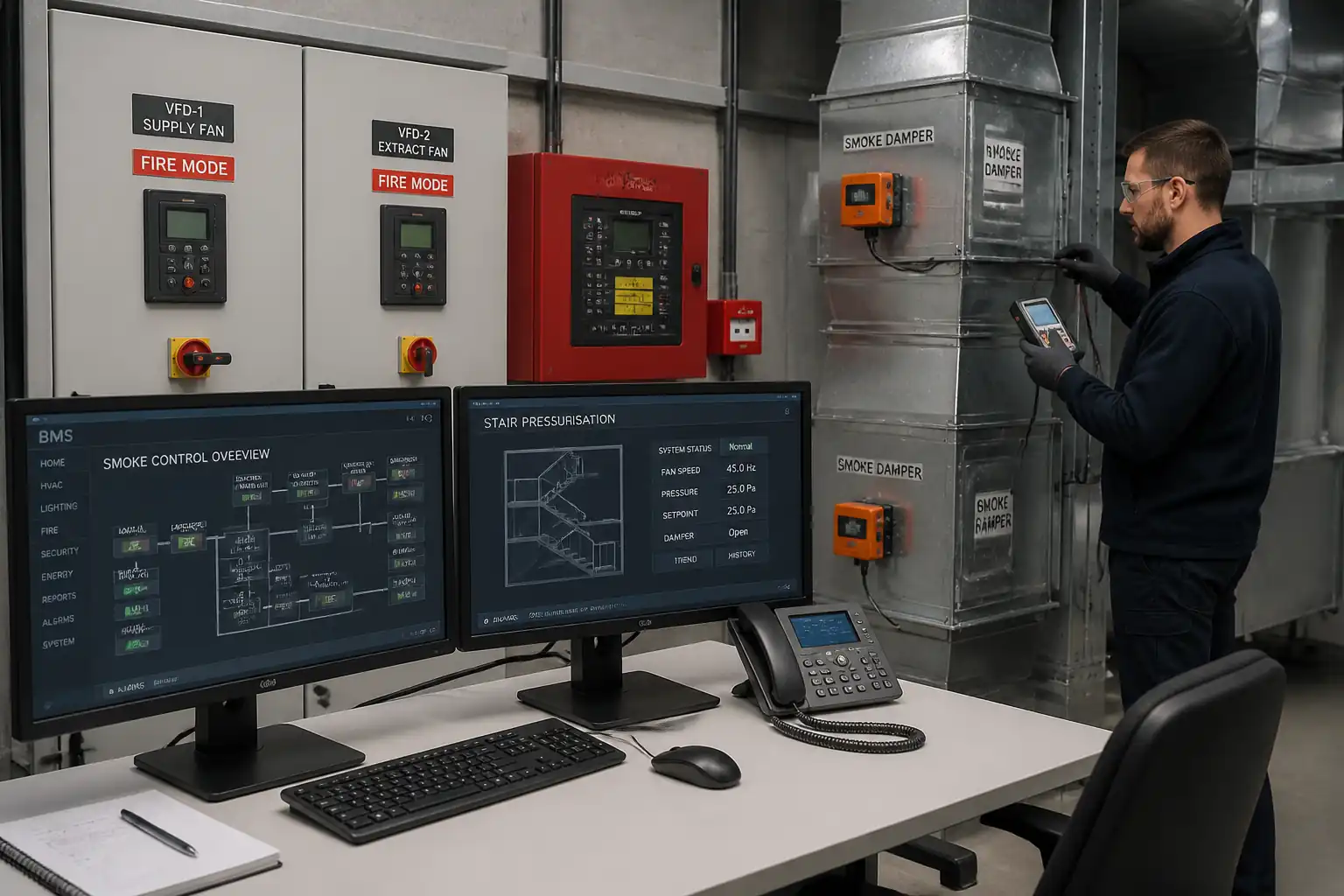
| HVAC Shutdown & Dampers Interface | Command and feedback timing via BMS trends and field verification | Shutdown/closure and feedback ≤60 s [Verify]; correct annunciation | BMS Engineer | Interface test sheet; BMS trend |
| Smoke Control/Pressurization Sequences | Start/stop fans; damper positions; pressure/airflow where available | Correct modes achieved; feedback ≤60 s [Verify] | BMS Engineer | Smoke control test sheet; trends |
| Elevator/Lift Recall | Phase I recall from affected floor; alternate recall | Recall and indications per ASME A17.1/EN 81-73; response ≤60 s [Verify] | Elevator Technician | Lift test form; witness sign-off |
| Access Control Release & Door Hold-opens | Alarm-to-release timing; door closure/latching | Release ≤10 s [Verify]; fire doors close and latch; correct monitoring | Security Engineer | Door checklist |
| Firefighting Systems Monitoring | Sprinkler flow/tamper; pump run; tank/air/low level signals | Correct signal types (alarm/supervisory/trouble); annunciation ≤10 s [Verify] | FP Engineer | FP monitoring sheets |
| Remote Monitoring/Transmission & Graphics | Send test signals; verify ARC receipt; check BMS graphics | Correct codes and locations received; ACK confirmed | Fire Alarm Engineer | ARC receipt; screenshots |
| Integrated Scenario Tests (Matrix) | Execute agreed scenarios end-to-end with timing | All programmed actions correct; no unintended operations; timing within limits [Verify] | Commissioning Manager | Scenario test sheets; witness sign-offs |
| Defect Closure & Retesting | Re-test 100% affected and sample regression as agreed | All NCRs closed; evidence attached | Commissioning Manager | Retest sheets; NCR log |
| Final System Restoration & Sign-off | Re-enable auto-dial and interlocks; confirm normal condition | System normal; all interfaces enabled; zero faults | Fire Alarm Engineer / Consultant | Final test certificate; as-builts; O&M |
This table is a read-only public reference. Download the PDF or Excel version, or customize this ITP to edit it for your project.
Frequently asked questions
Related method statement
This Inspection and Test Plan is associated with the Method Statement: Fire Alarm Cause-and-Effect Testing and Integrated Life-Safety Interface Verification method statement, which describes the step-by-step construction sequence, resources, materials, equipment, safety controls, and environmental controls for this activity.
View the Method Statement: Fire Alarm Cause-and-Effect Testing and Integrated Life-Safety Interface Verification method statement →Continue with related inspection, method statement, article, and checklist resources.