
Method Statement: Fire Alarm Cause-and-Effect Testing and Integrated Life-Safety Interface Verification – Method Statement
AI-assisted method statement with matching ITP, PDF download, and Excel export.
More than a static template
Unlike a downloadable Word or PDF template, this method statement is an AI-assisted editable starting point connected directly to a matching Inspection and Test Plan. Every section is structured, project-adaptable, and ready to export.
- AI-assisted drafting — Customize every section with AI for your specific project scope.
- Linked ITP — A matching inspection and test plan is generated alongside the method statement.
- Multiple export formats — Download as a formatted PDF or editable Excel spreadsheet.
- Editable starting point, not a final document — Review, verify, and adjust all content against your project requirements before use.
Static template vs. Quollnet workflow
| Feature | Static template | Quollnet |
|---|---|---|
| Project-specific content | Manual fill-in required | AI-assisted customization |
| Linked ITP | Separate document, no link | Matching ITP included |
| Export formats | Usually PDF only | PDF and Excel |
| Structured sections | Free-form layout | 13 standardized sections |
| Saved to your account | Local file only | Cloud-saved, reusable |
| Content accuracy | You verify everything | AI-assisted, you still verify |
| Cost | Often free but time-intensive | Free to customize and download |
What you can customize
When you save this method statement to your account, every section becomes editable. The following 13 sections are included:
- Scope — Defines the activity and its boundaries.
- References — Standards, specifications, and drawings.
- Responsibilities — Roles and accountabilities.
- Resources — Labour, plant, and equipment summary.
- Materials — Materials and compliance requirements.
- Equipment — Tools and equipment details.
- Prerequisites — Hold points and pre-conditions.
- Method sequence — Step-by-step construction sequence.
- Safety controls — HSE risk controls and PPE.
- Environmental controls — Environmental mitigation measures.
- QA/QC — Quality inspection and test requirements.
- ITP — Inspection and Test Plan table (has its own page).
- Attachments — Referenced drawings and documentation.
Why this method statement is used
This method statement is used to define and communicate the approved procedure for carrying out method statement: fire alarm cause-and-effect testing and integrated life-safety interface verification on site. It ensures the work is planned in advance, the correct resources and controls are in place, and all personnel understand responsibilities, sequence, quality requirements, and safety controls before work begins. It aligns site execution with the documented scope and acceptance expectations.
Who uses this method statement
This method statement is used by contractors, site supervisors, project engineers, QA/QC engineers, HSE officers, consultants, and client representatives. It serves as a shared reference for planning, execution, supervision, inspection, and approval of the activity on site.
When it is prepared and submitted
The method statement is prepared before the work activity starts and submitted as part of the pre-construction documentation package for review and approval.
Who reviews or approves it
The method statement is usually submitted to the client representative, consultant, resident engineer, or project management consultant for review and approval before the work commences.
Important approval note
This method statement is an AI-assisted editable starting point, not a pre-approved document. Before use on any project, all content must be reviewed and approved by the relevant parties (superintendent, principal contractor, or client representative) in accordance with your contract and project quality plan.
For example: if your specification requires a departure from a referenced standard, that departure must be documented and approved separately — this method statement will not capture that automatically. Always verify against your applicable drawings, specifications, and regulatory requirements.
Method statement content
Scope
Overview
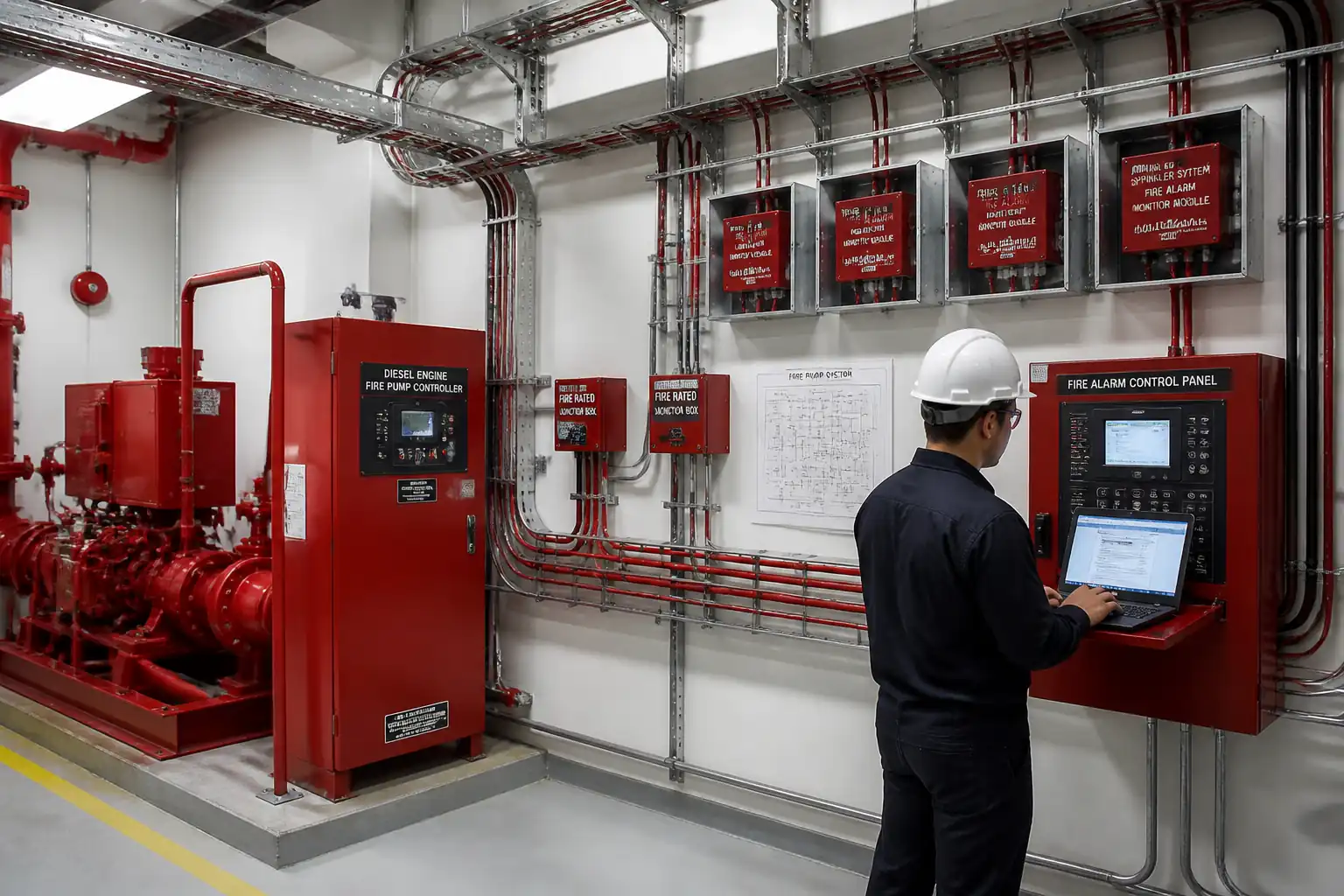
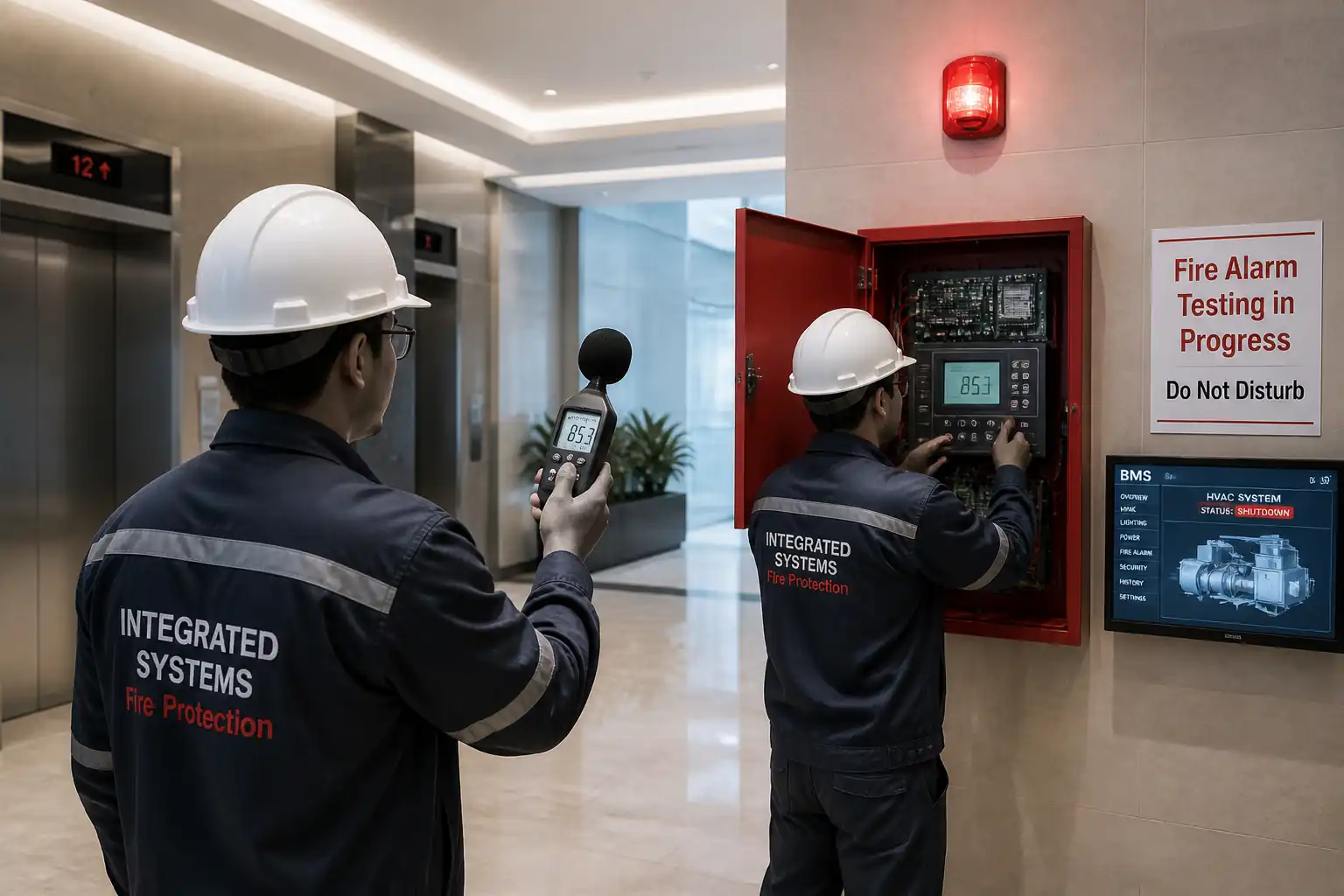
This method statement defines the procedures, resources, HSE controls, QA/QC checks, and records for end-to-end fire alarm cause-and-effect (C&E) testing, including integrated life-safety interfaces and witnessed performance verification.
Included Activities
- Verification of approved C&E matrix against panel programming.
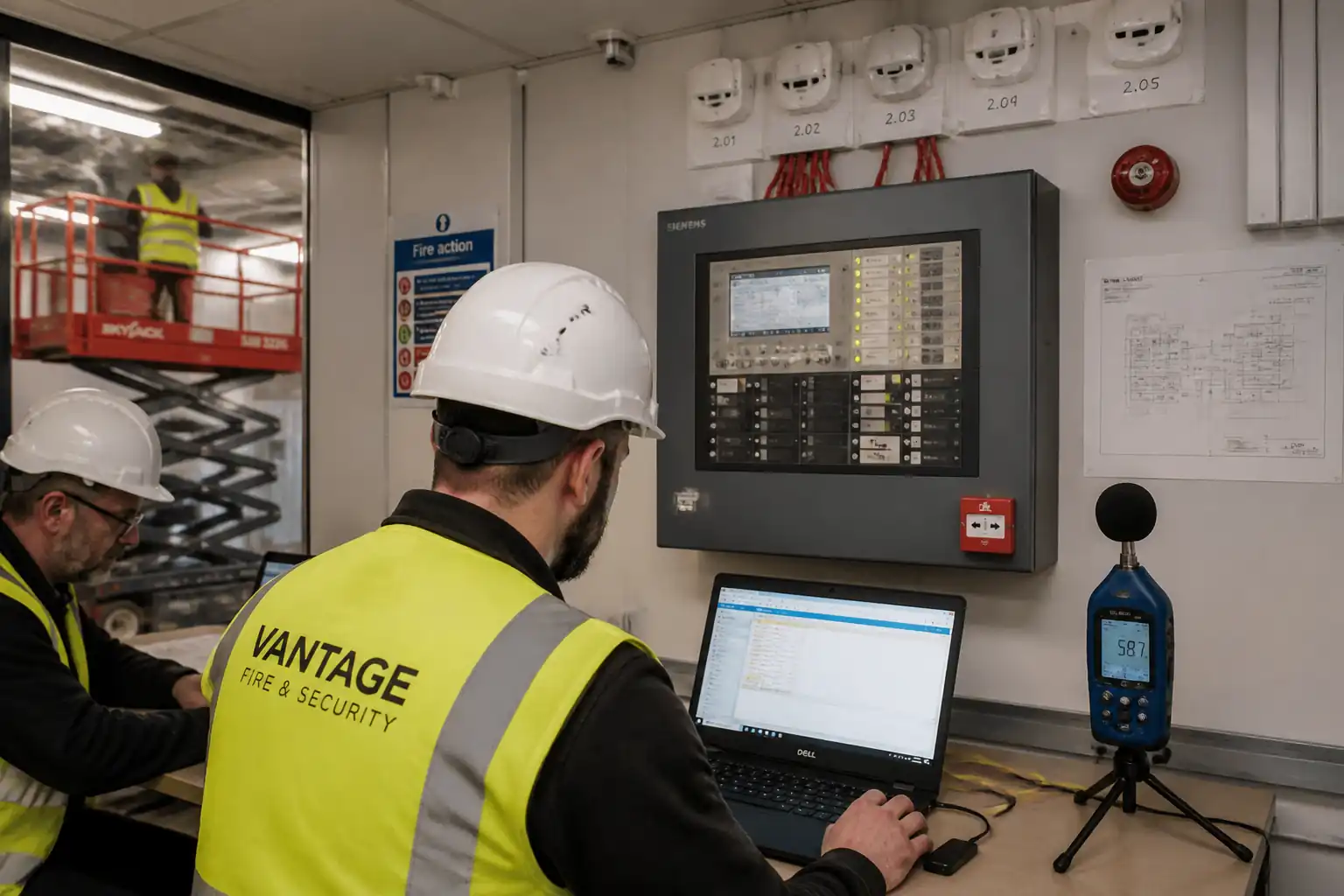
- 100% functional testing of initiating devices (manual call points, smoke/heat/beam/aspirating/duct detectors) and notification appliances (sounders/AVs).
- Scenario-based testing per approved matrix: floor/zone alarm, floor-above/below evacuation, phased evacuation where applicable.
- Interfaces testing: HVAC shutdown and smoke dampers, smoke control/pressurization fans, elevator/lift recall, access control release and door hold-open releases, fire curtains, firefighting systems monitoring (sprinkler flow, valve tamper, pump status, tank/air pressure/low level), BMS/graphics annunciation, remote monitoring/transmission.
- Witnessed testing by Consultant and Authority Having Jurisdiction (AHJ) as required.
- Defect logging, corrective actions, retesting, and final sign-off with completed test sheets and as-built updates.
Exclusions
- Base-building design changes; panel reprogramming outside approved matrix (unless NCR/variation).
- Hot works or invasive construction activities.
Completion Criteria
- 100% devices and programmed functions tested; all defects closed; final signed test sheets; updated as-built drawings and approved C&E matrix; commissioning certificate issued. [Verify per project specifications]
References
| Document Type | Reference / Number | Revision | Notes |
|---|---|---|---|
| Standard | NFPA 72 | ||
| Standard | BS 5839-1 | If project follows UK practice [Verify] | |
| Standard | EN 54 / ISO 7240 / UL 864 | [Verify listing and locality] | |
| Standard | EN 54-23 / NFPA 72 | [Verify per project jurisdiction] | |
| Standard | NFPA 92 / EN 12101 | ||
| Standard | ASME A17.1 / EN 81-73 | ||
| Standard | NFPA 90A | ||
| Project Docs | Project Specs / AHJ | Use latest approved revision |
Responsibilities
| Role | Responsibility | Name / Party |
|---|---|---|
| Commissioning Manager | Commissioning Manager | Main Contractor |
| Fire Alarm Engineer | Fire Alarm Engineer | FA Vendor |
| BMS Engineer | BMS/Controls Engineer | Controls Vendor |
| Elevator Technician | Elevator Technician | Lift Contractor |
| Security Engineer | Security/ACS Engineer | Security Vendor |
| FP Engineer | MEP/Fire Protection Engineer | Fire Protection Contractor |
| HSE Officer | HSE Officer | Main Contractor |
| Consultant / Client | Consultant Rep / Client | Engineer / Employer |
| AHJ | Fire Authority | Regulator |
Resources
| Resource Type | Description | Quantity | Remarks |
|---|---|---|---|
| Labor | Fire alarm engineers/technicians | 2–4 | |
| Labor | Coordinates interfaces and witnesses | 1 | |
| Labor | HVAC and smoke control integration | 1–2 | |
| Labor | Lift recall testing | 1–2 | |
| Labor | Door release & monitoring | 1 | |
| Labor | Permits & controls | 1 |
Materials
| Material | Specification / Grade | Quantity | Remarks |
|---|---|---|---|
| C&E Matrix | Project-approved | 1 set | |
| Drawings | IFC/As-built | 1 set | |
| Forms | Project templates | As required | |
| Permits | Project HSE plan | As required |
Equipment
| Equipment | Capacity / Type | Quantity | Inspection Required |
|---|---|---|---|
| SLM | 1–2 | ||
| Detectors test kits | As needed | ||
| MEWP/Ladders | As rated | 1–2 | |
| DMM | 1 set | ||
| Laptop | 1 | ||
| LOTO | As needed |
Prerequisites
- Approved cause-and-effect (C&E) matrix and latest as-built drawings available on site.
- Fire alarm panel programming frozen to approved C&E; software/firmware versions recorded and backed up.
- Power supplies, batteries, chargers installed and commissioned; troubles cleared; loops healthy.
- Calibration certificates for measurement instruments available and valid (≤12 months) [Verify per project].
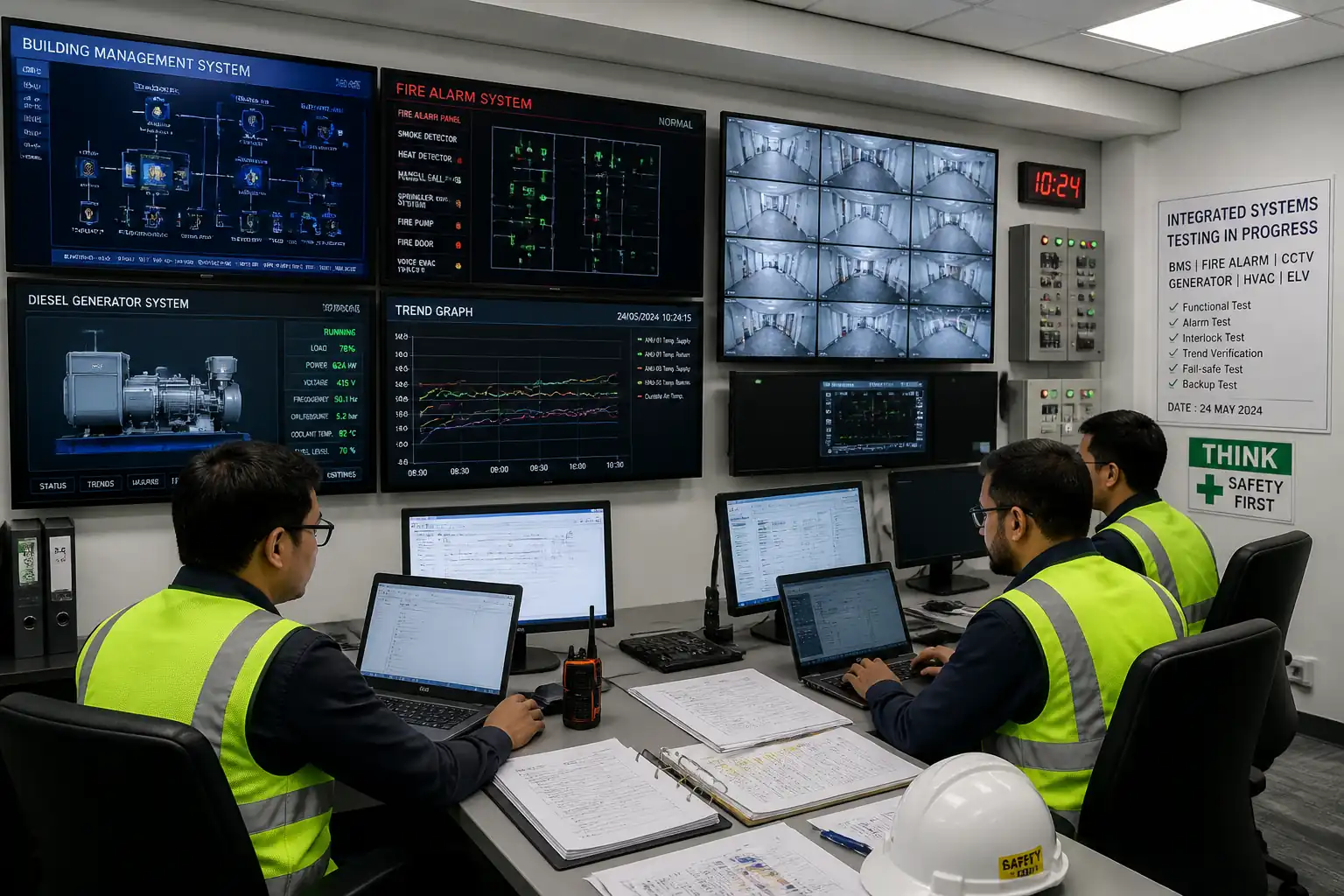
- Integrated systems ready and safe for test: BMS/HVAC, smoke control, elevator, access control, firefighting systems, remote monitoring.
- Impairment plan in place: disable external brigade auto-dial/central station transmission during staged tests to avoid false dispatch; maintain fire watch and temporary measures. Re-enable immediately post-test. [Verify per project HSE plan and local regulations]
- Gas suppression and fire curtains placed in “test mode” or mechanical disconnects applied to prevent unintended discharge/movement; aborts verified.
- Stakeholder notification issued: occupants, security, facility management, neighboring tenants (noise), building management.
- Permits/authorizations approved: Permit to Work, Electrical LOTO (as required), Work at Height permit for device access.
- Area readiness: access paths clear; ceiling tiles open where required; ladders/MEWP positioned; signage and barriers installed.
- Third-party vendors on site and briefed: elevator technician, BMS engineer, security/ACS engineer, FP contractor.
- Emergency contact list posted; communication plan agreed (radio channels and call signs).
Method Sequence
| Step | Activity | Description | Responsibility | Inspection / Hold Point |
|---|---|---|---|---|
| 1 | Kick-off & Briefing | Conduct start-of-day coordination with all vendors; review C&E matrix, sequence of scenarios, roles, and stop criteria. Confirm impairment plan, permits, and re-enablement plan. | Commissioning Manager | Toolbox talk; permit check |
| 2 | Panel Pre-Checks | Verify panel healthy status; time sync; loop/device counts match drawings; review event routing; print current config. Confirm notification circuit loading within manufacturer limits [Verify]. | Fire Alarm Engineer | Panel diagnostics |
| 3 | Ambient Noise Baseline | Measure ambient sound at representative points before alarm; record dB(A). Identify areas requiring higher output or additional devices. | Commissioning Manager | |
| 4 | Device Functional Tests | Test 100% of initiating devices by appropriate method (test key/smoke/heat/magnet/airflow for duct). Confirm device address/location text matches drawings, correct zone/latched states, and event type. | Fire Alarm Engineer | Spot witness by Consultant |
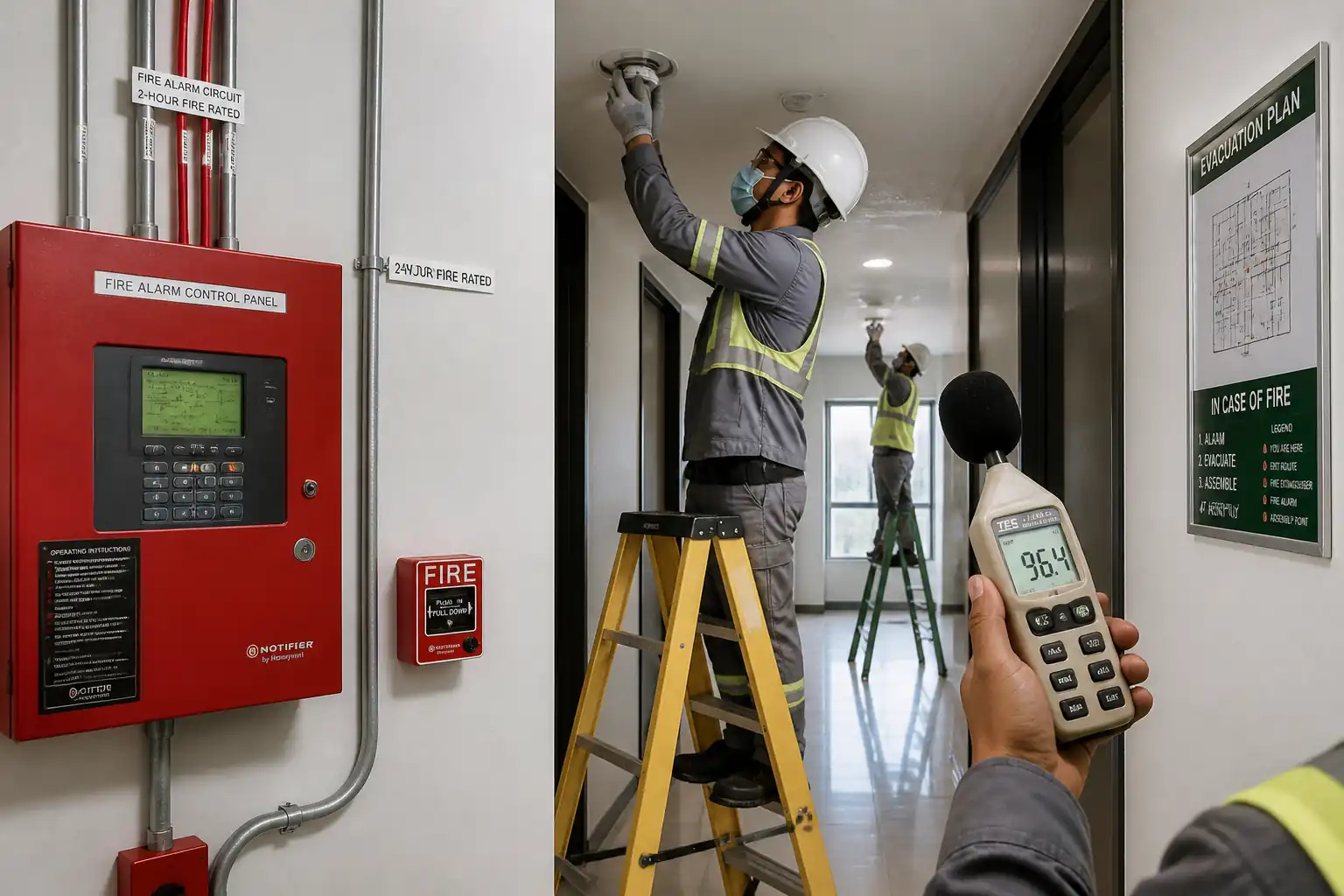
| 5 | Notification Appliances | Activate alarm and verify audibility/visibility. Measure sound pressure levels and check strobe operation/synchronization. | Fire Alarm Engineer | SLM readings |
| 6 | HVAC Shutdown & Dampers | Trigger scenarios causing AHU shutdown and smoke/fire damper closure. Verify command and feedback via BMS and local indicators. | BMS Engineer | BMS trend |
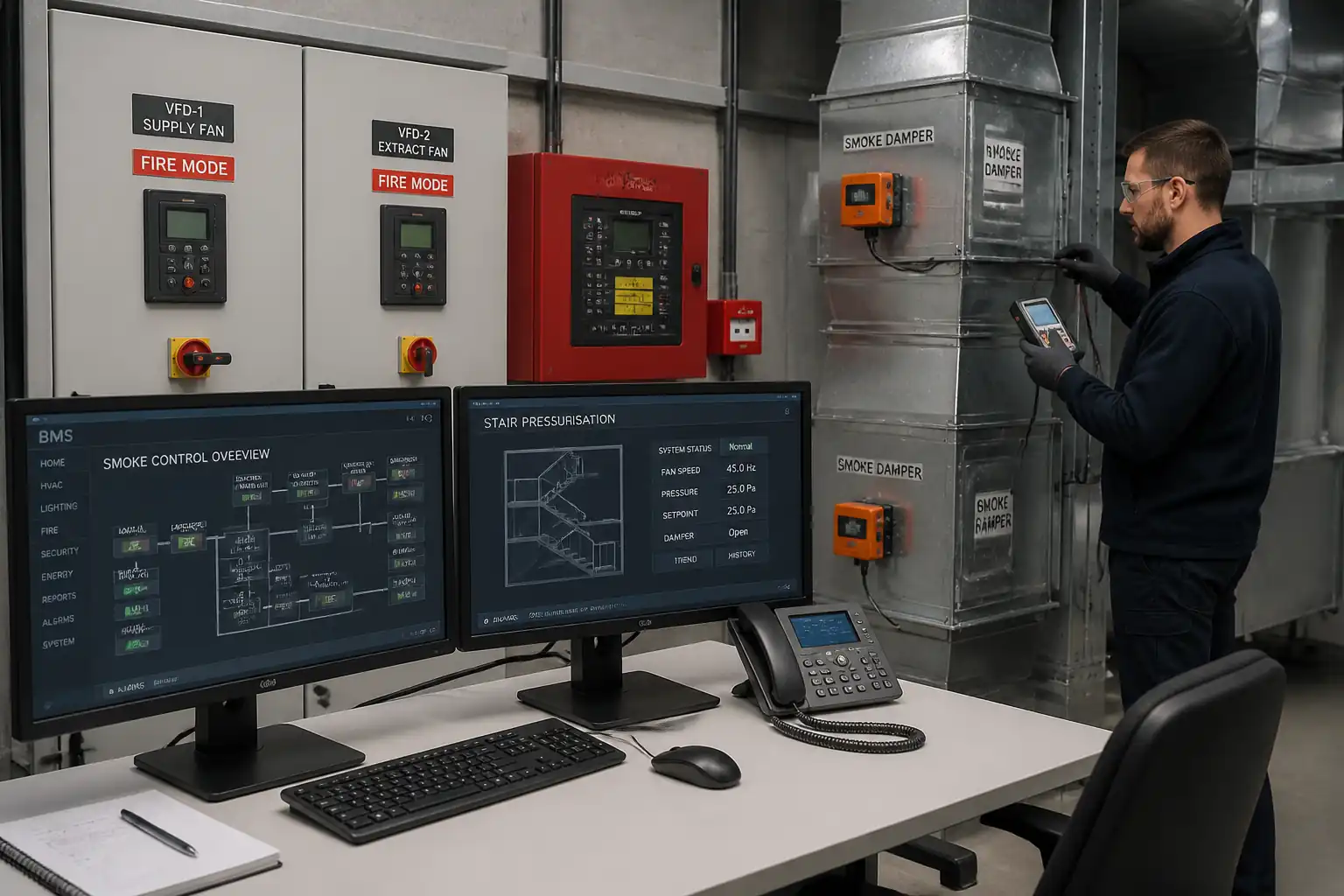
| 7 | Smoke Control/Pressurization | Initiate smoke control sequences (extract/start/pressurize) per C&E. Confirm direction, speeds, and damper positions with status feedback. | BMS Engineer | Field verification and BMS |
| 8 | Elevator/Lift Recall | With lift tech in attendance, trigger recall from affected lobby/shaft detector. Verify Primary/Alternate floor recall and firefighter service indications. | Elevator Technician | On-car indicators |
| 9 | Access Control & Doors | Trigger alarm to release maglocks/strike locks and door hold-opens. Verify egress routes, fire doors close and latch; status monitoring correct. | Security Engineer | Field checks |
| 10 | Firefighting Systems Monitoring | Simulate/operate sprinkler flow switch, valve tamper, low tank level, pump run/phase failure where safe. Ensure signal types correct (alarm/supervisory/trouble). | FP Engineer | Panel/BMS annunciation |
| 11 | Remote Monitoring/Graphics | Verify transmission to monitoring station (in controlled window) and BMS/graphics page indications and point descriptions. | Fire Alarm Engineer | Call/ACK from station |
| 12 | Scenario Walkthroughs | Execute representative integrated scenarios from C&E (e.g., fire on Level N causes alarms on Level N and adjacent, HVAC reactions, lift recall, doors release, smoke control modes). | Commissioning Manager | Consultant/AHJ witness |
| 13 | Defect Recording | Log defects with unique IDs, locations, screenshots/photos, responsible party, and target dates. Classify severity (A life-safety/B functionality/C documentation). | Commissioning Manager | |
| 14 | Rectification | Vendors correct defects; submit evidence; update program/drawings as needed with change control. | Relevant Vendor | |
| 15 | Retesting | Re-test 100% of affected functions; if software changes impact multiple zones, perform risk-based regression sampling (typ. ≥10% per impacted zone) [Verify]. | Commissioning Manager | Witness if hold point |
| 16 | Re-enable & Handover | Restore all impairments (auto-dial, suppression interlocks); remove isolations; final printouts; archive logs; sign final test sheets and commissioning certificate. | Fire Alarm Engineer / Commissioning Manager | Handover checklist |
Safety Controls
Task-specific Hazards, Consequences, and Controls
1) Hazard: Unintended dispatch to fire brigade / building evacuation
- Likely consequence: Public alarm, panic, fines, loss of credibility
- Engineering/procedural control: Implement impairment plan; isolate external communicator during tests; staged area testing; clear signage “Fire Alarm Testing in Progress” at entrances
- Required PPE: Hi-vis vest, radio
- Collective preventive measure: Brief security/concierge; post marshals at main lobbies
- Inspection/permit/supervision: Permit to Work; authorization from Client/FM; log disable/enable times and responsible person [Verify per project HSE plan and local regulations]
2) Hazard: Excessive sound pressure levels from alarms
- Likely consequence: Temporary/permanent hearing damage
- Engineering/procedural control: Pre-brief and temporary hearing protection; minimize alarm-on duration; rotate staff exposure
- Required PPE: Hearing protection (earplugs/earmuffs) rated SNR/NRR appropriate
- Collective preventive measure: Exclude non-essential persons from test areas; schedule noisy tests during low occupancy
- Inspection/permit/supervision: HSE officer to verify SLM availability and PPE use
3) Hazard: Work at height to access detectors/AVs
- Likely consequence: Falls causing serious injury
- Engineering/procedural control: Use MEWP or podium steps with guardrails; 3:1 ladder rule; maintain three points of contact; no overreaching
- Required PPE: Fall arrest (if required by MEWP), safety boots, gloves, hard hat
- Collective preventive measure: Barrier off work zone; spotter present
- Inspection/permit/supervision: Work at Height permit; pre-use inspection tags on MEWP/ladders; competent operator certification
4) Hazard: Live electrical panels
- Likely consequence: Electric shock, arc flash
- Engineering/procedural control: De-energize where practicable; covers closed during operation; only authorized FA engineer to access internals; insulated tools
- Required PPE: Electrical gloves (rated), eye protection
- Collective preventive measure: LOTO on interfacing circuits where required
- Inspection/permit/supervision: Electrical PTW/LOTO; supervisor authorization; test-before-touch
5) Hazard: Aerosol test agents and heat sources
- Likely consequence: Respiratory/eye irritation, minor burns
- Engineering/procedural control: Use manufacturer-approved aerosols with targeted application; ventilate area; heat cups with temperature control
- Required PPE: Safety glasses, nitrile gloves, dust mask (P2) if needed
- Collective preventive measure: Keep MSDS on site; restrict use near occupants
- Inspection/permit/supervision: COSHH/chemical assessment; tool inspection
6) Hazard: Elevator movement during recall testing
- Likely consequence: Crushing/entrapment
- Engineering/procedural control: Testing in lift test mode under licensed technician; barricade lobbies; clear communication before recall
- Required PPE: Hi-vis, safety shoes
- Collective preventive measure: Exclude public from test area; keys controlled by lift tech
- Inspection/permit/supervision: Lift contractor method statement and permit; supervisor presence
7) Hazard: HVAC/smoke control plant operations
- Likely consequence: Contact with moving machinery, pressure changes affecting doors
- Engineering/procedural control: Guarding in place; keep clear of rotating parts; verify door opening forces acceptable; emergency stops known
- Required PPE: Safety shoes, gloves, eye protection
- Collective preventive measure: Controlled access to plant rooms; BMS operator present
- Inspection/permit/supervision: PTW for plant rooms; equipment guards inspection
8) Hazard: Strobe lighting for photosensitive individuals
- Likely consequence: Seizure triggers
- Engineering/procedural control: Advance notice to occupants; minimize strobe duration; exclude sensitive persons during tests
- Required PPE: None specific
- Collective preventive measure: Signage at entrances; schedule tests
- Inspection/permit/supervision: HSE officer to verify controls
9) Hazard: Security compromise due to door release
- Likely consequence: Unauthorized access/theft
- Engineering/procedural control: Coordinate with security; temporary guards at perimeters; staggered release by zone only
- Required PPE: Radios for security team
- Collective preventive measure: Access control fallback plan
- Inspection/permit/supervision: Security manager approval and presence
10) Hazard: Manual handling of equipment and batteries
- Likely consequence: Strains/injury
- Engineering/procedural control: Use team lifts/trolleys; observe weight limits; training
- Required PPE: Gloves, safety footwear
- Collective preventive measure: Plan lifts; keep routes clear
- Inspection/permit/supervision: Manual handling assessment
[All controls to be verified per project HSE plan and local regulations.]
Environmental Controls
- Aerosol test agents: Use minimal quantities; avoid overspray; ensure ventilation; store and dispose per MSDS and local regulations.
- Noise: Schedule high-noise tests during off-peak hours; limit duration; inform neighbors/tenants.
- Waste: Collect and segregate packaging, used wipes, and disposable test canisters; dispose via approved waste stream.
- Energy: Avoid prolonged operation of large fans during tests beyond timing needed for verification; shut down promptly after data capture.
- Dust/disturbance: When accessing ceiling tiles, minimize disturbance and reinstate cleanly.
- Spills/leaks: Keep drip trays for any plant condensate when testing shutdowns; clean immediately.
- Batteries/e-waste: Handle any replaced devices/batteries as hazardous waste; follow approved recycling channels.
- Documentation: Maintain digital records to reduce paper where possible; print only signed copies needed for turnover.
QA / QC
Quality Objectives
- Demonstrate full compliance with approved C&E matrix and applicable codes.
- Achieve 100% test coverage of devices and programmed functions.
Controls and Checks
- Instrument calibration: SLM and test tools with valid certificates (≤12 months) [Verify].
- Documentation control: Use controlled templates; record device IDs, locations, test stimuli, times, outcomes, corrective actions.
- Identification: Device labels and panel text match drawings; deviations noted and corrected.
- Timing: Record initiation-to-notification and initiation-to-interface response times for each representative scenario.
- Sound levels: Record dB(A) values vs. baseline and acceptance; record locations and meter settings (A/C weighting, slow/fast) [Verify per code].
- Interface verification: Record command and feedback points, signal types (alarm/supervisory/trouble), and interlocks.
- Nonconformance: Issue NCRs with root cause and corrective actions; track to closure.
- Retesting: 100% of affected scope after any change; risk-based regression testing where programming changes may have wider impact [Verify per project].
- Witnessing: Obtain signatures at hold/witness points; attach evidence (photos, logs, screenshots).
- Records: Panel configuration backup (pre/post), event logs, BMS trends, lift logs, FP monitoring forms, final test certificates.
Acceptance
- All programmed effects executed correctly with recorded evidence; all defects closed; deliverables submitted and approved by Consultant/Client/AHJ as applicable.
Attachments
- Sample Device Test Sheet (MCP/Detector/AV) – controlled template
- Interface Test Sheet (HVAC, Dampers, Smoke Control) – controlled template
- Elevator Recall Test Form – lift vendor format
- Access Control & Door Release Checklist – security vendor format
- Firefighting Systems Monitoring Checklist – FP contractor format
- Pre-test Checklist and Permit Pack (PTW, Electrical LOTO, WAH)
- Defect/NCR Log Template and Tracking Register
- Calibration Certificates – SLM, DMM, test kits
- Approved C&E Matrix (signed) and latest As-built Drawings
- Final Commissioning Certificate and Witness Sign-off Sheets
This content is a read-only public reference. Download or customize to get an editable version.
ITP preview
The first inspection activities from the linked ITP for Method Statement: Fire Alarm Cause-and-Effect Testing and Integrated Life-Safety Interface Verification:
| Activity | Inspection / Test | Acceptance Criteria | Responsibility | Record |
|---|---|---|---|---|
| Pre-test Documentation & Approvals | Check approved C&E matrix, drawings, permits, calibration certs | All approvals current; instruments in calibration; permits active | Commissioning Manager | Pre-test checklist; approvals register |
| Panel Health & Configuration Backup | Panel shows normal; print/save current configuration and device list | No faults/isolations beyond planned; config archived | Fire Alarm Engineer | Panel printouts; config file backup |
| Initiating Devices Functional Test (100%) | Stimulate MCPs, smoke/heat/beam/aspirating/duct detectors | Correct event type and location displayed; event within typical ≤10 s [Verify]; panel resets cleanly | Fire Alarm Engineer | Device test sheets; event logs |
Showing 3 of 13 inspection activities. View full ITP →
Related Inspection and Test Plan
An Inspection and Test Plan (ITP) is available for Method Statement: Fire Alarm Cause-and-Effect Testing and Integrated Life-Safety Interface Verification. The ITP defines the inspection activities, acceptance criteria, hold and witness points, responsible parties, and records required to verify the work described in this method statement.
View the Method Statement: Fire Alarm Cause-and-Effect Testing and Integrated Life-Safety Interface Verification ITP →Frequently asked questions
Continue with related Quollnet resources connected to this method statement.