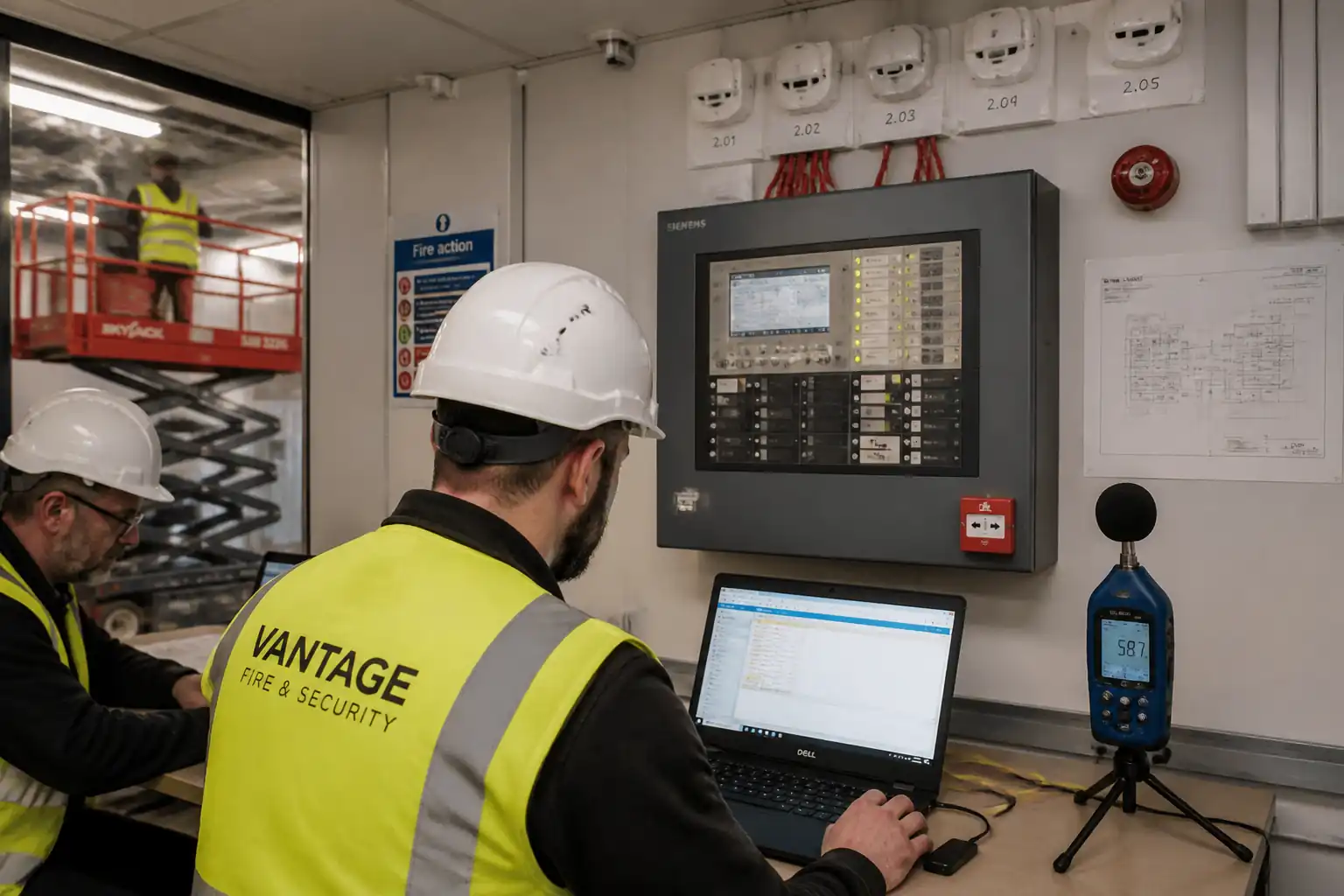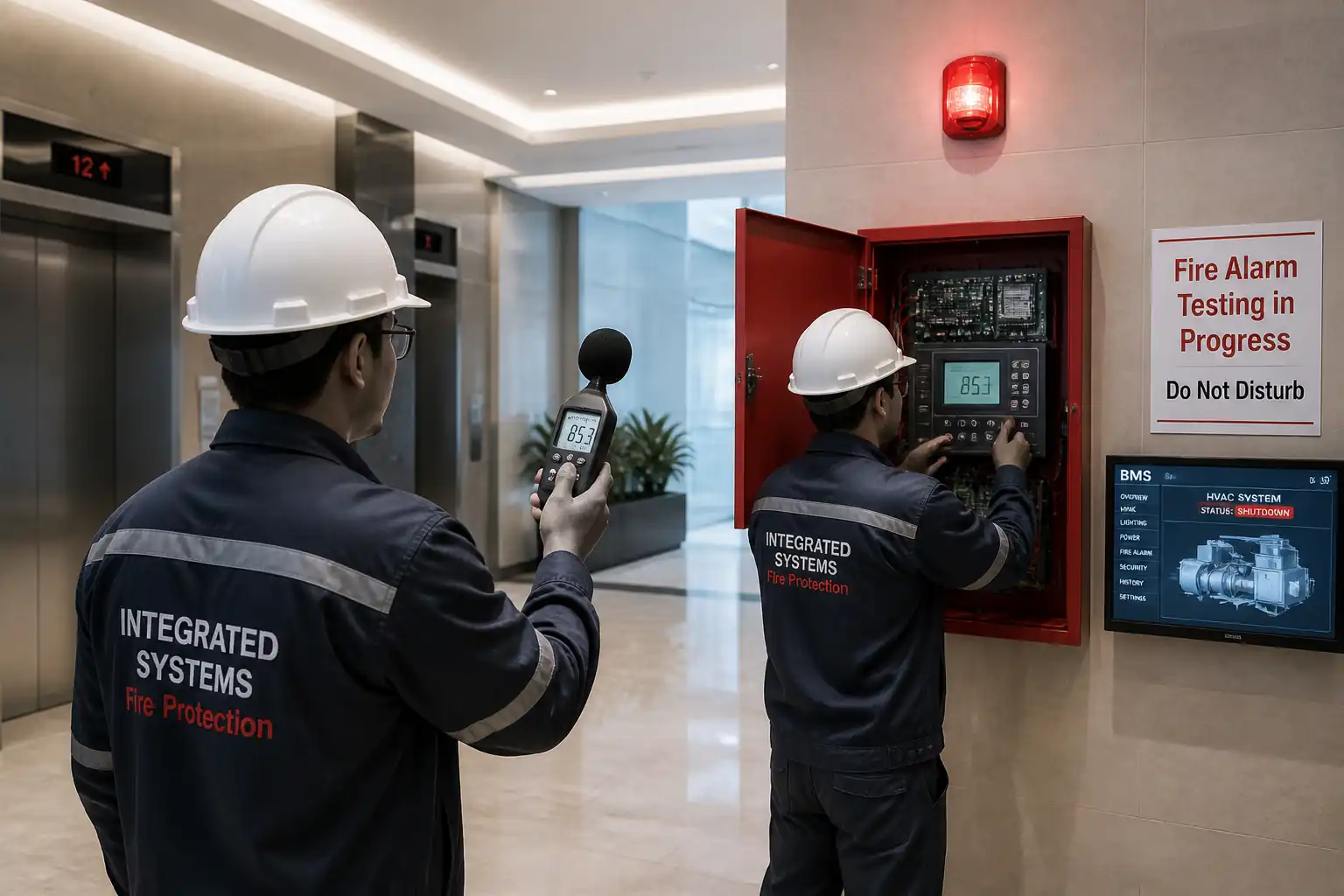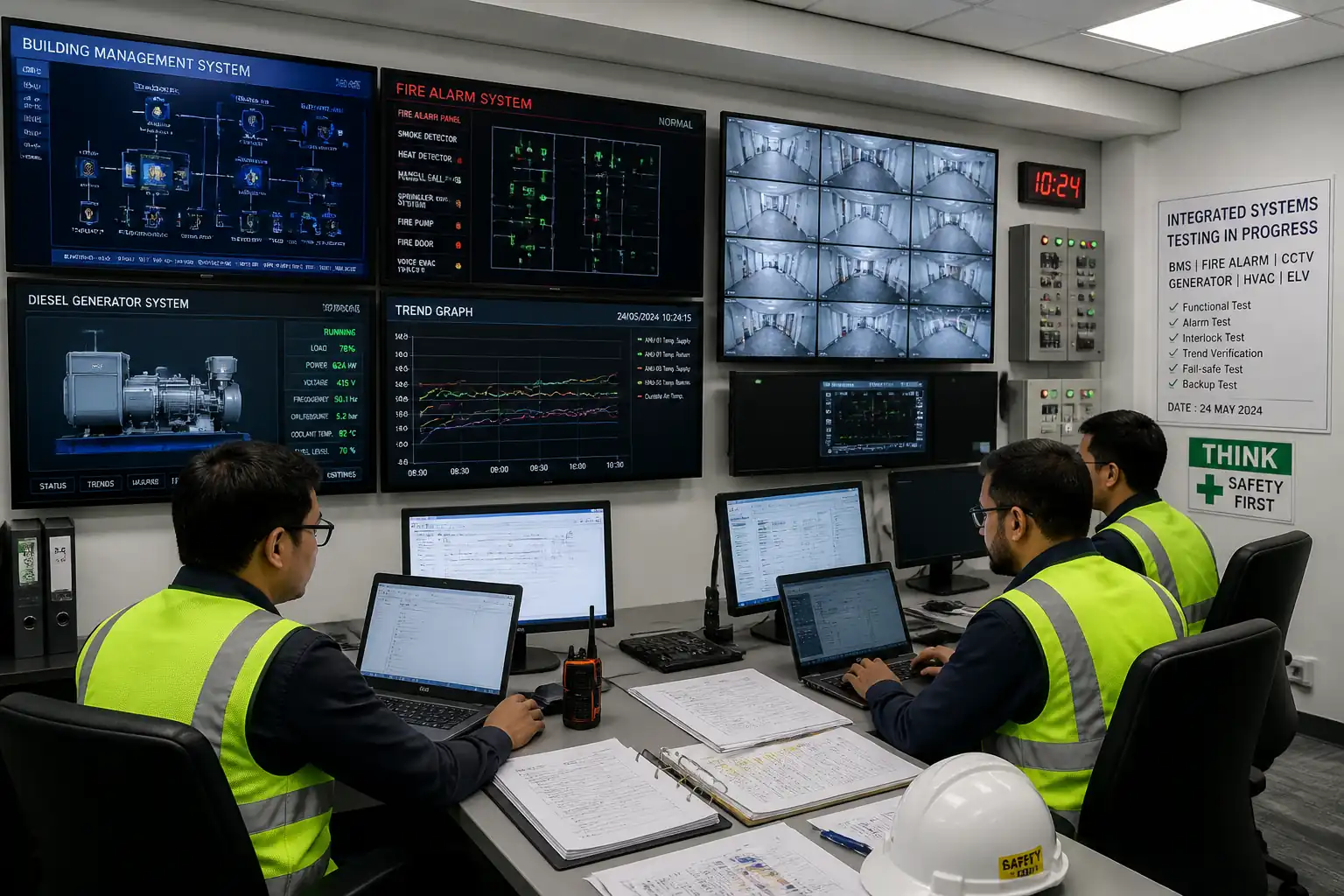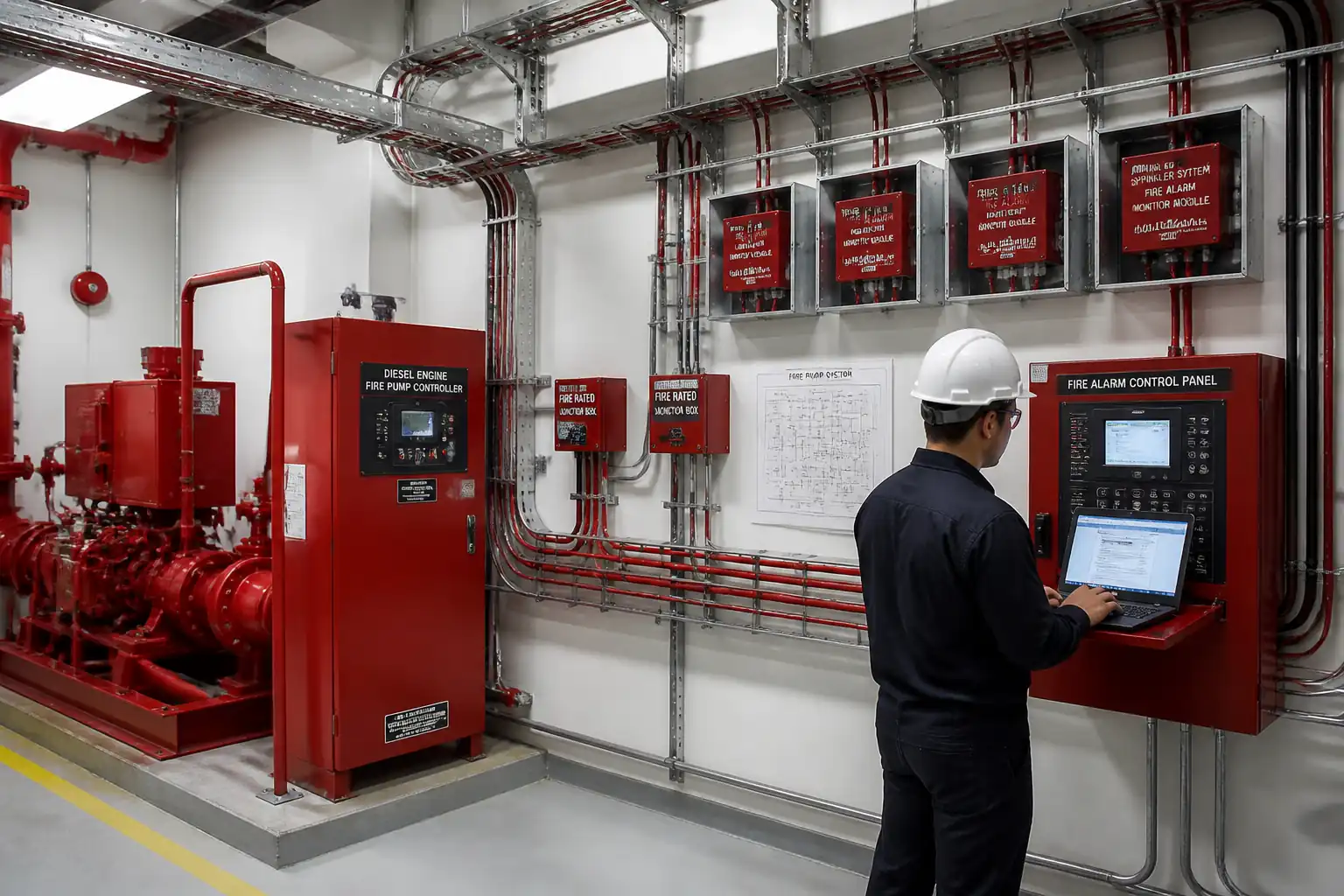

Method Statement: Fire Alarm System Training and Handover – Method Statement
AI-assisted method statement with matching ITP, PDF download, and Excel export.
More than a static template
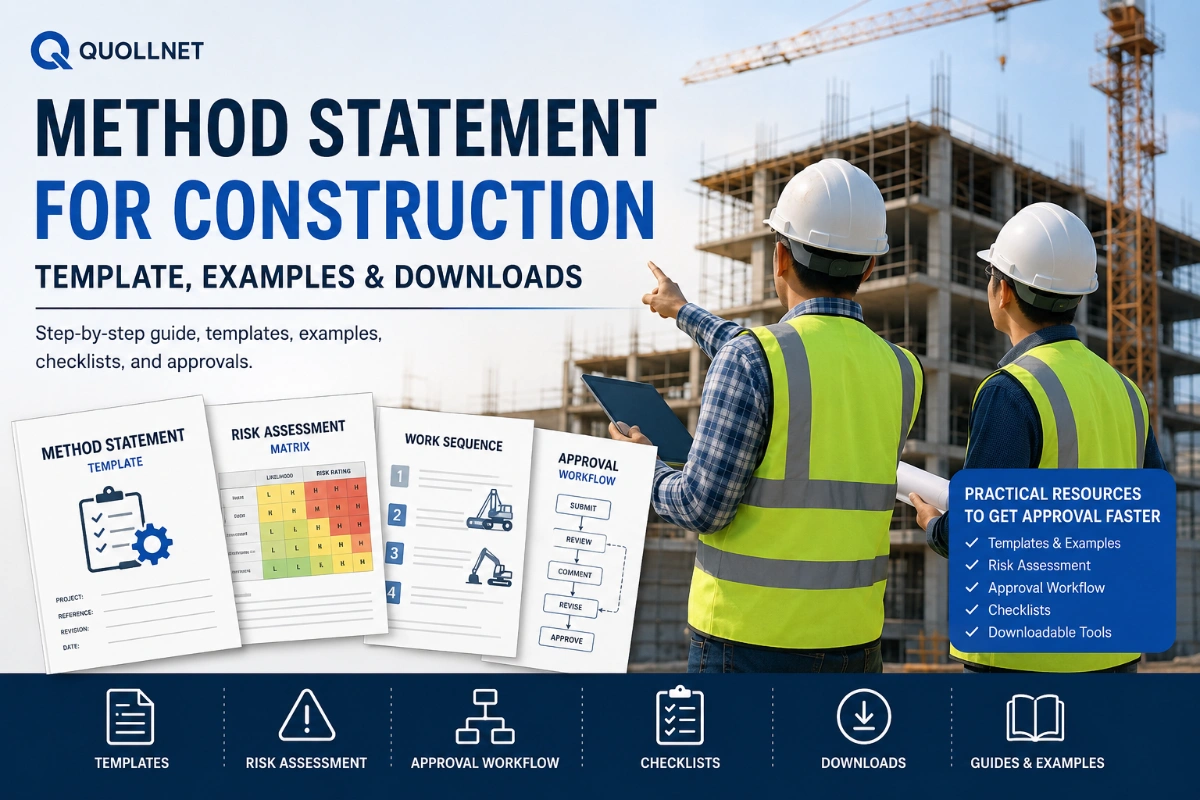
Unlike a downloadable Word or PDF template, this method statement is an AI-assisted editable starting point connected directly to a matching Inspection and Test Plan. Every section is structured, project-adaptable, and ready to export.
- AI-assisted drafting — Customize every section with AI for your specific project scope.
- Linked ITP — A matching inspection and test plan is generated alongside the method statement.
- Multiple export formats — Download as a formatted PDF or editable Excel spreadsheet.
- Editable starting point, not a final document — Review, verify, and adjust all content against your project requirements before use.
Static template vs. Quollnet workflow
| Feature | Static template | Quollnet |
|---|---|---|
| Project-specific content | Manual fill-in required | AI-assisted customization |
| Linked ITP | Separate document, no link | Matching ITP included |
| Export formats | Usually PDF only | PDF and Excel |
| Structured sections | Free-form layout | 13 standardized sections |
| Saved to your account | Local file only | Cloud-saved, reusable |
| Content accuracy | You verify everything | AI-assisted, you still verify |
| Cost | Often free but time-intensive | Free to customize and download |
What you can customize
When you save this method statement to your account, every section becomes editable. The following 13 sections are included:
- Scope — Defines the activity and its boundaries.
- References — Standards, specifications, and drawings.
- Responsibilities — Roles and accountabilities.
- Resources — Labour, plant, and equipment summary.
- Materials — Materials and compliance requirements.
- Equipment — Tools and equipment details.
- Prerequisites — Hold points and pre-conditions.
- Method sequence — Step-by-step construction sequence.
- Safety controls — HSE risk controls and PPE.
- Environmental controls — Environmental mitigation measures.
- QA/QC — Quality inspection and test requirements.
- ITP — Inspection and Test Plan table (has its own page).
- Attachments — Referenced drawings and documentation.
Why this method statement is used
This method statement is used to define and communicate the approved procedure for carrying out method statement: fire alarm system training and handover on site. It ensures the work is planned in advance, the correct resources and controls are in place, and all personnel understand responsibilities, sequence, quality requirements, and safety controls before work begins. It aligns site execution with the documented scope and acceptance expectations.
Who uses this method statement
This method statement is used by contractors, site supervisors, project engineers, QA/QC engineers, HSE officers, consultants, and client representatives. It serves as a shared reference for planning, execution, supervision, inspection, and approval of the activity on site.
When it is prepared and submitted
The method statement is prepared before the work activity starts and submitted as part of the pre-construction documentation package for review and approval.
Who reviews or approves it
The method statement is usually submitted to the client representative, consultant, resident engineer, or project management consultant for review and approval before the work commences.
Important approval note
This method statement is an AI-assisted editable starting point, not a pre-approved document. Before use on any project, all content must be reviewed and approved by the relevant parties (superintendent, principal contractor, or client representative) in accordance with your contract and project quality plan.
For example: if your specification requires a departure from a referenced standard, that departure must be documented and approved separately — this method statement will not capture that automatically. Always verify against your applicable drawings, specifications, and regulatory requirements.
Method statement content
Scope
Overview
This method statement defines the steps to plan, execute, verify, and document the training and handover of the completed fire alarm system (FAS), including Fire Alarm Control Panel (FACP) and any Voice Alarm/PA, graphics, repeater panels, interfaces to third-party systems (e.g., smoke control, elevators, access control, suppression), and networked nodes.
Inclusions
- End-user/operator training and competency assessment.
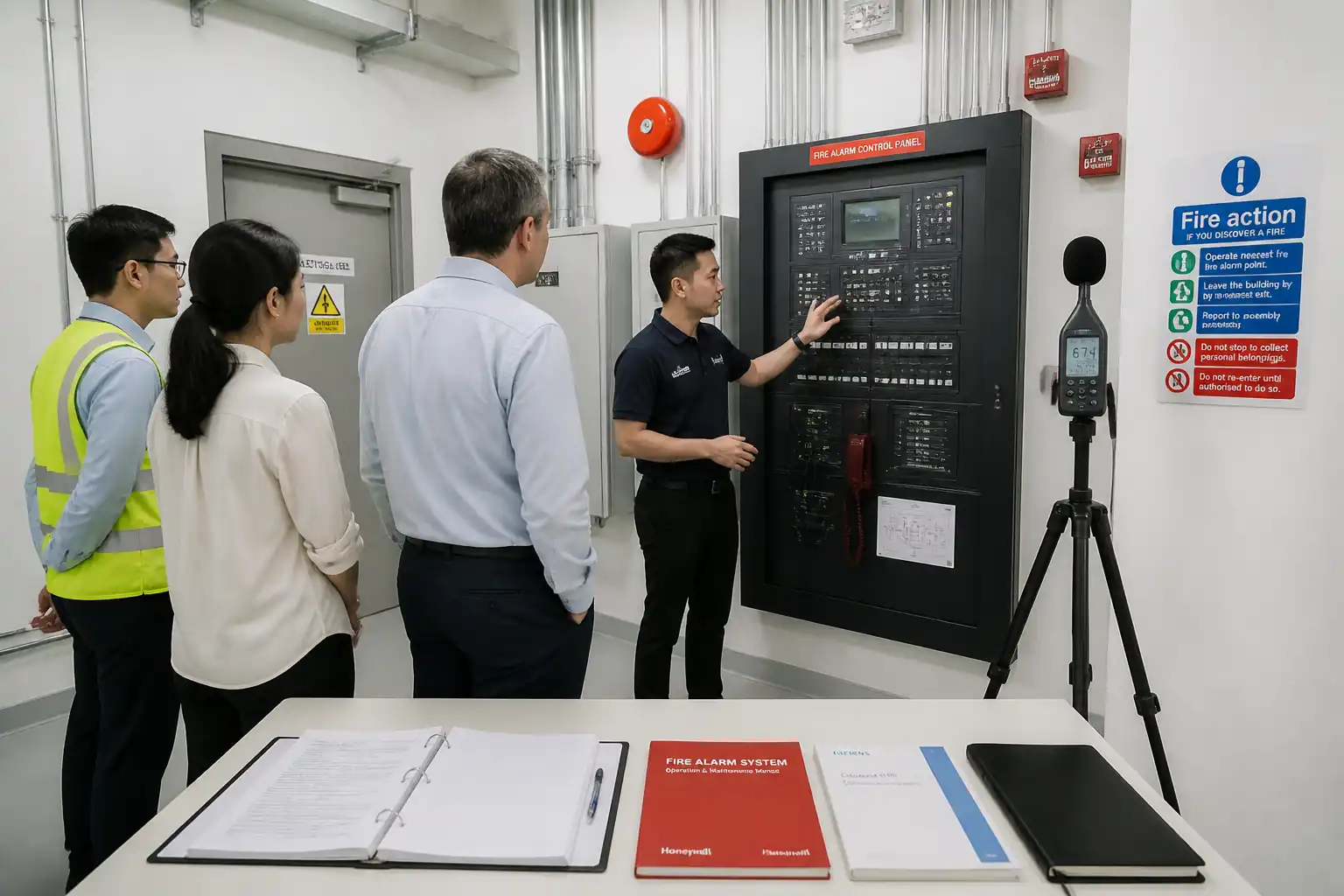
- Live demonstration of: panel operation, alarm acknowledgement, silence, reset, isolation/disable/enable controls, fault/trouble handling, history log retrieval, and back-up/restore of configuration.
- Demonstration of cause-and-effect logic and key third-party interfaces.
- Maintenance instructions handover and walkthrough of O&M manuals.
- Test report submission and records: attendance, training materials, as-built, software backups, calibration certificates.
- Final handover documentation and certificates (e.g., Taking-Over, Manufacturer Training, Warranty Start).
Exclusions
- System installation, pre-commissioning, and commissioning (assumed completed and accepted prior to this activity).
- Permanent modifications to programming other than as-built backup and minor corrections approved by the Engineer.
Constraints and Assumptions
- System is commissioned with all defects cleared and AHJ/Engineer approvals obtained for acceptance testing prior to training/handover.
- Any impairment or isolation during demonstration will follow an approved impairment plan with compensatory measures.
- Quantitative criteria follow referenced standards or project specifications; where not specified, typical benchmarks are provided and marked [Verify per project specifications].
References
| Document Type | Reference / Number | Revision | Notes |
|---|---|---|---|
| Standard | NFPA 72: National Fire Alarm and Signaling Code (Acceptance testing, operations, maintenance) | Use applicable edition per project/AHJ. [Verify per project specifications] | |
| Standard | BS 5839-1: Fire detection and fire alarm systems for buildings – Non-domestic premises | Design, commissioning, user responsibilities, routine testing. [Verify per project specifications] | |
| Standard | EN 54 series / ISO 7240 series (Fire detection and alarm systems – components and control equipment) | Product conformity; control and power supply (e.g., EN 54-2, EN 54-4). [Verify per project specifications] | |
| Standard | IEC 61672-1 (Sound level meters) | For audibility measurements; Class 1/2 meters acceptable per project. [Verify per project specifications] | |
| Standard | Manufacturer O&M and Programming Guides for installed FAS | Model and firmware-specific instructions for operation/maintenance. | |
| Project Document | Approved Cause & Effect Matrix, As-Built Drawings, Approved Shop Drawings | Latest revisions with Engineer’s approval stamps. [Verify per project specifications] |
Responsibilities
| Role | Responsibility | Name / Party |
|---|---|---|
| MEP Commissioning Manager | Overall coordination and approvals | Main Contractor |
| Fire Alarm Specialist Engineer | Lead execution of training, demonstrations, programming back-up, and documentation collation | Main Contractor / Specialist Subcontractor |
| OEM/Vendor Representative | Technical training delivery, OEM certification, sign-off of correct operation | System Manufacturer |
| Supervising Engineer / Consultant | Witnessing, acceptance of training outcomes, review of records | Engineer |
| Client’s Facilities/Operations Team | Attendance, competency assessment, receipt of keys/passwords, daily/weekly testing post-handover | Employer |
| HSE Officer | HSE plan enforcement, permits (impairment), monitoring noise and crowd control | Main Contractor |
| Document Controller | Record keeping, transmittals, close-out dossiers | Main Contractor |
Resources
| Resource Type | Description | Quantity | Remarks |
|---|---|---|---|
| Personnel | Leads overall activity and approvals | 1 | Chartered/registered engineer preferred [Verify per project specifications] |
| Personnel | Delivers training and demonstrations | 1–2 | Manufacturer-certified [Verify] |
| Personnel | OEM-certified trainer and signatory | 1 | |
| Personnel | Client O&M personnel to be trained | As nominated (typically 4–12) [Verify] | Minimum attendance 90% of scheduled hours recommended |
Materials
| Material | Specification / Grade | Quantity | Remarks |
|---|---|---|---|
| O&M Manuals (System, Devices, Accessories) | Manufacturer-approved, project-specific; includes maintenance schedules and spares list [Verify] | 2 sets hard copy + digital master | Indexed and bookmarked PDF with searchable text |
| As-Built Drawings & Address/Loop Schedules | Engineer-approved final revision [Verify] | Complete set | Red-lined and CAD/PDF formats; include addressing plans and loop diagrams |
| Panel Configuration Backups | Native project file + CSV/printouts of databases [Verify] | 1 encrypted copy + 1 sealed media | Include version/firmware notes and checksum |
| Spare Parts Kit | Fuses, modules, detectors, bases, sounders, MCP glasses [Verify] | As per spares list | Tagged and inventoried |
| Panel Keys, Passwords, Access Credentials | Handover under controlled register | Set per panel/network | Passwords, user levels, lockout tags |
Equipment
| Equipment | Capacity / Type | Quantity | Inspection Required |
|---|---|---|---|
| Fire Alarm Control Panel (FACP) and Repeater(s) | As installed | 1 | Yes |
| Laptop with Programming/Diagnostic Tools | Meets OEM requirements | 1 | Yes |
| Sound Level Meter | IEC 61672 compliant | 1 Class 1 or 2 | Yes |
| Smoke and Heat Detector Testers | As per device type | 1 each | Yes |
| Multimeter/Loop Tester | Low-voltage suitable | 1 | Yes |
| Lockout/Tagout (LOTO) Kit | Set | Yes | |
| Two-way Radios | As required | No |
Prerequisites
- Approved commissioning and acceptance test results available, defects/NCRs closed.
- Approved Cause & Effect Matrix and Integration Test Reports.
- AHJ/Engineer acceptance (where required) for the installed system prior to training/handover.
- Training Plan and Agenda approved by Engineer and Client, including attendee list and competency outcomes.
- Impairment/Isolation Plan approved, including compensatory measures (fire watch, restricted hot works). [Verify per project HSE plan and local regulations]
- Notifications issued to building management, security, and occupants with schedule and test areas identified.
- Confirm remote links (e.g., Fire Brigade dialer/ARC) permission for test or temporarily disabled under permit.
- Calibration certificates current for test devices (sound level meter, gas/smoke test tools as applicable).
- O&M manuals, as-built drawings, and configuration backups prepared for review.
- Third-party vendors on standby for interfaces (elevators, smoke control, suppression, access control, BMS, PA/VA).
Method Sequence
| Step | Activity | Description | Responsibility | Inspection / Hold Point |
|---|---|---|---|---|
| 1 | Pre-handover readiness review | Verify closure of commissioning punch list; confirm all loops/devices operational; confirm approved C&E Matrix and integration sign-offs are on file. | Commissioning Manager / FA Specialist | Document check |
| 2 | HSE and impairment controls | Prepare and brief impairment plan, LOTO where necessary (e.g., suppression release circuits). Arrange fire watch and occupant notifications. | HSE Officer / FA Specialist | Permit/briefing verification |
| 3 | Training kick-off and agenda | Introduce trainer(s), objectives, schedule, emergency stops, and scope. Confirm attendance list and competency expectations. | OEM Trainer / FA Specialist | Attendance verification |
| 4 | Panel orientation | Explain panel layout, power supplies, user levels, display/LEDs, common controls: ACK, SILENCE, RESET, DISABLE/ENABLE. | OEM Trainer | Demonstration |
| 5 | Alarm scenario – Manual Call Point (MCP) | Activate MCP in selected zone. Observe panel indications, acknowledge, silence, verify C&E actions (e.g., sounders, strobes, door release, lift recall). Execute panel reset once cleared. | FA Specialist / OEM Trainer | Live test |
| 6 | Alarm scenario – Smoke detector | Functionally test a representative smoke detector using approved test aerosol/heat source as applicable. | FA Specialist | Live test |
| 7 | Alarm scenario – Heat detector | Functionally test a representative heat detector. Demonstrate difference in delay/verification (if configured). | FA Specialist | Live test |
| 8 | Trouble/Supervisory demonstration | Simulate a line fault (e.g., open circuit/earth fault) under controlled conditions. | FA Specialist | Functional |
| 9 | Isolation/disable/enable controls | Demonstrate zonal/device disable, output isolate for maintenance, and restore with logbook entries and panel printout. | OEM Trainer | Operational check |
| 10 | Integration and cause-and-effect | Trigger selected inputs to demonstrate interlocks: door holders, dampers, fans, smoke control, elevator recall, access control release, suppression pre-discharge (without agent release). | FA Specialist + Third-Party Vendors | Witness test |
| 11 | Voice alarm/PA audibility (if applicable) | Announce evacuation/alert messages. Measure SPL at representative locations. | FA Specialist / OEM Trainer | Measurement |
| 12 | Power and battery back-up overview | Explain power paths, charger operation, and battery calculations. Optionally conduct a controlled mains fail demonstration. | OEM Trainer | Observation |
| 13 | Event logs, reports, and backups | Demonstrate retrieving/printing event history, exporting configuration, and secure storage/hand-over of backups. | FA Specialist | Operational |
| 14 | Maintenance instruction briefing | Walk through weekly/monthly/quarterly/annual tasks per standards and manufacturer guidance. | OEM Trainer | Review |
| 15 | Operator competency assessment | Each operator to perform ACK, SILENCE, RESET, ISOLATE/ENABLE and retrieve a log under supervision. | OEM Trainer / Engineer | Practical assessment |
| 16 | Documentation handover | Submit O&M manuals, as-builts, test reports, calibration certs, training attendance, and backups through document control. | Document Controller / FA Specialist | Document check |
| 17 | Final handover and certification | Conduct close-out meeting; agree snags (if any) and dates; issue Manufacturer Training Certificates, Warranty/Defects Liability commencement, and Taking-Over Certificate (TOC) upon acceptance. | Contractor / Engineer / Client | Meeting/witness |
Health, Safety, and Environment (HSE) – Safety Controls
Key Task-Specific Hazards and Controls
1) Hazard: Life safety system impairment during tests
- Likely consequence: Reduced fire protection leading to delayed evacuation/response.
- Engineering/procedural control: Approved impairment plan; isolate only required zones/outputs; maintain fire watch and portable extinguishers; restrict hot works; schedule after-hours where feasible.
- PPE: Hi-vis, safety footwear, hearing protection when alarms sound.
- Collective preventive measure: Temporary signage “System Under Test,” muster marshals briefed, alternative notification means.
- Inspection/permit/supervision: Impairment permit with start/finish times; HSE Officer and FA Specialist to supervise; logbook entries. [Verify per project HSE plan and local regulations]
2) Hazard: Unintended activation of connected systems (e.g., gaseous suppression, elevator recall, HVAC shutdown)
- Likely consequence: Accidental agent discharge, equipment damage, service disruption.
- Engineering/procedural control: LOTO on release circuits/actuators; remove/disable discharge links; vendor present; simulate signals where possible; verify safe state before test.
- PPE: Eye protection, gloves as needed.
- Collective preventive measure: Physical barriers/tags on actuators; disable only within test window; reinstatement checklist.
- Inspection/permit/supervision: Permit to work and isolation checklists signed by responsible persons.
3) Hazard: High sound pressure levels during audible alarm tests
- Likely consequence: Temporary hearing loss or discomfort.
- Engineering/procedural control: Prior notice to occupants; conduct by floors/zones; keep duration minimal; measure SPL to ensure compliance.
- PPE: Hearing protection for participants in test zones.
- Collective preventive measure: Exclude non-essential personnel from test areas; use signage and marshals.
- Inspection/permit/supervision: HSE monitoring; record SPL readings if required by spec.
4) Hazard: Electrical exposure from control equipment
- Likely consequence: Electric shock, short circuit, equipment damage.
- Engineering/procedural control: Work on extra-low voltage circuits only; isolate mains to PSU if intrusive work is necessary; use insulated tools; competent persons only.
- PPE: Insulated gloves where appropriate, eye protection.
- Collective preventive measure: Access control to panels; covers replaced promptly.
- Inspection/permit/supervision: Electrical permit if mains isolation required; supervisor sign-off.
5) Hazard: Crowd/occupant confusion due to test alarms
- Likely consequence: Panic, unnecessary evacuation, interference with operations.
- Engineering/procedural control: Clear notices, PA announcements “Testing in Progress,” coordination with security and facility management.
- PPE: Hi-vis for marshals.
- Collective preventive measure: Controlled access and visitor briefings.
- Inspection/permit/supervision: Communication plan issued and approved.
6) Hazard: Ladder/step access (if detectors or speakers at height are demonstrated)
- Likely consequence: Fall from height, dropped objects.
- Engineering/procedural control: Use podium steps/approved ladders; 3-point contact; exclusion zone below; tool lanyards.
- PPE: Helmet with chin strap, gloves.
- Collective preventive measure: Spotter present; cordon area.
- Inspection/permit/supervision: Work at Height permit where applicable.
Environmental Controls
- Noise management: Schedule tests to minimize disturbance; limit duration; provide advance notifications; monitor SPL and keep within any site-specific limits [Verify per project specifications].
- Emissions/consumables: Use manufacturer-approved smoke/heat testers; avoid overuse; ensure adequate ventilation; prohibit discharge of suppression agents during demonstration.
- Waste management: Dispose of spent aerosols, batteries, packaging, and electronic media via approved recyclers. Battery handling/disposal per local hazardous waste regulations. Maintain records.
- Paper reduction: Prefer digital O&M submission; print only controlled copies with Engineer’s approval.
- Energy: Minimize mains-fail demonstrations; promptly restore normal power after tests.
- Data security: Encrypt digital backups and control distribution media; prevent data loss/unauthorized access (indirect environmental and security consideration).
Quality Assurance and Quality Control
- Trainer competency: OEM manufacturer certification to be current and submitted.
- Calibration: Sound level meter and test tools to have valid calibration certificates (typically ≤12 months). [Verify per project specifications]
- Records: Use controlled forms for attendance, competency assessments, device demonstrations, isolation logs, SPL sheets, and transmittals. Unique IDs and revision control.
- Traceability: Event logs and backups stamped with date/time and panel firmware version; checksums recorded for media.
- Acceptance metrics: All demonstration scenarios passed; audibility/intelligibility verified where applicable; operators complete practical assessment without error.
- NCR management: Any failures logged as NCR/Snag with root cause and close-out before TOC.
- Document control: O&M/as-builts and training materials submitted via the DMS; Engineer’s approvals recorded.
- Handover readiness review: Internal audit prior to final meeting confirming all deliverables complete.
- Post-handover support: Provide defect liability contacts and response times per contract. [Verify per project specifications]
Attachments
- Training Plan & Agenda (approved)
- Attendance Sheets and Operator Competency Forms
- Demonstration Test Sheets (MCP, smoke, heat, trouble, integration)
- SPL Measurement Sheets and Calibration Certificates (if PA/VA)
- Isolation/Impairment Permits and LOTO Checklists
- O&M Manuals index; As-built drawing list; Address/Loop schedules
- Panel Configuration Backup Register and Media Issue Form
- Warranty Certificates, Spare Parts List, and Contacts
- Meeting Minutes (Kick-off, Handover) and TOC/Final Certificates
- Risk Assessment/Method Statement (RAMS) for testing session
This content is a read-only public reference. Download or customize to get an editable version.
ITP preview
The first inspection activities from the linked ITP for Method Statement: Fire Alarm System Training and Handover:
| Activity | Inspection / Test | Acceptance Criteria | Responsibility | Record |
|---|---|---|---|---|
| Training Plan and Agenda Approval | Review and approval of plan, schedule, attendee list | Plan approved; competencies defined; resources confirmed | Commissioning Manager / Engineer | Approved Training Plan, meeting minutes |
| Impairment/Isolation Permit | Permit issue and briefing verification | Active permit; LOTO in place; notifications issued | HSE Officer / FA Specialist | Permit to Work; toolbox talk record |
| Panel Familiarization Demonstration | Walkthrough of controls, indications, access levels | Correct explanation; panel operates as described | OEM Trainer / Engineer (Witness) | Training log; witness sign-off |
Showing 3 of 11 inspection activities. View full ITP →
Related Inspection and Test Plan
An Inspection and Test Plan (ITP) is available for Method Statement: Fire Alarm System Training and Handover. The ITP defines the inspection activities, acceptance criteria, hold and witness points, responsible parties, and records required to verify the work described in this method statement.
View the Method Statement: Fire Alarm System Training and Handover ITP →Frequently asked questions
Continue with related Quollnet resources connected to this method statement.