
Method Statement: Safe Operation of Mobile Elevating Work Platforms (MEWPs) – Method Statement
AI-assisted method statement with matching ITP, PDF download, and Excel export.
More than a static template
Unlike a downloadable Word or PDF template, this method statement is an AI-assisted editable starting point connected directly to a matching Inspection and Test Plan. Every section is structured, project-adaptable, and ready to export.
- AI-assisted drafting — Customize every section with AI for your specific project scope.
- Linked ITP — A matching inspection and test plan is generated alongside the method statement.
- Multiple export formats — Download as a formatted PDF or editable Excel spreadsheet.
- Editable starting point, not a final document — Review, verify, and adjust all content against your project requirements before use.
Static template vs. Quollnet workflow
| Feature | Static template | Quollnet |
|---|---|---|
| Project-specific content | Manual fill-in required | AI-assisted customization |
| Linked ITP | Separate document, no link | Matching ITP included |
| Export formats | Usually PDF only | PDF and Excel |
| Structured sections | Free-form layout | 13 standardized sections |
| Saved to your account | Local file only | Cloud-saved, reusable |
| Content accuracy | You verify everything | AI-assisted, you still verify |
| Cost | Often free but time-intensive | Free to customize and download |
What you can customize
When you save this method statement to your account, every section becomes editable. The following 13 sections are included:
- Scope — Defines the activity and its boundaries.
- References — Standards, specifications, and drawings.
- Responsibilities — Roles and accountabilities.
- Resources — Labour, plant, and equipment summary.
- Materials — Materials and compliance requirements.
- Equipment — Tools and equipment details.
- Prerequisites — Hold points and pre-conditions.
- Method sequence — Step-by-step construction sequence.
- Safety controls — HSE risk controls and PPE.
- Environmental controls — Environmental mitigation measures.
- QA/QC — Quality inspection and test requirements.
- ITP — Inspection and Test Plan table (has its own page).
- Attachments — Referenced drawings and documentation.
Why this method statement is used
This method statement is used to define and communicate the approved procedure for carrying out method statement: safe operation of mobile elevating work platforms (mewps) on site. It ensures the work is planned in advance, the correct resources and controls are in place, and all personnel understand responsibilities, sequence, quality requirements, and safety controls before work begins. It aligns site execution with the documented scope and acceptance expectations.
Who uses this method statement
This method statement is used by contractors, site supervisors, project engineers, QA/QC engineers, HSE officers, consultants, and client representatives. It serves as a shared reference for planning, execution, supervision, inspection, and approval of the activity on site.
When it is prepared and submitted
The method statement is prepared before the work activity starts and submitted as part of the pre-construction documentation package for review and approval.
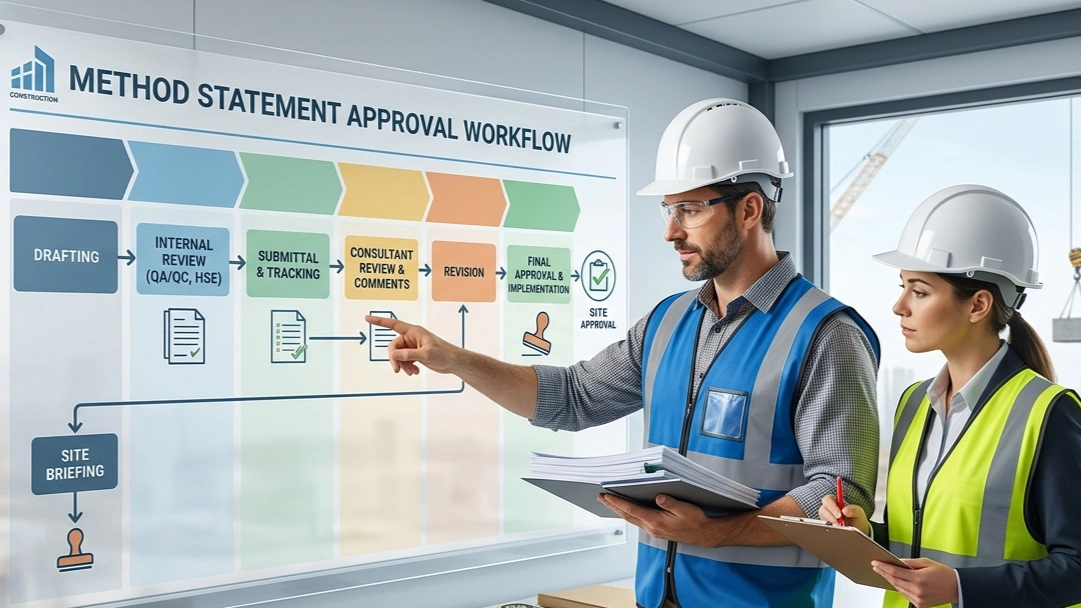
Who reviews or approves it
The method statement is usually submitted to the client representative, consultant, resident engineer, or project management consultant for review and approval before the work commences.
Important approval note
This method statement is an AI-assisted editable starting point, not a pre-approved document. Before use on any project, all content must be reviewed and approved by the relevant parties (superintendent, principal contractor, or client representative) in accordance with your contract and project quality plan.
For example: if your specification requires a departure from a referenced standard, that departure must be documented and approved separately — this method statement will not capture that automatically. Always verify against your applicable drawings, specifications, and regulatory requirements.
Method statement content
Scope
Overview
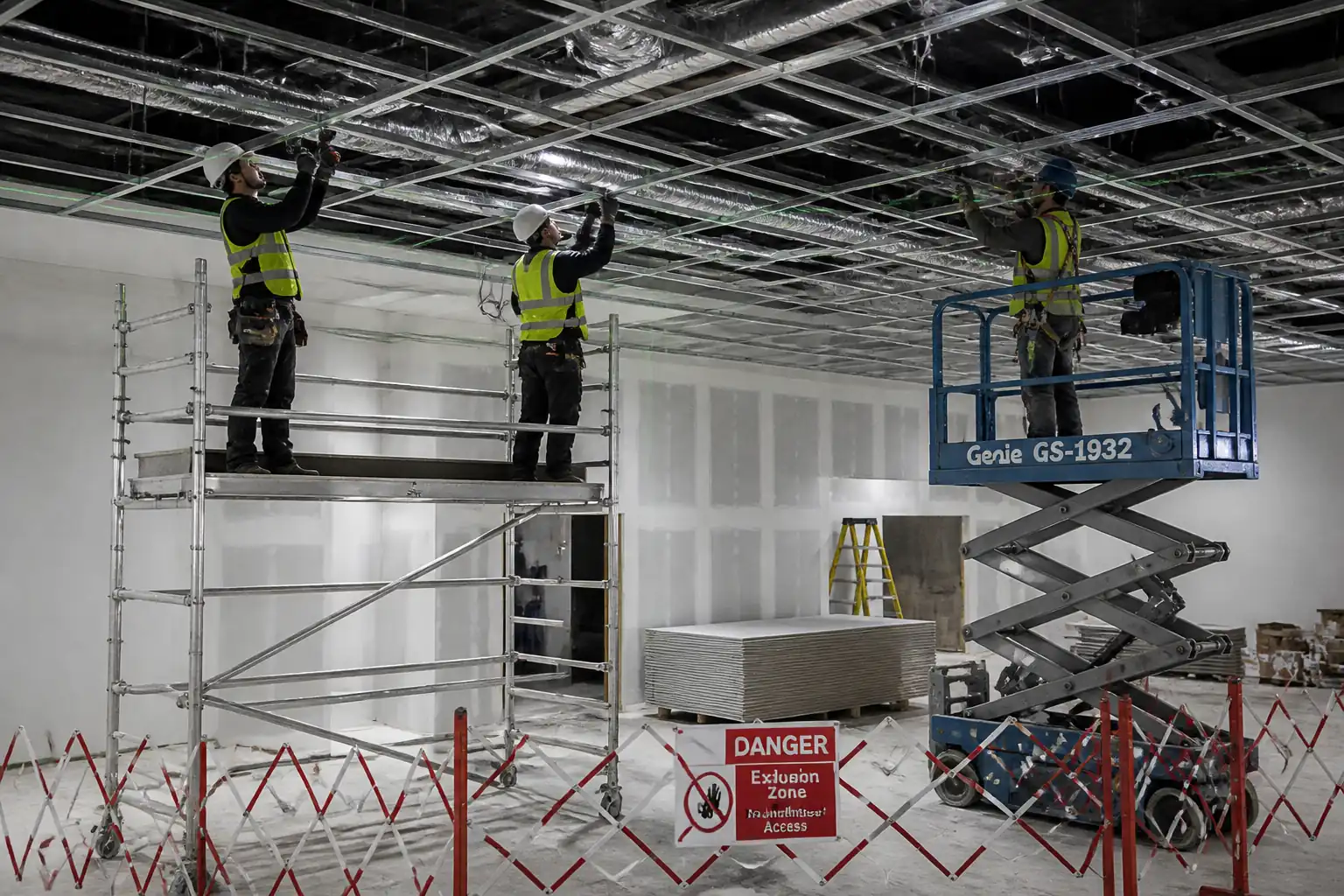
This method statement covers planning, pre-use inspection, ground condition verification, establishment of exclusion zones, operator competency verification, emergency/rescue procedures, controlled work-at-height tasks, safe travel within active construction areas, shutdown, and documentation for Mobile Elevating Work Platforms (MEWPs), including self-propelled booms (articulating/telescopic) and scissor lifts.
Included Activities
- Equipment verification and statutory/third-party certifications
- Operator training/authorization verification and familiarization
- Task-specific risk assessment and toolbox briefing
- Ground bearing capacity checks and use of spreader mats/outrigger pads
- Powerline and overhead obstruction controls
- Pre-use checks and function tests (including emergency lowering)
- Establishment of exclusion zones and traffic management
- Weather/wind monitoring and operational limits
- Harness/lanyard selection and use [Verify per project HSE plan]
- Safe approach, positioning, elevation, work execution, and movement in live sites
- Emergency/rescue plan implementation and drills
- Post-use inspection, parking, isolation, and maintenance reporting
Exclusions
- Crane-lifted work platforms (man-baskets)
- Suspended access platforms (Gondolas/Boatswain's chairs)
- Permanent building maintenance units (BMUs)
Location
- All project work areas where MEWPs are required, internal and external, on level or prepared working platforms.
References
| Document Type | Reference / Number | Revision | Notes |
|---|---|---|---|
| ISO 18893 | Operation & maintenance framework. | ||
| ISO 18878 | Training/competency baseline. | ||
| EN 280 / EN 280-1 | Design/manufacturer limits. | ||
| BS 8460:2017 | Planning and safe use guidance. | ||
| ANSI/SAIA A92.22 & A92.24 | US safe use/training standards. | ||
| OSHA 29 CFR 1926.453 | US federal safety requirements. | ||
| ISO 45001 | H&S governance framework. | ||
| ISO 14001 | Environmental controls framework. | ||
| Utility Standards | Overhead/underground services. |
Responsibilities
| Role | Responsibility | Name / Party |
|---|---|---|
| Project Manager | Project Manager | Main Contractor |
| Supervisor | Construction/Lift Supervisor | Main Contractor |
| HSE Officer | HSE Officer | Main Contractor |
| Operator | Competent MEWP Operator | Main Contractor/Subcontractor |
| Banksman | Banksman/Spotter/Traffic Marshal | Main Contractor |
| Technician | Plant/Service Technician | Plant Owner/Hirer |
| Rescue Appointed Person | Appointed Person for Rescue | Main Contractor |
Resources
| Resource Type | Description | Quantity | Remarks |
|---|---|---|---|
| Manpower | Competent MEWP Operator(s) (IPAF PAL/ANSI A92 authorization or equivalent) | 1–2 per MEWP [Verify per task] | |
| Manpower | Lift/Construction Supervisor | 1 | |
| Manpower | HSE Officer / Safety Advisor | 1 (shared) | |
| Manpower | Dedicated Banksman/Spotter for movements in live areas | 1 per MEWP during travel | |
| Manpower | Plant/Service Technician (on call) | As required |
Materials
| Material | Specification / Grade | Quantity | Remarks |
|---|---|---|---|
| Spreader mats/outrigger pads | High-density hardwood/composite; min 50 mm thick [Verify]. | As calculated | |
| Barriers & signs | High-visibility; night reflectors as required. | As layout | |
| PPE | EN/ANSI certified [Verify]. | Per person | |
| Spill kit | Absorbents, pads, disposal bags. | 1 kit/MEWP in area |
Equipment
| Equipment | Capacity / Type | Quantity | Inspection Required |
|---|---|---|---|
| Boom lift (diesel/electric) | Working height 12–45 m [Verify per task]. | As required | Yes – pre-use + 6-month thorough exam [Verify per law]. |
| Scissor lift | Working height 6–18 m [Verify]. | As required | Yes – pre-use + 6-month thorough exam [Verify per law]. |
| Anemometer & inclinometer | Wind 0–30 m/s; tilt ±0.1° | 1 set/work area | Calibration certificate |
| Radios/alarms | Per team | ||
| Rescue kit | 1 set/work face | Pre-use check |
Prerequisites
Permits and Planning
- Permit to Work and task-specific Risk Assessment/Method Statement (RAMS) approved. [Verify per project HSE plan]
- Utility clearances: Overhead line assessment and underground utility scan/mark-up completed; isolations/encroachments authorized by utility owner where required.
- Traffic Management Plan for live areas approved; drawings showing routes, access/egress, laydown, and exclusion zones.
- Emergency/Rescue Plan specific to MEWP task issued and briefed; competent ground person appointed to operate emergency controls.
Documentation & Competency
- Operator evidence: Valid IPAF PAL/ANSI A92 authorization or equivalent; familiarization on the specific MEWP model completed and recorded.
- MEWP documents: Manufacturer manual onboard; daily/weekly inspection records; maintenance log; last 6-month thorough examination certificate; commissioning/functional test report. [Verify per local regulations]
- Equipment identification: Asset ID, SWL/working height, wind rating, gradeability/tilt limits displayed.
Site Readiness
- Ground bearing capacity assessed; mats/pads sized and installed where needed.
- Lighting adequate for task (≥ 200 lux typical for general construction; [Verify]).
- Weather within limits; anemometer available; forecast reviewed.
- Workface clear of loose materials; overhead obstructions identified; safe approach paths marked.
- Toolbox Talk delivered covering entrapment, powerline hazard, travel routes, permits, and rescue plan.
Method Sequence
| Step | Activity | Description | Responsibility | Inspection / Hold Point |
|---|---|---|---|---|
| 1 | Arrival & documentation check | Verify MEWP ID, certificate of thorough examination (≤6 months old [Verify per law]), maintenance status, and manufacturer manual onboard. | Supervisor / Operator | Document review |
| 2 | Operator competency verification | Confirm operator training (IPAF/ANSI or equivalent), medical fitness where required, and model-specific familiarization. | Supervisor | ID/competency check |
| 3 | Ground condition assessment | Inspect surface, slope, voids, services, and weather effects. Calculate required ground bearing pressure using machine data. Install spreader mats/pads if required. | Supervisor / Engineer | Visual + calculation |
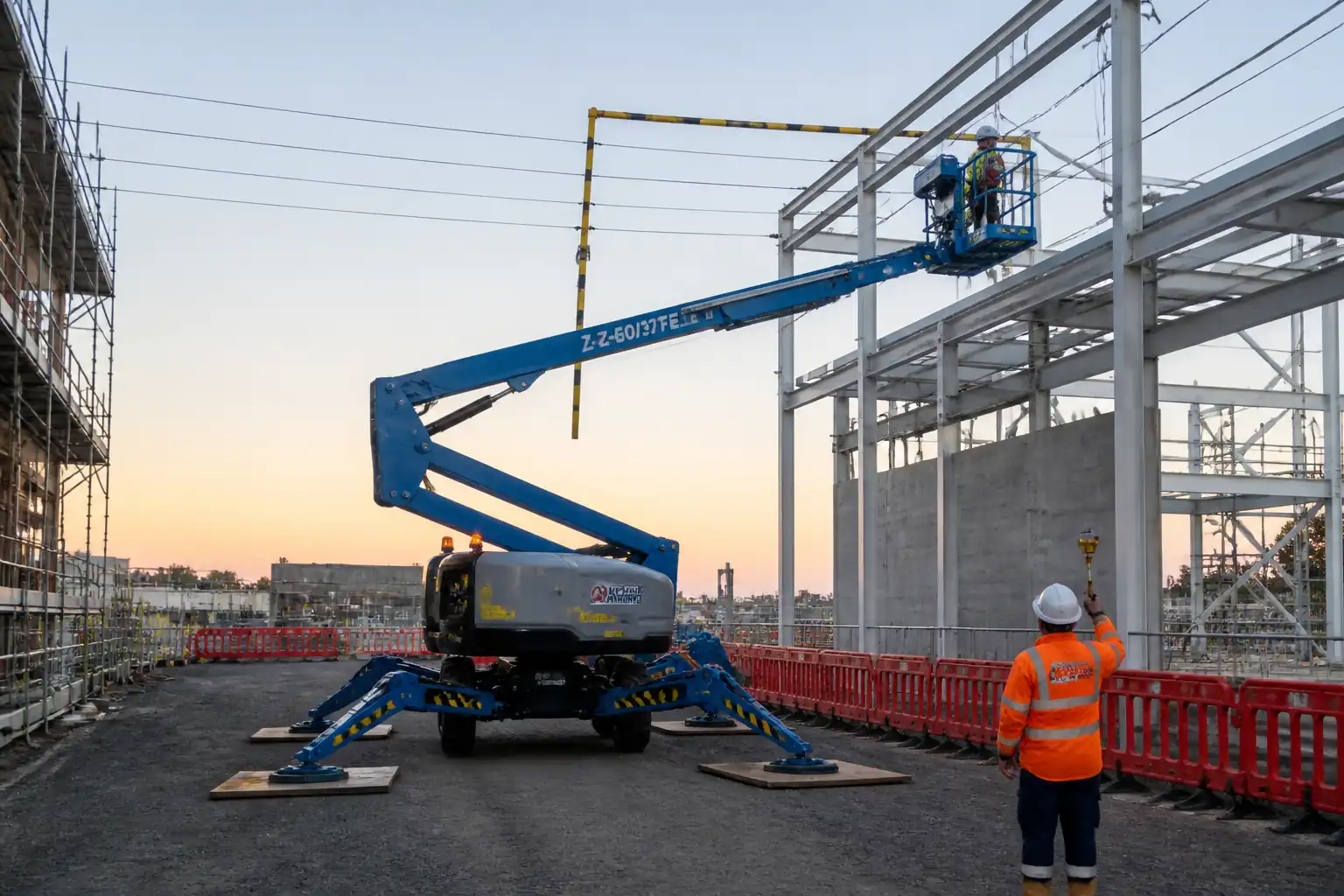
| 4 | Utilities & overhead hazards | Confirm safe approach distances to power lines; install physical goalposts/warning bunting; obtain isolation if encroachment unavoidable. | Supervisor | Survey confirmation |
| 5 | Exclusion zone & traffic setup | Establish barriers, signage, and spotter positions; segregate pedestrian routes; set speed limit and one-way system. | Supervisor / Banksman | Layout verification |
| 6 | Pre-use inspection | Operator conducts daily inspection: structure, tires/tracks, hydraulics, leaks, controls, alarms, tilt sensor, load plate, guardrails, platform gates, anchor points, harness, decals, emergency lowering, fuel/battery levels. | Operator | Checklist |
| 7 | Weather/wind verification | Measure wind at workface with anemometer; review forecast and gusts; consider wind funnelling near structures. | Operator / HSE | Measurement |
| 8 | Positioning & stabilization | Position MEWP on prepared area; deploy outriggers (if fitted) fully per manual; verify pads/mats seated; recheck tilt/level; chock if necessary (per manual). | Operator | Visual + level check |
| 9 | Work-at-height execution | Raise platform smoothly; maintain three points while entering/exiting; use harness with lanyard (boom types); maintain exclusion; avoid leaning/climbing guardrails; maintain safe clearance to structures. | Operator | Spotter oversight |
| 10 | Controlled movement in live area | Travel only with platform stowed unless the manufacturer allows elevated travel on rated surfaces; engage spotter; adhere to routes and speed limits. | Operator / Banksman | Traffic control |
| 11 | Emergency/rescue readiness | Confirm ground controls accessible; a trained rescuer present; test auxiliary descent; brief contact numbers; prepare rescue kit. | Supervisor / Appointed Person | Functional test |
| 12 | Pause/stop criteria | Cease work for high winds, lightning, loss of visibility, unsafe ground movement, encroachment breach, or equipment fault. | Operator / Supervisor | Ongoing monitoring |
| 13 | Post-use & parking | Lower platform, stow outriggers, clean area, park at designated bay on level ground, isolate key, connect charger/refuel, tag status. | Operator | Visual |
| 14 | Defect reporting & maintenance | Log defects; remove from service if safety critical; notify technician; close-out after repair and test. | Operator / Technician | Defect control |
Safety Controls
Task-Specific Hazards and Controls
- Hazard: Ground failure/overturning due to inadequate bearing capacity.
- Consequence: Tip-over causing fatality and equipment loss.
- Engineering/Procedural Control: Ground assessment and bearing calculation; install spreader mats sized for calculated pressure with FoS 1.5–2.0; maintain setback from edges ≥ excavation depth unless engineered; verify slope within machine limits.
- Required PPE: Helmet with chinstrap, hi-vis, safety boots, gloves.
- Collective Measure: Physical barriers preventing encroachment onto weak ground; spotter control.
-
Inspection/Permit: Pre-use ground check sheet; supervisor approval; Temporary Works check where applicable.
-
Hazard: Overhead powerline contact or arcing.
- Consequence: Electrocution, burns, fire, arc blast.
- Engineering/Procedural Control: Survey and mark exclusion; maintain statutory clearances (e.g., 3–10 m by voltage) or isolate; install physical goalposts.
- PPE: Standard PPE; arc-rated PPE only if approved and required for specific tasks [Verify].
- Collective Measure: Dedicated banksman; lockable barriers; permit-to-work near HV.
-
Inspection/Permit: Utility permit/authorization; daily verification of clearance.
-
Hazard: Crush/entrapment between platform and structure.
- Consequence: Serious injury or fatality.
- Engineering/Procedural Control: Use anti-entrapment devices if available; maintain stand-off; plan approach path; use slow speed; spotter to monitor blind spots; never climb guardrails.
- PPE: Helmet with chinstrap, gloves.
- Collective Measure: Exclusion zone beneath; emergency lowering trained ground person.
-
Inspection/Permit: Pre-task briefing highlighting entrapment zones; function test of emergency stop.
-
Hazard: Fall from platform.
- Consequence: Serious injury or fatality.
- Engineering/Procedural Control: Keep gates closed; no leaning outside rails; use harness and lanyard attached to designated anchor for boom lifts; scissor lifts per site rules/manufacturer [Verify].
- PPE: Full body harness with short restraint or energy-absorbing lanyard as specified; helmet with chinstrap.
- Collective Measure: Guardrails maintained; periodic supervision checks.
-
Inspection/Permit: Harness inspection (pre-use and periodic); tag system.
-
Hazard: Falling objects from platform.
- Consequence: Injuries to persons below; property damage.
- Engineering/Procedural Control: Toe boards, tool lanyards, secure materials; prohibit stacking above rail height.
- PPE: Hard hats for all below.
- Collective Measure: Exclusion zone; debris netting if required.
-
Inspection/Permit: Supervisor checks; tool tethering verification.
-
Hazard: Plant–people interface in live construction area.
- Consequence: Struck-by injuries.
- Engineering/Procedural Control: Traffic Management Plan; designated routes; speed ≤5 km/h [Verify]; spotter during travel and reversing; horns and beacons active.
- PPE: Hi-vis, boots.
- Collective Measure: Physical segregation and barriers; pedestrian detours.
-
Inspection/Permit: TMP approval; daily inspection of signage and barriers.
-
Hazard: Adverse weather (wind, lightning, heavy rain, dust).
- Consequence: Loss of control, tip-over, reduced visibility.
- Engineering/Procedural Control: Monitor wind with calibrated anemometer; stop above manufacturer wind limit (typically 12.5 m/s) or during lightning; clean decks from water/ice; postpone works if visibility poor.
- PPE: Weather-appropriate gear; eye protection in dusty conditions.
- Collective Measure: Shelter plans; rescheduling.
-
Inspection/Permit: Weather log; supervisor authorization to resume.
-
Hazard: Battery charging/fuel handling.
- Consequence: Fire, explosion, chemical burns.
- Engineering/Procedural Control: Charge in ventilated areas; spill kits at refueling; isolate ignition sources; follow MSDS.
- PPE: Nitrile gloves, goggles for electrolyte/fuel.
- Collective Measure: Designated charging/refueling bays; fire extinguishers.
-
Inspection/Permit: Hot work/charging permit if required; extinguisher monthly checks.
-
Hazard: Loading/unloading from transport.
- Consequence: Falls, roll-off, crush injury.
- Engineering/Procedural Control: Level ground; rated ramps; chock wheels; use winch as required; banksman control.
- PPE: Standard PPE.
- Collective Measure: Exclusion zone around trailer.
-
Inspection/Permit: Pre-use ramp inspection; loading plan.
-
Hazard: Unauthorized use/tampering.
- Consequence: Injury, equipment damage.
- Engineering/Procedural Control: Key control; lockable isolation; remove from service if defective; signage.
- PPE: N/A beyond standard.
- Collective Measure: Access control and supervision.
- Inspection/Permit: Daily key register; defect tag system.
[All controls to be verified per project HSE plan and local regulations.]
Environmental Controls
- Noise: Schedule noisy movements for permitted hours; maintain equipment; use electric units indoors; fit beacons instead of alarms where allowed and safe. Monitor as per site EMP.
- Air quality/emissions: Prefer electric/Stage V/Tier 4 engines; prevent idling; ensure adequate ventilation indoors; use CO/NOx monitoring in enclosed spaces [Verify].
- Spills/leaks: Pre-stage spill kits; drip trays during refueling; immediate containment and reporting; dispose waste via licensed contractor.
- Ground protection: Use mats to prevent rutting/contamination on soft soils; avoid wetlands; reinstate ground post-works.
- Dust: Minimize sweeping/vehicle movements near unsealed areas; damp down if required.
- Waste: Segregate consumables (rags, filters, batteries) and dispose per hazardous waste rules; maintain waste transfer notes.
- Wildlife/light: Use task lighting with cutoffs; avoid light spill to sensitive receptors where applicable.
- Energy: Charge batteries during off-peak if practicable; maintain chargers for efficiency.
Quality Assurance / Quality Control
QA/QC Controls
- Documentation control: Maintain current revisions of RAMS, TMP, rescue plan, and manufacturer manuals at point of use.
- Calibration: Anemometer and inclinometer calibrated within 12 months [Verify]; keep certificates in QA file.
- Inspection frequencies:
- Pre-use inspection: Every shift by operator using approved checklist.
- Weekly supervisory inspection: Visual condition, decals, guards, emergency systems.
- Periodic thorough examination: At intervals per law (typically 6 months for platforms lifting persons) by competent third party. [Verify per jurisdiction]
- Post-repair verification: Functional test before returning to service.
- Records: Operator checklists, ground bearing calculations, weather logs, rescue drill records, defect logs, maintenance/service reports, certificates.
- Nonconformity control: Tag-out defective equipment; issue NCR; implement corrective action; verify closure with re-test.
- Audits: Monthly HSE/QA audit of MEWP operations; sample size ≥10% of active shifts [Verify per project].
- Acceptance metrics (examples):
- Zero operation beyond manufacturer wind limit.
- 100% operator competency verification before use.
- 100% pre-use checklist completion rate.
- No MEWP travel without spotter in live areas.
Attachments
- Manufacturer Operation & Maintenance Manual (specific model)
- Sample MEWP Pre-Use Inspection Checklist
- Ground Bearing Pressure Calculation Sheet & Spreader Mat Sizing Guide
- Utility Clearance/Goalpost Detail Sketch
- Traffic Management Plan (routes, signage, speeds)
- Task-Specific Rescue Plan & Drill Record Template
- Training/Competency Matrix and Familiarization Log
- Certificates: Thorough Examination, Maintenance/Service Records, Calibration Certificates (anemometer/inclinometer)
- Daily Weather Log Template
This content is a read-only public reference. Download or customize to get an editable version.
ITP preview
The first inspection activities from the linked ITP for Method Statement: Safe Operation of Mobile Elevating Work Platforms (MEWPs):
| Activity | Inspection / Test | Acceptance Criteria | Responsibility | Record |
|---|---|---|---|---|
| Operator competency verification | Verify license/card and familiarization | Valid training/authorization for MEWP category; familiarization record present. | Supervisor | Training register copy |
| Equipment certification review | Check thorough exam ≤6 months [Verify] and maintenance status | Certificates current; no outstanding safety defects. | Supervisor / HSE | Certificate log |
| Ground condition & bearing calc | Inclinometer reading; bearing calc; mat sizing | Slope within spec; capacity ≥ demand × FoS 1.5–2.0; mats installed if required. | Engineer / Supervisor | Ground assessment sheet |
Showing 3 of 12 inspection activities. View full ITP →
Related Inspection and Test Plan
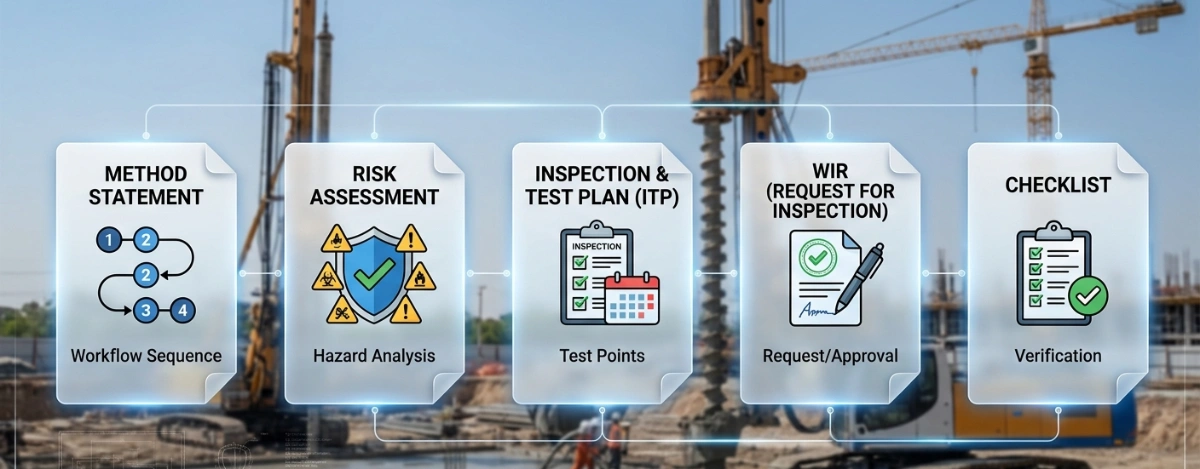
An Inspection and Test Plan (ITP) is available for Method Statement: Safe Operation of Mobile Elevating Work Platforms (MEWPs). The ITP defines the inspection activities, acceptance criteria, hold and witness points, responsible parties, and records required to verify the work described in this method statement.
View the Method Statement: Safe Operation of Mobile Elevating Work Platforms (MEWPs) ITP →Frequently asked questions
Continue with related Quollnet resources connected to this method statement.