Inspect façade O&M manuals, warranties, and maintenance guidance at closeout for general contractors, owners, and facility managers, ensuring complete, traceable documentation, serviceable instructions, and verifiable warranty obligations before handover.
- Verify completeness, version control, and cross-references against submittal logs.
- Confirm warranty terms, responsibilities, contacts, and start dates are correct.
- Assess maintenance methods, intervals, access equipment loads, and safe chemicals.
- Interactive, commentable checklist; export PDF/Excel with QR code evidence.
The checklist
Document Control and Indexing
- Confirm final façade O&M manual index matches the approved submittal log using a side-by-side comparison. Acceptance: one-to-one correspondence with section numbers and titles. Evidence: annotated index PDF and signed checklist entry.
- Verify digital formats meet archival requirements: PDF/A-1b for manuals and native DWG/IFC for drawings/BIM. Method: check file properties and validators. Acceptance: correct formats without encryption. Evidence: screenshots of file properties and validator reports.
- Check revision numbers and date stamps are consistent across covers, TOCs, and headers. Method: sample 10% of sections. Acceptance: latest revision throughout, issued prior to handover. Evidence: photos/screenshots of representative pages with dates highlighted.
- Ensure serial/model and batch/lot numbers are recorded for anchors, brackets, sealants, gaskets, and IGUs. Method: cross-check delivery dockets and labels. Acceptance: traceable IDs for major façade components. Evidence: label photos and consolidated asset register.
O&M Manuals Review
- Verify operable windows/vents procedures include torque settings, stroke limits, and emergency override. Method: compare to manufacturer data sheets. Acceptance: values stated in SI units with safety notes. Evidence: annotated page references and manufacturer confirmation email.
- Confirm cleaning procedures specify approved detergents, acceptable pH (6–8), and maximum pressure ≤ 4 MPa for washing. Method: review care instructions. Acceptance: named products or types and test patch guidance. Evidence: excerpt with highlighted limits and product SDS links.
- Review replacement parts list for hardware, gaskets, and sealants including part numbers and suppliers. Method: check completeness against elevations and schedules. Acceptance: each asset has serviceable spares identified. Evidence: parts table and vendor contact sheets.
- Check as-built façade drawings legibility and scale (1:20 typical details, 1:5 critical interfaces). Method: print-to-scale test. Acceptance: readable dimensions and section references. Evidence: scaled print snapshot with measured dimension verification.
Warranties Verification
- Compile a warranty matrix listing component, provider, duration (years), start trigger, coverage, and exclusions. Method: extract from letters and contract. Acceptance: no scope gaps or overlaps. Evidence: signed matrix by GC and owner.
- Verify manufacturer warranties are on letterhead, signed, and assignable to the owner. Method: check legal names, project ID, and address. Acceptance: correct entity names and assignment clause. Evidence: executed PDFs and transmittal log.
- Confirm installer workmanship warranty duration aligns with approved project specifications and authority requirements. Method: compare to contract. Acceptance: stated term with start date and remedy terms. Evidence: contractor letter with countersignature.
- Validate maintenance prerequisites (e.g., annual inspections, cleaning frequency) are practical and reflected in FM plans. Method: cross-reference to PM schedule. Acceptance: all conditions mapped to tasks. Evidence: linkage table and PM schedule export.
Maintenance Guidance Evaluation
- Check preventive maintenance schedules define task, method, interval (monthly/quarterly/annually), and skill level. Method: review maintenance tables. Acceptance: no undefined intervals or vague tasks. Evidence: calendar export with task IDs.
- Verify access methods (BMU, rope access, MEWP) include equipment ratings and tie-back anchor capacities in kN. Method: review calculations and certificates. Acceptance: documented loads and inspection cycles. Evidence: certificates and marked roof plan photos.
- Ensure sealant inspection criteria include bead width tolerance ±2 mm and adhesion test frequency (e.g., annually). Method: review test methods. Acceptance: defined actions for defects. Evidence: inspection template and sample photos.
- Confirm spare parts and consumables for two years are listed and delivered. Method: compare list to inventory receipts. Acceptance: quantities match; storage conditions stated. Evidence: delivery notes, photos, and inventory register.
Closeout Deliverables and Handover
- Validate FM training occurred covering façade operation, emergency procedures, and safe access. Method: review agenda and materials. Acceptance: attendee list with signatures and date. Evidence: sign-in sheet and training recording link.
- Ensure contact directory includes manufacturer, installer, and service agents with 24/7 numbers. Method: place-call spot check. Acceptance: two successful call tests. Evidence: time-stamped call log and directory PDF.
- Confirm digital folder structure matches owner standard: consistent naming, no orphan files. Method: run folder audit. Acceptance: zero critical findings. Evidence: file tree screenshot and audit report.
- Obtain owner’s formal acceptance of façade O&M closeout package. Method: issue transmittal for signature. Acceptance: signed transmittal noting deviations and actions. Evidence: countersigned form stored in DMS.
Preview the printable checklist
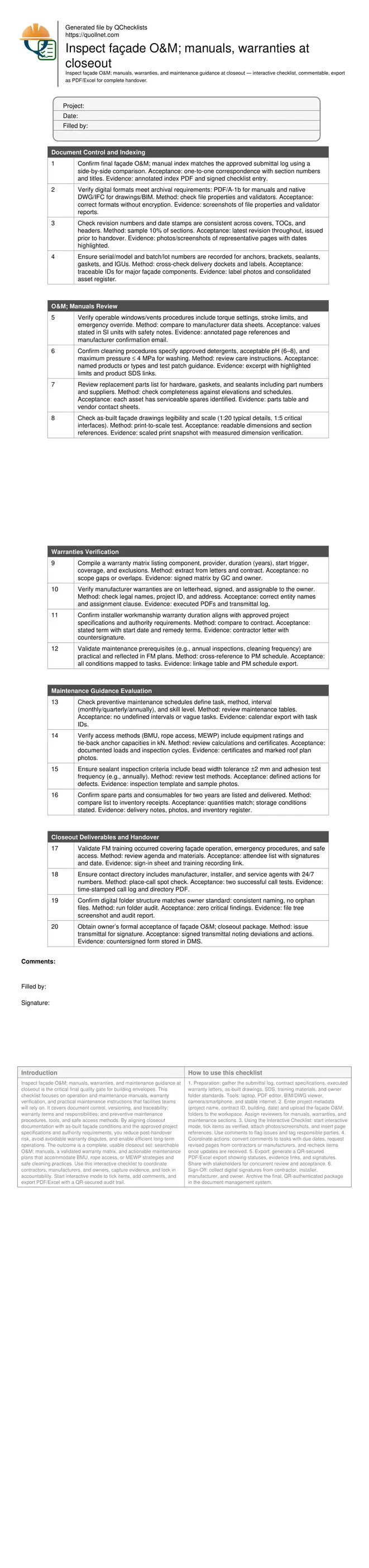
Preview page one below. Open the image or download the PDF for all pages.
At a glance
- Establish one source of truth for façade closeout by validating O&M manuals against submittal logs, drawing registers, and approved specifications. Capture evidence such as signed warranty letters, annotated page references, and file property screenshots to prove completeness, version control, and traceability before handover.
- Reduce lifecycle risk by confirming warranty providers, terms, start triggers, and maintenance conditions precedent. A structured warranty matrix prevents coverage gaps, accelerates claims, and clarifies responsibilities between manufacturer, installer, and owner, avoiding disputes during leaks, coating failures, or hardware malfunctions.
- Turn manuals into usable maintenance guidance by reviewing intervals, methods, safe chemicals, access equipment limits, and inspection tolerances. Clear, measurable acceptance criteria—like maximum washing pressure and sealant bead tolerances—help facilities teams execute work without voiding warranties or damaging the façade.
- Interactive online checklist with tick, comment, and export features secured by QR code.
How to Use This Interactive Closeout Checklist
- Preparation: gather the submittal log, contract specifications, executed warranty letters, as-built drawings, SDS, training materials, and owner folder standards. Tools: laptop, PDF editor, BIM/DWG viewer, camera/smartphone, and stable internet.
- Enter project metadata (project name, contract ID, building, date) and upload the façade O&M folders to the workspace. Assign reviewers for manuals, warranties, and maintenance sections.
- Using the Interactive Checklist: start interactive mode, tick items as verified, attach photos/screenshots, and insert page references. Use comments to flag issues and tag responsible parties.
- Coordinate actions: convert comments to tasks with due dates, request revised pages from contractors or manufacturers, and recheck items once updates are received.
- Export: generate a QR-secured PDF/Excel export showing statuses, evidence links, and signatures. Share with stakeholders for concurrent review and acceptance.
- Sign-Off: collect digital signatures from contractor, installer, manufacturer, and owner. Archive the final, QR-authenticated package in the document management system.
Document traceability and usable records at handover
A robust façade closeout hinges on document traceability. Start by aligning the O&M manual index with the approved submittal log and drawing register, ensuring every section is present and correctly titled. Archival formats matter for longevity: PDF/A for static manuals and native DWG/IFC for models allow future editing and searchability. Consistent revisions and date stamps across covers, tables of contents, and headers prevent version confusion years later. As-built drawings must print to scale and remain legible for field crews. Asset traceability—serial, model, and batch numbers for curtain wall frames, anchors, gaskets, and IGUs—underpins future replacement and warranty claims. Capture screenshots of file properties, annotate page references, and photograph labels to create an indisputable evidence trail. A short, signed checklist for each binder or folder establishes accountability and makes audits faster. Structured, searchable records reduce callbacks, accelerate onboarding of FM teams, and support rapid resolution of any post-handover issues.
- PDF/A for manuals; native DWG/IFC for editable records
- Match index to submittal log and drawing register
- Keep latest revision consistent across all pages
- Ensure as-built drawings scale and remain legible
- Capture serial and batch numbers for key assets
Warranties: clarity on coverage, triggers, and duties
Warranty clarity avoids expensive disputes. Build a warranty matrix listing each façade component, provider, term, coverage scope, exclusions, and start trigger. Confirm manufacturer letters are on letterhead, signed, and assignable to the owner. Installer workmanship coverage must align with the approved project specifications and authority requirements. Many warranties depend on routine care; extract these maintenance prerequisites and map them into the preventive maintenance plan so conditions precedent are met. Contact directories with 24/7 numbers shorten response times when failures occur. Document every element of this verification with signed matrices, countersigned letters, and transmittal logs. When warranty terms, parties, and triggers are unambiguous, owners can action claims promptly, and contractors can close out cleanly. This upfront diligence often cuts resolution times drastically and ensures continuous protection through the early operational period.
- Compile a complete, signed warranty matrix
- Verify assignment to owner and legal names
- Record clear start dates and triggers
- Map conditions precedent into PM tasks
- Maintain an up-to-date contact directory
Maintenance guidance that protects assets and warranties
Maintenance content must be practical, safe, and measurable. Cleaning procedures should specify compatible detergents, acceptable pH ranges, and limits like maximum washing pressure to avoid damaging coatings or gaskets. Access plans for BMUs, rope access, or MEWPs need equipment ratings, tie-back anchor capacities, and rescue references to prevent unsafe loads. Inspection criteria for sealants and hardware should contain tolerances and test frequencies, enabling technicians to judge acceptability on-site. Spare parts and consumables for at least two years minimize downtime. Training sessions and recordings transfer this knowledge to the FM team and embed safe systems of work. Converting narrative manuals into a scheduled PM plan with task IDs, intervals, and responsibility clarifies execution and safeguards warranties. Evidence such as SDS links, calculations, inspection templates, and training records proves readiness for operations.
- State pH limits and maximum pressure for cleaning
- Detail access loads and anchor capacities
- Define inspection tolerances and test frequencies
- List two years of spares and consumables
- Provide FM training with attendance records