
Method Statement – Routine Inspection, Color-Coding, and Testing of Loose Lifting Tackle – Method Statement
AI-assisted method statement with matching ITP, PDF download, and Excel export.
More than a static template
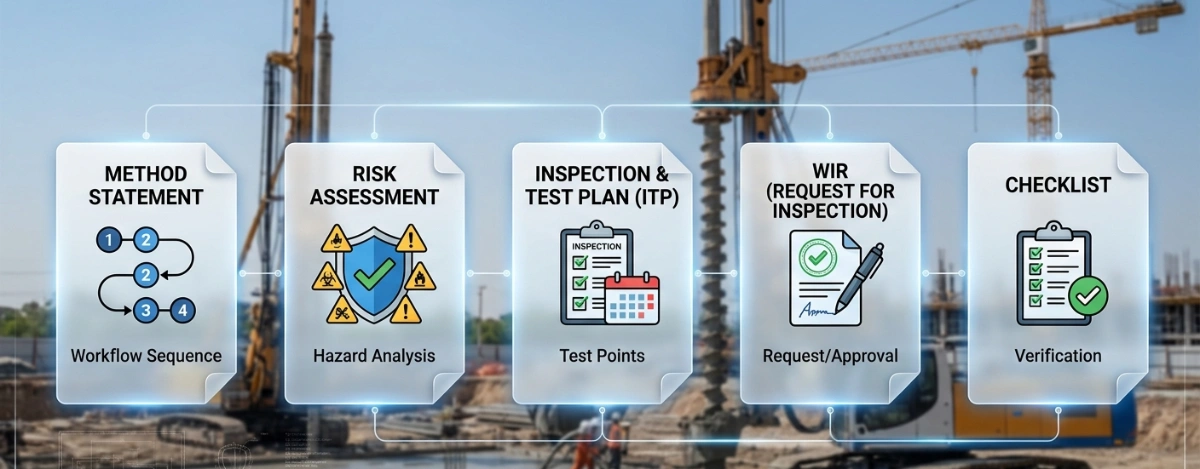
Unlike a downloadable Word or PDF template, this method statement is an AI-assisted editable starting point connected directly to a matching Inspection and Test Plan. Every section is structured, project-adaptable, and ready to export.
- AI-assisted drafting — Customize every section with AI for your specific project scope.
- Linked ITP — A matching inspection and test plan is generated alongside the method statement.
- Multiple export formats — Download as a formatted PDF or editable Excel spreadsheet.
- Editable starting point, not a final document — Review, verify, and adjust all content against your project requirements before use.
Static template vs. Quollnet workflow
| Feature | Static template | Quollnet |
|---|---|---|
| Project-specific content | Manual fill-in required | AI-assisted customization |
| Linked ITP | Separate document, no link | Matching ITP included |
| Export formats | Usually PDF only | PDF and Excel |
| Structured sections | Free-form layout | 13 standardized sections |
| Saved to your account | Local file only | Cloud-saved, reusable |
| Content accuracy | You verify everything | AI-assisted, you still verify |
| Cost | Often free but time-intensive | Free to customize and download |
What you can customize
When you save this method statement to your account, every section becomes editable. The following 13 sections are included:
- Scope — Defines the activity and its boundaries.
- References — Standards, specifications, and drawings.
- Responsibilities — Roles and accountabilities.
- Resources — Labour, plant, and equipment summary.
- Materials — Materials and compliance requirements.
- Equipment — Tools and equipment details.
- Prerequisites — Hold points and pre-conditions.
- Method sequence — Step-by-step construction sequence.
- Safety controls — HSE risk controls and PPE.
- Environmental controls — Environmental mitigation measures.
- QA/QC — Quality inspection and test requirements.
- ITP — Inspection and Test Plan table (has its own page).
- Attachments — Referenced drawings and documentation.
Why this method statement is used
This method statement is used to define and communicate the approved procedure for carrying out method statement – routine inspection, color-coding, and testing of loose lifting tackle on site. It ensures the work is planned in advance, the correct resources and controls are in place, and all personnel understand responsibilities, sequence, quality requirements, and safety controls before work begins. It aligns site execution with the documented scope and acceptance expectations.
Who uses this method statement
This method statement is used by contractors, site supervisors, project engineers, QA/QC engineers, HSE officers, consultants, and client representatives. It serves as a shared reference for planning, execution, supervision, inspection, and approval of the activity on site.
When it is prepared and submitted
The method statement is prepared before the work activity starts and submitted as part of the pre-construction documentation package for review and approval.
Who reviews or approves it
The method statement is usually submitted to the client representative, consultant, resident engineer, or project management consultant for review and approval before the work commences.
Important approval note
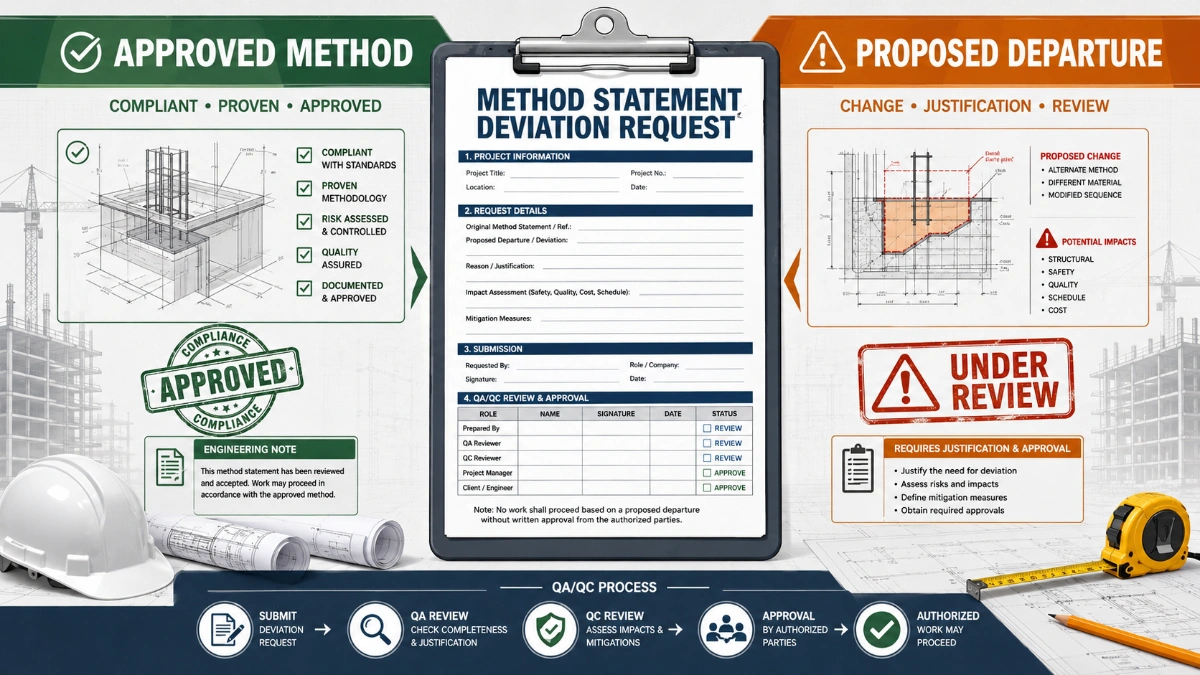
This method statement is an AI-assisted editable starting point, not a pre-approved document. Before use on any project, all content must be reviewed and approved by the relevant parties (superintendent, principal contractor, or client representative) in accordance with your contract and project quality plan.
For example: if your specification requires a departure from a referenced standard, that departure must be documented and approved separately — this method statement will not capture that automatically. Always verify against your applicable drawings, specifications, and regulatory requirements.
Method statement content
Scope
Purpose
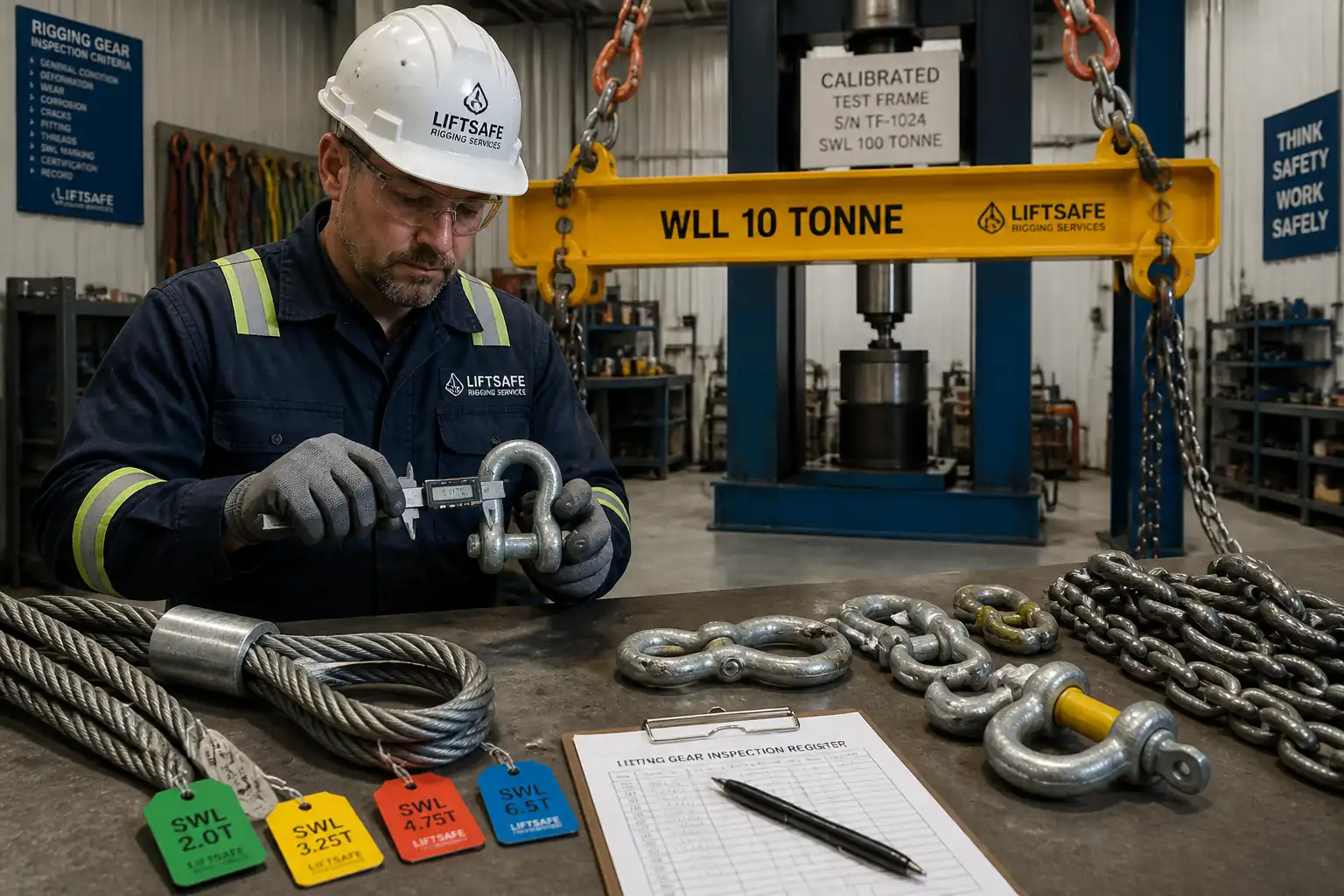
This method statement defines the systematic process for routine inspection, functional verification, testing (where required), certification traceability, and quarterly color-coding of loose lifting tackle, including:
- Wire rope slings (single/multi-leg with thimbles/ferrules)
- Chain slings and components (master links, hooks)
- Textile slings (web/round slings)
- Shackles and rigging hardware
- Spreader beams and non-fixed lifting attachments
It establishes acceptance/rejection criteria, document checks, quarantine of defective gear, load test/NDT where applicable, and record-keeping requirements.
Scope of Application
- All project lifting accessories used on including yard, workshops, and site locations.
- Covers pre-use checks, routine periodic inspections (monthly/quarterly), thorough examinations, and color-code management.
- Excludes fixed lifting machines (e.g., cranes, hoists) except interface checks with lifting accessories.
Frequency Benchmarks [Verify per project specifications]
- Pre-use check: each use (by user)
- Monthly visual: by Lifting Supervisor/Store
- Quarterly color-code program: Competent Person
- Thorough examination: every 6 months for lifting accessories; 12 months for spreader beams/non-fixed attachments unless otherwise required by law or service severity
- Proof load: for spreader beams and as required after manufacture/repair/modification or as directed by certifying authority
- NDT: as risk-based or annually for spreader beams/critical attachments
Deliverables
- Updated Lifting Gear Register with unique IDs and status
- Color-coded tags issued and posted color chart
- Inspection/Examination Reports with acceptance criteria results
- Load test and NDT certificates (where applicable)
- Quarantine Register and Disposal Records for rejected items
- Release Certificates for service-ready items
Constraints
- Only calibrated and certified test/measurement equipment may be used.
- No in-service proof loading of slings/shackles unless specified and performed under controlled conditions to avoid damage.
- Defective gear must be quarantined immediately and removed from service pending decision.
References
| Document Type | Reference / Number | Revision | Notes |
|---|---|---|---|
| Standard/Code | ASME B30.9 – Slings | Use for inspection and removal criteria for wire rope, chain, and synthetic slings [Verify applicability]. | |
| Standard/Code | ASME B30.26 – Rigging Hardware | Use for shackles, hooks, eyebolts acceptance/removal guidance. | |
| Standard/Code | ISO 4309 – Steel wire ropes – Care and discard criteria | Wire rope sling inspection and discard criteria (broken wires, kinks, birdcaging, corrosion). | |
| Standard/Code | BS EN 818 (Parts for chain slings) | Grade, marking, and inspection of chain sling components; wear/elongation limits. | |
| Standard/Code | BS EN 1492 (Textile slings) | Inspection/removal criteria for webbing and round slings; label requirements. | |
| Standard/Code | BS EN 13155 – Cranes – Non-fixed load lifting attachments | Design/marking/testing of spreader beams and lifting attachments; documentation checks. | |
| Regulation | LOLER 1998 / Local lifting regulations [Verify per jurisdiction] | Thorough examination intervals (6 months accessories, 12 months equipment) and competent person definition. | |
| Standard | ISO 9712 / ASNT SNT-TC-1A – NDT personnel qualification | Qualification of NDT technicians for PT/MT on lifting attachments. | |
| Standard | ISO 3452 (PT) / ISO 23278 (MT) | Penetrant and magnetic particle testing methods and acceptance of indications. | |
| Standard | ISO 7500-1 – Verification of testing machines | Calibration/verification of load test benches and load cells by accredited labs (ISO/IEC 17025). | |
| Manufacturer | OEM manuals and certificates for slings, shackles, spreader beams | WLL, proof load, geometry, materials, inspection limits, and maintenance guidance. |
Responsibilities
| Role | Responsibility | Name / Party |
|---|---|---|
| Project Manager | Overall delivery of program | Contractor |
| Lifting Equipment Competent Person (LECP) | Plan and execute inspections, verify acceptance criteria, sign-off examinations, manage quarantine, authorize release | Contractor |
| Riggers / End Users | Daily pre-use checks, identify defects, ensure correct gear selection and return for inspection | Contractor |
| Lifting Supervisor / Storekeeper | Coordinate monthly checks, maintain store layout, administer tags and registers | Contractor |
| NDT Level II Technician | Perform PT/MT per approved procedures, report indications, recommend repair/rejection | Approved NDT Subcontractor |
| Third-Party Certifying Authority | Witness hold points for proof load/NDT when required, issue third-party certificates | Independent |
| HSE Manager / Officer | Risk assessments, permits, safety oversight, PPE compliance, waste management | Contractor |
Resources
| Resource Type | Description | Quantity | Remarks |
|---|---|---|---|
| Personnel | 1–2 [Verify per workload] | Certified and experienced. | |
| Personnel | 1 each | ||
| Personnel | 2–4 | Assist handling and functional checks. | |
| Personnel | As required | PT/MT on spreader beams/padeyes. | |
| Personnel | As required | Witness proof load, review documents. |
Materials
| Material | Specification / Grade | Quantity | Remarks |
|---|---|---|---|
| Quarterly color tags/cable ties/heat-shrink sleeves | Site color code standard [Verify] | Set per quarter | Four-color tagging/clip system with year identification; heat-shrink or robust tags. |
| Red REJECT/QUARANTINE tags | Oil/UV resistant | Sufficient | Clearly marked DO NOT USE |
| Inspection paint/paint markers/engraving labels | Non-obliterating; contrast color | As required | Low-VOC if possible |
| Cleaning solvents/rags | Non-chlorinated [Verify] | As required | With SDS available |
| Metal ID tags / RFID tags | Corrosion resistant; unique serial numbers | As required | For asset tracking |
| PT/MT materials | ISO 3452 / ISO 9934 compliant | As required | NDT consumables |
Equipment
| Equipment | Capacity / Type | Quantity | Inspection Required |
|---|---|---|---|
| Load test bench with digital load cell | ≥1.25× max WLL to be tested [Verify] | 1 | Y |
| Measuring tools (vernier, micrometer, calipers, go/no-go gauges) | 1 set | Y | |
| Chain wear gauge | 1 | Y | |
| Wire rope lay length ruler/gauge | 1 | Y | |
| Magnetic particle yoke with accessories | 1 | Y | |
| Dye penetrant kit | 1 | Y | |
| UV lamp & lux meter | 1 | Y | |
| Forklift/overhead crane | Adequate for max load + rigging [Verify] | 1 | Y |
Prerequisites
- Approved Method Statement and Risk Assessment (including COSHH/SDS for chemicals) [Verify per project HSE plan and local regulations].
- Posted quarterly color-code chart and current quarter color identified.
- Lifting Gear Master Register established with unique IDs, previous certificates, and due dates imported.
- Calibrated measuring instruments, load test bench/load cells with current certificates (traceable to ISO/IEC 17025).
- Design certificates and WLL markings available for spreader beams and attachments.
- Quarantine area established: physically segregated, lockable cage, red signage “Do Not Use – Quarantine”.
- Permits: lifting/hoisting permit for handling heavy items; chemical use/ventilation controls for NDT; hot work permit if decommissioning by cutting [Verify].
- Competence: LECP appointed in writing; NDT Level II qualified; riggers trained in pre-use inspection.
- Housekeeping: inspection benches clear, drip trays for chemicals, spill kit available.
- Emergency plan: spill response, first aid for cuts/solvent exposure, eyewash station operational.
- Communication: toolbox talk covering hazards (pinch points, snap-back, stored energy, chemicals).
Method Sequence
| Step | Activity | Description | Responsibility | Inspection / Hold Point |
|---|---|---|---|---|
| 1 | Pre-start briefing and area setup | Conduct toolbox talk; confirm color-code for quarter; verify permits; check calibration certificates for load cells and gauges; set barricades around test area (exclusion zone 1.5× sling length or beam diagonal). | LECP / HSE / Lifting Supervisor | Document check and area inspection |
| 2 | Receipt and identification of gear | Receive items from site; clean gross debris; verify serial numbers and legible ID tags; if missing/illegible assign new unique ID and tag as “ID Assigned – Pending Exam”; reconcile with register. | Storekeeper / LECP | Visual/administrative |
| 3 | Cleaning and pre-inspection | Degrease as required; lay out on inspection bench; for textile slings dry surface; ensure adequate lighting ≥500 lux. | Riggers | Visual preparation |
| 4 | Detailed inspection – Wire rope slings | Inspect along full length. Check: broken wires (count per lay), kinks, birdcaging, core protrusion, corrosion/pitting, diameter reduction, ferrules/thimbles integrity, eye deformation, heat damage, label legibility. | LECP | Detailed visual and measurement |
| 5 | Detailed inspection – Chain slings | Check links and components for wear, nicks, corrosion, stretch, bent links, heat damage, hooks latches, master link wear. | LECP | Detailed visual and measurement |
| 6 | Detailed inspection – Textile slings (web/round) | Check for cuts, broken stitching, abrasion, chemical burn, melted fibers, UV degradation, exposed core (round slings), hardware damage, label legibility. | LECP | Visual |
| 7 | Detailed inspection – Shackles and rigging hardware | Inspect body and pin for wear, corrosion, cracks, thread condition, straightness, jaw spread; verify correct pin type; check markings (WLL, manufacturer, grade). | LECP | Visual and measurement |
| 8 | Documentation audit – Spreader beams and attachments | Verify current load certificate, design/WLL plate, serial number, year of manufacture, last proof load/NDT date, and compatibility with intended rigging. Physical walkdown for cracks, deformation, padeye ovality, corrosion. | LECP | Document and visual inspection |
| 9 | NDT of critical areas (if due) | Perform MT or PT on high-stress locations (padeyes, lug-to-beam weld toes, lifting points) per approved NDT procedure. | NDT Level II / LECP | NDT execution and interpretation |
| 10 | Proof load testing (as required) | Set up in test frame/bench with correct rigging; load gradually to specified proof load; hold for dwell time; monitor extension/deflection if required; unload and re-inspect. | LECP / Third-Party Inspector | Witness test |
| 11 | Color-coding and marking | Apply current quarter color tag and next due date; cross-check against register; apply paint dot/stamp where permitted (not on textile load-bearing areas). Post updated color chart at store. | Storekeeper / LECP | Administrative check |
| 12 | Quarantine and control of defective items | Affix red REJECT tag; enter in Quarantine Register; move to locked quarantine cage. Decide repair, re-test, or scrap. For scrap: render unusable (e.g., cut sling, drill shackle pin) and record disposal. | LECP / Storekeeper | Verification of segregation |
| 13 | Storage and release to service | Store approved gear on dedicated racks by type/size; protect textile slings from UV/chemicals; lightly lubricate wire rope terminations if required; issue only against signed requisition. | Storekeeper | Final check |
| 14 | Records and reporting | Compile inspection sheets, certificates, NDT reports; update Master Register; issue summary report with outstanding actions and next due dates. | LECP | Document review |
Health & Safety Controls
The following task-specific controls apply. Where local rules differ, implement the more stringent requirement [Verify per project HSE plan and local regulations].
- Hazard: Handling heavy gear and pinch points (beams, shackles, chains)
- Likely consequence: Crush injuries, sprains, amputations
- Engineering/procedural control: Use mechanical aids (forklift/overhead crane); designate pinch-free zones; use tag lines; keep hands on handles/ends; team lifts for >20 kg; racks rated and labeled
- Required PPE: Safety shoes S3, cut-resistant gloves, long sleeves, safety glasses
- Collective preventive measure: Exclusion zones with barriers; floor kept dry/clear; lifting plan for handling large beams
-
Inspection/permit/supervision: Pre-use inspection of lifting aids; lifting permit for handling beams; supervisor present
-
Hazard: Stored energy during proof load (snap-back/rigging failure)
- Likely consequence: Struck-by, fatal injury
- Engineering/procedural control: Proof load only in certified test area; use restraints and guards; position personnel outside line-of-fire; gradual loading; emergency stop
- Required PPE: Hard hat, eye/face protection, gloves, safety footwear
- Collective preventive measure: Physical barricades 1.5× sling length; remote readout of load cell
-
Inspection/permit/supervision: Verify calibration; third-party witness where required; LECP authorization
-
Hazard: Sharp wire rope strands/broken wires
- Likely consequence: Lacerations, eye injury
- Engineering/procedural control: Brush/clean carefully; use leather-palmed or cut level A5+ gloves; handle from thimbles/eyes
- Required PPE: Cut-resistant gloves, safety glasses with side shields
- Collective preventive measure: Provide guards and bins for offcuts; magnetic sweepers for stray wires
-
Inspection/permit/supervision: HSE spot checks; first-aid kit available
-
Hazard: Chemical exposure from solvents and NDT materials (PT/MT)
- Likely consequence: Dermatitis, respiratory irritation, fire risk
- Engineering/procedural control: Use low-VOC, non-chlorinated products; local exhaust/ventilation; follow SDS; no ignition sources
- Required PPE: Nitrile gloves, goggles/face shield; flame-retardant coverall when MT with aerosols
- Collective preventive measure: Spill kits and drip trays; flammables cabinet; waste segregation
-
Inspection/permit/supervision: COSHH assessment; periodic air quality/ventilation check; chemical use permit if required
-
Hazard: Forklift/overhead crane movement
- Likely consequence: Collision, run-over
- Engineering/procedural control: Certified operators; spotter; horn use; defined routes; speed limits
- Required PPE: High-visibility vest, safety shoes, hard hat
- Collective preventive measure: One-way systems; floor markings; mirrors at blind corners
-
Inspection/permit/supervision: Pre-use checks; equipment inspection log; supervisor authorization
-
Hazard: Working at height on storage racks (>1.8 m)
- Likely consequence: Falls
- Engineering/procedural control: Use mobile work platform or podium steps; no climbing on racks; keep top tiers for light items
- Required PPE: Non-slip footwear; fall protection if >2 m where platform not possible [Verify]
- Collective preventive measure: Edge protection on platforms; rack load labels
-
Inspection/permit/supervision: Mobile platform inspection; WAH permit if applicable
-
Hazard: Noise during testing/handling
- Likely consequence: Hearing damage
- Engineering/procedural control: Keep exposure time short; maintain equipment; schedule noisy tasks
- Required PPE: Hearing protection where >80 dB(A)
- Collective preventive measure: Noise signage; acoustic screens if practical
-
Inspection/permit/supervision: Noise meter spot checks
-
Hazard: Hot work when scrapping defective gear
- Likely consequence: Burns, fire
- Engineering/procedural control: Prefer cold-cutting; if hot work needed, implement hot work permit, fire watch, extinguishers
- Required PPE: Welding face shield, FR clothing, gloves
- Collective preventive measure: Designated hot work bay
-
Inspection/permit/supervision: Hot work permit; gas/leak checks; fire watch sign-off
-
Hazard: Ergonomic strain from repetitive inspection
- Likely consequence: Musculoskeletal injuries
- Engineering/procedural control: Height-adjustable benches; job rotation; micro-breaks
- Required PPE: Support belts if prescribed by HSE
- Collective preventive measure: Task redesign; lifting aids
-
Inspection/permit/supervision: Ergonomic assessment review quarterly
-
Hazard: Electrical/UV exposure during MT
- Likely consequence: Shock, eye damage
- Engineering/procedural control: PAT-tested equipment; insulated yoke leads; UV shields; max exposure times
- Required PPE: UV-rated safety glasses, insulated gloves as needed
- Collective preventive measure: RCD protection
-
Inspection/permit/supervision: PAT records; UV intensity and ambient light checks before testing
-
Hazard: Documentation errors leading to wrong WLL use
- Likely consequence: Overload and failure in service
- Engineering/procedural control: Dual verification of certificates; software register with due-date alerts
- Required PPE: N/A
- Collective preventive measure: Issuing from store only against valid status
- Inspection/permit/supervision: Monthly document audit by LECP/HSE
Environmental Controls
- Chemical management
- Control: Use low-VOC cleaners and compliant PT/MT materials; keep SDS on site; secondary containment for aerosols/solvents; prohibit washing to drains.
- Monitoring: Weekly storage inspection; spill drill quarterly.
-
Waste: Collect used rags/empties as hazardous waste; manifest via licensed handler [Verify per local law].
-
Paint/marker use for color coding
- Control: Use minimal quantities; drip trays; no paint on textile sling fibers; ventilated area.
-
Waste: Empty cans recycled or disposed as hazardous per SDS.
-
Metal and textile scrap
-
Control: Segregate by type; render unusable before disposal; recycle ferrous components where possible; textiles to approved landfill or waste-to-energy [Verify].
-
Noise
-
Control: Schedule noisy proof-loads daytime; maintain equipment; install rubber pads.
-
Energy and equipment efficiency
-
Control: De-energize test bench when idle; periodic maintenance for efficient operation; LED lighting in inspection bay.
-
Housekeeping and drainage
- Control: Keep inspection area clean and dry; use absorbent mats; never discharge NDT materials or solvents to storm drains.
Quality Assurance / Quality Control
QA System
- Maintain a controlled Lifting Gear Master Register: item type, ID/serial, WLL, standard, location, last exam, next due, certificates.
- Use controlled forms with unique numbers for each inspection/examination/test.
- Calibration: All load cells, gauges, UV/lux meters, and yokes in-date; calibration interval typically 6–12 months [Verify per procedure].
- Competency: LECP appointed; NDT to ISO 9712 Level II; operators certified for MHE.
Acceptance Criteria (Benchmarks – Verify per project specs/standards)
- Wire rope slings: Broken wire counts, kinks, birdcage, core protrusion, heat damage; diameter loss ≥10% → reject; legible ID.
- Chain slings: Diameter wear >10%, elongation >5%, cracks/heat damage → reject; functional latches; legible ID.
- Textile slings: Any cut, melted/glazed area, chemical damage, exposed core yarns, or unreadable label → reject.
- Shackles/hardware: Wear >10%, deformation/jaw spread beyond OEM tolerance, thread damage, illegible markings → reject.
- Spreader beams: Cert matches serial/WLL; no deformation/cracks; NDT acceptable; proof load per OEM; markings legible.
Inspection/Test Frequencies [Verify]
- Pre-use: each use (user check)
- Monthly: store check
- Quarterly: color-code and LECP inspection
- 6-month: thorough examination (accessories)
- Annual: spreader beam review + NDT/proof load as specified by OEM/certifying authority
Records and Retention
- Keep inspection sheets, NDT/PT/MT and load test certificates, calibration certificates, quarantine/disposal records for ≥5 years or per contract.
- Maintain electronic backups with access control and audit trail.
Nonconformance and Corrective Action
- Issue NCR for failed items; quarantine; root cause (e.g., misuse); implement training/controls; verify effectiveness at next audit.
Attachments
- Example: Lifting Gear Master Register template (CSV/PDF)
- Example: Wire Rope Sling Inspection Checklist (Form L-01)
- Example: Chain Sling Inspection Checklist (Form L-02)
- Example: Textile Sling Inspection Checklist (Form L-03)
- Example: Rigging Hardware (Shackles/Hooks) Inspection Checklist (Form L-04)
- Example: Spreader Beam Audit & NDT Request (Form L-05)
- Example: Load Test Report Template (Form L-06)
- Quarterly Color Code Chart (Poster)
- Quarantine Register & Red Tag Template
- Calibration Certificates for load cells, gauges, UV/lux meters
- OEM manuals and latest third-party certificates for spreader beams
This content is a read-only public reference. Download or customize to get an editable version.
ITP preview
The first inspection activities from the linked ITP for Method Statement – Routine Inspection, Color-Coding, and Testing of Loose Lifting Tackle:
| Activity | Inspection / Test | Acceptance Criteria | Responsibility | Record |
|---|---|---|---|---|
| Receiving and identification | Check ID, serial, WLL, certificates on arrival/return | Unique ID traceable; WLL and manufacturer marking legible; documentation available | Storekeeper / LECP | Goods-in log; photo record; register update |
| Pre-use user check (toolbox) | Visual check for obvious damage; correct selection vs. load and geometry | No visible defect; correct WLL; tag current quarter | Rigger / User | Daily checklist or sign-on sheet |
| Routine detailed inspection – Wire rope slings | Broken wires count; kinks/birdcage; diameter at 3 points; ferrule/thimble | Within ISO 4309/ASME B30.9 limits; no kinks/birdcage; diameter loss <10%; tag legible | LECP | Wire rope sling checklist; photos; register update |
Showing 3 of 11 inspection activities. View full ITP →
Related Inspection and Test Plan
An Inspection and Test Plan (ITP) is available for Method Statement – Routine Inspection, Color-Coding, and Testing of Loose Lifting Tackle. The ITP defines the inspection activities, acceptance criteria, hold and witness points, responsible parties, and records required to verify the work described in this method statement.
View the Method Statement – Routine Inspection, Color-Coding, and Testing of Loose Lifting Tackle ITP →Frequently asked questions
Continue with related Quollnet resources connected to this method statement.