
Inspection and Test Plan for Method Statement – Routine Inspection, Color-Coding, and Testing of Loose Lifting Tackle
AI-assisted inspection and test plan connected to a method statement, with PDF and Excel export.
More than a static template
Unlike a downloadable Word or PDF template, this ITP is an AI-assisted editable starting point directly connected to its method statement. Every inspection activity, hold point, and acceptance criterion is structured and ready to adapt to your project.
- AI-assisted customization — Tailor inspection activities and acceptance criteria to your specific project scope.
- Linked method statement — This ITP is connected to the corresponding method statement describing the work sequence.
- Multiple export formats — Download as a formatted PDF or editable Excel spreadsheet.
- Editable starting point, not a final document — Review and verify all content against your project specifications and standards before use.
What you can customize
When you save this ITP to your account, every inspection row becomes editable. You can add, remove, or modify:
- Inspection activity — Description of what is being inspected.
- Inspection type — Hold point (H), Witness point (W), Review (R), or Monitor (M).
- Responsibility — Contractor, subcontractor, engineer, or client.
- Frequency — How often the inspection occurs.
- Acceptance criteria — Referenced standard or specification requirement.
- Records — Forms, test reports, or checklists required as evidence.
Why this ITP is used
To ensure lifting accessories are safe, compliant, and traceable before release to service, minimizing risk of failure.
Who uses this inspection and test plan
Lifting Equipment Competent Person, Lifting Supervisor, Storekeeper, NDT technicians, and Third-Party Inspectors.
When this ITP is prepared and submitted
At receiving/return, routine intervals (monthly/quarterly), 6‑monthly thorough exams, and whenever proof load or NDT is due.
Who receives or approves this ITP
Contractor’s PM and Client/Third-Party Certifying Authority for review/approval [Verify].
Inspection scope
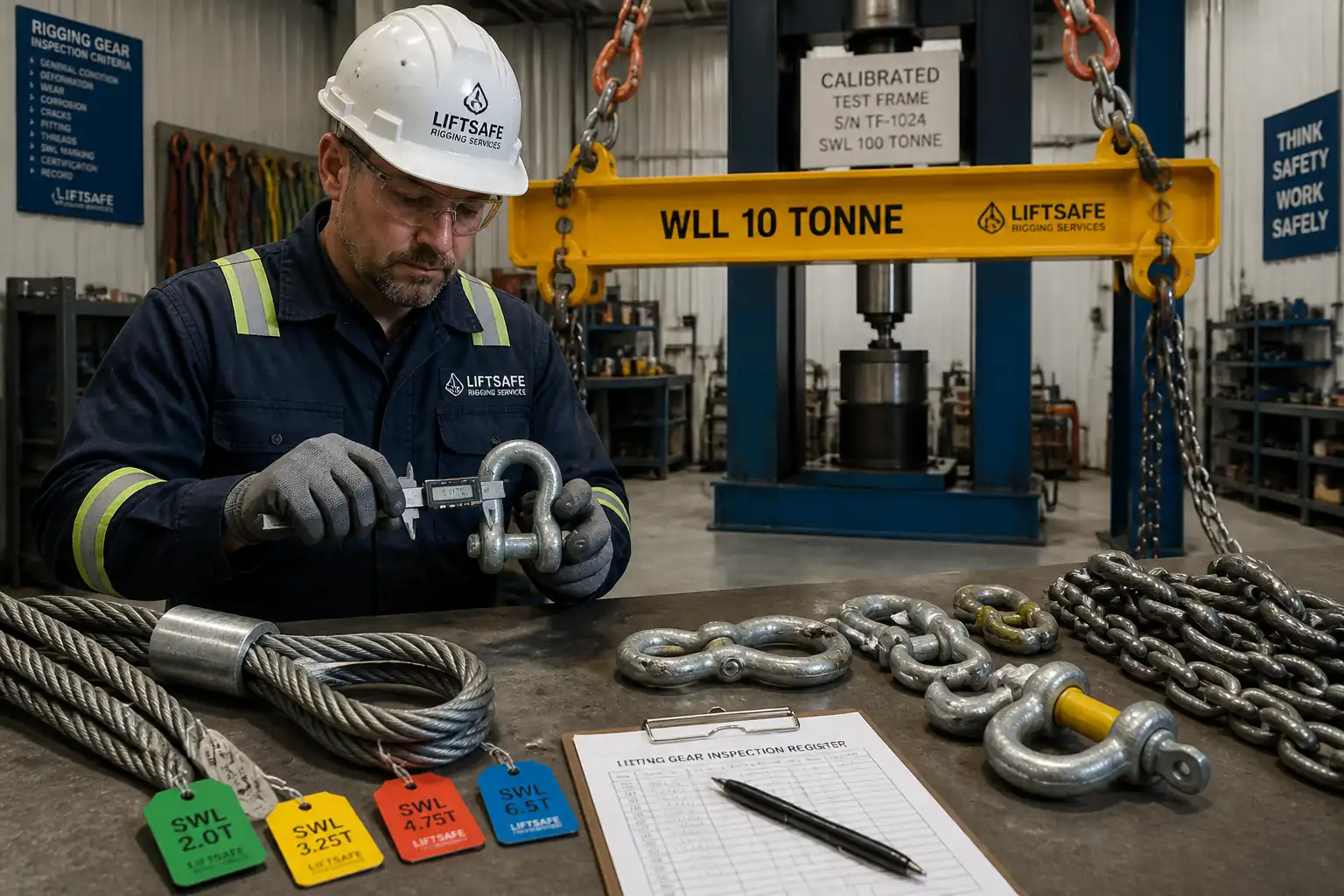
Covers ID verification, visual/dimensional checks, functional checks, document audits, NDT of critical areas, proof load testing, and tagging.
Typical hold, witness, and review points
Witness: proof load tests, NDT interpretation (as required). Hold: before color-tagging pending document/NDT result verification.
Typical inspection records
Inspection checklists, photos, updated register, NDT and load test certificates, calibration records, quarantine and disposal logs.
Important approval note
This ITP is an AI-assisted editable starting point, not a pre-approved document. Before use on any project, all inspection activities, hold points, and acceptance criteria must be reviewed and approved by the relevant parties (superintendent, principal contractor, or client representative) in accordance with your contract and project quality plan.
Always verify acceptance criteria against your applicable drawings, specifications, and regulatory requirements. Hold points must be confirmed with the relevant authority before work proceeds past that point.
Inspection and test plan
| Activity | Inspection / Test | Acceptance Criteria | Responsibility | Record |
|---|---|---|---|---|
| Receiving and identification | Check ID, serial, WLL, certificates on arrival/return | Unique ID traceable; WLL and manufacturer marking legible; documentation available | Storekeeper / LECP | Goods-in log; photo record; register update |
| Pre-use user check (toolbox) | Visual check for obvious damage; correct selection vs. load and geometry | No visible defect; correct WLL; tag current quarter | Rigger / User | Daily checklist or sign-on sheet |
| Routine detailed inspection – Wire rope slings | Broken wires count; kinks/birdcage; diameter at 3 points; ferrule/thimble | Within ISO 4309/ASME B30.9 limits; no kinks/birdcage; diameter loss <10%; tag legible | LECP | Wire rope sling checklist; photos; register update |
| Routine detailed inspection – Shackles/hardware | Wear on pin/body; thread condition; jaw spread; markings | Wear <10% of original dia; threads fully engage; no deformation; markings legible per ASME B30.26 | LECP | Hardware inspection sheet; photos; register update |
| Routine detailed inspection – Chain slings | Diameter wear; elongation; hook latch; master link | Wear <10%; elongation <5%; no cracks/heat damage; tag legible per EN 818 | LECP | Chain sling inspection sheet |
| Routine detailed inspection – Textile slings | Cuts/abrasion; chemical/heat damage; exposed core; label | No cuts or exposed core; no melt/chemical damage; label legible per EN 1492 | LECP | Textile sling checklist |
| Spreader beam documentation audit | Certificate review vs. serial; marking verification; visual condition | Valid cert; serial/WLL match; no obvious damage | LECP | Spreader beam checklist; cert copy |
| NDT on spreader beam critical areas (if due) | PT/MT per approved procedure; UV/lighting checks | No relevant rejectable indications per procedure/ISO 23278 | NDT Level II / LECP | NDT report with indication maps |
| Proof load test (as required) | Apply specified proof load; hold; re-inspect for set/deformation | Proof load achieved without permanent deformation; test certificate issued | LECP / Third-Party Inspector | Load test certificate; load graph/printout; photos |
| Quarterly color tag application | Correct color vs. posted chart; next due date marked | Tag color correct; secure; not on load-bearing textile areas; ID visible | Storekeeper / LECP | Color tag log; photos |
| Quarantine and disposal of rejected gear | Segregation and tag-out; render unusable before disposal | No defective items in service area; disposal documented and irreversible | LECP / Storekeeper | Quarantine Register; Disposal Certificate; photos |
This table is a read-only public reference. Download the PDF or Excel version, or customize this ITP to edit it for your project.
Frequently asked questions
Related method statement
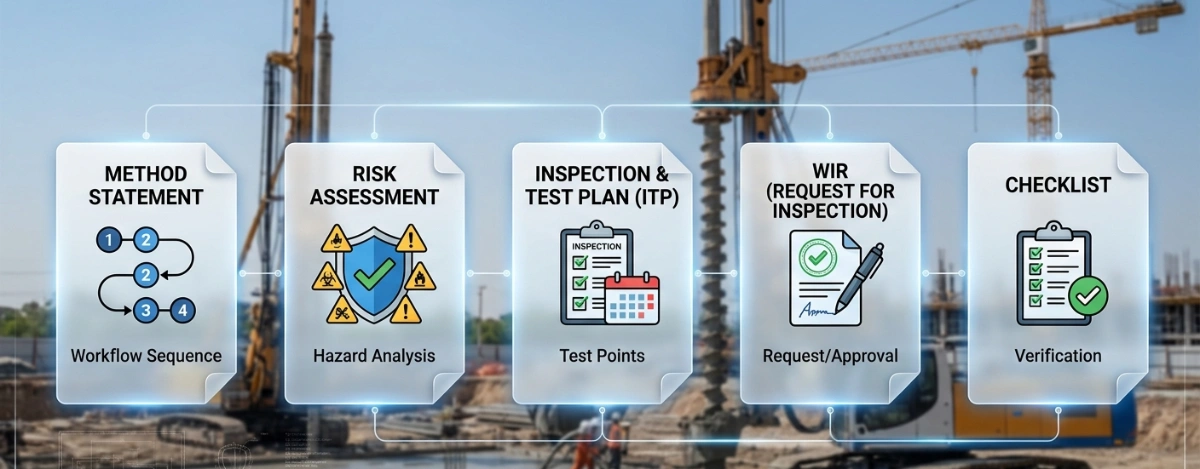
This Inspection and Test Plan is associated with the Method Statement – Routine Inspection, Color-Coding, and Testing of Loose Lifting Tackle method statement, which describes the step-by-step construction sequence, resources, materials, equipment, safety controls, and environmental controls for this activity.
View the Method Statement – Routine Inspection, Color-Coding, and Testing of Loose Lifting Tackle method statement →Continue with related inspection, method statement, article, and checklist resources.