
Method Statement: Curing of Mass Concrete (Water Curing, Wet Hessian, Curing Compounds, Insulating Blankets) with Temperature and Maturity Monitoring – Method Statement
AI-assisted method statement with matching ITP, PDF download, and Excel export.
More than a static template
Unlike a downloadable Word or PDF template, this method statement is an AI-assisted editable starting point connected directly to a matching Inspection and Test Plan. Every section is structured, project-adaptable, and ready to export.
- AI-assisted drafting — Customize every section with AI for your specific project scope.
- Linked ITP — A matching inspection and test plan is generated alongside the method statement.
- Multiple export formats — Download as a formatted PDF or editable Excel spreadsheet.
- Editable starting point, not a final document — Review, verify, and adjust all content against your project requirements before use.
Static template vs. Quollnet workflow
| Feature | Static template | Quollnet |
|---|---|---|
| Project-specific content | Manual fill-in required | AI-assisted customization |
| Linked ITP | Separate document, no link | Matching ITP included |
| Export formats | Usually PDF only | PDF and Excel |
| Structured sections | Free-form layout | 13 standardized sections |
| Saved to your account | Local file only | Cloud-saved, reusable |
| Content accuracy | You verify everything | AI-assisted, you still verify |
| Cost | Often free but time-intensive | Free to customize and download |
What you can customize
When you save this method statement to your account, every section becomes editable. The following 13 sections are included:
- Scope — Defines the activity and its boundaries.
- References — Standards, specifications, and drawings.
- Responsibilities — Roles and accountabilities.
- Resources — Labour, plant, and equipment summary.
- Materials — Materials and compliance requirements.
- Equipment — Tools and equipment details.
- Prerequisites — Hold points and pre-conditions.
- Method sequence — Step-by-step construction sequence.
- Safety controls — HSE risk controls and PPE.
- Environmental controls — Environmental mitigation measures.
- QA/QC — Quality inspection and test requirements.
- ITP — Inspection and Test Plan table (has its own page).
- Attachments — Referenced drawings and documentation.
Why this method statement is used
This method statement is used to define and communicate the approved procedure for carrying out method statement: curing of mass concrete (water curing, wet hessian, curing compounds, insulating blankets) with temperature and maturity monitoring on site. It ensures the work is planned in advance, the correct resources and controls are in place, and all personnel understand responsibilities, sequence, quality requirements, and safety controls before work begins. It aligns site execution with the documented scope and acceptance expectations.
Who uses this method statement
This method statement is used by contractors, site supervisors, project engineers, QA/QC engineers, HSE officers, consultants, and client representatives. It serves as a shared reference for planning, execution, supervision, inspection, and approval of the activity on site.
When it is prepared and submitted
The method statement is prepared before the work activity starts and submitted as part of the pre-construction documentation package for review and approval.
Who reviews or approves it
The method statement is usually submitted to the client representative, consultant, resident engineer, or project management consultant for review and approval before the work commences.
Important approval note
This method statement is an AI-assisted editable starting point, not a pre-approved document. Before use on any project, all content must be reviewed and approved by the relevant parties (superintendent, principal contractor, or client representative) in accordance with your contract and project quality plan.
For example: if your specification requires a departure from a referenced standard, that departure must be documented and approved separately — this method statement will not capture that automatically. Always verify against your applicable drawings, specifications, and regulatory requirements.
Method statement content
Scope
Overview
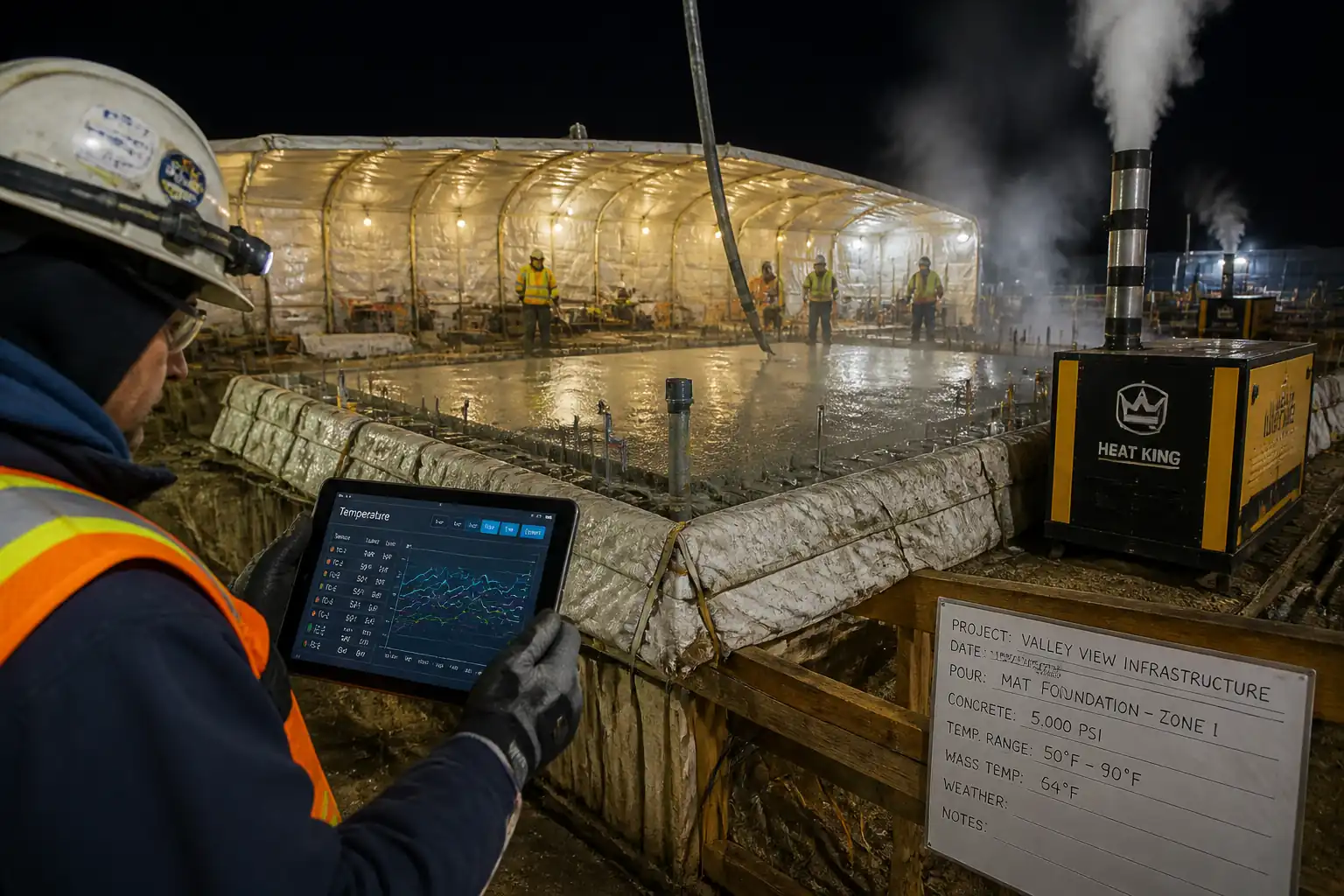
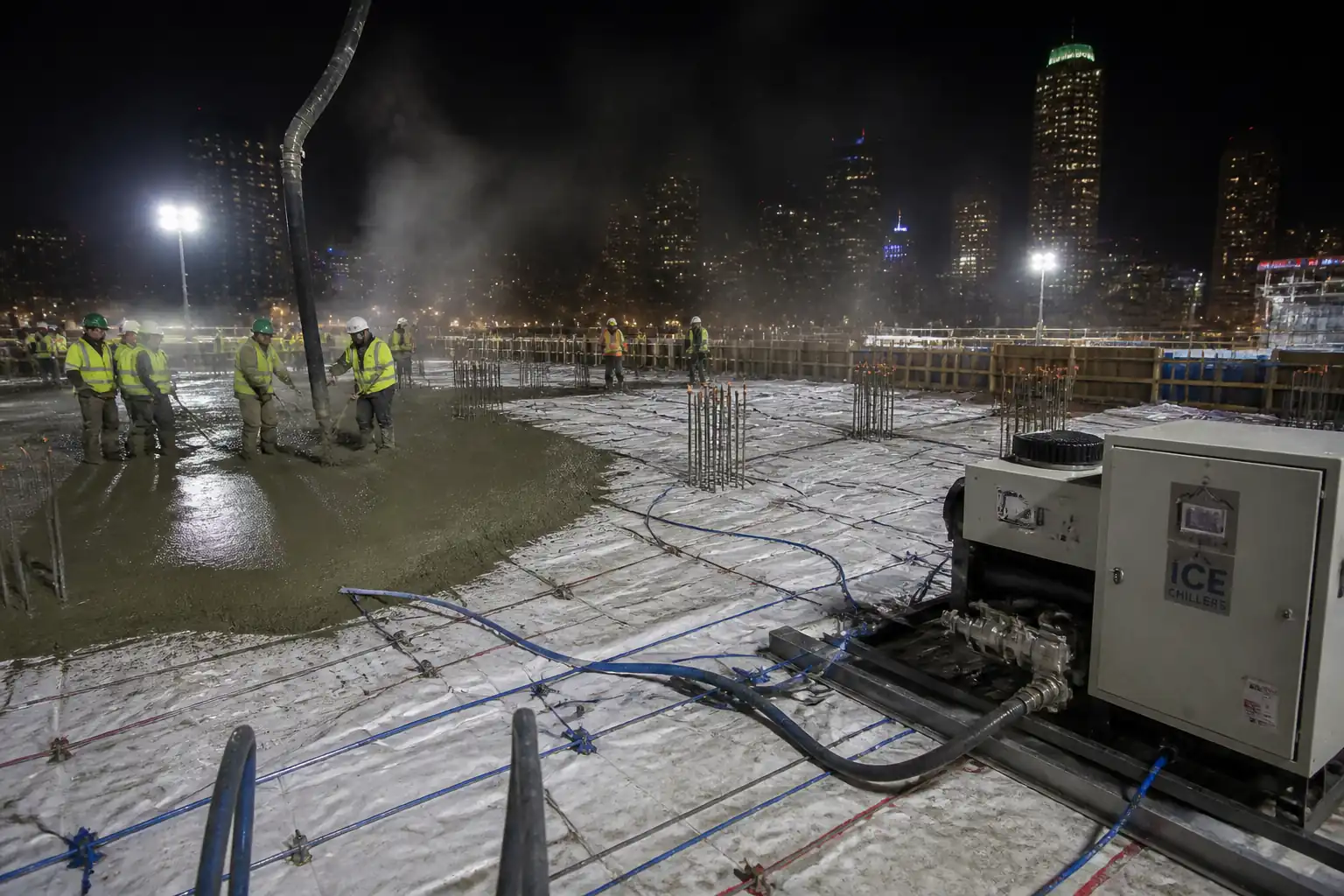
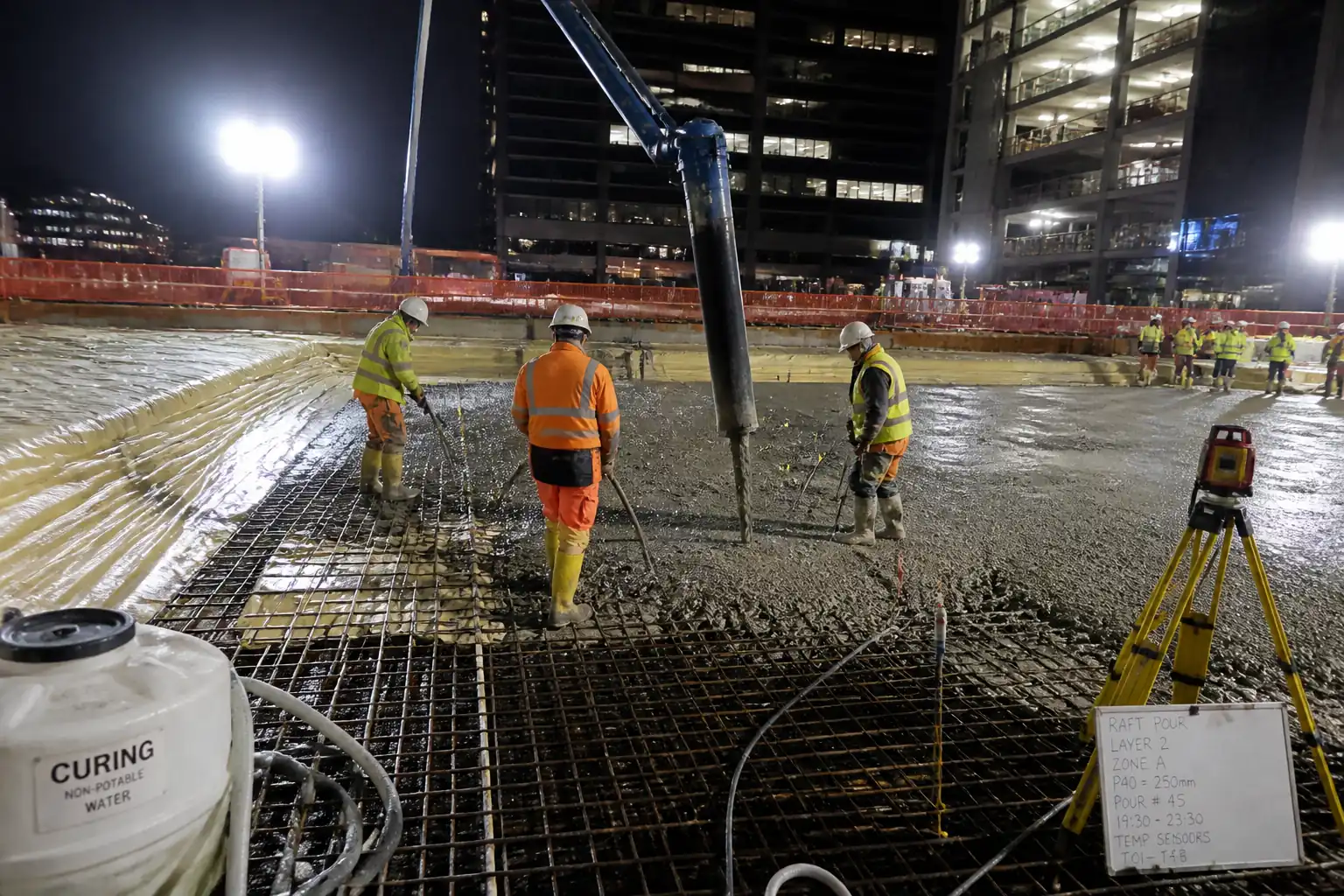
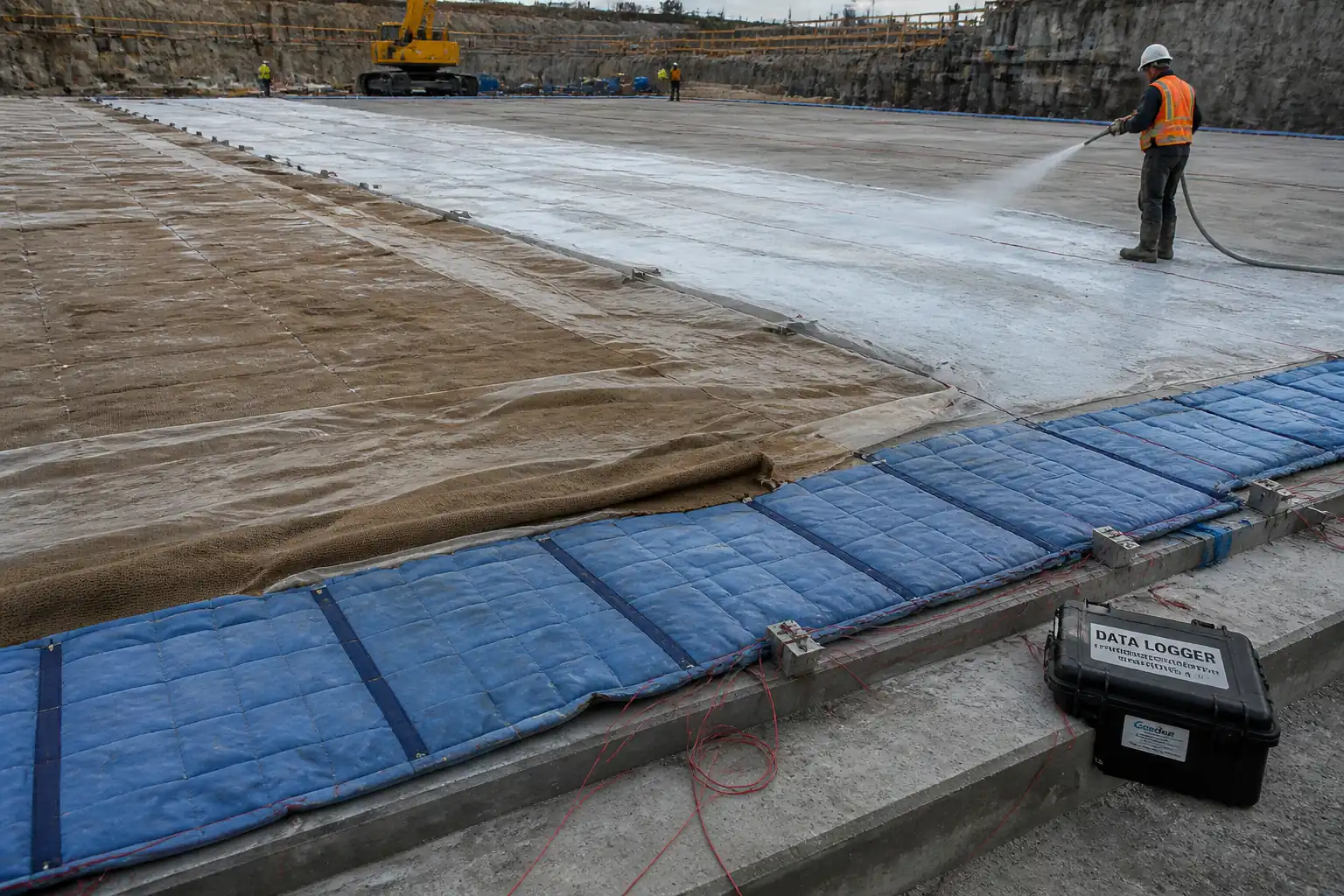
This method statement details planning, resources, and procedures to cure mass concrete elements (e.g., rafts, pile caps, thick walls, piers) using water curing (ponding/sprinkling/fogging), wet hessian (burlap) coverings, membrane-forming curing compounds, and insulating blankets. It includes temperature monitoring, thermal gradient control, maturity-based strength estimation, QA/QC, and HSE controls.
Objectives
- Maintain adequate internal moisture and favorable temperature profile to minimize thermal cracking and ensure specified strength and durability.
- Control maximum concrete temperature, core-to-surface temperature differential, and rate of cooling per approved Thermal Control Plan (TCP) [Verify per project specifications].
- Verify curing duration by time, strength (cylinders), and/or maturity per ASTM C1074.
Inclusions
- Pre-placement planning and installation of thermocouples/data loggers.
- Execution of curing by selected methods or combinations, including transitions between methods.
- Continuous temperature and maturity monitoring, logging, and response actions.
- Acceptance criteria and documentation, including ITP.
Exclusions
- Concrete batching, transport, placement, and finishing (refer to separate method statement).
References
| Document Type | Reference / Number | Revision | Notes |
|---|---|---|---|
| Standard | ACI 207R / 207.1R | ||
| Standard | ACI 308R, ACI 308.1 | ||
| Standard | ACI 301 | ||
| Standard | ASTM C1074 | ||
| Standard | ASTM C309, ASTM C1315 | ||
| Standard | ASTM C171 | ||
| Standard | ASTM C1602 | ||
| Standard | ASTM E230/E230M | ||
| Standard | BS EN 206 | ||
| Standard | BS EN 13670 | ||
| Standard | BS EN 12390 Series |
Responsibilities
| Role | Responsibility | Name / Party |
|---|---|---|
| Project Manager | Project Manager | Contractor |
| Site Engineer | Site Engineer | Contractor |
| QA/QC Engineer | QA/QC Engineer | Contractor |
| HSE Officer | HSE Officer | Contractor |
| Instrumentation Technician | Instrumentation Technician | Contractor |
| Engineer | Engineer/Consultant | Engineer |
| Testing Laboratory | Third-Party Laboratory | Independent |
Resources
| Resource Type | Description | Quantity | Remarks |
|---|---|---|---|
| Personnel | Lead field team for curing operations. | 1 | |
| Personnel | Apply curing compound, install blankets and hessian, manage water systems. | 4–8 per pour [Verify] | |
| Personnel | Operate water pumps/sprinklers for continuous curing. | 1–2 | |
| Personnel | Monitor edges, water hazards, chemical use, electrical safety. | 1 |
Materials
| Material | Specification / Grade | Quantity | Remarks |
|---|---|---|---|
| Water | Potable | As required | |
| Hessian/Burlap | Heavy-duty, lint-free | Sufficient to double-layer coverage | |
| Curing compound | Low-VOC if required [Verify] | As calculated + 10% contingency | |
| Curing blankets | Quilted or foam-insulated | Coverage of all exposed surfaces + overlaps | |
| PE Sheet | Min 0.2 mm [Verify] | As required |
Equipment
| Equipment | Capacity / Type | Quantity | Inspection Required |
|---|---|---|---|
| Airless sprayer | > 5 L/min | 2+ | |
| Pump/sprinkler/fog nozzles | ≥ 10 m³/h system [Verify] | As required | |
| Sensors & loggers | ≥ 16 channels [Verify] | As per TCP | |
| Portable station | 1 | ||
| IR thermometer | 2 |
Prerequisites
- Approved Method Statement, Thermal Control Plan (TCP), mix design, and ITP.
- Pre-pour coordination meeting covering curing method selection, sequencing, emergency water supply, and monitoring thresholds.
- Sensor layout drawing indicating number, locations, depths: minimum one core and one near-surface thermocouple per pour segment; not less than 2 sets per 500 m³ [Verify].
- Calibrations for data loggers, thermometers, and sprayers (within 12 months).
- Confirm continuous potable water source and backup pump/generator.
- Materials on site: hessian, PE sheets, blankets, curing compound with MSDS, spill kits.
- Access, edge protection, lighting, and exclusion zones established.
- Permits: Hot Work (if heaters used), Chemical Use, Work at Height near slab edges [Verify per project HSE plan and local regulations].
- Weather contingency: windbreaks, shade, additional blankets; plan for rain protection.
- Ensure no subsequent bonded finishes on surfaces where curing compound will be used, unless compatible product and surface prep are specified.
Method Sequence
| Step | Activity | Description | Responsibility | Inspection / Hold Point |
|---|---|---|---|---|
| 1 | Pre-Work Briefing | Toolbox talk on hazards, curing sequence, thermal limits, communication tree. | HSE Officer / Site Engineer | Yes |
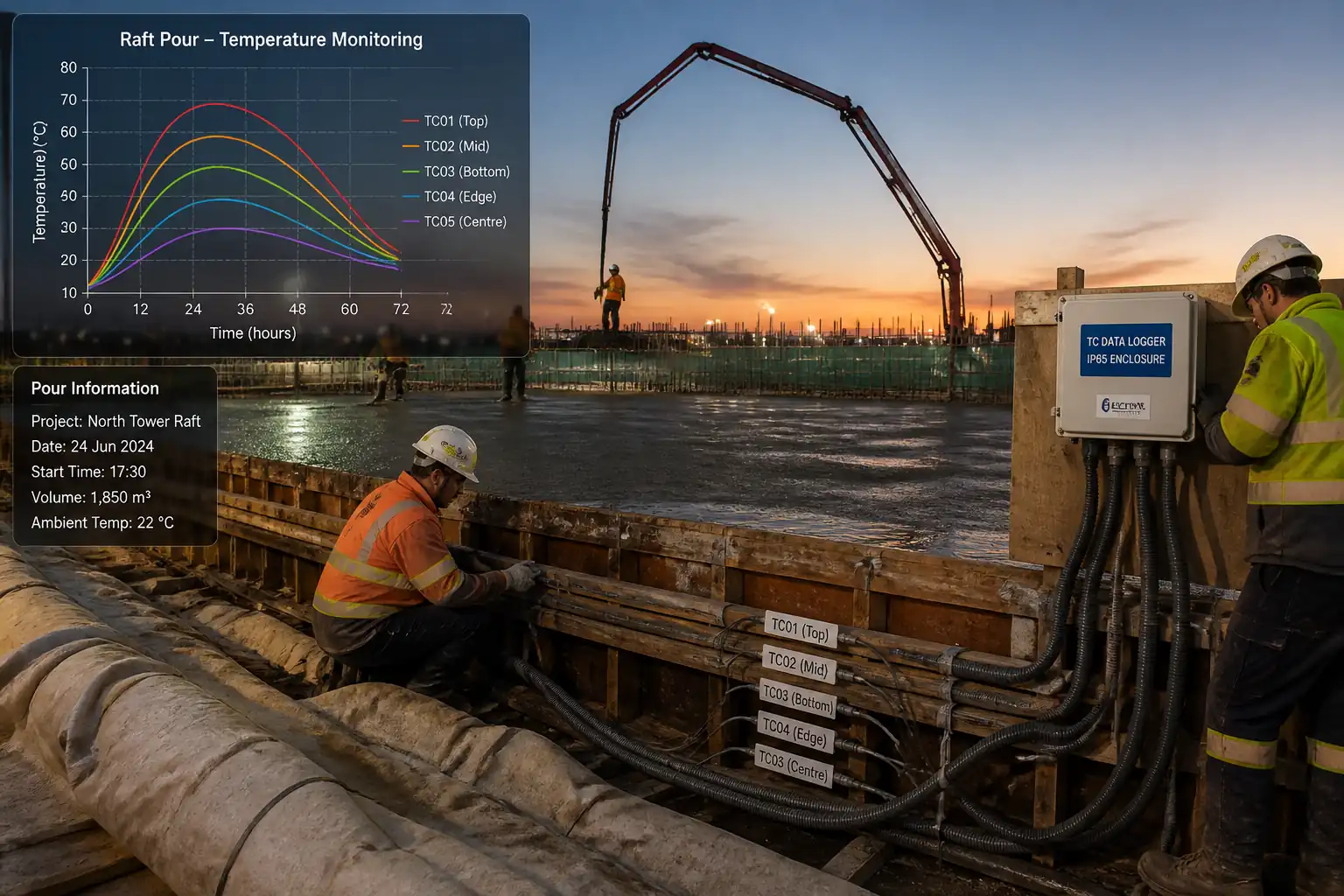
| 2 | Install Thermocouples & Loggers | Fix core and near-surface thermocouples per TCP; protect leads; verify channel IDs; set logging interval 5–15 min; start pre-pour baseline logging. | Instrumentation Technician | Hold Point |
| 3 | Placement & Finishing Interface | Coordinate finishing to avoid premature drying; retain forms as insulation where possible. | Site Engineer | Surveillance |
| 4 | Initiate Curing (General) | Commence curing immediately after final set or when surface sheen has disappeared and no standing bleed water remains. | Supervisor | Witness |
| 5A | Water Curing – Sprinkling/Fogging | Apply continuous gentle spray to keep surface moist without runoff; water temperature within 10°C of surface to prevent shock [Verify]; avoid erosion at edges/joints. | Pump Operator | Surveillance |
| 5B | Water Curing – Ponding (if feasible) | Form shallow dikes; establish 25–50 mm head of water; maintain continuously; monitor water temperature within 10°C of surface [Verify]. | Supervisor | Surveillance |
| 6 | Wet Hessian + Poly Cover | Lay pre-soaked hessian (double layer) carefully; cover with PE sheet to reduce evaporation; secure edges/overlaps; re-wet at intervals to maintain saturation. | Supervisor | Surveillance |
| 7 | Curing Compound Application | Spray uniformly after surface water sheen disappears; apply two perpendicular passes; protect from rain/dust per manufacturer; verify coverage by consumption. | Supervisor | Witness |
| 8 | Insulating Blankets / Retain Forms | Place blankets without gaps; lap ≥150 mm; keep dry on top; avoid trapping free water against hot surfaces; retain formwork as insulation when feasible. | Supervisor | Surveillance |
| 9 | Temperature Monitoring & Control | Record and review temperatures at least twice daily (live trending preferred). If |Tcore − Tsurf| approaches limit (typ. 20°C) or cooling rate exceeds 1–2°C/h [Verify], add insulation/reduce cooling; adjust water temp/flow as needed. | Site Engineer / QA | Hold/Witness |
| 10 | Maturity Tracking (ASTM C1074) | Use approved calibration curve; compute maturity index; correlate to f’c; verify opening/stripping criteria per spec. | QA/QC Engineer | Witness |
| 11 | Curing Duration | Maintain curing for min 7 days (OPC) or per spec, or until 70% of specified strength achieved by maturity/cylinders [Verify]. | Site Engineer | Surveillance |
| 12 | Controlled Removal of Insulation/Blankets | Reduce insulation incrementally when ΔT ≤ 10°C and cooling rate ≤ 1°C/h for ≥12 h [Verify]; avoid sudden exposure to wind/sun. | Supervisor | Witness |
| 13 | Final Inspection & Documentation | Check surfaces for crazing/thermal cracks; compile temperature charts, maturity reports, curing records; close ITP. | QA/QC Engineer | Hold Point |
Health and Safety Controls
Key Hazards and Controls
- Hazard: Slips, trips, and falls on wet cured surfaces.
- Likely consequence: Sprains, fractures.
- Engineering/procedural control: Non-slip access routes, restrict access with barriers and signage, squeegee/manage standing water; designated walkways with anti-slip mats.
- PPE: Slip-resistant boots, gloves.
- Collective preventive measure: Edge protection and exclusion zones around curing areas.
-
Inspection/permit/supervision: Daily HSE inspections; supervisor to authorize access.
-
Hazard: Edge/height exposure on large rafts or pits.
- Likely consequence: Falls from height.
- Engineering/procedural control: Guardrails or temporary edge protection; harness and lifeline where rails not feasible; spotter during operations at edges.
- PPE: Full body harness (where required), hard hat.
- Collective preventive measure: Physical guardrails and toe boards.
-
Inspection/permit/supervision: Work at Height permit; pre-use checks; competent supervision. [Verify per project HSE plan and local regulations]
-
Hazard: Electrical equipment near water (pumps, sprayers, data loggers power supplies).
- Likely consequence: Electric shock.
- Engineering/procedural control: Use 110V center-tapped or GFCI/RCD protected circuits; IP-rated connectors; elevated cable management.
- PPE: Dielectric gloves where required, dry gloves.
- Collective preventive measure: Residual current devices, lockout for maintenance.
-
Inspection/permit/supervision: Electrical inspection checklist; tag-and-test program.
-
Hazard: Chemical exposure to curing compounds (solvents/VOCs).
- Likely consequence: Dermal/eye irritation, inhalation hazards, fire risk.
- Engineering/procedural control: Low-VOC products where specified; use in well-ventilated areas; no ignition sources; decant in bunded areas; follow SDS.
- PPE: Nitrile gloves, goggles/face shield, long sleeves, half-mask respirator with organic vapor cartridges if required.
- Collective preventive measure: Product substitution (water-based), spill kits.
-
Inspection/permit/supervision: Chemical Use permit; SDS available; fire extinguisher present.
-
Hazard: Manual handling of wet hessian and blankets.
- Likely consequence: Strains, back injuries.
- Engineering/procedural control: Team lifts; mechanical aids; limit roll weight; staged handling plan.
- PPE: Gloves, back support as needed.
- Collective preventive measure: Pre-task lifting assessment.
-
Inspection/permit/supervision: Supervisor to monitor; toolbox talk on handling.
-
Hazard: Thermal shock from cold water or sudden blanket removal.
- Likely consequence: Thermal cracking of concrete.
- Engineering/procedural control: Control water temperature differential (≤10°C [Verify]); staged removal of insulation.
- PPE: N/A (engineering control dominant).
- Collective preventive measure: Thermal Control Plan adherence.
-
Inspection/permit/supervision: Hold point before insulation removal; engineer approval.
-
Hazard: Dust and silica when cutting insulating materials (if trimming required).
- Likely consequence: Respiratory irritation.
- Engineering/procedural control: Use hand tools or low-dust methods; cut in ventilated area; wet methods if appropriate.
- PPE: Safety glasses; dust mask (P2/P3) as required.
- Collective preventive measure: Designated cutting area away from pour.
-
Inspection/permit/supervision: HSE supervision; compliance checks.
-
Hazard: Night works/poor visibility.
- Likely consequence: Trips, collisions.
- Engineering/procedural control: Task lighting ≥ 200 lux at workface; reflective barriers.
- PPE: Hi-vis vest.
- Collective preventive measure: Light towers; delineation.
- Inspection/permit/supervision: Daily lighting checklists.
Environmental Controls
- Water management: Prevent runoff contamination; ponded or sprinkling water to be contained and, if discharged, meet local limits for pH and turbidity [Verify]. Use sediment traps/filters. Reuse curing water where feasible.
- Curing compound management: Control overspray and VOCs; use low-VOC products if specified; avoid spraying in high wind; bunded storage; spill response kits within 20 m.
- Waste: Segregate used hessian/PE sheets; dispose per waste plan; recycle PE where available. Empty curing compound containers triple-rinsed or returned to supplier [Verify].
- Noise: Limit pump noise at night; use acoustic shrouds if near receptors.
- Energy: Optimize blanket use to reduce active heating/cooling needs; shut down idle pumps.
- Materials handling: Prevent hessian fibers/debris entering drains; install inlet protection.
- Wildlife and watercourses: No discharge to surface water without permit; maintain 10 m buffer to open drains where feasible.
- Compliance: Follow project CEMP and local regulations [Verify per project HSE plan and local regulations].
Quality Assurance and Quality Control
Hold/Witness Points
- Approval of Thermal Control Plan (Hold).
- Thermocouple installation and logger commissioning (Hold).
- Start of curing (Witness).
- Curing compound application (Witness).
- Blanket removal (Hold).
- Final inspection and records closeout (Hold).
Monitoring and Records
- Temperature: Log at 5–15 min intervals; review min 2x daily. Alarm thresholds per TCP (typical: Tmax ≤ 70°C, ΔTcore-surface ≤ 20°C, cooling rate ≤ 1–2°C/h) [Verify].
- Moisture: Visual checks every 2 h (first 24 h) then every 4 h; document in Daily Curing Log.
- Maturity: Apply approved ASTM C1074 calibration; reconcile with cylinder breaks as required by spec.
- Curing compound: Wet film thickness or coverage by mass balance; application rate within ±10% of target; uniform appearance.
- Equipment: Calibration certificates current (<12 months); sprayer flow verification before use.
Acceptance Criteria [Verify per project specifications]
- Curing maintained continuously for specified duration (e.g., 7 days OPC; 3 days for Type III; or until ≥70% f’c by maturity/cylinders).
- Thermal limits not exceeded: Tmax, ΔT, and cooling rate within TCP limits.
- Surface condition: No visible plastic shrinkage or thermal cracking; no curing-induced surface damage or erosion.
- Documentation complete: Temp charts, maturity reports, curing logs, photos, approvals.
Nonconformance and Corrective Action
- If ΔT or Tmax exceeds limits: Increase insulation, reduce surface cooling, implement staged thermal equalization, consult Engineer for extended curing and crack monitoring.
- If surface drying observed: Intensify moisture application, re-wet hessian, reduce wind exposure, consider evaporation reducers for future pours (pre-placement control).
Attachments
- Sample Thermal Control Plan (TCP) with sensor layouts and set points.
- Daily Curing Log template (moisture/coverage checks, water temps, wind speed).
- Temperature Monitoring Log and charts (CSV and plots).
- Maturity Calibration Report (ASTM C1074) and field maturity worksheets.
- Curing Compound Application Log (batch numbers, coverage, WFT checks).
- Calibration certificates (data loggers, IR thermometers, sprayers).
- SDS for curing compounds; environmental spill response plan.
- Photographic records (start of curing, intermediate checks, final condition).
This content is a read-only public reference. Download or customize to get an editable version.
ITP preview
The first inspection activities from the linked ITP for Method Statement: Curing of Mass Concrete (Water Curing, Wet Hessian, Curing Compounds, Insulating Blankets) with Temperature and Maturity Monitoring:
| Activity | Inspection / Test | Acceptance Criteria | Responsibility | Record |
|---|---|---|---|---|
| Review and approval of Method Statement and Thermal Control Plan | Document review and approval | Approved prior to works | Engineer / Contractor QA | Approval letter / RFI response |
| Instrumentation calibration and setup | Calibration certs verification; function test | Valid calibration; sensors operational | QA/QC Engineer | Calibration certs; setup checklist |
| Thermocouple installation (pre-pour) | Location/depth verification; continuity test | As per approved layout; tagged channels | Instrumentation Technician / QA | Sensor installation record, photos |
Showing 3 of 13 inspection activities. View full ITP →
Related Inspection and Test Plan
An Inspection and Test Plan (ITP) is available for Method Statement: Curing of Mass Concrete (Water Curing, Wet Hessian, Curing Compounds, Insulating Blankets) with Temperature and Maturity Monitoring. The ITP defines the inspection activities, acceptance criteria, hold and witness points, responsible parties, and records required to verify the work described in this method statement.
View the Method Statement: Curing of Mass Concrete (Water Curing, Wet Hessian, Curing Compounds, Insulating Blankets) with Temperature and Maturity Monitoring ITP →Frequently asked questions
Continue with related Quollnet resources connected to this method statement.