
Method Statement: Clearance Air Monitoring, Aggressive Sampling (PCM/TEM), Visual Inspection and Clearance Certification after Asbestos Removal – Method Statement
AI-assisted method statement with matching ITP, PDF download, and Excel export.
More than a static template
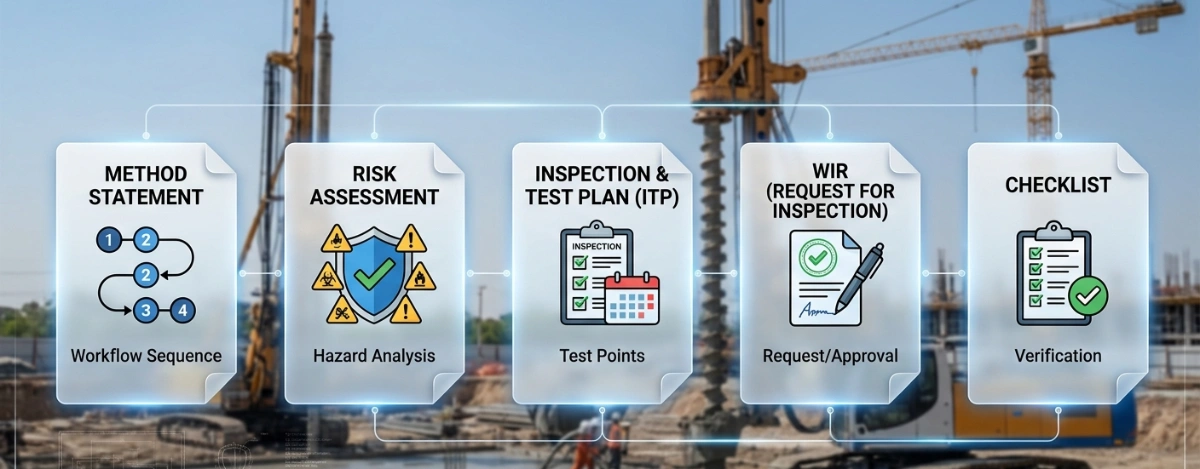
Unlike a downloadable Word or PDF template, this method statement is an AI-assisted editable starting point connected directly to a matching Inspection and Test Plan. Every section is structured, project-adaptable, and ready to export.
- AI-assisted drafting — Customize every section with AI for your specific project scope.
- Linked ITP — A matching inspection and test plan is generated alongside the method statement.
- Multiple export formats — Download as a formatted PDF or editable Excel spreadsheet.
- Editable starting point, not a final document — Review, verify, and adjust all content against your project requirements before use.
Static template vs. Quollnet workflow
| Feature | Static template | Quollnet |
|---|---|---|
| Project-specific content | Manual fill-in required | AI-assisted customization |
| Linked ITP | Separate document, no link | Matching ITP included |
| Export formats | Usually PDF only | PDF and Excel |
| Structured sections | Free-form layout | 13 standardized sections |
| Saved to your account | Local file only | Cloud-saved, reusable |
| Content accuracy | You verify everything | AI-assisted, you still verify |
| Cost | Often free but time-intensive | Free to customize and download |
What you can customize
When you save this method statement to your account, every section becomes editable. The following 13 sections are included:
- Scope — Defines the activity and its boundaries.
- References — Standards, specifications, and drawings.
- Responsibilities — Roles and accountabilities.
- Resources — Labour, plant, and equipment summary.
- Materials — Materials and compliance requirements.
- Equipment — Tools and equipment details.
- Prerequisites — Hold points and pre-conditions.
- Method sequence — Step-by-step construction sequence.
- Safety controls — HSE risk controls and PPE.
- Environmental controls — Environmental mitigation measures.
- QA/QC — Quality inspection and test requirements.
- ITP — Inspection and Test Plan table (has its own page).
- Attachments — Referenced drawings and documentation.
Why this method statement is used
This method statement is used to define and communicate the approved procedure for carrying out method statement: clearance air monitoring, aggressive sampling (pcm/tem), visual inspection and clearance certification after asbestos removal on site. It ensures the work is planned in advance, the correct resources and controls are in place, and all personnel understand responsibilities, sequence, quality requirements, and safety controls before work begins. It aligns site execution with the documented scope and acceptance expectations.
Who uses this method statement
This method statement is used by contractors, site supervisors, project engineers, QA/QC engineers, HSE officers, consultants, and client representatives. It serves as a shared reference for planning, execution, supervision, inspection, and approval of the activity on site.
When it is prepared and submitted
The method statement is prepared before the work activity starts and submitted as part of the pre-construction documentation package for review and approval.
Who reviews or approves it
The method statement is usually submitted to the client representative, consultant, resident engineer, or project management consultant for review and approval before the work commences.
Important approval note
This method statement is an AI-assisted editable starting point, not a pre-approved document. Before use on any project, all content must be reviewed and approved by the relevant parties (superintendent, principal contractor, or client representative) in accordance with your contract and project quality plan.
For example: if your specification requires a departure from a referenced standard, that departure must be documented and approved separately — this method statement will not capture that automatically. Always verify against your applicable drawings, specifications, and regulatory requirements.
Method statement content
Scope
Purpose
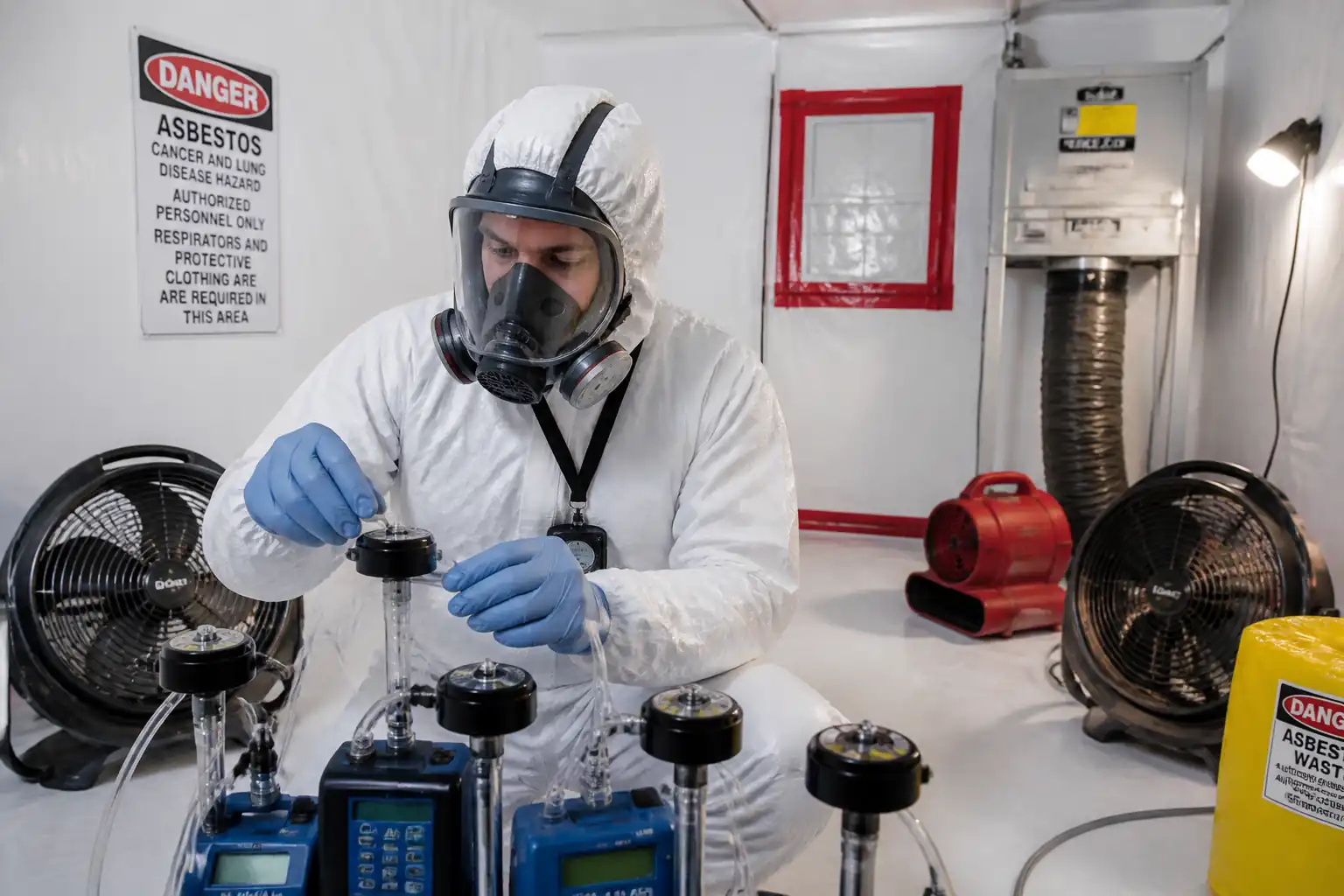
This method statement defines the end-to-end procedure for post-asbestos removal clearance, including the four-stage clearance process, aggressive air sampling with calibrated pumps, Phase Contrast Microscopy (PCM) counting and/or Transmission Electron Microscopy (TEM) analysis as specified, evaluation of results against acceptance criteria, and issuance of a clearance certificate with complete documentation for the Client.
Works Covered
- Stage 1: Preliminary checks of the work area and abatement completion status.
- Stage 2: Thorough visual inspection for debris, dust, and surface contamination.
- Stage 3: Aggressive clearance air monitoring (set-up, calibration, sampling, field QA/QC, chain of custody, PCM/TEM lab analysis).
- Stage 4: Final assessment and clearance certification; controlled handover and document submission.
Locations
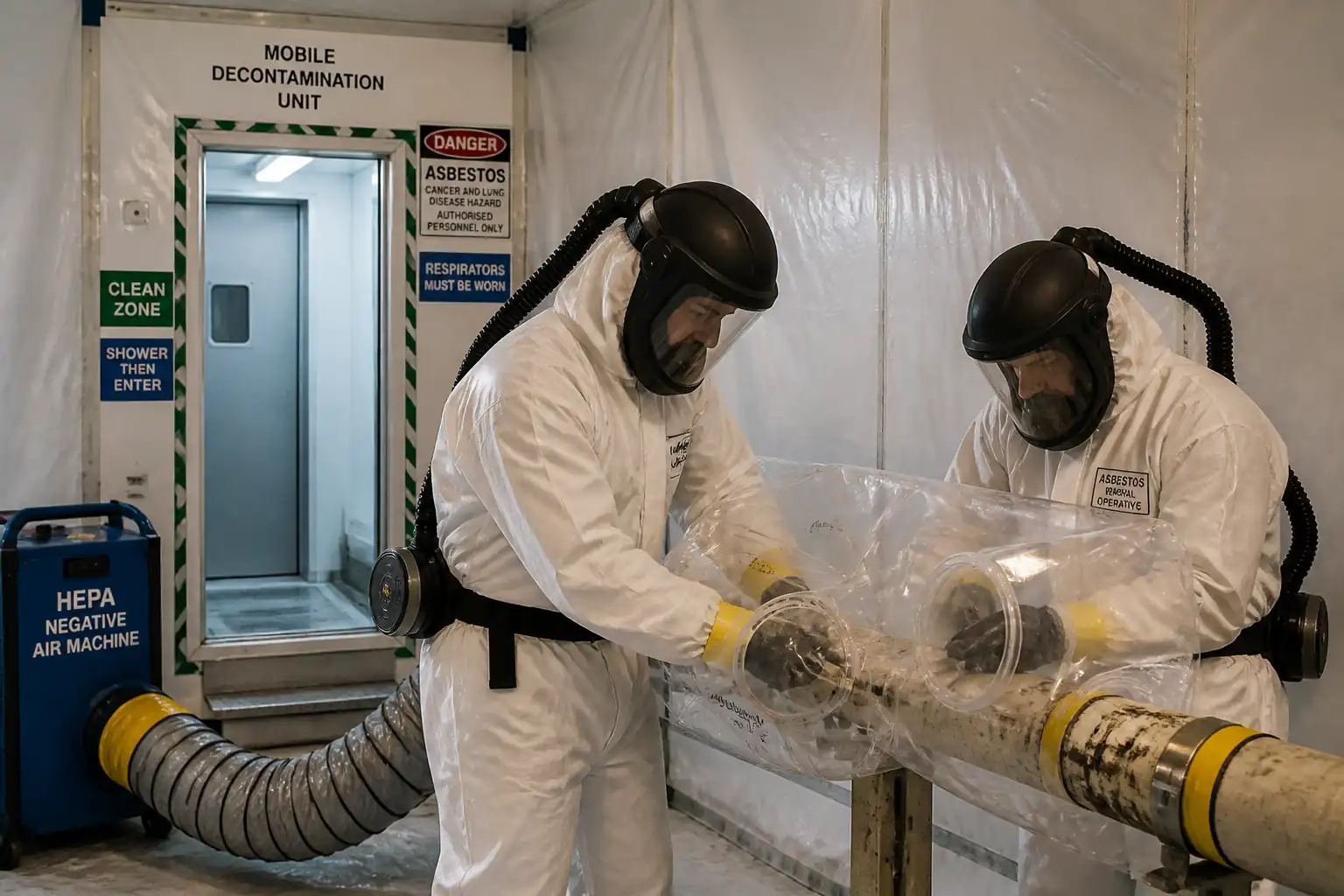
- Within asbestos abatement enclosures, glovebags, or controlled areas; adjoining airlocks/dirty/clean chambers as applicable.
Exclusions
- The asbestos removal itself (performed by licensed removal contractor under separate method).
- Repair of building finishes not related to clearance testing.
Interfaces
- Abatement contractor, independent analyst/consultant, accredited laboratory, Client/Engineer, and HSE authority as applicable.
References
| Document Type | Reference / Number | Revision | Notes |
|---|---|---|---|
| Guidance | HSG248 | Four-stage clearance, aggressive sampling guidance | |
| Regulation | 29 CFR 1926.1101 | ||
| Regulation | 40 CFR Part 763 Subpart E, App A | TEM clearance criteria and aggressive sampling requirements | |
| Analytical Method | NIOSH 7400 | Phase Contrast Microscopy fiber counting | |
| Analytical Method | NIOSH 7402 | TEM confirmation of PCM | |
| Standard | ASTM D6281 | Direct-transfer TEM analysis | |
| Guidance | WHO (1997) PCM method | Fiber definition and counting rules | |
| Standard | ISO/IEC 17025 | Accreditation for asbestos analysis labs | |
| Contract Document | Project Specs |
Responsibilities
| Role | Responsibility | Name / Party |
|---|---|---|
| Project Manager | Contractor's Project Manager | Main Contractor |
| Lead Engineer | Principal/Lead Civil Engineer (Contractor) | Main Contractor |
| Analyst | Independent Asbestos Analyst / Licensed Asbestos Assessor (UKAS/ISO 17025-affiliated) | Independent Consultant |
| Lab | Accredited Laboratory (ISO/IEC 17025) | Third-Party |
| Removal Contractor | Licensed Asbestos Removal Contractor | Specialist Subcontractor |
| HSE Manager | HSE Manager / Permit Issuer | Main Contractor |
| Client Rep | Client/Engineer/Authority | Client/Engineer |
Resources
| Resource Type | Description | Quantity | Remarks |
|---|---|---|---|
| Personnel | Licensed Asbestos Assessor/Analyst (BOHS P403/P404 or equivalent) | 1–2 [Verify] | |
| Personnel | Assists with pumps, logistics, documentation | 1 [Verify] | |
| Personnel | Monitors compliance and permits | 1 |
Materials
| Material | Specification / Grade | Quantity | Remarks |
|---|---|---|---|
| MCE Filter Cassettes | 25 mm; 0.8–1.2 µm | As per sample plan + 10% field blanks | |
| TEM-compatible cassettes | Per lab method [Verify] | As required by spec | |
| Labels/COC | Unique IDs | Sufficient for all samples | |
| Hazardous waste bags | UN approved | As needed |
Equipment
| Equipment | Capacity / Type | Quantity | Inspection Required |
|---|---|---|---|
| Air sampling pumps | 8–12 L/min | 4–8 units [Verify] | |
| Primary calibrator | 0.5–20 L/min | 1 | |
| Fans/leaf blower | ≥ 0.5–1.0 m3/s each (typical) | 2–3 fans; 1 blower [Verify] | |
| HEPA vac | 1 | ||
| Lighting/tools | As required | ||
| PPE/RPE | Per crew size |
Prerequisites
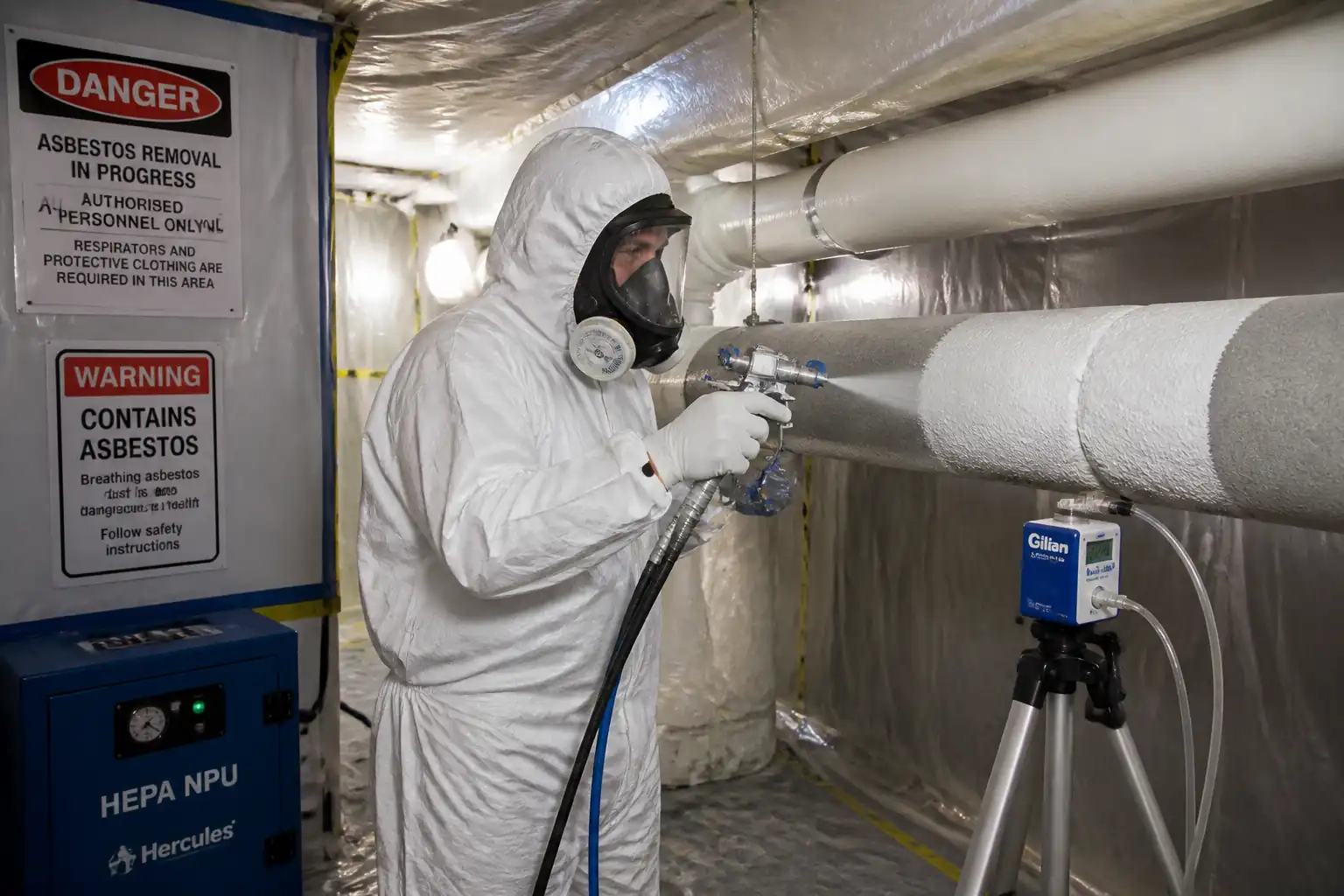
- Confirm abatement completion and preliminary contractor self-cleaning completed; enclosure remains under negative pressure with NPUs running [Verify per HSG248 or local guidance].
- Confirm surfaces are visibly dry to permit valid air sampling.
- Permits to Work: Asbestos-related work permit; electrical permit for portable equipment; confined space permit if applicable [Verify per project HSE plan and local regulations].
- Utilities: Safe 110V/230V power distribution with RCD/ELCB for fans and pumps.
- Sampling plan approved by Client/Engineer: number of samples, locations, durations, PCM vs. TEM, acceptance criteria, and re-test rules.
- Laboratory appointment secured (ISO/IEC 17025 accredited), turnaround time agreed; Chain of Custody (CoC) forms prepared.
- Calibration certificates valid for pumps and primary calibrator (within 12 months or per project requirements).
- Toolbox talk completed covering aggressive sampling hazards, RPE use, decon protocol, electrical safety.
- Decontamination route and waste management arrangements confirmed; double-bagging materials staged.
- Ambient conditions suitable: record temperature, RH, pressure; document NPU differential pressure if required by spec.
- Independent analyst confirmed to be organizationally independent from removal contractor [Verify per project specifications].
Method Sequence
| Step | Activity | Description | Responsibility | Inspection / Hold Point |
|---|---|---|---|---|
| 1 | Stage 1 – Preliminary checks | Verify enclosure integrity, signage, NPUs operating; contractor completion notice received; all gross debris reportedly removed; surfaces dry. | Analyst | Site check with contractor supervisor |
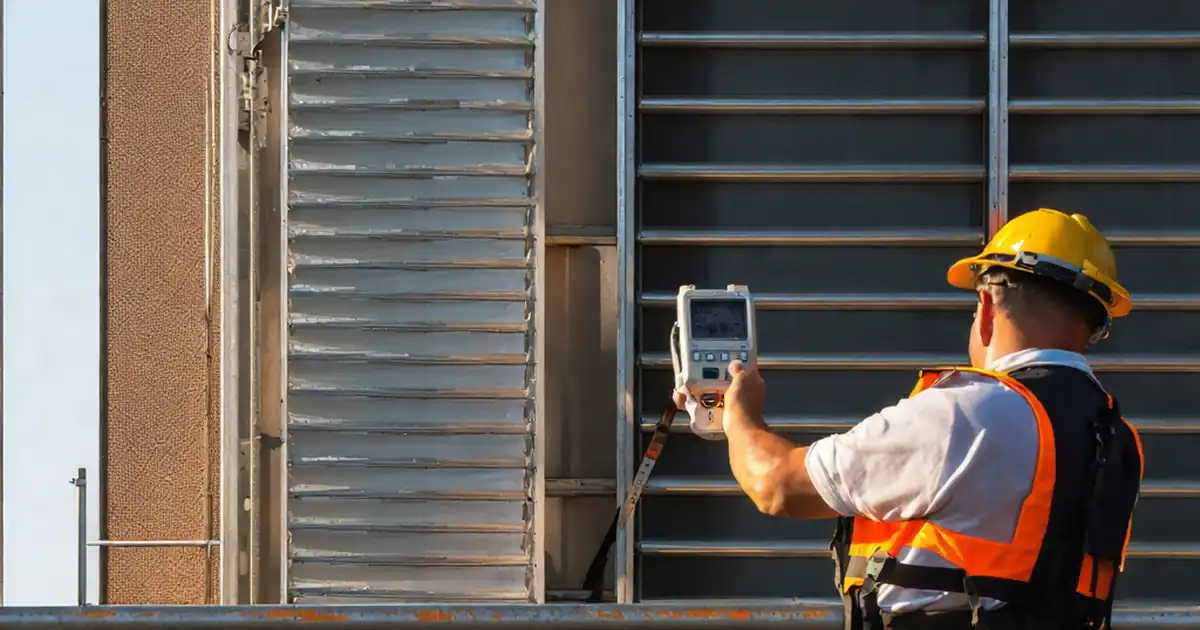
| 2 | Stage 2 – Thorough visual inspection | Systematically inspect ceilings, walls, floors, ledges, fixtures, and equipment using high-lux lighting and mirrors; rake/brushing where needed; HEPA vacuum minor residues; inspect transit routes and airlocks. | Analyst | 100% visual sweep in grid pattern |
| 3 | Aggressive pre-conditioning | Close all windows/doors; maintain NPUs. Run box fans to create turbulent air; use leaf blower to agitate surfaces (avoid dislodging materials). Duration ≥ 5–10 minutes per 10 m² [Verify]. | Analyst/Technician | Observe air movement coverage |
| 4 | Pump setup & pre-calibration | Position sampling heads at 1.2–1.5 m height (breathing zone) away from obstructions, evenly spaced. Connect cassettes with conductive tubing. Calibrate each pump with primary standard to target flow 8–12 L/min (PCM) or per lab method (TEM). | Analyst/Technician | Calibration verification |
| 5 | Field blanks | Prepare ≥10% field blanks (min 2); uncap, immediately recap without drawing air; label and log. | Analyst | Check blank handling |
| 6 | Aggressive sampling – run | Start pumps; continue fans and periodic leaf blower sweeps to maintain agitation during entire run. Typical sample volume 1,200–3,000 L per cassette to achieve LOD ≤ 0.01 f/cc [Verify per spec]. Typical duration 60–180 min depending on flow and dustiness. | Analyst/Technician | Periodic checks every 15–30 min |
| 7 | Post-calibration & sample closure | Stop pumps; perform post-calibration with primary standard; calculate mean flow. Seal cassettes with caps and tape; wipe exterior; label with unique IDs. | Analyst/Technician | Calibration verification |
| 8 | Chain of custody & dispatch | Complete CoC with sample IDs, times, volumes, method (PCM/TEM), requested turnaround, and acceptance criteria. Package with blanks and send to ISO 17025 lab under custody seals. | Analyst | COC check by second person (if available) |
| 9 | Laboratory analysis | PCM counting to NIOSH 7400/WHO rules (fiber >5 µm, d<3 µm, AR>3:1). TEM per ASTM D6281 or NIOSH 7402 if specified or if PCM borderline/over-limit. | Accredited Laboratory | Internal lab QA/QC |
| 10 | Result evaluation | Compare results to project criteria. Typical PCM clearance indicator: <0.01 fibers/cm³ [Verify per project specifications]. AHERA TEM pass criteria per 40 CFR 763 App A [Verify applicability]. | Analyst/Lead Engineer | Technical review |
| 11 | Stage 4 – Final assessment & certificate | If pass, issue Clearance Certificate referencing sample IDs, locations, volumes, methods, criteria, and visual pass. Authorize controlled dismantling of enclosure. If fail, document fail reasons and re-clean/retest protocol. | Analyst/Lead Engineer | Document check |
| 12 | Client handover & records | Compile clearance pack: method, permits, checklists, calibration logs, field sheets, CoC, lab reports, certificate, photos, layout plan. Submit to Client/Engineer and archive. | Project Manager/Analyst | Review by QA/QC |
Health, Safety, and Environment (HSE) – Safety Controls
Key Hazards, Consequences, and Controls
- Hazard: Residual airborne asbestos fibers during inspection and sampling.
- Likely consequence: Inhalation leading to serious long-term illness.
- Engineering/procedural control: Maintain enclosure negative pressure; aggressive sampling only after successful Stage 2 visual; minimize personnel in area; use HEPA vacuums for spot clean; adhere to decontamination procedures.
- Required PPE: Fit-tested half/full-face respirator with P100/FFP3 filters; type 5/6 disposable coveralls; nitrile gloves; safety boots.
- Collective preventive measure: Negative pressure units (NPUs) with HEPA filtration; restricted access; signage and barriers.
-
Inspection/permit/supervision: Permit to Work (asbestos); RPE fit-test records; HSE supervision; daily NPU checks [Verify per project HSE plan and local regulations].
-
Hazard: Electrical risks from portable fans, leaf blowers, pumps, and lighting.
- Likely consequence: Electric shock, burns, fire.
- Engineering/procedural control: Use 110V center-tapped or RCD-protected circuits; PAT-tested equipment; cable management off floor; do not overload circuits; inspect before use.
- Required PPE: Insulated gloves for setup; safety footwear; eye protection.
- Collective preventive measure: Temporary distribution boards with RCD/ELCB; lockout of defective equipment.
-
Inspection/permit/supervision: Electrical permit as required; PAT labels in date; pre-use checklist.
-
Hazard: Trip/fall due to hoses, tubing, and low lighting.
- Likely consequence: Sprains, fractures.
- Engineering/procedural control: Route hoses at high level or along perimeter; tape-down crossings; maintain adequate lux levels; housekeeping during sampling.
- Required PPE: Safety boots with slip-resistant soles; head protection where overhead hazards exist.
- Collective preventive measure: Cable ramps; barriered walkways.
-
Inspection/permit/supervision: Supervisor walk-through prior to sampling; housekeeping audits.
-
Hazard: Leaf blower/fan projectile and noise exposure.
- Likely consequence: Eye injury, hearing damage.
- Engineering/procedural control: Inspect blower/fans; remove loose items; maintain safe direction; limit runtime; comply with manufacturer’s instructions.
- Required PPE: Safety glasses or goggles; hearing protection (SNR per site assessment).
- Collective preventive measure: Noise zoning; signage; time limits.
-
Inspection/permit/supervision: Equipment inspection log; noise monitoring if required.
-
Hazard: Working at height for high surfaces/ducts during visual inspection.
- Likely consequence: Falls.
- Engineering/procedural control: Use podium steps or mobile tower with guardrails; maintain three points of contact; no overreaching.
- Required PPE: Fall protection as required; hard hat.
- Collective preventive measure: Exclusion zones under work at height.
-
Inspection/permit/supervision: Equipment inspection; permit for working at height as applicable.
-
Hazard: Contamination spread during egress.
- Likely consequence: Secondary exposure, environmental contamination.
- Engineering/procedural control: Use designated decon unit; peel-off coveralls; HEPA vacuum PPE before exit; wipe down equipment; bag used consumables.
- Required PPE: Asbestos-rated PPE/RPE.
- Collective preventive measure: Dirty/clean separation; waste stations.
-
Inspection/permit/supervision: HSE supervision; decon procedure briefing; spot checks.
-
Hazard: Manual handling of equipment (pumps, fans, NPUs).
- Likely consequence: Musculoskeletal injuries.
- Engineering/procedural control: Team lifts; use trolleys; keep weights within limits.
- Required PPE: Gloves; safety boots.
- Collective preventive measure: Mechanical aids; job rotation.
- Inspection/permit/supervision: Manual handling training; supervision during setup.
Environmental Controls
- Asbestos Waste Management: Treat used cassettes, disposable PPE, wipes, and HEPA bags as hazardous asbestos waste. Double-bag (inner/outer) with hazard labels; store in locked, signed area; consign to licensed landfill via licensed carrier. EWC 17 06 05* or local equivalent [Verify per local regulations].
- Spill/Release Prevention: Maintain enclosure integrity and negative pressure until clearance is achieved. Keep entryways sealed; avoid opening doors during sampling.
- Decontamination: Use designated decon unit; bag-out procedure for equipment consumables; wipe down hard surfaces with damp cloths; HEPA vacuum tools.
- Noise and Vibration: Limit blower/fan runtime to necessary sampling periods; schedule during day hours; provide hearing protection.
- Air Quality: Do not vent NPUs or fans to uncontrolled areas; ensure HEPA exhaust integrity with pre-use checks.
- Energy Use: Use energy-efficient fans and switch off when not sampling; maintain equipment to reduce losses.
- Documentation: Record waste quantities, carrier license, consignment notes; retain per contract and regulation (typically ≥3–5 years) [Verify].
Quality Assurance / Quality Control
- Competence & Accreditation: Analysts competent to HSG248 (e.g., BOHS P403/P404). Laboratory accredited to ISO/IEC 17025 for asbestos PCM/TEM.
- Sampling Plan: Pre-approved plan defining number of samples, locations, target flows, target volumes, and acceptance criteria, including re-test triggers.
- Calibration: Pre- and post-calibration with a primary flow calibrator; mean flow used for volume. Pre vs post drift ≤ ±5% [Verify per project]. Calibrator certificate within validity.
- Blanks & Duplicates: Field blanks at ≥10% (min 2). Consider field duplicates at 10% for larger jobs [Verify]. All blanks within lab QC limits.
- Counting Rules (PCM): WHO/NIOSH fiber definition (L>5 µm, d<3 µm, AR>3:1); minimum countable fields to achieve required precision; stop rules per method.
- LOD/LOQ: Select sample volumes to achieve LOD ≤ 0.01 f/cc (typical clearance indicator) [Verify per project]. Document LOD in report.
- Data Validation: Check sample IDs, times, flows, volumes, environmental conditions, field notes, and custody seals before acceptance.
- Nonconformance: If visual fails or any sample exceeds criteria, issue NCR; contractor to reclean; resample after corrective action. Borderline PCM results may trigger TEM confirmation per spec.
- Records Retention: Maintain calibration logs, field logs, CoC, lab reports, certificates, photos, risk assessments, permits per contract (≥10 years recommended) [Verify].
Attachments
- Clearance sampling plan and layout sketch with sample head positions.
- Stage 1–4 checklists (visual inspection forms and sign-offs).
- Pump and calibrator calibration certificates (traceable to national standards).
- Field calibration logs (pre/post), sampling field sheets, environmental condition records.
- Chain of Custody forms and courier documentation.
- Laboratory accredited reports (PCM and/or TEM) with QC summaries.
- Clearance Certificate template and completed certificate.
- HSE documentation: Permits to Work, toolbox talk records, RPE fit-test certificates.
- Waste consignment notes and carrier licenses.
- Photo log (before visual, after visual, during sampling, final condition).
This content is a read-only public reference. Download or customize to get an editable version.
ITP preview
The first inspection activities from the linked ITP for Method Statement: Clearance Air Monitoring, Aggressive Sampling (PCM/TEM), Visual Inspection and Clearance Certification after Asbestos Removal:
| Activity | Inspection / Test | Acceptance Criteria | Responsibility | Record |
|---|---|---|---|---|
| Stage 1 – Preliminary checks | Verify enclosure integrity, NPUs operating, surfaces dry | Enclosure intact; negative pressure maintained; access safe | Analyst / HSE | Stage 1 checklist; photos |
| Stage 2 – Visual inspection | Systematic visual sweep with high-lux lighting; inspect all surfaces and fixtures | No visible asbestos debris/dust; no damaged ACM; area clean and dry | Analyst (Independent) | Stage 2 checklist; annotated plan; photos |
| Pump pre-calibration | Calibrate each pump with primary standard to target flow (PCM 8–12 L/min; TEM per method) | Pre-cal within ±5% of target; documented | Analyst/Technician | Calibration log |
Showing 3 of 10 inspection activities. View full ITP →
Related Inspection and Test Plan
An Inspection and Test Plan (ITP) is available for Method Statement: Clearance Air Monitoring, Aggressive Sampling (PCM/TEM), Visual Inspection and Clearance Certification after Asbestos Removal. The ITP defines the inspection activities, acceptance criteria, hold and witness points, responsible parties, and records required to verify the work described in this method statement.
View the Method Statement: Clearance Air Monitoring, Aggressive Sampling (PCM/TEM), Visual Inspection and Clearance Certification after Asbestos Removal ITP →Frequently asked questions
Continue with related Quollnet resources connected to this method statement.