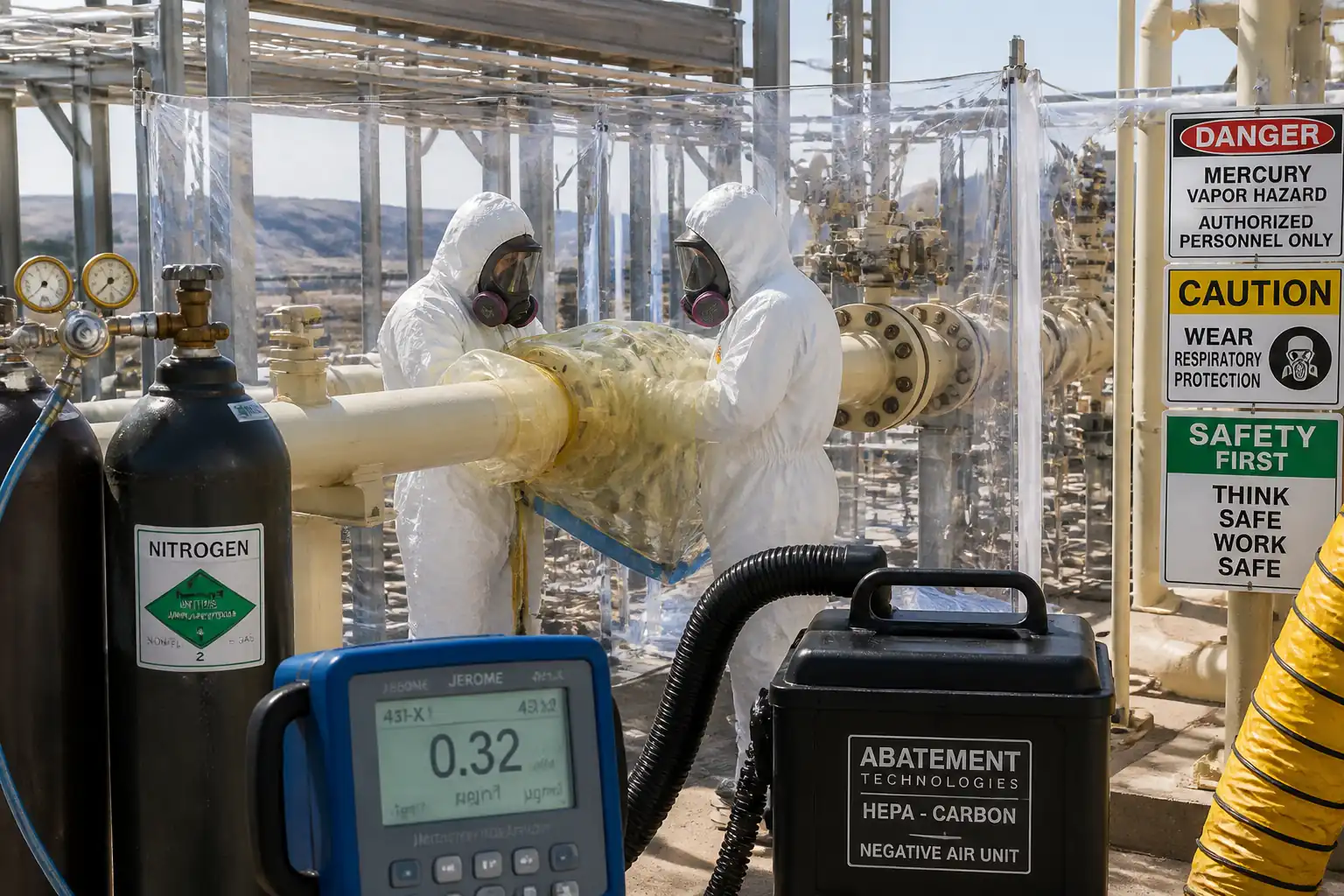

Method Statement: Removal of Mercury-Contaminated Piping from Natural Gas Pressure Regulation Station with Mercury Vapour Monitoring, Inert Cutting, Special Waste Packaging, and Clearance Air Monitoring – Method Statement
AI-assisted method statement with matching ITP, PDF download, and Excel export.
More than a static template
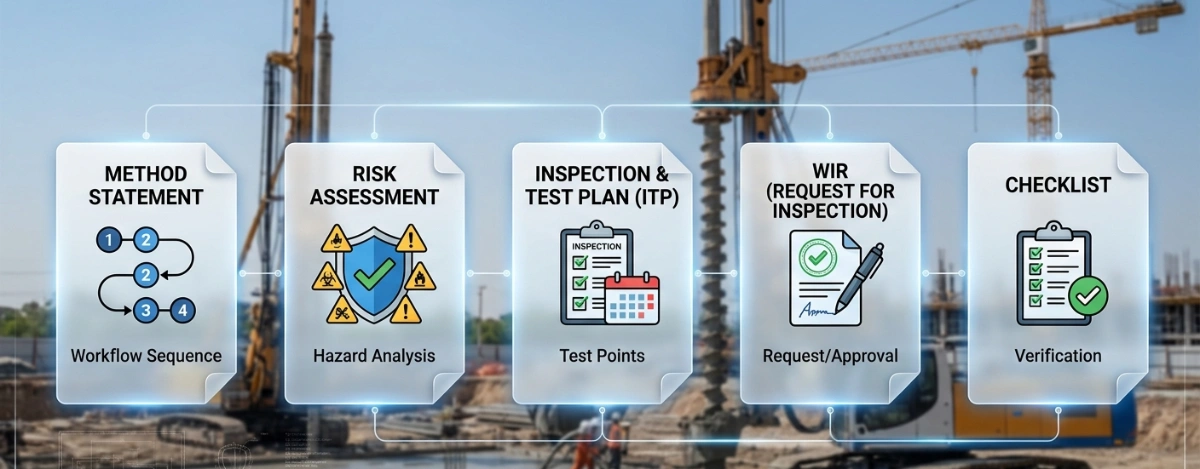
Unlike a downloadable Word or PDF template, this method statement is an AI-assisted editable starting point connected directly to a matching Inspection and Test Plan. Every section is structured, project-adaptable, and ready to export.
- AI-assisted drafting — Customize every section with AI for your specific project scope.
- Linked ITP — A matching inspection and test plan is generated alongside the method statement.
- Multiple export formats — Download as a formatted PDF or editable Excel spreadsheet.
- Editable starting point, not a final document — Review, verify, and adjust all content against your project requirements before use.
Static template vs. Quollnet workflow
| Feature | Static template | Quollnet |
|---|---|---|
| Project-specific content | Manual fill-in required | AI-assisted customization |
| Linked ITP | Separate document, no link | Matching ITP included |
| Export formats | Usually PDF only | PDF and Excel |
| Structured sections | Free-form layout | 13 standardized sections |
| Saved to your account | Local file only | Cloud-saved, reusable |
| Content accuracy | You verify everything | AI-assisted, you still verify |
| Cost | Often free but time-intensive | Free to customize and download |
What you can customize
When you save this method statement to your account, every section becomes editable. The following 13 sections are included:
- Scope — Defines the activity and its boundaries.
- References — Standards, specifications, and drawings.
- Responsibilities — Roles and accountabilities.
- Resources — Labour, plant, and equipment summary.
- Materials — Materials and compliance requirements.
- Equipment — Tools and equipment details.
- Prerequisites — Hold points and pre-conditions.
- Method sequence — Step-by-step construction sequence.
- Safety controls — HSE risk controls and PPE.
- Environmental controls — Environmental mitigation measures.
- QA/QC — Quality inspection and test requirements.
- ITP — Inspection and Test Plan table (has its own page).
- Attachments — Referenced drawings and documentation.
Why this method statement is used
This method statement is used to define and communicate the approved procedure for carrying out method statement: removal of mercury-contaminated piping from natural gas pressure regulation station with mercury vapour monitoring, inert cutting, special waste packaging, and clearance air monitoring on site. It ensures the work is planned in advance, the correct resources and controls are in place, and all personnel understand responsibilities, sequence, quality requirements, and safety controls before work begins. It aligns site execution with the documented scope and acceptance expectations.
Who uses this method statement
This method statement is used by contractors, site supervisors, project engineers, QA/QC engineers, HSE officers, consultants, and client representatives. It serves as a shared reference for planning, execution, supervision, inspection, and approval of the activity on site.
When it is prepared and submitted
The method statement is prepared before the work activity starts and submitted as part of the pre-construction documentation package for review and approval.
Who reviews or approves it
The method statement is usually submitted to the client representative, consultant, resident engineer, or project management consultant for review and approval before the work commences.
Important approval note
This method statement is an AI-assisted editable starting point, not a pre-approved document. Before use on any project, all content must be reviewed and approved by the relevant parties (superintendent, principal contractor, or client representative) in accordance with your contract and project quality plan.
For example: if your specification requires a departure from a referenced standard, that departure must be documented and approved separately — this method statement will not capture that automatically. Always verify against your applicable drawings, specifications, and regulatory requirements.
Method statement content
Scope
Overview
This method statement covers the controlled removal and packaging of mercury-contaminated carbon steel pipework and appurtenances (regulators, filters, drip pots) within a natural gas pressure regulation station. Works include isolation, depressurization, inerting, cold cutting inside negative-pressure containment, mercury spill control, decontamination, hazardous waste packaging, and clearance air monitoring prior to demobilization.
Inclusions
- Pre-work survey and confirmation of mercury contamination hotspots.
- Permit-to-Work, lockout/tagout (LOTO) of gas system, isolation verification, and gas-free/inert status confirmation.
- Establishment of exclusion zones and local containment (glove-bag or soft-wall enclosure) with negative pressure and vapour filtration.
- Continuous LEL, oxygen, and mercury vapour monitoring.
- Nitrogen purge and inerting of target piping prior to cutting.
- Cold cutting of pipework within inerted, enclosed containment; capping and sealing of open ends.
- Recovery of free mercury droplets, decontamination of components and surfaces.
- Special hazardous waste packaging, labeling, and temporary storage pending licensed transport and disposal.
- Clearance air monitoring and, where specified, surface wipe verification.
Exclusions
- Structural modifications beyond temporary supports required for safe removal.
- Permanent reinstatement or installation of new piping.
- Off-site transport and final disposal (by licensed hazardous waste contractor under separate scope).
Key Interfaces
- Station operations for isolation and purging.
- Industrial hygiene team for exposure assessment.
- Licensed hazardous waste contractor for packaging guidance and removal.
- Gas utility permit authority and local regulatory bodies.
References
| Document Type | Reference / Number | Revision | Notes |
|---|---|---|---|
| Standard/Guideline | ACGIH TLV: 0.025 mg/m³ (25 µg/m³) TWA for mercury vapour [Verify per project HSE plan] | UK HSE EH40 WEL: 0.02 mg/m³ TWA; OSHA PEL often cited 0.1 mg/m³ TWA (skin) [Verify locally]. | |
| Standard | NIOSH/OSHA Respiratory Protection (29 CFR 1910.134) [Verify local equivalent] | Use Hg/P100 cartridges with change-out schedule or supplied air as required. | |
| Standard | OSHA 1910 (General Industry), API RP 14C/500-series, ATEX/IECEx for equipment in explosive atmospheres [Verify per site] | Use intrinsically safe equipment in classified zones. | |
| Manufacturer/Guidance | Jerome J505/J405; Lumex RA-915 series; follow manufacturer QA/QC and calibration | Daily zero/span check; bump tests before use. | |
| Method | OSHA ID-140 (mercury vapour on solid sorbent, CVAA); NIOSH guidance [Verify lab capability] | Use accredited laboratory; maintain chain of custody. | |
| Transport/Regulatory | UN Model Regulations; ADR; IATA/ICAO; US DOT 49 CFR; Basel Convention [Verify local] | Mercury metal: UN 2809; contaminated solids often Class 6.1 or UN 3077/UN 3288 depending on analysis [Verify with DG specialist]. | |
| Guidance | AIHA/ACGIH ventilation guidelines; -5 to -10 Pa typical negative pressure [Verify per design] | Use HEPA + activated carbon filtration for mercury vapour. | |
| Guidance | Common industrial criteria: ≤3–10 µg/100 cm² depending on area sensitivity [Verify per project] | Use validated lab method; consistent wipe media/area templates. |
Responsibilities
| Role | Responsibility | Name / Party |
|---|---|---|
| Project Manager | Overall delivery, resources, program, approvals | Contractor |
| Construction Manager | Site execution, sequencing, toolbox talks, supervision | Contractor |
| Gas Operations Supervisor | Permit-to-Work, LOTO, gas isolation, purging oversight | Owner/Operator |
| Industrial Hygienist | Task-specific risk assessment, exposure control plan, fit testing, air monitoring strategy | Contractor or Specialist |
| Environmental Specialist | Mercury waste classification, packaging, labels, consignment notes | Contractor |
| QA/QC Engineer | Inspection and tests, records, ITP compliance, NCRs | Contractor |
| HSE Manager | Daily HSE checks, permits, supervision of controls, PPE compliance | Contractor |
| Mechanical/Piping Supervisor & Crew | Executes cutting, capping, decon within containment | Contractor |
Resources
| Resource Type | Description | Quantity | Remarks |
|---|---|---|---|
| Mechanical crew (pipefitters) | 1 Lead + 3 Fitters | ||
| Industrial hygienist/monitoring tech | 1 + 1 Tech | ||
| HSE supervisor | 1 | ||
| Waste handling technicians | 2 |
Materials
| Material | Specification / Grade | Quantity | Remarks |
|---|---|---|---|
| Nitrogen gas (N2) | Dry, oil-free; supply pressure per purge calc [Verify] | ||
| Sulfur powder / amalgamation reagent | Industrial grade; mercury-binding formulated media | ||
| UN-rated steel open-head drums (1A2) with poly liners | UN certified; suitable for Class 6.1, PG II/III [Verify] | ||
| Blind flanges/caps and PTFE gaskets | Rating per system design [Verify] | ||
| Activated carbon (sulfur-impregnated) filters | Sized for mercury vapour; vendor data [Verify] | ||
| Tychem/Tyvek coveralls, double nitrile + neoprene gloves, boot covers | PPE category for mercury handling [Verify] |
Equipment
| Equipment | Capacity / Type | Quantity | Inspection Required |
|---|---|---|---|
| Containment enclosure (glove-bag/tent) + negative air unit | 500–1500 m³/h | Yes | |
| Real-time mercury vapour analyzer | Detection to sub-µg/m³ | Yes | |
| Multi-gas detector | Continuous | Yes | |
| Pipe cutting tools (cold work) | Per pipe OD | Yes | |
| Nitrogen cylinders/manifold and regulators | As per purge calc | Yes | |
| Negative air machine/vapour scrubber | Per enclosure volume | Yes | |
| Mercury-rated vacuum (wet/dry) | Vendor-rated | Yes | |
| Torque wrench set | Up to required rating | Yes |
Prerequisites
- Approved task-specific Risk Assessment/Method Statement (RAMS) and Job Safety Analysis (JSA).
- Permits: Cold Work; Hot Work (only if absolutely necessary); Gas Free/Inerting Certificate; LOTO; Confined Space (not expected as no entry into enclosure) [Verify per project HSE plan].
- Competency/training: Mercury handling, spill response, respiratory fit testing, gas testing (authorised gas tester), LOTO, hazardous waste packaging.
- Instruments: Calibration certificates (within validity). Daily zero/span verifications recorded.
- Pre-work survey: Identify suspect components (regulators, filters, drip pots) and plan cut points. Verify structural support of pipe segments prior to cutting.
- Emergency plan: Spill response for mercury, gas release response, first aid, decontamination and eyewash/shower availability.
- Communication: Toolbox talk covering sequence, monitoring thresholds, stop-work criteria, and roles.
- Verification of hazardous area classification; ensure all powered tools and lights are intrinsically safe in classified zones.
Method Sequence
| Step | Activity | Description | Responsibility | Inspection / Hold Point |
|---|---|---|---|---|
| 1 | Site establishment and exclusion | Set up controlled work zone with barriers, signage, and access control. Install lined drip trays beneath work area. | Construction Manager | HSE walkdown |
| 2 | Instrument setup and verification | Set up mercury analyser(s), multi-gas meters, negative air unit with carbon filter. Perform daily zero/span or bump tests and record. | QA/QC + Industrial Hygienist | Calibration check |
| 3 | LOTO and isolation | Apply LOTO to upstream/downstream block valves; verify isolation per operations procedure. Install blinds if required [Verify]. | Gas Operations Supervisor | Permit/LOTO audit |
| 4 | Depressurization and venting | Controlled venting to flare/approved system until pressure at target line is 0 barg; verify with calibrated gauge. | Gas Operations Supervisor | Pressure check |
| 5 | Nitrogen purge (gas-free) | Purge isolated pipework with dry N2 at calculated volume turnovers (typically ≥5–7 volume exchanges [Verify]). Vent from the far end through a gas test point. | Gas Operations + Piping Supervisor | Gas test |
| 6 | Pre-clean external surfaces | Wipe exterior of target pipework with damp disposable wipes and compatible detergent to reduce external contamination. | Crew | Visual |
| 7 | Install containment enclosure | Fit glove-bag or soft-wall tent around cut location; connect to negative air unit with carbon filter; smoke test for leaks; maintain -5 to -10 Pa. | Piping Supervisor | Pressure/Integrity |
| 8 | Baseline monitoring | Record ambient Hg vapour at perimeter, inside enclosure, and operator breathing zone. Record LEL and O2. | Industrial Hygienist | Monitoring |
| 9 | Support and secure pipe | Install temporary supports; verify no unintended movement on cutting. | Piping Supervisor | Mechanical check |
| 10 | Open drain/low point recovery | Within enclosure, carefully open low-point drains to capture liquids/mercury into sealed containers. Use mercury-rated vacuum if droplets present. Dust sulfur powder on beads to reduce vapour. | Crew | Visual/monitoring |
| 11 | Cold cutting in inert atmosphere | Perform mechanical cold cut using pipe cutter or hydraulic shear inside the glove-bag. Maintain N2 trickle purge. Avoid sparks; tools intrinsically safe. | Piping Supervisor | Live monitoring |
| 12 | Immediate capping/sealing | Fit blind flanges/caps with PTFE gaskets to both cut ends before removing from enclosure. Torque to spec; soap-solution leak check if pressurization is possible. | Crew | Torque/leak test |
| 13 | Segment removal and bagging | Place removed segment into heavy-duty poly bag within enclosure; decon exterior; then transfer to UN-rated drum with liner. Seal, label, and mark gross weight. | Crew + Environmental Specialist | Packaging inspection |
| 14 | Decontaminate area and tools | Wipe down interior of enclosure and tools using suitable wipes/solution; capture all waste. Use mercury-rated vacuum if required. | Crew | Visual/monitoring |
| 15 | Progressive monitoring and action thresholds | Continue real-time Hg/LEL/O2 monitoring every 15 min (or continuous logging). Implement stop-work if any reading exceeds thresholds. | Industrial Hygienist | Monitoring |
| 16 | Clearance air monitoring | After removal and decon, conduct clearance testing at work area and adjacent zones. If specified, collect confirmatory sorbent tube samples for lab. | Industrial Hygienist | Air testing |
| 17 | Waste staging and documentation | Store sealed drums in ventilated, bunded area with secondary containment. Complete hazardous waste labels and consignment notes. | Environmental Specialist | Storage audit |
| 18 | Demobilization | Remove enclosures, filters, and equipment. Treat used carbon filters as hazardous waste if mercury-laden. | Construction Manager | Final HSE/QA walkdown |
Health, Safety, and Environment: Task-Specific Safety Controls
Key hazards, consequences, and controls
1) Natural gas release and explosion
- Consequence: Fire/explosion, severe injury/fatality.
- Engineering/procedural control: Formal LOTO; verify isolation; depressurize and purge to LEL 0%; inert cut zone; intrinsically safe tools; continuous LEL monitoring; no ignition sources; bonding/earthing of metallic components.
- PPE: FR clothing (outer), safety glasses/face shield, antistatic footwear.
- Collective measures: Exclusion zone, hot work prohibited (unless approved with additional controls), fire watch, firefighting equipment staged.
- Inspection/permit: Gas Free/Inerting certificate; Cold/Hot Work permit; gas test log by authorised gas tester.
2) Mercury vapour exposure
- Consequence: Neurotoxicity, renal injury.
- Engineering/procedural control: Negative-pressure glove-bag/tent with carbon filtration; minimize disturbance; real-time Hg monitoring; sulfur/amalgamation reagent on droplets; task duration minimization.
- PPE: Full-face respirator or PAPR with Hg/P100 cartridges; change-out schedule per OEM (max shift or ESLI) [Verify]; chemical-resistant coveralls (Tychem), double gloves (inner nitrile, outer neoprene), disposable boot covers.
- Collective measures: Perimeter monitoring and action levels (e.g., 50% of OEL); hygiene facilities; no eating/drinking in work zone.
- Inspection/permit: Respiratory fit test records; daily instrument bump tests; exposure log.
3) Oxygen deficiency in enclosure (nitrogen purge)
- Consequence: Asphyxiation if enclosure is breached/entered.
- Engineering/procedural control: No personnel entry into enclosure; operate via glove ports only; O2 monitor at perimeter; clear signage “Inert Atmosphere – No Entry”.
- PPE: Respiratory protection as above for vapour; no SCBA needed unless rescue scenario.
- Collective measures: Barriers and supervision to prevent entry; standby person.
- Inspection/permit: Permit noting inert atmosphere; O2 readings logged.
4) Tool-related cuts/pinch points during cold cutting
- Consequence: Lacerations, hand injuries.
- Engineering/procedural control: Use guarded mechanical cutters; secure work; hands clear of cutting path; proper body positioning.
- PPE: Cut-resistant gloves over chemical gloves where compatible; face shield; long sleeves.
- Collective measures: Task-specific toolbox talk; adequate lighting (intrinsically safe).
- Inspection/permit: Supervisor check of tool condition before use.
5) Manual handling of pipe sections and drums
- Consequence: Strains, crush injuries.
- Engineering/procedural control: Use mechanical aids (trolleys, hoists); plan lift; limit drum fill to weight limits [Verify].
- PPE: Safety boots, gloves, back support as needed.
- Collective measures: Team lifts; clear travel paths; spotter.
- Inspection/permit: Lift plan (if using hoist); equipment inspection tags.
6) Spill/release of mercury droplets
- Consequence: Environmental contamination; vapour escalation.
- Engineering/procedural control: Lined containment trays; mercury-rated vacuum; amalgamation reagent; controlled movements within enclosure.
- PPE: As per mercury exposure control.
- Collective measures: Dedicated spill kit; trained responders.
- Inspection/permit: Spill drill reviewed; waste logs.
7) Electrical equipment in classified area
- Consequence: Ignition, shock.
- Engineering/procedural control: Use ATEX/IECEx-rated equipment; inspect cables; avoid overloading circuits; battery tools preferred where allowed.
- PPE: Dielectric gloves if necessary, FR clothing.
- Collective measures: Area classification plan; cable management.
- Inspection/permit: Equipment certification verified; pre-use inspection records.
8) Psychological/heat stress in PPE
- Consequence: Fatigue, errors, heat illness.
- Engineering/procedural control: Work/rest regimen; shaded rest area; hydration; cooling vests if required.
- PPE: Appropriate underlayers; consider PAPR for reduced breathing resistance.
- Collective measures: Buddy system; supervisor monitoring.
- Inspection/permit: HSE monitoring; incident near-miss reporting.
[Verify all controls per project HSE plan and local regulations]
Environmental Controls
- Secondary containment: Place poly-lined trays beneath work to capture any liquids/droplets; keep drain covers installed over nearby sumps.
- Enclosure filtration: Use HEPA + sulfur-impregnated activated carbon; monitor pressure drop and replace when breakthrough suspected or per OEM hours; treat spent filters as hazardous.
- Spill response: Dedicated mercury spill kit (amalgamation powder, scoops, syringes for beads, sealable containers). Stop-work and notify Environmental Specialist for any release beyond containment.
- Waste segregation: Separate free mercury, contaminated solids (rags, PPE), and metal pipe sections; package in UN-rated drums with liners; label “Hazardous Waste – Mercury.”
- Storage: Temporary staging in ventilated, bunded area, away from traffic and drains; maintain inventory.
- Transport readiness: Ensure DG classification, packing group, and labels are confirmed by licensed waste contractor; complete consignment notes/manifests.
- Noise and vibration: Limit cutting noise; observe local limits; use daytime working hours where possible [Verify].
- Air emissions: Vent nitrogen via safe point; ensure no uncontrolled mercury vapour releases; perimeter monitoring confirms protection of receptors.
- Housekeeping: No dry sweeping; use mercury-rated vacuum; wet methods for wipe-down.
- Records: Maintain waste weights, container IDs, and chain-of-custody for samples.
Quality Assurance / Quality Control
- Calibration: Maintain current calibration certificates for mercury analysers, multi-gas detectors, manometers; perform daily zero/span checks and record.
- Purge verification: Record purge volumes/turnovers and gas readings (LEL 0%; O2 <8% inside pipe) before cutting; ambient O2 19.5–23.5%.
- Enclosure performance: Verify negative pressure (-5 to -10 Pa) by manometer and smoke test; record hourly.
- Monitoring frequency: Record Hg vapour at 15-minute intervals at enclosure, breathing zone, and perimeter, or use continuous logging.
- Cutting quality: Visual inspection of cut edges; no burrs preventing cap fit; torque records for blinds per spec [Verify torque values].
- Leak checks: Soap solution test where pressure can be applied; record results.
- Waste QA: Verify UN marks, closure method (e.g., ring clamp torque), labels, and compatibility; record gross weights; maintain photos.
- Clearance criteria: Real-time Hg ≤ project clearance criterion (typ. ≤10 µg/m³) and, where specified, wipe samples within limits (typ. ≤3–10 µg/100 cm²) [Verify].
- Documentation: ITP sign-offs, checklists, monitoring logs, waste manifests, training/fit test records, NCRs/Corrective Actions where deviations occur.
Attachments
- Sample forms: Pre-start checklist; Gas-free certificate; Enclosure setup sheet; Monitoring log; Torque/leak record; Drum packing list; Clearance certificate; Chain of Custody.
- Manufacturer data sheets: Mercury analyser(s); negative air/carbon filters; mercury-rated vacuum; PPE specifications.
- SDS: Sulfur/amalgamation reagents; cleaning agents.
- Sketches: Enclosure arrangement; purge/vent schematic; cut locations and supports.
- Emergency plan and contact list.
This content is a read-only public reference. Download or customize to get an editable version.
ITP preview
The first inspection activities from the linked ITP for Method Statement: Removal of Mercury-Contaminated Piping from Natural Gas Pressure Regulation Station with Mercury Vapour Monitoring, Inert Cutting, Special Waste Packaging, and Clearance Air Monitoring:
| Activity | Inspection / Test | Acceptance Criteria | Responsibility | Record |
|---|---|---|---|---|
| Pre-start documentation and permits | Approved RAMS, permits, LOTO plan, calibration certs available | All approvals in place; documents current | Project Manager / HSE Manager | ITP sign-off; permit copies |
| Instrument daily checks | Zero/span or bump tests per OEM | Within OEM tolerance | Industrial Hygienist / QA-QC | Calibration/bump logs |
| LOTO and isolation verification | Physical check of valves/tags; pressure gauge at 0 barg | Isolation confirmed; 0 barg | Gas Operations Supervisor | LOTO log; isolation certificate |
Showing 3 of 10 inspection activities. View full ITP →
Related Inspection and Test Plan
An Inspection and Test Plan (ITP) is available for Method Statement: Removal of Mercury-Contaminated Piping from Natural Gas Pressure Regulation Station with Mercury Vapour Monitoring, Inert Cutting, Special Waste Packaging, and Clearance Air Monitoring. The ITP defines the inspection activities, acceptance criteria, hold and witness points, responsible parties, and records required to verify the work described in this method statement.
View the Method Statement: Removal of Mercury-Contaminated Piping from Natural Gas Pressure Regulation Station with Mercury Vapour Monitoring, Inert Cutting, Special Waste Packaging, and Clearance Air Monitoring ITP →Frequently asked questions
Continue with related Quollnet resources connected to this method statement.
Related Method Statements
Related ITPs
Related Articles

Related Checklists

Related resources
- Inspection and Test Plan (ITP) for Method Statement: Removal of Mercury-Contaminated Piping from Natural Gas Pressure Regulation Station with Mercury Vapour Monitoring, Inert Cutting, Special Waste Packaging, and Clearance Air Monitoring →
- Browse all method statement templates →
- Browse all ITP templates →