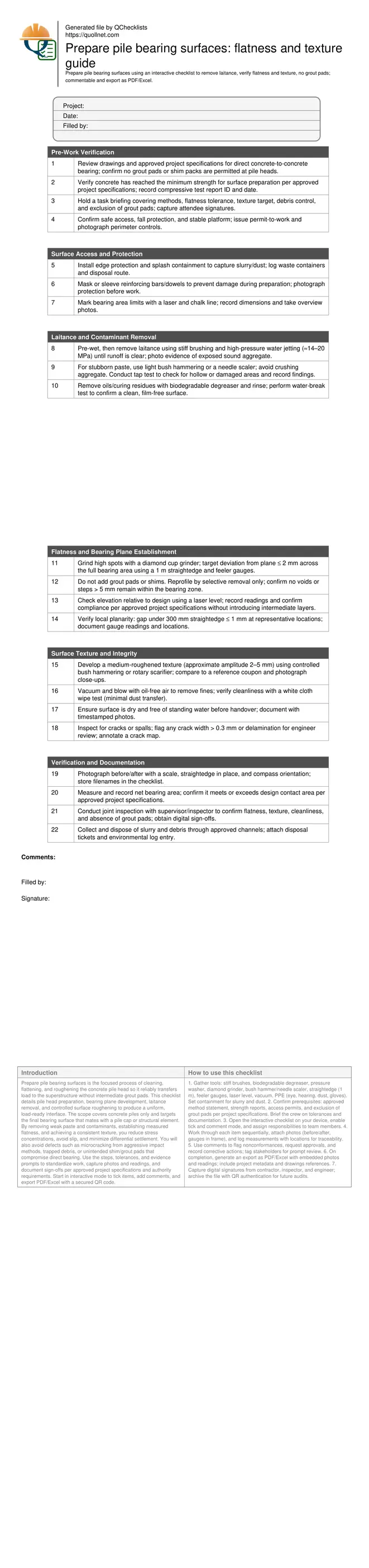
Pile Bearing Surface Preparation Checklist: Flatness and Texture
Definition: Prepare pile bearing surfaces for concrete piles by removing laitance, achieving verified flatness and roughened texture; aimed at site engineers, inspectors, and foremen ensuring reliable load transfer.
- Remove laitance and contaminants to expose sound aggregate for bearing.
- Grind high spots to meet planarity tolerance across the bearing area.
- Create a medium-roughened texture that promotes dependable load transfer.
- Interactive, commentable checklist with export and QR code sign-off.
Prepare pile bearing surfaces is the focused process of cleaning, flattening, and roughening the concrete pile head so it reliably transfers load to the superstructure without intermediate grout pads. This checklist details pile head preparation, bearing plane development, laitance removal, and controlled surface roughening to produce a uniform, load-ready interface. The scope covers concrete piles only and targets the final bearing surface that mates with a pile cap or structural element. By removing weak paste and contaminants, establishing measured flatness, and achieving a consistent texture, you reduce stress concentrations, avoid slip, and minimize differential settlement. You will also avoid defects such as microcracking from aggressive impact methods, trapped debris, or unintended shim/grout pads that compromise direct bearing. Use the steps, tolerances, and evidence prompts to standardize work, capture photos and readings, and document sign-offs per approved project specifications and authority requirements. Start in interactive mode to tick items, add comments, and export PDF/Excel with a secured QR code.
- This checklist standardizes pile head preparation to remove laitance, establish a true bearing plane, and create a consistent texture. It emphasizes measurable tolerances, evidence-based verification, and excludes grout pads to maintain direct concrete-to-concrete load transfer.
- Technicians and inspectors can apply controlled methods—hydro-cleaning, light bush hammering, and diamond grinding—to expose sound aggregate without inducing microcracks. Acceptance cues include planarity checks, gap measurements, and visual texture confirmation across the entire bearing area.
- Interactive online checklist with tick, comment, and export features secured by QR code.
- Documented results improve handover quality: photo records with scales, straightedge gap logs, surface texture notes, and elevation references support approval per approved project specifications and authority requirements and streamline dispute resolution.
Pre-Work Verification
Surface Access and Protection
Laitance and Contaminant Removal
Flatness and Bearing Plane Establishment
Surface Texture and Integrity
Verification and Documentation
Why laitance removal and direct bearing matter
Laitance is a weak, paste-like layer that forms on concrete surfaces during placement and bleeding. If left on a pile head, it dramatically reduces friction and creates localized stress concentrations under service loads. Proper removal exposes sound coarse aggregate, allowing true concrete-to-concrete bearing without slip. This approach, combined with measured flatness, prevents high-point loading that can crack the cap or overstress reinforcement. Equally important is excluding grout pads or shims, which can mask unevenness, creep over time, or debond, undermining long-term performance. By focusing on controlled cleaning (hydro-wash and brushing), selective mechanical removal (light bush hammering), and final refinement by grinding, crews achieve a uniform, durable interface. Evidence-based checks—straightedge gaps, feeler gauge records, and photo documentation—provide confidence at handover and support approvals per approved project specifications and authority requirements.
- Expose sound aggregate; remove weak paste and films.
- Exclude grout pads and shims at the bearing interface.
- Use straightedge and gauges to prove planarity.
- Capture before/after photos with scales and locations.
Achieving flatness without inducing damage
Planarity governs how loads distribute across the pile head. The safest path is to remove only what is necessary: identify high spots, grind them down with a diamond cup, and recheck with a 1 m straightedge. Aggressive impact tools can microcrack the surface and crush aggregates, so use light bush hammering sparingly and verify integrity with a tap test or close inspection. Target small, consistent gaps and avoid sudden steps or ridges. Do not add intermediate layers to make up flatness; instead, correct the concrete surface itself. Verify elevation with a laser level so the cap seats without rocking. Document each reading and location so any later movement or settlement can be differentiated from initial geometry.
- Remove high spots; avoid deep gouges or steps.
- Prefer grinding over heavy impact methods.
- Prove elevation with laser level readings.
- Record gap measurements at multiple locations.
Texture, cleanliness, and handover evidence
A medium-roughened texture enhances contact by reducing micro-slip at the interface while preserving aggregate integrity. Aim for a repeatable texture using controlled bush hammering or scarifying, then thoroughly vacuum and air-blow the surface to remove fines. Avoid leaving water or slurry, which can act as a lubricant at seating. Inspect for cracks and delamination; any defects beyond minor cosmetic issues warrant escalation. At handover, provide clear photos with a scale and straightedge in frame, note the net contact area, and capture signatures from responsible parties. QR-secured exports of the checklist, including readings and photos, close the loop for quality and traceability per approved project specifications and authority requirements.
- Create a uniform, medium-roughened surface.
- Leave the surface clean, dry, and dust-free.
- Map and escalate cracks over 0.3 mm width.
- Export records with QR-secured verification.
How to Use This Pile Bearing Surface Prep Checklist
- Gather tools: stiff brushes, biodegradable degreaser, pressure washer, diamond grinder, bush hammer/needle scaler, straightedge (1 m), feeler gauges, laser level, vacuum, PPE (eye, hearing, dust, gloves). Set containment for slurry and dust.
- Confirm prerequisites: approved method statement, strength reports, access permits, and exclusion of grout pads per project specifications. Brief the crew on tolerances and documentation.
- Open the interactive checklist on your device, enable tick and comment mode, and assign responsibilities to team members.
- Work through each item sequentially, attach photos (before/after, gauges in frame), and log measurements with locations for traceability.
- Use comments to flag nonconformances, request approvals, and record corrective actions; tag stakeholders for prompt review.
- On completion, generate an export as PDF/Excel with embedded photos and readings; include project metadata and drawings references.
- Capture digital signatures from contractor, inspector, and engineer; archive the file with QR authentication for future audits.
Call to Action
- Start Checklist Tick off tasks, leave comments on items or the whole form, and export your completed report to PDF or Excel—with a built-in QR code for authenticity.
- Download Excel - Pile Bearing Surface Preparation
- Download PDF - Pile Bearing Surface Preparation
- View Image - Pile Bearing Surface Preparation
Cite & Embed
“Pile Bearing Surface Preparation by Quollnet”
with a link to
this source page.

FAQ
Question: What is the best way to remove laitance from a pile head?
Question: How flat should the pile bearing surface be before placing the cap?
Question: Why are grout pads or shims excluded in this checklist?
Question: How do I avoid microcracking when roughening the surface?
Related Articles
Broader reading and guidance connected to this checklist topic.

Master Construction Project Cashflow With Cashflowpot


Is It Important To Customize Your Qr Code And How To Do It?

Construction Tender Preparation Guide | Step-by-step Bidding Process

Concrete Cube Vs Cylinder Strength: Why The 0.8 Rule Can Mislead
Related Checklists
Keep the workflow moving with nearby templates chosen from similar checklist content.