
Method Statement: Asbestos-Containing Pipe Insulation Removal via Glovebag, Negative Pressure Enclosure, Air Monitoring, Decontamination, Waste Management, and Clearance – Method Statement
AI-assisted method statement with matching ITP, PDF download, and Excel export.
More than a static template
Unlike a downloadable Word or PDF template, this method statement is an AI-assisted editable starting point connected directly to a matching Inspection and Test Plan. Every section is structured, project-adaptable, and ready to export.
- AI-assisted drafting — Customize every section with AI for your specific project scope.
- Linked ITP — A matching inspection and test plan is generated alongside the method statement.
- Multiple export formats — Download as a formatted PDF or editable Excel spreadsheet.
- Editable starting point, not a final document — Review, verify, and adjust all content against your project requirements before use.
Static template vs. Quollnet workflow
| Feature | Static template | Quollnet |
|---|---|---|
| Project-specific content | Manual fill-in required | AI-assisted customization |
| Linked ITP | Separate document, no link | Matching ITP included |
| Export formats | Usually PDF only | PDF and Excel |
| Structured sections | Free-form layout | 13 standardized sections |
| Saved to your account | Local file only | Cloud-saved, reusable |
| Content accuracy | You verify everything | AI-assisted, you still verify |
| Cost | Often free but time-intensive | Free to customize and download |
What you can customize
When you save this method statement to your account, every section becomes editable. The following 13 sections are included:
- Scope — Defines the activity and its boundaries.
- References — Standards, specifications, and drawings.
- Responsibilities — Roles and accountabilities.
- Resources — Labour, plant, and equipment summary.
- Materials — Materials and compliance requirements.
- Equipment — Tools and equipment details.
- Prerequisites — Hold points and pre-conditions.
- Method sequence — Step-by-step construction sequence.
- Safety controls — HSE risk controls and PPE.
- Environmental controls — Environmental mitigation measures.
- QA/QC — Quality inspection and test requirements.
- ITP — Inspection and Test Plan table (has its own page).
- Attachments — Referenced drawings and documentation.
Why this method statement is used
This method statement is used to define and communicate the approved procedure for carrying out method statement: asbestos-containing pipe insulation removal via glovebag, negative pressure enclosure, air monitoring, decontamination, waste management, and clearance on site. It ensures the work is planned in advance, the correct resources and controls are in place, and all personnel understand responsibilities, sequence, quality requirements, and safety controls before work begins. It aligns site execution with the documented scope and acceptance expectations.
Who uses this method statement
This method statement is used by contractors, site supervisors, project engineers, QA/QC engineers, HSE officers, consultants, and client representatives. It serves as a shared reference for planning, execution, supervision, inspection, and approval of the activity on site.
When it is prepared and submitted
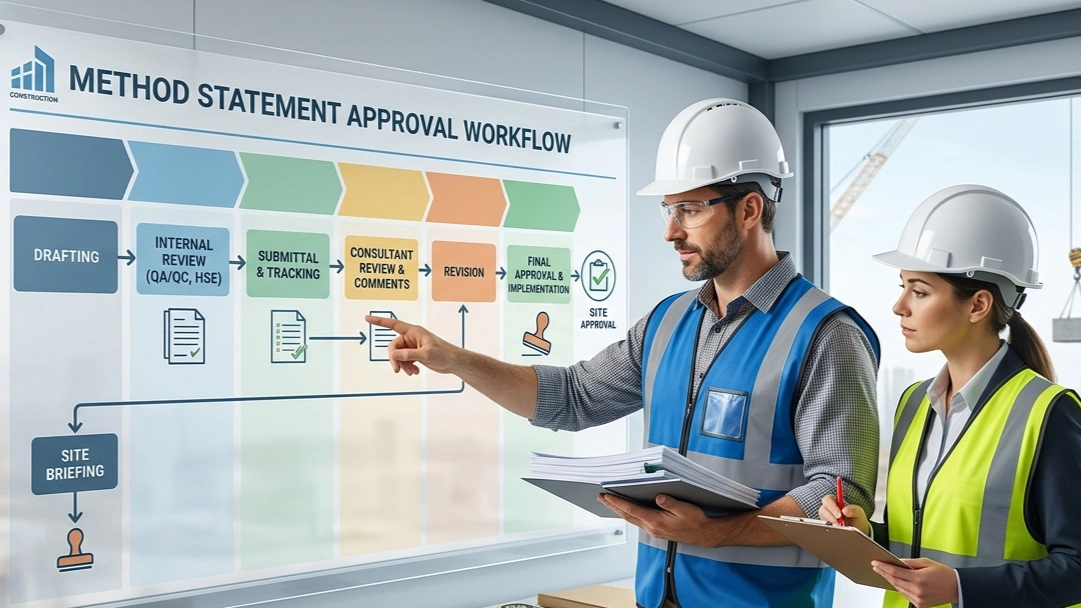
The method statement is prepared before the work activity starts and submitted as part of the pre-construction documentation package for review and approval.
Who reviews or approves it
The method statement is usually submitted to the client representative, consultant, resident engineer, or project management consultant for review and approval before the work commences.
Important approval note
This method statement is an AI-assisted editable starting point, not a pre-approved document. Before use on any project, all content must be reviewed and approved by the relevant parties (superintendent, principal contractor, or client representative) in accordance with your contract and project quality plan.
For example: if your specification requires a departure from a referenced standard, that departure must be documented and approved separately — this method statement will not capture that automatically. Always verify against your applicable drawings, specifications, and regulatory requirements.
Method statement content
Scope
Work Scope
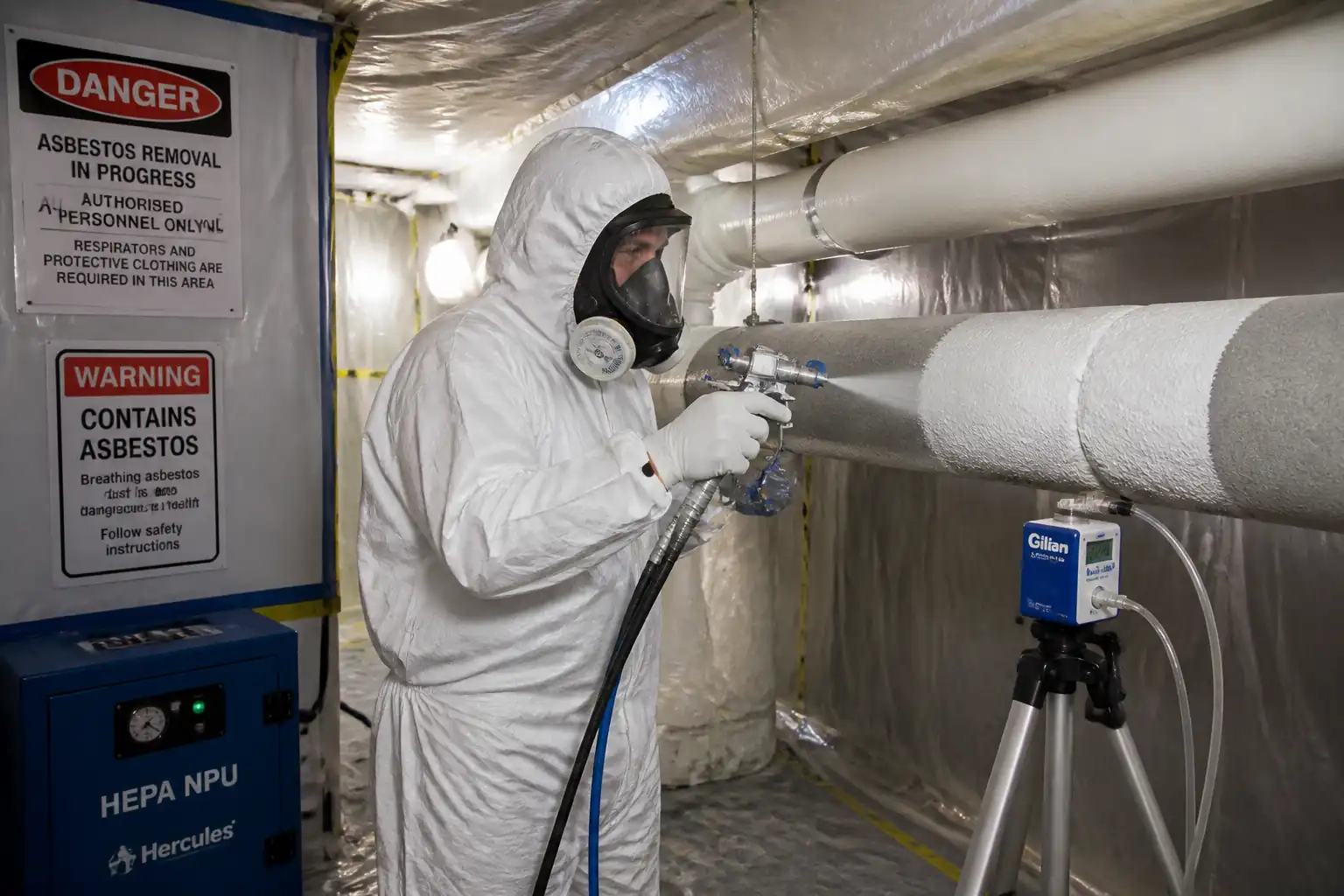
- Controlled removal of asbestos-containing material (ACM) from pipe insulation/lagging using the glovebag technique within a sealed negative pressure enclosure (NPE).
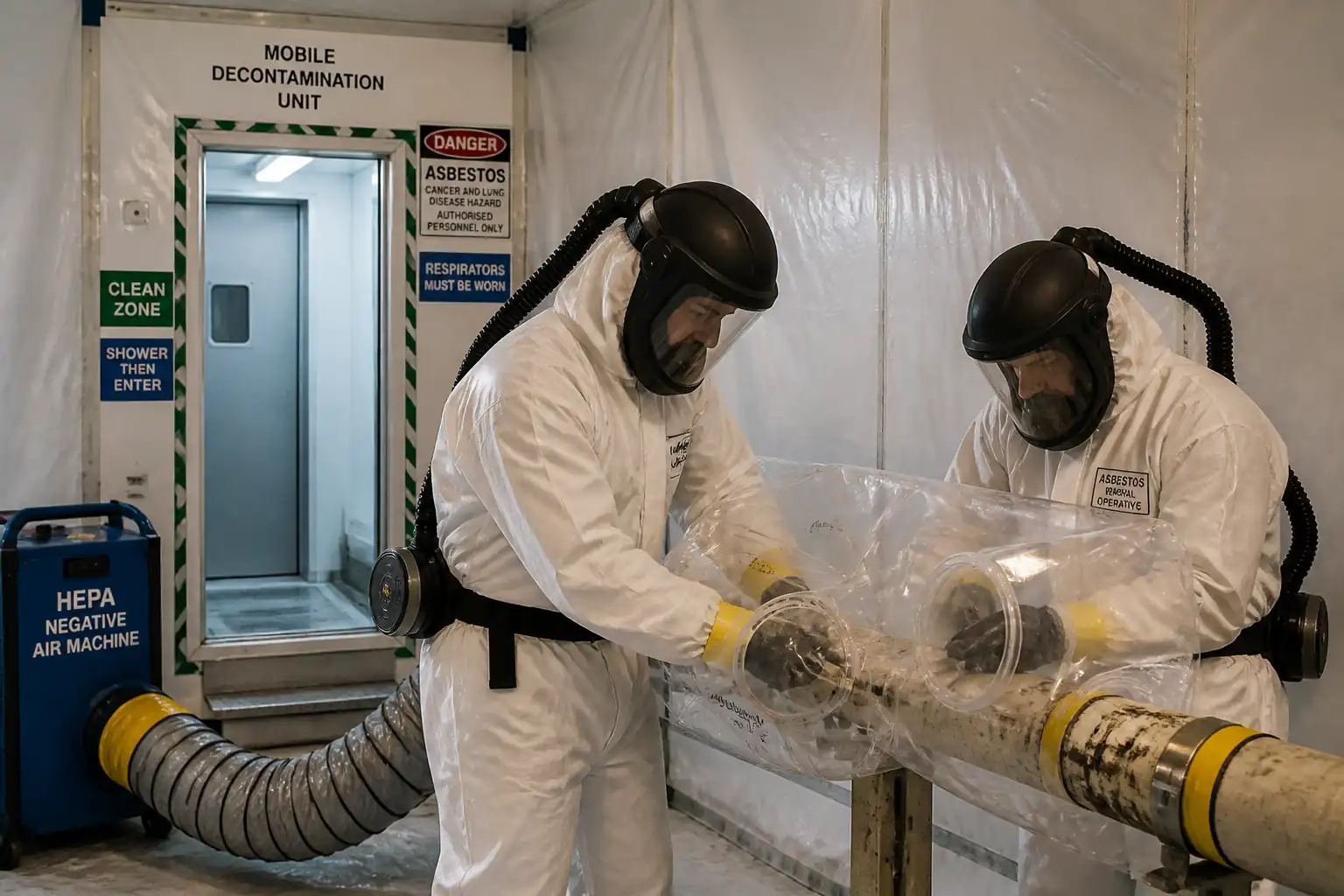
- Establishment of access control, transit and waste routes, and a mobile 3-stage decontamination unit (DCU).
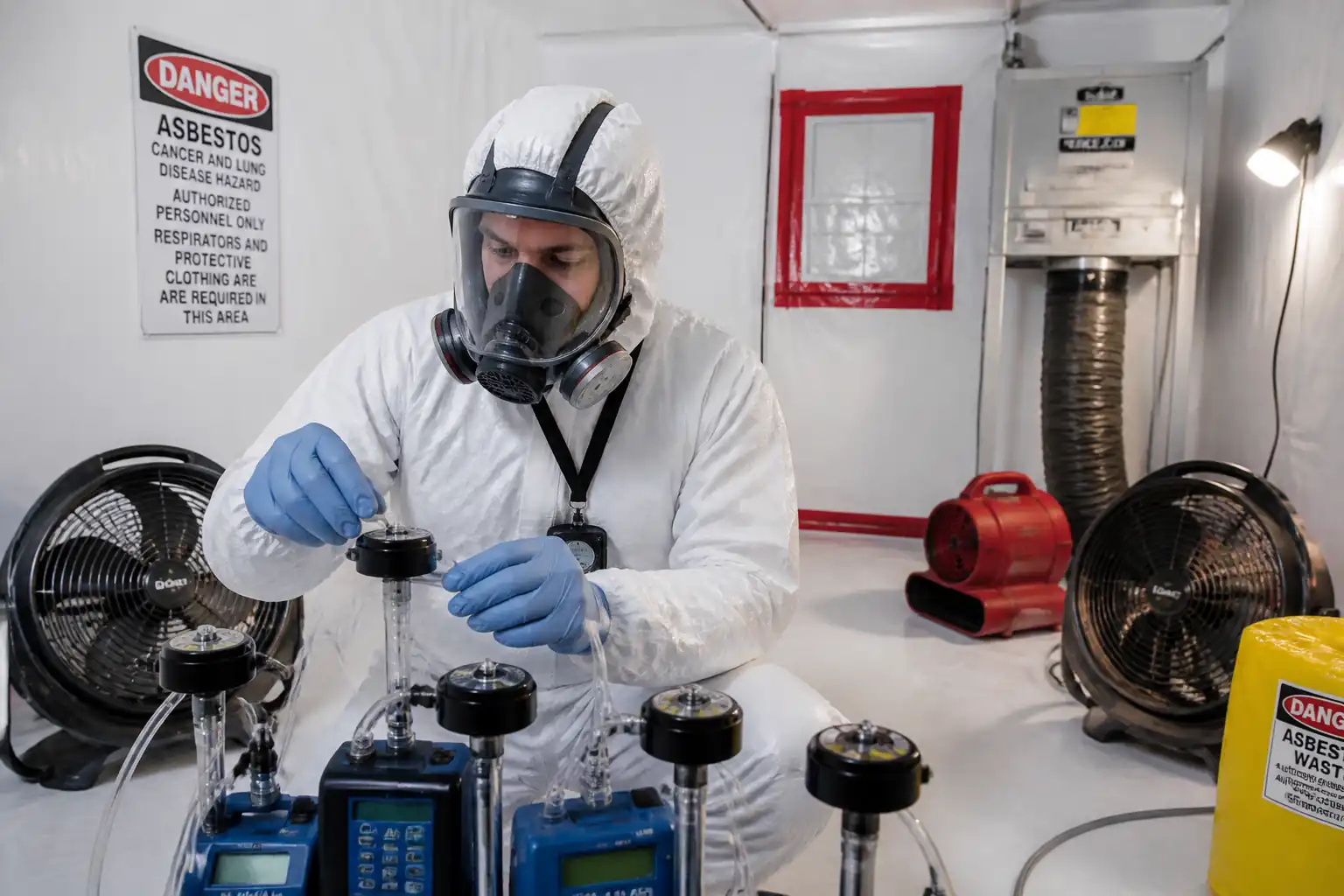
- Continuous negative pressure, leak testing, and air monitoring (background, leak, personal, and clearance sampling).
- Controlled wetting of ACM, removal, local decontamination of pipework, encapsulation as required, and reinstatement/temporary protection.
- Double-bagging, labelling, and secure transfer of asbestos waste to a licensed disposal facility.
- Four-stage clearance (visual and air testing) and issuance of Certificate of Reoccupation.
Exclusions
- Removal of non-pipe ACMs (unless stated in project-specific Plan of Work).
- Permanent insulation reinstatement beyond temporary encapsulation/protection.
- Structural alterations, scaffold erection by others, or MEP isolation by others (unless specified).
References
| Document Type | Reference / Number | Revision | Notes |
|---|---|---|---|
| Standard | ASTM E1368 | Visual criteria for clearance/cleanliness | |
| Standard | ISO 10312 | TEM method for airborne asbestos | |
| Method | NIOSH 7400/7402 | Personal and clearance sampling methods | |
| Standard | BS 8520-2/-3 | Equipment performance and use | |
| Standard | EN 1822 | HEPA performance of NPUs/vacuums | |
| Standard | ISO/IEC 17025 | Accreditation for asbestos air/fibre analysis | |
| Guidance | HSG247 | Industry good practice for abatement | |
| Guidance | HSG248 | Four-stage clearance and air testing | |
| Regulation | ADR/UN | Packaging, labelling, transport of asbestos waste | |
| Regulation | Asbestos Regulations | Licensing, notification, exposure limits, training |
Responsibilities
| Role | Responsibility | Name / Party |
|---|---|---|
| Principal Contractor (PC) | Overall delivery, compliance with regulations and project specifications, resource allocation, approvals. | PC |
| Licensed Asbestos Removal Contractor (LARC) – Site Supervisor | Prepare Plan of Work (PoW), supervise abatement, ensure containment integrity, training, RPE/PPE, and waste control. | LARC |
| Independent Asbestos Analyst/Consultant | Conduct background/leak/personal/clearance testing, manage pumps and media, issue clearance/Reoccupation Certificate. | Analyst |
| MEP Coordinator/Authorised Person (AP) | Ensure electrical/mechanical isolations and permits to work, verify zero-energy state. | PC/MEP |
| HSE Manager/Advisor | HSE plan, permits, site inductions, monitoring compliance, incident response. | PC |
| Asbestos Operatives | Daily checks, glovebag installation/removal, wetting, removal, decon, records. | LARC |
Resources
| Resource Type | Description | Quantity | Remarks |
|---|---|---|---|
| Personnel | 1 | ||
| Personnel | 2–4 [Verify] | ||
| Personnel | 1 |
Materials
| Material | Specification / Grade | Quantity | Remarks |
|---|---|---|---|
| Glovebags | Heavy-duty, clear polythene; heat-sealed seams; integral gloves | Sufficient for sections | |
| Polythene sheeting and tape | Flame-retardant sheeting; high-tack cloth tape | As required | |
| Surfactant/wetting solution | Water + surfactant (e.g., 0.2–0.5% v/v) [Verify] | As required | |
| Asbestos waste bags | UN-approved, 6 mil (≥150 µm) inner (red) and outer (clear) bags; printed warnings | Sufficient bags | |
| Encapsulant/bridging sealant | PVA or acrylic encapsulant suitable for ACM residue control | As required |
Equipment
| Equipment | Capacity / Type | Quantity | Inspection Required |
|---|---|---|---|
| Negative Pressure Units (NPUs) | Provide ≥4–10 ACH; maintain -5 to -10 Pa [Verify] | 1–2 units [Verify] | |
| H-class HEPA vacuums | ≥99.95% at MPPS (H13) | 2+ | |
| Manometer/pressure logger | Resolution ≤0.1 Pa | 1 | |
| Garden sprayers/misters | Low-foaming, adjustable nozzle | 2 | |
| Hand tools (scrapers, cable knives, snips) | Non-sparking or guarded | As needed | |
| Mobile Decontamination Unit (DCU) | Negative pressure and HEPA exhaust | 1 | |
| Personal and static air sampling pumps | Flow 2–10 L/min; ±5% accuracy | As required | |
| Podiums/step-ups/towers | With guardrails/toeboards [Verify] | As required | |
| RPE and PPE | EN 136/140 masks; EN 143 P3 filters | Per operative |
Prerequisites
- Approved Plan of Work (PoW), Risk Assessment, and this Method Statement signed by PC, LARC, and HSE Manager.
- Valid asbestos removal license/competency [Verify per jurisdiction].
- Asbestos survey (Refurbishment/Demolition) available; scope confirmed; drawings marked up.
- Notifications/permits submitted to the regulator/client where required and within statutory lead times [Verify].
- Personnel medicals, training records, and face-fit/PAPR records current.
- Equipment certification: HEPA integrity test (PAO/DOP) for NPUs/H-class vacuums within 6–12 months [Verify]; PAT tests current.
- Decontamination Unit (DCU) commissioned; water/power arranged; waste water management agreed.
- Service isolations for affected pipework confirmed (mechanical/electrical/thermal); zero energy verified and locked/tagged out.
- Transit and waste routes agreed, segregated, and signed; emergency egress plan in place.
- Independent Analyst appointed (ISO/IEC 17025); sampling/analysis methods and clearance criteria agreed.
- Waste carrier license and disposal facility consents verified; consignment note templates prepared.
- Neighbour/stakeholder notifications arranged where required; work hours and noise controls agreed.
- Pre-start briefing and task-specific toolbox talk completed; emergency procedures (bag rupture, RPE failure, first aid) briefed.
- Weather and environmental constraints checked where applicable (e.g., external locations).
Method Sequence
| Step | Activity | Description | Responsibility | Inspection / Hold Point |
|---|---|---|---|---|
| 1 | Site handover and exclusion | Set up barriers, signage, and access control. Establish transit/waste routes. Record pre-existing conditions. | LARC Supervisor / PC | Site boundary and signage check |
| 2 | Enclosure build (NPE) | Erect polythene enclosure around work area with timber/metal framing as needed; seal all penetrations; install airlocks and baglock. | LARC Supervisor | Joint integrity check |
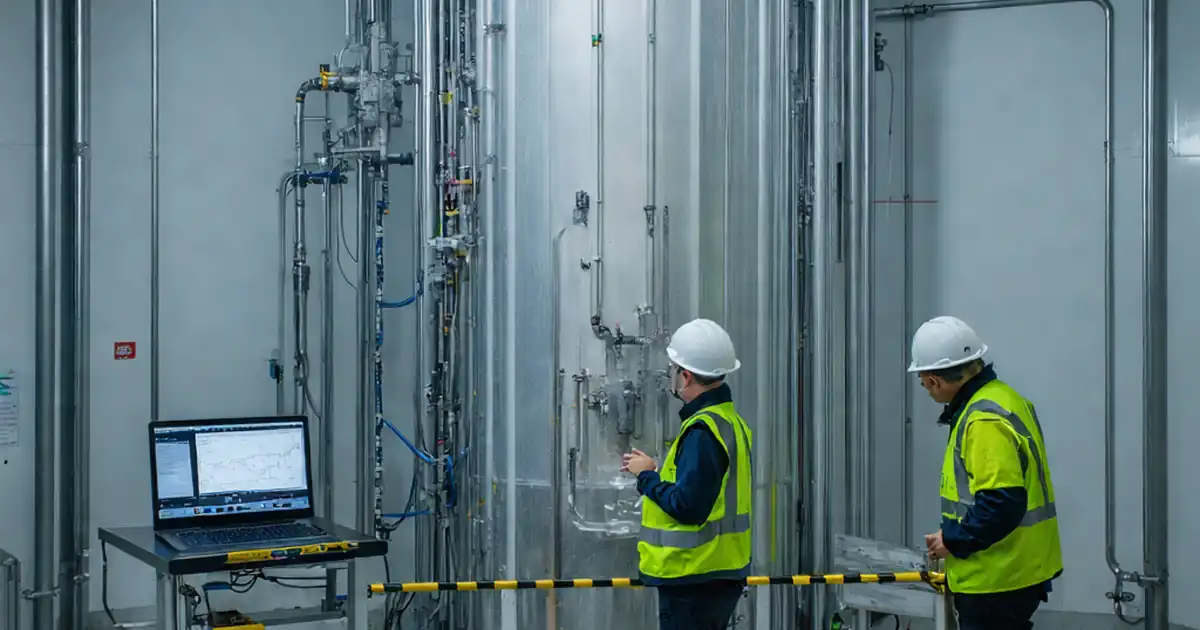
| 3 | Install NPUs and pressure monitoring | Fit NPUs with HEPA H13/H14 filters; vent to safe exterior if possible; install manometer/pressure logger; verify airflow path. | LARC Supervisor | NPU function; HEPA cert check |
| 4 | Smoke test of enclosure | Introduce theatrical smoke inside enclosure with NPUs running to prove inward leakage only; observe at all seams/penetrations. | LARC Supervisor / Analyst witness (if required) | Smoke pattern observation |
| 5 | DCU commissioning and routes | Position and power DCU; check negative pressure and HEPA exhaust; test showers. Confirm transit/waste routes signage and integrity. | LARC Supervisor | Operational checks |
| 6 | Baseline and background air testing | Independent Analyst conducts background air sampling outside/inside the enclosure prior to disturbance. | Analyst | Pump calibration |
| 7 | Glovebag preparation/installation | Select correct glovebag size; wipe pipe; place tools and sprayer inside bag; secure bag to pipe with tape/clamps ensuring airtight seal; attach HEPA vacuum to waste port if applicable. | Asbestos Operatives | Seal integrity check |
| 8 | Controlled wetting | Introduce low-foaming surfactant solution to fully saturate insulation through bag sleeves; allow dwell time. | Asbestos Operatives | Observation |
| 9 | ACM removal in glovebag | Carefully cut jacket/lagging; remove in sections, keeping material wet; place directly into glovebag sump; avoid tearing. Use HEPA vacuum at source to maintain negative pressure within bag. | Asbestos Operatives | Supervisor oversight |
| 10 | Local clean and encapsulation | HEPA vacuum and wet-wipe pipe surface; apply approved encapsulant or temporary wrap as specified. | Asbestos Operatives | Visual clean check |
| 11 | Glovebag removal and waste transfer | Evacuate air from bag via HEPA vacuum; twist, goose-neck, and tape; cut off and place into pre-labelled inner asbestos waste bag inside enclosure. Decontaminate tools in-bag before removal. | Asbestos Operatives | Waste seal check |
| 12 | Leak monitoring (if required) | Analyst conducts leak air testing outside enclosure during active removal or if pressure excursions occur. | Analyst | Pump calibration |
| 13 | Personal exposure monitoring | Representative operatives wear personal air pumps for task duration. | Analyst / LARC coordination | Flow check before/after |
| 14 | Baglock/waste dispatch | Double-bag: inner red to outer clear; wipe down; move via waste route to locked skip/bulk bag/container; maintain chain-of-custody. | Asbestos Operatives | Label/UN code check |
| 15 | Decontamination of personnel | Follow 3-stage DCU: gross decon in enclosure, shower, remove RPE in clean stage when cleared; store PPE/RPE per manufacturer. | All Operatives | Supervisor check |
| 16 | Pre-clearance clean and visual | Full HEPA vacuum and wet-wipe of work and transit areas; remove gross debris; Supervisor pre-check. | LARC Supervisor | Internal visual |
| 17 | Four-stage clearance and certificate | Independent Analyst conducts 4-stage clearance (visual inside enclosure; thorough clean check; clearance air testing; final inspection). Issue Certificate of Reoccupation on pass. | Analyst | Air pumps calibration; sampling |
| 18 | Dismantle enclosure and demobilise | After clearance, carefully strike enclosure; bag polythene as asbestos waste if contaminated; remove NPUs last. | LARC Supervisor | Area final check |
Safety Controls
Task-Specific Hazards and Controls
1) Hazard: Asbestos fibre inhalation
- Consequence: Asbestosis, lung cancer, mesothelioma.
- Engineering/Procedural Control: Negative pressure enclosure (-5 to -10 Pa) with HEPA NPUs; glovebag containment; controlled wetting; H-class HEPA vacuums; four-stage clearance; disciplined decon.
- Required PPE: Full-face PAPR/airline with P3 filters (APF ≥40) [Verify]; Category 5/6 disposable coveralls with hood; nitrile/latex inner gloves + cut-resistant outer gloves; boots without laces.
- Collective Measure: Segregated exclusion zones; airlocks; transit/waste routes; supervision.
- Inspection/Permit: Enclosure smoke test; pressure logging; RPE checks and face-fit; Analyst air monitoring; permits to work.
2) Hazard: Glovebag rupture or seal failure
- Consequence: Uncontrolled fibre release.
- Control: Pre-use inspection; double-taping; continuous HEPA extraction of glovebag; do not overfill; immediate bag-off and misting if failure occurs; deploy spare glovebag for containment.
- PPE: As above plus cut-resistant sleeves.
- Collective: Emergency spill kit and spare glovebags within enclosure.
- Inspection/Permit: Supervisor to verify seals before work; contingency briefed at TBT.
3) Hazard: Disturbance of live/hot pipework or unisolated services
- Consequence: Burns, flooding, electrical shock, fibre spread.
- Control: LOTO and isolation certificates; verify zero energy; temperature checks; drain and cool lines.
- PPE: Heat-resistant gloves where needed; eye/face protection integral to RPE.
- Collective: Coordination with AP/MEP; barriers around valves.
- Inspection/Permit: Isolation permit; pre-start sign-off by AP.
4) Hazard: Working at height (WAH) around elevated pipework
- Consequence: Falls, dropped objects.
- Control: Use podium steps/towers with guardrails; tool lanyards; maintain three points of contact; exclusion below.
- PPE: Harness only if specified with engineered anchor [Verify]; hard hats with chin straps.
- Collective: Edge protection; toe boards.
- Inspection/Permit: Tower inspection tag; WAH permit.
5) Hazard: Manual handling of waste and equipment
- Consequence: Musculoskeletal injuries.
- Control: Split loads; use trolleys; correct posture; team lifts; bag sizes limited to safe weight (e.g., ≤20–25 kg) [Verify].
- PPE: Gloves with grip; safety boots.
- Collective: Mechanical aids where practicable.
- Inspection/Permit: Manual handling assessment.
6) Hazard: Negative pressure loss (power failure/NPU fault)
- Consequence: Fibre escape through airlocks/defects.
- Control: Backup NPU; power via RCD; alarmed pressure logger; stop work, mist area, and rectify before resuming.
- PPE: RPE remains on until pressure restored.
- Collective: Emergency response plan.
- Inspection/Permit: Daily NPU checks; HEPA cert valid; PAT tests.
7) Hazard: RPE failure/poor fit
- Consequence: Inhalation exposure.
- Control: Pre-use checks; face-fit testing; PAPR battery management; spare units and filters; clean-shaven policy [Verify].
- PPE: Approved RPE only.
- Collective: Supervisor RPE audits.
- Inspection/Permit: RPE inspection records; maintenance logs.
8) Hazard: Cutting tools and sharp edges on pipework
- Consequence: Lacerations, glove punctures, bag tears.
- Control: Use guarded tools; cut away from gloves; reinforce bag contact points with tape; slow controlled movements.
- PPE: Cut-resistant outer gloves; sleeves.
- Collective: Tool control procedures.
- Inspection/Permit: Tool inspection; PAT where applicable.
9) Hazard: Heat stress/fatigue in PPE and enclosure
- Consequence: Heat exhaustion, reduced concentration.
- Control: Work/rest rotation; hydration; temperature monitoring; schedule in cooler periods; DCU cool water available.
- PPE: Lightweight breathable coveralls rated for asbestos.
- Collective: Supervisor to enforce breaks.
- Inspection/Permit: HSE plan for heat stress.
10) Hazard: Slips, trips, and poor housekeeping inside enclosure
- Consequence: Falls, bag tears, exposure.
- Control: Route cables overhead; keep floor clear; immediate waste bag-off; anti-slip mats.
- PPE: Safety boots; head protection.
- Collective: Housekeeping regime.
- Inspection/Permit: Supervisor walkdowns.
11) Hazard: Noise from NPUs and equipment
- Consequence: Hearing damage, communication issues.
- Control: Low-noise NPUs where possible; exposure assessment; rotation.
- PPE: Hearing protection if levels exceed action values [Verify].
- Collective: Signage for hearing protection zone.
- Inspection/Permit: Noise monitoring as required.
12) Hazard: Cross-contamination during transit/decon
- Consequence: Fibre spread to clean areas.
- Control: Strict DCU protocol; gross decon before exit; dedicated transit route; wipe-down of loads.
- PPE: Maintain PPE until shower stage complete.
- Collective: Segregation and supervision.
- Inspection/Permit: Spot checks; TBT records.
[All controls to be verified per project HSE plan and local regulations.]
Environmental Controls
- Asbestos fibre containment: Maintain negative pressure (-5 to -10 Pa) and HEPA filtration; smoke test integrity; continuous housekeeping to prevent debris build-up.
- Air emissions: Exhaust NPUs to exterior away from air intakes; HEPA H13/H14 filters certified; inspect for leaks; record pressure and NPU run-hours.
- Water/effluent: Collect DCU shower water and glovebag liquids for disposal per local regulation; prohibit discharge to storm drains; use settlement/filtration if approved [Verify].
- Waste management: Double-bag (inner red, outer clear) UN-approved 6 mil bags; label with asbestos hazard, UN number (UN 2212/2590 as applicable), generator details; maintain consignment notes and chain-of-custody; store in locked, covered container.
- Dust suppression: Wet methods only; prohibit dry brushing/air lines.
- Spill response: Immediate misting; contain within enclosure; use H-class vacuum; treat contaminated materials as asbestos waste; record incident.
- Noise: Schedule high-noise tasks in agreed hours; maintain equipment; use acoustic screening if required.
- Energy: Optimize NPU sizing to achieve ACH while minimizing energy use; shut down non-essential equipment when safe.
- Neighbour impact: Advance notices; route planning to avoid sensitive receptors; clean wheels and trolleys at exit points.
- Monitoring and reporting: Analyst leak/background and boundary reassurance monitoring as specified; promptly address exceedances; environmental incident log maintained.
QA/QC
- Competence: LARC license/competency verified; operatives trained; medicals current; face-fit or PAPR suitability confirmed.
- Equipment certifications: HEPA integrity test certificates (EN 1822 H13/H14) current; PAT testing records available; NPUs sized to deliver ≥4–10 ACH [Verify].
- Enclosure integrity: Smoke test witnessed as hold point; pressure differential logged continuously where practicable; daily boundary checks.
- Air monitoring QA: Pumps calibrated before/after to ±5% using primary standard; field blanks; sample volumes and flowrates per NIOSH 7400/ISO 10312; accredited (ISO/IEC 17025) laboratory analysis; custody seals.
- Work practice audits: Supervisor spot checks on glovebag sealing, wetting, removal, and tool control; no dry removal permitted.
- Acceptance criteria: Visual cleanliness per ASTM E1368; clearance air ≤0.01 f/cc (typical) or per specification; personal exposure below legal limits [Verify per jurisdiction].
- Documentation: Daily logs, NPU logs, manometer records, waste consignment notes, training/RPE records, incident/NCR forms.
- Nonconformance: Stop work, contain, correct; investigate cause; implement corrective actions; re-test as needed; client notification as required.
- Records retention: Maintain all records for statutory period (typically ≥40 years for exposure and health records) [Verify local requirement].
Attachments
- Plan of Work (PoW) and risk assessment
- Enclosure layout sketches and airflow schematic
- NPU sizing calculation and ACH confirmation
- Certificates: HEPA integrity, PAT, RPE maintenance, medicals, training
- Air monitoring strategy and laboratory accreditation (ISO/IEC 17025)
- Emergency response plan (bag rupture, power failure, first aid)
- Waste management plan and consignment note template
- Daily checklists: enclosure integrity, NPU log, glovebag checks, DCU checks
- Four-stage clearance procedure summary and acceptance criteria
- Permit to Work(s) and isolation certificates
This content is a read-only public reference. Download or customize to get an editable version.
ITP preview
The first inspection activities from the linked ITP for Method Statement: Asbestos-Containing Pipe Insulation Removal via Glovebag, Negative Pressure Enclosure, Air Monitoring, Decontamination, Waste Management, and Clearance:
| Activity | Inspection / Test | Acceptance Criteria | Responsibility | Record |
|---|---|---|---|---|
| Licensing/notifications | Valid LARC license; statutory notifications submitted within required timeframe. | Approvals/notification receipts | ||
| Pre-start documentation | Approved PoW/Method Statement; risk assessment; permits issued. | Signed PoW; permits | ||
| Equipment certification | NPUs/H-vacs with in-date HEPA integrity and PAT certificates; RPE serviceable. | Certificates; checklists |
Showing 3 of 16 inspection activities. View full ITP →
Related Inspection and Test Plan
An Inspection and Test Plan (ITP) is available for Method Statement: Asbestos-Containing Pipe Insulation Removal via Glovebag, Negative Pressure Enclosure, Air Monitoring, Decontamination, Waste Management, and Clearance. The ITP defines the inspection activities, acceptance criteria, hold and witness points, responsible parties, and records required to verify the work described in this method statement.
View the Method Statement: Asbestos-Containing Pipe Insulation Removal via Glovebag, Negative Pressure Enclosure, Air Monitoring, Decontamination, Waste Management, and Clearance ITP →Frequently asked questions
Continue with related Quollnet resources connected to this method statement.