
Method Statement – Backfilling and Compaction of Utility Trenches for Stormwater Drainage – Method Statement
AI-assisted method statement with matching ITP, PDF download, and Excel export.
More than a static template
Unlike a downloadable Word or PDF template, this method statement is an AI-assisted editable starting point connected directly to a matching Inspection and Test Plan. Every section is structured, project-adaptable, and ready to export.
- AI-assisted drafting — Customize every section with AI for your specific project scope.
- Linked ITP — A matching inspection and test plan is generated alongside the method statement.
- Multiple export formats — Download as a formatted PDF or editable Excel spreadsheet.
- Editable starting point, not a final document — Review, verify, and adjust all content against your project requirements before use.
Static template vs. Quollnet workflow
| Feature | Static template | Quollnet |
|---|---|---|
| Project-specific content | Manual fill-in required | AI-assisted customization |
| Linked ITP | Separate document, no link | Matching ITP included |
| Export formats | Usually PDF only | PDF and Excel |
| Structured sections | Free-form layout | 13 standardized sections |
| Saved to your account | Local file only | Cloud-saved, reusable |
| Content accuracy | You verify everything | AI-assisted, you still verify |
| Cost | Often free but time-intensive | Free to customize and download |
What you can customize
When you save this method statement to your account, every section becomes editable. The following 13 sections are included:
- Scope — Defines the activity and its boundaries.
- References — Standards, specifications, and drawings.
- Responsibilities — Roles and accountabilities.
- Resources — Labour, plant, and equipment summary.
- Materials — Materials and compliance requirements.
- Equipment — Tools and equipment details.
- Prerequisites — Hold points and pre-conditions.
- Method sequence — Step-by-step construction sequence.
- Safety controls — HSE risk controls and PPE.
- Environmental controls — Environmental mitigation measures.
- QA/QC — Quality inspection and test requirements.
- ITP — Inspection and Test Plan table (has its own page).
- Attachments — Referenced drawings and documentation.
Why this method statement is used
This method statement is used to define and communicate the approved procedure for carrying out method statement – backfilling and compaction of utility trenches for stormwater drainage on site. It ensures the work is planned in advance, the correct resources and controls are in place, and all personnel understand responsibilities, sequence, quality requirements, and safety controls before work begins. It aligns site execution with the documented scope and acceptance expectations.
Who uses this method statement
This method statement is used by contractors, site supervisors, project engineers, QA/QC engineers, HSE officers, consultants, and client representatives. It serves as a shared reference for planning, execution, supervision, inspection, and approval of the activity on site.
When it is prepared and submitted
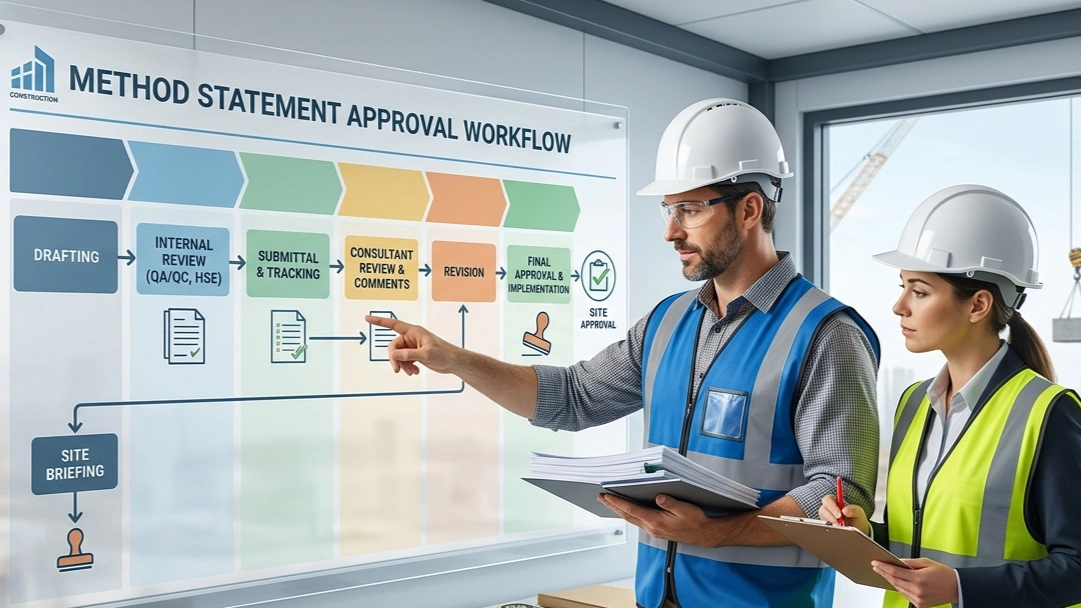
The method statement is prepared before the work activity starts and submitted as part of the pre-construction documentation package for review and approval.
Who reviews or approves it
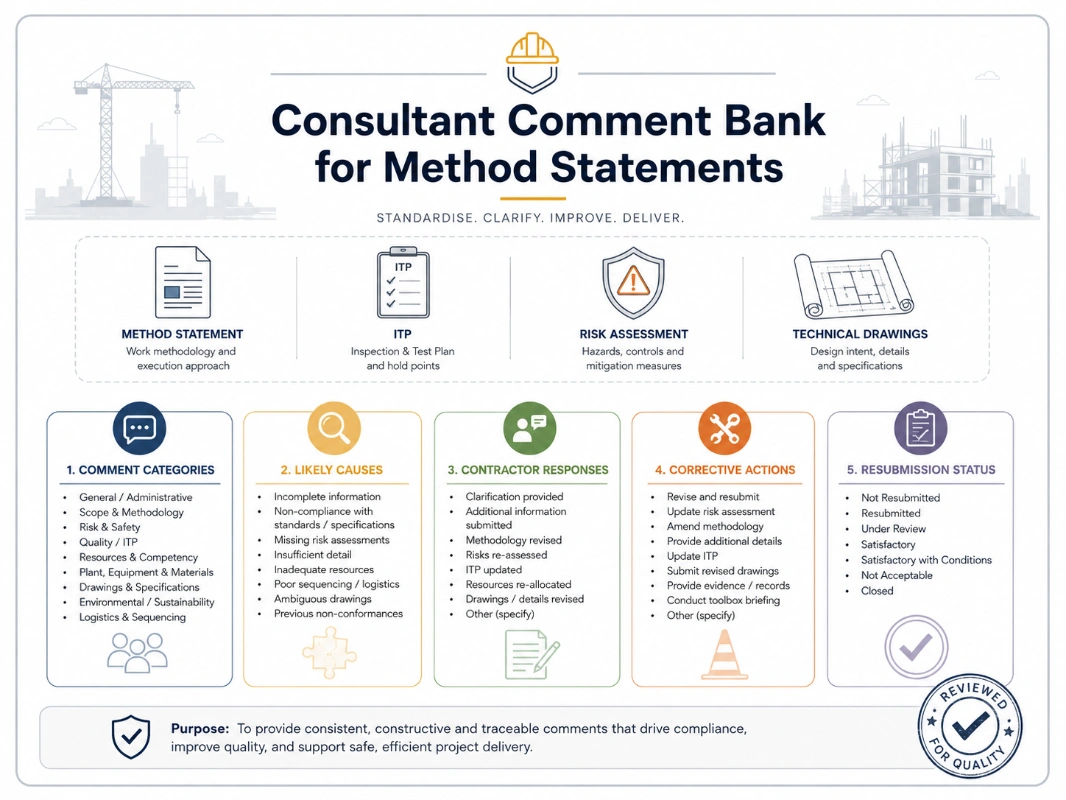
The method statement is usually submitted to the client representative, consultant, resident engineer, or project management consultant for review and approval before the work commences.
Important approval note
This method statement is an AI-assisted editable starting point, not a pre-approved document. Before use on any project, all content must be reviewed and approved by the relevant parties (superintendent, principal contractor, or client representative) in accordance with your contract and project quality plan.
For example: if your specification requires a departure from a referenced standard, that departure must be documented and approved separately — this method statement will not capture that automatically. Always verify against your applicable drawings, specifications, and regulatory requirements.
Method statement content
Scope
Overview
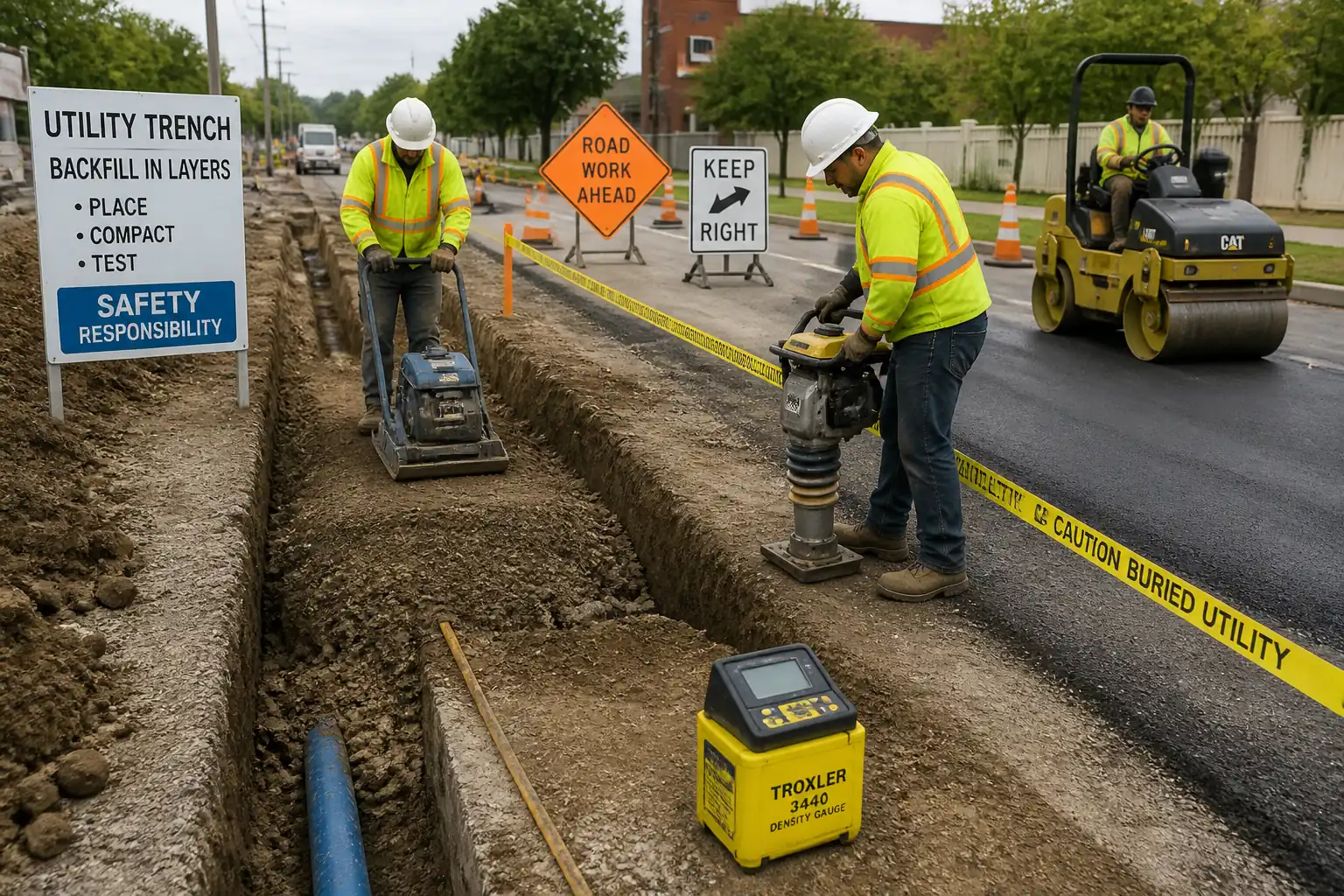
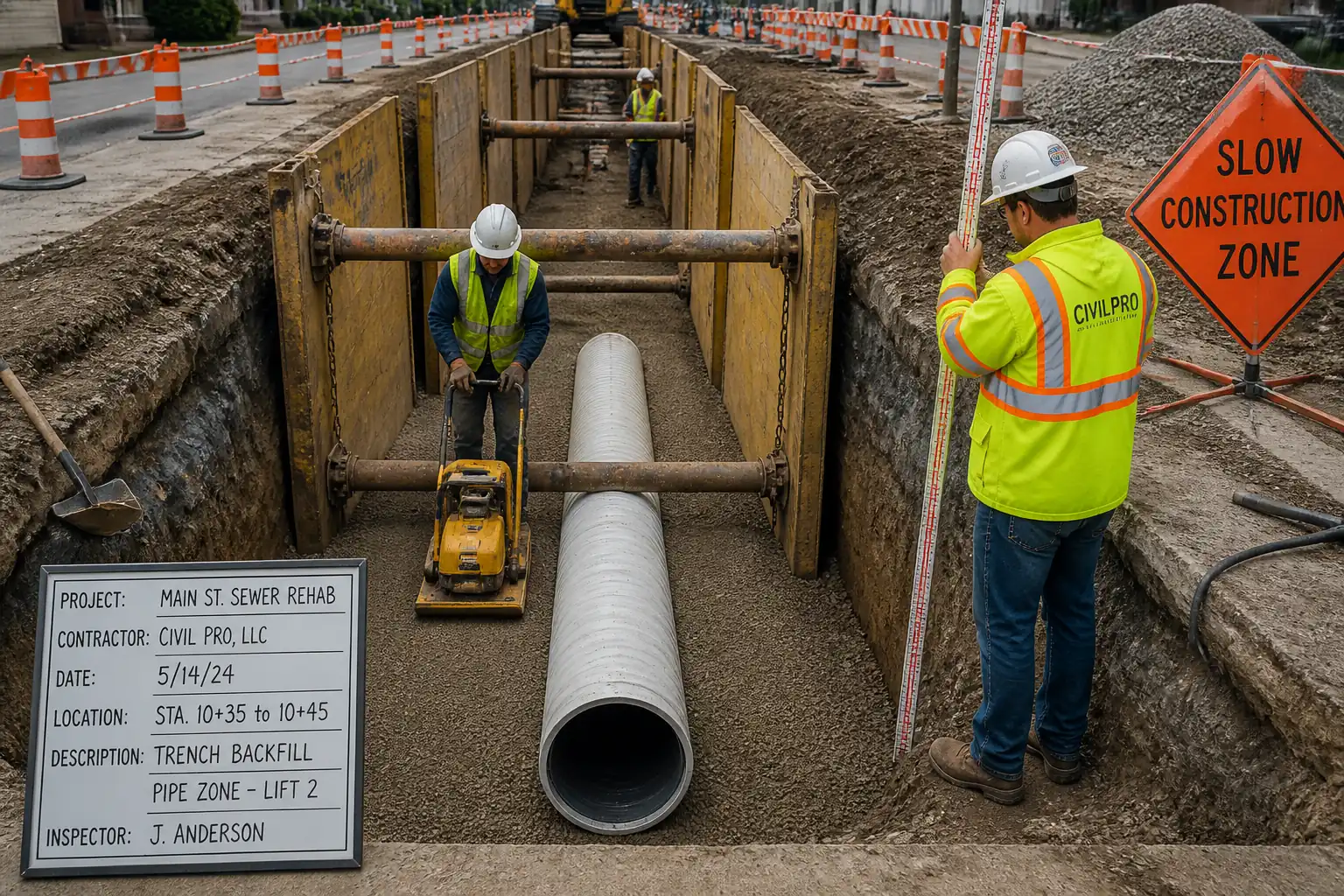
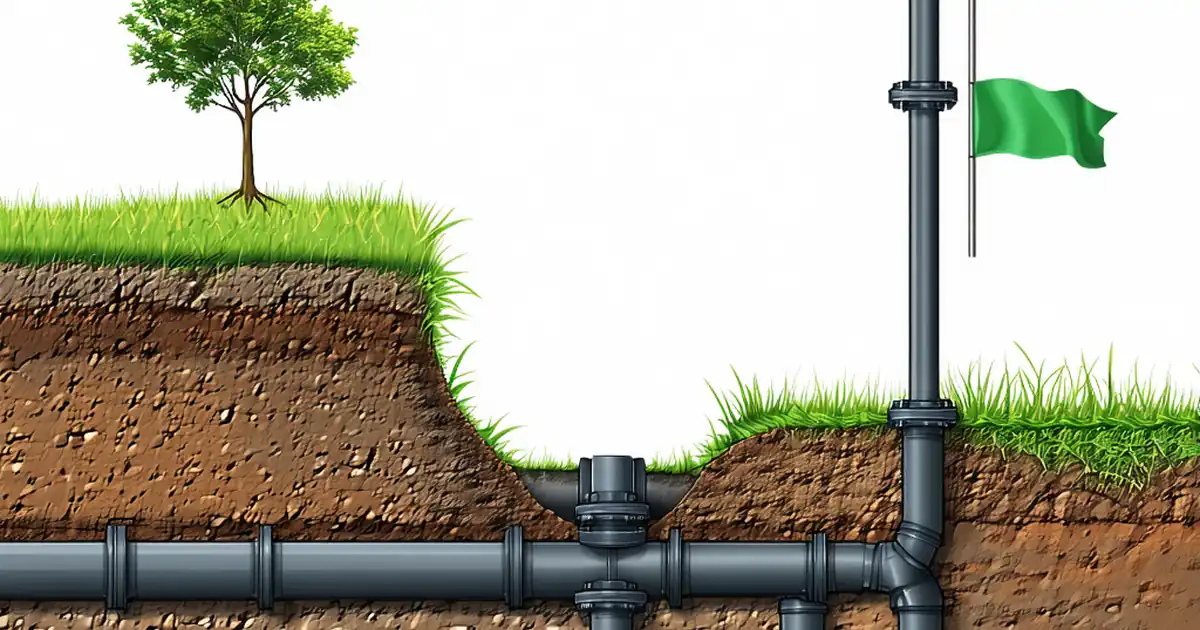
This method statement covers supply, placement, and compaction of structural backfill to stormwater drainage utility trenches, including embedment, initial backfill, and final backfill, with nuclear gauge density testing. It includes protection of installed pipes and appurtenances (chambers, manholes, catch basins), control of layer thickness, moisture conditioning, and reinstatement to formation/subgrade.
Included Activities
- Verification of completed pipe installation, bedding and haunching condition prior to backfilling.
- Selection, delivery, and approval of structural fill materials.
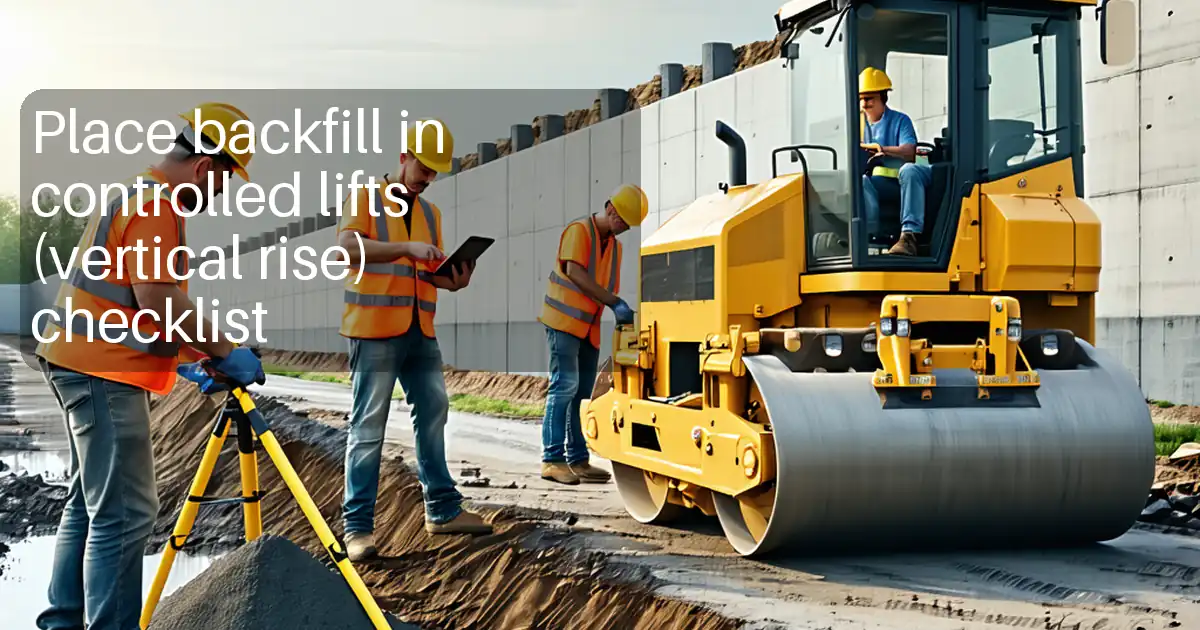
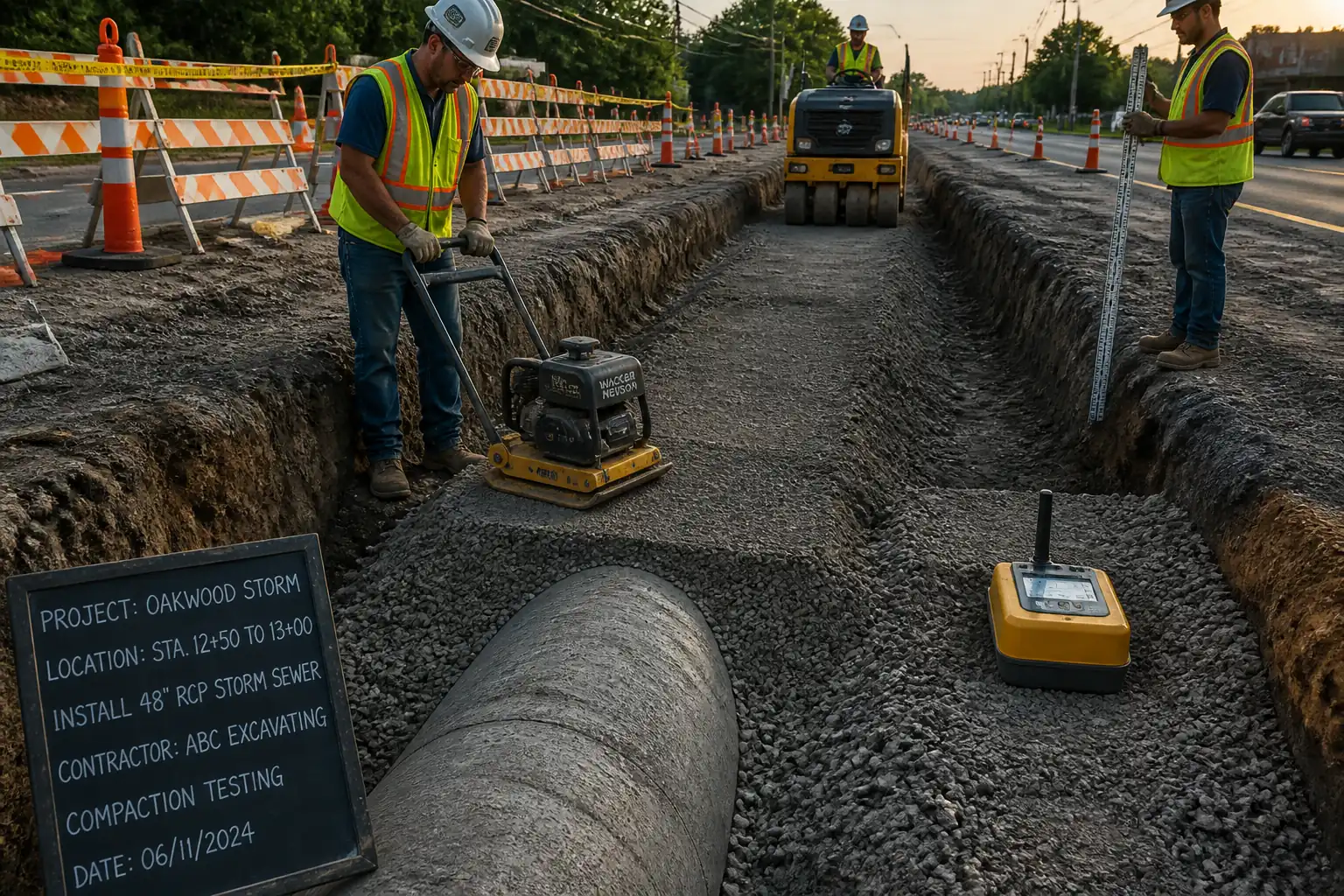
- Backfilling in controlled lifts with appropriate compaction equipment (vibratory plate, rammer, trench roller) based on soil type and lift thickness.
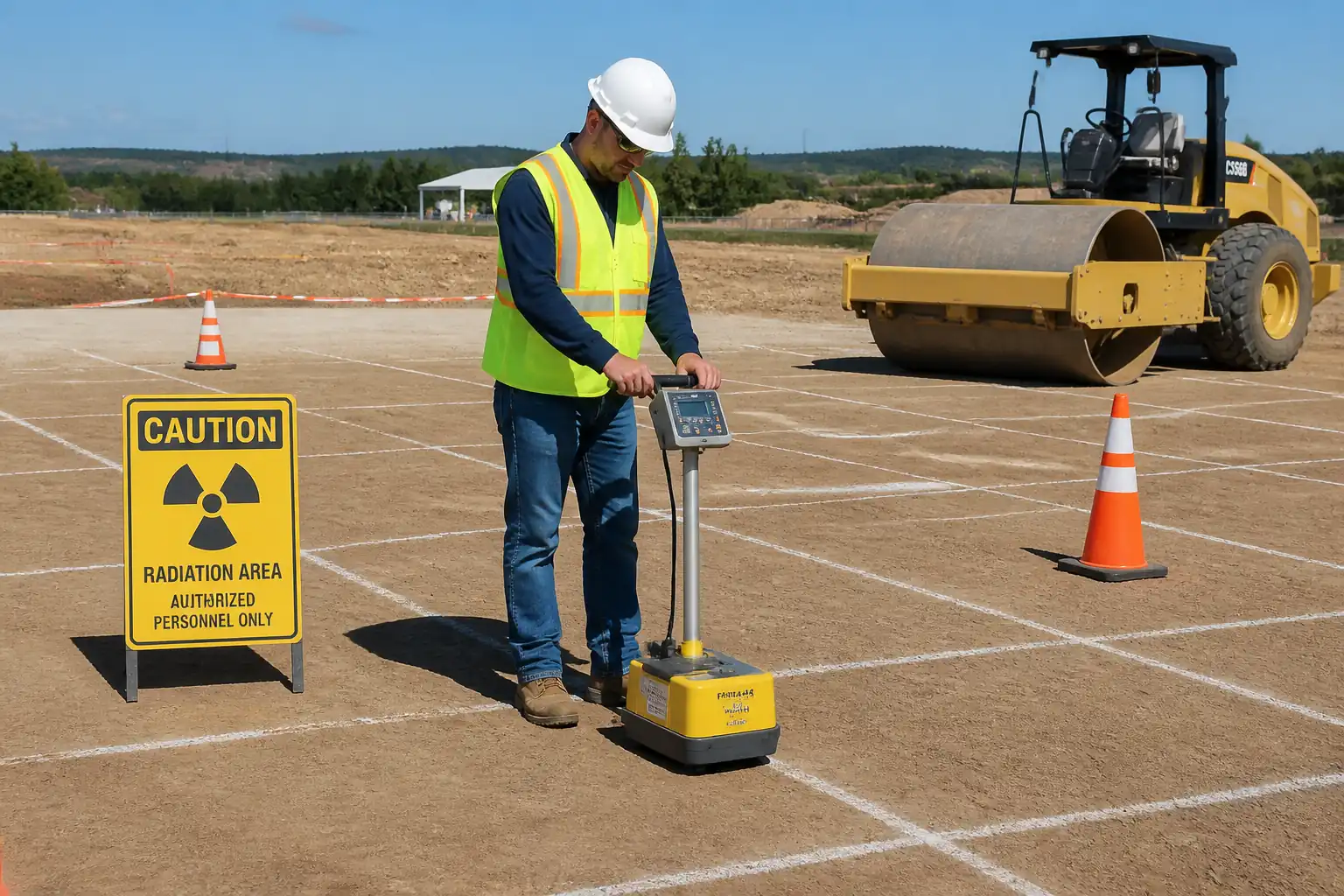
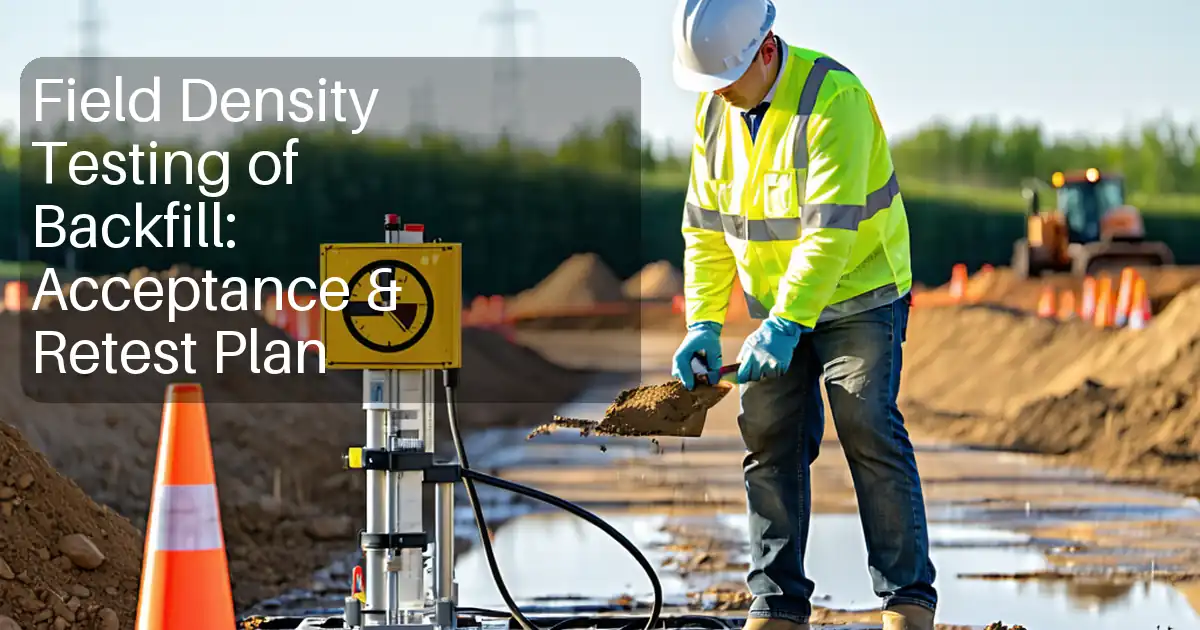
- In-situ density/moisture testing with a nuclear gauge and/or alternative methods where geometry restricts use.
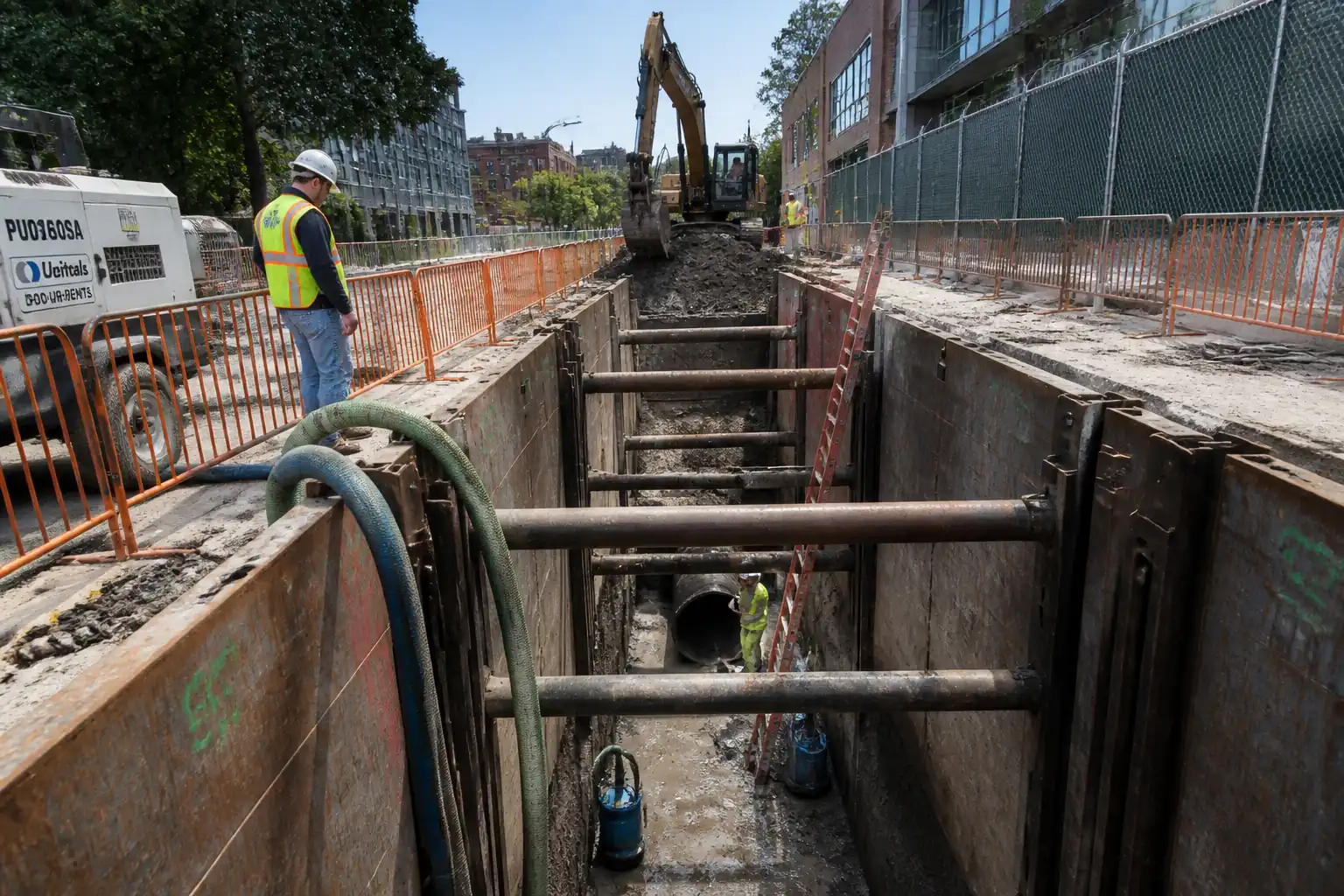
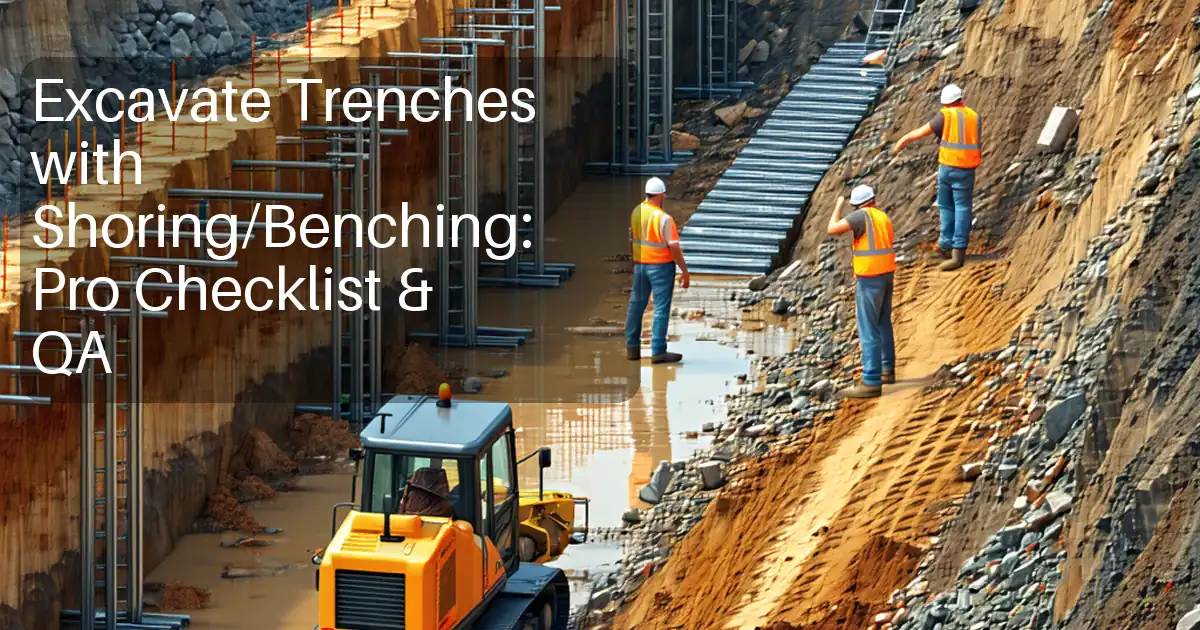
- Progressive removal of trench support/shoring in coordination with backfill lifts.
- Protection of pipes from damage and displacement during compaction.
- Temporary surface protection and formation tolerance checks.
Exclusions
- Pipe installation, pressure/leak testing, or CCTV of pipelines (unless stated elsewhere).
- Permanent pavement reinstatement beyond formation/subgrade [Verify per project scope].
- Dewatering design beyond local sump control [Refer to project dewatering plan].
References
| Document Type | Reference / Number | Revision | Notes |
|---|---|---|---|
| ASTM D2487 / D2488 | |||
| ASTM D698 (Standard Proctor) / ASTM D1557 (Modified Proctor) [Verify per project] | Use D1557 for structural backfill under pavements/structures unless specified otherwise. | ||
| ASTM D6938 | Gauge daily standardization and valid calibration certificates required. | ||
| ASTM D1556 | Use when trench width or proximity to walls causes edge effects for nuclear gauge. | ||
| ASTM D2216 / ASTM D4944 | |||
| ASTM C136 / ASTM D6913 | |||
| ASTM D4595, D4632, D4751, D4491 [Verify per design] | |||
| Pipe manufacturer installation manual (e.g., AASHTO M294 for HDPE, ASTM C76 for RCP) [Verify] | Follow pipe-specific embedment and backfill requirements. | ||
| BS 6031 / BS EN 16907 (Earthworks) [Informative] | |||
| ISO 45001; IAEA/Local radiation regulations for nuclear gauge; Temporary Works Code (e.g., BS 5975) [Verify] |
Responsibilities
| Role | Responsibility | Name / Party |
|---|---|---|
| Project Manager | Project Manager | Contractor |
| Site Engineer | Construction Manager / Site Engineer | Contractor |
| Surveyor | Land Surveyor | Contractor |
| QA/QC Engineer | QA/QC Engineer | Contractor |
| HSE | HSE Manager / Officer | Contractor |
| Lab Technician | Materials Technician / Authorized Nuclear Gauge Operator | Contractor/Lab |
| Foreman/Operator | Foreman & Plant Operators | Contractor |
| Engineer | Engineer/Employer’s Representative | Engineer |
Resources
| Resource Type | Description | Quantity | Remarks |
|---|---|---|---|
| Manpower | Foreman, 2 operators, 4 laborers, 1 QA/QC tech, 1 HSE officer (shared). | 8 (typical) | |
| Manpower | 1 Nuclear gauge operator (authorized) + 1 assistant. | 2 |
Materials
| Material | Specification / Grade | Quantity | Remarks |
|---|---|---|---|
| GW, GP, SW, SP or SM/SC with low PI (ASTM D2487) | ASTM C136/D6913 gradation; project spec | ||
| CL/ML (ASTM D2487) | Project specification [Verify] | ||
| ASTM D2321 Class I/II for flexible pipes [Verify] | Per pipe manufacturer/AASHTO/ASTM | ||
| Nonwoven PP/PET | ASTM D4751, D4491, D4632 | ||
| Detectable or non-detectable tape | Project requirement [Verify] |
Equipment
| Equipment | Capacity / Type | Quantity | Inspection Required |
|---|---|---|---|
| Vibratory plate compactor | 15–25 kN | Yes | |
| Vibratory rammer | 50–70 J | Yes | |
| Remote-controlled trench roller | 1.5–3.0 t | Yes | |
| Nuclear gauge | Yes (Radiation permit) | ||
| Water bowser/sprayers | 3–5 m³ | Yes | |
| Digital level/total station | Yes | ||
| Excavator 10–20 t | Yes |
Prerequisites
Approvals and Submittals
- Material approvals: structural backfill gradations, Proctor curves (ASTM D698/D1557), geotextile datasheets.
- Calibration and authorization: nuclear gauge calibration certificate (≤12 months), daily standardization log, radiation license/permits, operator authorization.
- ITP approval with defined hold/witness points and test frequencies.
- Temporary works and shoring permits, excavation/radiation permits [Verify per project HSE plan and local regulations].
Pre-Start Inspections
- Confirm pipe installation accepted by Engineer (alignment, level, jointing) and bedding/haunch conform to manufacturer/specification.
- Verify trench is dry, stable, and free of debris or frozen material. Dewater as needed; discharge under environmental permit.
- Check minimum safe cover requirements and compaction energy limits from pipe manufacturer.
- Confirm utilities coordination and protection of any crossing/adjacent services.
Stakeholder Notifications
- Traffic/operations interface agreed, barricading and access maintained.
- Inspection request (IR) submitted for initial backfill commencement.
Training & Briefings
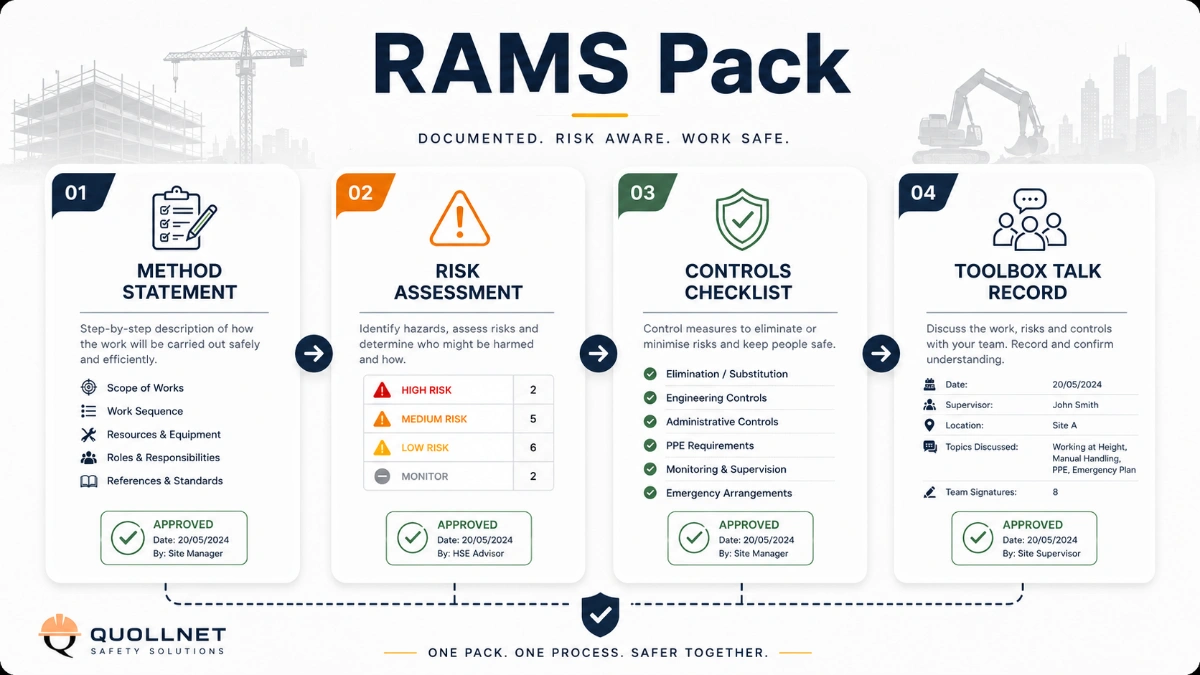
- Toolbox talk on trench backfilling hazards, plant–people interface, and radiation safety for the day’s crew.
- Competency verification for plant operators and nuclear gauge operator.
Method Sequence
| Step | Activity | Description | Responsibility | Inspection / Hold Point |
|---|---|---|---|---|
| 1 | Setout and verification | Survey trench extents, formation, and check pipe invert and line vs. design. Mark test locations per ITP. | Surveyor / Site Engineer | Pre-works check |
| 2 | Prepare trench and pipe protection | Ensure haunching to springline is complete and compacted as specified. Install protective sand cushion if required. Cover pipe crown to min 150–300 mm with approved embedment before any mechanical compaction above [Verify per pipe manufacturer]. | Foreman / Site Engineer | Hold point before initial backfill |
| 3 | Place sidefill/initial backfill (around pipe) | Place approved material in thin lifts on both sides of pipe simultaneously. Compact with hand tamper or light rammer, avoiding direct impact on pipe. Progress evenly to 300 mm above crown. | Foreman | Witness |
| 4 | Progressive shoring removal | Withdraw trench supports progressively as backfilling rises, ensuring trench stability. Backfill immediately against exposed trench walls. | Foreman / Temporary Works Supervisor | Supervision |
| 5 | Main trench backfill placement | Place structural backfill in controlled lifts. Moisture condition to OMC ±2% [Verify]. Select equipment by soil type and trench width. | Foreman / QA/QC | Ongoing |
| 6 | Compaction of lifts | Compact each lift before next placement. Use: (a) Granular: vibratory plate; (b) Cohesive: rammer or padfoot roller (if width allows). | Plant Operator / Foreman | QA/QC witness |
| 7 | Nuclear gauge testing | Perform density/moisture tests at specified frequency. Use direct transmission where feasible. Avoid edge effects by maintaining ≥300 mm clearance from trench wall; otherwise use backscatter/thin-lift corrections or sand cone. | Materials Technician | Witness by QA/QC |
| 8 | Warning tape installation | Install marker tape at specified depth uniformly along trench alignment. | Foreman | Engineer witness (as required) |
| 9 | Top formation trimming | Trim to formation or subgrade level with tolerance. Protect surface from traffic until final reinstatement. | Foreman / Surveyor | QA/QC check |
| 10 | Post-backfill monitoring (if required) | Observe for settlement prior to permanent surfacing. | Site Engineer | Periodic |
Safety Controls
Key Task-Specific Hazards and Controls
- Hazard: Collapse of trench walls during backfilling and shoring removal.
- Likely consequence: Crush injuries/fatality.
- Engineering/procedural control: Follow approved Temporary Works design and sequence for progressive shoring removal; maintain safe stand-off zones; backfill immediately against exposed soil; no personnel in unsupported trench >1.2 m.
- Required PPE: Helmet with chin strap, safety boots, gloves, eye protection.
- Collective preventive measure: Trench edge barriers and exclusion zones; trench boxes/shoring left in place until backfill reaches safe level.
-
Inspection/permit/supervision: Temporary works inspection by TWS each shift; Excavation permit to work; Supervisor present.
-
Hazard: Plant–person interface (excavator, plate compactor, trench roller).
- Likely consequence: Struck-by/crush injuries.
- Engineering/procedural control: Segregated walkways; banksman for all reversing; two-way radios; exclusion arc around plant; spotlights/beacons.
- Required PPE: Hi-vis, helmet, boots; hearing protection near compactors.
- Collective preventive measure: Physical barriers and signage; tagged plant only.
-
Inspection/permit/supervision: Daily plant checks; operator certification; lifting permits where applicable.
-
Hazard: Damage to installed pipes/appurtenances by compaction energy.
- Likely consequence: Pipe deformation/leaks; rework.
- Engineering/procedural control: Respect minimum cover before using vibratory equipment; hand tamp near pipe; symmetrical sidefill placement to prevent float/shift.
- Required PPE: Task-standard PPE.
- Collective preventive measure: Method statement briefings; manufacturer limits posted at workface.
-
Inspection/permit/supervision: QA/QC verification before switching equipment; Engineer witness at initial backfill hold point.
-
Hazard: Underground service strikes at crossings.
- Likely consequence: Electrocution, flooding, service outage.
- Engineering/procedural control: Updated utility plans; potholing and marking; safe dig zones; no vibrating equipment within exclusion distances of live services [Verify].
- Required PPE: Dielectric gloves as required, insulated tools for handwork.
- Collective preventive measure: Permit-to-dig; CAT/Genny scans where applicable.
-
Inspection/permit/supervision: Utility owner clearances; Supervisor sign-off.
-
Hazard: Radiation exposure from nuclear gauge.
- Likely consequence: Radiation dose/contamination.
- Engineering/procedural control: Authorized operator only; time–distance–shielding principles; controlled area during readings; transport in approved case; source lock checks.
- Required PPE: Dosimeter, standard PPE.
- Collective preventive measure: Radiation safety plan; inventory and leak test records.
-
Inspection/permit/supervision: Radiation license/permit; daily standardization log; RSO oversight; [Verify per project HSE plan and local regulations].
-
Hazard: Manual handling of compactors/plates.
- Likely consequence: Musculoskeletal injuries.
- Engineering/procedural control: Mechanical aids/lifts; team handling; weight limits respected; training.
- Required PPE: Gloves, boots.
- Collective preventive measure: Use winches/ramps for lowering equipment.
-
Inspection/permit/supervision: Supervisor to approve lift plans for >25 kg.
-
Hazard: Noise and vibration.
- Likely consequence: Hearing loss; nuisance; effect on adjacent structures.
- Engineering/procedural control: Working-hour limits; low-vibration settings; vibration monitoring near sensitive assets if specified.
- Required PPE: Hearing protection (SNR matched to equipment levels).
- Collective preventive measure: Acoustic barriers where practicable.
-
Inspection/permit/supervision: Noise/vibration logs; complaints register.
-
Hazard: Slips/trips at trench edges and uneven backfill.
- Likely consequence: Sprains/falls.
- Engineering/procedural control: Good housekeeping; maintain access; immediate trimming/compaction of lifts.
- Required PPE: Boots with good tread.
- Collective preventive measure: Edge protection; lighting for night/low light.
- Inspection/permit/supervision: Daily HSE inspection.
Environmental Controls
Controls
- Runoff and sediment control
- Risk: Silty water discharge from dewatering or rainfall; siltation of drains.
- Control: Silt bags/bunds on discharge; settlement tank if needed; no direct discharge to watercourses without permit.
-
Inspection: Daily check of BMPs before/after rain; permits verified.
-
Dust generation from dry fill and traffic
- Control: Light water spray to maintain moisture; cover stockpiles; speed limits.
-
Inspection: Visual dust checks; water bowser log.
-
Noise/vibration to receptors
- Control: Limit hours; select quieter equipment; maintain equipment; position plant away from sensitive receptors.
-
Inspection: Spot measurements if required; complaint tracking.
-
Material sourcing and waste
- Control: Use approved quarries; segregate and dispose of unsuitable excavated material at licensed facilities; reuse compliant excavated fill where allowed.
-
Inspection: Delivery tickets; waste transfer notes.
-
Fuel/chemical spills
- Control: Refuel in designated bunded area; spill kits at workface; drip trays under parked plant.
-
Inspection: Daily plant checks; spill log.
-
Protection of existing drainage
- Control: Temporary caps on open pipes; prevent ingress of fines; remove temporary plugs after works.
-
Inspection: Pre- and post-works CCTV/visual confirmation if specified.
-
Ecology/heritage constraints [Project-specific]
- Control: Follow permits, buffer zones; stop-work if finds occur.
- Inspection: Environmental officer oversight.
[Verify per project environmental management plan and local regulations].
QA/QC
Key Acceptance Criteria
- Materials
- Structural backfill conforms to approved gradation, plasticity, and cleanliness. No frozen, organic, or deleterious material.
-
Proctor curve available and current for each source (ASTM D698 or D1557 as specified).
-
Placement and Compaction
- Lift thickness: 100–150 mm loose in embedment/initial backfill; 150–200 mm loose for main backfill [Verify per specification].
- Moisture: Target at OMC ±2% (granular) and OMC −1%/+3% (cohesive) [Verify].
- Density: ≥95% MDD (ASTM D1557) beneath pavements/structures; ≥90–92% MDD in verges/landscaped areas [Verify per project].
-
Surface tolerances: Formation level ±10 mm; crossfall within 0.5%; line within ±50 mm horizontally [Verify].
-
Testing Frequency (typical)
- Field density: Minimum 1 test per 30 m length per lift for trenches ≤1.2 m wide; 1 per 50 m per lift for 1.2–3.0 m wide; min 3 tests per lift per day; additional test each side of manholes/structures per lift [Verify].
-
Moisture checks: At least every second lift or when material source/appearance changes.
-
Testing Methodology
- Nuclear gauge per ASTM D6938; use direct transmission when lift thickness permits (≥100 mm). Maintain ≥300 mm from trench walls to avoid edge effects; otherwise apply corrections or use sand cone (ASTM D1556).
-
Record test location chainage, offset, lift number, material type, moisture, %MDD, and retest outcomes.
-
Nonconformance and Rectification
- If density fails: Recondition moisture, re-compact, or reduce lift thickness; re-test. Persistent failures trigger change of equipment or material replacement.
-
Record NCRs and corrective actions; obtain Engineer approval before progressing.
-
Documentation
- ITP checklists, IR approvals, material submittals, daily reports, calibration certificates, radiation permits, and as-built survey of formation and warning tape depth (spot checks).
Attachments
Attachments / Records
- Approved drawings and trench details (sections of embedment, initial and final backfill).
- Material approvals: structural backfill gradations, Proctor curves, geotextile datasheets.
- Nuclear gauge calibration certificate, daily standardization logs, radiation license/permit, operator authorization.
- ITP checklists, Inspection Requests (IRs), test reports (ASTM D6938/D1556/D2216).
- Temporary works design and inspection records for shoring.
- Daily site diary, toolbox talk attendance, plant inspection checklists.
- As-built survey records (formation levels, warning tape spot depths).
- NCRs, CARs, and close-out documentation.
- Environmental permits and dewatering discharge logs.
This content is a read-only public reference. Download or customize to get an editable version.
ITP preview
The first inspection activities from the linked ITP for Method Statement – Backfilling and Compaction of Utility Trenches for Stormwater Drainage:
| Activity | Inspection / Test | Acceptance Criteria | Responsibility | Record |
|---|---|---|---|---|
| Pre-backfill verification of pipe bedding/haunch | Visual check versus manufacturer/specification | Uniform support; no voids; correct material type; to springline complete | Site Engineer / Engineer’s Rep (W) | IR, photos |
| Material approval – structural backfill | Gradation (ASTM C136/D6913), PI, Proctor (D698/D1557) | Meets approved gradation/PI; valid Proctor curve | QA/QC Engineer (H) / Engineer’s Rep (H) | Material submittal approval, lab reports |
| Moisture conditioning | Moisture (ASTM D2216/D4944) | Within OMC control band [Verify] | Foreman / QA/QC | Moisture logs |
Showing 3 of 7 inspection activities. View full ITP →
Related Inspection and Test Plan
An Inspection and Test Plan (ITP) is available for Method Statement – Backfilling and Compaction of Utility Trenches for Stormwater Drainage. The ITP defines the inspection activities, acceptance criteria, hold and witness points, responsible parties, and records required to verify the work described in this method statement.
View the Method Statement – Backfilling and Compaction of Utility Trenches for Stormwater Drainage ITP →Frequently asked questions
Continue with related Quollnet resources connected to this method statement.