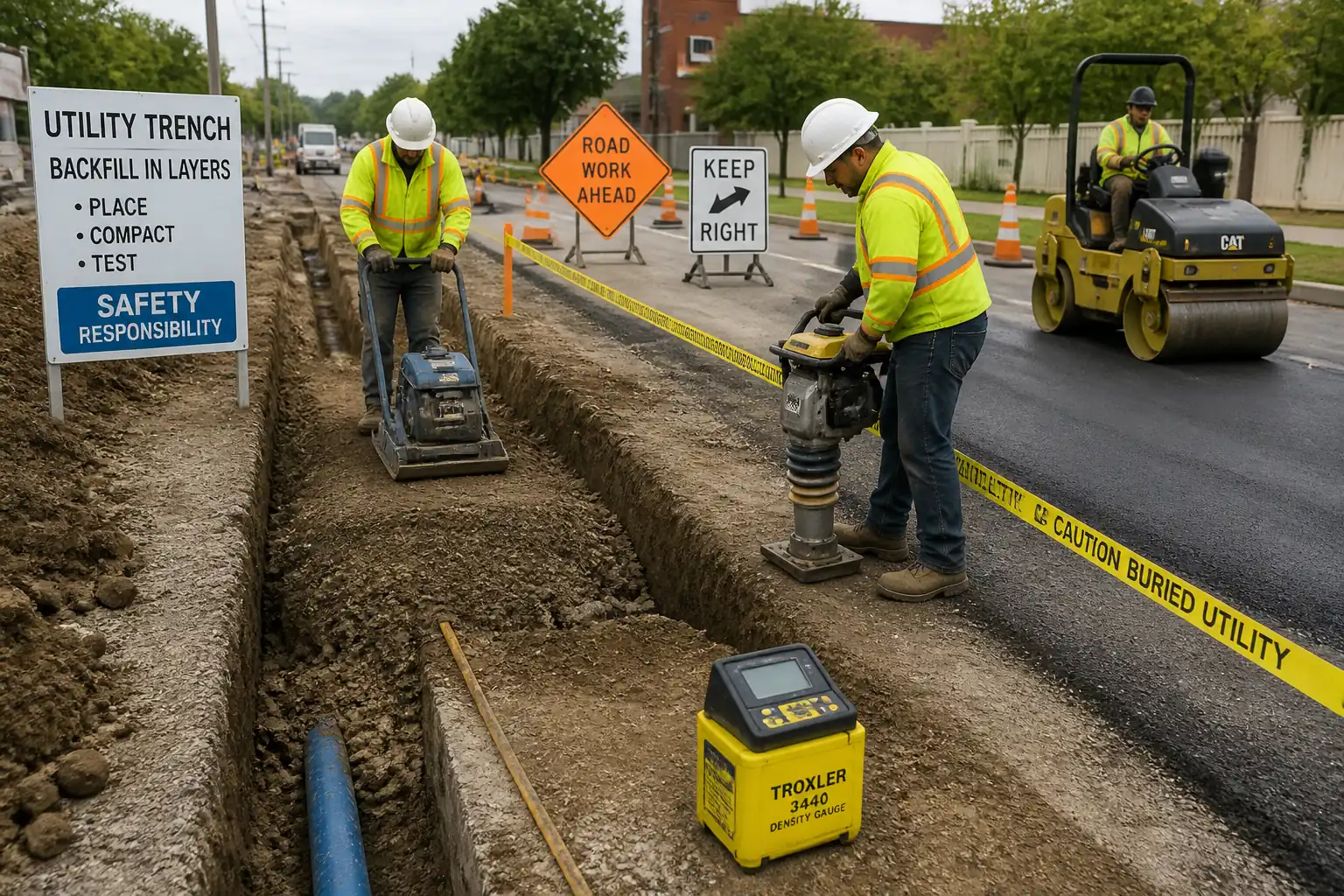

Inspection and Test Plan for Method Statement: Backfilling and Compaction of Utility Trenches and Pavement Reinstatement
AI-assisted inspection and test plan connected to a method statement, with PDF and Excel export.
More than a static template
Unlike a downloadable Word or PDF template, this ITP is an AI-assisted editable starting point directly connected to its method statement. Every inspection activity, hold point, and acceptance criterion is structured and ready to adapt to your project.
- AI-assisted customization — Tailor inspection activities and acceptance criteria to your specific project scope.
- Linked method statement — This ITP is connected to the corresponding method statement describing the work sequence.
- Multiple export formats — Download as a formatted PDF or editable Excel spreadsheet.
- Editable starting point, not a final document — Review and verify all content against your project specifications and standards before use.
What you can customize
When you save this ITP to your account, every inspection row becomes editable. You can add, remove, or modify:
- Inspection activity — Description of what is being inspected.
- Inspection type — Hold point (H), Witness point (W), Review (R), or Monitor (M).
- Responsibility — Contractor, subcontractor, engineer, or client.
- Frequency — How often the inspection occurs.
- Acceptance criteria — Referenced standard or specification requirement.
- Records — Forms, test reports, or checklists required as evidence.
Why this ITP is used
To control quality and verify that trench backfilling and pavement reinstatement meet specified compaction, material, and level requirements.
Who uses this inspection and test plan
Site engineers, QA/QC staff, materials technicians, and the Engineer/Client Representative.
When this ITP is prepared and submitted
From pre-works permits through each lift of backfill to final pavement reinstatement and before reopening to traffic.
Who receives or approves this ITP
Engineer/Client Representative
Inspection scope
Permits, temporary works, materials approval, bedding verification, layer thickness and moisture, in-situ density, asphalt temperatures and density, surface level and finish.
Typical hold, witness, and review points
Hold: bedding verification, sub-base acceptance, final surface acceptance. Witness: in-situ density per lift, asphalt placement.
Typical inspection records
ITP checklists, density/moisture reports, material COCs, delivery tickets, temperature logs, survey records, photos, handover certificate.
Important approval note
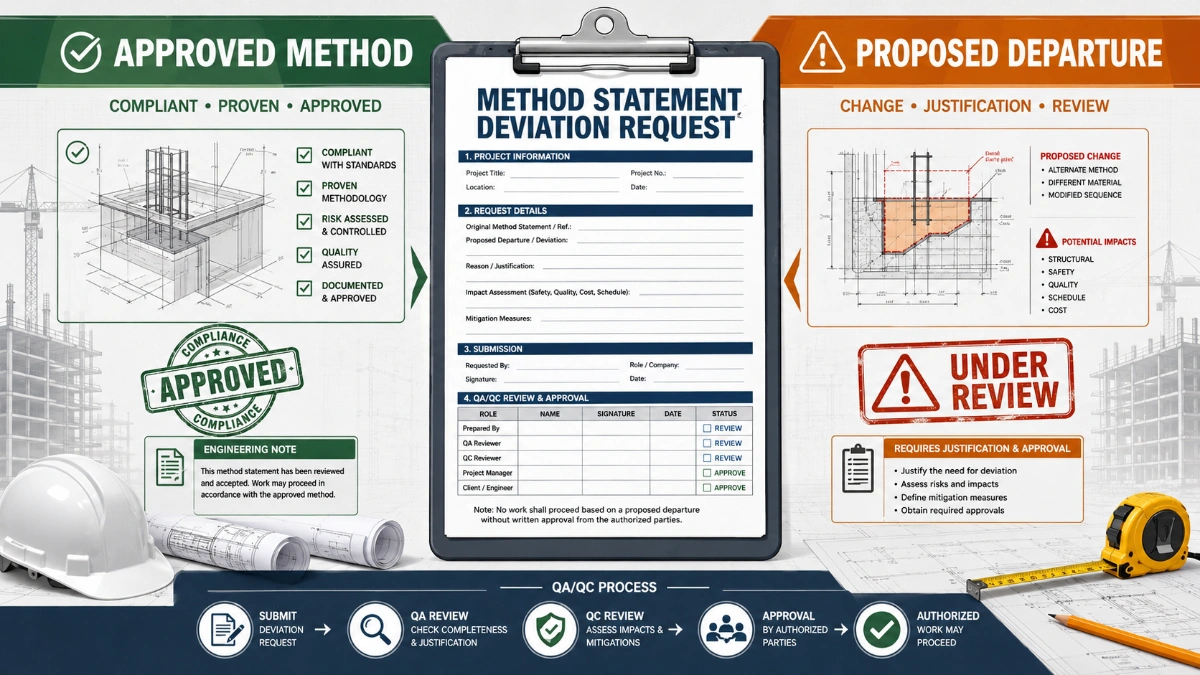
This ITP is an AI-assisted editable starting point, not a pre-approved document. Before use on any project, all inspection activities, hold points, and acceptance criteria must be reviewed and approved by the relevant parties (superintendent, principal contractor, or client representative) in accordance with your contract and project quality plan.
Always verify acceptance criteria against your applicable drawings, specifications, and regulatory requirements. Hold points must be confirmed with the relevant authority before work proceeds past that point.
Inspection and test plan
| Activity | Inspection / Test | Acceptance Criteria | Responsibility | Record |
|---|---|---|---|---|
| Permit-to-dig and utility locating | Permit approved; services marked and trial holed; exclusion zones established | Site Engineer / HSE | Permit-to-dig; utility survey/trial hole records | |
| Trench support installation | Support per TWD; no signs of distress; access/egress provided | TWC / Site Supervisor | TWC inspection log; photos | |
| Material approval—granular backfill and sub-base | Gradation/PI as required | Matches approved submittal; clean, non-plastic within limits [Verify] | QA/QC Engineer | COC; test reports |
| Bedding/utility protection verification | Bedding thickness and cover above utility per utility standard [Verify] | Site Engineer | IR; photos | |
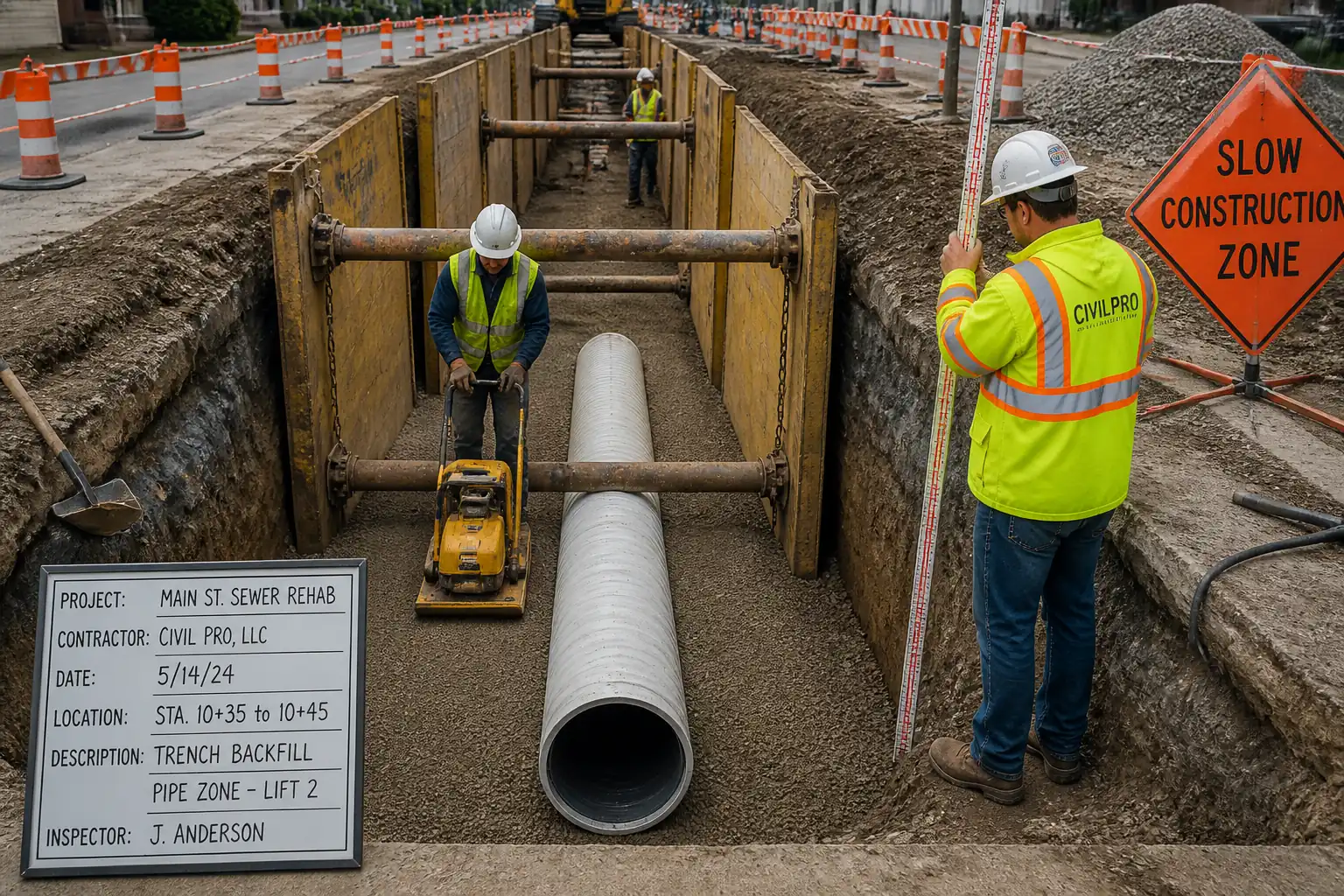
| Backfill placement—lift thickness and moisture | Moisture (ASTM D2216 or gauge) | Lift thickness within ±10 mm; moisture within OMC ±2% [Verify] | Site Engineer / QC | Daily QA sheet |
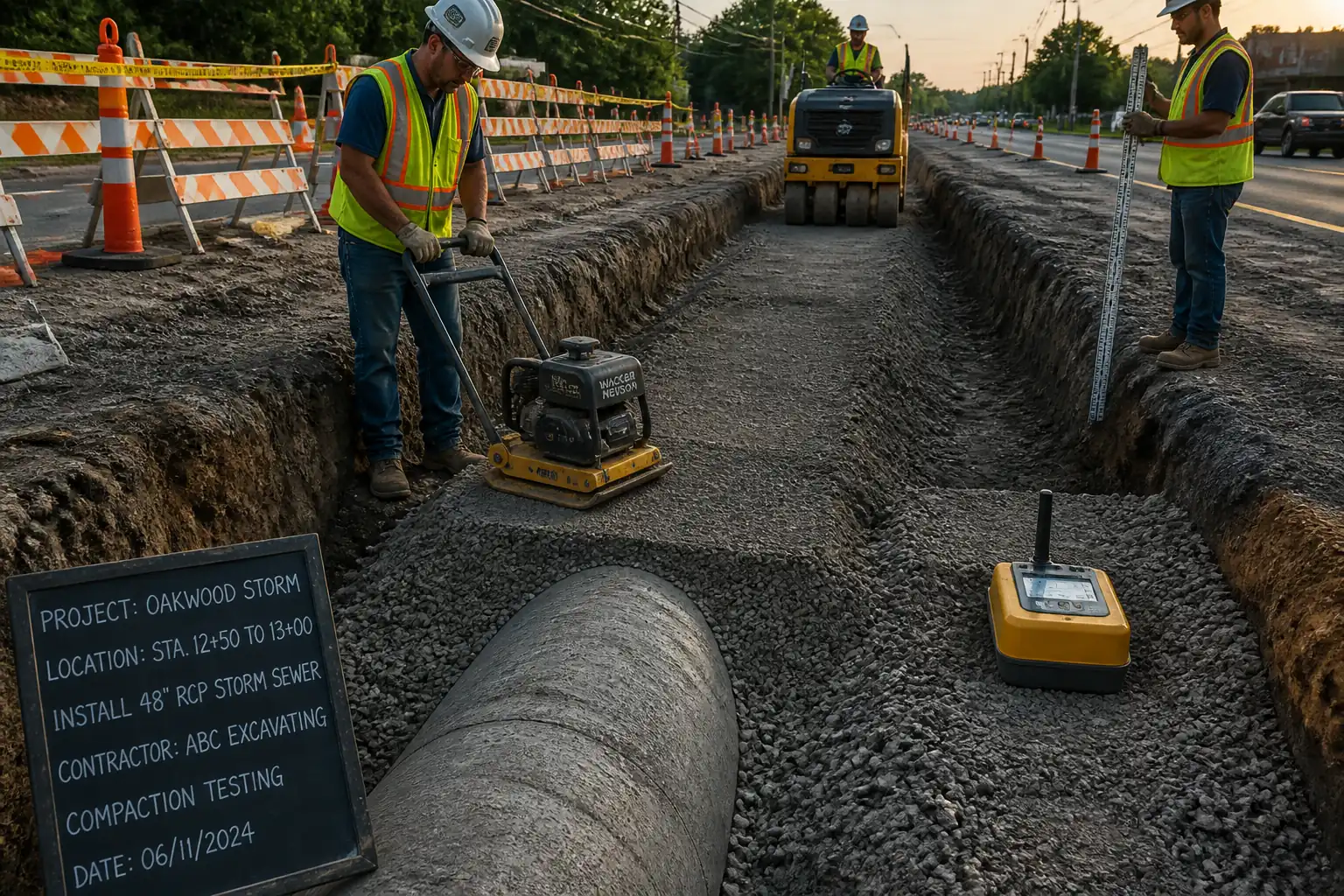
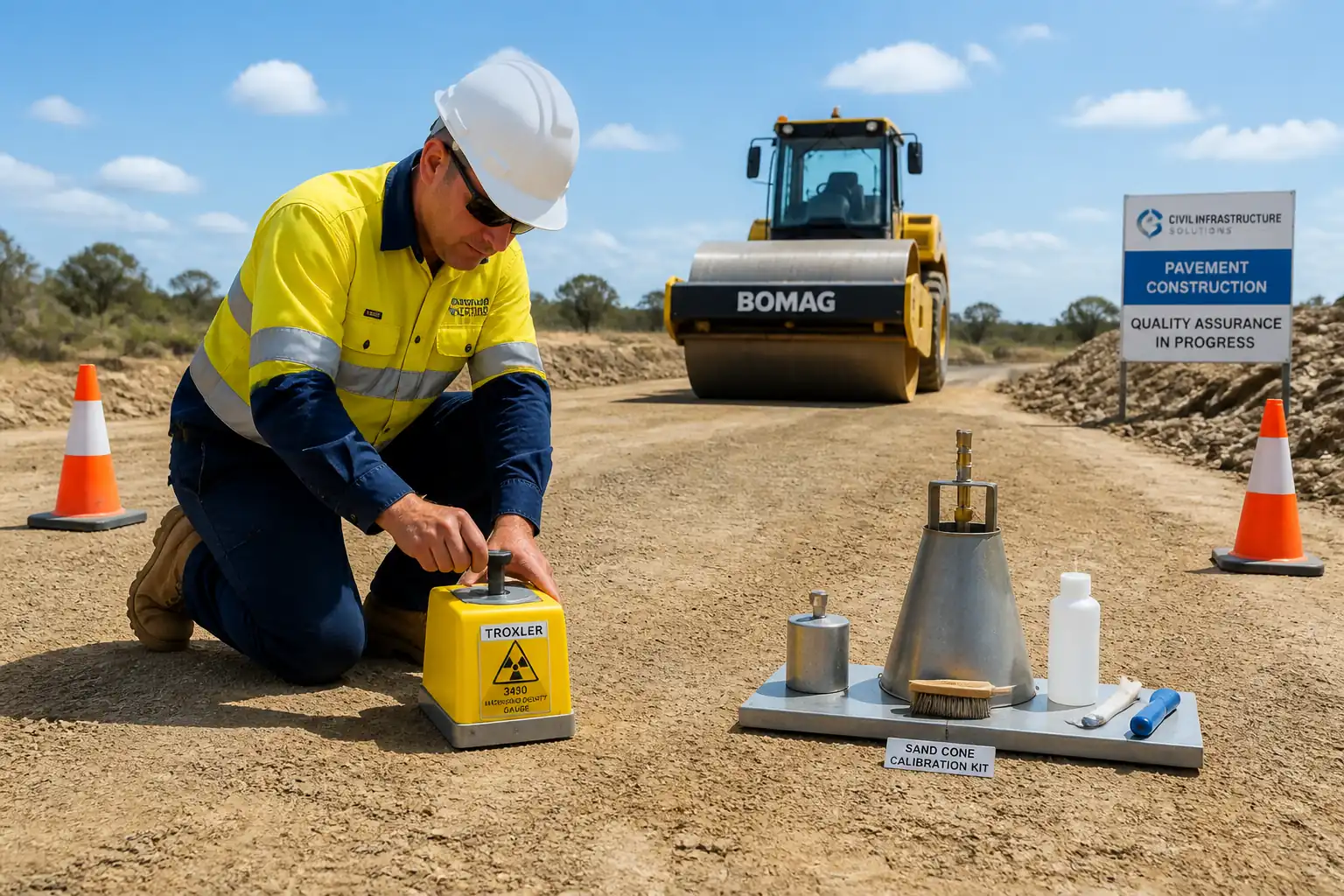
| In-situ density per lift (trenches ≤1.5 m wide) | ASTM D6938 or ASTM D1556 | ≥98% MDD under pavements; ≥95% MDD verges/footways [Verify] | Lab Technician / QC | Field density report; gauge standardization log |
| In-situ density per lift (areas >1.5 m wide) | ASTM D6938 or ASTM D1556 | As above | Lab Technician / QC | Field density report |
| Warning tape installation | Placed 300 mm above utility, correct color/legend [Verify] | Site Supervisor | Checklist; photos | |
| Sub-base reinstatement | In-situ density | ≥98% MDD; level ±10 mm; thickness per existing/spec [Verify] | Site Engineer / Lab | Density reports; IR |
| Asphalt binder course placement | Temp checks; density/voids (cores or approved NDT) | Delivery/laydown temperatures within spec; density per project (e.g., ≥92–97% of Gmm) [Verify]; levels within ±6 mm | Paving Supervisor / QC | Tickets; temp logs; test results |
| Asphalt surface course placement | Density/voids; level/straightedge | Level +0/−10 mm vs. adjacent; joints sealed and tight; texture matches | Paving Supervisor / QC | Test results; IR; photos |
| Final acceptance and reopening to traffic | All prior holds released; documents submitted; surface free of defects | Engineer/Client Rep | Handover/acceptance certificate |
This table is a read-only public reference. Download the PDF or Excel version, or customize this ITP to edit it for your project.
Frequently asked questions
Related method statement
This Inspection and Test Plan is associated with the Method Statement: Backfilling and Compaction of Utility Trenches and Pavement Reinstatement method statement, which describes the step-by-step construction sequence, resources, materials, equipment, safety controls, and environmental controls for this activity.
View the Method Statement: Backfilling and Compaction of Utility Trenches and Pavement Reinstatement method statement →Continue with related inspection, method statement, article, and checklist resources.