
Method Statement: Backfilling and Compaction of Utility Trenches and Pavement Reinstatement – Method Statement
AI-assisted method statement with matching ITP, PDF download, and Excel export.
More than a static template
Unlike a downloadable Word or PDF template, this method statement is an AI-assisted editable starting point connected directly to a matching Inspection and Test Plan. Every section is structured, project-adaptable, and ready to export.
- AI-assisted drafting — Customize every section with AI for your specific project scope.
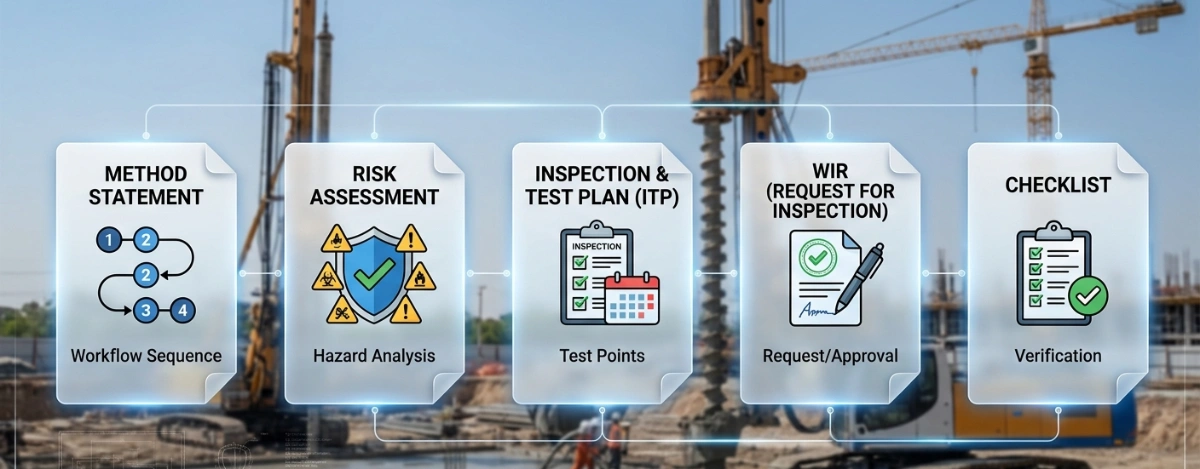
- Linked ITP — A matching inspection and test plan is generated alongside the method statement.
- Multiple export formats — Download as a formatted PDF or editable Excel spreadsheet.
- Editable starting point, not a final document — Review, verify, and adjust all content against your project requirements before use.
Static template vs. Quollnet workflow
| Feature | Static template | Quollnet |
|---|---|---|
| Project-specific content | Manual fill-in required | AI-assisted customization |
| Linked ITP | Separate document, no link | Matching ITP included |
| Export formats | Usually PDF only | PDF and Excel |
| Structured sections | Free-form layout | 13 standardized sections |
| Saved to your account | Local file only | Cloud-saved, reusable |
| Content accuracy | You verify everything | AI-assisted, you still verify |
| Cost | Often free but time-intensive | Free to customize and download |
What you can customize
When you save this method statement to your account, every section becomes editable. The following 13 sections are included:
- Scope — Defines the activity and its boundaries.
- References — Standards, specifications, and drawings.
- Responsibilities — Roles and accountabilities.
- Resources — Labour, plant, and equipment summary.
- Materials — Materials and compliance requirements.
- Equipment — Tools and equipment details.
- Prerequisites — Hold points and pre-conditions.
- Method sequence — Step-by-step construction sequence.
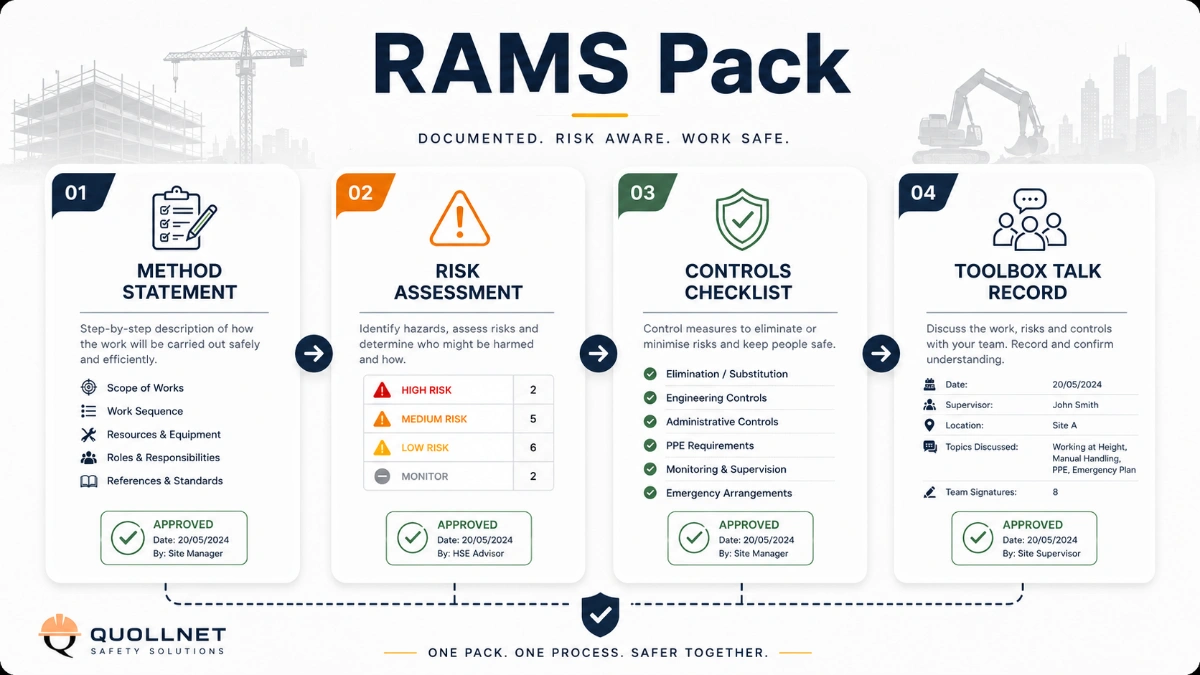
- Safety controls — HSE risk controls and PPE.
- Environmental controls — Environmental mitigation measures.
- QA/QC — Quality inspection and test requirements.
- ITP — Inspection and Test Plan table (has its own page).
- Attachments — Referenced drawings and documentation.
Why this method statement is used
This method statement is used to define and communicate the approved procedure for carrying out method statement: backfilling and compaction of utility trenches and pavement reinstatement on site. It ensures the work is planned in advance, the correct resources and controls are in place, and all personnel understand responsibilities, sequence, quality requirements, and safety controls before work begins. It aligns site execution with the documented scope and acceptance expectations.
Who uses this method statement
This method statement is used by contractors, site supervisors, project engineers, QA/QC engineers, HSE officers, consultants, and client representatives. It serves as a shared reference for planning, execution, supervision, inspection, and approval of the activity on site.
When it is prepared and submitted
The method statement is prepared before the work activity starts and submitted as part of the pre-construction documentation package for review and approval.
Who reviews or approves it
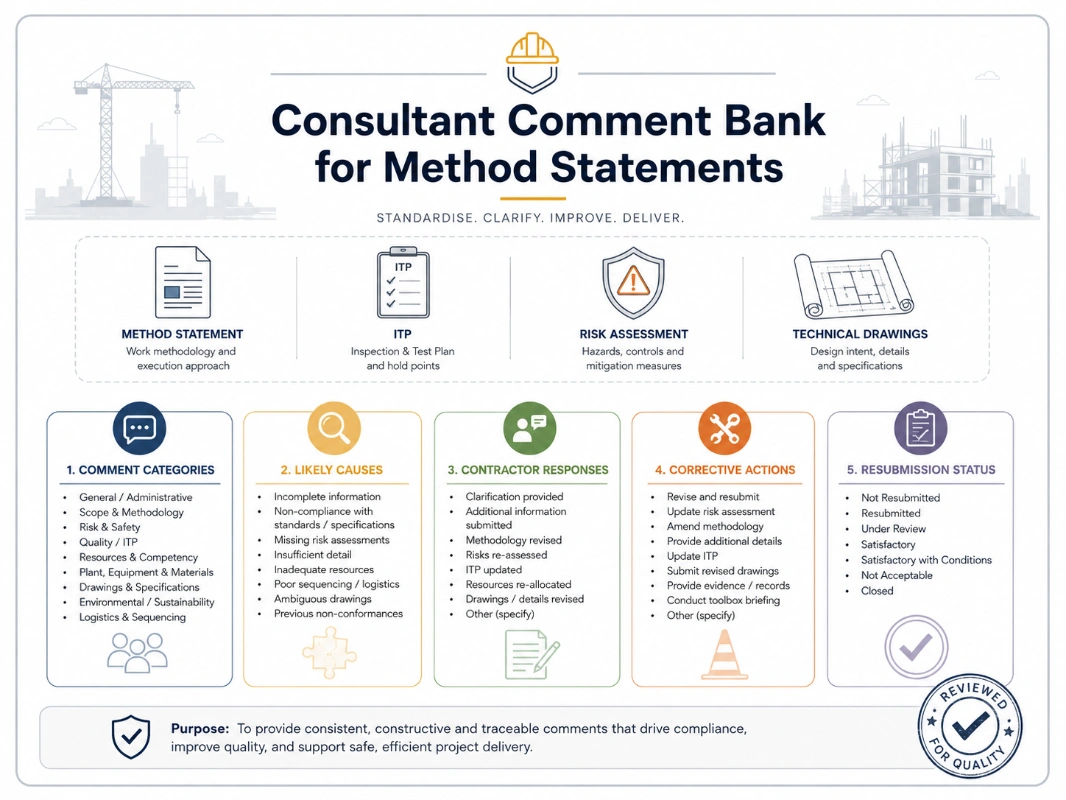
The method statement is usually submitted to the client representative, consultant, resident engineer, or project management consultant for review and approval before the work commences.
Important approval note
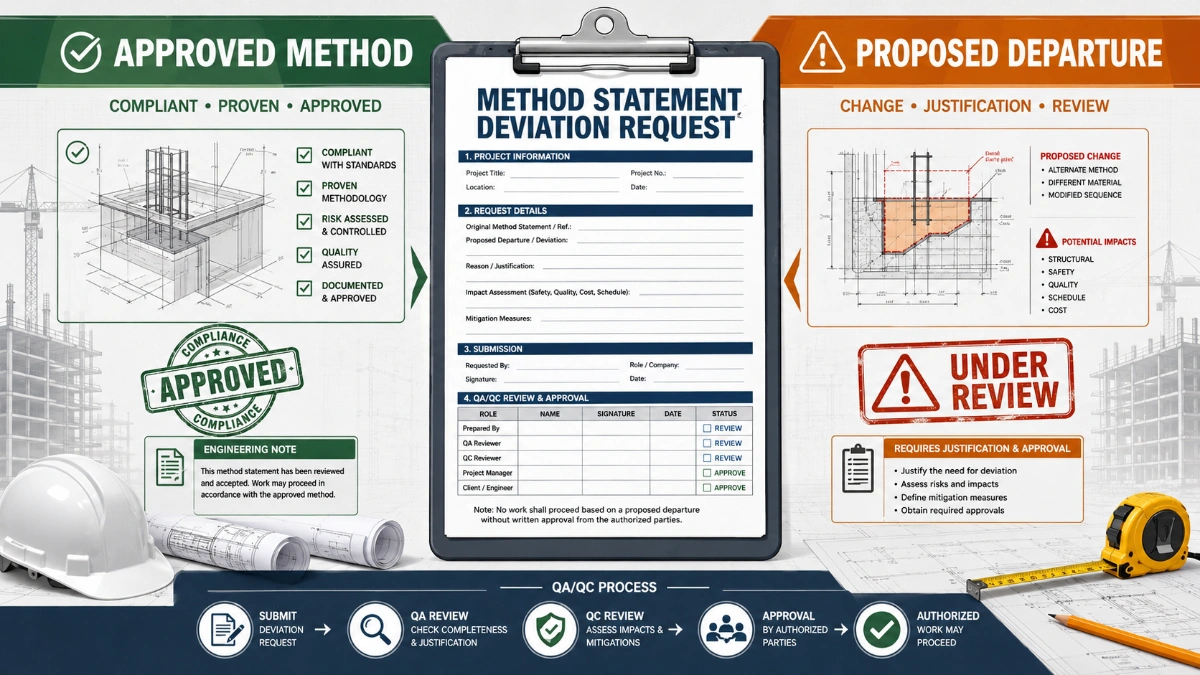
This method statement is an AI-assisted editable starting point, not a pre-approved document. Before use on any project, all content must be reviewed and approved by the relevant parties (superintendent, principal contractor, or client representative) in accordance with your contract and project quality plan.
For example: if your specification requires a departure from a referenced standard, that departure must be documented and approved separately — this method statement will not capture that automatically. Always verify against your applicable drawings, specifications, and regulatory requirements.
Method statement content
Scope
Overview
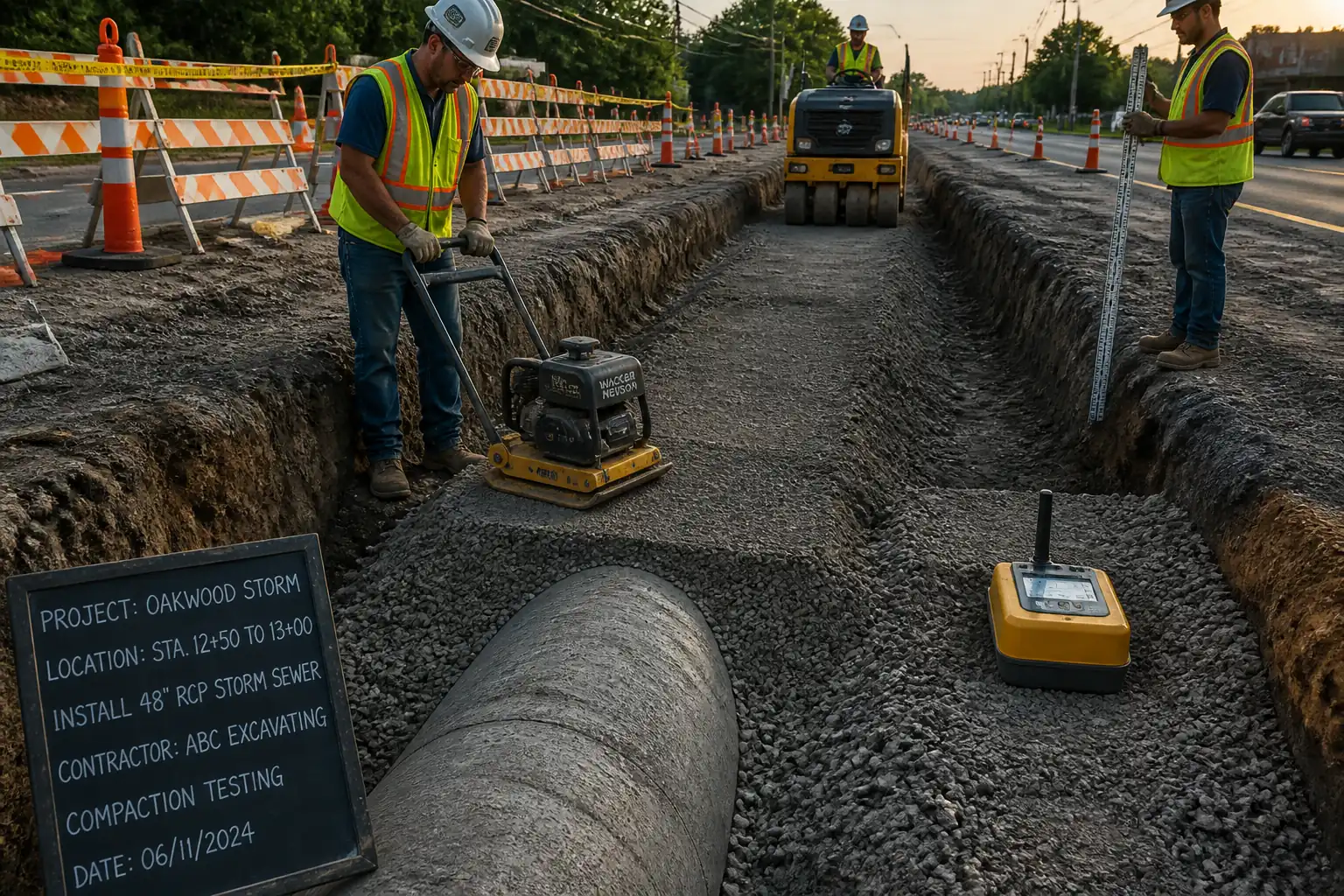
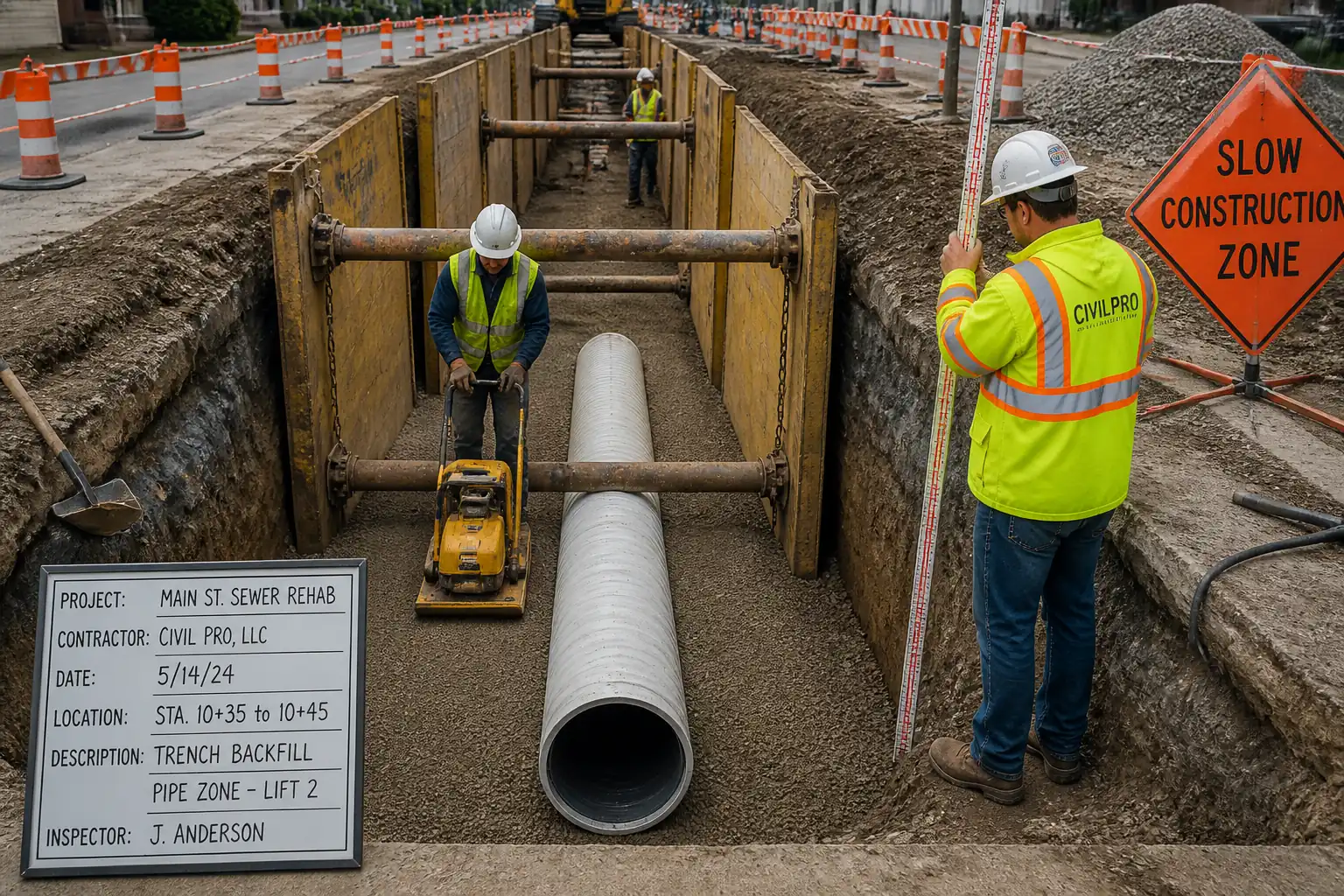
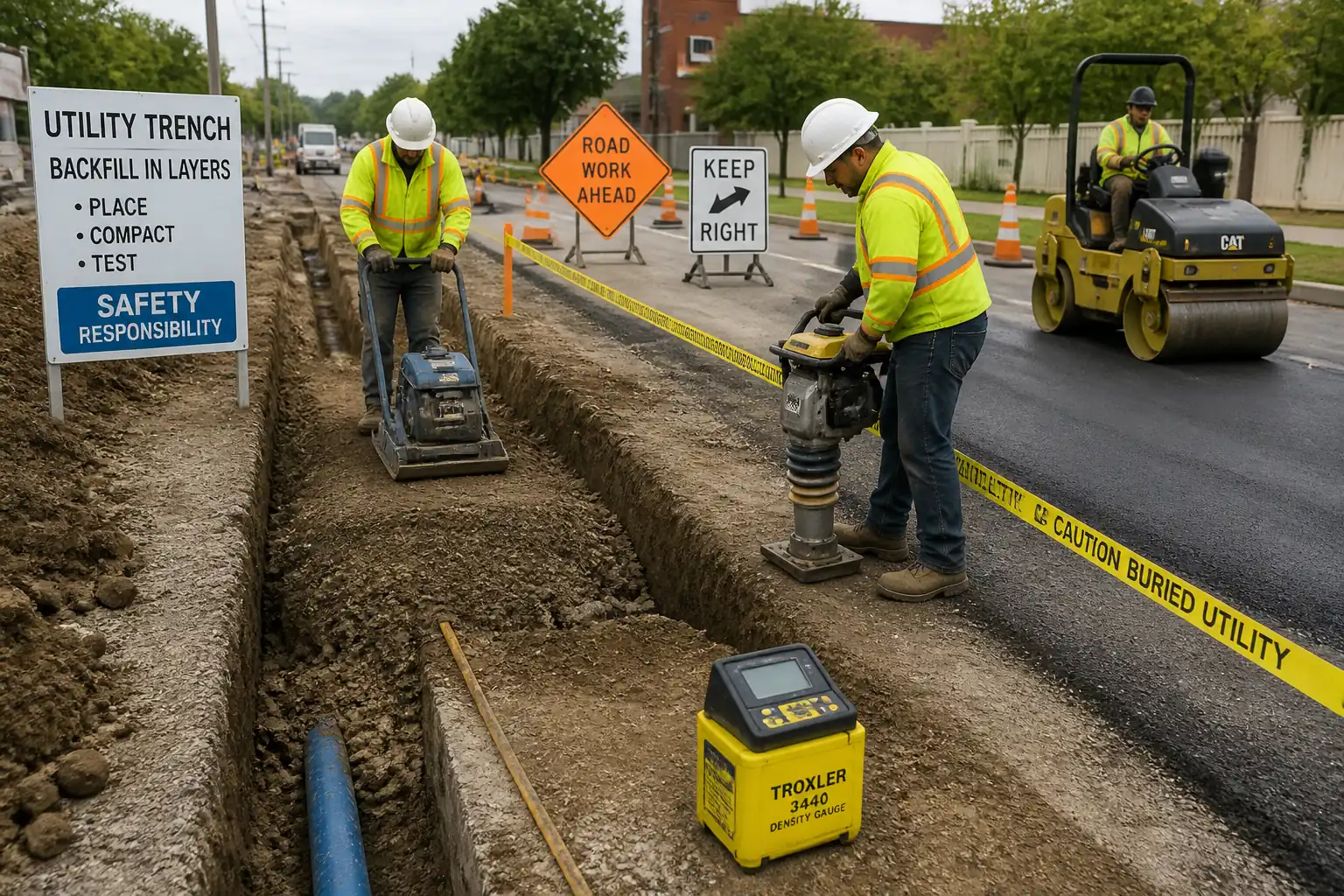
This method statement covers backfilling and compaction of utility trenches with selected granular material, including moisture conditioning, layer thickness control, mechanical compaction, density testing by sand replacement or nuclear gauge, and reinstatement of pavement layers to match existing. It applies to trenches for water, sewer, telecom, electrical, and gas utilities in carriageways, shoulders, footpaths, and verges.
Included Activities
- Pre-works planning, permits-to-dig, utility locating and trial holes.
- Verification of installed utilities, protective bedding, and separation from backfill.
- Delivery, inspection, and approval of selected granular backfill and pavement materials.
- Layered backfilling with moisture conditioning and controlled compaction.
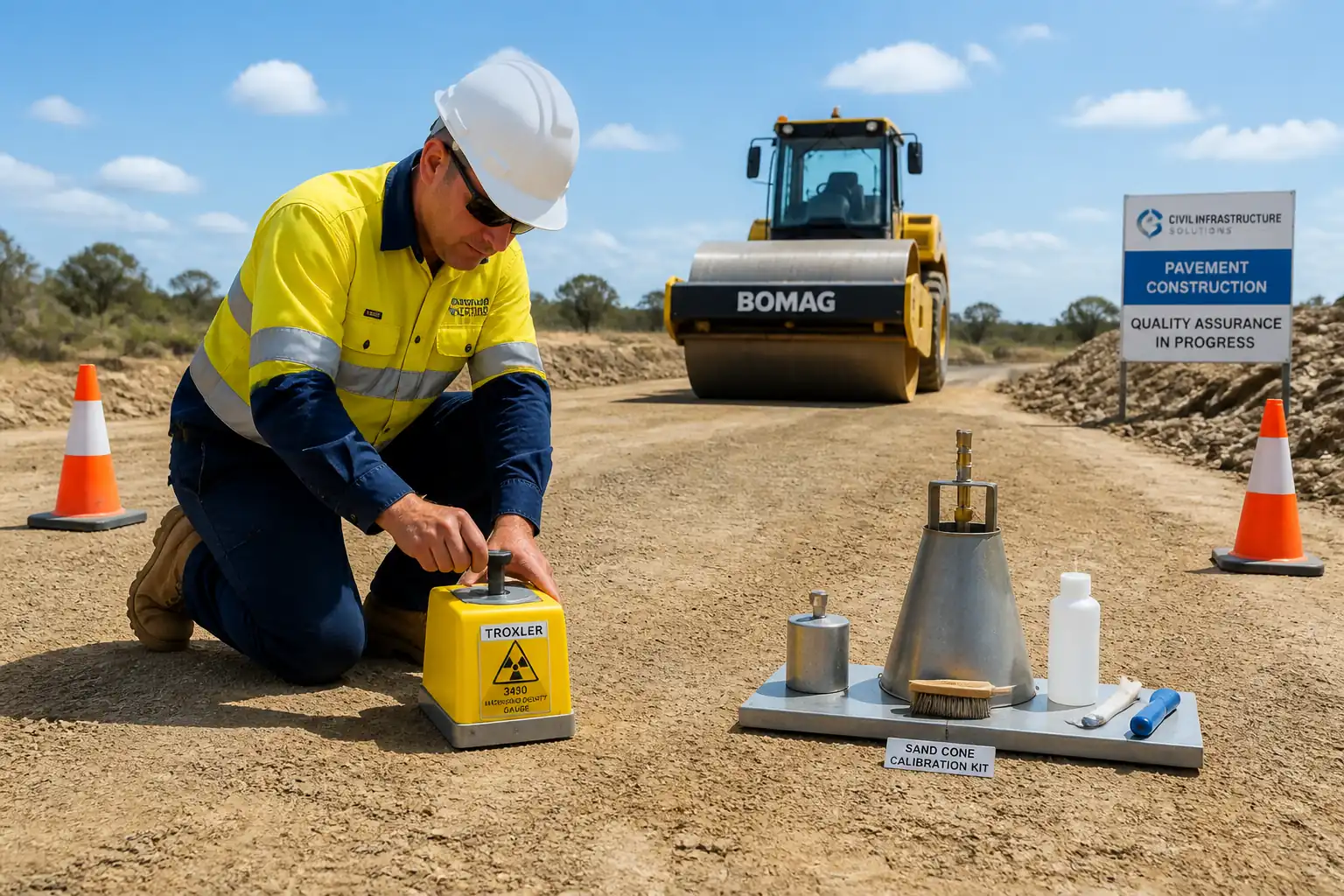
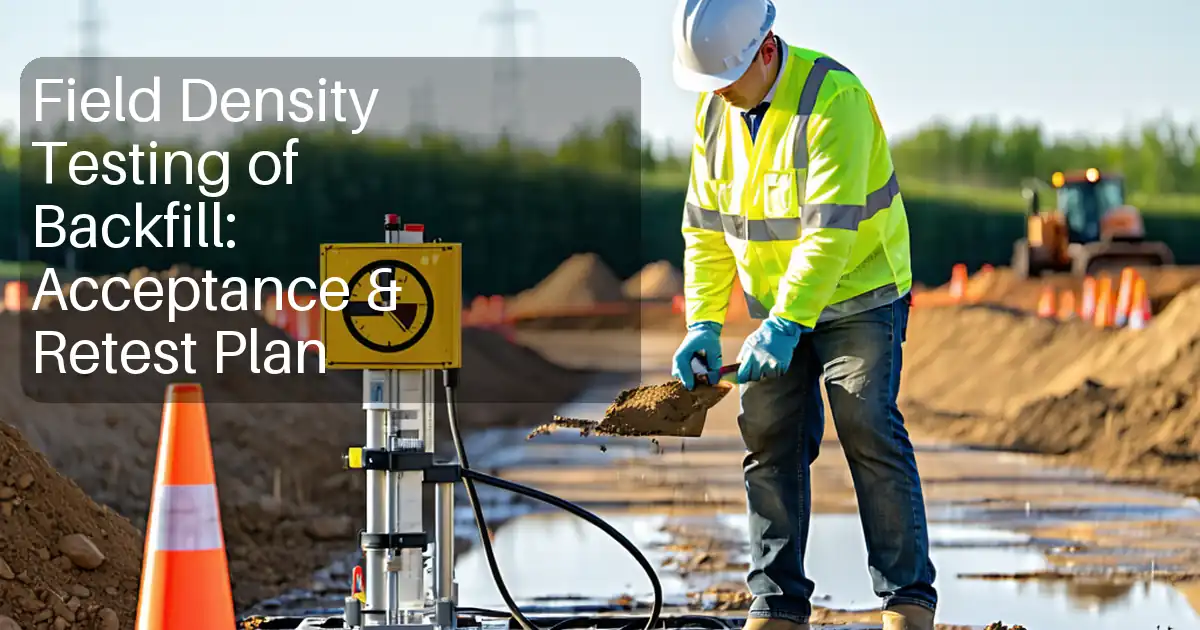
- In-situ density and moisture testing (ASTM D1556 sand cone or ASTM D6938 nuclear gauge) and documentation.
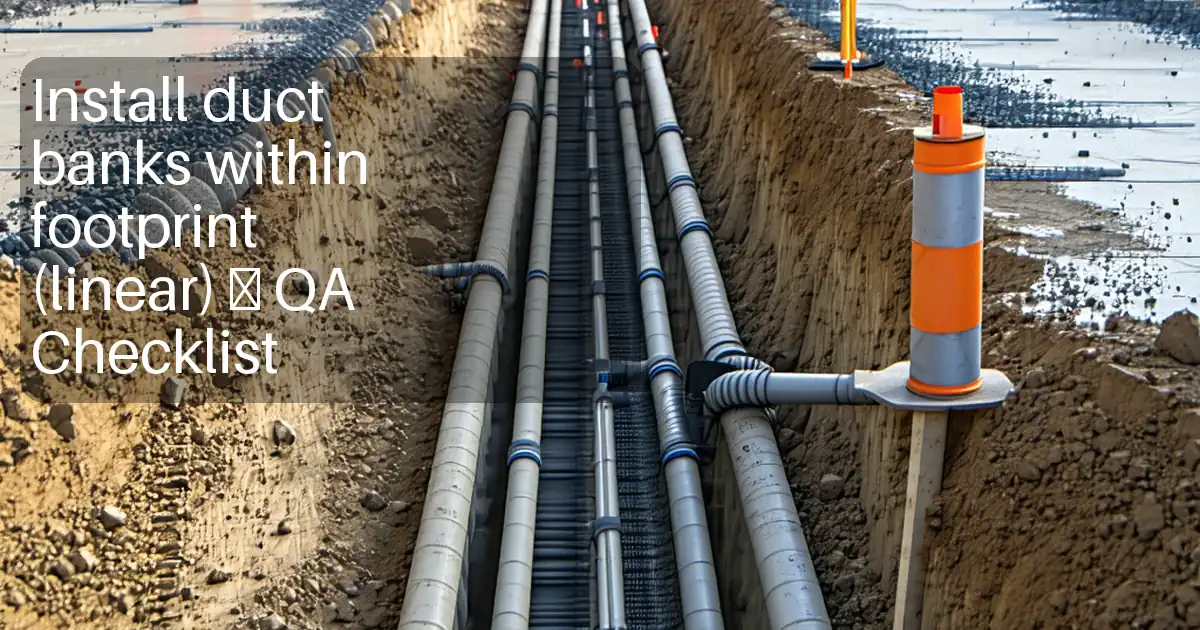
- Placement of marker/warning tape and utility cover slabs/boards where specified.
- Reinstatement of unbound sub-base/roadbase and bituminous layers to match existing thicknesses, materials, and levels.
- Final cleaning, demobilisation, and handover for reopening to traffic.
Exclusions
- Installation of new utilities (by others) except coordination and protection during backfill.
- Permanent road marking or traffic signal reinstatement unless noted otherwise.
- Dewatering design and treatment of contaminated soils (specialist as required).
References
| Document Type | Reference / Number | Revision | Notes |
|---|---|---|---|
| ASTM Standard | ASTM D698 / ASTM D1557 | Determine MDD/OMC for compaction control [Verify per project specifications] | |
| ASTM Standard | ASTM D1556 | ||
| ASTM Standard | ASTM D6938 | Daily gauge standardization and project correlation to sand-cone [Verify] | |
| ASTM Standard | ASTM D2216 | ||
| ASTM Standard | ASTM D2487 / D2488 | ||
| BS Standard | BS 1377 (notably Part 9) [Verify current parts] | ||
| BS EN Standard | BS EN 13242 | For Type 1/Type 2 aggregates | |
| BS EN Standard | BS EN 13286 (series) | e.g., -2 for Proctor; -47 for in-situ tests [Verify exact parts per lab] | |
| BS EN Standard | BS EN 13108 (series) | ||
| BS EN Standard | BS EN 12697 (relevant parts) | e.g., -6 bulk density, -8 voids, -10 gyratory compaction [Verify per project] | |
| BS Code | BS 5975 | Temporary Works Coordination | |
| Guide | CIRIA guidance on underground services (e.g., C704/C756/C742) [Verify] | ||
| Regulation | OSHA 29 CFR 1926 Subpart P or local equivalent [Verify] | Use local regulations where applicable | |
| Standard/Manual | MUTCD / UK Traffic Signs Manual Chapter 8 or local equivalent [Verify] |
Responsibilities
| Role | Responsibility | Name / Party |
|---|---|---|
| Project/Construction Manager | Overall delivery, compliance with contract and specifications, resource allocation, approval of method and ITP. | Contractor |
| Site Engineer | Daily supervision, sequencing, coordination with utility owner, verification of hold/witness points, sign-off of ITP. | Contractor |
| HSE Officer | HSE risk assessments, permits-to-dig, trench safety audits, toolbox talks, monitoring of controls. | Contractor |
| QA/QC Engineer | Inspection of materials, verification of test frequencies, review of lab and field test results, NCR management. | Contractor |
| Surveyor | Utility locating, control points, trench line/level, reinstatement levels and tolerances. | Contractor |
| Compaction Plant Operator | Operation of rollers/plate compactors to achieve specified density without damaging utilities. | Contractor |
| Materials Technician (Lab) | Nuclear gauge/sand cone testing, moisture content tests, test lotting, reporting. | Independent/Contractor Lab |
| Plant/Equipment Supervisor | Equipment inspections, lifting and plant interface control, isolation and tagging if required. | Contractor |
| Engineer/Client Representative | Review/approve method, ITP, materials, and key hold points; conduct surveillance. | Engineer/Client |
Resources
| Resource Type | Description | Quantity | Remarks |
|---|---|---|---|
| Supervision | 1 | ||
| Supervision | 1–2 [Verify] | ||
| HSE | 1 | ||
| Survey | 1 | ||
| Trades/Plant | 2–3 [Verify] | Includes trench rammer operator | |
| Labour | 3–6 [Verify] | ||
| Lab/QA | 1–2 [Verify] |
Materials
| Material | Specification / Grade | Quantity | Remarks |
|---|---|---|---|
| Selected Granular Backfill | Complies with BS EN 13242; PI ≤ 6; fines (P0.075 mm) ≤ 12%; max particle size ≤ 37.5 mm for 200 mm lifts [Verify per project specifications] | ||
| Bedding Sand | Clean, well-graded sand meeting utility standard; chloride/sulfate limits as specified [Verify] | ||
| Unbound Sub-base (Type 1/Type 2) | BS EN 13242; LA abrasion, FI, and grading within project limits [Verify] | ||
| Asphalt (AC mixes) | BS EN 13108 (e.g., AC 20 dense bin; AC 10 surface) with binder grade to match existing [Verify] | ||
| Bituminous Emulsion / Joint Sealant | Cationic emulsion (e.g., C60B3) and hot/cold joint paint per project [Verify] | ||
| Warning/Marker Tape | Color and legend per utility owner; 300 mm cover above service [Verify] |
Equipment
| Equipment | Capacity / Type | Quantity | Inspection Required |
|---|---|---|---|
| Excavator/Backhoe + Buckets | 5–20 t [Verify] | Daily pre-start, certification [Verify] | |
| Wheel Loader/Skid Steer | 0.5–1.5 m³ bucket | Daily pre-start | |
| Trench Rammer (Wacker-type) | 13–70 kN impact [Verify] | Pre-start, HAVS control | |
| Vibratory Plate Compactor | 15–30 kN centrifugal force [Verify] | Pre-start, HAVS control | |
| Walk-behind Roller | 1–3 t [Verify] | Pre-start | |
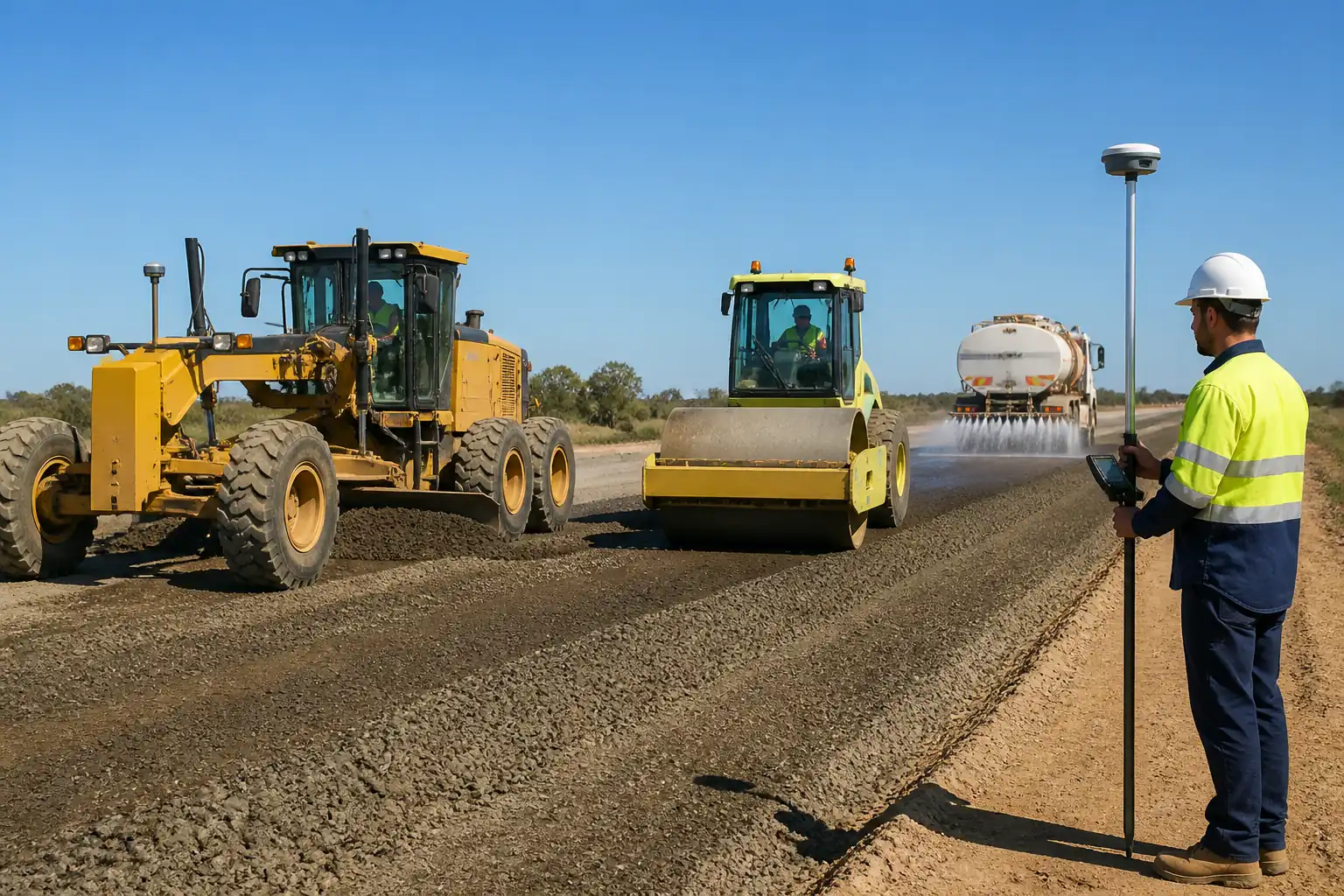
| Tandem Vibratory Roller | 8–12 t [Verify] | Pre-start, vibration isolation near structures | |
| Nuclear Density Gauge | Calibration certificate, operator license, radiation permit [Verify] | ||
| Sand Replacement Kit | Calibrated cones/sand, tray, scales | ||
| GPR/Cable Avoidance Tool | Calibration/function check | ||
| Dewatering Pump & Hose | Rate per site [Verify] | Check discharge controls | |
| Small Asphalt Paver or Hand Lay Tools | Pre-start |
Prerequisites
- Approved IFC drawings, method statement, and ITP.
- Permit-to-dig signed, with current utility maps, GPR/CAT scan results, and marked-up service locations. Trial holes completed to verify depth/position [Verify per project HSE plan and local regulations].
- Temporary Works design/selection for trench support (shoring/box/benching) reviewed by Temporary Works Coordinator.
- Traffic Management Plan (TMP) approved and implemented before lane occupation.
- Material submittals approved: selected granular backfill, sub-base, asphalt mixes, emulsion, warning tape.
- Laboratory compaction curves (MDD/OMC) established for each backfill source (ASTM D698 or D1557 as specified) and asphalt mix data (if applicable).
- Calibration/standardization records for nuclear gauge (ASTM D6938) and correlation to sand-cone (ASTM D1556) established for site material [Verify].
- Compaction trial/test strip completed to confirm target roller/plate passes for each lift and compaction plant configuration [Verify per project].
- Weather conditions acceptable: no heavy rain during placement/compaction; asphalt laid within specified temperature/wind limits [Verify per project specifications].
- Emergency plans, spill kits, first aid, and fire extinguishers in place.
- Interfaces agreed with utility owners and local authority for reinstatement acceptance and inspections.
Method Sequence
| Step | Activity | Description | Responsibility | Inspection / Hold Point |
|---|---|---|---|---|
| 1 | Pre-start and Site Establishment | Conduct pre-start meeting; verify approved docs, permits-to-dig, TMP, and TWC checks. Set up site fencing, lighting, signage, and pedestrian routes. Establish exclusion zones around trench and plant operating areas. | Site Engineer / HSE Officer | Permit-to-dig; TMP in place |
| 2 | Utility Verification | Locate existing utilities using GPR/CAT and trial holes; physically verify alignment and depth; install protective measures (boards/sand surround) as specified by utility owner. | Site Engineer / Utility Coordinator | Witness utility owner if required |
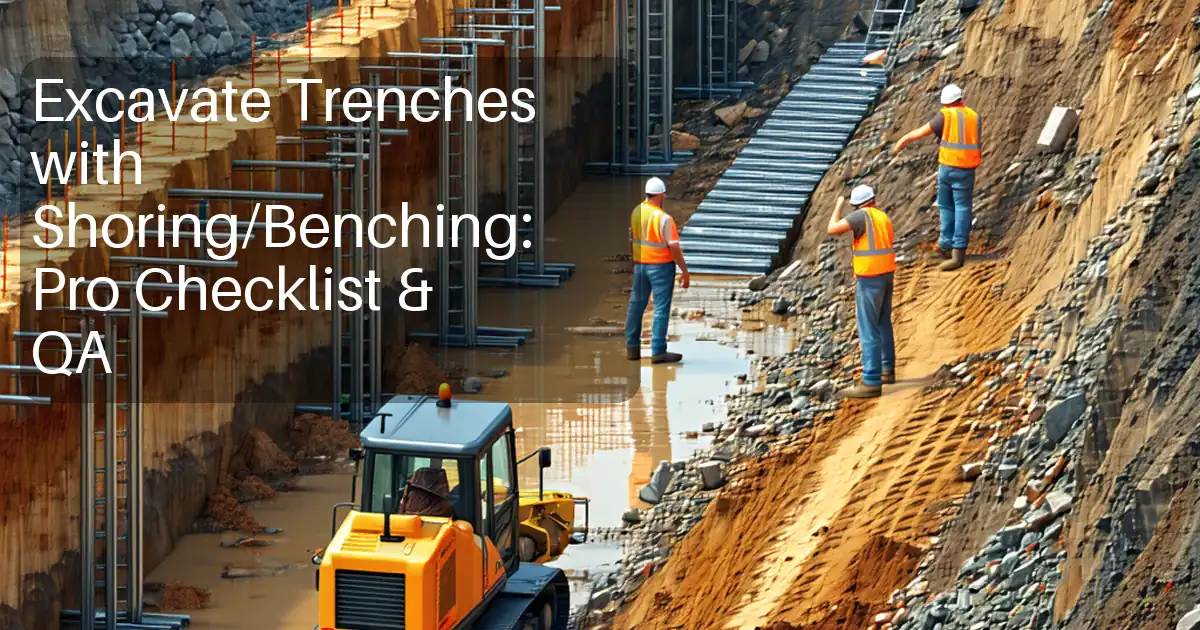
| 3 | Trench Support and Access | Install shoring/box/benching per Temporary Works. Provide safe access/egress ladders within 7.5 m. Keep surcharge loads/setbacks per design. No entry to unsupported trench >1.2 m depth [Verify per local regulations]. | TWC / Site Supervisor | Daily TWC inspections |
| 4 | Material Receipt and Verification | Receive backfill and pavement materials; check delivery tickets/COCs; confirm grading, cleanliness, and moisture condition fit-for-use. | QA/QC Engineer | Visual + document check |
| 5 | Bedding/Initial Surround Check | Verify bedding/surround around utility installed per utility standard; ensure minimum cover above crown before mechanical compaction over pipe (typically ≥300 mm) [Verify]. | Site Engineer | Visual |
| 6 | Backfill Placement—Lower Lifts | Place selected granular backfill in uniform layers. Typical loose lift thickness: 150 mm with rammer/plate; up to 200 mm with trench roller [Verify]. Hand tamp around sides of utility to avoid voids. Maintain moisture within OMC ±2% [Verify]. | Site Supervisor | Layer thickness checks (random) |
| 7 | Mechanical Compaction—Lower Lifts | Compact each lift using appropriate plant. Establish pass counts from trial: e.g., trench rammer 6–10 passes/lane; plate 6–10 passes; trench roller 4–8 passes [Verify by trial]. Avoid direct compaction over pipe until minimum cover achieved. | Compaction Operator / Site Engineer | Operator logs; observation |
| 8 | Warning Tape Installation | Install marker/warning tape 300 mm above the utility (or as specified) along trench line, centered and continuous. | Site Supervisor | Visual |
| 9 | Backfill Placement—Upper Lifts to Subgrade | Continue placing and compacting backfill in controlled lifts to formation/subgrade level. Maintain level tolerance typically ±15 mm and crossfall to match existing [Verify]. Protect edges; avoid overbuild/underbuild. | Site Engineer | Survey spot checks |
| 10 | Sub-base/Unbound Layer Reinstatement | Place approved Type 1/Type 2 to required thickness matching existing. Typical loose lift ≤150 mm. Compact with roller/plate as appropriate. Apply edge saw-cut and joint preparation if not already completed. | Site Engineer | Layer thickness checks |
| 11 | Bituminous Reinstatement—Binder Course | Saw-cut edges square; clean and tack coat vertical and horizontal faces. Place AC binder to match existing thickness (typ. 50–60 mm [Verify]) and compact with roller. Complete compaction before mix cools below specified temperature (typ. ≥90°C) [Verify]. | Paving Crew / Site Engineer | Delivery temp, laydown temp |
| 12 | Bituminous Reinstatement—Surface Course | Apply tack coat; place AC surface to match existing thickness (typ. 30–40 mm [Verify]). Ensure texture and aggregate size compatible with adjacent pavement. Roll to refusal without flushing/segregation. | Paving Crew / Site Engineer | Surface finish and joints |
| 13 | Final Checks and Handover | Clean site, remove TMP when authorized. Restore road markings if included. Submit as-built levels, test results, and IRs for final acceptance. Reopen to traffic after cooling and authority approval. | Construction Manager / Client Rep | Walkthrough |
Safety Controls
The following task-specific controls apply. Verify per project HSE plan and local regulations.
- Hazard: Underground utility strike (electric, gas, fiber)
- Likely consequence: Electrocution, explosion, service outage.
- Engineering/procedural control: Permit-to-dig; GPR/CAT scan and marked services; trial holes to confirm; maintain minimum hand-dig zones within 500 mm horizontally of known utilities; insulated tools near live cables; liaison with utility owner; lock-out/tag-out if arranged.
- Required PPE: EH-rated gloves, dielectric boots when applicable, arc-rated clothing near HV [Verify]; insulated tools; eye/face protection.
- Collective preventive measure: Exclusion zones and barriers; non-conductive trench shields where required.
-
Inspection/permit/supervision: Permit-to-dig signed daily; supervisor present during hand-dig; utility owner witness as required.
-
Hazard: Trench collapse/ground instability
- Likely consequence: Burial/asphyxiation, crush injuries.
- Engineering/procedural control: Shoring/box/benching per TWD; keep spoil/plant ≥0.6–1.0 m from edge [Verify]; daily excavation inspection; restrict entry during placement unless shielded.
- Required PPE: Hard hat, safety boots, gloves.
- Collective preventive measure: Trench boxes, guardrails, ladder within 7.5 m.
-
Inspection/permit/supervision: Daily competent person inspection; TWC sign-off; stop work during rain/undermining.
-
Hazard: Plant–pedestrian interface
- Likely consequence: Struck-by, run-over.
- Engineering/procedural control: Segregated walkways; banksman for reversing; amber beacons and alarms; defined one-way routes; spotter communications (radios/hand signals).
- Required PPE: Hi-vis class 3, hard hat, safety boots.
- Collective preventive measure: Physical barriers, designated loading zones.
-
Inspection/permit/supervision: Daily TMP inspection; operator competency (CPCS/NPORS or equivalent).
-
Hazard: Compaction vibration near structures/utility joints
- Likely consequence: Damage to utilities, settlement, nuisance.
- Engineering/procedural control: Maintain minimum cover above utilities before using heavy vibration; use lighter equipment initially; vibration monitoring where sensitive; set PPV trigger (e.g., 5–10 mm/s at building foundations) [Verify].
- Required PPE: Standard PPE; hearing protection.
- Collective preventive measure: Exclusion zone around sensitive assets.
-
Inspection/permit/supervision: Pre-work asset survey; monitor PPV if specified.
-
Hazard: Manual handling of plates/compaction equipment
- Likely consequence: Musculoskeletal injuries.
- Engineering/procedural control: Use mechanical aids; team lifts; weight limits; task rotation.
- Required PPE: Gloves with grip, safety boots.
- Collective preventive measure: Trolley/lifting points provided.
-
Inspection/permit/supervision: Manual handling training; supervisor checks.
-
Hazard: Noise and HAVS from vibrating tools/rollers
- Likely consequence: Hearing loss, hand–arm vibration syndrome.
- Engineering/procedural control: Select low-vibration tools; adhere to exposure points/hours matrix; job rotation; maintain equipment; implement hearing conservation program.
- Required PPE: Hearing protection; anti-vibration gloves as comfort (not primary control).
- Collective preventive measure: Noise barriers where practicable.
-
Inspection/permit/supervision: HAVS logs; noise monitoring as required.
-
Hazard: Dust and silica from cutting/sawing/trimming
- Likely consequence: Respiratory irritation, long-term disease.
- Engineering/procedural control: Wet cutting; local extraction when practical; water mist suppression on spoil; cover stockpiles.
- Required PPE: RPE (P2/P3) when controls insufficient; safety glasses.
- Collective preventive measure: Dust screens.
-
Inspection/permit/supervision: Dust monitoring if specified; water supply available.
-
Hazard: Hot asphalt and bitumen fumes
- Likely consequence: Burns, respiratory irritation.
- Engineering/procedural control: Control delivery temperatures; no hand contact; safe handling of emulsion; clear exclusion during tipping and rolling.
- Required PPE: Heat-resistant gloves, long sleeves, face shield/eye protection.
- Collective preventive measure: Barriers and lookouts during paving.
-
Inspection/permit/supervision: SDS available; toolbox talk on burns/fume.
-
Hazard: Traffic (live carriageways)
- Likely consequence: Collision with workforce/plant.
- Engineering/procedural control: Approved TMP; lane closures with taper lengths; work within protected zones; night works lighting to standard; spotters.
- Required PPE: Hi-vis class 3, impact-resistant helmets where required.
- Collective preventive measure: Crash-rated barriers where specified.
-
Inspection/permit/supervision: Traffic authority permits; daily TMP inspection.
-
Hazard: Contaminated water/ground (if encountered)
- Likely consequence: Exposure, environmental release.
- Engineering/procedural control: Stop work; sample and classify; specialist disposal; avoid pumping to storm drains.
- Required PPE: Chemical-resistant gloves, splash goggles.
- Collective preventive measure: Bunded storage; sealed containers.
- Inspection/permit/supervision: Environmental permit; waste transfer notes.
Environmental Controls
- Silt and sediment runoff
- Impact: Waterway pollution, clogged drains.
- Controls: Silt socks around gullies; sediment traps in dewatering discharge; pump to settlement tank; avoid discharge to natural water without treatment.
-
Monitoring/permits: Inspect after rainfall; discharge permits as required.
-
Dust emissions from backfill handling and cutting
- Impact: Nuisance, air quality breaches.
- Controls: Water spraying, wet saws, limit drop heights, cover trucks/stockpiles, wheel wash/track-out control.
-
Monitoring/permits: Visual checks; PM monitoring if specified; working hour restrictions [Verify].
-
Noise and vibration
- Impact: Community disturbance, structural annoyance.
- Controls: Time works to daytime hours, maintain equipment, use low-vibration plant near structures, temporary barriers. Set vibration trigger levels (e.g., PPV 5–10 mm/s) [Verify].
-
Monitoring/permits: Noise/vibration monitoring if required by consent.
-
Waste management (surplus spoil, asphalt, packaging)
- Impact: Resource wastage, improper disposal.
- Controls: Segregate waste; classify excavated material; reuse compliant backfill where allowed; dispose via licensed carriers; maintain waste transfer notes.
-
Monitoring/permits: Duty of Care documentation; landfill diversion targets [Verify].
-
Spills and hydrocarbons
- Impact: Soil/water contamination.
- Controls: Spill kits at plant; refuel in bunded area; drip trays; immediate containment and reporting.
-
Monitoring/permits: Environmental incident reporting per project.
-
Material sourcing and haulage
- Impact: Embodied carbon and traffic.
- Controls: Source nearest compliant quarry; optimize loads; avoid idling; consider recycled aggregates where approved.
-
Monitoring/permits: Supplier declarations; COC.
-
Hot works/bitumen handling emissions
- Impact: Odor, VOCs.
- Controls: Maintain manufacturer temperature ranges; avoid overheating; ensure adequate ventilation at night works.
- Monitoring/permits: Local authority requirements [Verify].
QA/QC
- Lotting: Define test lots by uniform material, layer, and length (e.g., trenches <1.5 m wide: one lot per 30–50 m per lift; wider >1.5 m: by 200–300 m² per lift) [Verify per project specifications].
- Compaction criteria:
- Under pavements/trafficked areas: ≥98% MDD (ASTM D1557 or BS EN 13286 reference density) [Verify].
- Verges/landscaped: ≥95% MDD (ASTM D698) unless higher specified [Verify].
- Moisture during compaction: OMC ±2% unless otherwise specified [Verify].
- Testing methods and frequency (minimum typical):
- In-situ density: 1 test per 30 m of trench per lift (W≤1.5 m) or 1 per 200 m² per lift, minimum 3 per lot [Verify].
- Moisture content check: 1 per density test location.
- Sub-base density: same as above or per authority standard [Verify].
- Asphalt: density/voids by cores or approved NDT; temperature checks each load; one core per 50–100 m of trench or per 50 m² patch minimum [Verify].
- Instrument control: Nuclear gauge daily standardization and weekly leak test status; correlation to sand cone at start and when material/source changes.
- Non-conformances: Record NCR for failed density or levels; rework by scarifying/re-compacting or replacing material; re-test until compliant. Document corrective and preventive actions.
- Records: ITP checklists; field density reports; moisture tests; material COCs; delivery tickets; temperature logs; survey level sheets; photos; as-built sketches.
- Hold/Witness points: Prior to backfill over utilities; prior to asphalt; reopening to traffic. Notify Engineer 24 hours in advance [Verify].
- Tolerances (typical—verify): Layer thickness ±10 mm; formation level ±15 mm; sub-base level ±10 mm; asphalt finished level +0/−10 mm relative to adjacent; longitudinal and transverse joint offsets per authority.
- Protection of works: Prevent traffic loading until compaction and reinstatement accepted; barricade freshly placed asphalt until cooled.
Attachments
- Approved drawings and typical trench details.
- Temporary Works design and excavation support data sheets.
- Traffic Management Plan and permits.
- Material submittals and Certificates of Conformance (granular backfill, sub-base, asphalt, emulsion, warning tape).
- Laboratory compaction curves (ASTM D698/D1557) and asphalt mix design data sheets.
- Nuclear density gauge calibration/standardization certificates and radiation permits.
- Compaction trial/test strip report (pass counts, achieved densities).
- ITP forms, inspection checklists, and test report templates.
- SDS for bituminous products and fuel.
- Emergency response plan and spill response procedure.
This content is a read-only public reference. Download or customize to get an editable version.
ITP preview
The first inspection activities from the linked ITP for Method Statement: Backfilling and Compaction of Utility Trenches and Pavement Reinstatement:
| Activity | Inspection / Test | Acceptance Criteria | Responsibility | Record |
|---|---|---|---|---|
| Permit-to-dig and utility locating | Permit approved; services marked and trial holed; exclusion zones established | Site Engineer / HSE | Permit-to-dig; utility survey/trial hole records | |
| Trench support installation | Support per TWD; no signs of distress; access/egress provided | TWC / Site Supervisor | TWC inspection log; photos | |
| Material approval—granular backfill and sub-base | Gradation/PI as required | Matches approved submittal; clean, non-plastic within limits [Verify] | QA/QC Engineer | COC; test reports |
Showing 3 of 12 inspection activities. View full ITP →
Related Inspection and Test Plan
An Inspection and Test Plan (ITP) is available for Method Statement: Backfilling and Compaction of Utility Trenches and Pavement Reinstatement. The ITP defines the inspection activities, acceptance criteria, hold and witness points, responsible parties, and records required to verify the work described in this method statement.
View the Method Statement: Backfilling and Compaction of Utility Trenches and Pavement Reinstatement ITP →Frequently asked questions
Continue with related Quollnet resources connected to this method statement.