
Method Statement: Artificial Ground Freezing for Cross Passage Construction Between Running Tunnels – Method Statement
AI-assisted method statement with matching ITP, PDF download, and Excel export.
More than a static template
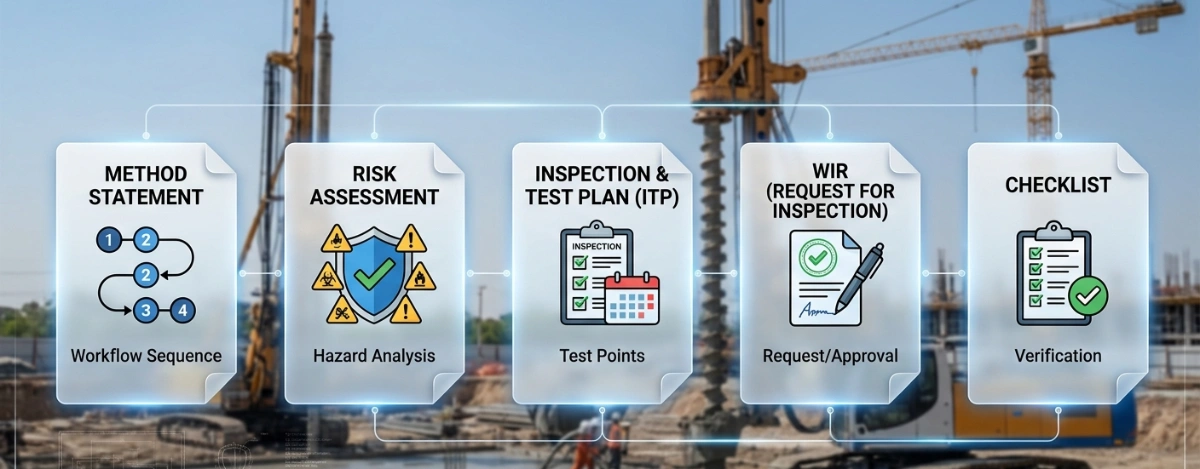
Unlike a downloadable Word or PDF template, this method statement is an AI-assisted editable starting point connected directly to a matching Inspection and Test Plan. Every section is structured, project-adaptable, and ready to export.
- AI-assisted drafting — Customize every section with AI for your specific project scope.
- Linked ITP — A matching inspection and test plan is generated alongside the method statement.
- Multiple export formats — Download as a formatted PDF or editable Excel spreadsheet.
- Editable starting point, not a final document — Review, verify, and adjust all content against your project requirements before use.
Static template vs. Quollnet workflow
| Feature | Static template | Quollnet |
|---|---|---|
| Project-specific content | Manual fill-in required | AI-assisted customization |
| Linked ITP | Separate document, no link | Matching ITP included |
| Export formats | Usually PDF only | PDF and Excel |
| Structured sections | Free-form layout | 13 standardized sections |
| Saved to your account | Local file only | Cloud-saved, reusable |
| Content accuracy | You verify everything | AI-assisted, you still verify |
| Cost | Often free but time-intensive | Free to customize and download |
What you can customize
When you save this method statement to your account, every section becomes editable. The following 13 sections are included:
- Scope — Defines the activity and its boundaries.
- References — Standards, specifications, and drawings.
- Responsibilities — Roles and accountabilities.
- Resources — Labour, plant, and equipment summary.
- Materials — Materials and compliance requirements.
- Equipment — Tools and equipment details.
- Prerequisites — Hold points and pre-conditions.
- Method sequence — Step-by-step construction sequence.
- Safety controls — HSE risk controls and PPE.
- Environmental controls — Environmental mitigation measures.
- QA/QC — Quality inspection and test requirements.
- ITP — Inspection and Test Plan table (has its own page).
- Attachments — Referenced drawings and documentation.
Why this method statement is used
This method statement is used to define and communicate the approved procedure for carrying out method statement: artificial ground freezing for cross passage construction between running tunnels on site. It ensures the work is planned in advance, the correct resources and controls are in place, and all personnel understand responsibilities, sequence, quality requirements, and safety controls before work begins. It aligns site execution with the documented scope and acceptance expectations.
Who uses this method statement
This method statement is used by contractors, site supervisors, project engineers, QA/QC engineers, HSE officers, consultants, and client representatives. It serves as a shared reference for planning, execution, supervision, inspection, and approval of the activity on site.
When it is prepared and submitted
The method statement is prepared before the work activity starts and submitted as part of the pre-construction documentation package for review and approval.
Who reviews or approves it
The method statement is usually submitted to the client representative, consultant, resident engineer, or project management consultant for review and approval before the work commences.
Important approval note
This method statement is an AI-assisted editable starting point, not a pre-approved document. Before use on any project, all content must be reviewed and approved by the relevant parties (superintendent, principal contractor, or client representative) in accordance with your contract and project quality plan.
For example: if your specification requires a departure from a referenced standard, that departure must be documented and approved separately — this method statement will not capture that automatically. Always verify against your applicable drawings, specifications, and regulatory requirements.
Method statement content
Scope
Purpose
Execute artificial ground freezing (AGF) to create a continuous, watertight, and structurally competent frozen arch/wall around the proposed cross passage between two running tunnels, followed by controlled excavation and primary support installation under the frozen condition.
Included Activities
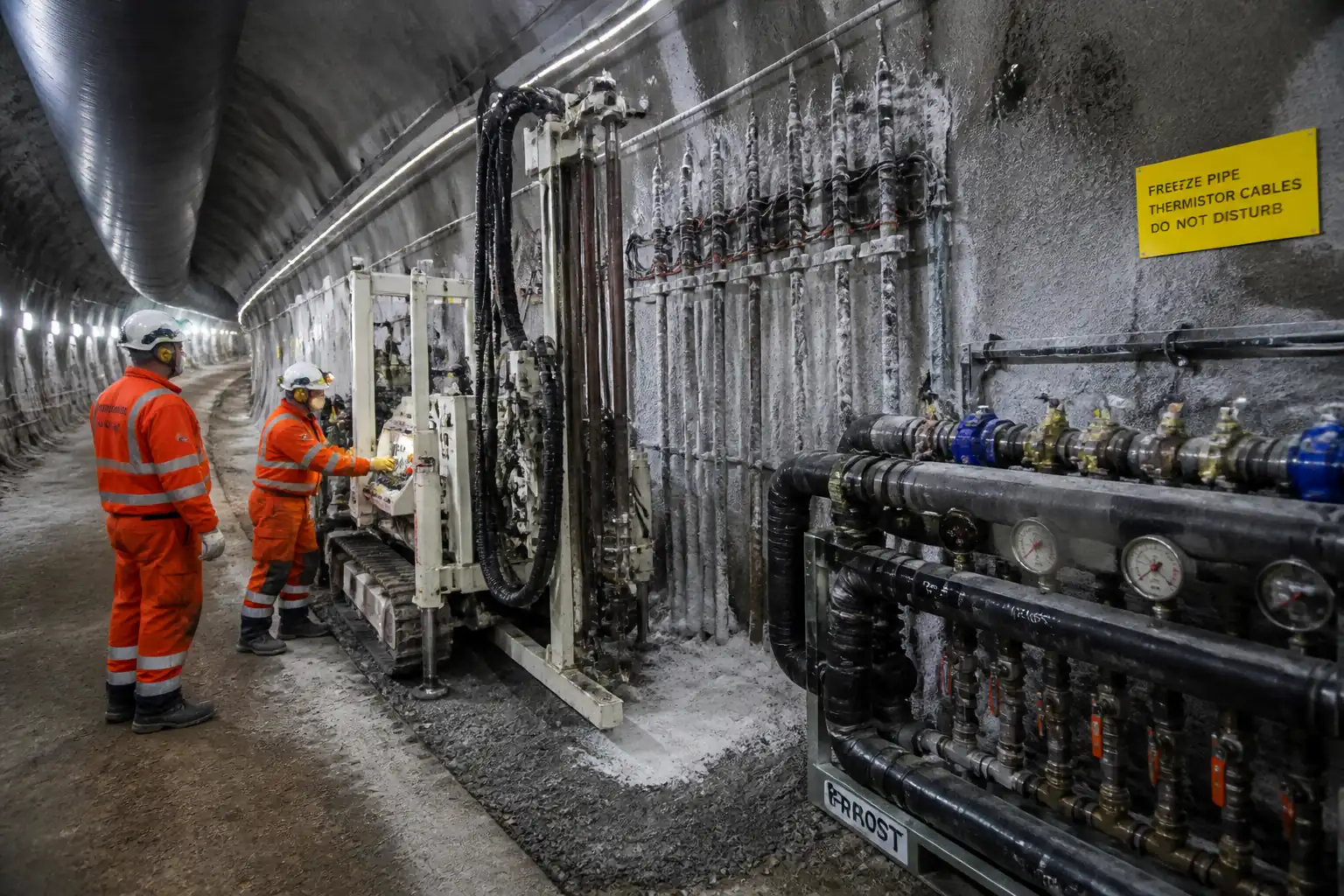
- Survey control, drilling through tunnel linings, and installation of freeze pipes and thermistor strings.
- Supply, installation, and commissioning of brine freezing plant, manifolds, headers, and controls.
- Thermal monitoring, verification of freeze wall thickness and closure, and hold points before excavation.
- Sequential excavation of cross passage under frozen ground, installation of primary lining/support, and temporary works.
- QA/QC documentation, ITP execution, and as-built records.
Exclusions
- Permanent secondary lining and final tunnel systems (unless otherwise specified).
- Liquid nitrogen freezing (not applicable to this method).
Key Constraints
- Works within live tunnels/rail environments; strict interface control with the Operator [Verify per project HSE plan and local regulations].
- Groundwater head management and inflow risk during coring and drilling.
- Limited space and ventilation in tunnels; continuous monitoring of temperature, airflow, and gases.
Performance Objectives
- Achieve continuous frozen wall/arch around cross passage profile with minimum design thickness (typically 1.0–2.0 m) and temperature criterion (e.g., ≤ -5°C to -10°C at verification isotherm) sustained for defined hold time (e.g., ≥72 hours) [Verify per project specifications].
- No measurable water ingress during pilot break-through and excavation (target: zero visible inflow; allowable seepage rate per design [Verify]).
- Excavation-induced tunnel lining movement/convergence within design limits (e.g., ≤ 5 mm at crown/SPR readings) [Verify].
References
| Document Type | Reference / Number | Revision | Notes |
|---|---|---|---|
| Standard | BS 5930; BS EN ISO 14688-1/-2; BS EN ISO 14689-1; BS EN ISO 22475-1 | For drilling methods and logs. | |
| Standard | BS EN 12715 | ||
| Standard | ASME B31.5; EN 378 | Apply to secondary brine circuit and plant safety integration. | |
| Standard | ASTM D5334 | ||
| Standard | EN 14487; EN 14488 | ||
| Standard | EN 10025; EN 1090 | ||
| Standard | ISO 9712; ASNT SNT-TC-1A | ||
| Standard | ISO 9001; ISO 14001; ISO 45001 | ||
| Specification | Project/Operator Requirements | [Verify per project HSE plan and local regulations]. |
Responsibilities
| Role | Responsibility | Name / Party |
|---|---|---|
| Project Manager | PC | |
| Freezing Lead | Specialist | |
| Tunnel Superintendent | PC | |
| Chief Surveyor | PC | |
| I&M Engineer | I&M Subcontractor | |
| HSE Manager | PC | |
| QA/QC Engineer | PC | |
| Refrigeration Supervisor | Specialist |
Resources
| Resource Type | Description | Quantity | Remarks |
|---|---|---|---|
| Personnel | Design, modelling, supervision during freezing and excavation phases. | 2–4 [Verify] | |
| Personnel | Operate tunnel-compatible drilling rig, coring through lining, install pipes/thermistors. | 6–10 [Verify] | |
| Personnel | Thermistor/data logger installation and management; survey convergence. | 3–5 [Verify] | |
| Personnel | Primary lining application under frozen conditions. | 4–8 [Verify] | |
| Personnel | Run chillers, monitor brine temps/flow, maintain plant. | 2–3/shift [Verify] |
Materials
| Material | Specification / Grade | Quantity | Remarks |
|---|---|---|---|
| CS Pipe | EN 10216-2 / ASTM A106 Gr B | As design layout [Verify] | |
| Thermal Grout | EN 12715 guidance; Project Spec [Verify] | As required | |
| CaCl2 Brine | OEM / Project Spec [Verify] | As per circuit volume + 10% reserve | |
| Piping & Valves | ASME B31.5 / EN 378 | As design | |
| Instrumentation | OEM / I&M Plan | Per monitoring plan [Verify] | |
| Shotcrete & Steel | Project Spec [Verify] | As per CP geometry |
Equipment
| Equipment | Capacity / Type | Quantity | Inspection Required |
|---|---|---|---|
| Drilling Rig | 1–2 rigs [Verify] | ||
| Core Drill | 1 set/rig | ||
| Grout Plant | 1 set | ||
| Chiller/Brine System | As design | ||
| I&M Suite | As design | ||
| Ventilation | As required |
Prerequisites
- Approved designs: Freeze design report, pipe layout drawings, structural check of tunnel lining penetrations, and cross passage temporary works.
- Permits to work: Confined space, hot work (for welding), drilling through lining, pressure testing, lifting, and energisation [Verify per project HSE plan and local regulations].
- Operator interfaces: Possessions/isolations, earthing/bonding, communications plan, evacuation routes, and emergency response confirmed.
- Survey control established: Primary/secondary control points, tunnel convergence baseline readings.
- Groundwater and geotechnical data verified: Permeability, groundwater head, fines content, salinity; confirm against freeze design assumptions.
- Utilities/Services mapping in tunnel: Cable routes, signalling, drainage; identify and protect.
- Plant locations and services: Freezer plant footprint, power capacity, heat rejection, ventilation; spill containment/bunding installed.
- Materials submittals approved: Pipes, grout mix designs, brine certificates, valves, thermistors.
- Calibration certificates current: Flow/temperature instruments, pressure gauges, data loggers, survey equipment.
- ITP approved and briefed; hold/witness points understood by all parties.
- Trial mixes/tests (if specified): Thermal grout thermal conductivity verification; thermistor check; plant FAT/SAT completed.
- Emergency contingencies ready: Dewatering pumps on standby, pipe repair clamps, spill kits, backup power, rescue team.
- Pre-condition surveys: Adjacent assets, tunnel lining, and surface structures; set monitoring alarms and thresholds.
Method Sequence
| Step | Activity | Description | Responsibility | Inspection / Hold Point |
|---|---|---|---|---|
| 1 | Site Establishment & Controls | Set up freezer plant area, bunding, drip trays, ventilation, lighting, exclusion zones, and signage. Establish survey control and monitoring points. | PC / HSE / Survey | Pre-start checks |
| 2 | Lining Coring at Collars | Mark and core through tunnel lining at each freeze/thermistor location using diamond core with full water capture and vacuum recovery. Fit temporary sleeves/packers. | Drilling Foreman | Witness by QA/QC |
| 3 | Drilling Freeze Boreholes | Drill inclined/curved holes along design array using cased rotary or duplex drilling; manage returns. Measure deviation with gyro/inclinometer. | Drilling Foreman | Daily log review |
| 4 | Install Freeze Pipes | Install inner/outer freeze pipes (supply/return) to design depth; centralizers fitted. Set at design spacing and elevation. | Freezing Specialist | Fit-up inspection |
| 5 | Annular Thermal Grouting | Grout annulus from bottom up using tremie; monitor pressure and volume; ensure thermal contact and sealing. | Grout Supervisor | Grout witness |
| 6 | Manifolds & Headers Installation | Fabricate/install brine headers and manifolds; connect to freeze pipes with insulated hoses; install valves, gauges, and drains. | Piping Supervisor | Fit-up and weld/NDT (if applicable) |
| 7 | Thermistors Installation | Install multi-point thermistor strings in dedicated holes; protect and terminate to data loggers; label and map channels. | I&M Engineer | QA/QC witness |
| 8 | Pre-Freezing Checks | Confirm grout strength (if required), manifold pressure tests, thermistor readiness, alarm thresholds, and emergency response. | Freezing Lead | Pre-freeze inspection |
| 9 | Start Freezing (Brine Charging) | Charge and circulate brine; ramp-down to setpoint (e.g., -25°C to -35°C at supply) [Verify]; stabilize flows and ΔT. | Refrigeration Supervisor | Operator witness |
| 10 | Freeze Growth & Monitoring | Continuous monitoring of thermistors; compare to thermal model; adjust flows/valves. Inspect tunnel for icing/condensation. | I&M / Freezing Lead | Daily review |
| 11 | Closure Verification | Verify frozen wall/arch thickness and continuity around cross passage. Confirm isotherm achieved at verification points. | Freezing Lead | Engineer & Independent Checker |
| 12 | Pilot Break-through | Excavate small pilot heading to confirm no inflow and frozen ground strength; install immediate support. | Tunnel Superintendent | Engineer witness |
| 13 | Full Excavation under Frozen Arch | Sequential enlargement with short rounds (0.5–1.0 m) [Verify]; immediate shotcrete and ribs; manage ventilation and ice removal. | Tunnel Superintendent | Shift inspections |
| 14 | Primary Lining Completion | Complete invert and final primary support; seal interfaces to running tunnels. | Tunnel Superintendent | QA/QC |
| 15 | Freeze Maintenance or Controlled Thaw | Maintain freezing until primary lining achieves required properties; then controlled thaw per design. | Freezing Lead | Engineer review |
| 16 | Demobilization & As-Builts | Isolate and drain brine; recover hoses; cap penetrations as required; compile records and as-builts. | PC / Specialist | Final inspection |
Health, Safety, and Environment (HSE) – Safety Controls
Key Hazards and Controls
1) Confined tunnel environment
- Consequence: Asphyxiation, toxic exposure, heat/cold stress.
- Engineering/procedural controls: Mechanical ventilation to achieve ≥6 ACH [Verify]; continuous O2/CO/NOx monitoring with alarms; defined egress routes every ≤50 m; thermal PPE rotation plan.
- Required PPE: Hard hat, hi-vis, cut-resistant gloves, eye protection, safety boots; cold-weather layers during freezing.
- Collective preventive measure: Fixed ventilation and alarm beacons; rescue tripod at access.
- Inspection/permit/supervision: Confined Space PTW; gas test each entry; tunnel supervisor present.
2) Drilling through pressurized, water-bearing ground and tunnel lining
- Consequence: Sudden water/sand inflow, loss of ground, flooding.
- Controls: Stage drilling with casing advance; packers at penetrations; standby dewatering pumps; drilling parameters limits; emergency grout pack.
- PPE: Face shield, waterproof gloves, dielectric boots when near water.
- Collective: Exclusion zone; emergency stop and sump containment.
- Inspection/permit: Drilling permit; daily review of groundwater head; Engineer witness for first holes.
3) Brine system under pressure and low temperature
- Consequence: Hose rupture, frostbite, slips/ice.
- Controls: Hose pressure rating ≥1.25× design; whip-checks; insulation; drip trays; heat tracing where needed.
- PPE: Cryogenic gloves for handling cold lines; eye/face protection.
- Collective: Guarding of rotating equipment; non-slip mats; spill kits.
- Inspection/permit: Pressure test certificate; daily leak walkdowns; isolation/LOTO for maintenance.
4) Welding/hot works on manifolds
- Consequence: Fire/smoke in tunnel; burns.
- Controls: Hot work permit; fire watch; non-combustible blankets; gas detection.
- PPE: Welding helmet, gloves, FR clothing.
- Collective: Portable extinguishers and hose reels; dedicated ventilation extract.
- Inspection/permit: Hot Work PTW; welder qualifications (ASME IX); WPS approved.
5) Lifting and handling in restricted space
- Consequence: Crushing, dropped objects.
- Controls: Rated lifting points; low headroom hoists; tag lines; barricades under suspended loads.
- PPE: Helmet with chin strap, gloves.
- Collective: Exclusion zones; banksman appointed.
- Inspection/permit: Lift plan; equipment inspection certificates.
6) Shotcreting and excavation under frozen ground
- Consequence: Falling ground/ice, rebound injuries, silica dust.
- Controls: Short rounds; immediate support; mesh/ice-scaling prior to work; dust suppression; rebound shields.
- PPE: FFP3 respirator, eye/face protection, hearing protection.
- Collective: Temporary support designed by engineer; dedicated scaling tools.
- Inspection/permit: Daily ground control inspection; nozzleman certification.
7) Electrical hazards and energisation of plant
- Consequence: Electric shock, arc flash.
- Controls: IP-rated distribution; RCDs; earthing/bonding to Operator’s standard; LOTO procedures.
- PPE: Electrical gloves for testing; arc-rated PPE where required.
- Collective: Barriers around panels; dry platforms.
- Inspection/permit: Electrical PTW; test and tag records current.
8) Noise and vibration
- Consequence: Hearing damage, hand-arm vibration.
- Controls: Low-vibration tools; duty time limits; acoustic enclosures on plant.
- PPE: Hearing protection SNR per risk assessment; anti-vibration gloves.
- Collective: Noise barriers; monitoring at tunnel limits.
- Inspection/permit: Noise/vibration monitoring per plan.
9) Emergency flooding/ingress scenario
- Consequence: Drowning, asset damage.
- Controls: Flood boards; check valves at penetrations; emergency grout packs; remote shutoff valves.
- PPE: Life jackets where required near sumps; headlamps.
- Collective: Muster points; emergency pumps on auto start.
- Inspection/permit: Emergency drill prior to drilling; weekly readiness checks.
[All controls to be verified per project HSE plan and local regulations.]
Environmental Controls
- Brine containment: All manifolds and plant within bunds sized for ≥110% of largest vessel; drip trays along hoses; spill kits every 25 m; brine compatible absorbents only.
- Leak detection: Daily visual checks, pressure/flow trending alarms for suspected leaks; immediate isolation and recovery SOP.
- Drill cuttings and water: Closed-loop water capture for coring; filter press or settlement tanks; dispose as controlled waste per permit; analyze chloride content before discharge [Permit to Discharge – Verify].
- Noise and vibration: Acoustic enclosures around chiller/compressors; work hours per consent; noise monitoring at set receptors.
- Energy and heat rejection: Optimize setpoints and ΔT to reduce power; route condenser exhaust away from personnel; record kWh/ton for reporting.
- Dust and rebound: Use wet methods and extraction during shotcrete; clean-down at end of shift; prevent dust migration to operational tunnel sections.
- Ground movement: Monitor settlement and tunnel convergence; adjust freezing rate if heave/settlement trends exceed trigger values [Verify thresholds].
- Waste management: Segregate steel offcuts, grout bags, hoses; maintain waste transfer notes.
- Water resources: Prevent saline contamination of drainage/sumps; use dedicated IBCs for waste brine; contractor to provide licensed disposal route.
- Flora/Fauna and community: If surface plant near sensitive receptors, install temporary screens and lighting control (downward-directed, low-spill).
Quality Assurance / Quality Control
- Document control: All drawings, calculations, and procedures under ISO 9001 with revision control. Redline as-built maintained daily.
- Materials QA: Mill certificates for pipes; brine certificate and lab test; grout mix design and preconstruction trial (thermal conductivity and bleed). Thermistor calibration certificates (<12 months).
- Drilling QA: Deviation surveys at completion of each hole; as-built coordinates; bore logs retained with bit size, casing, drilling fluid, and returns.
- Grouting QA: Record volumes/pressures; cube/beam tests as specified; verification of top-up where settlement/void suspected.
- Piping QA: WPS/PQR approvals; welder qualifications; NDT extent per risk (e.g., 10–100% of critical welds) [Verify]; pressure testing and leak tests documented.
- Instrumentation QA: Channel mapping cross-checked; baseline data ≥24 h; alarm thresholds and escalation tested.
- Freezing QA: Daily freeze report with supply/return temps, flows, ΔT, plant capacity; temperature contour plots; model vs. measured variance documented.
- Closure verification: Formal certificate signed by Freezing Specialist and Engineer at Hold Point HP-3.
- Excavation QA: Round length, support timing, and thickness measured; convergence readings per round; shotcrete QA per EN 14487 (panels/cores rebound, fiber count if used).
- Nonconformances: NCR raised for deviations (e.g., pipe position beyond tolerance, temp shortfall); corrective action plan with re-freeze or additional pipes if required.
- Handover: As-built pipe/thermistor coordinates, pressure test certs, grout results, temperature logs, closure certificate, and primary lining QA pack.
Attachments
- Freeze Design Report and Thermal Model Outputs (design isotherms, wall thickness).
- Pipe Layout Drawings, Manifold/Header General Arrangement, Penetration Details.
- I&M Plan (thermistor locations, alarm thresholds, data management procedures).
- HSE Documents: Risk Assessment/Method Statement (RAMS), Confined Space Plan, Emergency Response Plan.
- Pressure Testing Procedures and Certificates.
- Grout Mix Designs and Test Certificates (thermal conductivity, strength, bleed).
- Shotcrete QA Procedures, WPS/PQR, and Welder Qualifications.
- Survey Control and As-Built Records.
- Operator Interface Agreements, Permits, and Communications Protocol.
- Daily Freeze Reports and Closure Certificate.
- Environmental Permits (discharge consent, waste transfer notes), Spill Response Plan.
This content is a read-only public reference. Download or customize to get an editable version.
ITP preview
The first inspection activities from the linked ITP for Method Statement: Artificial Ground Freezing for Cross Passage Construction Between Running Tunnels:
| Activity | Inspection / Test | Acceptance Criteria | Responsibility | Record |
|---|---|---|---|---|
| Pre-start and Permits | PTW verification, emergency drill record | All permits approved; emergency drill completed; toolbox talks held | PC / HSE | PTW, Briefing Records |
| Survey Set-out of Pipe Collars | Check against design coordinates | Within ±10 mm relative to control [Verify] | Surveyor | Set-out Report |
| Coring Through Tunnel Lining | Visual and leak check | No uncontrolled inflow; penetration sealed; collar within tolerance | Drilling Foreman / QA | Coring Log, Photos |
Showing 3 of 15 inspection activities. View full ITP →
Related Inspection and Test Plan
An Inspection and Test Plan (ITP) is available for Method Statement: Artificial Ground Freezing for Cross Passage Construction Between Running Tunnels. The ITP defines the inspection activities, acceptance criteria, hold and witness points, responsible parties, and records required to verify the work described in this method statement.
View the Method Statement: Artificial Ground Freezing for Cross Passage Construction Between Running Tunnels ITP →Frequently asked questions
Continue with related Quollnet resources connected to this method statement.