Static Tension Test (Uplift) Checklist and Acceptance Guide
Definition: Static tension test (uplift) checklist guiding field engineers through reaction setup, load increments, creep measurement, and acceptance decisions for piles or anchors, excluding compression testing and aligned with project specifications.
- Verify reaction capacity, alignment, and instrumentation before applying load.
- Apply uplift loads in controlled increments with timed holds.
- Record displacement and creep; compare to acceptance thresholds.
- Interactive, commentable checklist with PDF/Excel export and QR code.
Static tension test (uplift) verifies the uplift resistance of piles or ground anchors through controlled static loading, displacement monitoring, and creep evaluation. This checklist focuses solely on tension uplift testing and excludes compression testing. It supports related practices such as pile uplift test procedures, static load test in tension scheduling, and anchor uplift testing instrumentation. You’ll set up reactions, align the jack and load cell, step loads in calibrated increments, and capture creep behavior against acceptance criteria per approved project specifications and authority requirements. Following this process helps avoid misalignment, load loss, instrumentation drift, and unsafe reactions that can invalidate results or damage works. The outcome is defensible data—load versus displacement plots and creep curves—suitable for foundation capacity confirmation, QA sign-off, or dispute resolution. Use this interactive checklist to tick tasks, add comments with photos, and export results as PDF/Excel. Start, collaborate, and share with a secure QR for verification.
- Deliver reliable uplift capacity verification by tightly controlling reaction setup, jack alignment, and load increments. The checklist sequences approvals, calibration checks, and instrument placement so readings are trustworthy, repeatable, and traceable across teams and shifts under real site conditions.
- Reduce risk of invalid tests by excluding compression hardware, minimizing eccentricity, and holding each load step for defined durations. Timed observations and cross-checks between load cell and jack pressure expose leaks, stiffness changes, or sensor drift before they compromise results.
- Decision-making is simplified through explicit acceptance cues for displacement, creep, and data agreement. The workflow produces a clear pass/fail record with plots, calibrated device IDs, photos, and signatures—ready for submittal per approved project specifications and authority requirements.
- Interactive online checklist with tick, comment, and export features secured by QR code.
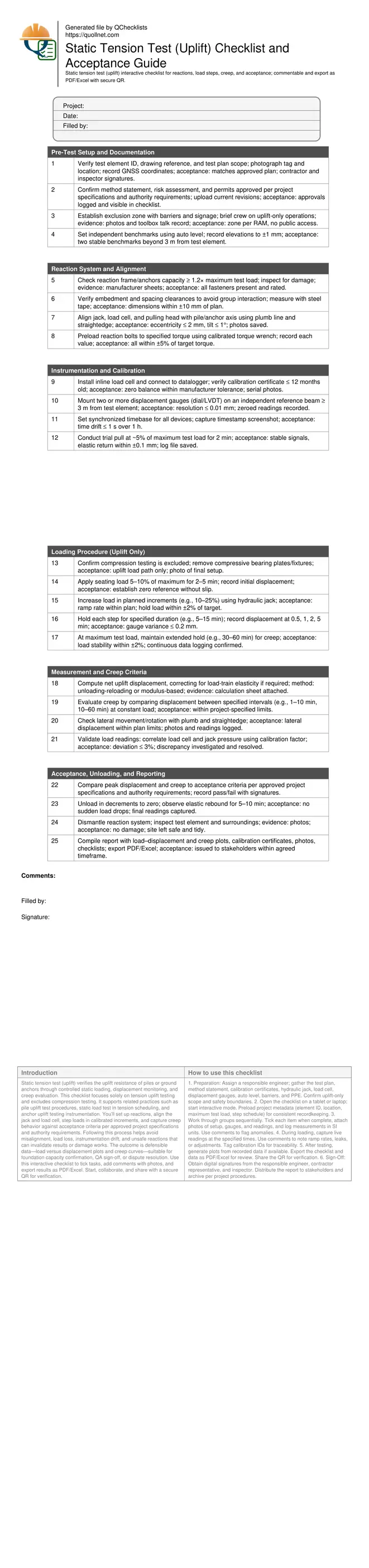
Pre-Test Setup and Documentation
Reaction System and Alignment
Instrumentation and Calibration
Loading Procedure (Uplift Only)
Measurement and Creep Criteria
Acceptance, Unloading, and Reporting
Purpose and Scope of Uplift Static Tension Testing
An uplift static tension test confirms the resistance of piles or ground anchors to tensile forces that can occur from wind, overturning, hydrostatic uplift, or seismic effects. The scope here is limited to tension-only testing; compression tests are intentionally excluded to avoid mixing procedures and acceptance criteria. The process begins with documentation control and a method statement that defines maximum test load, step increments, hold durations, instrumentation, and safety boundaries. Proper establishment of independent reference beams and synchronized timebases ensures any displacement recorded truly reflects test element behavior, not frame movement or clock drift. This disciplined sequence prevents false readings caused by eccentric loading, leaks, or unstable reactions. When executed correctly, the test produces clear load–displacement curves and creep behavior that inform design confirmation or remediation decisions, all backed by photos, calibration certificates, and digital signatures that withstand technical review and audit.
- Uplift-only scope; compression testing is excluded.
- Independent reference beam avoids frame movement errors.
- Synchronized timebases ensure reliable creep timing.
- Method statement governs loads, holds, and safety.
Reaction System, Alignment, and Load Increments
The reaction system must safely deliver the required tensile load without unintended bending or slip. Verify the frame or anchors have capacity above the maximum test load and are free from defects. Maintain clearances and embedments to limit group interaction and soil disturbance near the test element. Axial alignment is critical: small eccentricities can inflate measured displacement and misrepresent capacity, so use a plumb line, straightedge, and visual checks to confirm. Load steps should follow an agreed schedule with controlled ramp rates and timed holds at each increment. Limit pressure fluctuations by using a stable hydraulic manifold and vigilant monitoring. Recording displacement at consistent time points during each hold yields comparable datasets across tests. This disciplined approach allows engineers to detect non-linear behavior, bedding-in, and stiffness changes while keeping personnel safe and equipment within rated limits.
- Reaction capacity exceeds maximum test load.
- Alignment limits eccentricity and tilt.
- Controlled ramp rates and timed holds.
- Consistent time-tagged displacement readings.
Creep Measurement, Acceptance, and Reporting
Creep assessment at the maximum test load distinguishes immediate elastic response from time-dependent movement. Maintain a steady load, typically within ±2% of target, and capture displacement at prescribed intervals. Evaluate the difference between early and later readings (for example, 1–10 minutes versus 10–60 minutes) to determine stability. Net uplift displacement may require correction for elastic shortening of the load train; apply an unloading–reloading cycle or modulus-based calculation, and document the method. Acceptance depends on displacement and creep limits defined in the approved project specifications and authority requirements. After unloading, document rebound, remove the reaction system, and restore the site. A complete report includes plots, calibration certificates, photos, raw logs, and sign-offs, delivered in an exportable PDF/Excel package to facilitate peer review and recordkeeping.
- Hold load steady during creep assessment.
- Compute creep over defined time windows.
- Correct for load-train elasticity when required.
- Report includes plots, certificates, and photos.
How to Use This Interactive Uplift Test Checklist
- Preparation: Assign a responsible engineer; gather the test plan, method statement, calibration certificates, hydraulic jack, load cell, displacement gauges, auto level, barriers, and PPE. Confirm uplift-only scope and safety boundaries.
- Open the checklist on a tablet or laptop; start interactive mode. Preload project metadata (element ID, location, maximum test load, step schedule) for consistent recordkeeping.
- Work through groups sequentially. Tick each item when complete, attach photos of setup, gauges, and readings, and log measurements in SI units. Use comments to flag anomalies.
- During loading, capture live readings at the specified times. Use comments to note ramp rates, leaks, or adjustments. Tag calibration IDs for traceability.
- After testing, generate plots from recorded data if available. Export the checklist and data as PDF/Excel for review. Share the QR for verification.
- Sign-Off: Obtain digital signatures from the responsible engineer, contractor representative, and inspector. Distribute the report to stakeholders and archive per project procedures.
Call to Action
- Start Checklist Tick off tasks, leave comments on items or the whole form, and export your completed report to PDF or Excel—with a built-in QR code for authenticity.
- Download Excel - Static Tension Test (Uplift)
- Download PDF - Static Tension Test (Uplift)
- View Image - Static Tension Test (Uplift)
Cite & Embed
“Static Tension Test (Uplift) by Quollnet”
with a link to
this source page.
FAQ
Question: What distinguishes an uplift static tension test from a compression test?
Question: How many load steps and how long should holds be during the test?
Question: What instruments are required to measure load and displacement accurately?
Question: How is creep assessed and what indicates acceptance?
Related Articles
Broader reading and guidance connected to this checklist topic.



How To Perform a Concrete Compressive Strength Test: Cubes & Cylinders
Slump Test Vs Slump Flow Test: When To Use Each

Related Checklists
Keep the workflow moving with nearby templates chosen from similar checklist content.