
Inspection and Test Plan for Method Statement – Commissioning of Gaseous Fire Suppression Systems (FM‑200 / Novec 1230)
AI-assisted inspection and test plan connected to a method statement, with PDF and Excel export.
More than a static template
Unlike a downloadable Word or PDF template, this ITP is an AI-assisted editable starting point directly connected to its method statement. Every inspection activity, hold point, and acceptance criterion is structured and ready to adapt to your project.
- AI-assisted customization — Tailor inspection activities and acceptance criteria to your specific project scope.
- Linked method statement — This ITP is connected to the corresponding method statement describing the work sequence.
- Multiple export formats — Download as a formatted PDF or editable Excel spreadsheet.
- Editable starting point, not a final document — Review and verify all content against your project specifications and standards before use.
What you can customize
When you save this ITP to your account, every inspection row becomes editable. You can add, remove, or modify:
- Inspection activity — Description of what is being inspected.
- Inspection type — Hold point (H), Witness point (W), Review (R), or Monitor (M).
- Responsibility — Contractor, subcontractor, engineer, or client.
- Frequency — How often the inspection occurs.
- Acceptance criteria — Referenced standard or specification requirement.
- Records — Forms, test reports, or checklists required as evidence.
Why this ITP is used
To ensure all commissioning activities are controlled, witnessed as required, and verified against codes, OEM procedures, and the approved C&E matrix.
Who uses this inspection and test plan
Commissioning teams, OEM representatives, QA/QC, HSE, and Client/Consultant witnesses.
When this ITP is prepared and submitted
After installation completion and pre-functional checks, prior to placing the system into service.
Who receives or approves this ITP
The ITP is usually submitted to the client representative, consultant, resident engineer, or project management consultant for review and approval before the related work activity starts.
Inspection scope
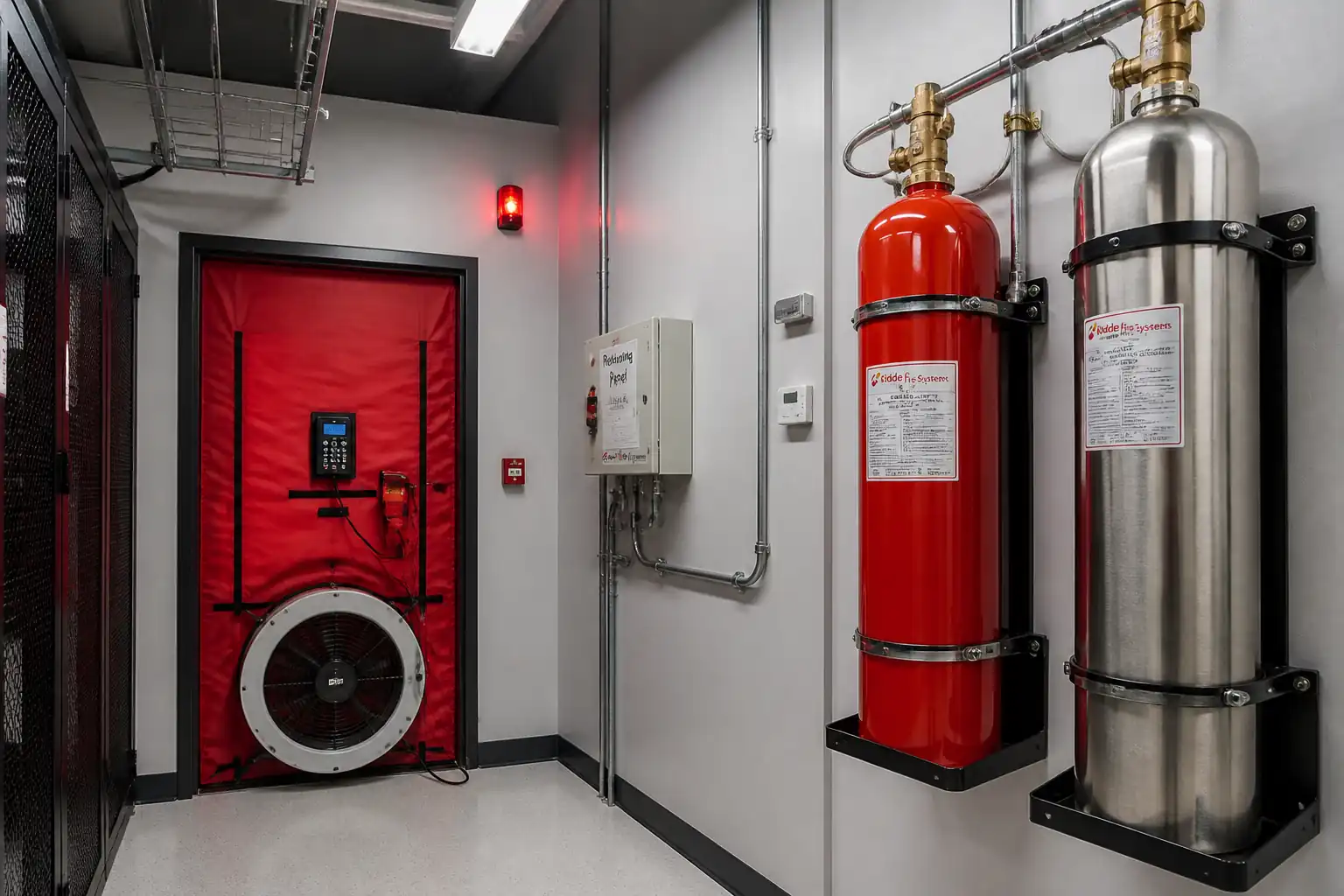
Document verification, HSE impairment controls, cylinder weight/pressure checks, release circuits, abort and manual releases, interfaces, room integrity test, restoration, and handover.
Typical hold, witness, and review points
Impairment setup (Hold), Cylinder weighing (Witness), Abort testing (Hold), Door fan test (Hold), Actuator functional simulation (Witness).
Typical inspection records
Pre-functional checklists, weight/pressure logs, circuit test sheets, C&E verification, interface tests, door fan report, restoration certificate, training log.
Important approval note
This ITP is an AI-assisted editable starting point, not a pre-approved document. Before use on any project, all inspection activities, hold points, and acceptance criteria must be reviewed and approved by the relevant parties (superintendent, principal contractor, or client representative) in accordance with your contract and project quality plan.
Always verify acceptance criteria against your applicable drawings, specifications, and regulatory requirements. Hold points must be confirmed with the relevant authority before work proceeds past that point.
Inspection and test plan
| Activity | Inspection / Test | Acceptance Criteria | Responsibility | Record |
|---|---|---|---|---|
| Document & Drawing Verification | Check approvals for C&E, as-builts, OEM manuals, calculations. | All current and approved; revisions consistent. | QA/QC Engineer | Pre-test checklist / approvals register |
| Calibration Verification | Check calibration certs for scale, DMM, blower door manometer. | Valid within 12 months or per project; traceable to standards. | QA/QC Engineer | Calibration register copies |
| HSE Setup & Impairment Controls | Verify LOTO, safety pins, inhibits, signage, barriers. | No possibility of discharge; PTW active; controls signed off. | HSE Officer / Cx Manager | PTW; LOTO log; impairment form |
| Visual/Mechanical Inspection | Cylinders, brackets, piping, nozzles, relief vents, labels. | Matches drawings/spec; no damage/corrosion; labels legible. | QA/QC Engineer / OEM Rep | Inspection checklist; photos |
| Cylinder Pressure (Temp-Corrected) | Read gauges; compare to OEM pressure-temperature chart. | Within OEM allowable band. | OEM Rep | Pressure log |
| Cylinder Weight Check | Weigh cylinders; compute net fill vs nameplate. | Within −5% to +5% or OEM tolerance [Verify]. | OEM Rep / QA/QC | Weight sheets; calibration refs |
| Release Circuit Integrity | Continuity/EOL with dummy loads; no megger. | Resistance/current within OEM limits; panel normal. | ELV Supervisor | Circuit test sheets |
| Manual Release Test (Simulated) | Operate manual release under inhibit/test mode. | Pre-discharge alarms and timer initiate; no discharge. | ELV Supervisor / Consultant | Functional log; C&E checklist |
| Abort Function Test | Activate abort during countdown; observe logic. | Discharge prevented while held; logic per C&E. | ELV Supervisor / OEM Rep / Consultant | Abort test record |
| Detection Logic / Cross-Zone | Initiate two-detect or programmed condition. | Sequence matches C&E; annunciation correct. | Fire Specialist / Consultant | C&E verification sheet |
| Interfaces (HVAC/Dampers/Relief) | Simulate release; verify shutdown/closure/opening. | Responses within specified time; status indication OK. | ELV Supervisor | Interface test sheets |
| Notification Appliances | Sounders/strobes/messages. | Meets NFPA 72 audibility/intelligibility [Verify]. | ELV Supervisor | A/V log |
| Room Integrity (Door Fan) Test | Blower door at 50 Pa; compute predicted hold time. | Predicted hold time ≥ design (typically ≥10 min) [Verify]. | Door Fan Specialist / QA/QC / Consultant | Integrity test report |
| Actuator Functional (No-Discharge) | Energize via test box/lockout; measure coil current. | Within OEM range; no valve movement; indications correct. | OEM Rep / Consultant | Actuator test sheet |
| System Restoration | Remove inhibits as authorized; restore normal; verify supervision. | System normal; all pins/seals reinstated; logs clear. | Fire Specialist / HSE | Restoration certificate |
| Handover & Training | O&M and training delivery; acceptance sign-off. | Documents complete; attendance signed; punch-list closed. | Commissioning Manager / Client Rep | Training log; acceptance form |
This table is a read-only public reference. Download the PDF or Excel version, or customize this ITP to edit it for your project.
Frequently asked questions
Related method statement
This Inspection and Test Plan is associated with the Method Statement – Commissioning of Gaseous Fire Suppression Systems (FM‑200 / Novec 1230) method statement, which describes the step-by-step construction sequence, resources, materials, equipment, safety controls, and environmental controls for this activity.
View the Method Statement – Commissioning of Gaseous Fire Suppression Systems (FM‑200 / Novec 1230) method statement →Continue with related inspection, method statement, article, and checklist resources.