
Method Statement – Post-Tensioned Slab Stressing and Grouting (Tendons, Elongations, Anchors, Grout QA/QC) – Method Statement
AI-assisted method statement with matching ITP, PDF download, and Excel export.
More than a static template
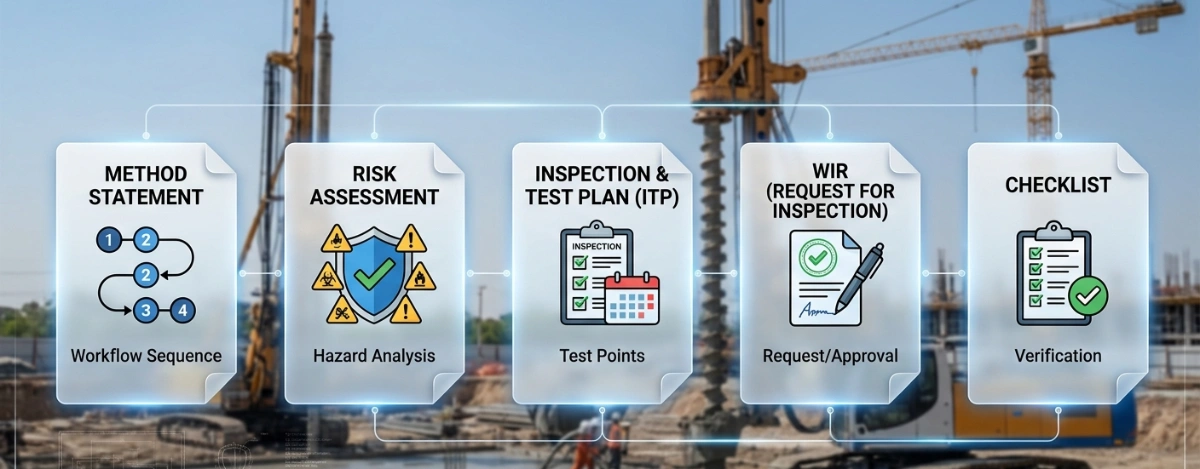
Unlike a downloadable Word or PDF template, this method statement is an AI-assisted editable starting point connected directly to a matching Inspection and Test Plan. Every section is structured, project-adaptable, and ready to export.
- AI-assisted drafting — Customize every section with AI for your specific project scope.
- Linked ITP — A matching inspection and test plan is generated alongside the method statement.
- Multiple export formats — Download as a formatted PDF or editable Excel spreadsheet.
- Editable starting point, not a final document — Review, verify, and adjust all content against your project requirements before use.
Static template vs. Quollnet workflow
| Feature | Static template | Quollnet |
|---|---|---|
| Project-specific content | Manual fill-in required | AI-assisted customization |
| Linked ITP | Separate document, no link | Matching ITP included |
| Export formats | Usually PDF only | PDF and Excel |
| Structured sections | Free-form layout | 13 standardized sections |
| Saved to your account | Local file only | Cloud-saved, reusable |
| Content accuracy | You verify everything | AI-assisted, you still verify |
| Cost | Often free but time-intensive | Free to customize and download |
What you can customize
When you save this method statement to your account, every section becomes editable. The following 13 sections are included:
- Scope — Defines the activity and its boundaries.
- References — Standards, specifications, and drawings.
- Responsibilities — Roles and accountabilities.
- Resources — Labour, plant, and equipment summary.
- Materials — Materials and compliance requirements.
- Equipment — Tools and equipment details.
- Prerequisites — Hold points and pre-conditions.
- Method sequence — Step-by-step construction sequence.
- Safety controls — HSE risk controls and PPE.
- Environmental controls — Environmental mitigation measures.
- QA/QC — Quality inspection and test requirements.
- ITP — Inspection and Test Plan table (has its own page).
- Attachments — Referenced drawings and documentation.
Why this method statement is used
This method statement is used to define and communicate the approved procedure for carrying out method statement – post-tensioned slab stressing and grouting (tendons, elongations, anchors, grout qa/qc) on site. It ensures the work is planned in advance, the correct resources and controls are in place, and all personnel understand responsibilities, sequence, quality requirements, and safety controls before work begins. It aligns site execution with the documented scope and acceptance expectations.
Who uses this method statement
This method statement is used by contractors, site supervisors, project engineers, QA/QC engineers, HSE officers, consultants, and client representatives. It serves as a shared reference for planning, execution, supervision, inspection, and approval of the activity on site.
When it is prepared and submitted
The method statement is prepared before the work activity starts and submitted as part of the pre-construction documentation package for review and approval.
Who reviews or approves it
The method statement is usually submitted to the client representative, consultant, resident engineer, or project management consultant for review and approval before the work commences.
Important approval note
This method statement is an AI-assisted editable starting point, not a pre-approved document. Before use on any project, all content must be reviewed and approved by the relevant parties (superintendent, principal contractor, or client representative) in accordance with your contract and project quality plan.
For example: if your specification requires a departure from a referenced standard, that departure must be documented and approved separately — this method statement will not capture that automatically. Always verify against your applicable drawings, specifications, and regulatory requirements.
Method statement content
Scope
Work Summary
This method statement covers end-to-end activities for bonded post-tensioned (PT) slab works:
- Pre-pour tendon/duct/anchor installation checks and records.
- Post-pour pre-stressing readiness checks including concrete strength verification.
- Stressing operations using calibrated hydraulic jacks and pumps.
- Monitoring and recording of jack pressure, target force and tendon elongations.
- Anchor wedge seating verification and strand cut-off.
- Grout material control, mixing, testing, injection, venting, and capping of tendons/anchorages.
- QA/QC inspections, witness and hold points, and record handover.
Exclusions
- Design of PT system and calculation of theoretical elongations (by Designer/PT specialist).
- Formwork/falsework design and general concreting method (covered under separate MS).
Key Performance Requirements
- Stress tendons only when concrete has achieved the specified minimum compressive strength and curing age [Verify per project specifications].
- Measured tendon elongations within ±7% of calculated theoretical elongations accounting for friction and wobble [Verify per project specifications/PTI].
- Anchor seating (wedge draw-in) within supplier’s limits (typically 4–8 mm per live end for multi-strand systems) [Verify per system manual].
- Grout meets flow, bleed, density, and strength criteria; ducts completely filled with no voids.
- Completion of inspection/test records and as-built documentation.
References
| Document Type | Reference / Number | Revision | Notes |
|---|---|---|---|
| Standard | PTI (latest edition) [Verify edition] | ||
| Standard | ACI 318 (latest) | Concrete strength prior to stressing per design/ACI [Verify per project specs] | |
| Standard | ASTM A416/A416M | Grade 270 typical [Verify] | |
| Standard | ASTM E4 / ISO 7500-1 | Calibration certificates within validity [Verify] | |
| Standard | BS EN 445/446/447 | Flow, bleed, density criteria for PT grout | |
| Standard | BS EN 523 / EN 613 | For bonded multi-strand ducts and anchorage caps | |
| Standard | ISO Standards | Apply per project IMS [Verify] |
Responsibilities
| Role | Responsibility | Name / Party |
|---|---|---|
| Project Manager | Project Manager | Main Contractor |
| Construction Manager | Construction Manager / Site Engineer | Main Contractor |
| PT Supervisor | PT Specialist Supervisor | PT Subcontractor |
| HSE Officer | HSE Officer | Main Contractor |
| QA/QC Engineer | QA/QC Engineer | Main Contractor |
| Land Surveyor | Surveyor | Main Contractor |
| PT Jack Operator | Certified PT Jack Operator | PT Subcontractor |
| Grouting Technician | Grouting Crew Leader / Technician | PT Subcontractor |
| Consultant | Consultant Representative | Engineer/Client |
Resources
| Resource Type | Description | Quantity | Remarks |
|---|---|---|---|
| Personnel | PT Supervisor, Jack Operator, 2x riggers, 1x recorder | 1 crew | |
| Personnel | Grout technician, pump operator, 2x hose men, 1x QA sampler | 1 crew | |
| Equipment/Support | First aider, spill kit, eye-wash near grouting station | As required |
Materials
| Material | Specification / Grade | Quantity | Remarks |
|---|---|---|---|
| Strand | Low-relaxation | As per drawings | |
| Duct | Diameter per design [Verify] | As per drawings | |
| Anchorage | Supplier manual | As per drawings | |
| Grout | Low bleed, thixotropic | As required | |
| Water | Potable | As required | |
| Sealant | Non-shrink, compatible | As required |
Equipment
| Equipment | Capacity / Type | Quantity | Inspection Required |
|---|---|---|---|
| Hydraulic jack | Up to 2,000 kN [Verify] | 1–2 | |
| Pump & gauges | Pressure up to 700 bar [Verify] | 1 set | |
| Measuring tools | As required | ||
| Grout plant | Output ≥30 l/min [Verify] | 1–2 sets | |
| QA test kit | 1 kit | ||
| Compressor | ≥6 bar | 1 | |
| Cutting tools | As required |
Prerequisites
Documentation and Approvals
- Approved PT shop drawings, profiles, anchor layouts, stressing/grouting plans.
- Approved Method Statement and ITP with defined hold/witness points.
- Theoretical elongation calculations per tendon (including friction coefficient μ and wobble k) signed by Designer/PT specialist.
- Jack/pump/gauge calibration certificates valid and traceable to national standards.
- Grout product data sheets, MSDS, and approved submittals; grout trial test results.
- Permits: Hot work (strand cut), Working at height (if edges open), Pressure systems, Confined space (if applicable) [Verify per project HSE plan].
Site Readiness
- Tendon/duct/anchor installation completed and pre-pour inspection recorded; vents at all high points and anchorages fitted and tagged.
- Concrete placed and cured; access and lighting available; edge protection in place.
- Concrete compressive strength reports: minimum required for stressing achieved (typical ≥75% f’c, not less than 21–25 MPa for slabs) [Verify per project specs].
- Anchor pockets de-shuttered and cleaned; bearing concrete sound (no honeycombing). Any defects repaired and approved.
- Exclusion zones and barricades planned; signage and spotters arranged.
- Emergency plan and first aid arrangements briefed to crews.
Method Sequence
| Step | Activity | Description | Responsibility | Inspection / Hold Point |
|---|---|---|---|---|
| 1 | Pre-pour tendon/duct/anchor inspection | Verify tendon layout, duct diameter/continuity, supports/chairs at spacing per drawings (typ. ≤1.0–1.5 m) [Verify], cover blocks fixed, anchors/trumpets aligned; vents/drains installed; duct joints taped/sealed. Record as-built and sign off. | PT Supervisor / QA-QC / Consultant (W) | Visual + blow-through if required |
| 2 | Concrete strength & readiness to stress (HOLD) | Review cubes/cylinders; confirm minimum compressive strength and minimum curing age per spec. Inspect anchor pockets and surrounding concrete; repair defects. | QA/QC Engineer / Consultant (H) | Document review + site check |
| 3 | Jack/gauge/hose verification | Check jack ID, gauge ID, calibration validity, pressure-force chart; verify hose condition, whip checks; conduct no-load function test and leak check. | PT Supervisor / QA-QC | Visual + documents |
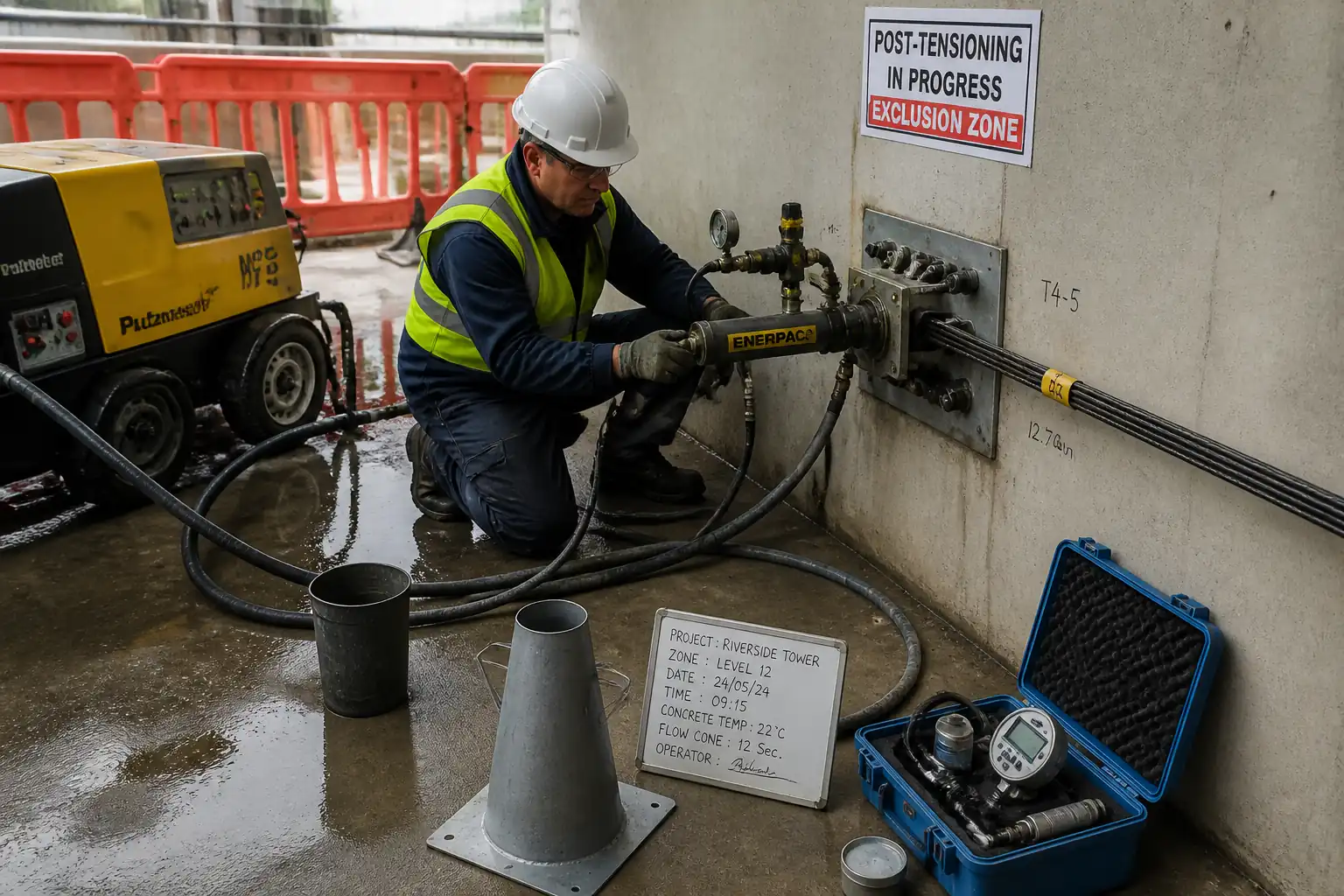
| 4 | Establish exclusion zone | Barricade the line of tendon and back of jack; post spotter; brief crew; confirm edge protection. | HSE Officer / Supervisor | Site inspection |
| 5 | Set up stressing end | Clean anchor pocket; install wedges lightly greased as per supplier; seat jack concentrically; mark strand(s) for zero reference; measure free length for elongation calc. | PT Jack Operator | Visual |
| 6 | Stressing operation (Consultant Witness) | Load sequence: 0.10Pj take-up; 0.25Pj hold/inspect; 0.50Pj hold; 0.75Pj hold; 1.00Pj target hold ≥60 s. Record gauge pressure and jack force each stage. | PT Jack Operator / PT Supervisor / Consultant (W) | Witness |
| 7 | Elongation measurement & comparison | Measure strand extension (jack stroke/LVDT and mark-to-mark). Correct for seating draw-in. Compare to theoretical elongation including μ and k losses. | PT Supervisor / QA-QC | Review |
| 8 | Anchor seating and lock-off | Release jack slowly to seat wedges; confirm wedge draw-in within supplier limit; re-check final force if specified; cut strand tail to specified projection; cap and seal. | PT Jack Operator / PT Supervisor | Visual + measurement |
| 9 | Stressing sequence across slab | Follow sequence from mid-span towards supports, symmetrical and alternating tendons to minimize differential shortening. Complete per pour strip plan. | Site Engineer / PT Supervisor | Supervision |
| 10 | Pre-grouting checks (HOLD) | Verify all tendons stressed/accepted; anchor caps installed; ducts proven continuous and free of debris/moisture (blow-through). Prepare vents and return lines. | PT Supervisor / QA-QC / Consultant (H) | Witness |
| 11 | Grout batching and testing | Mix per supplier data sheet; conduct flow cone, density and bleed setup; maintain grout temperature 5–30°C [Verify]; continuous mixing/agitator running. | Grouting Technician / QA-QC | On-site tests |
| 12 | Grout injection (Consultant Witness) | Inject from low end; open vents sequentially until neat grout flows air-free; close vent and proceed; maintain injection pressure 0.5–1.0 MPa unless limited by system [Verify]. Top-up and hold pressure 2 min at live end. | Grouting Technician / PT Supervisor / Consultant (W) | Witness |
| 13 | Post-grout checks | Inspect for leaks/void indicators; seal vents; label tendons; clean equipment and area. Cure grout caps if applicable. | PT Supervisor / QA-QC | Visual |
| 14 | Documentation and handover | Compile stressing sheets, elongation comparisons, calibration certificates, grout logs, test results, as-built tendon layout; submit for Consultant approval. | QA/QC Engineer | Document review |
Health & Safety Controls
Key Hazards and Controls
1) Hazard: Sudden strand release/whiplash during stressing
- Likely consequence: Severe laceration, struck-by injury, fatality
- Engineering/procedural control: Establish exclusion zone along tendon line and behind jack; use jack restraint handles; inspect wedges/anchor seats prior to loading; load in stages with holds; never stand inline with strand
- Required PPE: Safety helmet with chin strap, eye/face protection, cut-resistant gloves, safety boots
- Collective preventive measure: Physical barricades and signage; spotter controlling access
- Inspection/permit/supervision: PT Supervisor and HSE Officer verify zone; pre-start checklist; toolbox talk; [Verify per project HSE plan]
2) Hazard: Hydraulic hose failure or jack instability
- Likely consequence: Fluid injection injury, uncontrolled movement
- Engineering/procedural control: Use pressure-rated hoses with whip-checks; protect hoses from abrasion; secure jack on flat bearing; conduct leak/pressure test before stressing
- PPE: Eye/face shield, gloves rated for oil, protective clothing
- Collective preventive measure: Drip trays and spill absorbents; barriers around pump
- Inspection/permit/supervision: Daily equipment check; calibration/maintenance records; competent operator only
3) Hazard: Anchor pocket concrete failure/blowout
- Consequence: Sudden loss of load, falling debris
- Control: Inspect and repair honeycombs; adhere to minimum concrete strength before stressing; avoid eccentric jack setup
- PPE: Helmet, goggles, gloves
- Collective measure: Exclusion of personnel beneath/behind slab edges
- Inspection/permit/supervision: QA/QC hold point to verify strength and pocket condition
4) Hazard: Working near slab edges/openings
- Consequence: Fall from height
- Control: Install guardrails and toe-boards; use fall arrest where necessary; maintain good housekeeping
- PPE: Harness with double lanyard if guardrails absent
- Collective measure: Edge protection systems, safety nets where required
- Inspection/permit/supervision: Work at height permit; daily inspection by Supervisor
5) Hazard: Hot works for strand cut-off
- Consequence: Burns, fire, fumes
- Control: Hot work permit; fire watch; non-sparking alternatives where possible; keep extinguishers ready; remove combustibles
- PPE: Face shield, heat-resistant gloves, FR clothing, hearing protection
- Collective measure: Fire blanket/screening; dedicated cut area
- Inspection/permit/supervision: Permit-to-work; gas tester if required; post-work fire watch 30 min [Verify]
6) Hazard: High-pressure grout injection
- Consequence: Hose whip, injection injury, blowout at vents
- Control: Pressure relief valve; rated hoses; secure all couplings; stand clear of vents during pressurization; do not exceed specified pressure
- PPE: Face shield, gloves, long sleeves
- Collective measure: Barricade vents; clear communication via radios/hand signals
- Inspection/permit/supervision: Pre-grout equipment inspection; EN 446 compliance check
7) Hazard: Cementitious grout dust and alkaline splash
- Consequence: Eye/skin irritation, chemical burns
- Control: Wet mixing inside guarded station; closed bags handling technique; emergency eyewash available; SDS briefing
- PPE: Goggles/face shield, nitrile gloves, long sleeves, dust mask (P2) when handling dry powder
- Collective measure: Local containment and wash-down bunded area
- Inspection/permit/supervision: SDS on site; HSE inspections
8) Hazard: Noise and vibration from pumps/compressors
- Consequence: Hearing loss
- Control: Maintain equipment; limit exposure time; position equipment away from personnel
- PPE: Hearing protection
- Collective measure: Acoustic barriers where feasible
- Inspection/permit/supervision: Noise assessment [Verify per local regulations]
9) Hazard: Manual handling of ducts, hoses, and grout bags
- Consequence: Musculoskeletal injuries
- Control: Use team lifts and mechanical aids; split loads; proper ergonomics training
- PPE: Gloves, back support if approved
- Collective measure: Trolleys/hoists
- Inspection/permit/supervision: Supervisor monitors handling practices
10) Hazard: Energized electrical equipment/wet environment
- Consequence: Electric shock
- Control: RCD/GFCI protection; IP-rated connectors; keep cables off wet ground; lockout/tagout for maintenance
- PPE: Dielectric gloves when required
- Collective measure: Cable management racks
- Inspection/permit/supervision: Electrical permit where applicable; weekly checks
Note: All controls to be aligned with project HSE plan and local regulations. Conduct daily pre-start briefings, last-minute risk assessments, and ensure first aid/spill response readiness.
Environmental Controls
Environmental Risks and Controls
- Cementitious grout washout (high pH):
- Control: Mix and clean-out in bunded, lined area; collect wash water for neutralization and off-site disposal by licensed contractor.
-
Monitoring: pH testing of effluent; records retained.
-
Grout spills/leaks from ducts or equipment:
-
Control: Inspect ducts/vents before injection; use drip trays under pumps; spill kits at station; immediate containment with absorbents; remove contaminated soil if any.
-
Dust from dry grout handling:
-
Control: Minimize bag drops; use vacuum attachments; damp-wipe; avoid compressed air for cleaning.
-
Noise from compressor/pump:
-
Control: Place equipment away from receptors; schedule within permitted hours; maintain equipment.
-
Waste management:
-
Control: Segregate grout bags (empty) and general waste; dispose per project EMP; keep material safety data sheets available.
-
Water use and silt control:
-
Control: Use potable water efficiently; prevent discharge to storm drains; use filters/screens in wash-out.
-
Resource efficiency:
- Control: Batch grout to actual demand to minimize waste; keep continuous mixer running to avoid set losses.
Verification: Environmental inspections and checklists per ISO 14001 and project EMP; records retained. [Verify per project EMP/local regulations]
Quality Assurance / Quality Control
General
- Works executed by approved PT specialist per approved PT drawings and supplier manuals.
- Use only calibrated equipment with traceable certificates.
- Maintain tendon-wise records for traceability.
Stressing QA/QC
- Theoretical elongations prepared by PT Designer including friction μ and wobble k.
- Acceptance: Measured elongation within ±7% of theoretical [Verify]. Outside tolerance: halt, investigate (jack leakage, wedge slip, duct blockage, friction variation); perform controlled re-stress if instructed; raise NCR if unresolved.
- Jacking force Pj and lock-off force to meet design [Verify]. Stage hold ≥60 s at final to stabilize readings.
- Wedge seating/draw-in within supplier limits (typ. 4–8 mm per live end) [Verify]. Anchor bearing concrete free of defects.
- Sequence: Stress from mid-panels to supports, alternating tendons to limit distortions.
Grout QA/QC (per BS EN 445/446/447 and PTI)
- Materials: Pre-packaged grout only; chloride content within supplier limits (typically <0.1% by mass of cement) [Verify].
- Mixing: Water-to-grout ratio per data sheet (typ. 0.33–0.43) [Verify]. Maintain grout temp 5–30°C [Verify]. Continuous mixing with agitator.
- Tests per batch: Flow cone time (target 11–30 s); density (per data sheet, typ. 1.90–2.10 g/cm³); bleed test setup (limit ≤0.5%); visual stability (no segregation). Compressive strength if specified (e.g., ≥30 MPa at 7 days) [Verify].
- Injection: Pressure 0.5–1.0 MPa unless system limit lower [Verify]; inject from low to high point; vent until air-free; close vents sequentially; hold pressure 2 minutes; record volumes, start/finish times, temperatures.
- Completion: All vents/caps sealed and labeled; leaks repaired; records compiled.
Records
- Pre-pour PT installation checklist and photos.
- Concrete strength test certificates.
- Jack/gauge/hose calibration certificates and ID registers.
- Stressing sheets: tendon ID, Pj, pressures, stage holds, measured elongations, theoretical comparison, seating draw-in, operator signatures, Consultant witness signatures.
- Grouting logs: tendon ID, batch numbers, W/C, flow/density/bleed results, injection pressure, volume, start/finish times, temperature, vent status, signatures/witness.
- As-built tendon layout and deviations (if any) approved.
Tolerances [Verify per project specifications]
- Tendon profile elevation: ±10 mm typical.
- Anchor plate alignment: ≤3 mm eccentricity relative to tendon axis.
- Duct curvature: No kinks; minimum bend radius per supplier.
- Exposed strand tail after cut: As specified (e.g., flush to cap or ≤25 mm inside cap).
Attachments
- Sample: Pre-pour PT tendon/duct/anchor inspection checklist.
- Template: Tendon-wise stressing sheet with pressure/force/elongation and seating fields.
- Template: Theoretical elongation calculation sheet with μ and k factors.
- Sample: Grouting log and EN 445 test report forms.
- Register: Jack/pump/gauge calibration certificates and validity tracker.
- PT system supplier manuals (stressing and grouting procedures).
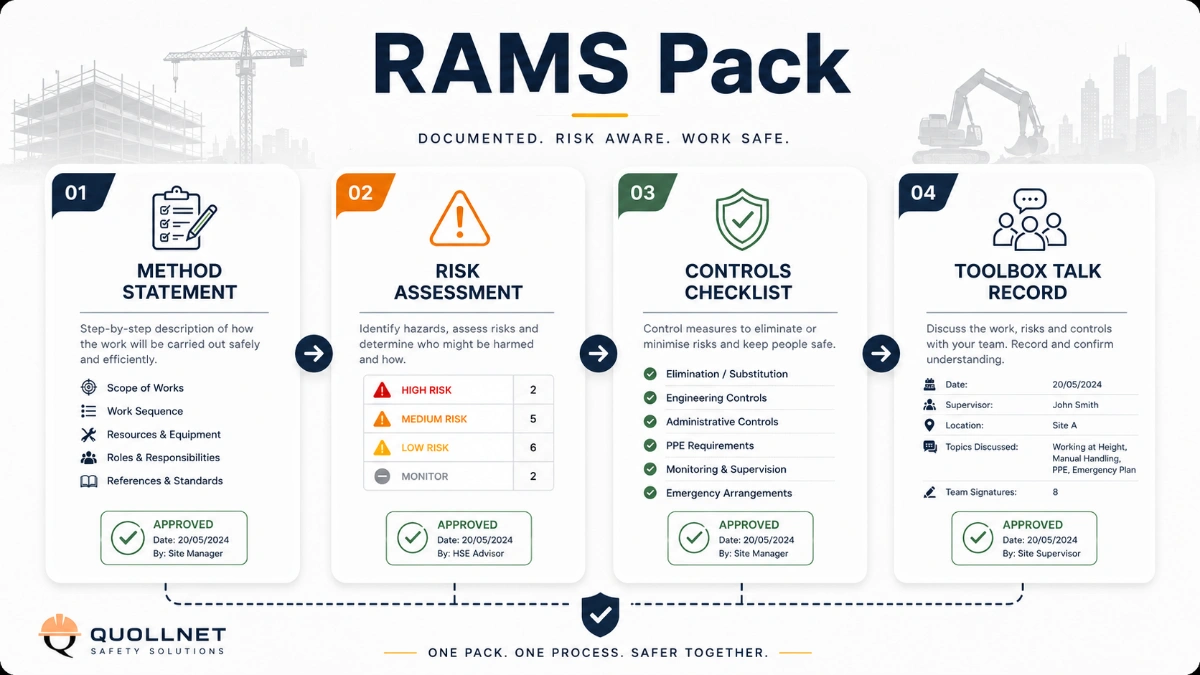
- Risk Assessment/Method Statement (RAMS) including HIRA.
- Permits: Hot work, pressure systems, working at height [as applicable].
- SDS: PT grout and chemical products.
- As-built tendon layout drawing and mark-up legend.
This content is a read-only public reference. Download or customize to get an editable version.
ITP preview
The first inspection activities from the linked ITP for Method Statement – Post-Tensioned Slab Stressing and Grouting (Tendons, Elongations, Anchors, Grout QA/QC):
| Activity | Inspection / Test | Acceptance Criteria | Responsibility | Record |
|---|---|---|---|---|
| Pre-pour tendon/duct/anchor installation | Visual, duct continuity (blow-through/rodded) | Layout/profile/cover as per drawings; anchors aligned; vents installed at all high points and ends; ducts sealed | PT Supervisor / QA-QC / Consultant (W) | PT installation checklist, photos |
| Concrete strength prior to stressing (HOLD) | Review compressive strength reports; age verification | Minimum required strength and age achieved per design/spec [Verify] | QA-QC / Consultant (H) | Test certificates; hold point release |
| Jack/gauge calibration verification | Review calibration certificates vs asset IDs | Valid calibration; pressure-force chart on site | QA-QC / PT Supervisor | Equipment inspection form |
Showing 3 of 10 inspection activities. View full ITP →
Related Inspection and Test Plan
An Inspection and Test Plan (ITP) is available for Method Statement – Post-Tensioned Slab Stressing and Grouting (Tendons, Elongations, Anchors, Grout QA/QC). The ITP defines the inspection activities, acceptance criteria, hold and witness points, responsible parties, and records required to verify the work described in this method statement.
View the Method Statement – Post-Tensioned Slab Stressing and Grouting (Tendons, Elongations, Anchors, Grout QA/QC) ITP →Frequently asked questions
Continue with related Quollnet resources connected to this method statement.