
Method Statement: Low-Current (ELV/ICT) Systems Handover and As‑Built Documentation – Method Statement
AI-assisted method statement with matching ITP, PDF download, and Excel export.
More than a static template
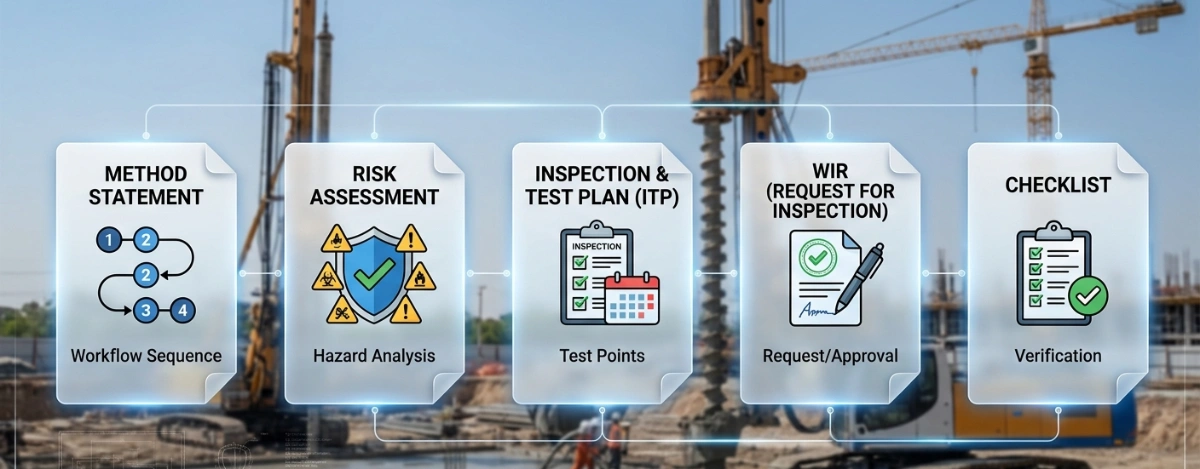
Unlike a downloadable Word or PDF template, this method statement is an AI-assisted editable starting point connected directly to a matching Inspection and Test Plan. Every section is structured, project-adaptable, and ready to export.
- AI-assisted drafting — Customize every section with AI for your specific project scope.
- Linked ITP — A matching inspection and test plan is generated alongside the method statement.
- Multiple export formats — Download as a formatted PDF or editable Excel spreadsheet.
- Editable starting point, not a final document — Review, verify, and adjust all content against your project requirements before use.
Static template vs. Quollnet workflow
| Feature | Static template | Quollnet |
|---|---|---|
| Project-specific content | Manual fill-in required | AI-assisted customization |
| Linked ITP | Separate document, no link | Matching ITP included |
| Export formats | Usually PDF only | PDF and Excel |
| Structured sections | Free-form layout | 13 standardized sections |
| Saved to your account | Local file only | Cloud-saved, reusable |
| Content accuracy | You verify everything | AI-assisted, you still verify |
| Cost | Often free but time-intensive | Free to customize and download |
What you can customize
When you save this method statement to your account, every section becomes editable. The following 13 sections are included:
- Scope — Defines the activity and its boundaries.
- References — Standards, specifications, and drawings.
- Responsibilities — Roles and accountabilities.
- Resources — Labour, plant, and equipment summary.
- Materials — Materials and compliance requirements.
- Equipment — Tools and equipment details.
- Prerequisites — Hold points and pre-conditions.
- Method sequence — Step-by-step construction sequence.
- Safety controls — HSE risk controls and PPE.
- Environmental controls — Environmental mitigation measures.
- QA/QC — Quality inspection and test requirements.
- ITP — Inspection and Test Plan table (has its own page).
- Attachments — Referenced drawings and documentation.
Why this method statement is used
This method statement is used to define and communicate the approved procedure for carrying out method statement: low-current (elv/ict) systems handover and as‑built documentation on site. It ensures the work is planned in advance, the correct resources and controls are in place, and all personnel understand responsibilities, sequence, quality requirements, and safety controls before work begins. It aligns site execution with the documented scope and acceptance expectations.
Who uses this method statement
This method statement is used by contractors, site supervisors, project engineers, QA/QC engineers, HSE officers, consultants, and client representatives. It serves as a shared reference for planning, execution, supervision, inspection, and approval of the activity on site.
When it is prepared and submitted
The method statement is prepared before the work activity starts and submitted as part of the pre-construction documentation package for review and approval.
Who reviews or approves it
The method statement is usually submitted to the client representative, consultant, resident engineer, or project management consultant for review and approval before the work commences.
Important approval note
This method statement is an AI-assisted editable starting point, not a pre-approved document. Before use on any project, all content must be reviewed and approved by the relevant parties (superintendent, principal contractor, or client representative) in accordance with your contract and project quality plan.
For example: if your specification requires a departure from a referenced standard, that departure must be documented and approved separately — this method statement will not capture that automatically. Always verify against your applicable drawings, specifications, and regulatory requirements.
Method statement content
Scope
Overview
This method statement defines the structured process to complete handover of low-current (ELV/ICT) systems, including:
- Redline drawing capture and validation
- Production of As‑Built drawings and data drops schedules
- Compilation and verification of test reports (structured cabling, fiber, fire alarm, security, BMS, PA/GA)
- O&M manual preparation and submission
- Asset registers and tagging/labeling verification
- Training plan delivery and records
- Snag identification, rectification, and closure
- QA/QC review and final dossier submission to Consultant/Client
Systems Covered
- Structured Cabling (Copper/Fiber)
- Fire Alarm System (FAS)
- CCTV System
- Access Control and Intrusion
- Public Address/General Alarm (PA/GA)
- Building Management System (BMS)/DDC Controls
- IT/Network passive infrastructure within the Contractor scope
Out of Scope
- Active IT network configuration beyond verification of physical connectivity [Verify per project specifications]
- Remedial works arising from Client change requests after agreed handover baseline
- Vendor warranty administration beyond initial registration and certificates
Objectives
- Achieve Consultant/Client approval of the full handover package
- Ensure traceable, accurate, and complete as‑built documentation and test evidence
- Transfer system knowledge to Client/FM operations through formal training and records
- Establish warranty start, spares handover, and final acceptance
Deliverables
- Signed redlines and Consultant-approved As‑Built drawings (native CAD/BIM + PDF)
- Certified test reports for 100% of installed outlets/devices/fibers [Verify per project specifications]
- Approved O&M manuals (soft + hard copy as required)
- Asset registers with unique IDs aligned to labeling protocol
- Training materials, attendance sheets, and competency confirmation
- Snag-free certification and final submission transmittals with index and cross-references
- Warranty, spares, and statutory compliance certificates where applicable
Constraints & Interfaces
- Work sequencing around live systems, impairment permits (e.g., FAS), and access windows
- Interface with Civil/Architectural trades for ceiling access and ID finishes
- Coordination with IT, FM, and Security stakeholders for acceptance testing windows and data handling
References
| Document Type | Reference / Number | Revision | Notes |
|---|---|---|---|
| ISO/IEC 11801-1 (Generic cabling for customer premises) | Performance limits for copper/fiber testing [Verify per project specifications] | ||
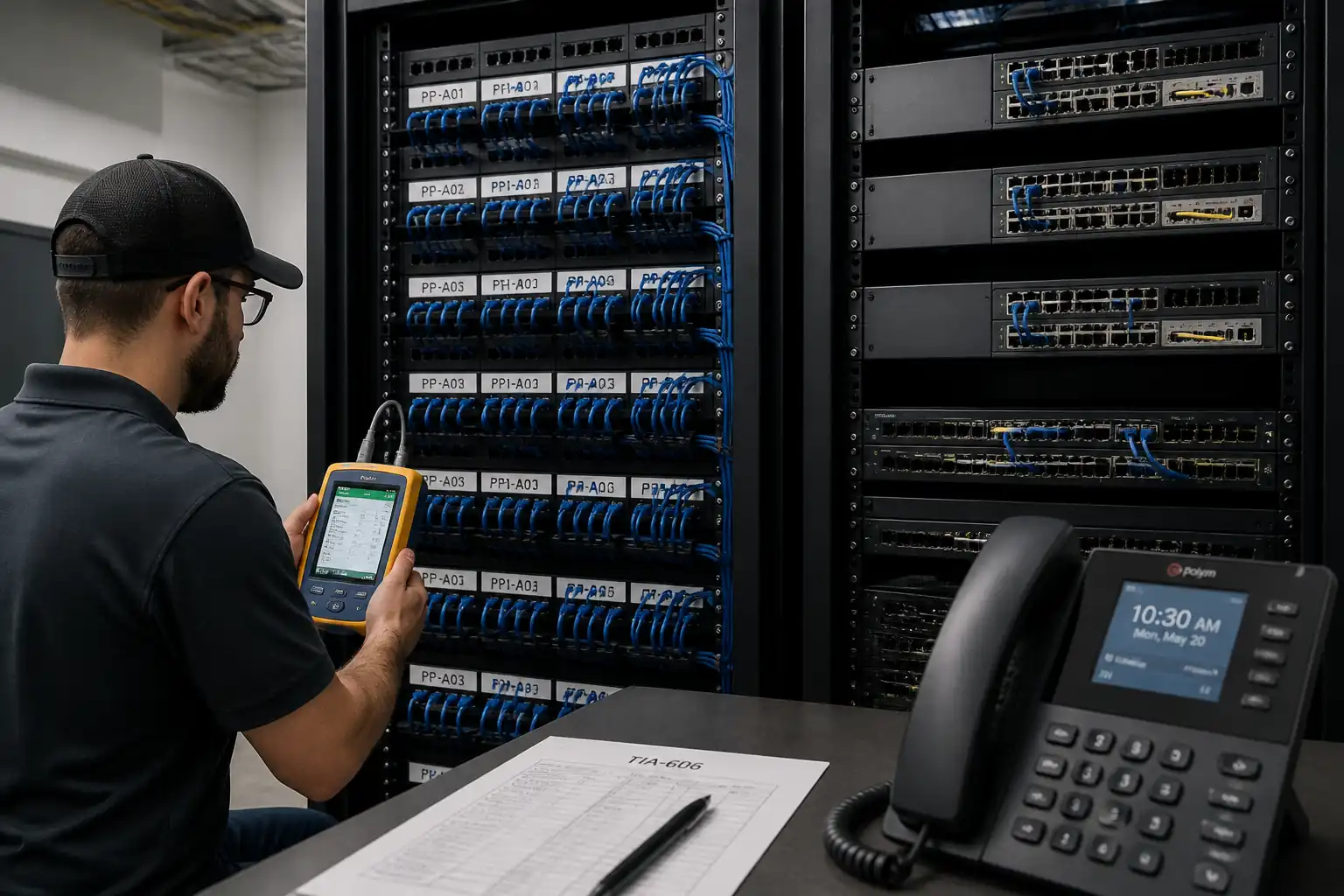
| TIA-606-C (Administration of Telecommunications Infrastructure) | Labeling conventions, colors, IDs, records | ||
| ANSI/TIA-1152-A and ANSI/TIA-568.2-D (Field testing, balanced twisted-pair) | Field tester accuracy levels; test limits Cat6/Cat6A etc. | ||
| IEC 61280-4-1/-4-2 (OLTS/OTDR measurement methods) | Tier 1 (OLTS) and Tier 2 (OTDR) methodologies | ||
| NFPA 72 (National Fire Alarm and Signaling Code) / EN 54 series (where applicable) | Device testing, audibility, intelligibility [Verify per project specifications] | ||
| BS EN 62676 (Video surveillance systems for use in security applications) | Image quality and performance criteria | ||
| IEC 60839-11 series (Electronic access control systems) | Functional and security performance testing | ||
| ASHRAE Guideline 1.1 / ISA standards for instrumentation (as applicable) | Point-to-point and functional performance tests [Verify per project specifications] | ||
| ISO 9001 (Quality management systems) | Control of documented information, versioning, approval | ||
| BS 8210 (Guide to facilities maintenance) and CSI MasterFormat/SectionFormat (O&M structure) | O&M content organization [Verify per project specifications] |
Responsibilities
| Role | Responsibility | Name / Party |
|---|---|---|
| Handover Manager | Handover Manager | Contractor |
| QA/QC Engineer | QA/QC Engineer | Contractor |
| Document Controller | Document Controller | Contractor |
| CAD/BIM Lead | CAD/BIM Lead | Contractor |
| Commissioning Engineer | ELV Commissioning Engineer | Contractor |
| Vendor Specialist | OEM/Vendor Engineers | Supplier/OEM |
| Consultant | Consultant Rep | Consultant |
| Client/FM | Client/FM Rep | Client |
Resources
| Resource Type | Description | Quantity | Remarks |
|---|---|---|---|
| Human | Handover Manager, QA/QC Engineer, Document Controller, CAD/BIM Technicians | As required [Verify per project specifications] | |
| Human | Structured cabling, FAS, Security, BMS, PA/GA test technicians | Sufficient to meet schedule [Verify] | |
| Human | OEM trainers and Contractor engineers for end-user training | Per system complexity [Verify] |
Materials
| Material | Specification / Grade | Quantity | Remarks |
|---|---|---|---|
| Heat-shrink, wrap-around, engraved traffolyte/laminate | UV-resistant; legible at ≥300 mm; contrast ratio ≥70% [Typical] [Verify] | 100% of endpoints | |
| A4 ring binders, USB 3.0 SSD/HDD | PDF/A-1b for archival; native CAD/BIM files; checksum manifest | As required | |
| Barcode/QR/RFID labels | Permanent adhesive; chemical-resistant [Verify] | 100% tagged |
Equipment
| Equipment | Capacity / Type | Quantity | Inspection Required |
|---|---|---|---|
| Fluke DSX-8000 or equivalent | Cat6/Cat6A up to 2 GHz | ≥1 set | Calibration certificate valid |
| Light source/power meter + OTDR | SM/MM; dynamic range ≥35 dB (OTDR) [Typical] | ≥1 set each | Calibration certificate valid |
| Solo/approved testers; Class 2 SLM | dBA/dBC logging | As required | Calibration certificate valid |
| DMM CAT III, latch/force gauge | Voltage/current/resistance | As required | Function check prior to use |
| Brady/Dymo printer; engraving machine | Heat-shrink/laminate | ≥2 | Print quality and adhesion check |
| AutoCAD/Revit; Navisworks; CDE client | Project-authorized versions | As required | License validity; antivirus updated |
Prerequisites
- Approved shop drawings and latest design revisions loaded to CDE; redline templates issued.
- All installations completed and preliminarily verified; access to all areas confirmed.
- Calibrated test instruments available with valid certificates.
- Permits: Fire Alarm Impairment Permit for device/audibility testing; Work at Height permit for labeling in ceilings; Hot Work not anticipated; IT/Network access approvals for NVR/ACS/BMS functional tests. [Verify per project HSE plan and local regulations]
- Stakeholder notifications for disruptive tests (sounders, PA/GA) issued ≥48 hours prior [Verify].
- Asset coding schema approved (aligned with TIA-606-C and Client conventions).
- Training plan, agenda, and materials approved by Consultant/Client.
- Draft O&M index and Master Document Register (MDR) approved.
- Spare parts, software keys, firmware/licences available for demonstration/recording where applicable.
- Pre-handover snag walk scheduled with Consultant and Client/FM.
Method Sequence
| Step | Activity | Description | Responsibility | Inspection / Hold Point |
|---|---|---|---|---|
| 1 | Kick-off & Baseline Freeze | Confirm handover scope, deliverables, drawing/list indices, and acceptance path. Freeze baseline of IFC/shop drawings and device schedules in CDE. | Handover Manager | Meeting minutes; baseline index approved |
| 2 | Redline Collection | Site engineers mark deviations on approved shop drawings using red pen/digital markup: device locations, terminations, cable IDs, routing, panel schedules, IP/MAC where applicable. | Site Engineers/Foremen | Supervisor review 100% |
| 3 | As‑Built Drafting (CAD/BIM) | Convert approved redlines to as‑built drawings/models. Update device IDs, cable routes, elevations, and schedules. | CAD/BIM Lead | Self-check + peer review |
| 4 | Labeling Installation/Verification | Install/verify labels per TIA-606-C across racks, patch panels, outlets, cables, devices, and cabinets. Barcode/QR if specified. | Labeling Team | 100% visual and cross-check to schedules |
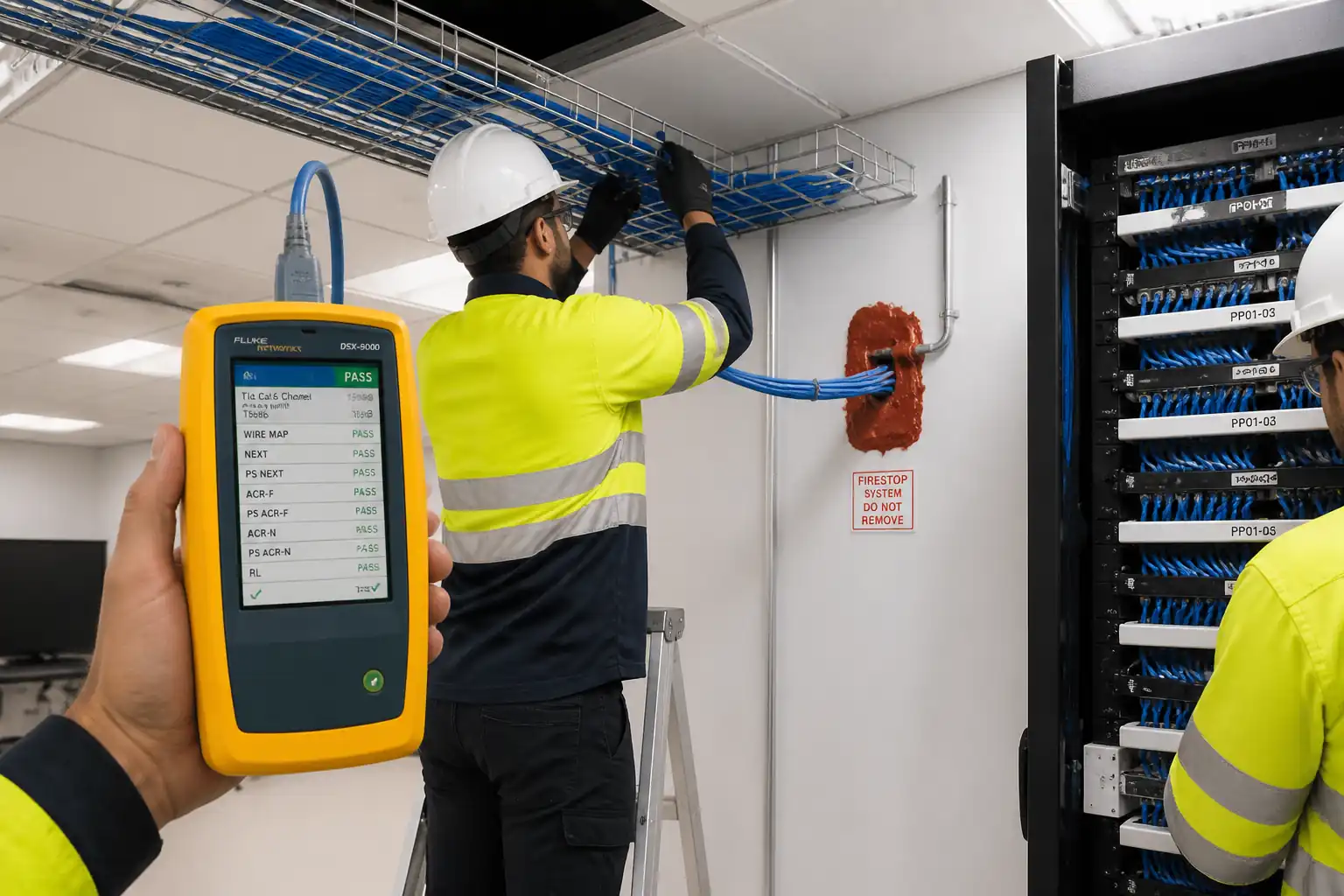
| 5 | Structured Cabling Testing (Copper) | Certify 100% permanent links/channels using calibrated certifier with correct test limits (e.g., Cat6/Cat6A). | ELV Test Technicians | Witness by QA/QC; random Consultant witness |
| 6 | Structured Cabling Testing (Fiber) | Tier 1 OLTS and Tier 2 OTDR for 100% fibers including pigtails and trunks. | ELV Test Technicians | QA/QC review; Consultant witness on sample/hold |
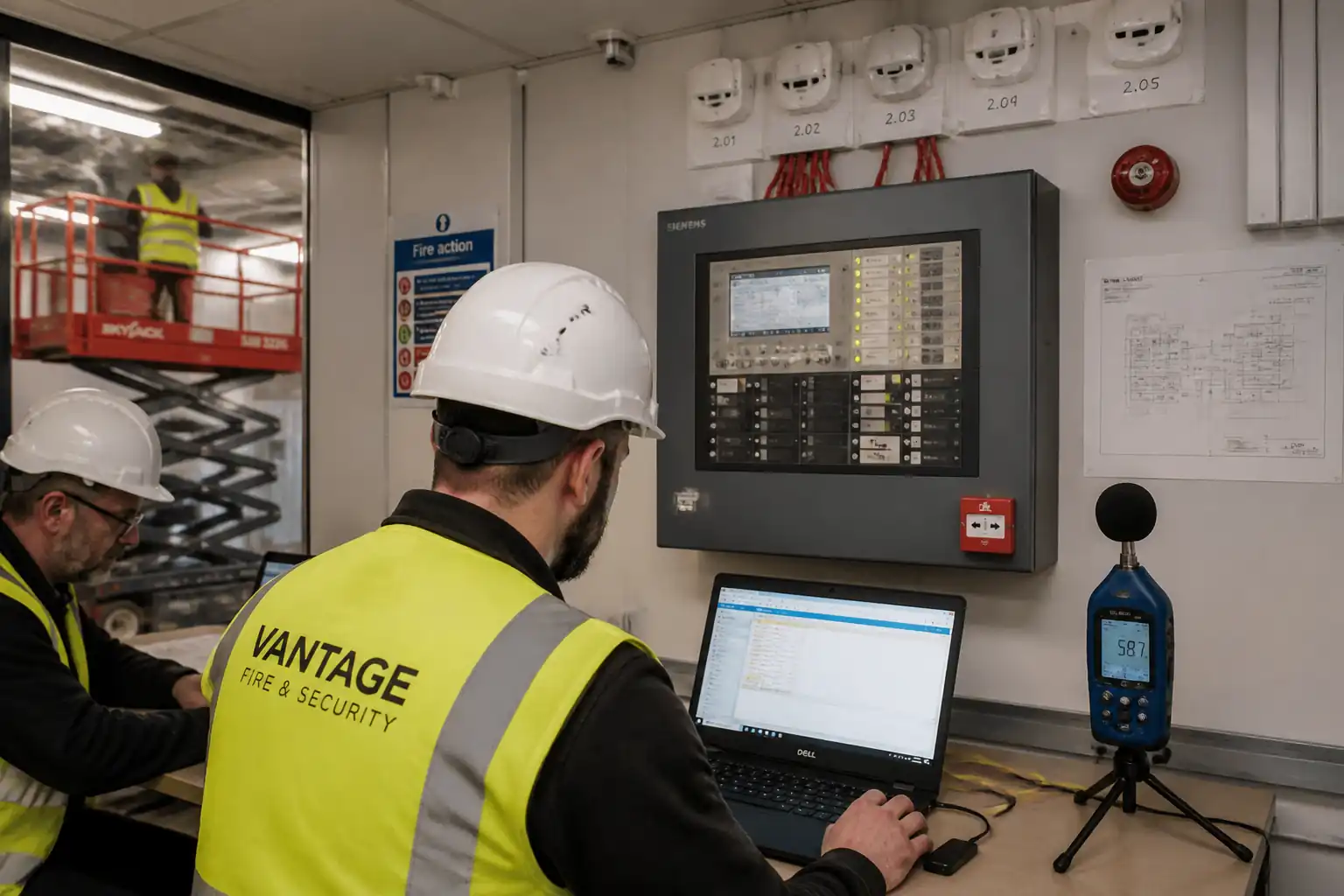
| 7 | Fire Alarm Testing | Device-by-device test of detectors, MCPs, sounders, interfaces; audibility/intelligibility where specified. | FAS Vendor Engineer | Impairment permit; Consultant witness for hold points |
| 8 | Security Systems Testing (CCTV/ACS/Intrusion) | Functional test of video quality, recording, retention; door hardware, access levels, alarms, fail-safe/secure, egress. | Security Vendor Engineer | Consultant/Client security rep witness |
| 9 | BMS/DDC Point-to-Point & Functional | Verify wiring, I/O mapping, trend logs, and interlocks with MEP equipment. | BMS Vendor Engineer | Consultant/MEP witness |
| 10 | PA/GA Testing | Audibility/intelligibility checks; zoning, priorities, emergency messages. | PA/GA Vendor | Consultant witness for hold points |
| 11 | Asset Register Compilation | Compile asset schedules with unique IDs, location, serials, MAC/IP, firmware, warranty, and spares list. | Documentation Engineer | QA/QC cross-check 100% |
| 12 | O&M Manual Preparation | Prepare O&M as per approved index: datasheets, warranties, spares, preventive maintenance, configuration backups, licenses. | Documentation Engineer | Internal QA; Consultant review cycle |
| 13 | Training Delivery | Conduct classroom and on-site training per plan; evaluate competence. | OEM/Contractor Trainers | Attendance capture; feedback forms |
| 14 | Snag Walk & Close-out | Joint snag walk; log items with photos; rectify and re-verify. | Handover Manager | Consultant/Client sign-off per item |
| 15 | QA/QC Final Review | Verify completeness, consistency, and compliance of dossier; checksum and virus-scan media. | QA/QC Engineer | Checklist; random sampling against field data |
| 16 | Pre-Handover Submission | Submit draft final package for Consultant review with transmittal and cross-reference index. | Document Controller | Consultant review cycle |
| 17 | Client Demonstration & Acceptance | Demonstrate systems against approved cause-and-effect and performance criteria. | Handover Manager & Vendors | Client/Consultant witness; sign ITRs |
| 18 | Final Dossier Submission & Archiving | Issue final signed dossier (hard + soft) including MDR, indices, and certificates. Archive master set in CDE with access rights. | Document Controller | Readability and integrity check |
Health, Safety, and Environment – Task-Specific Safety Controls
Key Hazards and Controls
- Hazard: Work at height on steps/ladders for ceiling labeling and device access.
- Likely consequence: Falls causing injury.
- Engineering/procedural control: Use industrial step ladders with platform and guardrail where possible; 3 points of contact; exclude lightweight domestic ladders; establish work-at-height permit; maintain clear floor area; do not overreach; use podium steps/scissor lift for extended work.
- Required PPE: Safety helmet with chin strap, safety shoes, gloves, and fall arrest if using MEWP per manufacturer.
- Collective preventive measure: Barriers and spotter; signage; segregated work zone.
-
Inspection/permit/supervision: Pre-use ladder inspection; MEWP inspection; Work at Height permit; competent supervisor oversight. [Verify per project HSE plan and local regulations]
-
Hazard: Live low-voltage/PoE and FAS circuits during testing.
- Likely consequence: Electric shock, inadvertent alarm/impairment.
- Engineering/procedural control: Lock-out/tag-out for affected panels; FAS impairment permit and fire watch; verify ELV circuits de-energized when terminating; use insulated tools; protect fire-stopping integrity.
- Required PPE: Electrical-rated gloves for panel work, eye protection, insulated tools.
- Collective preventive measure: Temporary covers on terminals; barriers around panels.
-
Inspection/permit/supervision: LOTO records; permit to work; testing plan approved by Consultant; supervision by competent ELV engineer.
-
Hazard: Sound pressure during FAS/PA/GA testing.
- Likely consequence: Hearing damage; disruption to occupants.
- Engineering/procedural control: Advance notifications; test outside peak hours; use hearing protection; limit test durations.
- Required PPE: Earplugs/earmuffs (SNR suited to measured SPL).
- Collective preventive measure: Area cordon; warning signage.
-
Inspection/permit/supervision: Test plan approved; decibel meter calibrated; supervisor present.
-
Hazard: Ceiling void/plenum exposure (dust, poor lighting, trip hazards).
- Likely consequence: Eye/respiratory irritation; slips/trips.
- Engineering/procedural control: Portable task lighting; maintain housekeeping; use dust masks where required; avoid disturbing asbestos-containing materials (check registers).
- Required PPE: Safety glasses, dust mask (at least FFP2 where dusty), gloves.
- Collective preventive measure: Access covers secured; step-off protection.
-
Inspection/permit/supervision: Ceiling access permit if required; daily site inspection.
-
Hazard: Server/IT rooms (ESD-sensitive, hot/cold aisles).
- Likely consequence: Equipment damage; heat stress.
- Engineering/procedural control: ESD wrist straps and mats; limit occupancy; maintain airflow; avoid blocking CRAC units; food/drink prohibition.
- Required PPE: ESD strap, anti-static footwear/covers as applicable.
- Collective preventive measure: Access control and escort; temperature monitoring.
-
Inspection/permit/supervision: Room access permit; toolbox talk; supervision by IT coordinator.
-
Hazard: Manual handling of racks/binders/equipment.
- Likely consequence: Musculoskeletal injury.
- Engineering/procedural control: Use trolleys; team lifts; weight limits observed; training on handling techniques.
- Required PPE: Gloves, safety shoes.
- Collective preventive measure: Mechanical aids; clear routes.
-
Inspection/permit/supervision: Manual handling risk assessment; supervisor oversight.
-
Hazard: Data privacy/security during CCTV/ACS testing and document handling.
- Likely consequence: Data breach, regulatory non-compliance.
- Engineering/procedural control: Mask sensitive data; restrict distribution; encrypt media; non-disclosure adherence.
- Required PPE: Not applicable.
- Collective preventive measure: Controlled CDE permissions.
-
Inspection/permit/supervision: Data handling plan approval; audit logs.
-
Hazard: Fire compartment breach during access.
- Likely consequence: Loss of fire integrity.
- Engineering/procedural control: Temporary fire-stopping maintained; permanent sealing post-works by certified installer.
- Required PPE: Gloves, eye protection.
- Collective preventive measure: Permit/inspection of penetrations.
- Inspection/permit/supervision: Fire stopping inspection record; sign-off by approved party.
Note: Exact permit types and local statutory requirements to be confirmed. [Verify per project HSE plan and local regulations]
Environmental Controls
- Waste segregation: Collect packaging, cable offcuts, defective devices, printer cartridges, and batteries for approved recycling streams. Hazardous waste (e.g., sealed lead-acid batteries, electronic boards) handled by licensed contractor with manifests.
- Noise control: Schedule FAS/PA/GA tests outside sensitive hours; limit test durations; inform stakeholders 48 hours prior [Verify].
- Dust and indoor air quality: Minimize ceiling disturbance; use HEPA vacuum for clean-up; avoid solvent cleaners; use low-VOC adhesives for labels.
- Energy and resource use: Power down test equipment when idle; consolidate printing; issue O&M digitally as primary, hard copies per contract only.
- Spill prevention: Keep liquids away from server rooms; drip trays for any maintenance near electronics.
- Data protection: Encrypt portable media; redact sensitive info in shared sets; follow Client data retention policy.
- Compliance checks: Maintain environmental inspection checklist; include waste transfer notes in final dossier.
Quality Assurance / Quality Control
QA/QC Strategy
- Use an approved Master Document Register (MDR) with status codes (A/Revise/Reject) and target dates.
- Apply document control per ISO 9001: unique numbering, revision control, author/check/approve workflow, and CDE metadata.
- Use calibrated instruments (certificates valid at test date; traceability to ISO/IEC 17025 [Verify]).
- 100% testing of installed terminations/devices where specified; otherwise minimum sampling rates only if explicitly approved in writing.
- Maintain Hold/Witness points as per ITP; no activity to proceed past Hold without signed release.
Acceptance Metrics
- Drawings: As‑built status, correct layering, coordinates, device IDs match schedules; zero open comments.
- Labeling: 100% presence and correctness; zero duplicates; adhesion verification after 72 hours on a 5% sample [Typical] [Verify].
- Copper: PASS per ISO/IEC 11801/TIA-568 limits; wiremap 100% correct; length within design; results in native + PDF.
- Fiber: OLTS/OTDR within limits; event table compliant; end faces inspected per IEC 61300-3-35.
- FAS: 100% device operation; audibility ≥15 dBA above ambient or per spec; cause-and-effect verified; impairment permits closed.
- CCTV/ACS: Functional performance per specification (coverage, frame rates, retention); door safety and security modes verified.
- BMS: 100% I/O verified; sequences and alarms per design; backups exported and archived.
- Training: Attendance ≥90% of nominated staff [Typical] [Verify]; competency acknowledgments filed.
- Dossier: Complete, indexed, virus-scanned; all certificates and warranties included; checksum manifest provided.
Nonconformity and Snag Control
- Register NCRs and SNAGs with root-cause, corrective action, responsible person, and due date.
- Preventive actions logged for recurring issues (e.g., labeling errors).
- Close-out requires evidence (photos, re-test reports) and Consultant/Client sign-off.
Attachments
- Sample forms: Redline template, CAD/BIM checklist, Labeling checklist, Copper/Fiber test sheets, FAS device sheet, CCTV/ACS/BMS/PA-GA FAT/SAT checklists, Training attendance sheet, QA final checklist, Transmittal form.
- Master Document Register (MDR) template with document coding convention.
- Risk assessments and method-specific permits (Work at Height, Electrical LOTO, FAS impairment).
- Vendor calibration certificates (latest).
- Warranty certificates and spares lists.
- Data protection and media encryption procedure for handover materials.
This content is a read-only public reference. Download or customize to get an editable version.
ITP preview
The first inspection activities from the linked ITP for Method Statement: Low-Current (ELV/ICT) Systems Handover and As‑Built Documentation:
| Activity | Inspection / Test | Acceptance Criteria | Responsibility | Record |
|---|---|---|---|---|
| Baseline Freeze and Redline Template Issue | Verification of indices and templates | Baseline and templates approved and signed | Handover Manager / QA-QC Engineer / Consultant | Meeting minutes; approved templates; index register |
| Redline Drawing Verification | Completeness and clarity check | 100% deviations captured; signed and dated by discipline lead | QA/QC Engineer / Consultant | Reviewed redline set (PDF/native) |
| As‑Built CAD/BIM Review | CAD/BIM standard compliance; ID consistency | Title block, layers, coordinates, schedules correct; zero critical comments | QA/QC Engineer / Consultant | ITR-AB-01; marked-up set; approval note |
Showing 3 of 16 inspection activities. View full ITP →
Related Inspection and Test Plan
An Inspection and Test Plan (ITP) is available for Method Statement: Low-Current (ELV/ICT) Systems Handover and As‑Built Documentation. The ITP defines the inspection activities, acceptance criteria, hold and witness points, responsible parties, and records required to verify the work described in this method statement.
View the Method Statement: Low-Current (ELV/ICT) Systems Handover and As‑Built Documentation ITP →Frequently asked questions
Continue with related Quollnet resources connected to this method statement.