
Method Statement: Final Document Control Submission for Project Closeout – Method Statement
AI-assisted method statement with matching ITP, PDF download, and Excel export.
More than a static template
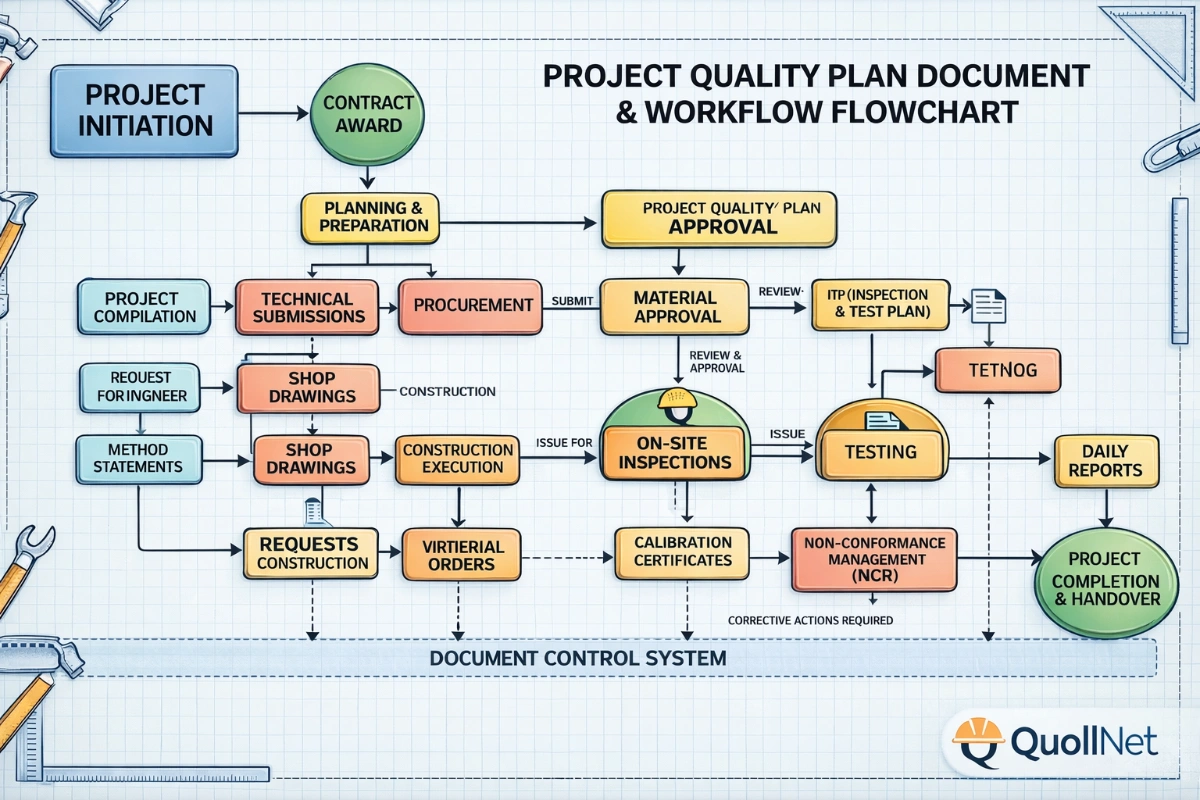
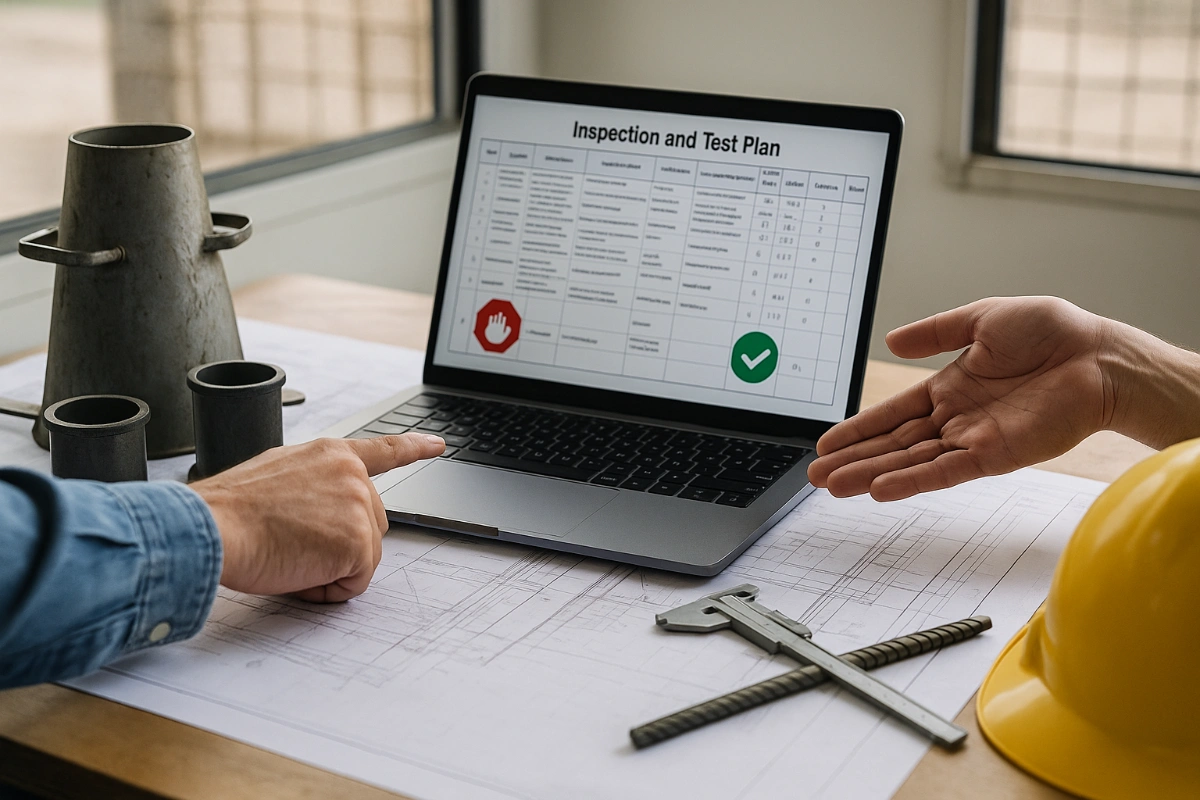
Unlike a downloadable Word or PDF template, this method statement is an AI-assisted editable starting point connected directly to a matching Inspection and Test Plan. Every section is structured, project-adaptable, and ready to export.
- AI-assisted drafting — Customize every section with AI for your specific project scope.
- Linked ITP — A matching inspection and test plan is generated alongside the method statement.
- Multiple export formats — Download as a formatted PDF or editable Excel spreadsheet.
- Editable starting point, not a final document — Review, verify, and adjust all content against your project requirements before use.
Static template vs. Quollnet workflow
| Feature | Static template | Quollnet |
|---|---|---|
| Project-specific content | Manual fill-in required | AI-assisted customization |
| Linked ITP | Separate document, no link | Matching ITP included |
| Export formats | Usually PDF only | PDF and Excel |
| Structured sections | Free-form layout | 13 standardized sections |
| Saved to your account | Local file only | Cloud-saved, reusable |
| Content accuracy | You verify everything | AI-assisted, you still verify |
| Cost | Often free but time-intensive | Free to customize and download |
What you can customize
When you save this method statement to your account, every section becomes editable. The following 13 sections are included:
- Scope — Defines the activity and its boundaries.
- References — Standards, specifications, and drawings.
- Responsibilities — Roles and accountabilities.
- Resources — Labour, plant, and equipment summary.
- Materials — Materials and compliance requirements.
- Equipment — Tools and equipment details.
- Prerequisites — Hold points and pre-conditions.
- Method sequence — Step-by-step construction sequence.
- Safety controls — HSE risk controls and PPE.
- Environmental controls — Environmental mitigation measures.
- QA/QC — Quality inspection and test requirements.
- ITP — Inspection and Test Plan table (has its own page).
- Attachments — Referenced drawings and documentation.
Why this method statement is used
This method statement is used to define and communicate the approved procedure for carrying out method statement: final document control submission for project closeout on site. It ensures the work is planned in advance, the correct resources and controls are in place, and all personnel understand responsibilities, sequence, quality requirements, and safety controls before work begins. It aligns site execution with the documented scope and acceptance expectations.
Who uses this method statement
This method statement is used by contractors, site supervisors, project engineers, QA/QC engineers, HSE officers, consultants, and client representatives. It serves as a shared reference for planning, execution, supervision, inspection, and approval of the activity on site.
When it is prepared and submitted
The method statement is prepared before the work activity starts and submitted as part of the pre-construction documentation package for review and approval.
Who reviews or approves it
The method statement is usually submitted to the client representative, consultant, resident engineer, or project management consultant for review and approval before the work commences.
Important approval note
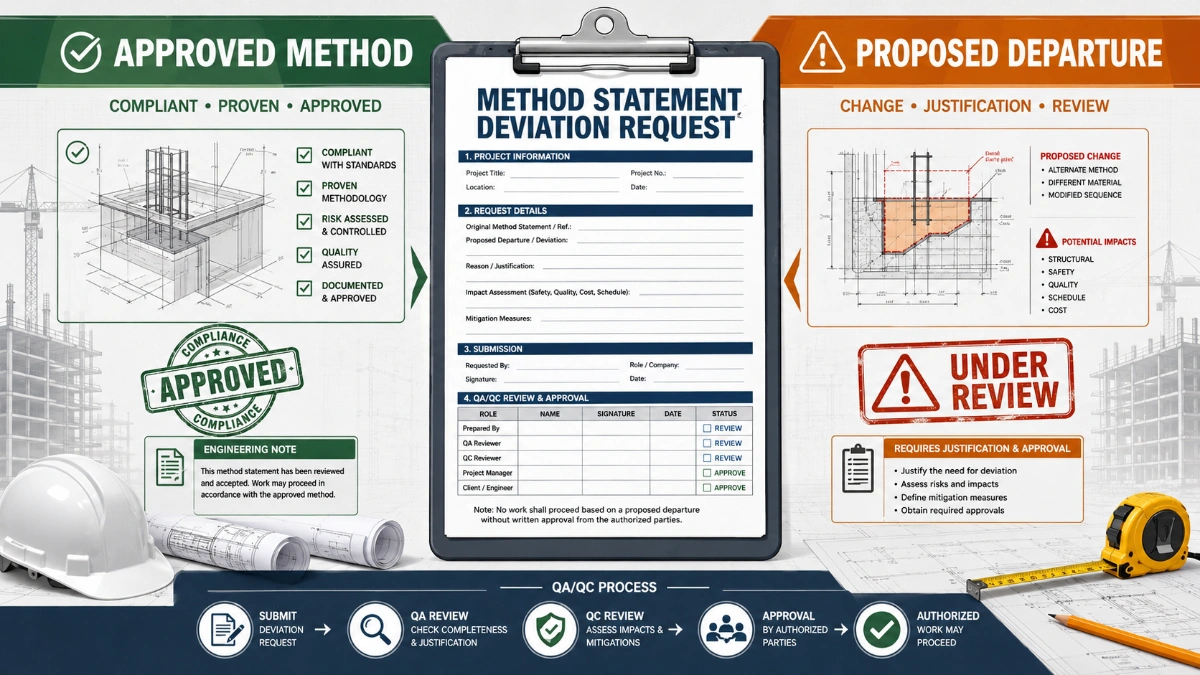
This method statement is an AI-assisted editable starting point, not a pre-approved document. Before use on any project, all content must be reviewed and approved by the relevant parties (superintendent, principal contractor, or client representative) in accordance with your contract and project quality plan.
For example: if your specification requires a departure from a referenced standard, that departure must be documented and approved separately — this method statement will not capture that automatically. Always verify against your applicable drawings, specifications, and regulatory requirements.
Method statement content
Scope
Purpose
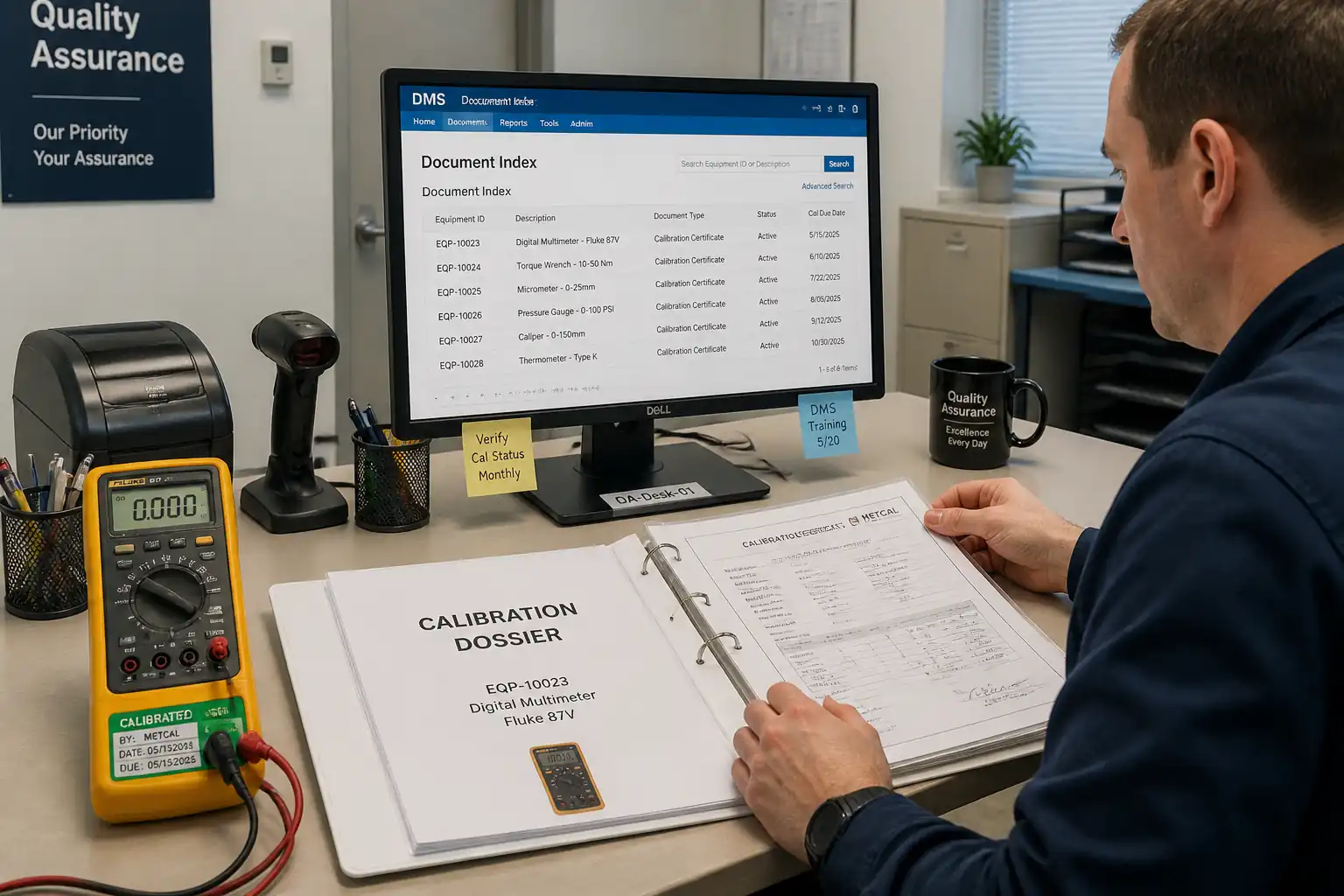
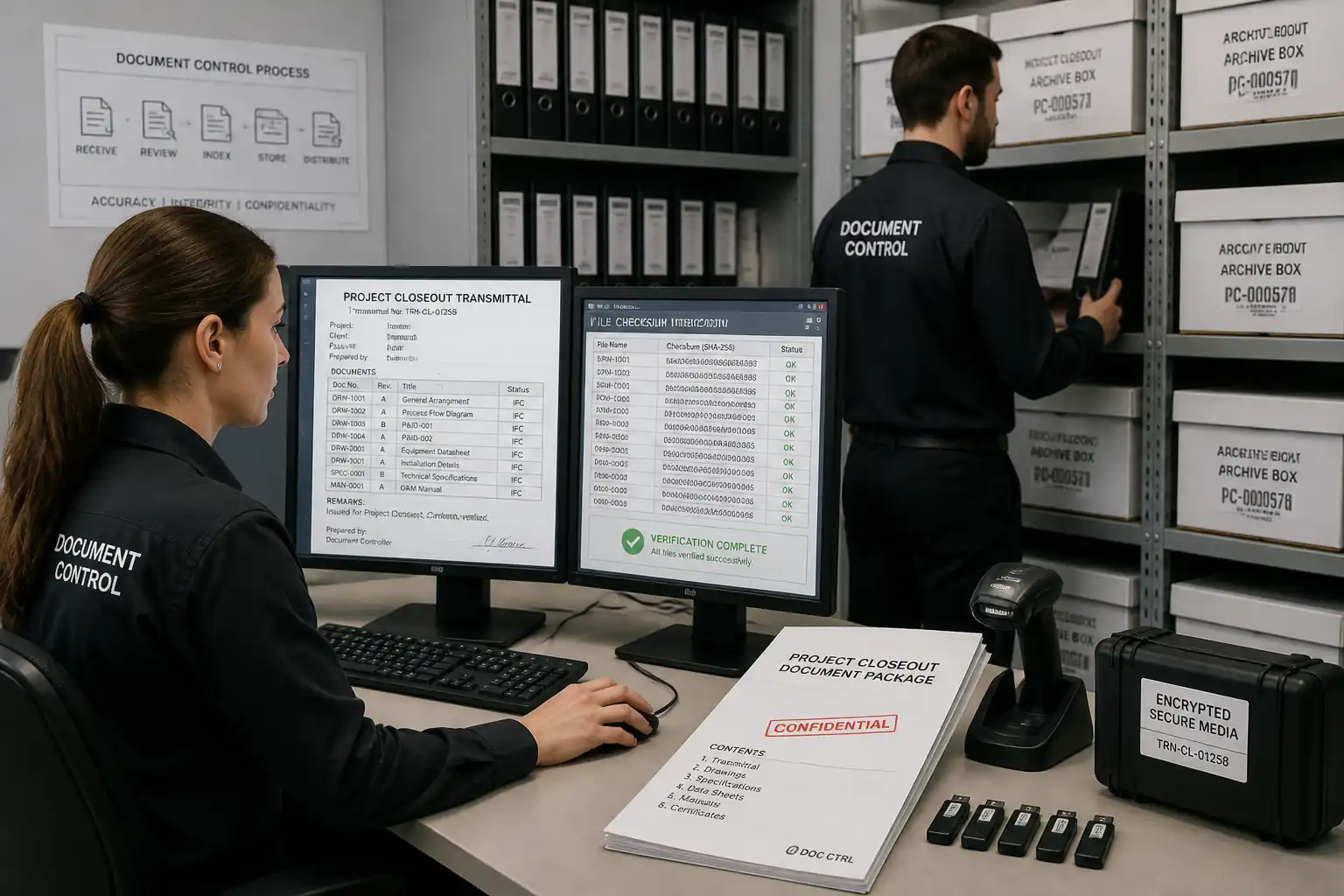
Define the controlled process to compile, verify, submit, and archive all project closeout documentation, including but not limited to as-builts, O&M manuals, warranties, certificates, test records, training records, commissioning dossiers, asset registers, and correspondence logs. The method ensures 100% completeness, correct revision status, proper approvals, compliant formats (hardcopy/digital), traceable transmittals, resolution of consultant comments, and establishment of final archive records.
Scope of Application
- Applies to the Main Contractor and all Subcontractors/Suppliers providing closeout deliverables.
- Covers both digital and hardcopy submissions, EDMS-based transmittals, media verification, and archive storage preparation.
- Interfaces with QA/QC, Engineering, BIM/Design, Commissioning, IT, and HSE teams.
Exclusions
- Physical asset handover, spare parts delivery, and training execution are managed by their respective work procedures but their evidential records are controlled within this method.
References
| Document Type | Reference / Number | Revision | Notes |
|---|---|---|---|
| ISO 9001, ISO 10013 | Contract-required quality framework. | ||
| ISO 15489, ISO 16245 | Retention and archival control. | ||
| ISO 19650, BS 1192 | Naming conventions, CDE workflows. | ||
| ISO 19005, ISO 32000, ISO 16739 | Format compliance and interoperability. | ||
| ISO/IEC 27001, NIST 800-88 | Secure transfer and storage. | ||
| Contract Docs | Primary source of deliverables list and acceptance. |
Responsibilities
| Role | Responsibility | Name / Party |
|---|---|---|
| PM | Overall accountability | Main Contractor |
| LDC | Process owner | Main Contractor |
| QA/QC Manager | Quality assurance | Main Contractor |
| BIM/Design Manager | Technical validation | Main Contractor |
| IT Admin | Systems integrity | Main Contractor |
| Vendor | Content providers | Subcontractor/Supplier |
| Consultant | Independent review | Engineer/Client Rep |
Resources
| Resource Type | Description | Quantity | Remarks |
|---|---|---|---|
| Human | 1 FTE for duration of closeout. | 1 | Must be EDMS proficient. |
| Human | Team to process submissions, quality checks, filing, and logistics. | 2–5 [Verify] | Scalable to workload. |
| Human | Performs audits and sample checks. | 1–2 [Verify] | |
| Human | Validates technical deliverables. | 1 | |
| Human | Checksum, AV scan, encryption, media write/verify. | 1 | |
| Service | Hardcopy production per spec. | As required | Prequalified vendor [Verify]. |
Materials
| Material | Specification / Grade | Quantity | Remarks |
|---|---|---|---|
| Archival storage boxes | A4/FC sizes, 1000 gsm min | As required | Compliant to ISO 16245 [Verify]. |
| Labels | Thermal/laser, archival-safe | As required | UV-resistant adhesive [Verify]. |
| Drives/USB | Minimum USB 3.1; capacity sized to dataset | As required | AES-256 encryption [Verify]. |
| Optical discs | Blu-ray BD-R HTL, 25–100 GB | As required | M-DISC or equivalent [Verify]. |
| Binders | D-ring 50–75 mm | As required | No-PVC archival sleeves [Verify]. |
Equipment
| Equipment | Capacity / Type | Quantity | Inspection Required |
|---|---|---|---|
| EDMS | Multi-user | 1 | |
| Scanner | 40–100 ppm | 1–2 | |
| PCs | 16–32 GB RAM [Verify] | As required | |
| Software | Installed | ||
| Software | Installed |
Prerequisites
- Approved Document Control Plan (DCP) and closeout deliverables list (VDRL/contract schedules) with latest revisions.
- Confirmed naming convention, metadata schema, and folder structure per ISO 19650/Contract [Verify per project specifications].
- EDMS configured: workflows, roles, approval gates, and transmittal templates.
- All design and construction revisions frozen and as-builts approved by Engineer/Consultant (or pending actions tracked).
- O&M manual templates issued to all vendors; training and warranty formats standardized.
- IT readiness: storage capacity, backup schedule, encryption keys, and virus definitions up to date.
- Print/bind vendor prequalified and sample approved where hardcopies are required.
- HSE arrangements for manual handling and media transport approved.
- Room/environment prepared for archival packing (dry, clean, controlled as per archive guidelines).
Method Sequence
| Step | Activity | Description | Responsibility | Inspection / Hold Point |
|---|---|---|---|---|
| 1 | Kick-off and Plan Freeze | Hold closeout coordination meeting, freeze deliverables list and schedule, agree on acceptance criteria and RACI. | PM/LDC | Minutes approved |
| 2 | Compile Closeout Master Index (CMI) | Create CMI with unique IDs, titles, document types, originators, disciplines, revision, status, format, media, and retention code. | LDC | Peer review |
| 3 | Vendor/Subcontractor Collection | Issue CMI extracts and templates to vendors; receive submissions via EDMS. | DC Team | Submission logs |
| 4 | Revision & Approval Check | Verify latest approved revision aligns with design/field changes; confirm status codes (A/B/C or S0–S4/AFC/As-built) per contract. | DC/QC | 100% check for key docs; sample others |
| 5 | Format Compliance | Convert and validate PDFs to PDF/A-1b or -2u [Verify]; ensure embedded fonts and searchable text for scans (OCR). | DC/IT | Automated validator + spot check |
| 6 | Naming & Metadata Validation | Check file naming per contract/ISO 19650; verify mandatory metadata fields populated (title, discipline, type, revision, status, originator, date). | DC | Automated script + visual check |
| 7 | Technical Validation of As-builts | BIM/Design review of as-built drawings/models vs redlines/field changes; ensure correct layers, scales, title blocks, and IFC export (if required). | BIM/Design | Checklist and sampling |
| 8 | O&M Manuals & Dossiers | Verify content against templates: asset lists, data sheets, maintenance schedules, spare parts, warranties, contacts, training records. | DC/QA | 100% table of contents; sample content |
| 9 | Certificates & Test Records | Collect and verify compliance certificates (materials, test results, commissioning, calibrations). | QA | Authenticity and date checks |
| 10 | Missing Document Tracking | Issue DCLs (Document Constraint Lists)/DRNs for outstanding items; set due dates and escalate. | LDC | Weekly report |
| 11 | Transmittal Preparation | Bundle per work package/system; assign transmittal numbers; include cover letter, index, revision history, and distribution matrix. | DC | Peer review |
| 12 | Consultant Review Cycle | Submit via EDMS; track comments and statuses; coordinate vendor resubmissions until final approved. | DC/PM | Turnaround time KPI |
| 13 | Hardcopy Production | Print, bind, and label per spec; verify page order, legibility, and color for MEP schematics where required. | Vendor/DC | Physical QA |
| 14 | Digital Media Creation | Write to encrypted media; generate SHA-256 checksums; perform write-verify; label and seal. | IT/DC | Checksum log |
| 15 | Final Submission & Receipt | Deliver per contract (EDMS/physical handover); obtain receipt and distribution sign-off. | PM/DC | Delivery record |
| 16 | Final Archive Setup | Assemble archive boxes with inventories; store media and hardcopies; record storage location and retention schedule. | DC | Archive audit |
| 17 | Closeout Sign-off | Issue final compliance statement, attach CMI, CRL closure, and QA certificates; obtain PM/Client sign-off. | PM/QA/DC | Document review |
Health & Safety Controls
Task-Specific Hazards and Controls
1) Hazard: Manual handling of archive boxes and hardcopy sets
- Likely consequence: Musculoskeletal injury, slips/trips
- Engineering/procedural control: Use trolleys, limit box weight to ≤15 kg [Verify per project HSE plan], team lifts for heavy items, clear walkways
- Required PPE: Safety shoes with toe protection, gloves
- Collective preventive measure: Manual handling training; ergonomic workstation setup
- Inspection/permit/supervision: Supervisor to verify loads and routes; HSE inspection of storage area weekly
2) Hazard: Use of step-ladders for accessing high archive shelving
- Likely consequence: Falls from height
- Engineering/procedural control: Use industrial step-ladders with handrails; 3 points of contact; no carrying loads while climbing
- Required PPE: Safety shoes; optional fall-arrest not required for step-ladders <2 m [Verify]
- Collective preventive measure: Store heavy boxes at waist height; segregated ladder area
- Inspection/permit/supervision: Pre-use ladder inspection checklist; competent person authorization
3) Hazard: Electrical/IT equipment use (scanners/PCs/UPS)
- Likely consequence: Electric shock, fire, overheating
- Engineering/procedural control: PAT-tested equipment; avoid overloading sockets; maintain ventilation clearances; UPS maintenance
- Required PPE: None beyond standard office PPE
- Collective preventive measure: RCD protection and surge protection
- Inspection/permit/supervision: Annual PAT; weekly visual checks; fire extinguisher (CO2) accessible
4) Hazard: Toner/ink handling during large-volume printing
- Likely consequence: Skin/eye irritation, minor spills
- Engineering/procedural control: Use OEM cartridges; handle per SDS; spill kits available; good ventilation
- Required PPE: Nitrile gloves; safety glasses if decanting
- Collective preventive measure: Centralized print station with spill mat
- Inspection/permit/supervision: SDS available at station; periodic HSE check
5) Hazard: Data transport off-site (physical media)
- Likely consequence: Loss or theft of sensitive information
- Engineering/procedural control: Encrypt media (AES-256), dual custody during transport, tamper-evident seals, chain-of-custody forms
- Required PPE: Not applicable
- Collective preventive measure: Secure vehicle storage; route planning
- Inspection/permit/supervision: Authorization by PM; records per ISO/IEC 27001; [Verify per project HSE plan and local regulations]
6) Hazard: Driving for deliveries
- Likely consequence: Road traffic incidents
- Engineering/procedural control: Use approved drivers/vehicles; journey management plan; avoid peak hours where possible
- Required PPE: High-visibility vest for loading zones
- Collective preventive measure: Vehicle inspection, seatbelt policy, no mobile use while driving
- Inspection/permit/supervision: Daily vehicle checklist; valid license check; [Verify per project HSE plan]
7) Hazard: Office ergonomics during prolonged data processing
- Likely consequence: Strain injuries, fatigue
- Engineering/procedural control: Adjustable chairs/desks; screen breaks every 50–60 minutes; alternate tasks
- Required PPE: Not applicable
- Collective preventive measure: Ergonomic assessments
- Inspection/permit/supervision: HSE DSE (Display Screen Equipment) assessments and records
8) Hazard: Paper cuts and dust from old documents
- Likely consequence: Minor injuries/respiratory irritation
- Engineering/procedural control: Use gloves for bulk handling; maintain cleanliness; HEPA vacuum if dusty
- Required PPE: Lightweight gloves; dust mask if needed
- Collective preventive measure: Housekeeping schedule
- Inspection/permit/supervision: Supervisor spot checks
Note: Implement all controls in accordance with the project HSE plan and local regulations. [Verify per project HSE plan and local regulations]
Environmental Controls
Environmental Aspects and Controls
1) Aspect: High-volume printing and paper use
- Impact: Resource consumption, waste generation
- Control: Duplex printing; use recycled/ FSC paper when allowed; print only contract-required copies
- PPE: Not applicable
- Collective measure: Print approval gate by LDC
- Inspection/permit: Monthly print usage report; align with project sustainability goals [Verify]
2) Aspect: Disposal of toner/ink cartridges
- Impact: Hazardous waste if mismanaged
- Control: Return to OEM recycling program; store in labeled containers; spill control kits
- PPE: Nitrile gloves when handling
- Collective measure: Centralized collection point
- Inspection/permit: Waste transfer records; MSDS available
3) Aspect: E-waste and obsolete media
- Impact: Landfill contamination, data breach risk
- Control: Certified e-waste recycler; data sanitization per NIST 800-88; destruction certificates retained
- PPE: Gloves and eye protection when handling broken casings
- Collective measure: Locked e-waste cage
- Inspection/permit: Disposal manifests; IT sign-off
4) Aspect: Transport emissions for physical deliveries
- Impact: CO2 and NOx emissions
- Control: Consolidate deliveries; use low-emission vehicles where available; optimize routing
- PPE: Not applicable
- Collective measure: Delivery scheduling
- Inspection/permit: Journey logs and fuel receipts tracking
5) Aspect: Archive storage environment
- Impact: Document degradation
- Control: Dry, dust-free storage; temperature/humidity control per archival guidance (typical 18–22°C, 35–55% RH) [Verify]
- PPE: Not applicable
- Collective measure: Environmental monitoring
- Inspection/permit: Quarterly archive condition checks
6) Aspect: Packaging waste from boxes and labels
- Impact: Solid waste generation
- Control: Right-size boxes; reuse where allowed; recycle corrugated material
- PPE: Not applicable
- Collective measure: Clearly labeled recycling bins
- Inspection/permit: Waste segregation audits weekly
QA/QC
Quality Objectives
- 100% completeness against contract deliverables list (CMI).
- 0% critical nonconformities at final submission (e.g., wrong revision, missing approval, unreadable files, malware).
- ≥99% compliance to naming conventions and mandatory metadata fields [Verify per project specifications].
Verification & Sampling
- Critical documents (as-builts, O&M volumes, warranties, test/commissioning records): 100% detailed check.
- Routine correspondence and minor records: 10–20% random sampling [Verify].
- Digital security: 100% checksum and anti-virus scan of deliverables media.
- Hardcopy: Random 10% bind/print audit per volume; 100% page count for critical volumes.
Tools & Metrics
- Automated validators for naming and PDF/A; logs retained.
- Regex rules for file naming; exceptions recorded and corrected.
- KPI: Average consultant turnaround time; resubmission count per package; defect density per 100 documents.
Nonconformance & Corrective Action
- Log any NC with root cause analysis; corrective action with responsible person and due date.
- Rework documentation and resubmit through EDMS with supersession control.
Records Retention
- Retain all closeout QA/QC logs, validator outputs, checksum lists, and approval certificates for not less than contract-specified retention period [Verify per project specifications].
Attachments
- Template: Closeout Master Index (CMI) fields list (CSV/Excel)
- Template: O&M Manual structure and cover page
- Template: Transmittal form and distribution matrix
- Checklist: PDF/A validation and scan quality
- Checklist: As-built drawing/model validation
- Checklist: Hardcopy QA (print/bind)
- Log: Comment Resolution Log (CRL)
- Log: Document Constraint List (DCL)
- Form: Chain-of-Custody for physical media
- Procedure: Media encryption and checksum generation steps
- Sample: Archive box label format and barcode schema
This content is a read-only public reference. Download or customize to get an editable version.
ITP preview
The first inspection activities from the linked ITP for Method Statement: Final Document Control Submission for Project Closeout:
| Activity | Inspection / Test | Acceptance Criteria | Responsibility | Record |
|---|---|---|---|---|
| Closeout Master Index (CMI) creation | CMI completeness and field validation | 100% of contract deliverables listed; unique IDs; mandatory fields populated | LDC | Approved CMI version-controlled copy |
| File naming & metadata validation | Automated regex check + 5% visual sample | ≥99% pass rate; 0% critical metadata missing [Verify] | DC | Naming Validation Log & exception report |
| Revision/status verification | Compare EDMS status with title block; check supersession | All as-builts final approved; no obsolete files in bundle | DC/QC | Revision Verification Log |
Showing 3 of 13 inspection activities. View full ITP →
Related Inspection and Test Plan
An Inspection and Test Plan (ITP) is available for Method Statement: Final Document Control Submission for Project Closeout. The ITP defines the inspection activities, acceptance criteria, hold and witness points, responsible parties, and records required to verify the work described in this method statement.
View the Method Statement: Final Document Control Submission for Project Closeout ITP →Frequently asked questions
Continue with related Quollnet resources connected to this method statement.