
Method Statement: Final Inspection and Client Walkthrough Procedure – Method Statement
AI-assisted method statement with matching ITP, PDF download, and Excel export.
More than a static template
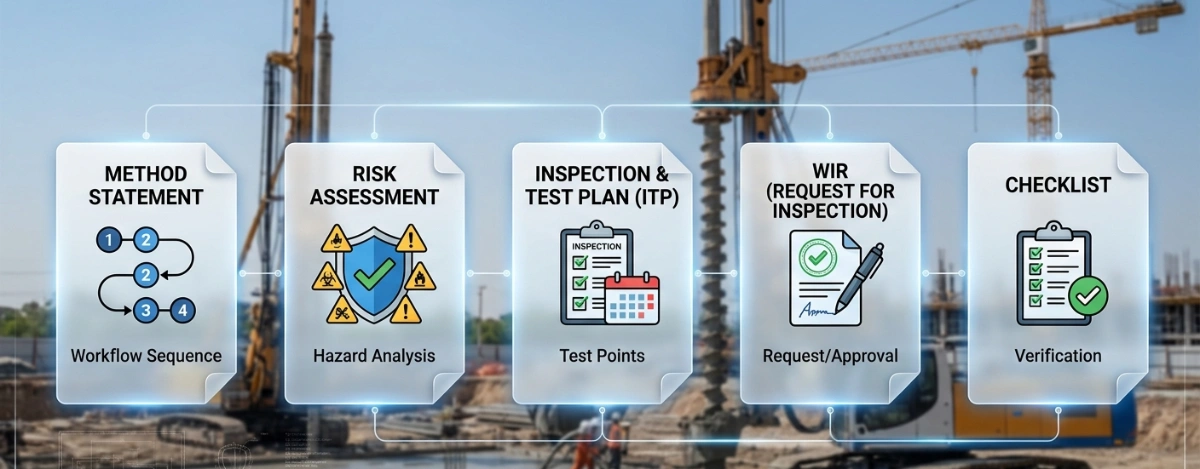
Unlike a downloadable Word or PDF template, this method statement is an AI-assisted editable starting point connected directly to a matching Inspection and Test Plan. Every section is structured, project-adaptable, and ready to export.
- AI-assisted drafting — Customize every section with AI for your specific project scope.
- Linked ITP — A matching inspection and test plan is generated alongside the method statement.
- Multiple export formats — Download as a formatted PDF or editable Excel spreadsheet.
- Editable starting point, not a final document — Review, verify, and adjust all content against your project requirements before use.
Static template vs. Quollnet workflow
| Feature | Static template | Quollnet |
|---|---|---|
| Project-specific content | Manual fill-in required | AI-assisted customization |
| Linked ITP | Separate document, no link | Matching ITP included |
| Export formats | Usually PDF only | PDF and Excel |
| Structured sections | Free-form layout | 13 standardized sections |
| Saved to your account | Local file only | Cloud-saved, reusable |
| Content accuracy | You verify everything | AI-assisted, you still verify |
| Cost | Often free but time-intensive | Free to customize and download |
What you can customize
When you save this method statement to your account, every section becomes editable. The following 13 sections are included:
- Scope — Defines the activity and its boundaries.
- References — Standards, specifications, and drawings.
- Responsibilities — Roles and accountabilities.
- Resources — Labour, plant, and equipment summary.
- Materials — Materials and compliance requirements.
- Equipment — Tools and equipment details.
- Prerequisites — Hold points and pre-conditions.
- Method sequence — Step-by-step construction sequence.
- Safety controls — HSE risk controls and PPE.
- Environmental controls — Environmental mitigation measures.
- QA/QC — Quality inspection and test requirements.
- ITP — Inspection and Test Plan table (has its own page).
- Attachments — Referenced drawings and documentation.
Why this method statement is used
This method statement is used to define and communicate the approved procedure for carrying out method statement: final inspection and client walkthrough procedure on site. It ensures the work is planned in advance, the correct resources and controls are in place, and all personnel understand responsibilities, sequence, quality requirements, and safety controls before work begins. It aligns site execution with the documented scope and acceptance expectations.
Who uses this method statement
This method statement is used by contractors, site supervisors, project engineers, QA/QC engineers, HSE officers, consultants, and client representatives. It serves as a shared reference for planning, execution, supervision, inspection, and approval of the activity on site.
When it is prepared and submitted
The method statement is prepared before the work activity starts and submitted as part of the pre-construction documentation package for review and approval.
Who reviews or approves it
The method statement is usually submitted to the client representative, consultant, resident engineer, or project management consultant for review and approval before the work commences.
Important approval note
This method statement is an AI-assisted editable starting point, not a pre-approved document. Before use on any project, all content must be reviewed and approved by the relevant parties (superintendent, principal contractor, or client representative) in accordance with your contract and project quality plan.
For example: if your specification requires a departure from a referenced standard, that departure must be documented and approved separately — this method statement will not capture that automatically. Always verify against your applicable drawings, specifications, and regulatory requirements.
Method statement content
Scope
Purpose
Define the process to plan, conduct, record, and close out the Final Inspection and Client Walkthrough for completed works/areas, culminating in formal acceptance and start of the Defects Liability Period (DLP).
Coverage
- All architectural, structural, MEP, ELV, life-safety, external works, and associated systems within the designated handover package/area.
- Readiness checks, route mapping, HSE and access arrangements, demonstrations, snag identification and categorization, corrective action tracking, re-inspections, documentation handover, and final sign-off.
Exclusions
- Intrusive tests that risk damage to finishes or live systems (unless specifically agreed in the walkthrough plan and risk-assessed).
Objectives
- Present completed works that are safe, clean, accessible, and compliant with contract requirements.
- Demonstrate system functionality and performance evidence.
- Achieve zero Category A (critical) snags and secure final acceptance sign-off.
References
| Document Type | Reference / Number | Revision | Notes |
|---|---|---|---|
| Standard | ISO 9001/10005/10013/19011 [Verify per project] | ||
| Standard/Plan | ISO 45001/14001 [Verify] | Local regulations apply [Verify per project HSE plan and local regulations] | |
| Guidance/Standard | BS 8536-1; CIBSE; BSRIA; ASHRAE [Verify] | ||
| Standard/Code | NFPA 72; Local Fire Authority [Verify] | Use project-approved code basis | |
| Standard | IEC 60364; BS 7671 [Verify] | ||
| Standard | ISO 19650; BS 1192-4 [Verify] | ||
| Standard | ASTM E2018-15 [Verify] | Adopt principles; contract prevails | |
| Contract | Project Docs [Verify] | Contract takes precedence |
Responsibilities
| Role | Responsibility | Name / Party |
|---|---|---|
| PM | Project Manager (PM) | Contractor |
| Handover / Closeout Manager | Contractor | |
| QA/QC Manager | Contractor | |
| HSE Manager / Officer | Contractor | |
| Commissioning Manager with MEP Leads and Vendors | Contractor/Vendors | |
| Client Rep / Engineer / Consultant | Client/Consultant | |
| Document Controller | Contractor | |
| Discipline/Subcontractor Leads | Subcontractors |
Resources
| Resource Type | Description | Quantity | Remarks |
|---|---|---|---|
| Personnel | PM, Handover Manager, QA/QC Manager, HSE Manager | 4 [Verify per project] | |
| Personnel | Commissioning Manager, HVAC Lead, Electrical Lead, Plumbing Lead, BMS Specialist, Fire System Specialist, Vendors | 6–12 [Verify] | |
| Personnel | Architectural/Finishes Supervisor, Civil Supervisor, External Works Supervisor | 3–6 [Verify] | |
| Personnel | Client PM, Consultant Engineer, FM Representative for soft-landing | 3–8 [Verify] | |
| Personnel | Document Controller(s) and Admin support for attendance and records | 1–3 [Verify] |
Materials
| Material | Specification / Grade | Quantity | Remarks |
|---|---|---|---|
| Signage | Reflective where required [Verify] | As required | Compliant with local regs |
| LOTO kits | Color-coded; keyed; registered [Verify] | As required | |
| Labels/Tags | As per BIM/COBie/Specs [Verify] | 100% installed in walkthrough area | |
| Finish materials | Approved submittals | Small kits |
Equipment
| Equipment | Capacity / Type | Quantity | Inspection Required |
|---|---|---|---|
| Tablets | 1 per lead + 1 spare | Function check | |
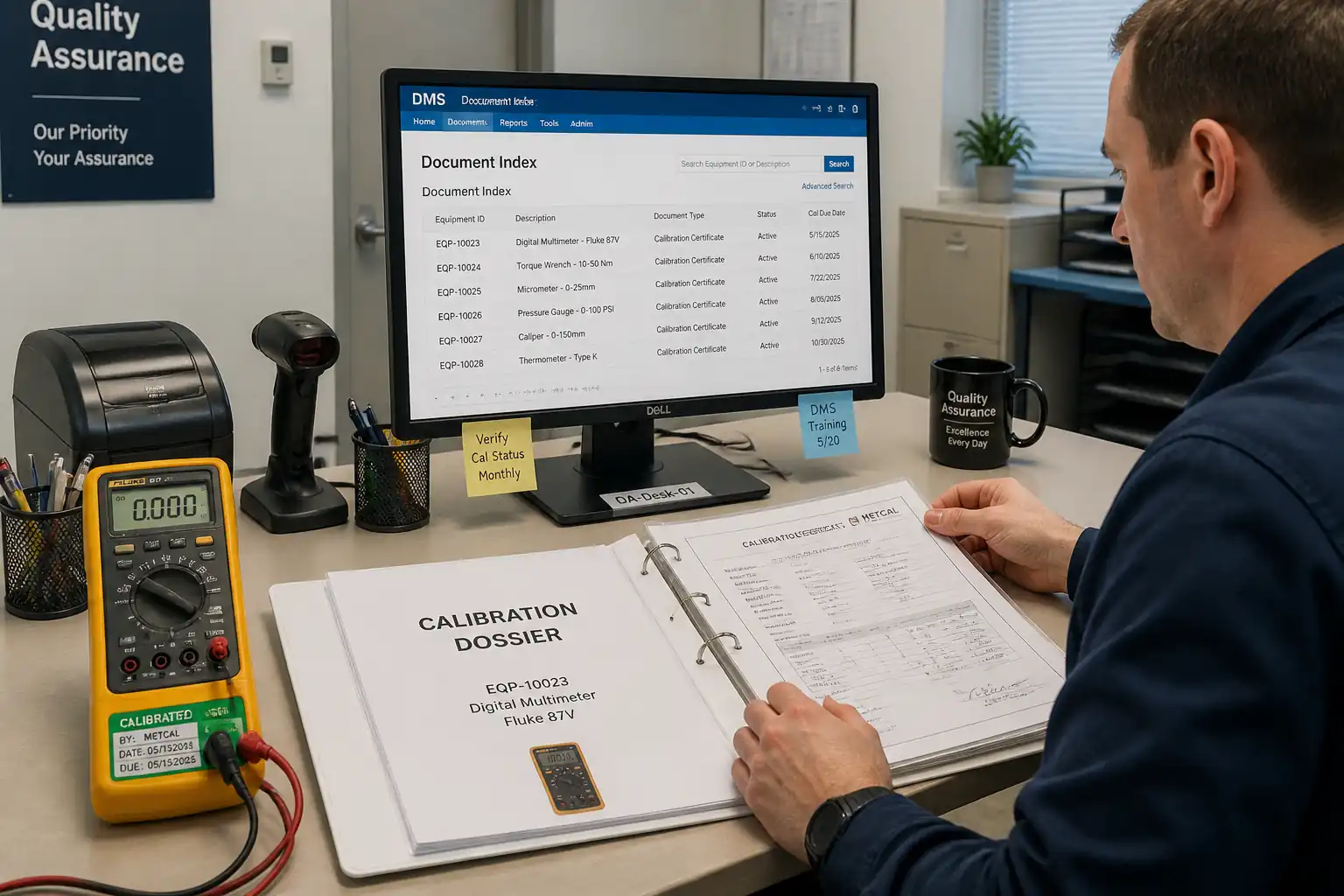
| Meters | Set per area [Verify] | Calibration in date | |
| Test instruments | As required | Calibration certificates | |
| Safety/access | As required | Pre-use inspection | |
| Admin | As required | Function check |
Prerequisites
- Area completion verification: All preceding works complete and snag-free from internal QC; cleaning to builder’s finish or final clean as agreed.
- Statutory and authority approvals obtained or scheduled (e.g., fire authority, elevator inspection) [Verify per project].
- All Inspection Requests (IRs) for concealed works and finishes approved; NCRs and SORs closed or with approved dispositions.
- Commissioning status: Pre-commissioning and commissioning completed with signed checklists; integrated systems testing for life-safety scheduled/completed with evidence.
- As-built drawings (latest revision), O&M manuals (issue version), warranties/guarantees draft, test certificates, asset registers, spares/tools lists compiled.
- HSE arrangements: Risk assessment and method statement briefed; PTW prepared; live system interfaces risk-assessed; emergency plan and muster points defined.
- Access and route: Route maps marked; exclusions/barriers planned; temporary protection installed where needed; lifts/escalators under control for demos.
- Attendance: Invitation and agenda issued (≥5 working days prior [Verify]); attendee cap per room/route set; sign-in/out process prepared.
- Instruments and demo aids calibrated and function-checked; LOTO kits issued and registered.
- Interfaces with other contractors/tenants coordinated; hot works prohibited on walkthrough day unless specifically permitted.
Method Sequence
| Step | Activity | Description | Responsibility | Inspection / Hold Point |
|---|---|---|---|---|
| 1 | Plan and approve walkthrough | Define area/package, objectives, date/time, attendee list, route, demo sequences, and constraints. Issue Walkthrough Plan for approval. | PM / Handover Manager | Review and approval by Client/Consultant (if required) |
| 2 | Readiness pre-scan | Internal contractor QC sweep to eliminate obvious defects; verify cleanliness, access, labeling, asset tags, and safety signage. | QA/QC with Discipline Leads | Internal checklist 100% of route |
| 3 | HSE and access setup | Install barriers and signage; confirm PTWs; brief toolbox talk; verify emergency routes clear; allocate marshals. | HSE Manager/Officer | Pre-start HSE inspection |
| 4 | Documentation staging | Prepare document packs: drawings, IRs, test certs, O&M index, asset list, demo sheets; load digital plans to devices. | Document Controller / QA/QC | Doc completeness check |
| 5 | Attendance control | Set up sign-in desk; verify PPE; issue visitor badges; brief agenda and rules; cap headcount per room size. | Handover Manager / Admin | Visual and register check |
| 6 | Architectural/finishes walk | Lead route to verify finishes, doors/ironmongery, ceilings, floors, signage, cleanliness, protection removed as agreed. | Architectural Lead / QA/QC | Visual inspection at 1.5 m in normal lighting |
| 7 | MEP demonstrations | Demonstrate lighting controls, small power sampling, HVAC operation/trending, water fixtures, drainage observation, fire alarm cause-and-effect (agreed points), emergency lighting function, BMS graphics. | Commissioning Manager & MEP Leads | Witness tests per demo script |
| 8 | External works route (if applicable) | Inspect pavements, kerbs, drainage gratings, landscaping, lighting, signage, accessibility routes. | Civil/External Works Lead | Visual inspection; function checks (lighting) |
| 9 | Snag capture and categorization | Log each item with photo, location, trade, category: A (critical/safety), B (functional/finish), C (minor). Assign responsible party and due date. | Handover Manager / QA/QC | Real-time review with Client/Consultant |
| 10 | Action plan issue | Compile and issue action tracker within 24 hours with owners, target dates, and evidence requirements. | Handover Manager / Document Controller | PM approval |
| 11 | Rectification works | Perform corrections safely under PTW; update evidence (before/after photos, test results). | Trade/Subcontractor Leads | Trade QC then QA/QC verification |
| 12 | Re-walk/verification | Conduct targeted re-inspection on closed items and any affected interfaces. Update status to Closed/Rejected/Deferred. | QA/QC with Client/Consultant (as agreed) | Witness (selected) |
| 13 | Documentation finalization | Submit final as-builts, O&M manuals, warranties, training records, spares/handover lists, authority approvals. | Document Controller / QA/QC | Review against submission matrix |
| 14 | Final acceptance sign-off | Present final status, residual snag summary (if any), warranties, DLP terms; obtain Client/Consultant acceptance certificate. | PM / Client Rep | Signatory verification |
Safety Controls (HSE)
Task-specific hazards, consequences, and controls
1) Hazard: Live electrical systems during demonstrations
- Likely consequence: Electric shock, arc flash, burns
- Engineering/procedural control: Energised work prohibited; demonstrations limited to operational controls; LOTO for non-required circuits; insulated barriers on open panels; competent electrician in charge.
- Required PPE: Arc-rated clothing where applicable [Verify], safety glasses, dielectric gloves when testing, safety footwear.
- Collective preventive measure: Exclusion zone around panels; lockable doors; temporary guards.
- Inspection/permit/supervision: Electrical PTW/energised work permit; panel covers integrity check; supervision by Electrical Lead; calibration check of meters.
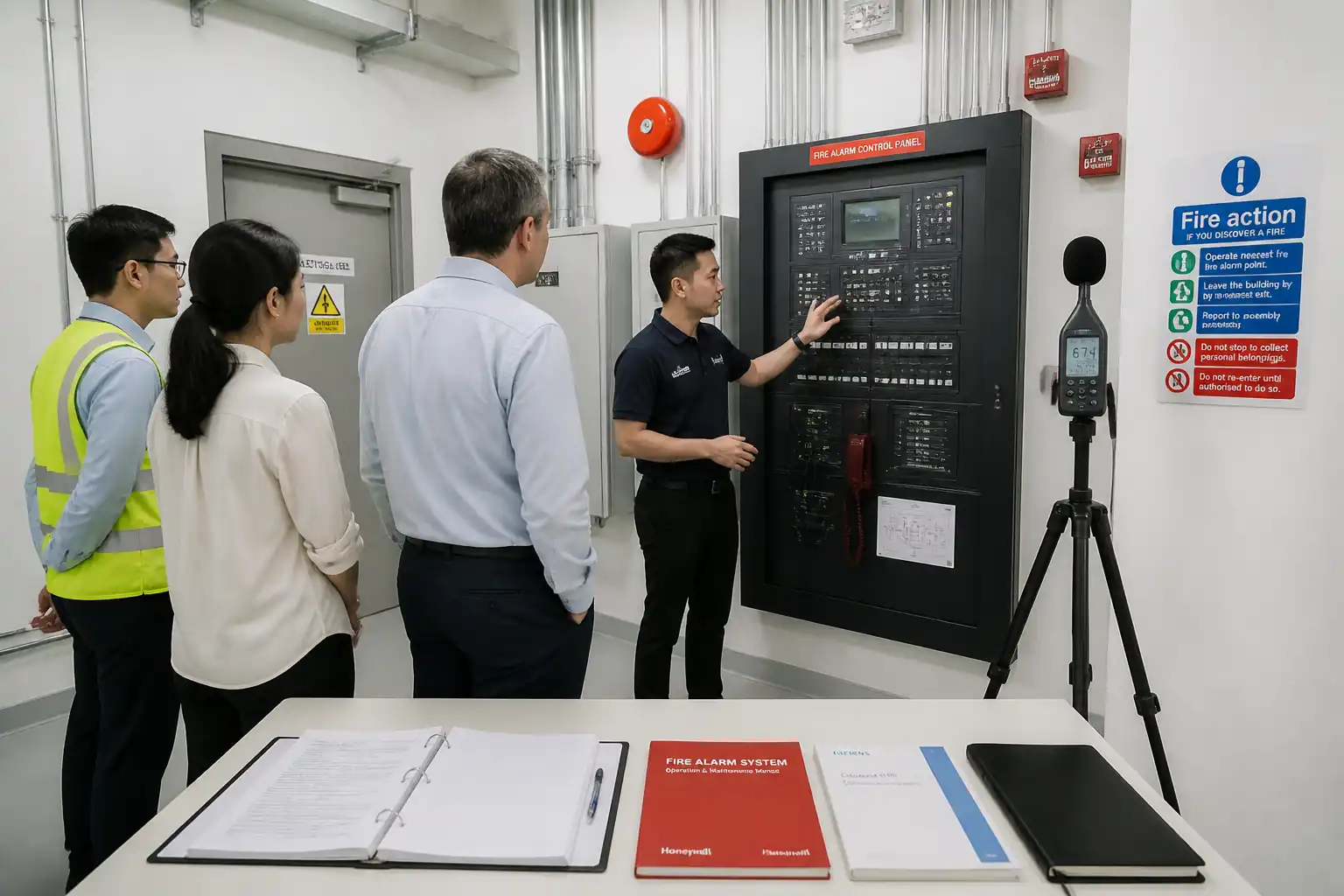
2) Hazard: Fire alarm and life-safety system activation
- Likely consequence: Panic, unintended evacuation, impairment of other systems
- Control: Pre-notification to occupants/authorities; temporary disable/enable under procedure; verify sounder levels in controlled manner.
- PPE: Hearing protection during sounder tests.
- Collective measure: Controlled muster instructions; signage and marshals.
- Inspection/permit/supervision: Hot/Noisy works permit (as required); test authorization; Fire/Life Safety Lead supervision.
3) Hazard: Trip/slip hazards on route (loose materials, thresholds, wet floors)
- Consequence: Falls, injury
- Control: Pre-walk housekeeping; anti-slip mats; remove obstructions; maintain lux levels ≥ 200 lx on route [Verify].
- PPE: Safety shoes with slip-resistant soles.
- Collective measure: Route delineation; barrier tape; cleaning completed prior.
- Inspection/permit/supervision: HSE pre-start inspection checklist; housekeeping sign-off.
4) Hazard: Working at height for accessing ceilings or roof walkthroughs
- Consequence: Falls from height
- Control: Avoid WAH during client walkthrough; if unavoidable, use podium steps/towers with guardrails; 3 points of contact; no ladders for sustained work.
- PPE: Helmet with chin strap; fall arrest where required.
- Collective measure: Exclusion zone below; spotter.
- Inspection/permit/supervision: WAH permit; equipment inspection tags in date; competent person supervision.
5) Hazard: Confined/poorly ventilated plantrooms
- Consequence: Asphyxiation, exposure to refrigerants/chemicals
- Control: Pre-entry gas test; ventilation on; access limited to small groups; SDS available.
- PPE: Gas detector for entry controller; gloves; safety footwear.
- Collective measure: Door kept open if safe; emergency egress clear.
- Inspection/permit/supervision: Confined space/Plantroom entry permit (if classified); supervision.
6) Hazard: Lift/escalator movement during demos
- Consequence: Entrapment, collision
- Control: Qualified lift vendor controls panel; barriers at machinery spaces; emergency stop tested with vendor supervision only.
- PPE: Standard PPE.
- Collective measure: Limit riders to capacity; marshal at doors.
- Inspection/permit/supervision: Vendor permit-to-test; method statement briefing.
7) Hazard: Crowding and poor egress
- Consequence: Crush, delayed evacuation
- Control: Cap attendees per room size; stage groups; maintain clear egress width per code [Verify].
- PPE: Standard PPE.
- Collective measure: Marshals manage flow; use radios.
- Inspection/permit/supervision: HSE to approve attendee cap; headcount log.
8) Hazard: Noise exposure from alarms and equipment
- Consequence: Temporary/permanent hearing loss
- Control: Limit duration; pre-warn; use calibrated sounders; measure dB(A) if required.
- PPE: Ear protection available and mandated during tests.
- Collective measure: Create quiet refuge point.
- Inspection/permit/supervision: Noisy work permit [Verify]; HSE monitoring.
9) Hazard: Chemical exposure from last-minute sealants/paints
- Consequence: Respiratory/skin irritation
- Control: Prohibit wet trades during walkthrough; ensure curing complete; adequate ventilation.
- PPE: Nitrile gloves for handlers; masks if residual odor in enclosed spaces.
- Collective measure: Air out area prior to visit.
- Inspection/permit/supervision: SDS review; HSE spot check.
10) Hazard: Data privacy/photography restrictions
- Consequence: Breach of policy
- Control: Brief on acceptable photography; blur sensitive panels; no photos in restricted zones.
- PPE: N/A
- Collective measure: Signage; escorts.
- Inspection/permit/supervision: Client approval required.
[Verify per project HSE plan and local regulations]
Environmental Controls
- Noise management: Schedule alarm/sound tests during permitted hours; notify neighbors; measure levels if complaint risk; limit duration.
- Dust/cleanliness: Complete dry cleaning prior; no grinding/cutting during walkthrough; provide sticky mats at entries.
- Waste and spill control: No generation of wet waste; have spill kits available; collect any packaging/temporary protection for proper segregation per site SWMP.
- Energy and utilities: Avoid unnecessary plant running; revert systems to normal after demos; log any temporary overrides on BMS.
- Water discharge: Do not flush to storm drains; any functional flow tests to sanitary line only; prevent ponding on external works.
- Refrigerants/FGas: No venting permitted; demonstrations must not cause releases; leak logs current [Verify per local law].
- Lighting/HVAC: Maintain adequate ventilation and lighting to reduce odor accumulation and ensure safe egress.
- Documentation: Record any environmental incidents on site form and close out within 24 hours.
[Verify per project EMP and local regulations]
QA/QC Requirements
Documentation
- As-builts: Latest revision, clouded changes removed, title blocks complete. Drawing index reconciled to scope.
- O&M Manuals: Structure per spec; include maintenance tasks, spares, warranties, and vendor contacts. Provide digital (searchable PDF) and hardcopy sets as required.
- Test Certificates: Pre-commissioning, commissioning, integrated testing, statutory approvals. Calibration certificates current for all instruments used.
- Asset Data: COBie/asset registers complete with tags, locations, serials [Verify per project].
Acceptance Metrics
- Category A (critical/safety): 0 open at acceptance.
- Category B/C: Residual defect policy to be agreed; typical benchmark ≤ 5 B-items per functional area with committed closure ≤ 5 working days; C-items ≤ 10 working days [Verify per project specifications].
- Documentation: 100% of mandatory records accepted with no critical comments.
Sampling and Witnessing
- Finishes visual: 100% of client route; additional 10% spot checks in adjacent spaces [Verify].
- MEP demonstrations: 100% life-safety; 20–30% representative sampling for repetitive devices (e.g., 20% lighting controls) unless contract requires 100% [Verify].
Nonconformance and Change
- Any failure recorded as snag or NCR depending on severity; root cause analysis for repeated issues; re-test after correction.
Records Control
- All records dated, signed, and uniquely referenced; electronic records time-stamped; photographs geolocated where possible.
- Retention in the project CDE per ISO 19650 naming conventions [Verify].
Attachments
- Sample Walkthrough Plan template (scope, route map, agenda, attendee list)
- Readiness Checklist (finishes, MEP, labeling, cleaning, HSE)
- Demo Scripts/Checklists (HVAC, Lighting, Fire Alarm, Plumbing, BMS)
- Snag Register fields definition (ID, location, photo, trade, category A/B/C, due date, owner, status, evidence link)
- Action Tracker template with SLA targets
- Attendance Register and Briefing Record
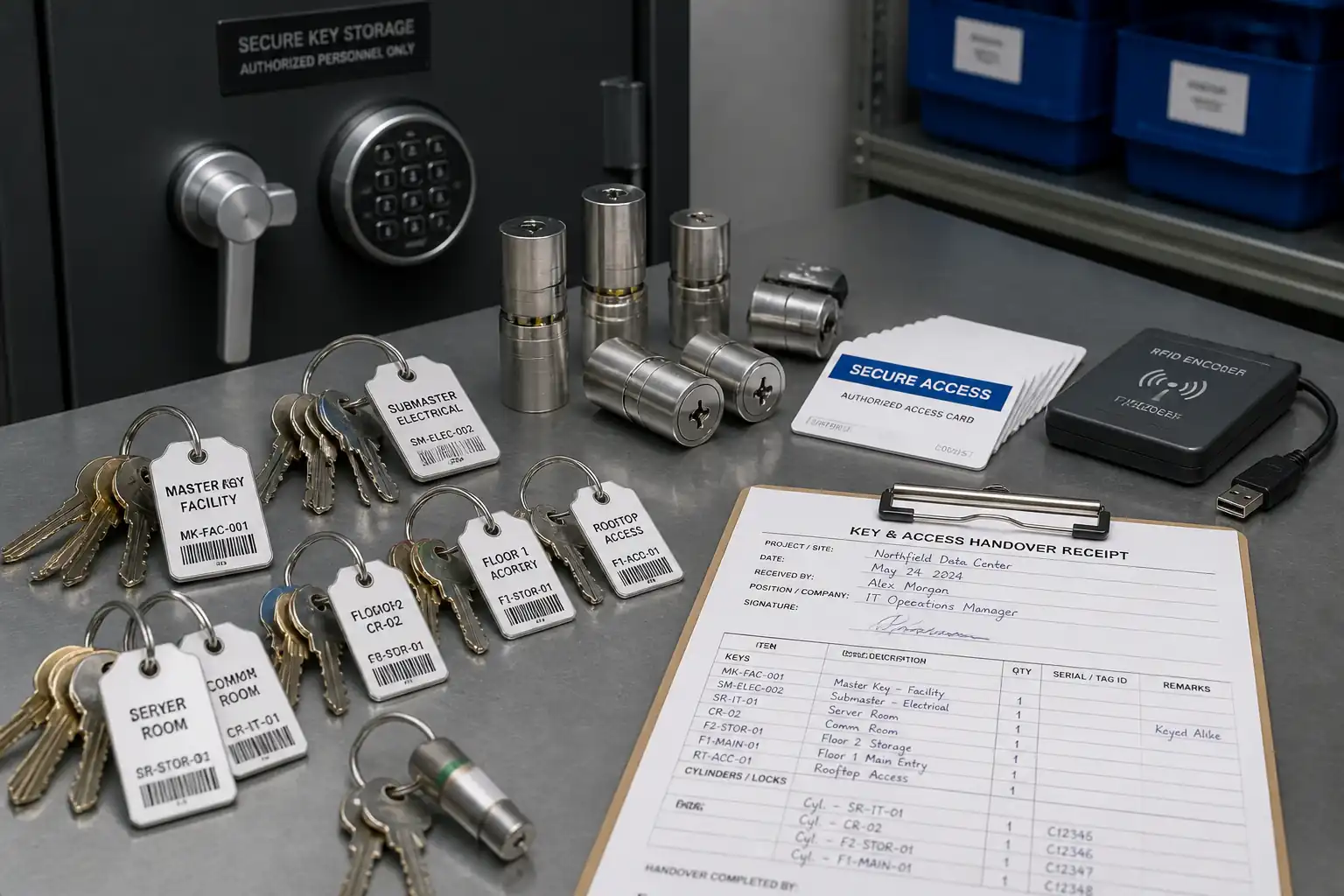
- Acceptance Certificate template and Key/Spares Handover Receipt
- Document Submission Matrix and O&M/As-built checklists
- Risk Assessment and PTW forms relevant to walkthrough
This content is a read-only public reference. Download or customize to get an editable version.
ITP preview
The first inspection activities from the linked ITP for Method Statement: Final Inspection and Client Walkthrough Procedure:
| Activity | Inspection / Test | Acceptance Criteria | Responsibility | Record |
|---|---|---|---|---|
| Walkthrough plan approval | Document review against scope and HSE | Plan approved; risks addressed; attendees confirmed | PM / Client Rep | Approved Plan/Agenda |
| Pre-walk readiness inspection | Checklist of finishes, access, signage, cleaning | Zero Cat A; route clear; labeling complete | QA/QC Manager | Readiness Checklist; Photos |
| HSE setup and permits | PTW validity, barriers, emergency plan | Valid permits; controls in place; TBT completed | HSE Manager | PTW; HSE Pre-start form |
Showing 3 of 13 inspection activities. View full ITP →
Related Inspection and Test Plan
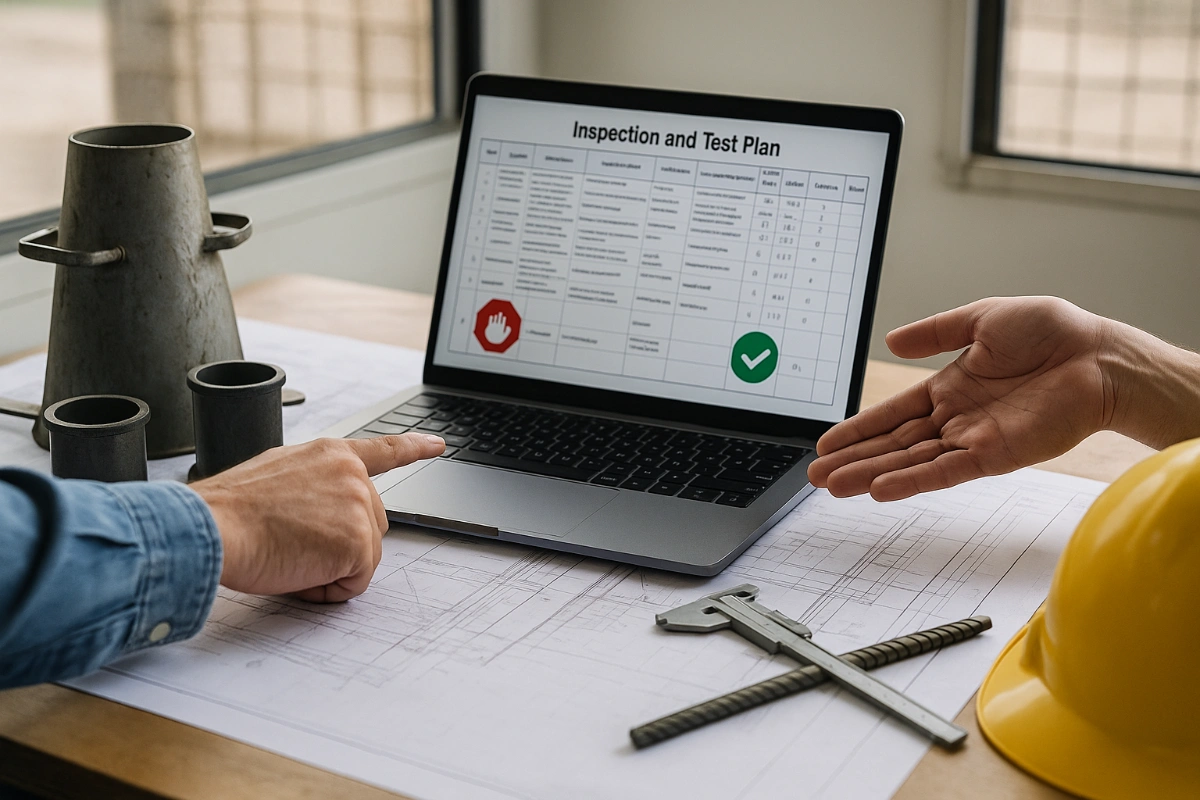
An Inspection and Test Plan (ITP) is available for Method Statement: Final Inspection and Client Walkthrough Procedure. The ITP defines the inspection activities, acceptance criteria, hold and witness points, responsible parties, and records required to verify the work described in this method statement.
View the Method Statement: Final Inspection and Client Walkthrough Procedure ITP →Frequently asked questions
Continue with related Quollnet resources connected to this method statement.