Façade Mock-Up Review Checklist for Specifications and Acceptance
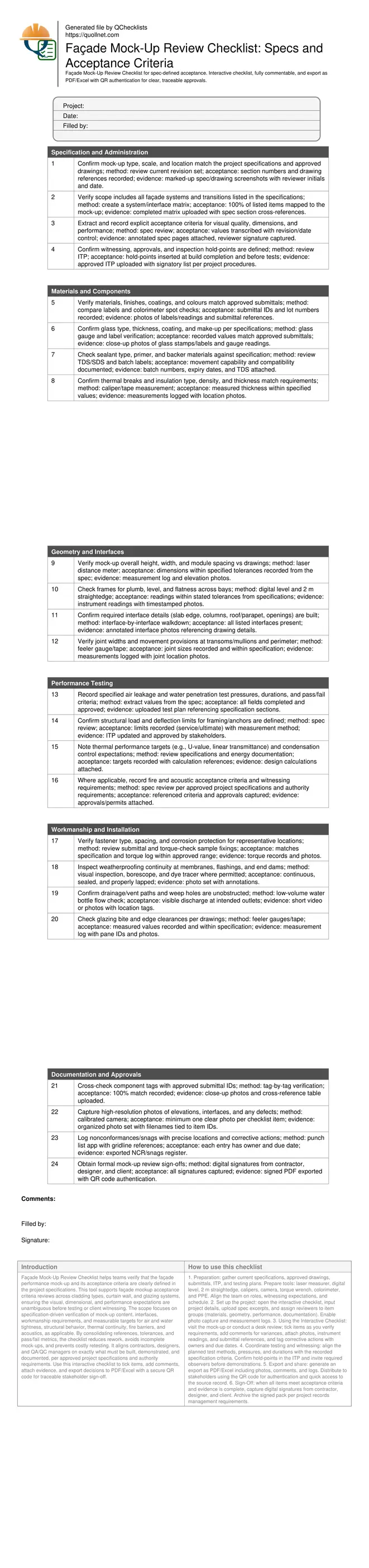
Definition: Façade Mock-Up Review Checklist guides design managers, QA/QC engineers, and contractors through verifying mock-up scope, interfaces, and acceptance criteria defined in project specifications before performance testing and client sign-off.
- Confirm mock-up scope, systems, and interfaces align with approved specifications.
- Capture measurable acceptance criteria for visual, dimensional, and performance targets.
- Standardize evidence: photos, readings, batch IDs, and marked-up references.
- Interactive, commentable checklist with export and QR code authentication.
Façade Mock-Up Review Checklist helps teams verify that the façade performance mock-up and its acceptance criteria are clearly defined in the project specifications. This tool supports façade mockup acceptance criteria reviews across cladding types, curtain wall, and glazing systems, ensuring the visual, dimensional, and performance expectations are unambiguous before testing or client witnessing. The scope focuses on specification-driven verification of mock-up content, interfaces, workmanship requirements, and measurable targets for air and water tightness, structural behavior, thermal continuity, fire barriers, and acoustics, as applicable. By consolidating references, tolerances, and pass/fail metrics, the checklist reduces rework, avoids incomplete mock-ups, and prevents costly retesting. It aligns contractors, designers, and QA/QC managers on exactly what must be built, demonstrated, and documented, per approved project specifications and authority requirements. Use this interactive checklist to tick items, add comments, attach evidence, and export decisions to PDF/Excel with a secure QR code for traceable stakeholder sign-off.
- Drive clarity and reduce risk by extracting the façade mock-up scope directly from approved specifications, mapping every system and interface that must appear, and capturing explicit visual, dimensional, and performance criteria before ordering materials or scheduling tests.
- Improve coordination between contractor, designer, and testing agency by agreeing early on pass/fail targets, witnessing and hold-points, and evidence requirements. This prevents scope gaps, ensures consistent expectations, and shortens the path to acceptance and sign-off.
- Strengthen quality records with standardized measurement logs, photos, submittal cross-references, and batch IDs. Clear traceability supports corrective action management, de-risks client demonstrations, and enables confident decisions grounded in documented specification requirements.
- Interactive online checklist with tick, comment, and export features secured by QR code.
Specification and Administration
Materials and Components
Geometry and Interfaces
Performance Testing
Workmanship and Installation
Documentation and Approvals
Why a specification-led façade mock-up review matters
A specification-led façade mock-up review aligns teams on exactly what must be built, shown, and accepted before testing begins. It limits disputes by translating the project specification into clear, measurable criteria for scope, workmanship, interfaces, and performance. The review compels early agreement on system coverage (curtain wall, cladding, glazing), transition details (slab edge, parapet, column), and visual targets (surface quality, colour, alignment). It also clarifies witnessing and hold-points, ensuring the right people observe the right events. By confirming acceptance thresholds and evidence types upfront—measurements, photos, batch IDs, and sign-offs—you avoid incomplete mock-ups, failed demonstrations, and rework. The boundaries of this checklist are deliberate: it validates scope and acceptance criteria defined in the specifications; it does not replace certified laboratory or field testing, only prepares for it. Use this process to de-risk procurement, streamline scheduling, and establish a single source of truth for acceptance.
- Base every decision on the current specification revision and drawings.
- Include all required interfaces the client expects to see proven.
- Define acceptance evidence before building the mock-up.
- Set hold-points to protect witnessing and sign-off moments.
Turning requirements into measurable, witnessed acceptance criteria
Strong acceptance criteria are observable, measurable, and tied to specific methods. For geometry, specify instruments and tolerances from the project documents. For materials, lock in submittal IDs, batch numbers, and label photos. For performance, record the required pressures, durations, and limits for air and water tests; capture deflection limits and thermal or condensation targets; and note when fire or acoustic outcomes apply. Define exactly who witnesses, how pass/fail is declared, and what documentation is required for closure. This clarity accelerates approvals and avoids subjective debates. Use a standardized matrix that maps each façade system and interface to its criteria and evidence. The matrix becomes the checkable backbone for site reviews and client demonstrations, ensuring nothing essential is missed as the mock-up is assembled and presented.
- Link every criterion to a method, instrument, and tolerance.
- Record where and how measurements are taken on the mock-up.
- Capture submittal references and batch IDs for traceability.
- Define witnessing roles and closure documents in the ITP.
Evidence capture, corrective actions, and sign-off
Reliable evidence shortens the road to acceptance. Require timestamped photos for each checklist item, instrument readings saved to logs, and clear annotations tying observations to locations. Organize nonconformances with corrective actions, owners, and due dates so the team can clear issues before formal witnessing. Export review packs to PDF/Excel with a QR code for authenticity and quick retrieval by stakeholders. Maintain alignment with approved project specifications and authority requirements at every step. When all criteria are met and evidence is complete, capture digital signatures from contractor, designer, and client to finalize acceptance. Archive the full record for downstream reference, including procurement, testing, and future maintenance considerations.
- Standardize filenames to match checklist item IDs.
- Use gridlines and elevations to locate observations.
- Require owner, action, and deadline for each NCR.
- Authenticate exports with QR codes for traceability.
How to Use This Façade Mock-Up Review Checklist
- Preparation: gather current specifications, approved drawings, submittals, ITP, and testing plans. Prepare tools: laser measurer, digital level, 2 m straightedge, calipers, camera, torque wrench, colorimeter, and PPE. Align the team on roles, witnessing expectations, and schedule.
- Set up the project: open the interactive checklist, input project details, upload spec excerpts, and assign reviewers to item groups (materials, geometry, performance, documentation). Enable photo capture and measurement logs.
- Using the Interactive Checklist: visit the mock-up or conduct a desk review; tick items as you verify requirements, add comments for variances, attach photos, instrument readings, and submittal references, and tag corrective actions with owners and due dates.
- Coordinate testing and witnessing: align the planned test methods, pressures, and durations with the recorded specification criteria. Confirm hold-points in the ITP and invite required observers before demonstrations.
- Export and share: generate an export as PDF/Excel including photos, comments, and logs. Distribute to stakeholders using the QR code for authentication and quick access to the source record.
- Sign-Off: when all items meet acceptance criteria and evidence is complete, capture digital signatures from contractor, designer, and client. Archive the signed pack per project records management requirements.
Call to Action
- Start Checklist Tick off tasks, leave comments on items or the whole form, and export your completed report to PDF or Excel—with a built-in QR code for authenticity.
- Download Excel - Façade Mock-Up Review
- Download PDF - Façade Mock-Up Review
- View Image - Façade Mock-Up Review
Cite & Embed
“Façade Mock-Up Review by Quollnet”
with a link to
this source page.

FAQ
Question: What level of detail should the façade mock-up include for a meaningful review?
Question: How do we define pass/fail criteria without over-specifying methods?
Question: When should the testing agency be engaged in the mock-up process?
Question: What evidence convinces stakeholders that the mock-up meets specifications?
Related Articles
Broader reading and guidance connected to this checklist topic.


Concrete Compressive Strength Acceptance Criteria: Aci 318-25 Vs En 206

3d Printed Concrete Qa/qc: Inspection, Process Control & Acceptance


Related Checklists
Keep the workflow moving with nearby templates chosen from similar checklist content.