Façade Glazing Specification Review: Solar Control, U-value, Safety
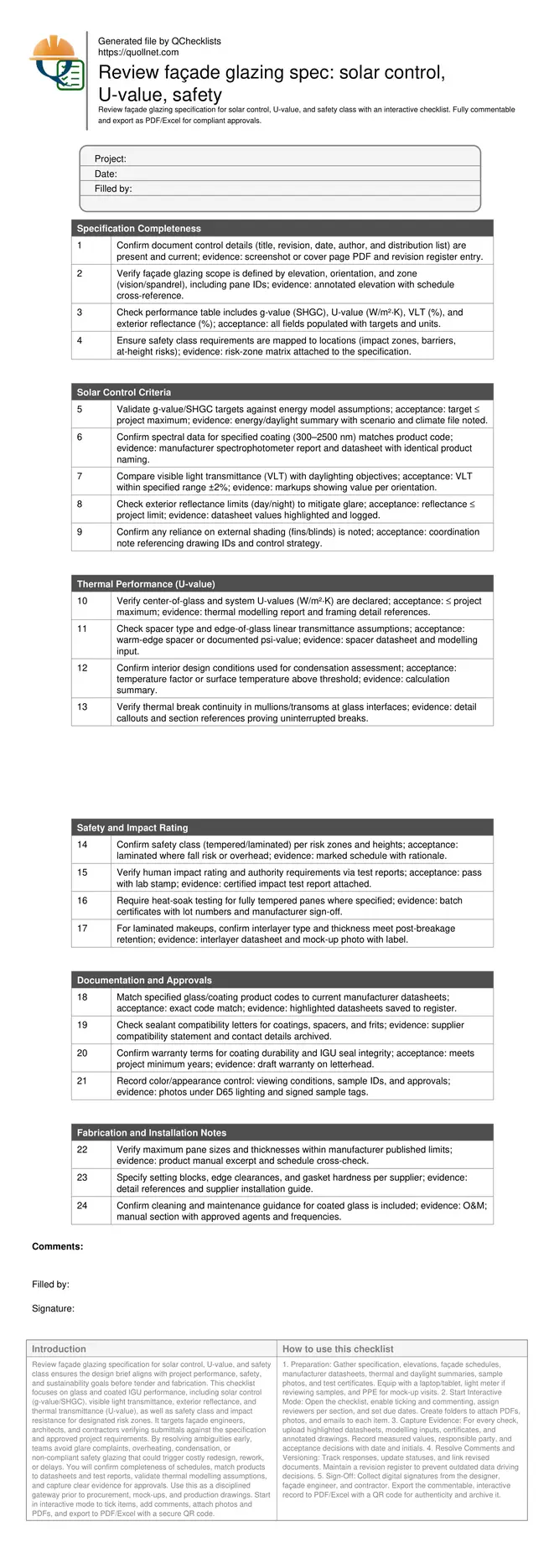
Definition: Review façade glazing specification for solar control, U-value, and safety class equips designers, façade engineers, and contractors to validate performance, safety, and documentation before procurement, fabrication, and installation sequencing.
- Verify g-value, U-value, and VLT against project performance targets.
- Confirm safety glass classes for all risk zones and fall hazards.
- Cross-check manufacturer data, samples, and test reports for consistency.
- Interactive, commentable checklist with export and QR code verification.
Review façade glazing specification for solar control, U-value, and safety class ensures the design brief aligns with project performance, safety, and sustainability goals before tender and fabrication. This checklist focuses on glass and coated IGU performance, including solar control (g-value/SHGC), visible light transmittance, exterior reflectance, and thermal transmittance (U-value), as well as safety class and impact resistance for designated risk zones. It targets façade engineers, architects, and contractors verifying submittals against the specification and approved project requirements. By resolving ambiguities early, teams avoid glare complaints, overheating, condensation, or non-compliant safety glazing that could trigger costly redesign, rework, or delays. You will confirm completeness of schedules, match products to datasheets and test reports, validate thermal modelling assumptions, and capture clear evidence for approvals. Use this as a disciplined gateway prior to procurement, mock-ups, and production drawings. Start in interactive mode to tick items, add comments, attach photos and PDFs, and export to PDF/Excel with a secure QR code.
- Use this checklist to confirm solar control targets (g-value/SHGC), visible transmittance, exterior reflectance, and thermal U-values are clearly stated, coordinated with energy/daylight analyses, and backed by consistent manufacturer data and modelling reports before tender.
- Validate safety glazing classes by area, height, and human impact risk zones. Ensure laminated or tempered makeups, interlayer types, and heat-soak requirements are explicit, with test certificates and mock-up evidence aligned to the specified performance outcomes.
- Coordinate product identifications, coatings, spacers, and sealant compatibility across drawings, schedules, and submittals. Capture acceptance evidence, including datasheets, stamped calculations, color-neutral sample approvals, and warranty terms, to prevent scope gaps and late-stage substitutions.
- Interactive online checklist with tick, comment, and export features secured by QR code.
Specification Completeness
Solar Control Criteria
Thermal Performance (U-value)
Safety and Impact Rating
Documentation and Approvals
Fabrication and Installation Notes
Interpreting Solar Control Metrics with Real-World Context
Solar control performance hinges on three coordinated metrics: g-value (SHGC), visible light transmittance (VLT), and exterior reflectance. The specification should state these for each façade orientation or zone and align them with energy and daylight analysis assumptions. Discrepancies between datasheets and energy models often stem from using generic glass families rather than exact coated products. Require spectral reports tied to precise product codes and coating stacks, and capture lighting conditions for sample reviews to avoid perception bias. Document any reliance on external shading, since modelled performance can collapse if shading is value-engineered away. Where glare concerns exist, verify night-time reflectance and interior blind policies. Acceptance cues include coherent units, tolerances, and consistent values across elevations and schedules, backed by manufacturer test reports. A short note referencing approved project specifications and authority requirements keeps compliance on track without over-prescription, allowing suppliers to propose equals while maintaining outcomes.
- Use exact product codes, not generic glass families
- Record units: %, W/m²·K, and assumptions clearly
- Attach spectral reports for the named coating
- Note any shading dependency and controls
- Validate glare limits for day and night
Verifying Thermal U-values and Condensation Risk
Thermal transmittance drives comfort and energy outcomes. Require both center-of-glass and system U-values so framing effects are not ignored. Confirm thermal modelling inputs: glass makeups, spacer type, gas fill, emissivity, and boundary conditions. Edge losses can be significant; warm-edge spacers and correct psi-values should be explicitly stated. For condensation control, specify interior design temperatures and humidity so surface temperature or temperature factor checks are meaningful. Request that reports clearly present assumptions, calculation methods, and the applicable climatic data set. Cross-reference results to details showing continuous thermal breaks at mullions and transoms. Acceptance is a U-value at or below the project maximum with documented inputs, and a condensation assessment demonstrating safety margin for typical winter conditions. Archive the report PDF and cite drawing IDs used in the analysis so field teams can trace decisions during submittal review and mock-up testing.
- Request model inputs and boundary conditions
- Capture psi-values and spacer type explicitly
- Check thermal break continuity at interfaces
- Log U-values by elevation with units
- Attach condensation assessment summary
Confirming Safety Class and Impact Performance
Safety glazing protects occupants at impact zones, near floor edges, and in overhead conditions. Map each elevation to a risk zone and state the required safety class: tempered, laminated, or combinations such as heat-treated laminated. For fall hazards or areas acting as guards, laminated glazing typically ensures post-breakage retention; require interlayer type and thickness to be explicit. Where fully tempered panes are specified, require heat-soak testing to reduce spontaneous breakage risk. Obtain certified impact test reports matching the exact product codes and thicknesses proposed. Coordinate with the façade schedule so substitutions do not degrade safety performance. Use concise language referencing approved project specifications and authority requirements to maintain compliance without quoting clause numbers. Acceptance requires complete risk mapping, valid test certificates, and mock-up evidence when practical, all cross-referenced to pane IDs and elevations for traceability.
- Map risk zones to elevations and panes
- State interlayer types and thicknesses
- Require heat-soak certificates for tempered
- Match test reports to product and thickness
- Cross-reference pane IDs for traceability
How to Use This Interactive Glazing Spec Review Checklist
- Preparation: Gather specification, elevations, façade schedules, manufacturer datasheets, thermal and daylight summaries, sample photos, and test certificates. Equip with a laptop/tablet, light meter if reviewing samples, and PPE for mock-up visits.
- Start Interactive Mode: Open the checklist, enable ticking and commenting, assign reviewers per section, and set due dates. Create folders to attach PDFs, photos, and emails to each item.
- Capture Evidence: For every check, upload highlighted datasheets, modelling inputs, certificates, and annotated drawings. Record measured values, responsible party, and acceptance decisions with date and initials.
- Resolve Comments and Versioning: Track responses, update statuses, and link revised documents. Maintain a revision register to prevent outdated data driving decisions.
- Sign-Off: Collect digital signatures from the designer, façade engineer, and contractor. Export the commentable, interactive record to PDF/Excel with a QR code for authenticity and archive it.
Call to Action
- Start Checklist Tick off tasks, leave comments on items or the whole form, and export your completed report to PDF or Excel—with a built-in QR code for authenticity.
- Download Excel - Façade Glazing Specification Review
- Download PDF - Façade Glazing Specification Review
- View Image - Façade Glazing Specification Review
Cite & Embed
“Façade Glazing Specification Review by Quollnet”
with a link to
this source page.

FAQ
Question: What is the difference between g-value (SHGC) and U-value for glazing?
Question: How do I verify that the safety glass class is appropriate for each location?
Question: What evidence should I collect to support U-value claims in submittals?
Question: How can I balance glare control with daylight when setting VLT and g-value?
Related Articles
Broader reading and guidance connected to this checklist topic.




Related Checklists
Keep the workflow moving with nearby templates chosen from similar checklist content.