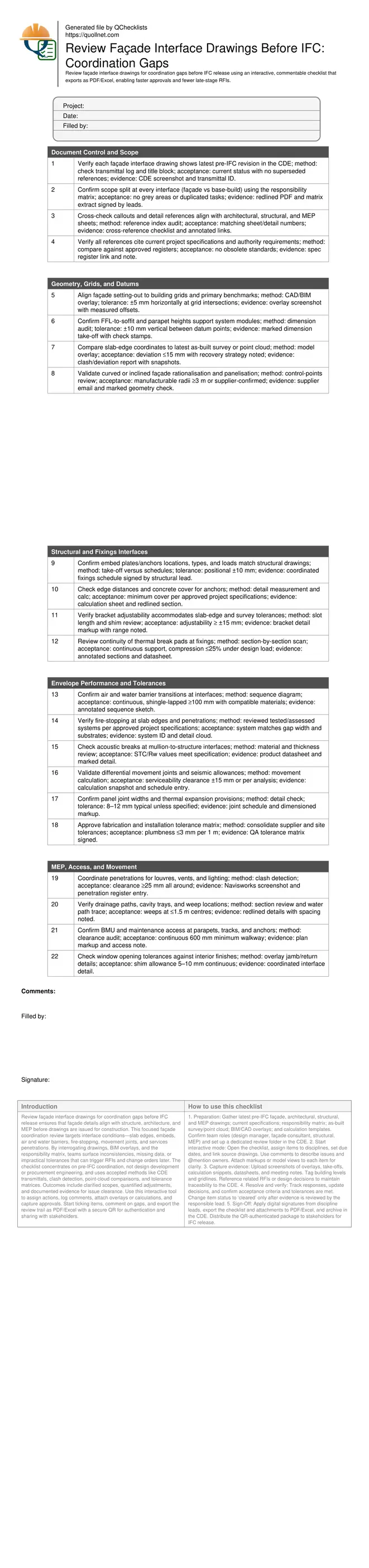
Review Façade Interface Drawings for Coordination Gaps Before IFC
Definition: Review façade interface drawings for coordination gaps before IFC release equips design managers and coordinators to detect mismatches, define responsibilities, and verify tolerances before drawings are issued for construction.
- Catch cross-discipline clashes early to prevent site rework and delay.
- Align grids, datums, and tolerances for buildable, surveyable façades.
- Clarify responsibilities and sequences at every interface detail.
- Interactive, commentable, export, QR code for authenticated sharing.
Review façade interface drawings for coordination gaps before IFC release ensures that façade details align with structure, architecture, and MEP before drawings are issued for construction. This focused façade coordination review targets interface conditions—slab edges, embeds, air and water barriers, fire-stopping, movement joints, and services penetrations. By interrogating drawings, BIM overlays, and the responsibility matrix, teams surface inconsistencies, missing data, or impractical tolerances that can trigger RFIs and change orders later. The checklist concentrates on pre-IFC coordination, not design development or procurement engineering, and uses accepted methods like CDE transmittals, clash detection, point-cloud comparisons, and tolerance matrices. Outcomes include clarified scopes, quantified adjustments, and documented evidence for issue clearance. Use this interactive tool to assign actions, log comments, attach overlays or calculations, and capture approvals. Start ticking items, comment on gaps, and export the review trail as PDF/Excel with a secure QR for authentication and sharing with stakeholders.
- Proactively validating façade interfaces before IFC locks scope, geometry, and tolerances across disciplines. This reduces RFIs, avoids out-of-sequence work, and confirms construction feasibility. Teams gain shared understanding of responsibilities, installation sequences, and testing requirements, supported by verifiable evidence embedded in each action.
- Applying overlays to grids, benchmarks, and as-built surveys highlights buildability risks like slab-edge variance, bracket reach, and joint sizing. Recording measurable acceptance criteria in SI units streamlines procurement, fabrication, and site setting-out while safeguarding performance targets for airtightness, water tightness, fire, acoustic, and thermal continuity.
- Interactive online checklist with tick, comment, and export features secured by QR code.
- A documented trail of decisions—screenshots, clash reports, calculations, datasheets, and signatures—creates a defensible basis for IFC release. It accelerates coordination meetings, supports authority and client reviews per approved project specifications and authority requirements, and enables fast sign-off and archive in the CDE.
Document Control and Scope
Geometry, Grids, and Datums
Structural and Fixings Interfaces
Envelope Performance and Tolerances
MEP, Access, and Movement
Why pre-IFC façade interface reviews prevent costly rework
Before drawings are issued for construction, interface gaps often hide in the joins between structure, façade, and services. A disciplined pre-IFC review exposes missing seal continuity, undersized joints, misaligned embeds, and ambiguous responsibilities that generate late RFIs and change orders. Start by confirming document control and scope splits, then interrogate high-risk interface types: slab edges, parapets, returns, penetrations, and transitions between systems. Use the CDE to compare revisions, overlay BIM or CAD against as-built surveys, and document measurable acceptance criteria. Capture evidence—screenshots, take-offs, calculations, datasheets—directly against each action. This creates a reliable audit trail for design managers, façade consultants, and contractors to sign off. The outcome is a set of coordinated, buildable details with clearly defined sequencing and testing requirements, ready for IFC release per approved project specifications and authority requirements.
- Target slab edges, penetrations, parapets, and transitions first.
- Overlay BIM or point clouds to reveal geometry drift.
- Define responsibilities at every interface line.
- Attach evidence to each resolved action.
- Record measurable acceptance criteria in SI units.
Geometry, tolerances, and buildability cues to verify
Geometry drives buildability and survey control. Confirm façade setting-out aligns to primary grids and datums, then validate FFL-to-soffit heights and slab-edge positions versus current surveys. For complex forms, check rationalisation and panelisation against supplier capabilities. Ensure bracket adjustability and shim ranges recover predictable site deviations. Establish a tolerance matrix that cascades from structure through fixings to panels, spelling out plumbness, level, joint width, and flatness limits. Link these to quality checkpoints and inspection methods, so later shop drawings and site measurements reference the same acceptance criteria. Document where deviations exceed recoverable ranges and propose mitigation: moving embeds, adjusting brackets, or resequencing trades. Clear tolerances reduce ambiguity, speed fabrication approvals, and prevent site improvisation.
- Set out from stable grids and benchmarks.
- Check survey-to-model deviations with overlays.
- Confirm adjustability and shim recovery ranges.
- Publish a project-wide tolerance matrix.
- Flag non-recoverable deviations early.
Performance continuity across structure, envelope, and MEP
Performance failures usually occur at interfaces, not within systems. Review continuity of air and water barriers at all transitions and ensure compatible materials with shingle laps. Validate fire-stopping solutions match actual gaps and substrates, and confirm acoustic breaks at structural connections. Coordinate MEP penetrations and façade-integrated components to maintain drainage paths and serviceability clearances. Sequence matters: define who installs first, who inspects, and what evidence is required. Close the loop with test-ready details and accessible maintenance routes, including BMU clearances. All findings must trace back to approved project specifications and authority requirements, with decisions recorded in the CDE for transparent accountability and rapid IFC readiness.
- Maintain continuous seals with compatible materials.
- Match fire-stopping systems to real gap sizes.
- Protect acoustics at structure connections.
- Preserve drainage paths and clearances.
- Define installation and inspection sequence.
How to Use This Interactive Checklist
- Preparation: Gather latest pre-IFC façade, architectural, structural, and MEP drawings; current specifications; responsibility matrix; as-built survey/point cloud; BIM/CAD overlays; and calculation templates. Confirm team roles (design manager, façade consultant, structural, MEP) and set up a dedicated review folder in the CDE.
- Start interactive mode: Open the checklist, assign items to disciplines, set due dates, and link source drawings. Use comments to describe issues and @mention owners. Attach markups or model views to each item for clarity.
- Capture evidence: Upload screenshots of overlays, take-offs, calculation snippets, datasheets, and meeting notes. Tag building levels and gridlines. Reference related RFIs or design decisions to maintain traceability to the CDE.
- Resolve and verify: Track responses, update decisions, and confirm acceptance criteria and tolerances are met. Change item status to ‘cleared’ only after evidence is reviewed by the responsible lead.
- Sign-Off: Apply digital signatures from discipline leads, export the checklist and attachments to PDF/Excel, and archive in the CDE. Distribute the QR-authenticated package to stakeholders for IFC release.
Call to Action
- Start Checklist Tick off tasks, leave comments on items or the whole form, and export your completed report to PDF or Excel—with a built-in QR code for authenticity.
- Download Excel - Façade Interface Drawing Coordination Review (Pre-IFC)
- Download PDF - Façade Interface Drawing Coordination Review (Pre-IFC)
- View Image - Façade Interface Drawing Coordination Review (Pre-IFC)
Cite & Embed
“Façade Interface Drawing Coordination Review (Pre-IFC) by Quollnet”
with a link to
this source page.

FAQ
Question: What drawings and models should be included in a pre-IFC façade interface review?
Question: How do I handle discrepancies between design drawings and the as-built survey at slab edges?
Question: What tolerances should I use for façade alignment and joints in this review?
Question: What should I do if I discover a critical coordination gap just before IFC?
Related Articles
Broader reading and guidance connected to this checklist topic.
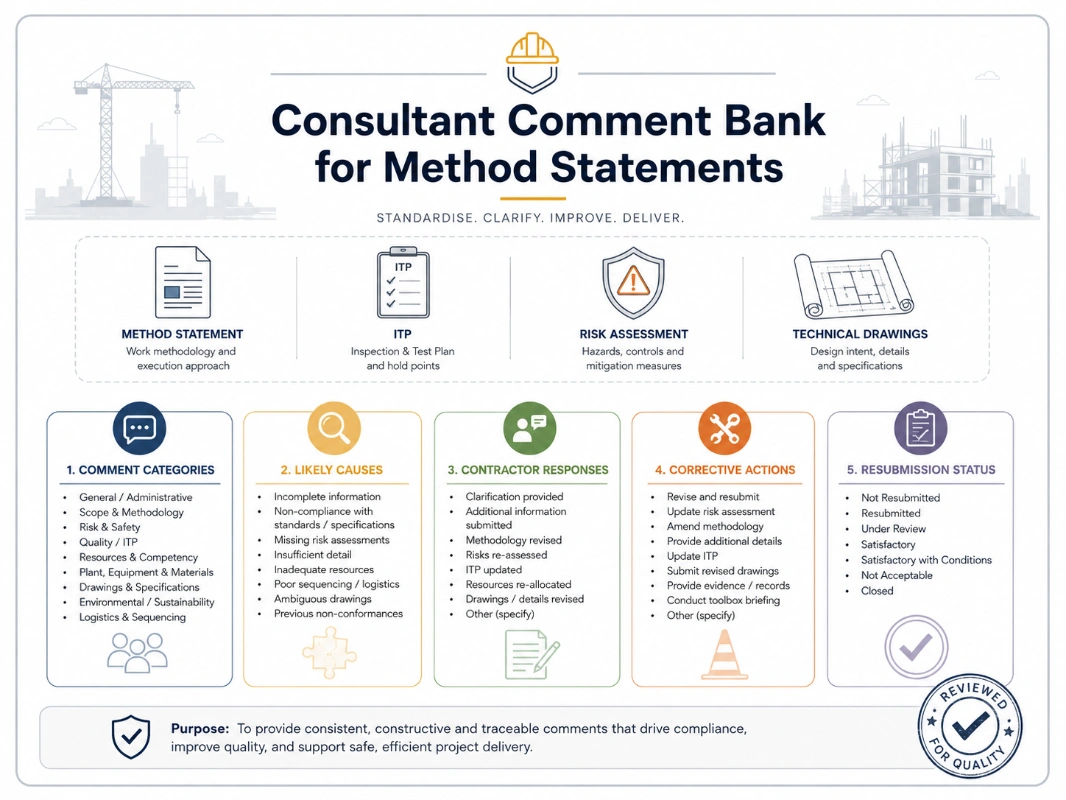
Consultant Comment Bank For Method Statements
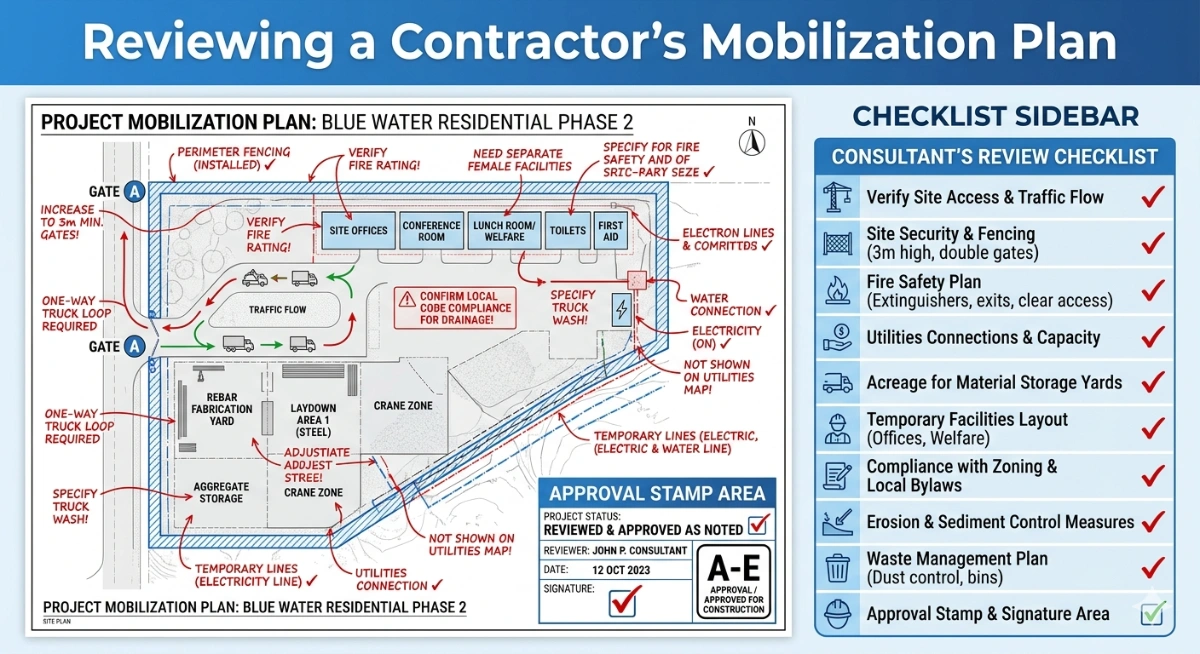
How To Review a Contractor’s Mobilization Plan


How Bim Modeling Supports Prefabrication And Modular Construction

Related Checklists
Keep the workflow moving with nearby templates chosen from similar checklist content.