Façade Movement Joints and Structural Tolerances: Design Review
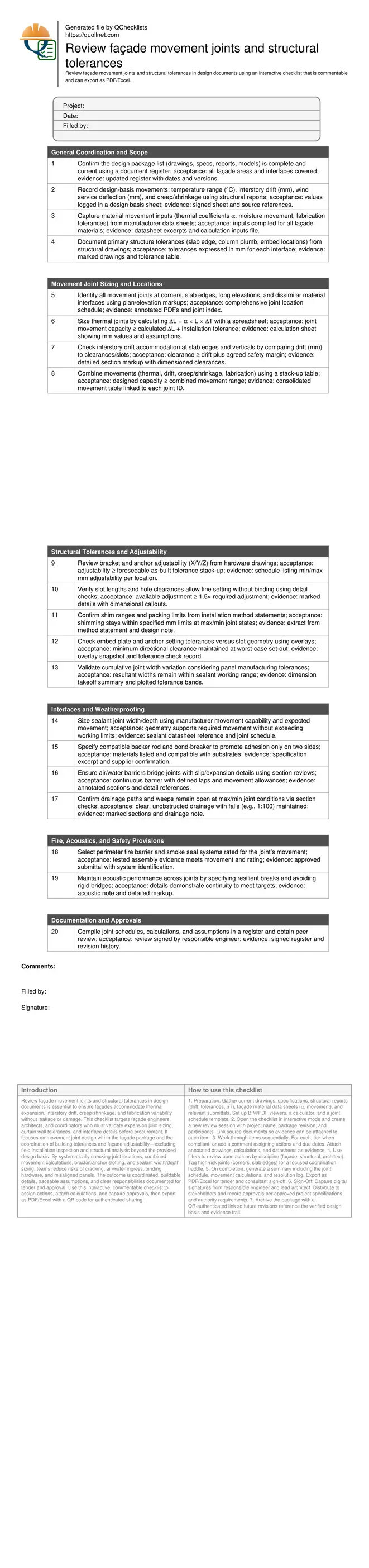
Definition: Review façade movement joints and structural tolerances in design documents guides façade engineers, architects, and coordinators to verify joint sizing, locations, and adjustability before tender, avoiding restraint, leaks, cracking, and costly redesigns.
- Confirm joint locations, sizes, and movement allowances against design basis.
- Coordinate structural tolerances with façade adjustability to prevent restraint.
- Verify sealant, barriers, and interfaces maintain performance through movement.
- Interactive, commentable workflow with export and QR code verification.
Review façade movement joints and structural tolerances in design documents is essential to ensure façades accommodate thermal expansion, interstory drift, creep/shrinkage, and fabrication variability without leakage or damage. This checklist targets façade engineers, architects, and coordinators who must validate expansion joint sizing, curtain wall tolerances, and interface details before procurement. It focuses on movement joint design within the façade package and the coordination of building tolerances and façade adjustability—excluding field installation inspection and structural analysis beyond the provided design basis. By systematically checking joint locations, combined movement calculations, bracket/anchor slotting, and sealant width/depth sizing, teams reduce risks of cracking, air/water ingress, binding hardware, and misaligned panels. The outcome is coordinated, buildable details, traceable assumptions, and clear responsibilities documented for tender and approval. Use this interactive, commentable checklist to assign actions, attach calculations, and capture approvals, then export as PDF/Excel with a QR code for authenticated sharing.
- Establish a clear design basis for movements (temperature range, interstory drift, creep/shrinkage, fabrication variability) and verify every façade joint’s capacity against combined effects. Produce a joint schedule that captures widths, depths, and adjustability ranges with referenced calculations and manufacturer data.
- Interactive online checklist with tick, comment, and export features secured by QR code. This enables accountable collaboration across disciplines, embeds evidence (markups, datasheets, calculations), and preserves a verifiable audit trail for tender, submittals, and authority coordination.
- Coordinate structural tolerances from the primary frame with façade bracket and anchor adjustability, including slot lengths and shim ranges. Validate cumulative stack-ups at corners, slab edges, and long runs so joints remain functional and sealants stay within manufacturer-recommended working ranges.
- Protect performance at interfaces: confirm continuity of air and water barriers with slip details, verify sealant geometry for expected motion, and specify fire/smoke/acoustic treatments that accommodate movement. Document tested systems and acceptance criteria per approved project specifications and authority requirements.
General Coordination and Scope
Movement Joint Sizing and Locations
Structural Tolerances and Adjustability
Interfaces and Weatherproofing
Fire, Acoustics, and Safety Provisions
Documentation and Approvals
Why movement joints must match real building movements
Façade joints must accommodate combined movements driven by temperature swings, interstory drift, creep/shrinkage, and fabrication variability. Underestimating any component can lock the façade to the structure, causing sealant failure, cracked cladding, or binding operables. Start by defining the design basis with α values, ΔT, service drift, and manufacturing tolerances. Then calculate thermal movement (ΔL = α × L × ΔT), add drift and long-term effects, and compare against the joint’s designed capacity. Capture min/max joint states, because sealants and gaskets often have asymmetric limits. Map locations: slab edges, corners, long runs, and interfaces between dissimilar materials. Where movements stack, ensure extra capacity and detail simplicity to avoid build-up conflicts. Finally, schedule each joint with its expected movement, geometry, and neighboring tolerances so stakeholders can review assumptions before tender and lock in a buildable, resilient solution.
- Set a clear movement design basis and document sources.
- Calculate combined movements, not single mechanisms in isolation.
- Check asymmetric limits for sealants and gaskets.
- Schedule min/max joint states with evidence links.
- Prioritize simplicity at high-movement interfaces.
Designing for structural tolerances and installation adjustability
Primary structure tolerances are unavoidable; façades must adjust to them. Translate slab edge, column, and embed tolerances into millimetres, then provide bracket/anchor adjustability in X/Y/Z that exceeds foreseeable stack-ups. Detail slots, shim ranges, and packing limits so installers can achieve line, level, and plumb without inducing restraint. Use overlays to check embed placement against hole/slot geometry, and verify clearance remains at worst-case conditions. Consider cumulative effects: panel manufacturing tolerance plus set-out plus structure can widen or pinch joints. Maintain sealant working ranges and drainage continuity through these extremes. Record acceptance cues such as minimum directional clearances and adjustment ratios (e.g., available ≥ 1.5× required). This approach turns variability into managed adjustability, reducing rework and ensuring the façade remains serviceable throughout its life.
- Exceed foreseeable stack-ups with bracket adjustability.
- Define shim ranges and packing limits clearly.
- Use overlays to test worst-case clearances.
- Maintain sealant working ranges under tolerance extremes.
- Record acceptance ratios and sign-offs.
Interfaces: weather, fire, and acoustic continuity across joints
Performance continuity often fails at interfaces. Verify air and water barriers bridge movement joints with slip details and compatible membranes. Size sealant width and depth per manufacturer data relative to expected motion, and specify backer rods or bond-breakers to control adhesion. Ensure drainage paths and weeps function at both maximum and minimum joint states. For life safety, select perimeter fire barrier and smoke seals that tolerate the calculated movement while maintaining ratings. Acoustic performance requires resilient breaks that avoid rigid bridges. Reference approved project specifications and authority requirements for all performance criteria, and attach supporting submittals or test reports. With these checks, joints move as intended while weather, fire, and acoustic lines remain continuous.
- Bridge joints with slip-capable air/water barriers.
- Size sealant geometry to manufacturer movement limits.
- Protect drainage continuity at joint extremes.
- Use tested fire/smoke systems that allow movement.
- Avoid rigid acoustic bridges across joints.
How to use this interactive façade design review checklist
- Preparation: Gather current drawings, specifications, structural reports (drift, tolerances, ΔT), façade material data sheets (α, movement), and relevant submittals. Set up BIM/PDF viewers, a calculator, and a joint schedule template.
- Open the checklist in interactive mode and create a new review session with project name, package revision, and participants. Link source documents so evidence can be attached to each item.
- Work through items sequentially. For each, tick when compliant, or add a comment assigning actions and due dates. Attach annotated drawings, calculations, and datasheets as evidence.
- Use filters to review open actions by discipline (façade, structural, architect). Tag high-risk joints (corners, slab edges) for a focused coordination huddle.
- On completion, generate a summary including the joint schedule, movement calculations, and resolution log. Export as PDF/Excel for tender and consultant sign-off.
- Sign-Off: Capture digital signatures from responsible engineer and lead architect. Distribute to stakeholders and record approvals per approved project specifications and authority requirements.
- Archive the package with a QR-authenticated link so future revisions reference the verified design basis and evidence trail.
Call to Action
- Start Checklist Tick off tasks, leave comments on items or the whole form, and export your completed report to PDF or Excel—with a built-in QR code for authenticity.
- Download Excel - Façade Movement Joints & Structural Tolerances Review
- Download PDF - Façade Movement Joints & Structural Tolerances Review
- View Image - Façade Movement Joints & Structural Tolerances Review
Cite & Embed
“Façade Movement Joints & Structural Tolerances Review by Quollnet”
with a link to
this source page.
FAQ
Question: How do I combine thermal expansion, interstory drift, and long-term movements for joint sizing?
Question: What level of structural tolerance should the façade adjustability accommodate?
Question: How do I ensure sealants and barriers still work at extreme joint positions?
Question: When should I request a performance mock-up or additional testing?
Related Articles
Broader reading and guidance connected to this checklist topic.
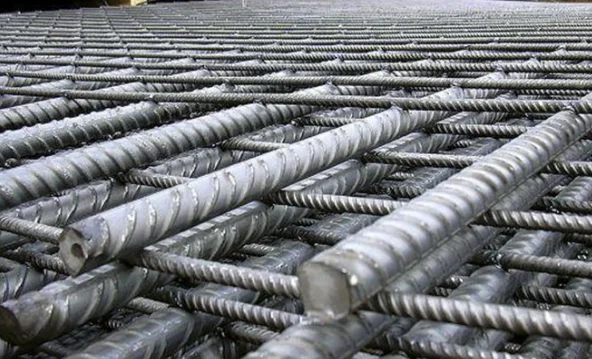


Is The Crack You See On Your Wall Serious Or Minor Cosmetic Issue?

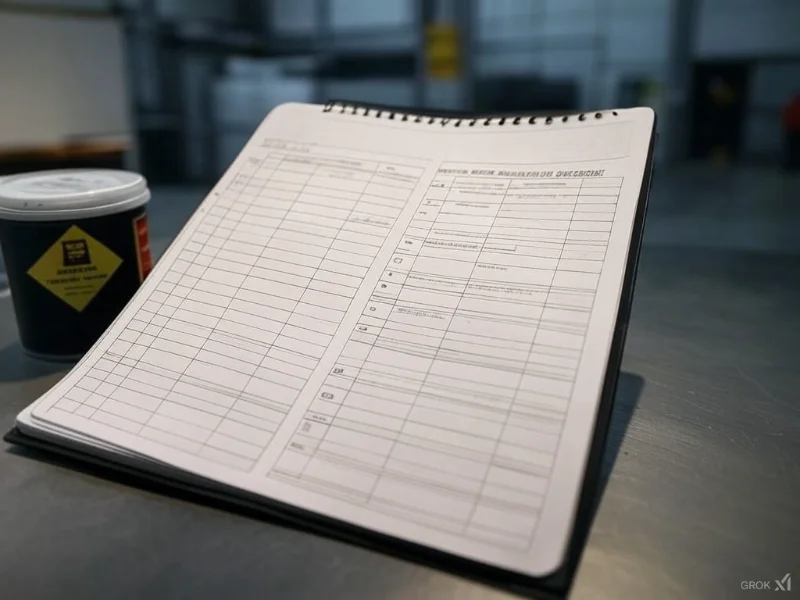
Related Checklists
Keep the workflow moving with nearby templates chosen from similar checklist content.