Demobilize Instrumentation Checklist for Closeout
Definition: Demobilize instrumentation for construction closeout teams, covering sealing of casings and wells, data archiving, and handover of logs per approved project specifications and authority requirements.
- Seal monitoring casings and wells to prevent contamination pathways.
- Archive complete datasets with metadata, plots, and audit-ready structure.
- Formalize handover packs with logs, approvals, and traceable sign-offs.
- Interactive, commentable checklist with export and QR code verification.
Demobilize instrumentation with a disciplined, auditable approach that seals casings and wells, archives all monitoring datasets, and hands over complete logs. This instrumentation demobilization checklist focuses on well abandonment, borehole casing sealing, data archiving, and documentation transfer, while explicitly excluding ongoing monitoring during the superstructure phase. By following clear methods and acceptance cues, teams prevent groundwater cross-contamination, eliminate trip hazards, and preserve data integrity for future reference and regulatory audits. Field crews and engineers will find practical instructions for grout selection, tremie placement, cap installation, and surface reinstatement, alongside robust data management steps like file normalization, checksum validation, and multi-location backups. Deliverables include signed sealing records, updated as-builts, calibrated reports, and a consolidated, searchable archive ready for client acceptance. Use this interactive checklist to tick tasks, add comments with photos, and export as PDF/Excel. Authenticate deliverables with a QR code so stakeholders can verify the latest approved revision instantly.
- Ensure permanent abandonment of casings and wells using bottom-up tremie grouting, proper caps, and surface reinstatement. Prevent water and contaminant migration, remove residual trip hazards, and deliver a predictable, inspection-ready closeout outcome aligned with approved project specifications and authority requirements.
- Protect data integrity by consolidating raw files, standardizing formats, embedding metadata, and validating checksums. Create synchronized, versioned archives in two or more locations, generate final plots and reports, and document chain-of-custody so future reviewers can reproduce results without ambiguity.
- Interactive online checklist with tick, comment, and export features secured by QR code. This enables transparent collaboration onsite and offsite, linking photos, measurements, and signatures to each task, then locking the record for sign-off and downstream audits without rework.
- Deliver a complete handover: sealing records with grout volumes and depths, updated as-builts, waste manifests, calibration certificates, and meeting minutes. Assign responsibilities, obtain digital approvals, and formally close the scope—ensuring readiness for subsequent construction activities without lingering liabilities.
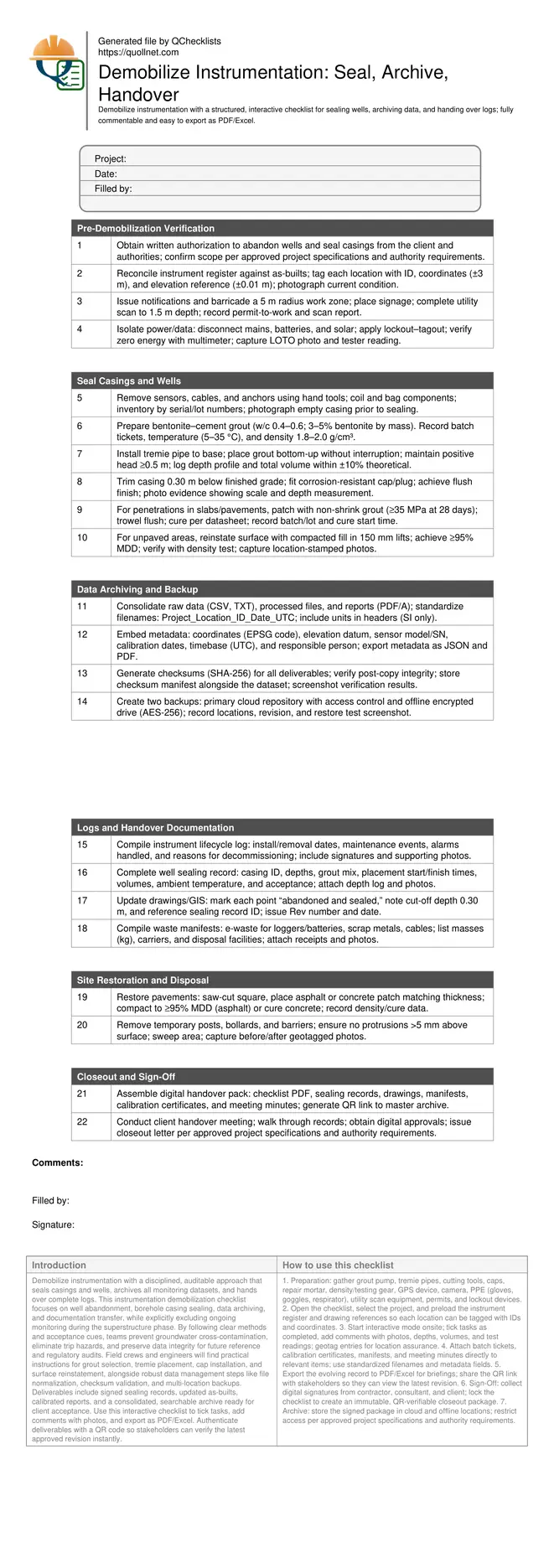
Pre-Demobilization Verification
Seal Casings and Wells
Data Archiving and Backup
Logs and Handover Documentation
Site Restoration and Disposal
Closeout and Sign-Off
Sealing Casings and Wells with Audit-Ready Methods
Effective abandonment prevents vertical migration of water and contaminants through old monitoring points. Use a bentonite–cement grout and place it from the base upward with a tremie to avoid voids or bridging. Maintain a positive grout head and continuous placement to ensure column integrity. Trim metallic or PVC casings 0.30 m below finished grade, cap with corrosion-resistant fittings, and reinstate surface finishes to original condition. For paved areas, use non-shrink repair mortar achieving at least 35 MPa at 28 days, and document batch numbers and cure times. In unpaved zones, compact fill in controlled lifts to at least 95% MDD and verify with density testing. Acceptance cues include grout returns free of cuttings, placed volume within ±10% of theoretical annulus volume, neat flush caps, and clean reinstatement. Photograph each step with a scale and timestamp, then log depths and volumes on the sealing record to provide undeniable traceability.
- Place grout bottom-up continuously via tremie.
- Maintain positive head ≥0.5 m during placement.
- Cut casings 0.30 m below finished grade.
- Target grout volume within ±10% theoretical.
- Capture geotagged photos at each milestone.
Data Archiving That Preserves Context and Integrity
Demobilization is incomplete without a clean, reproducible dataset. Normalize raw files to open formats (CSV, TXT) and preserve authored reports as PDF/A. Record critical metadata: coordinate system, elevation datum, instrument IDs, calibration dates, and UTC timestamps. Validate files with SHA-256 checksums before and after copying to eliminate silent corruption. Keep at least two secured copies, one in controlled cloud storage and one offline encrypted drive, and perform a documented restore test. Include a readme with folder structure, naming conventions, unit standards (SI), and contact details. Produce plots that summarize trends and annotate key events. Package everything with a versioned index so future reviewers can quickly navigate. These steps ensure continuity of knowledge and defend against disputes years after construction.
- Use open formats and PDF/A for longevity.
- Embed metadata: coordinates, datum, UTC timebase.
- Verify integrity with SHA-256 checksums.
- Maintain cloud and offline encrypted backups.
- Provide a clear, versioned index and readme.
Documented Handover for Transparent Project Closeout
A strong handover package aligns stakeholders and closes liabilities. Compile instrument lifecycle logs, sealing records with times, depths, and volumes, waste manifests, calibration certificates, updated as-builts, and meeting minutes. Reference each data element in a master index and link the archive with a QR code so recipients can verify the latest approved revision. Use digital signatures with names, roles, and timestamps. In the handover meeting, review accepted tolerances—such as grout volumes within ±10% of theoretical and reinstatement targets—and confirm any punch list items. Provide clear retention locations and access permissions. A documented, traceable closeout reduces rework, supports audits, and enables smooth transition to subsequent construction activities without lingering questions.
- Bundle sealed records, drawings, manifests, and certificates.
- Use QR-linked archives for revision verification.
- Record digital signatures with roles and timestamps.
- State access controls and retention location.
- Confirm punch list closure before sign-off.
How to Use This Interactive Demobilization Checklist
- Preparation: gather grout pump, tremie pipes, cutting tools, caps, repair mortar, density/testing gear, GPS device, camera, PPE (gloves, goggles, respirator), utility scan equipment, permits, and lockout devices.
- Open the checklist, select the project, and preload the instrument register and drawing references so each location can be tagged with IDs and coordinates.
- Start interactive mode onsite; tick tasks as completed, add comments with photos, depths, volumes, and test readings; geotag entries for location assurance.
- Attach batch tickets, calibration certificates, manifests, and meeting minutes directly to relevant items; use standardized filenames and metadata fields.
- Export the evolving record to PDF/Excel for briefings; share the QR link with stakeholders so they can view the latest revision.
- Sign-Off: collect digital signatures from contractor, consultant, and client; lock the checklist to create an immutable, QR-verifiable closeout package.
- Archive: store the signed package in cloud and offline locations; restrict access per approved project specifications and authority requirements.
Call to Action
- Start Checklist Tick off tasks, leave comments on items or the whole form, and export your completed report to PDF or Excel—with a built-in QR code for authenticity.
- Download Excel - Instrumentation Demobilization Closeout
- Download PDF - Instrumentation Demobilization Closeout
- View Image - Instrumentation Demobilization Closeout
Cite & Embed
“Instrumentation Demobilization Closeout by Quollnet”
with a link to
this source page.

FAQ
Question: What grout mix and placement method should I use to seal monitoring wells?
Question: How should I structure and protect the data archive for long-term access?
Question: What evidence will clients expect at handover to close this scope?
Question: When is it appropriate to demobilize instrumentation relative to construction phases?
Related Articles
Broader reading and guidance connected to this checklist topic.



Is It Important To Customize Your Qr Code And How To Do It?
Download Excel Format Snag List

Improper Concrete Specimen Curing: Impact On Cube & Cylinder Test Strength
Related Checklists
Keep the workflow moving with nearby templates chosen from similar checklist content.