
Inspection and Test Plan for Method Statement: Installation and Commissioning of UPS System with Battery Racks, DC Cabling, Static & Maintenance Bypass, Ventilation, and Performance Tests
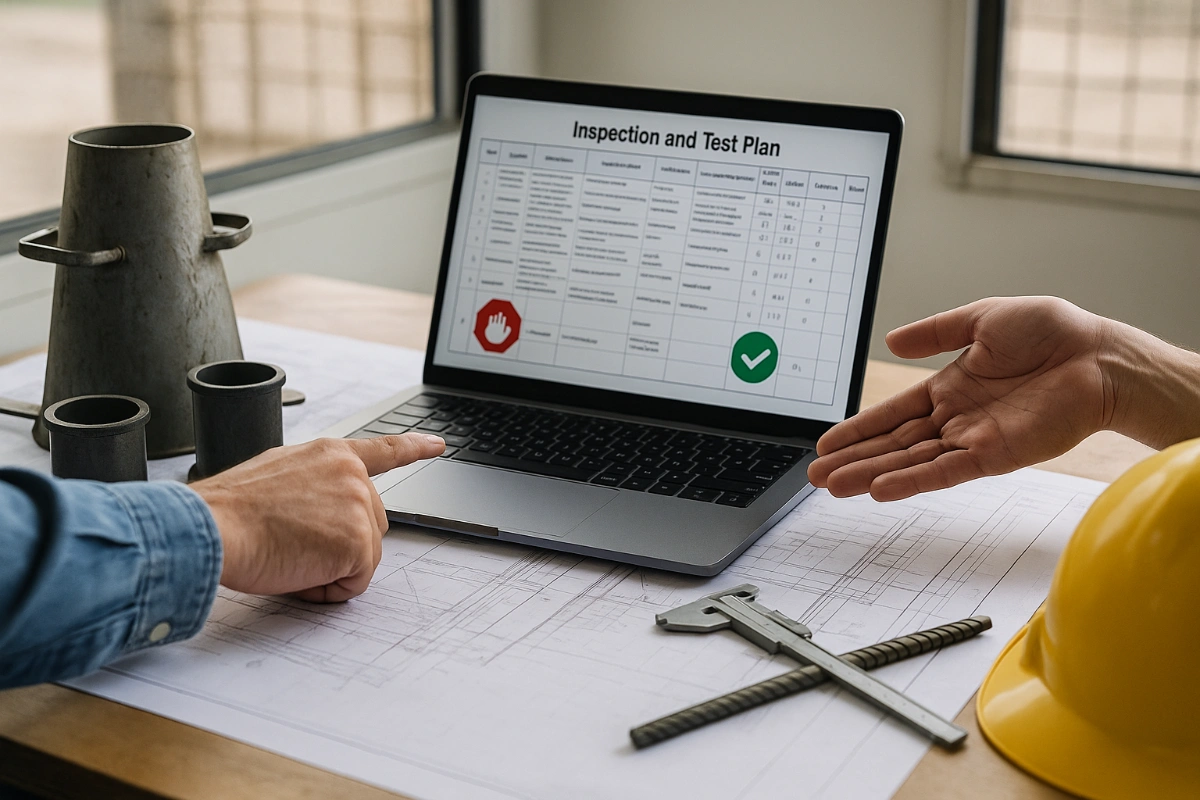
AI-assisted inspection and test plan connected to a method statement, with PDF and Excel export.
More than a static template
Unlike a downloadable Word or PDF template, this ITP is an AI-assisted editable starting point directly connected to its method statement. Every inspection activity, hold point, and acceptance criterion is structured and ready to adapt to your project.
- AI-assisted customization — Tailor inspection activities and acceptance criteria to your specific project scope.
- Linked method statement — This ITP is connected to the corresponding method statement describing the work sequence.
- Multiple export formats — Download as a formatted PDF or editable Excel spreadsheet.
- Editable starting point, not a final document — Review and verify all content against your project specifications and standards before use.
What you can customize
When you save this ITP to your account, every inspection row becomes editable. You can add, remove, or modify:
- Inspection activity — Description of what is being inspected.
- Inspection type — Hold point (H), Witness point (W), Review (R), or Monitor (M).
- Responsibility — Contractor, subcontractor, engineer, or client.
- Frequency — How often the inspection occurs.
- Acceptance criteria — Referenced standard or specification requirement.
- Records — Forms, test reports, or checklists required as evidence.
Why this ITP is used
To control quality and compliance at each critical stage of UPS installation and commissioning and to document acceptance.
Who uses this inspection and test plan
Contractor QA/QC, Site Engineers, OEM Commissioning Engineers, and the Client/Engineer for witness points.
When this ITP is prepared and submitted
From material receipt through final handover, with emphasis on pre-energization, baseline impedance, and full-load testing stages.
Who receives or approves this ITP
Engineer/Client Representative for review, witness, and acceptance.
Inspection scope
Materials, room readiness, mechanical installation, electrical terminations, functional performance, safety systems, and documentation.
Typical hold, witness, and review points
Battery baseline impedance (HOLD), full-load backup discharge (HOLD), key functional transfers (WITNESS).
Typical inspection records
MIRs, WIRs, torque logs, IR/continuity tests, earthing tests, ventilation reports, OEM commissioning logs, battery baseline and discharge reports, handover dossier.
Important approval note
This ITP is an AI-assisted editable starting point, not a pre-approved document. Before use on any project, all inspection activities, hold points, and acceptance criteria must be reviewed and approved by the relevant parties (superintendent, principal contractor, or client representative) in accordance with your contract and project quality plan.
Always verify acceptance criteria against your applicable drawings, specifications, and regulatory requirements. Hold points must be confirmed with the relevant authority before work proceeds past that point.
Inspection and test plan
| Activity | Inspection / Test | Acceptance Criteria | Responsibility | Record |
|---|---|---|---|---|
| Material receipt - UPS, racks, batteries | Visual, quantity, OCV (batteries) | No damage; OCV within OEM limits; documents complete | QA/QC, Storekeeper | MIR, Delivery Report |
| Room readiness | Clearances, earthing, HVAC/ventilation | Per approved drawings/spec; earth ≤ 1–10 Ω [Verify] | Site Engineer, QA/QC | Room Readiness Checklist |
| Anchors and bases | Layout, level, torque/pull test (if required) | Level ≤ 2 mm/m; torque/pull per spec [Verify] | Site Engineer | Anchor Log |
| Rack installation | Plumb/level; fasteners | As per OEM; all fasteners torqued | Battery Tech, QA/QC | Rack Inspection Sheet |
| UPS/MBB placement | Position, alignment, fixing | Alignment ±5 mm; access clearances maintained | Electrical Supervisor | UPS Install Sheet |
| Cable containment | Supports, segregation, fill | Fill ≤ 60%; segregation per SLD | Electrical Supervisor | Containment Inspection |
| Cables pre-test (before connection to UPS) | Continuity, IR 500 VDC (cables only) | IR ≥ 1 MΩ new cables [Verify] | Electrical Team, QA/QC | Cable Test Report |
| Terminations - UPS/MBB/SBS | Crimp quality, torque, polarity | IEC 61238-1 compliant; torque per OEM; correct polarity | Electrical Team, QA/QC | Termination/Torque Log |
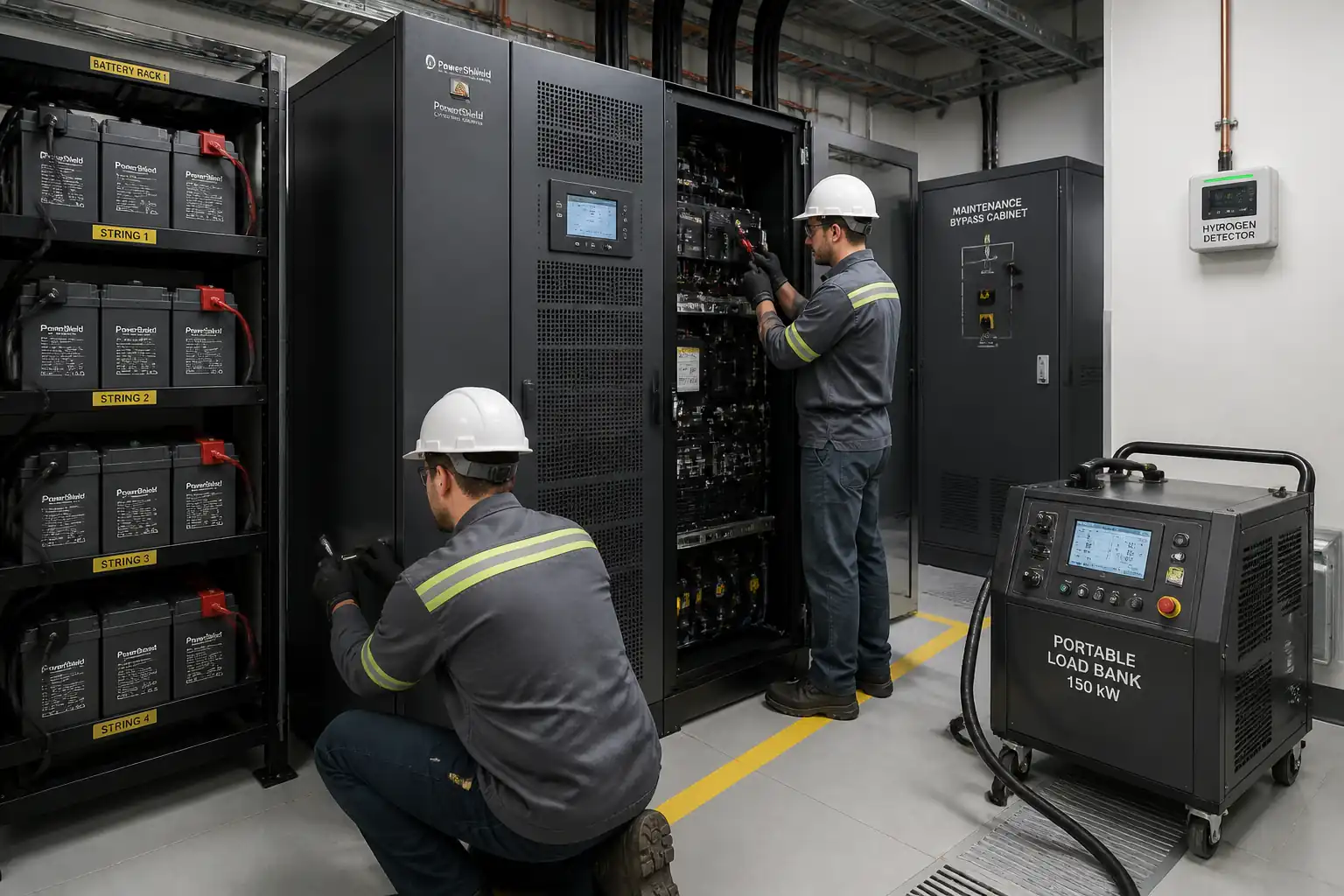
| Battery placement and links | Visual, torque, polarity | No damage; torque per OEM; link covers fitted | Battery Tech, QA/QC | Battery Install Log |
| Earthing and bonding | Continuity measurement | R ≤ 0.1 Ω typical [Verify] | Electrical Team | Earthing Test Report |
| Ventilation and H2 detection | Airflow, setpoints, detector calibration | Meets calc; alarm/trip setpoints per spec [Verify] | HVAC/Controls, QA/QC | Ventilation Commissioning Report |
| Pre-energization inspection | Covers, labels, polarity, EPO status | All complete and correct; MOP approved | Electrical Supervisor, QA/QC | Pre-Energization Checklist |
| Initial energization and float setup | Float V/I settings; temperature compensation | Within OEM limits; stable operation | OEM Engineer | Commissioning Log |
| Battery baseline impedance (HOLD) | Impedance/IR per IEEE 1188 | No unit > 25–30% above average/OEM threshold [Verify] | Battery Tech/OEM, Client Rep | Battery Baseline Report |
| Functional tests - static bypass/inverter | Transfer time, alarms | Transfer ≤ OEM spec (e.g., ≤ 4 ms) [Verify] | OEM Engineer | Functional Test Report |
| Maintenance bypass operation | Interlocks and sequence | Safe make-before/after-break per design; no backfeed | OEM/Contractor | MBB Test Checklist |
| Full-load backup discharge (HOLD) | Autonomy and end-voltage test with load bank | ≥ Specified autonomy at rated load; end V/cell within OEM min [Verify] | OEM/Battery Tech, Client Rep | Discharge Test Report |
| Integration and I/O (BMS/SCADA) | Point-to-point checks | All signals confirmed and logged | Controls/Commissioning | I/O Check Sheets |
| Final documentation and handover | Dossier review | All records complete and approved | Contractor/OEM | Handover Dossier |
This table is a read-only public reference. Download the PDF or Excel version, or customize this ITP to edit it for your project.
Frequently asked questions
Related method statement
This Inspection and Test Plan is associated with the Method Statement: Installation and Commissioning of UPS System with Battery Racks, DC Cabling, Static & Maintenance Bypass, Ventilation, and Performance Tests method statement, which describes the step-by-step construction sequence, resources, materials, equipment, safety controls, and environmental controls for this activity.
View the Method Statement: Installation and Commissioning of UPS System with Battery Racks, DC Cabling, Static & Maintenance Bypass, Ventilation, and Performance Tests method statement →Continue with related inspection, method statement, article, and checklist resources.