
Method Statement: Moisture Testing and Acceptance of Screed Prior to Flooring Installation – Method Statement
AI-assisted method statement with matching ITP, PDF download, and Excel export.
More than a static template
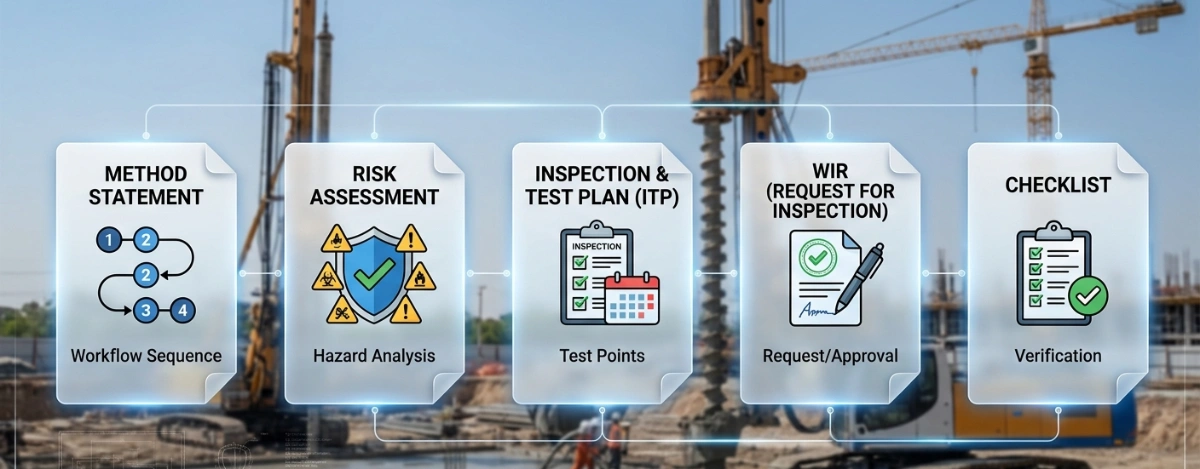
Unlike a downloadable Word or PDF template, this method statement is an AI-assisted editable starting point connected directly to a matching Inspection and Test Plan. Every section is structured, project-adaptable, and ready to export.
- AI-assisted drafting — Customize every section with AI for your specific project scope.
- Linked ITP — A matching inspection and test plan is generated alongside the method statement.
- Multiple export formats — Download as a formatted PDF or editable Excel spreadsheet.
- Editable starting point, not a final document — Review, verify, and adjust all content against your project requirements before use.
Static template vs. Quollnet workflow
| Feature | Static template | Quollnet |
|---|---|---|
| Project-specific content | Manual fill-in required | AI-assisted customization |
| Linked ITP | Separate document, no link | Matching ITP included |
| Export formats | Usually PDF only | PDF and Excel |
| Structured sections | Free-form layout | 13 standardized sections |
| Saved to your account | Local file only | Cloud-saved, reusable |
| Content accuracy | You verify everything | AI-assisted, you still verify |
| Cost | Often free but time-intensive | Free to customize and download |
What you can customize
When you save this method statement to your account, every section becomes editable. The following 13 sections are included:
- Scope — Defines the activity and its boundaries.
- References — Standards, specifications, and drawings.
- Responsibilities — Roles and accountabilities.
- Resources — Labour, plant, and equipment summary.
- Materials — Materials and compliance requirements.
- Equipment — Tools and equipment details.
- Prerequisites — Hold points and pre-conditions.
- Method sequence — Step-by-step construction sequence.
- Safety controls — HSE risk controls and PPE.
- Environmental controls — Environmental mitigation measures.
- QA/QC — Quality inspection and test requirements.
- ITP — Inspection and Test Plan table (has its own page).
- Attachments — Referenced drawings and documentation.
Why this method statement is used
This method statement is used to define and communicate the approved procedure for carrying out method statement: moisture testing and acceptance of screed prior to flooring installation on site. It ensures the work is planned in advance, the correct resources and controls are in place, and all personnel understand responsibilities, sequence, quality requirements, and safety controls before work begins. It aligns site execution with the documented scope and acceptance expectations.
Who uses this method statement
This method statement is used by contractors, site supervisors, project engineers, QA/QC engineers, HSE officers, consultants, and client representatives. It serves as a shared reference for planning, execution, supervision, inspection, and approval of the activity on site.
When it is prepared and submitted
The method statement is prepared before the work activity starts and submitted as part of the pre-construction documentation package for review and approval.
Who reviews or approves it
The method statement is usually submitted to the client representative, consultant, resident engineer, or project management consultant for review and approval before the work commences.
Important approval note
This method statement is an AI-assisted editable starting point, not a pre-approved document. Before use on any project, all content must be reviewed and approved by the relevant parties (superintendent, principal contractor, or client representative) in accordance with your contract and project quality plan.
For example: if your specification requires a departure from a referenced standard, that departure must be documented and approved separately — this method statement will not capture that automatically. Always verify against your applicable drawings, specifications, and regulatory requirements.
Method statement content
Scope
Overview
This method statement covers the standardized procedure to verify moisture condition and acceptance of completed screed areas before installation of floor finishes (resilient, carpet, wood, tile, epoxy, etc.). It applies to cementitious and anhydrite/gypsum screeds, heated or unheated, on-grade or suspended slabs.
Included Activities
- Environmental conditioning of test areas to service conditions.
- Locating and marking test points; avoiding embedded services/UFH pipes.
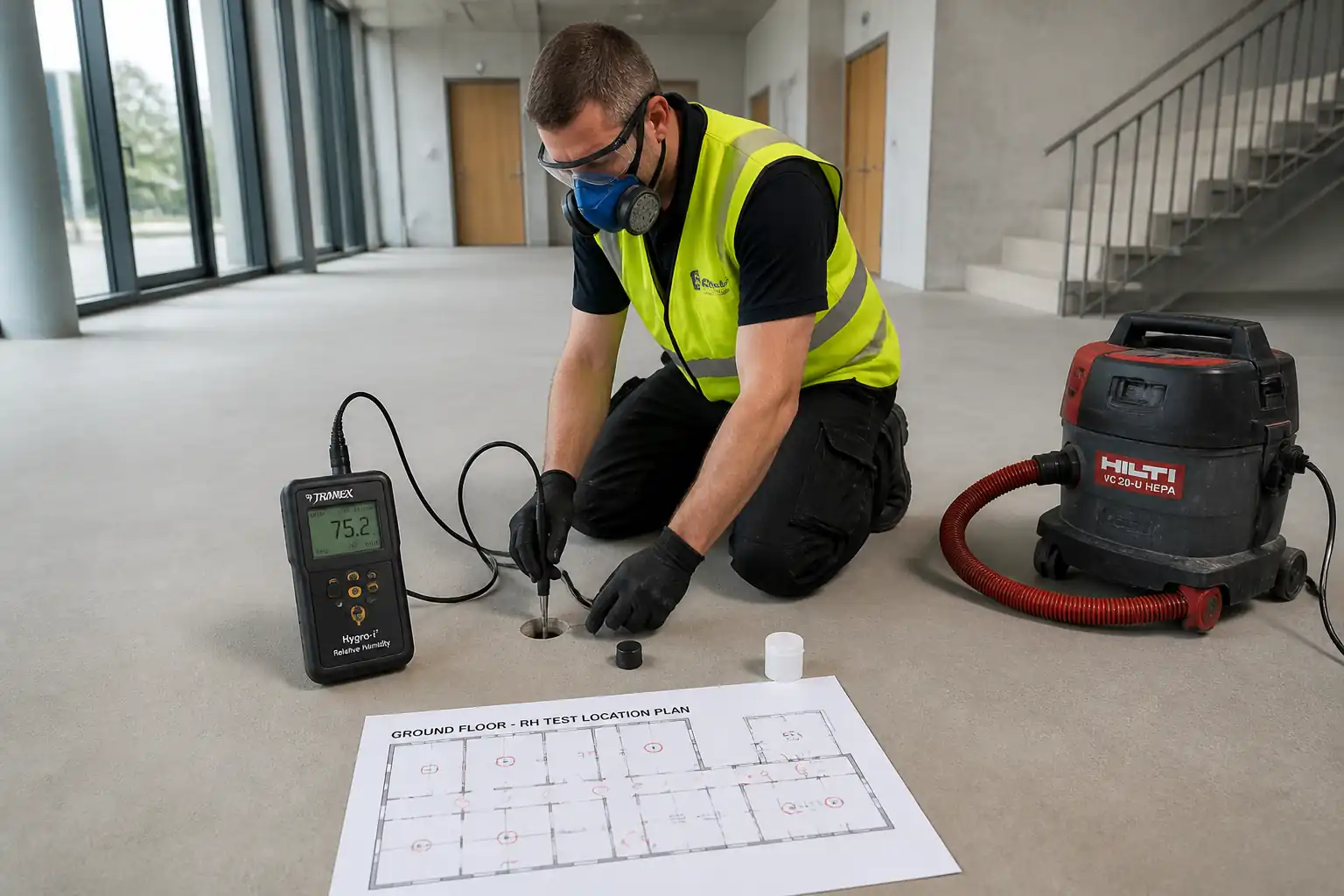
- Moisture testing by: in-situ relative humidity (RH) probes (primary method), optional Calcium Carbide (CM) testing, and optional Moisture Vapor Emission Rate (MVER) tests if specified.
- Data recording, mapping, acceptance evaluation, and issue of release for flooring.
- Consultant/Engineer hold/witness points.
- Corrective actions for non-compliant results and re-testing.
Exclusions
- Structural assessment of screed or substrate flatness/levels (covered under separate method statements).
- Remediation beyond moisture control systems (MVS/DPM) selection and application method statements.
Acceptance Summary [Verify per project specifications]
- Cementitious screeds (resilient/carpet): typically ≤75% in-situ RH (BS 8203) or per adhesive/system, often 75–85% RH (ASTM F2170-based, manufacturer-specific).
- Timber/wood flooring over screed: typically ≤65% in-situ RH (BS 8201/manufacturer). Wood moisture content must suit ambient RH.
- CM method typical thresholds: cement screed ≤2.0 CM% (≤1.8 CM% heated); anhydrite ≤0.5 CM% (≤0.3 CM% heated).
- MVER (ASTM F1869), if specified: typically ≤3–5 lb/1000 ft²/24 h (≤1.36–2.27 kg/100 m²/24 h) per flooring/adhesive manufacturer.
Where products specify different criteria (e.g., epoxy systems up to 90% RH with ASTM F3010 mitigation), the stricter of project specifications or manufacturer data shall govern.
References
| Document Type | Reference / Number | Revision | Notes |
|---|---|---|---|
| ASTM F2170 – Standard Test Method for Determining Relative Humidity in Concrete Floor Slabs Using in situ Probes | Primary method for in-situ RH testing of slabs/screeds; 40% depth (one-sided drying), 20% (two-sided). [Verify latest edition] | ||
| ASTM F1869 – Standard Test Method for Measuring Moisture Vapor Emission Rate of Concrete Subfloor Using Anhydrous Calcium Chloride | Use only if specified and substrate suitable. Not valid for lightweight concrete or calcium aluminate/anhydrite screeds. [Verify applicability] | ||
| BS 8203 – Code of practice for installation of resilient floor coverings | Guidance on subfloor RH limits (typically ≤75% RH) using in-situ hygrometer (BS/ASTM equivalent). | ||
| BS 8201 – Code of practice for installation of flooring of wood and wood-based panels | Guidance for wood flooring; typically stricter RH limits (commonly ≤65% RH at screed). | ||
| BS 8204-1 – Screeds, bases and in situ floorings. Concrete bases and cementitious levelling screeds to receive floorings – Code of practice | General screed requirements, drying, heated screeds protocols and surface regularity. | ||
| EN 13813 – Screed material and floor screeds – Screed materials – Properties and requirements | Material classification for cement/anhydrite screeds; reference for CM% moisture thresholds (regional practice). | ||
| DIN 18560 – Floor screeds in building construction (informative) | Commonly cited with CM% limits for cement and anhydrite screeds. [Verify adoption by project] | ||
| ASTM F710 – Preparing Concrete Floors to Receive Resilient Flooring | Substrate preparation and dryness verification prior to resilient flooring. | ||
| ASTM F3010 – Vapor Retarder Coatings Applied to Concrete Flooring Systems | Epoxy moisture mitigation systems acceptance (permeance ≤0.1 perms). | ||
| ISO/IEC 17025 – General requirements for the competence of testing and calibration laboratories | For external labs/calibration traceability of RH sensors and balances. |
Responsibilities
| Role | Responsibility | Name / Party |
|---|---|---|
| Main Contractor – Project/Site Manager | Overall implementation of method; coordination with flooring subcontractor; ensure HSE and QA/QC compliance. | Contractor |
| QA/QC Engineer | Execute testing, map locations, record data, compute accept/reject, issue release or NCR. | Contractor |
| HSE Officer | Ensure safe system of work; task risk assessment and permits; monitor silica dust, chemical handling (CM). | Contractor |
| Site Engineer | Confirm readiness of areas, isolate UFH circuits, provide as-built drawings/services maps, access, and cleaning. | Contractor |
| Consultant / Engineer | Witness hold points, review results, issue acceptance/rejection for flooring install. | Engineer |
| Flooring Subcontractor | Provide product-specific moisture limits; confirm flooring compatibility and primers/adhesives. | Subcontractor |
| Independent Testing Agency | Perform independent testing if specified; provide calibrated instruments and traceable results. | Third Party |
Resources
| Resource Type | Description | Quantity | Remarks |
|---|---|---|---|
| Personnel | 1 | Overall technical lead; cross-check acceptance; sign release. | |
| Personnel | 2–4 [Verify per project] | Trained in ASTM F2170, CM method, and equipment calibration. | |
| Personnel | 1 | Monitors dust, chemical handling, permits, and ventilation. | |
| Personnel | 1 | Maintains test location plans, logs, and submittals. |
Materials
| Material | Specification / Grade | Quantity | Remarks |
|---|---|---|---|
| Rapid-setting cementitious patching compound | Compressive strength ≥25 MPa at 24 h [Verify] | As required | For RH probe holes reinstatement; compatible with screed. |
| In-situ RH sleeves and probes | Probe accuracy ±2% RH, ±0.3°C; factory calibrated | Per test points | With caps and seals; per ASTM F2170 kit. |
| Calcium carbide (CM) reagent and test ampoules | Purity per manufacturer; stored per SDS | Per tests | Reagent ampoules; steel pressure vessel, steel balls. |
| Non-reactive hole sealing tape/putty | Air-tight, non-contaminating | As needed | Temporary seal for RH sleeves if prolonged equilibration. |
Equipment
| Equipment | Capacity / Type | Quantity | Inspection Required |
|---|---|---|---|
| In-situ RH meter with probes and sleeves (ASTM F2170 kit) | Accuracy ±2% RH; temperature ±0.3°C | 2 sets | Calibration check using 75% RH salt chamber or manufacturer fixture |
| Thermo-hygrometer (ambient) | Accuracy ±2% RH, ±0.5°C | 1 | Calibration certificate |
| Rotary hammer drill + HEPA vacuum | Bit Ø 12–19 mm as per sleeve | 1 | PAT/test tag [Verify local] |
| Calcium Carbide (CM) tester kit | Scale readability 0.01 g | 1 kit | Daily function check; annual service |
| Dehumidifiers and air movers | Extraction ≥50 L/day; airflow ≥2000 m³/h [Verify] | As required | Electrical safety; drip trays |
| Multi-scanner/thermal camera for UFH pipes | Detects PEX at ≥30 mm cover | 1 | Function check |
| Infrared thermometer | -20 to 250°C | 1 | Calibration check |
Prerequisites
Area Readiness
- Screed installation completed, cured, and free of standing water. No surface sealers/cures that would invalidate test unless identical conditions exist during service.
- Building envelope sealed; HVAC capable of maintaining service conditions.
- Floor area clean, dust/debris removed; no wet trades ongoing.
- UFH (underfloor heating) commissioning cycle completed per BS 8204-1/EN 1264 where applicable; system switched off 48 h before testing and remains off during RH/MVER testing unless otherwise specified.
Documents and Approvals
- Approved method statement and ITP.
- Latest drawings/as-builts showing services and UFH circuits.
- Manufacturer’s moisture limits for each flooring/adhesive/system.
- Calibration certificates for RH meters, thermohygrometers, scales, and CM kit.
Environmental Conditioning [Verify per project specifications]
- Maintain ambient temperature typically 18–27°C and RH 40–65% for minimum 48 h before and during RH testing (per product/service conditions). Record continuously.
Typical Drying Guidance (Informative – Not Acceptance)
- Cementitious screed: approx. 1 week per 10 mm up to 40 mm, then longer; anhydrite may dry slower. Actual acceptance is by test results, not time.
Permits
- Permit to drill/floor penetration near services and UFH.
- Chemical handling authorization for CM reagent.
- Electrical equipment PAT/inspection records. [Verify per project HSE plan and local regulations]
Method Sequence
| Step | Activity | Description | Responsibility | Inspection / Hold Point |
|---|---|---|---|---|
| 1 | Kick-off and HSE briefing | Pre-task briefing covering hazards (silica dust, CM reagent, UFH damage, slips), method, ITP points, and permits. | Site Manager / HSE Officer | Check permits and toolbox talk records |
| 2 | Review of drawings/services | Mark suspected UFH pipe routes and embedded services; scan where uncertain. | Site Engineer | Visual and scanner confirmation |
| 3 | Environmental conditioning | Stabilize target ambient conditions for ≥48 h; log temperature/RH. | QA/QC Engineer | Ambient readings every 4 h or data logger |
| 4 | Define sampling frequency | Determine number and distribution of test points per area. | QA/QC Engineer | Floor plan with test grid |
| 5 | Instrument verification | Check RH probe calibration; perform 75% RH salt check if required; verify thermohygrometer and CM scale status. | QA/QC Engineer | Review calibration certificates |
| 6 | Drill and install RH sleeves (ASTM F2170) | Drill to 40% screed thickness (one-side drying) or 20% (two-side), hole Ø per sleeve; brush and vacuum clean; insert and seal sleeve; cap. | Technician | Visual; depth measurement |
| 7 | Equilibration period | Allow minimum 24 h equilibration after sleeve installation before RH reading unless manufacturer provides validated shorter time. | Technician | Time log |
| 8 | Measure in-situ RH and temperature | Insert RH probe; allow stabilization; record RH, temperature, ambient values, time, hole depth, screed type/thickness. | Technician | Witness by QA/QC; Consultant at hold point as required |
| 9 | Optional CM test (if specified) | Drill sample from 20–40 mm depth; weigh; react with CM reagent in pressure vessel; read pressure to derive CM%. | Technician (CM-trained) | Supervision by QA/QC |
| 10 | Optional MVER test (ASTM F1869) | Place pre-conditioned CaCl kit on clean area; seal for 60–72 h; weigh gain to determine MVER. | Technician | QA/QC review |
| 11 | Hole reinstatement | After readings, remove sleeves if required; fill holes with compatible patching compound; finish flush. | Technician | Visual |
| 12 | Data evaluation and acceptance | Plot results on floor plan; compute area acceptance vs. criteria; identify any outliers and need for re-tests. | QA/QC Engineer | Internal QA review |
| 13 | Consultant hold/witness point | Submit IR for witness of key tests and/or review of compiled results before release for flooring. | QA/QC Engineer / Consultant | Consultant sign-off |
| 14 | Corrective actions (if non-compliant) | Implement controlled drying (dehumidification/airflow/heat), laitance removal (anhydrite), or install approved moisture mitigation (ASTM F3010 epoxy) per manufacturer. | Site Manager / QA/QC / Flooring Subcontractor | Method approval and HSE check |
| 15 | Re-testing and final release | Repeat RH/CM/MVER at failed zones after stabilization/mitigation; issue release to floor installer when compliant. | QA/QC Engineer | Consultant witness if required |
Health, Safety and Environment – Safety Controls
Task-specific Hazards and Controls
- Hazard: Silica dust from drilling screed.
- Likely consequence: Respiratory irritation, silicosis (chronic), eye injury.
- Engineering/procedural control: Use rotary hammer with on-tool HEPA extraction; wet wipe/vacuum debris; limit drilling duration; exclusion zone 2 m.
- Required PPE: FFP3/N99 respirator, safety glasses/goggles, gloves, hearing protection, safety boots.
- Collective preventive measure: Local exhaust ventilation; enclose area if near public; signage.
-
Inspection/permit/supervision: HSE inspection of extraction unit; daily filter check; permit to drill near services.
-
Hazard: Striking UFH pipes or embedded services while drilling.
- Likely consequence: Flooding, electrical shock, rework, program delay.
- Engineering/procedural control: Review as-builts; scan floor; mark no-drill zones; set drilling depth stop; trial holes in low-risk areas.
- Required PPE: Dielectric gloves (if near electrical), eye protection, boots.
- Collective preventive measure: Supervisor sign-off of locations before drilling.
-
Inspection/permit/supervision: Permit to drill; hold point for high-risk areas; supervisor presence.
-
Hazard: Chemical exposure and pressure hazard during CM testing (acetylene generation).
- Likely consequence: Eye/skin burns, container rupture, fire risk in confined space.
- Engineering/procedural control: Conduct CM tests in well-ventilated area/outdoors; use shield; ensure vessel integrity; follow reagent SDS; keep ignition sources away.
- Required PPE: Face shield + goggles, chemical-resistant gloves, lab coat/disposable coverall.
- Collective preventive measure: Designated CM test station with spill kit and eyewash.
-
Inspection/permit/supervision: Chemical handling authorization; equipment inspection log; trained personnel only.
-
Hazard: Noise from drilling.
- Likely consequence: Hearing loss.
- Engineering/procedural control: Use low-vibration tools; limit exposure time; schedule during low-occupancy periods.
- Required PPE: Ear defenders (SNR ≥ 30 dB).
- Collective preventive measure: Acoustic screens where practicable.
-
Inspection/permit/supervision: Noise monitoring if required by HSE plan.
-
Hazard: Electrical hazards from portable equipment/dehumidifiers.
- Likely consequence: Electric shock, fire.
- Engineering/procedural control: Use 110 V center-tapped or RCD-protected circuits; route cables to avoid trips; inspect cords.
- Required PPE: Dielectric gloves when inspecting, safety boots.
- Collective preventive measure: Cable ramps; lockout for defective gear.
-
Inspection/permit/supervision: PAT testing/current inspection tags.
-
Hazard: Manual handling of kits and dehumidifiers.
- Likely consequence: Strains/sprains.
- Engineering/procedural control: Team lifts; trolleys; keep loads <25 kg per person [Verify per local law].
- Required PPE: Gloves, boots.
- Collective preventive measure: Use mechanical aids.
-
Inspection/permit/supervision: Manual handling training record.
-
Hazard: Use of heaters for drying.
- Likely consequence: CO buildup (if combustion), fire, thermal damage to screed.
- Engineering/procedural control: Prefer electric heaters; prohibit unflued gas/diesel indoors; monitor CO; follow EN 1264 ramp for heated screeds; do not exceed manufacturer’s max surface temp.
- Required PPE: As appropriate.
- Collective preventive measure: CO detectors; fire watch if required.
- Inspection/permit/supervision: Hot-work/temporary heat permit [Verify per project HSE plan and local regulations].
Environmental Controls
- Dust control: On-tool HEPA extraction; vacuum with HEPA; damp wipe. Dispose of dust per local regulations.
- Noise and working hours: Schedule drilling within permitted hours; use acoustic screens near occupied areas.
- Chemical management: Store CM reagent in sealed, labeled containers; segregate from ignition sources; maintain spill kit and waste containers for spent ampoules.
- Waste segregation: Collect used sleeves, debris, CaCl/CM consumables in designated bins; dispose per SDS and local regulations.
- Energy and HVAC: Use energy-efficient dehumidifiers; doors/windows closed during conditioning to maintain steady-state; avoid over-drying that cracks screed.
- Water protection: Prevent wash water from entering drains; use absorbent mats; no discharge of slurry.
- Record ambient conditions: Continuous logging to demonstrate environmental compliance.
QA/QC
Controls and Records
- Calibration: Maintain valid certificates for RH meters, probes, thermohygrometers, scales; on-site salt check at 75% RH where practicable.
- Identification and traceability: Assign unique IDs to each test location; annotate on floor plan with coordinates and depths.
- Data capture: Use standardized Moisture Test Report including ambient T/RH, probe serial numbers, equilibration times, screed type/thickness, readings, acceptance criteria, and pass/fail.
- Acceptance criteria hierarchy: 1) Project specifications 2) Flooring/adhesive/system manufacturer limits 3) Applicable standards/guides (BS/ASTM). Apply the most stringent requirement unless mitigation is formally approved.
- Sampling frequency: Minimum per ASTM F2170 (≥3 for first 100 m²; +1 per additional 100 m²), plus at least 1 per small room (<25 m²) and additional tests at wet rooms, doorways, and shaded areas. [Verify per project]
- Hold/witness points: Consultant to witness selected RH tests and review compiled results prior to flooring release.
- Non-conformance: Issue NCR for any out-of-spec readings; document corrective actions; re-test after stabilization/mitigation.
- Records retention: Keep all reports, photos, calibration certificates, and IR/NCR for ≥ project retention period [Verify per contract].
- Competency: Technicians trained/assessed on ASTM F2170/CM methods; toolbox talk before works.
- Third-party verification: Use ISO/IEC 17025-accredited lab for independent checks if specified.
- Protection of test areas: Restrict trafficking that may disturb sleeves; signage and barriers until reinstatement complete.
Attachments
- Moisture Testing Checklist (ASTM F2170/CM/MVER)
- Ambient Conditioning Log Sheet (hourly)
- Floor Plan Template for Test Location Mapping
- Moisture Test Report Template (with acceptance criteria fields)
- NCR/Corrective Action Form
- IR/Inspection Request Form (Hold/Witness points)
- SDS for Calcium Carbide Reagent and Calcium Chloride Kits
- Equipment Calibration Certificates (RH meters, thermohygrometer, scales)
- Manufacturer Data Sheets for Flooring, Adhesives, Primers, and Mitigation Systems
This content is a read-only public reference. Download or customize to get an editable version.
ITP preview
The first inspection activities from the linked ITP for Method Statement: Moisture Testing and Acceptance of Screed Prior to Flooring Installation:
| Activity | Inspection / Test | Acceptance Criteria | Responsibility | Record |
|---|---|---|---|---|
| Review of specifications and manufacturer limits | Document review | Moisture limits identified for each flooring/adhesive/system; method approved | QA/QC Engineer (Contractor) / Consultant | Approved submittals, MS/ITP approvals |
| Area readiness and environmental conditioning | Ambient T/RH logging | Ambient within service range for ≥48 h; area clean and closed to wet trades | QA/QC Engineer | Ambient logs; readiness checklist |
| Sampling plan and locations | Plan review | Meets ASTM F2170 minimum frequency or project requirement | QA/QC Engineer / Site Engineer | Marked floor plan |
Showing 3 of 11 inspection activities. View full ITP →
Related Inspection and Test Plan
An Inspection and Test Plan (ITP) is available for Method Statement: Moisture Testing and Acceptance of Screed Prior to Flooring Installation. The ITP defines the inspection activities, acceptance criteria, hold and witness points, responsible parties, and records required to verify the work described in this method statement.
View the Method Statement: Moisture Testing and Acceptance of Screed Prior to Flooring Installation ITP →Frequently asked questions
Continue with related Quollnet resources connected to this method statement.