
Method Statement – Keys, Cylinders, and Access Card Handover – Method Statement
AI-assisted method statement with matching ITP, PDF download, and Excel export.
More than a static template
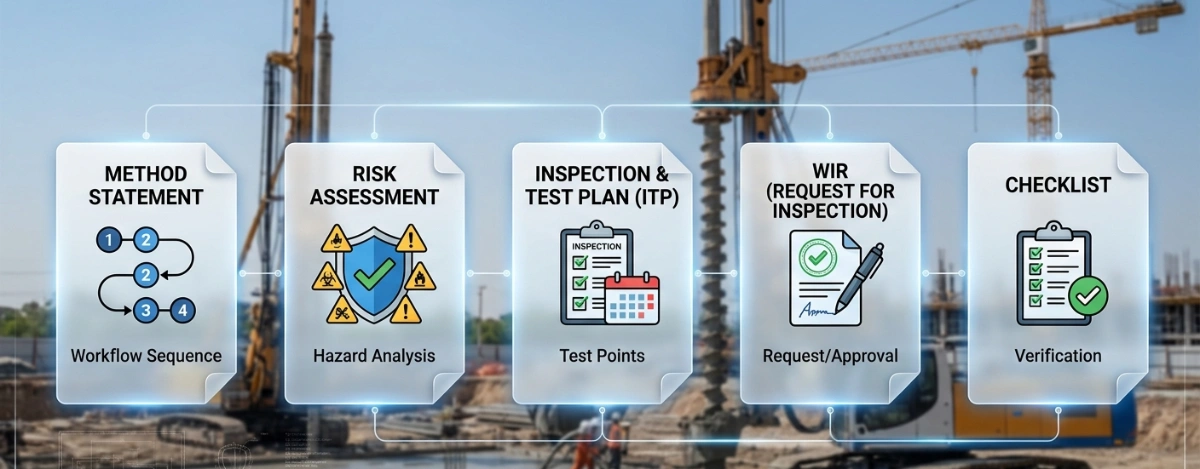
Unlike a downloadable Word or PDF template, this method statement is an AI-assisted editable starting point connected directly to a matching Inspection and Test Plan. Every section is structured, project-adaptable, and ready to export.
- AI-assisted drafting — Customize every section with AI for your specific project scope.
- Linked ITP — A matching inspection and test plan is generated alongside the method statement.
- Multiple export formats — Download as a formatted PDF or editable Excel spreadsheet.
- Editable starting point, not a final document — Review, verify, and adjust all content against your project requirements before use.
Static template vs. Quollnet workflow
| Feature | Static template | Quollnet |
|---|---|---|
| Project-specific content | Manual fill-in required | AI-assisted customization |
| Linked ITP | Separate document, no link | Matching ITP included |
| Export formats | Usually PDF only | PDF and Excel |
| Structured sections | Free-form layout | 13 standardized sections |
| Saved to your account | Local file only | Cloud-saved, reusable |
| Content accuracy | You verify everything | AI-assisted, you still verify |
| Cost | Often free but time-intensive | Free to customize and download |
What you can customize
When you save this method statement to your account, every section becomes editable. The following 13 sections are included:
- Scope — Defines the activity and its boundaries.
- References — Standards, specifications, and drawings.
- Responsibilities — Roles and accountabilities.
- Resources — Labour, plant, and equipment summary.
- Materials — Materials and compliance requirements.
- Equipment — Tools and equipment details.
- Prerequisites — Hold points and pre-conditions.
- Method sequence — Step-by-step construction sequence.
- Safety controls — HSE risk controls and PPE.
- Environmental controls — Environmental mitigation measures.
- QA/QC — Quality inspection and test requirements.
- ITP — Inspection and Test Plan table (has its own page).
- Attachments — Referenced drawings and documentation.
Why this method statement is used
This method statement is used to define and communicate the approved procedure for carrying out method statement – keys, cylinders, and access card handover on site. It ensures the work is planned in advance, the correct resources and controls are in place, and all personnel understand responsibilities, sequence, quality requirements, and safety controls before work begins. It aligns site execution with the documented scope and acceptance expectations.
Who uses this method statement
This method statement is used by contractors, site supervisors, project engineers, QA/QC engineers, HSE officers, consultants, and client representatives. It serves as a shared reference for planning, execution, supervision, inspection, and approval of the activity on site.
When it is prepared and submitted
The method statement is prepared before the work activity starts and submitted as part of the pre-construction documentation package for review and approval.
Who reviews or approves it
The method statement is usually submitted to the client representative, consultant, resident engineer, or project management consultant for review and approval before the work commences.
Important approval note
This method statement is an AI-assisted editable starting point, not a pre-approved document. Before use on any project, all content must be reviewed and approved by the relevant parties (superintendent, principal contractor, or client representative) in accordance with your contract and project quality plan.
For example: if your specification requires a departure from a referenced standard, that departure must be documented and approved separately — this method statement will not capture that automatically. Always verify against your applicable drawings, specifications, and regulatory requirements.
Method statement content
Scope
Work Scope
- Verification, custody, testing, labeling, and handover of all mechanical keys, lock cylinders, electronic credentials (cards/fobs), and associated documentation.
- Activities include: key schedule reconciliation, master keying matrix confirmation, cylinder/lockset functional testing on doors, access card encoding and access level confirmation, secure storage and chain-of-custody, client issuance and training, handling of missing/nonconforming items, QA/QC inspections, ITP compliance, and signed handover records.
Exclusions/Interfaces
- Door/frames installation and electrical rough-in by others.
- Access control panel installation and software platform base setup by Security/ELV contractor; this method covers provisioning, verification, and handover.
Objectives
- Deliver a complete, accurate set of operational keys/cylinders/credentials with zero unexplained shortages and validated access permissions.
- Maintain auditable chain-of-custody and compliance with project and regulatory requirements.
References
| Document Type | Reference / Number | Revision | Notes |
|---|---|---|---|
| Standard | BS EN 1303; UL 437 [Verify per project specifications] | ||
| Standard | BS EN 12209; ANSI/BHMA A156.x [Verify per project specifications] | ||
| Standard | EN 60839-11-1 | ||
| Standard | ISO/IEC 14443; ISO/IEC 15693; ISO/IEC 7810; ISO/IEC 7816 | ||
| Standard | ISO 9001; ISO/IEC 27001 [Verify per project requirements] | ||
| Regulation | Local data protection legislation [Verify per project] | Minimize personal data on cards; restrict access to systems. | |
| Project Docs | Latest Approved Issue | Current | Use only approved and current revisions. |
Responsibilities
| Role | Responsibility | Name / Party |
|---|---|---|
| Key Control Manager | Lead | Contractor |
| Security Systems Engineer | Execute | Contractor |
| Locksmith | Execute | Contractor |
| QA/QC Engineer | Assure | Contractor |
| HSE Officer | Support | Contractor |
| Document Controller | Support | Contractor |
| Client Representative | Approve/Receive | Client |
Resources
| Resource Type | Description | Quantity | Remarks |
|---|---|---|---|
| Personnel | Key Control Manager, Security Systems Engineer, Locksmith, QA/QC Engineer, HSE Officer, Document Controller, Commissioning Manager, Assistant Technicians. | As required | |
| Specialist | Lock manufacturer/authorized dealer (restricted key authorization), Access control vendor/engineer (software licensing), Independent inspector if required by contract. |
Materials
| Material | Specification / Grade | Quantity | Remarks |
|---|---|---|---|
| Cylinders & keys | Per schedule | ||
| RFID cards/fobs | Per schedule + 10% spare [Verify] | ||
| Tags/labels/seals | As required | ||
| Safe/cabinet | 1+ |
Equipment
| Equipment | Capacity / Type | Quantity | Inspection Required |
|---|---|---|---|
| Laptop + ACS | 1+ | Yes | |
| Encoder | 1+ | Yes | |
| Printer/Scanner | 1 each | Yes | |
| Hand tools | As required | Yes | |
| Multimeter + LOTO | 1 set | Yes | |
| Podium/ladder | As required | Yes |
Prerequisites
- Approved Door Hardware/Key Schedule and Master Key Matrix.
- Approved Access Level Matrix signed by Client Security Manager.
- Receipt of cylinders/keys/cards with manufacturer certificates (restricted key authorization letters where specified).
- Door hardware installed, aligned, and powered (for electronic locks/strikes/maglocks). Door closers set and functional.
- ACS servers/panels commissioned; stable network and power available; software licenses activated.
- Safe/cabinet installed and access-controlled; Key Register template prepared.
- Risk Assessment/Method Statement (RAMS) briefing completed; permits arranged (Electrical Permit-to-Work if isolation required; Working at Height permit if using podium) [Verify per project HSE plan and local regulations].
- Test forms and logs prepared: Delivery Inspection Log, Lockset Test Checklist, Card Encoding Log, Access Level Approval, Key/Card Receipt Form, NCR template.
- Coordination with Client for witness/hold points scheduling.
Method Sequence
| Step | Activity | Description | Responsibility | Inspection / Hold Point |
|---|---|---|---|---|
| 1 | Pre-start verification | Confirm approved schedules/matrices, current drawings, and submittals. Prepare chain-of-custody forms and assign Key Control Manager. | Key Control Manager | Document check by QA/QC |
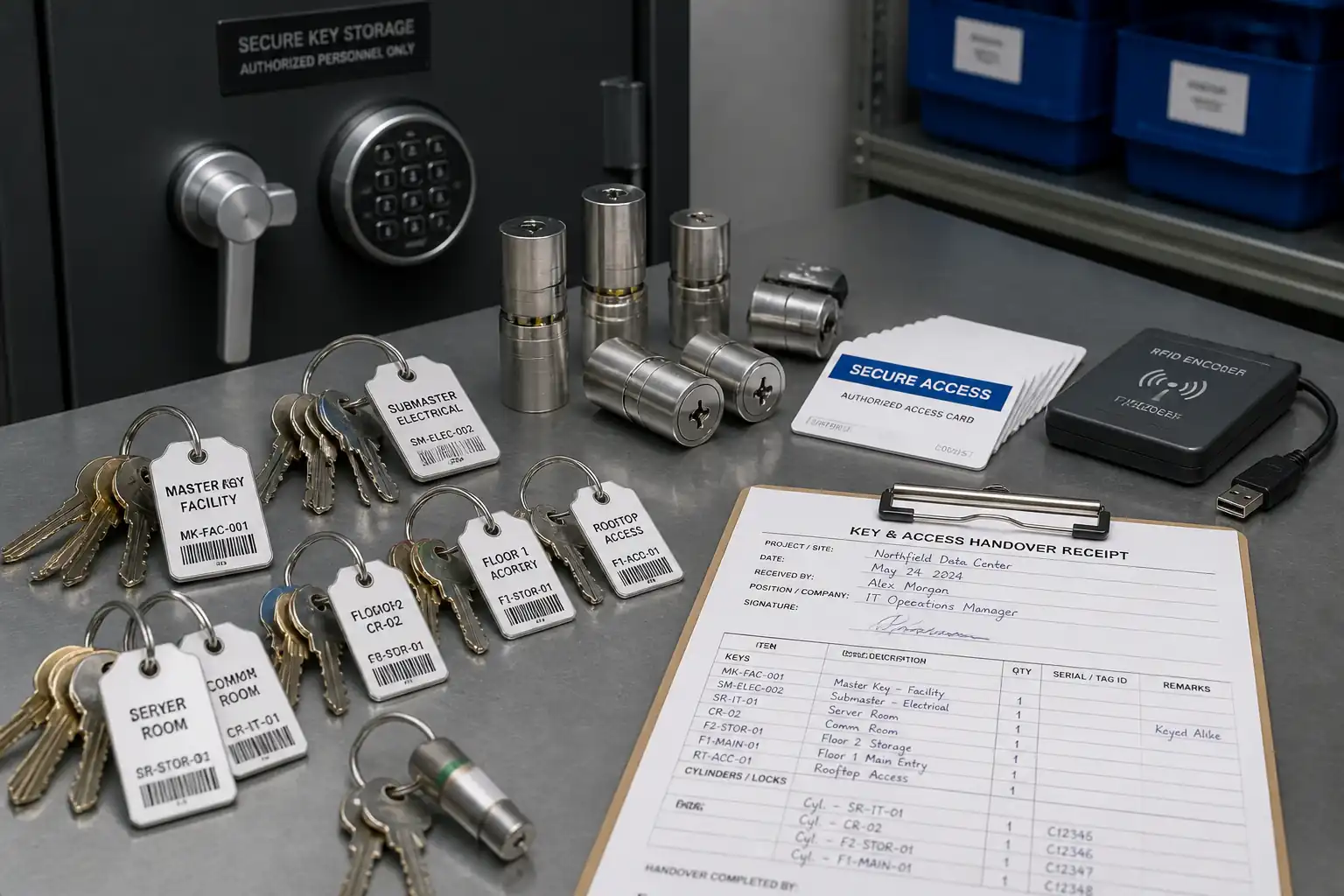
| 2 | Receipt and inventory of cylinders/keys/cards | Receive deliveries in controlled area. Count, inspect for damage, verify serials/batches vs delivery notes. Record unique IDs/UIDs. Segregate defects; apply tamper seals and place into safe. | Key Control Manager/QA | Visual; count; serial verification |
| 3 | Master keying verification (bench) | Sample-test cylinders per suite: verify correct keying vs Master Key Matrix. Use designated change keys where applicable. Negative test to confirm masters do not open unauthorized cylinders. | Locksmith | Witness by QA/QC (W) |
| 4 | Labeling and kitting | Issue durable labels with door/room ID and unique barcode. Assemble door packs: cylinders (if not installed), user keys (typ. 2–3/door [Verify]), spares sealed. Cross-check against schedule. | Key Control Manager | Label verification; count check |
| 5 | On-door mechanical functional test | Install/confirm cylinders. Test: key insertion fully; rotation smooth (no binding); correct latch/bolt operation; handle/lever returns; deadlatch functions; thumbturn where specified; door closes and latches reliably. | Locksmith | On-door test with checklist |
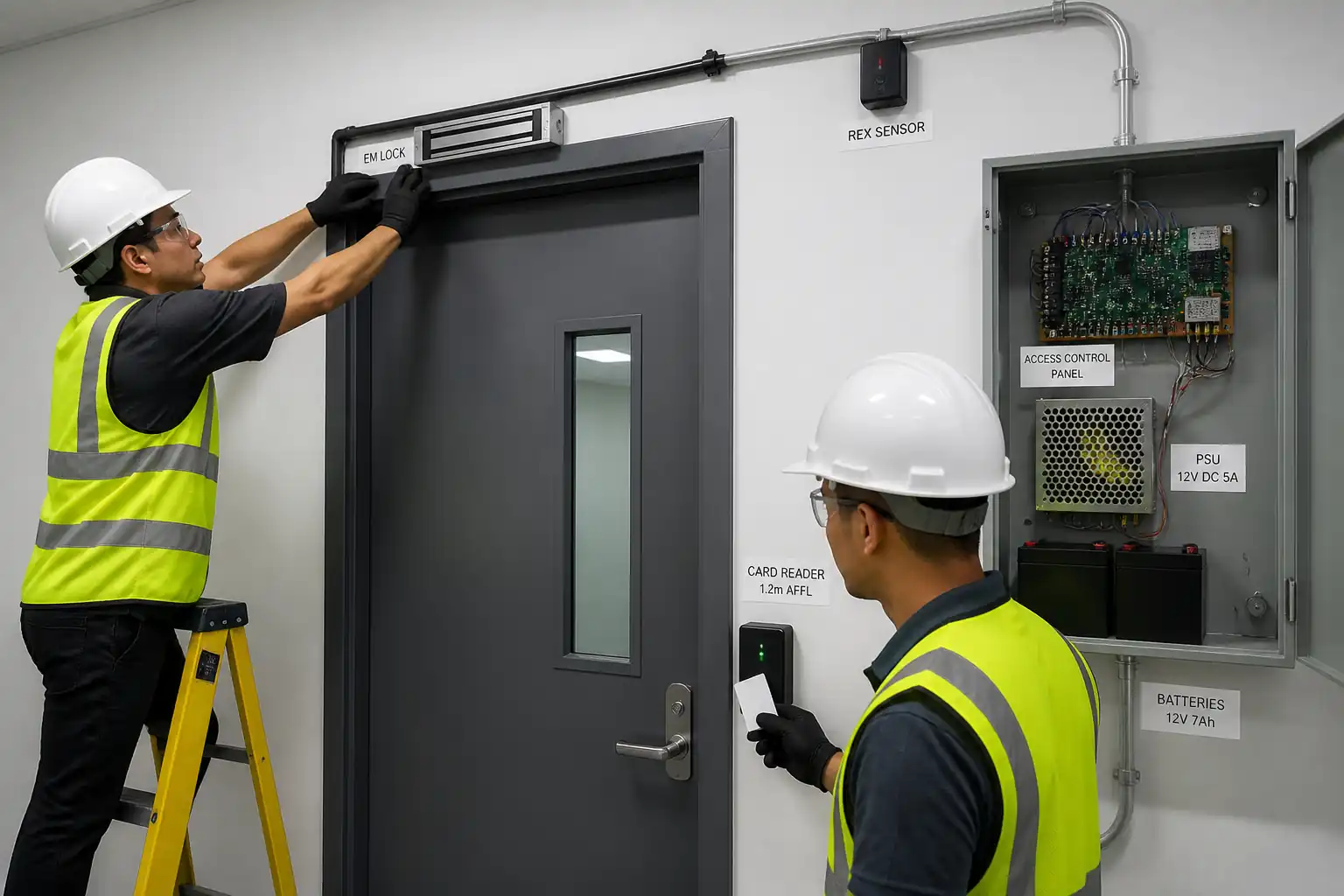
| 6 | Electronic lock/reader verification | Power check; verify fail-safe/fail-secure mode per design. Test card at reader: unlock event ≤1 s after present [Verify]; re-lock 3–5 s [Verify]; door contact and REX operate; event logs captured. | Security Systems Engineer | Functional tests witnessed (W) |
| 7 | Access card encoding and access level confirmation | Encode cards per approved Access Level Matrix; assign user ID; set validity/expiry; PIN policy if applicable; photo as per privacy policy. Negative test against unauthorized doors. | Security Systems Engineer | QA spot-check 10% or per risk [Verify] |
| 8 | Secure storage and chain-of-custody | Store all spares/masters in safe; two-person rule for master key access; sign-out/in logs; daily inventory; tamper-evident packaging for transfers. | Key Control Manager | Daily inventory; seal checks |
| 9 | Client witnessing and training | Demonstrate representative doors/readers; explain key hierarchy, emergency procedures, lost-card protocol, and reporting. Obtain witness signatures. | Commissioning Manager | Client witness (W) |
| 10 | Formal handover of keys/cards | Count items with Client; verify serials/UIDs; issue receipts; transfer custody; provide duplicates, authorization letters (restricted keys), and documentation/media. | Key Control Manager & Client Rep | Hold point (H) for handover |
| 11 | Missing/nonconforming item control | Raise NCR; investigate cause; implement mitigation (e.g., temporary construction core; disable compromised access levels); expedite replacement. | QA/QC & Key Control Manager | QA review |
| 12 | Closeout documentation | Compile signed ITP records, test sheets, registers, certificates, access level matrix, training records, as-builts, warranties, and O&M supplements. | Document Controller | QA document audit |
Health, Safety, and Security Controls
Principal Hazards and Controls
1) Loss/theft of master keys or cards
- Consequence: Unauthorized access, security breach, asset loss.
- Engineering/procedural controls: Key safe with two-person rule; tamper-evident bags; real-time Key Register; immediate lock-down procedure (disable card credentials; re-core per hierarchy); restricted access list approved by Client.
- Required PPE: Not task-specific; standard site PPE (safety shoes, vest) for site movements.
- Collective measures: Secure storage room with access control and CCTV [Verify per project HSE plan].
- Inspection/permit/supervision: Daily inventory and seal check; Key Control Permit/authorization list; supervision by Key Control Manager.
2) Pinch/crush injuries from doors and closers during testing
- Consequence: Finger/hand injuries; impact injuries.
- Controls: Use door stops; keep hands clear of hinge/strike; verify closer speed before cycling; communicate with nearby personnel.
- PPE: Cut-resistant gloves; safety footwear; eye protection when adjusting hardware.
- Collective measures: Barrier/“Do Not Enter – Testing” signage for high-traffic doors.
- Inspection/permit: Pre-use door hardware inspection; supervisor present for first-of-kind tests.
3) Electrical shock/short when working on electronic locks/readers
- Consequence: Electric shock; device damage; fire risk.
- Controls: Isolate circuits where required; Lock-Out/Tag-Out (LOTO); test for dead with multimeter; use insulated tools; avoid working on energized circuits unless justified and authorized.
- PPE: Insulated gloves (as required), safety glasses.
- Collective measures: Barriers to keep others away from energized panels.
- Inspection/permit: Electrical Permit-to-Work; LOTO log; competent person only [Verify per local regulations].
4) Working at height (podium/step-ladder for closers/readers)
- Consequence: Falls, sprains.
- Controls: Use podium steps with guardrails where possible; maintain three points of contact; no overreaching; secure tools; spotter.
- PPE: Non-slip footwear; where required, fall restraint per site rules.
- Collective measures: Exclusion zone; good housekeeping.
- Inspection/permit: Pre-use inspection; Working at Height permit if required.
5) Data privacy/information security breach during card provisioning
- Consequence: Breach of personal data; legal penalties; reputational damage.
- Controls: Minimize PII; role-based access to ACS; encrypt backups; strong admin passwords; disable default credentials; maintain access logs; follow Client data policy.
- PPE: Not applicable.
- Collective measures: Locked IT workspace; screen privacy filters where public footfall.
- Inspection/permit: Data handling authorization; periodic access review; compliance with local data protection law [Verify].
6) Manual handling of safes/boxes
- Consequence: Musculoskeletal injuries.
- Controls: Use trolleys; team lifts; keep loads <25 kg/person [Verify per local guidance]; clear pathways.
- PPE: Safety footwear; gloves.
- Collective measures: Mechanical aids; plan delivery route.
- Inspection/permit: Manual handling assessment.
7) Use of hand tools for cylinder adjustments
- Consequence: Cuts/eye injuries; dropped objects.
- Controls: Use correct bits; maintain tool condition; secure fixings; work from stable platform.
- PPE: Safety glasses; gloves.
- Collective measures: Exclusion zone below.
- Inspection/permit: Tool inspection log; supervision for first-of-kind.
Environmental Controls
- Packaging and general waste: Segregate cardboard/plastic; recycle where facilities exist; minimize single-use plastics.
- Electronic waste (defective cards/encoders): Dispose via certified WEEE recycler; maintain e-waste log [Verify per local regulation].
- Paper records containing PII: Shred/cross-cut; store only as long as necessary; prefer encrypted digital records with access control.
- Adhesives/labels: Use low-VOC products; avoid solvent cleaners; ensure adequate ventilation.
- Batteries (if used in electronic locks): Collect in battery recycling containers; no landfill.
- Nuisance: Schedule noisy adjustment works during permitted hours; maintain housekeeping to prevent trips and dust.
- Transport: Consolidate deliveries/handovers to reduce trips and emissions.
QA/QC
Quality Objectives
- 100% reconciliation of all keys, cylinders, and cards against approved schedules.
- All mechanical locks and electronic access points function as designed with documented evidence.
- Complete, signed handover dossier with auditable chain-of-custody.
Controls and Records
- Registers: Key Register, Seal Register, Card Encoding Log, Master Keying Test Log, Lockset Test Checklist, ACS Functional Test Sheets, Access Level Approval, NCR/Corrective Actions, Training Attendance, Handover Certificates.
- Sampling: Master keying bench verification ≥5% per keying hierarchy (min 2) unless specified otherwise; escalate to 100% for any failure [Verify per project specifications]. Card QA spot-check ≥10% or as specified.
- Calibration/IT: Multimeter in calibration; ACS backups verified by test restore on a non-production machine where feasible.
- Traceability: Each key/cylinder/card linked to a unique ID and door/area. Barcodes recommended; maintain chain-of-custody.
- Change control: Any revision to Access Level Matrix or Key Matrix requires Client approval and reissue of records with revision control.
- Acceptance: No open NCRs on security-critical items; Client witness points signed; final counts 100% verified.
- Training/competency: Only vetted/authorized personnel handle master keys; toolbox talks recorded.
Attachments / Forms
- Key Register (with barcode/UID fields)
- Seal Register and Chain-of-Custody Log
- Delivery Inspection Log (Cylinders/Keys/Cards)
- Master Keying Test Log
- Lockset On-Door Functional Test Checklist
- ACS Functional Test Sheets and Event Log Export Procedure
- Access Level Matrix (Approved) and Card Encoding Log
- Key/Card Receipt Form (Client)
- Nonconformance Report (NCR) and Corrective Action Form
- Training Attendance Sheet
- Safe Commissioning Checklist
- Data Handling Authorization and Backup Confirmation
This content is a read-only public reference. Download or customize to get an editable version.
ITP preview
The first inspection activities from the linked ITP for Method Statement – Keys, Cylinders, and Access Card Handover:
| Activity | Inspection / Test | Acceptance Criteria | Responsibility | Record |
|---|---|---|---|---|
| Receipt inspection of cylinders/keys/cards | Count, visual, serial/UID verification, document check | 100% reconciliation; no damage; certificates present; restricted key authorization on file [Verify] | QA/QC (Lead), Key Control Manager | Delivery Inspection Log; Key Register; Photos (if defects) |
| Master keying verification (bench) | Positive/negative key tests vs matrix | Sample per plan passes; any failure triggers 100% check and rework | Locksmith (Exec), QA/QC (W) | Master Keying Test Log; Updated Matrix if changes |
| On-door mechanical lockset test | Latch/bolt projection; 5-cycle operation; closer latch; key turns both directions | Smooth operation; no binding; correct projection per manufacturer; closer time 3–7 s [Verify] | Locksmith (Exec), QA/QC (W), Client (Witness optional) | Lockset Test Checklist; Punch List closure |
Showing 3 of 7 inspection activities. View full ITP →
Related Inspection and Test Plan
An Inspection and Test Plan (ITP) is available for Method Statement – Keys, Cylinders, and Access Card Handover. The ITP defines the inspection activities, acceptance criteria, hold and witness points, responsible parties, and records required to verify the work described in this method statement.
View the Method Statement – Keys, Cylinders, and Access Card Handover ITP →Frequently asked questions
Continue with related Quollnet resources connected to this method statement.