
Inspection and Test Plan for Method Statement – Keys, Cylinders, and Access Card Handover
AI-assisted inspection and test plan connected to a method statement, with PDF and Excel export.
More than a static template
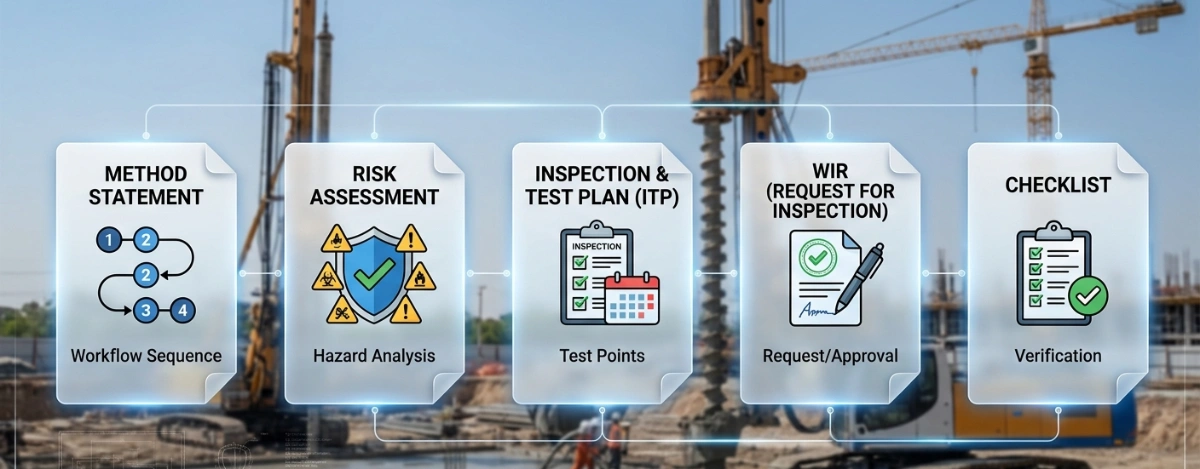
Unlike a downloadable Word or PDF template, this ITP is an AI-assisted editable starting point directly connected to its method statement. Every inspection activity, hold point, and acceptance criterion is structured and ready to adapt to your project.
- AI-assisted customization — Tailor inspection activities and acceptance criteria to your specific project scope.
- Linked method statement — This ITP is connected to the corresponding method statement describing the work sequence.
- Multiple export formats — Download as a formatted PDF or editable Excel spreadsheet.
- Editable starting point, not a final document — Review and verify all content against your project specifications and standards before use.
What you can customize
When you save this ITP to your account, every inspection row becomes editable. You can add, remove, or modify:
- Inspection activity — Description of what is being inspected.
- Inspection type — Hold point (H), Witness point (W), Review (R), or Monitor (M).
- Responsibility — Contractor, subcontractor, engineer, or client.
- Frequency — How often the inspection occurs.
- Acceptance criteria — Referenced standard or specification requirement.
- Records — Forms, test reports, or checklists required as evidence.
Why this ITP is used
To ensure every key, cylinder, and credential is verified, tested, documented, and handed over securely with auditable traceability.
Who uses this inspection and test plan
Contractor’s QA/QC and Key Control Manager, Security Systems Engineer, Locksmith, and Client Security Representative.
When this ITP is prepared and submitted
From delivery receipt through functional testing to final handover and closeout.
Who receives or approves this ITP
Client/Engineer for review and approval prior to commencement of handover works.
Inspection scope
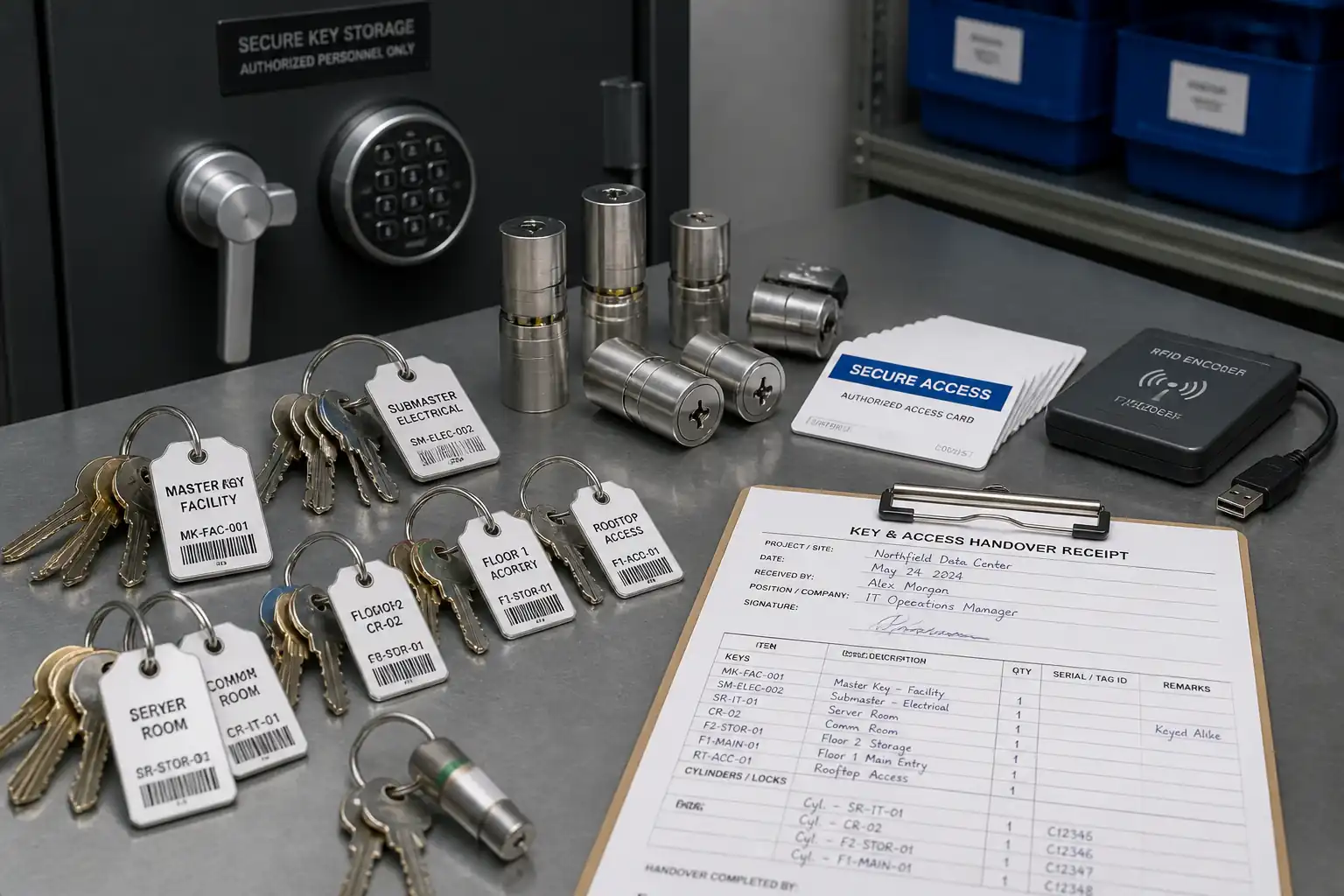
Covers receipt inspections, master keying verification, on-door mechanical testing, electronic access tests, card encoding verification, chain-of-custody audits, and final handover.
Typical hold, witness, and review points
Hold: Client handover and final reconciliation. Witness: on-door lockset tests, electronic access tests, and card encoding verification.
Typical inspection records
Delivery logs, Key Register, test checklists, event logs, Access Level approvals, NCRs, receipt forms, and final dossier index.
Important approval note
This ITP is an AI-assisted editable starting point, not a pre-approved document. Before use on any project, all inspection activities, hold points, and acceptance criteria must be reviewed and approved by the relevant parties (superintendent, principal contractor, or client representative) in accordance with your contract and project quality plan.
Always verify acceptance criteria against your applicable drawings, specifications, and regulatory requirements. Hold points must be confirmed with the relevant authority before work proceeds past that point.
Inspection and test plan
| Activity | Inspection / Test | Acceptance Criteria | Responsibility | Record |
|---|---|---|---|---|
| Receipt inspection of cylinders/keys/cards | Count, visual, serial/UID verification, document check | 100% reconciliation; no damage; certificates present; restricted key authorization on file [Verify] | QA/QC (Lead), Key Control Manager | Delivery Inspection Log; Key Register; Photos (if defects) |
| Master keying verification (bench) | Positive/negative key tests vs matrix | Sample per plan passes; any failure triggers 100% check and rework | Locksmith (Exec), QA/QC (W) | Master Keying Test Log; Updated Matrix if changes |
| On-door mechanical lockset test | Latch/bolt projection; 5-cycle operation; closer latch; key turns both directions | Smooth operation; no binding; correct projection per manufacturer; closer time 3–7 s [Verify] | Locksmith (Exec), QA/QC (W), Client (Witness optional) | Lockset Test Checklist; Punch List closure |
| Electronic access point functional test | Card read; unlock timing; re-lock; door contact; REX; alarm/logs | 3 consecutive passes; unlock ≤1 s; correct fail-safe/secure mode; event logged | Security Systems Engineer (Exec), QA/QC (W), Client (W) | ACS Functional Test Sheets; Event Logs |
| Card encoding and access level verification | Encode 100%; negative tests for unauthorized doors | No unauthorized openings; data matches Access Level Matrix; expiry set | Security Systems Engineer (Exec), Client Security (W) | Card Encoding Log; Access Level Approval |
| Secure storage and chain-of-custody audit | Daily inventory; seal match; access list current | Zero discrepancies; intact seals; authorized access only | Key Control Manager (Exec), QA/QC (Audit) | Key Register; Seal Register; Audit Report |
| Client handover | Final reconciliation and sign-off | 100% items handed over; documents complete; signatures/stamps obtained | Contractor/Client | Handover Certificate; Receipt Forms; Final Registers |
This table is a read-only public reference. Download the PDF or Excel version, or customize this ITP to edit it for your project.
Frequently asked questions
Related method statement
This Inspection and Test Plan is associated with the Method Statement – Keys, Cylinders, and Access Card Handover method statement, which describes the step-by-step construction sequence, resources, materials, equipment, safety controls, and environmental controls for this activity.
View the Method Statement – Keys, Cylinders, and Access Card Handover method statement →Continue with related inspection, method statement, article, and checklist resources.