
Method Statement: Chemical Flushing, Cleaning, and Passivation of Chilled Water (CHW) Closed-Loop Networks – Method Statement
AI-assisted method statement with matching ITP, PDF download, and Excel export.
More than a static template
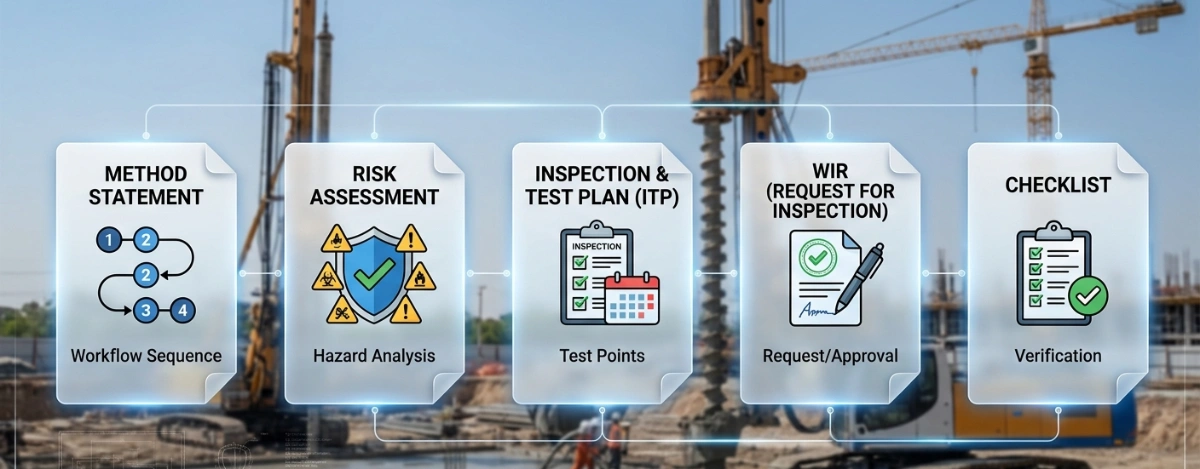
Unlike a downloadable Word or PDF template, this method statement is an AI-assisted editable starting point connected directly to a matching Inspection and Test Plan. Every section is structured, project-adaptable, and ready to export.
- AI-assisted drafting — Customize every section with AI for your specific project scope.
- Linked ITP — A matching inspection and test plan is generated alongside the method statement.
- Multiple export formats — Download as a formatted PDF or editable Excel spreadsheet.
- Editable starting point, not a final document — Review, verify, and adjust all content against your project requirements before use.
Static template vs. Quollnet workflow
| Feature | Static template | Quollnet |
|---|---|---|
| Project-specific content | Manual fill-in required | AI-assisted customization |
| Linked ITP | Separate document, no link | Matching ITP included |
| Export formats | Usually PDF only | PDF and Excel |
| Structured sections | Free-form layout | 13 standardized sections |
| Saved to your account | Local file only | Cloud-saved, reusable |
| Content accuracy | You verify everything | AI-assisted, you still verify |
| Cost | Often free but time-intensive | Free to customize and download |
What you can customize
When you save this method statement to your account, every section becomes editable. The following 13 sections are included:
- Scope — Defines the activity and its boundaries.
- References — Standards, specifications, and drawings.
- Responsibilities — Roles and accountabilities.
- Resources — Labour, plant, and equipment summary.
- Materials — Materials and compliance requirements.
- Equipment — Tools and equipment details.
- Prerequisites — Hold points and pre-conditions.
- Method sequence — Step-by-step construction sequence.
- Safety controls — HSE risk controls and PPE.
- Environmental controls — Environmental mitigation measures.
- QA/QC — Quality inspection and test requirements.
- ITP — Inspection and Test Plan table (has its own page).
- Attachments — Referenced drawings and documentation.
Why this method statement is used
This method statement is used to define and communicate the approved procedure for carrying out method statement: chemical flushing, cleaning, and passivation of chilled water (chw) closed-loop networks on site. It ensures the work is planned in advance, the correct resources and controls are in place, and all personnel understand responsibilities, sequence, quality requirements, and safety controls before work begins. It aligns site execution with the documented scope and acceptance expectations.
Who uses this method statement
This method statement is used by contractors, site supervisors, project engineers, QA/QC engineers, HSE officers, consultants, and client representatives. It serves as a shared reference for planning, execution, supervision, inspection, and approval of the activity on site.
When it is prepared and submitted
The method statement is prepared before the work activity starts and submitted as part of the pre-construction documentation package for review and approval.
Who reviews or approves it
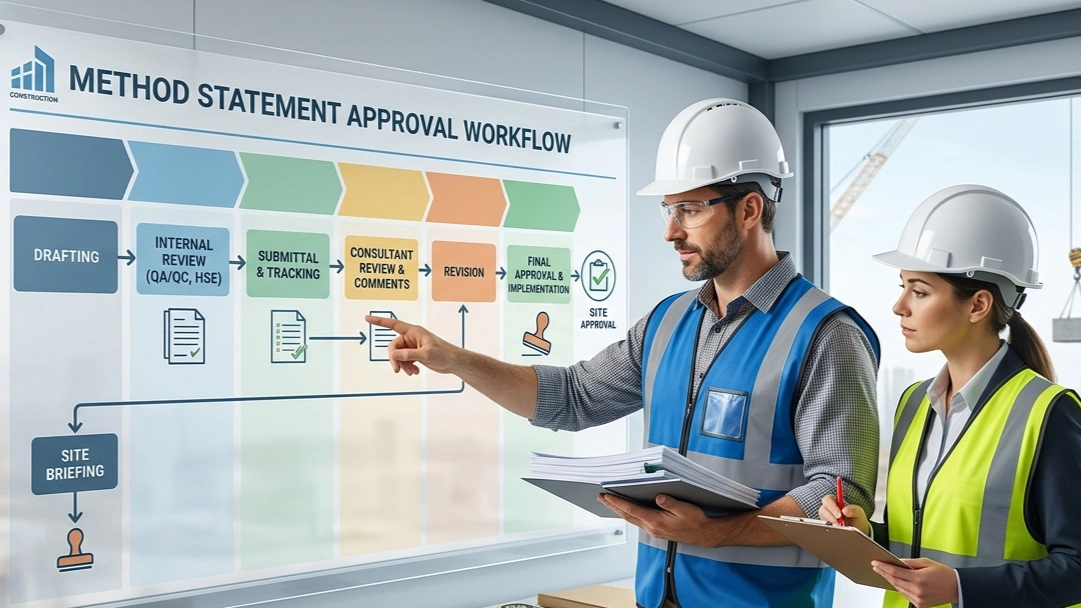
The method statement is usually submitted to the client representative, consultant, resident engineer, or project management consultant for review and approval before the work commences.
Important approval note
This method statement is an AI-assisted editable starting point, not a pre-approved document. Before use on any project, all content must be reviewed and approved by the relevant parties (superintendent, principal contractor, or client representative) in accordance with your contract and project quality plan.
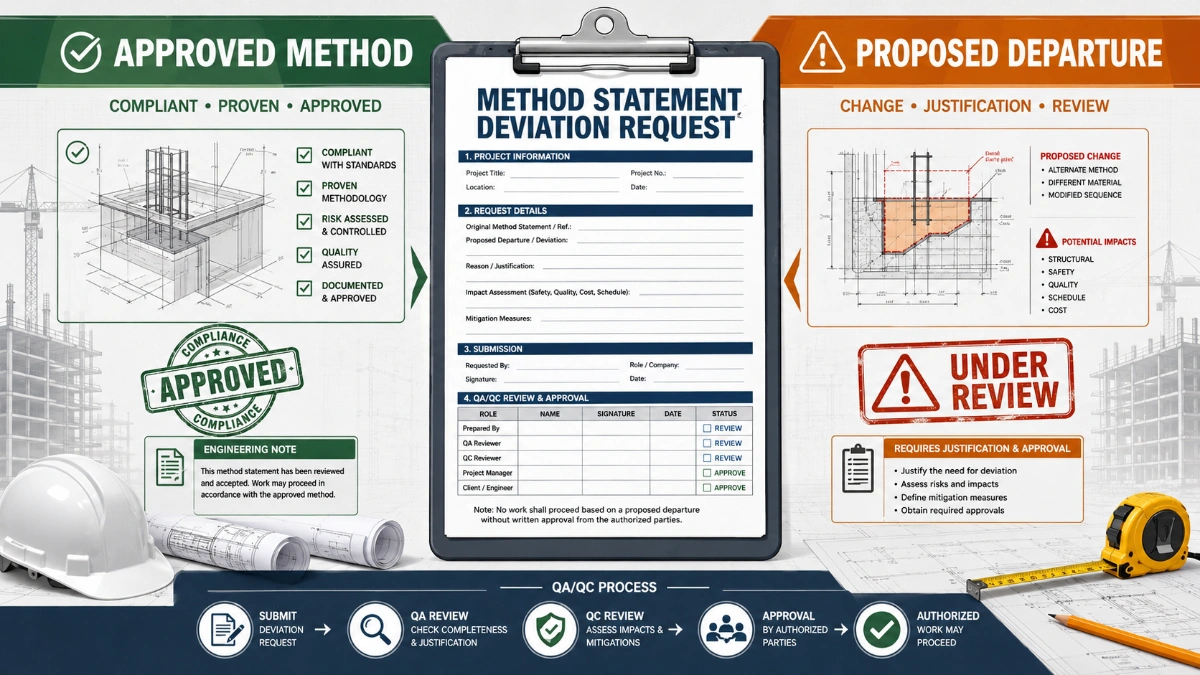
For example: if your specification requires a departure from a referenced standard, that departure must be documented and approved separately — this method statement will not capture that automatically. Always verify against your applicable drawings, specifications, and regulatory requirements.
Method statement content
Scope
Overview
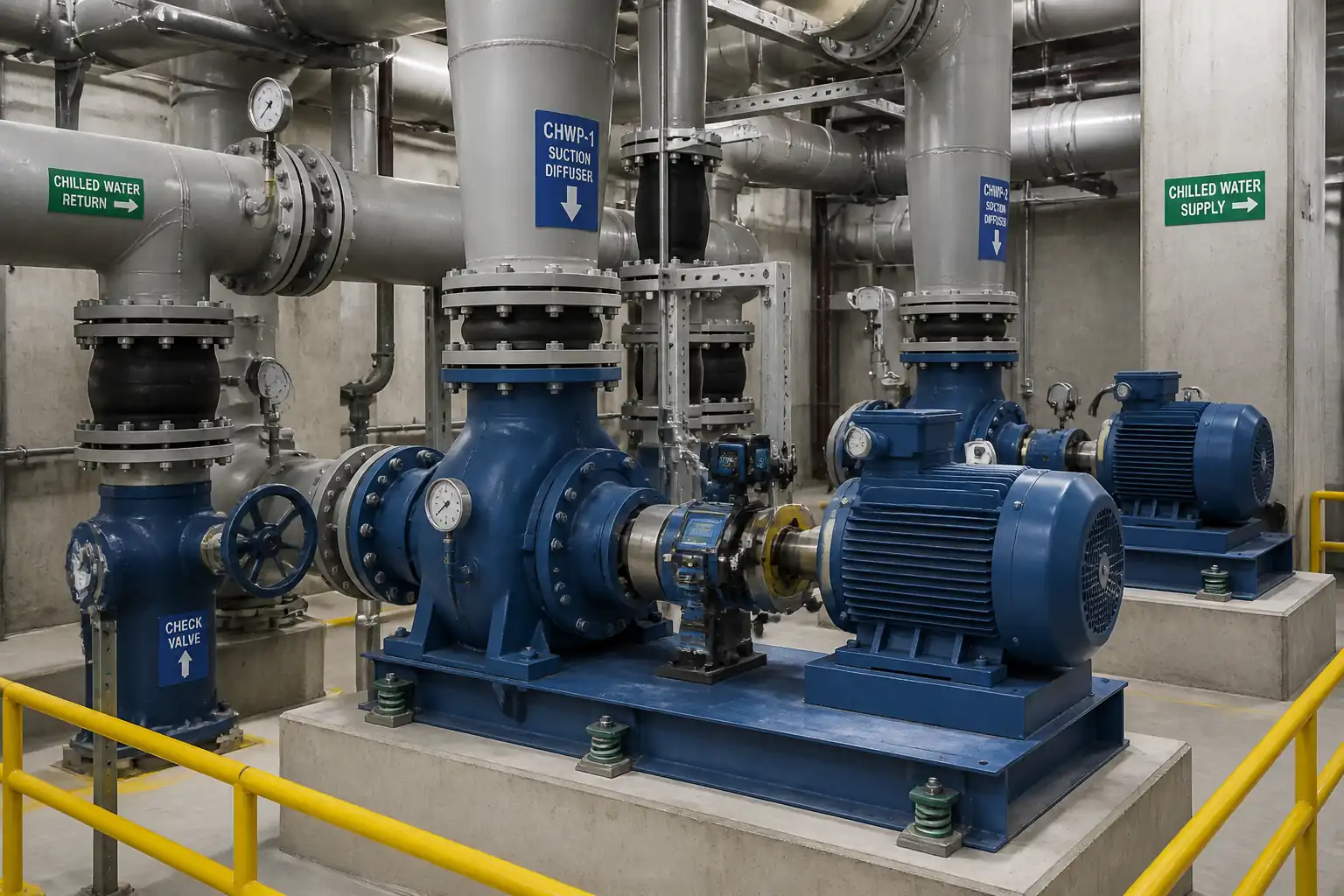
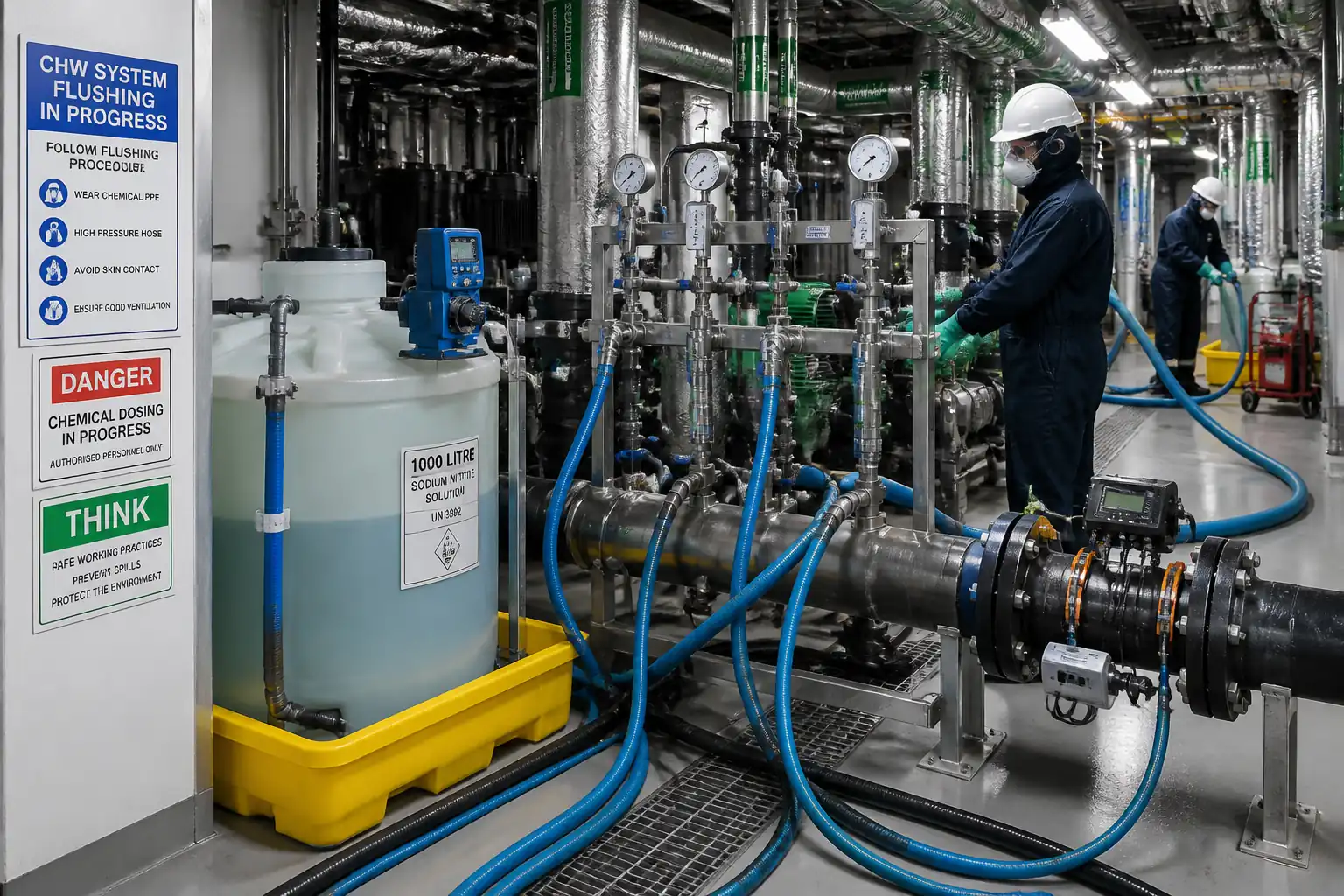
This method statement details the full procedure for chemical flushing, cleaning, and passivation of the closed-loop chilled water (CHW) network, including temporary bypass loop installation, strainer cleaning, dynamic high-velocity flushing, dosing of alkaline/acid cleaning agents as required, neutralization, corrosion inhibitor addition (passivation), biocide treatment, and water quality sampling with certified laboratory analysis. The process is intended to remove construction debris, mill scale, corrosion products, and biofouling from CHW pipework prior to commissioning.
Systems/Areas Covered
- CHW primary and secondary loops, headers, risers, branches, and terminal sub-circuits (FCUs/AHU coils isolated).
- Plantroom pipework, differential pressure bypass lines, and strainers.
- Ancillary items: expansion vessels isolated as needed, air/dirt separators, dosing pots, sidestream filters.
Exclusions/Notes
- Chillers, heat exchangers, and control valves/coils are isolated and protected via temporary bypass. No cleaning chemicals or debris to pass through chillers or terminal units.
- Hydrostatic testing and pressure integrity are assumed complete prior to cleaning [Verify per project specifications].
Objectives
- Achieve cleanliness suitable for commissioning and operation.
- Establish corrosion-inhibited, biostatically controlled water chemistry within target ranges [Verify per project specifications].
- Provide complete QA/QC records including test certificates, lab results, and flushing logs.
References
| Document Type | Reference / Number | Revision | Notes |
|---|---|---|---|
| BSRIA BG 29/2021 – Pre-Commission Cleaning of Pipework Systems | Primary guidance for closed system flushing/cleaning and acceptance criteria [Verify per project specifications]. | ||
| BSRIA BG 50/2021 – Water Treatment for Closed Heating and Cooling Systems | Chemical selection, inhibitor dosing, and control limits. | ||
| CIBSE Commissioning Code W – Water Distribution Systems | Commissioning interface and system readiness. | ||
| ASHRAE Guideline 1.1 – HVAC&R Systems Commissioning Process | Commissioning coordination reference. | ||
| ISO 5667 (all relevant parts) – Water Quality – Sampling | Sampling protocols and chain-of-custody. | ||
| ISO 7027 – Water Quality – Determination of Turbidity | On-site turbidity acceptance checks. | ||
| ASTM D1293 – pH of Water by Electrometric Method | Field pH verification. | ||
| ASTM D1125 – Electrical Conductivity and Resistivity of Water | Conductivity control. | ||
| ASTM D512 – Chloride Ion in Water | Chloride monitoring to mitigate pitting risk (especially stainless steel). | ||
| Standard Methods for the Examination of Water and Wastewater (APHA/AWWA/WEF) – relevant sections incl. 2130 (Turbidity), 2510 (Conductivity), 4500 series (pH, alkalinity), 9215 (HPC) | Laboratory methods and QA. |
Responsibilities
| Role | Responsibility | Name / Party |
|---|---|---|
| Main Contractor (MC) | Overall execution, resources, temporary works, compliance with method and ITP; ensure permits and isolation plans. | Contractor |
| Water Treatment Specialist (WTS) | Provide specialist chemicals, dosing strategy, on-site testing, adjust chemistry, advise on acceptance criteria and safety of chemicals. | Specialist Subcontractor |
| Engineer/Consultant (ENG) | Review and approve method statement, ITP, material submittals; witness/hold points; acceptance of final results. | Client Representative |
| Environmental Officer (EO) | Issue discharge permits, coordinate labs, verify environmental compliance. | Contractor |
| HSE Manager/Supervisor (HSE) | Task-specific risk assessments, chemical handling oversight, emergency response readiness, site inductions, PPE verification. | Contractor |
| Mechanical Supervisor & Pipefitters | Execute isolations, install temporary bypass, operate pumps/valves, clean strainers, log parameters. | Contractor |
| QA/QC Engineer | Collect samples per ISO 5667, maintain chain-of-custody, perform field tests, dispatch to accredited lab, file results. | Contractor |
Resources
| Resource Type | Description | Quantity | Remarks |
|---|---|---|---|
| Personnel | 1 | ||
| Personnel | 3–6 [Verify per system size] | ||
| Personnel | 1–2 | ||
| Personnel | 1 | ||
| Personnel | 1 | ||
| Subcontract | As required | Water analysis and reports. |
Materials
| Material | Specification / Grade | Quantity | Remarks |
|---|---|---|---|
| Alkaline Cleaning Agent (Detergent/Dispersant) | Non-foaming, compatible with carbon steel/copper; supplier datasheet; SDS required. | As calculated | |
| Acid Cleaning Agent (Inhibited) | e.g., Citric or Phosphoric acid 2–5% with corrosion inhibitor; chloride content controlled. | As calculated | |
| Neutralizing Agent | e.g., Sodium Bicarbonate/Lime for acids; Dilute acid for alkaline effluent. SDS required. | As required to reach discharge pH 6–9 | |
| Corrosion Inhibitor (Nitrite-/Molybdate-based or equivalent) | Closed-loop inhibitor compatible with system metals; typical nitrite 600–1000 mg/L as NO2- or molybdate 50–150 mg/L [Verify per supplier/project]. | Dose to achieve residual per supplier | |
| Biocide (non-oxidizing, e.g., isothiazolinone/THPS) | Closed-loop compatible; avoid oxidizers that increase chloride or attack elastomers unless approved. | Shock dose as recommended | |
| Filter Bags/Cartridges (e.g., 100 µm then 25–5 µm) | Progressive filtration media compatible with system fluids. | Cartridge/bag replacements as needed |
Equipment
| Equipment | Capacity / Type | Quantity | Inspection Required |
|---|---|---|---|
| Temporary Flushing Pump(s) | Up to ≥ 1.5–2.0 m/s line velocity in target branches [Verify per hydraulics]. | 1–2 | |
| Temporary Bypass Headers/Hoses/Spools | Pressure rating ≥ system test pressure [Verify]. | As required | |
| Temporary Basket/Y-Strainers | Sized for branch flows; cleanable. | Multiple | |
| Dosing Tank & Metering Pump | 0–50 L/h adjustable [Verify]. | 1 | |
| Ultrasonic Clamp-On Flow Meter | Pipe sizes DN25–DN300+ | 1–2 | |
| Handheld pH/Conductivity/TDS/Turbidity Meters | pH 0–14; EC 0–20 mS/cm; Turbidity 0–1000 NTU | Set | |
| Effluent Filter Bag Housing | Flow per discharge permit [Verify]. | As required | |
| Sidestream Filter Unit | Sized per loop volume [Verify]. | 1 |
Prerequisites
Documentation and Approvals
- Approved method statement and ITP; chemical data sheets (SDS) submitted and approved.
- Water treatment proposal including dosing rates, contact times, passivation targets approved by ENG.
- Discharge permit/consent from relevant authority; confirmation of discharge route to foul sewer (not storm) [Verify per project HSE plan and local regulations].
System Readiness
- Hydrostatic test completed and leaks rectified; system dry or filled with clean water suitable for circulation.
- All coils, control valves, chillers, and sensitive equipment isolated and protected with temporary bypass. Install tagged blanks as necessary.
- Verify valve line-up, air vents operational, and ability to purge/vent high points.
- Temporary strainers installed at strategic points; differential pressure gauges fitted.
Calibrations and Instruments
- Calibration certificates (≤6 months) for flow, pH, conductivity, turbidity meters; verify on-site with standards.
HSE and Permits
- Task risk assessment and COSHH completed; chemical handling plan and spill response kit at point of use.
- Confined/plant room ventilation verified; eye wash and shower within 10 s travel distance.
- Permit-to-Work for chemical cleaning, pressure systems, and drainage discharge as applicable.
Sampling and Lab
- Sampling plan per ISO 5667 with locations (headers, extremities, return legs, low points). Chain-of-custody forms prepared.
- Accredited laboratory engaged; bottleware and preservatives available (sterile for microbiology).
Method Sequence
| Step | Activity | Description | Responsibility | Inspection / Hold Point |
|---|---|---|---|---|
| 1 | Pre-start walkdown and isolation | Joint walkdown (MC/WTS/ENG) to confirm isolation of coils/chillers, valve positions, bypass routing, temporary strainers installed, drains available, and discharge permits in place. | MC | ITP Hold Point: Pre-start acceptance |
| 2 | Install and commission temporary bypass loop | Fit temporary headers/hoses to bypass plant and create a closed circuit. Pressure test temporary loop to system cold fill pressure + safety margin [Verify]. | MC | Visual inspection; pressure gauge check |
| 3 | Initial fill and air purge | Fill circuit with potable or approved water. Vent high points until air-free flow achieved; operate air/dirt separators. | MC | Observe vents and separator operation |
| 4 | Dynamic high-velocity flushing (gross debris removal) | Run temporary flushing pump(s) to achieve high turbulence. Flush each branch/sub-circuit individually by throttle/valve sequencing. Clean strainers frequently. | MC/WTS | Flowmeter readings recorded at branch headers |
| 5 | Strainer inspection and cleaning | Isolate and depressurize; remove baskets; clean debris; inspect for damage; reinstall with new gaskets as required. | MC | Visual inspection; DP before/after |
| 6 | Chemical cleaning – alkaline stage | Dose alkaline detergent/dispersant via dosing tank. Circulate through all pipework (plant bypassed) to lift oils and loose oxides. Maintain temperature if allowed by spec [Verify]. | WTS | Concentration and pH checks hourly |
| 7 | Rinse to drain (controlled) | Displace chemical solution with fresh water while filtering effluent through filter bags. Discharge under permit; neutralize if outside pH 6–9. | MC/EO | pH and turbidity at discharge |
| 8 | Conditional acid/chelant cleaning (if required) | If inspection indicates persistent scale/magnetite, dose inhibited acid/chelant under controlled conditions with corrosion inhibitor. Circulate and monitor metals compatibility. | WTS | Corrosion coupon/instantaneous corrosion rate if available; pH and temperature hourly |
| 9 | Neutralization and thorough flushing | Neutralize acidic cleaning solution to pH 6–8.5, then flush with fresh water until turbidity and conductivity stabilize near supply water baseline. | MC/WTS | Continuous pH monitoring; turbidity checks |
| 10 | Biocide shock dosing (if specified) | Dose non-oxidizing biocide to control microbial growth; circulate to all extremities with valves cycled. | WTS | Concentration checks; ensure full circulation |
| 11 | Passivation / inhibitor dosing | Refill system with treated water; add corrosion inhibitor to achieve target residual. Adjust pH per metallurgy (carbon steel vs. aluminum components). | WTS | On-site tests every 2–4 h initially |
| 12 | Final high-velocity polishing flush (through sidestream filter) | Operate system circulation with sidestream filtration 5–10% of flow. Maintain filtration down to 5–10 µm until turbidity and solids meet criteria. | MC/WTS | Filter DP and solids loading |
| 13 | Sampling and laboratory testing | Collect samples per ISO 5667 from agreed points after stabilization (≥24 h post-passivation unless specified). Include field blanks/control as needed. | QA/QC | Witness by ENG (hold/witness) |
| 14 | Demobilization and reinstatement | Remove temporary bypass and strainers; reinstate normal configuration; open coils/chillers as approved; install/commission permanent dosing pot and sidestream filter. | MC | Final walkdown |
Safety Controls (HSE)
Task-Specific Hazards and Controls
- Hazard: Chemical exposure (alkaline/acid cleaners, inhibitors, biocide)
- Likely consequence: Chemical burns, eye injury, respiratory/skin sensitization.
- Engineering/procedural control: Use closed dosing with metering pump; decant within bunded area; verify compatibility; maintain SDS on site; emergency eyewash/shower within 10 s; prohibit mixing incompatible chemicals; training in COSHH.
- Required PPE: Chemical goggles + face shield, chemical-resistant gloves (nitrile/neoprene), acid/alkali apron, long sleeves, safety boots.
- Collective preventive measure: Local exhaust/ventilation in plantroom; spill containment trays; barriers to restrict access.
-
Inspection/permit: COSHH assessment approval; Chemical Handling Permit; inspect hoses, seals, and bunds before each shift [Verify per project HSE plan and local regulations].
-
Hazard: Pressurized system and hose/connection failure during high-velocity flushing
- Likely consequence: Fluid injection injury, flooding, impact from whipping hoses.
- Engineering/procedural control: Pressure test temporary works; use rated hoses and positive locking couplings; whip checks; gradually ramp pump speed; relief valve on discharge manifold.
- Required PPE: Safety goggles, gloves, long sleeves, safety boots.
- Collective preventive measure: Physical barriers/exclusion zones around temporary manifolds; emergency stop at pump skid.
-
Inspection/permit: Pressure Systems Permit; pre-start inspection checklist; continuous pressure/DP monitoring.
-
Hazard: Slips/trips due to wet floors and hoses
- Likely consequence: Strains, fractures.
- Engineering/procedural control: Keep hoses routed overhead or in cable ramps; deploy absorbent mats; maintain housekeeping; immediate cleanup of spills.
- Required PPE: Slip-resistant boots, gloves.
- Collective preventive measure: Signage and cordoned walkways; adequate lighting.
-
Inspection/permit: Daily HSE inspection log.
-
Hazard: Confined/poorly ventilated plantroom
- Likely consequence: Chemical vapor accumulation, hypoxia, heat stress.
- Engineering/procedural control: Forced ventilation; temperature monitoring; work/rest cycles; no decanting in unventilated rooms.
- Required PPE: As above; consider respirator with appropriate cartridges if indicated by COSHH.
- Collective preventive measure: Continuous ventilation fans; door open policy where safe.
-
Inspection/permit: Confined Space assessment if applicable; atmospheric monitoring if required.
-
Hazard: Manual handling of chemical containers and strainers
- Likely consequence: Musculoskeletal injuries.
- Engineering/procedural control: Use trolleys/hoists; team lifts; decant smaller containers; design lifting points on strainers.
- Required PPE: Gloves, safety boots.
- Collective preventive measure: Mechanical aids available at point of use.
-
Inspection/permit: Manual handling training verified.
-
Hazard: Electrical hazards from temporary pumps and wet environment
- Likely consequence: Electric shock, fire.
- Engineering/procedural control: Use IP55+ equipment; RCD protection; lockable isolators; cables elevated; regular PAT/visual checks.
- Required PPE: Dielectric gloves where required, dry gloves/boots.
- Collective preventive measure: Temporary power boards with RCD; spill protection.
-
Inspection/permit: Electrical Permit to Work; PAT certificates.
-
Hazard: Aerosol generation and microbiological exposure (during draining or sampling)
- Likely consequence: Respiratory illness, infection.
- Engineering/procedural control: Minimize splashing; use hose to drain to sealed system; biocide dosing before opening stagnant sections if required.
- Required PPE: Goggles/face shield, gloves, mask where risk- assessed.
- Collective preventive measure: Controlled drainage connections; covers on sumps.
- Inspection/permit: HSE review and approval of method; sampling SOP adherence.
Environmental Controls
Discharge and Pollution Prevention
- Route all effluent to foul sewer via approved connection; never to storm drains or ground. Obtain discharge consent and comply with permit conditions [Verify per project HSE plan and local regulations].
- Neutralize effluent to pH 6–9 before discharge. Use in-line pH monitoring when neutralizing acidic/alkaline streams.
- Install filter bags/cartridges on discharge to capture suspended solids; change out when DP high or visibly loaded.
Chemical Management
- Store chemicals in bunded area sized ≥110% of largest container. Segregate acids and alkalis; maintain SDS and spill response materials.
- Maintain spill kits (acid neutralizer, absorbents) at point of use; train team in spill response and reporting.
Waste Handling
- Collect spent filter media, contaminated PPE, and empty containers for disposal via licensed waste contractor. Triple-rinse/neutralize as required by supplier.
- Keep waste transfer notes and hazardous waste consignment records.
Noise and Energy
- Use variable-speed pumps to minimize noise and energy; confine noisy operations to permitted hours.
Monitoring and Records
- Log discharge volumes, pH, turbidity, and any neutralization chemicals used. Keep chain-of-custody for all samples. Immediate stop-work and notify EO/ENG if out-of-spec discharge is detected.
QA/QC
Quality Objectives
- Demonstrate that the CHW system is cleaned to industry standards with water chemistry stabilized and protected against corrosion and microbiological growth.
Controls and Records
- Calibration certificates for all meters; daily verification with buffer/standards (documented).
- Flushing Log: branch velocity/flow, duration, temperature, DP across strainers, time stamps.
- Chemical Dosing Log: product, batch no., start/end times, doses, on-site test readings (pH, inhibitor residual, conductivity).
- Neutralization/Discharge Log: volumes, pH, turbidity, permit references.
- Sampling Records: ISO 5667-compliant chain-of-custody; sample ID, location, time, field measurements (pH, EC, temp), preservatives, courier details.
- Laboratory Certificates: accredited lab results, method references (ASTM/ISO/Standard Methods), detection limits.
- Nonconformance and Corrective Action: trigger if any parameter outside limits; re-flush/re-dose until compliant.
Typical Acceptance Criteria [Verify per project specifications]
- Hydraulics: Branch flushing velocity ≥ 1.5 m/s and Re > 4000 (or ≥1.5× design flow where practicable).
- Turbidity (post-clean): ≤ 5–10 NTU (or as specified by ENG/BSRIA guidance).
- pH (operational): 8.5–10.0 for carbon steel; 8.2–8.5 if aluminum present.
- Inhibitor residual: Nitrite 600–1000 mg/L as NO2- or Molybdate 50–150 mg/L (supplier-specific).
- Chloride: Within material compatibility limits (e.g., ≤50 mg/L if stainless steel present) [Verify].
- Conductivity/TDS: Stable trend consistent with treated water baseline.
- Microbiology: Heterotrophic Plate Count within acceptable project limits; Legionella not detected where specified [Verify].
Handover
- Submit compiled dossier: approvals, logs, calibration certs, permits, marked-up drawings (sampling points), lab results, O&M update (chemical schedules, inhibitor MSDS, monitoring plan).
Attachments
Attachments / Forms (to be included in the dossier)
- Pre-Start Isolation and Readiness Checklist (FRM-CHW-01)
- Temporary Bypass Pressure Test Record (FRM-CHW-02)
- Flushing Log Sheet (branch-wise) (FRM-CHW-03)
- Strainer Cleaning Log (FRM-CHW-04)
- Chemical Dosing and On-site Test Sheet (FRM-CHW-05)
- Neutralization and Discharge Log with Permit Reference (FRM-CHW-06)
- Sampling Plan and Chain-of-Custody Form (FRM-CHW-07)
- Laboratory Certificates (COC + Results) (FRM-CHW-08)
- Nonconformance Report (NCR) Template (FRM-CHW-09)
- Final Acceptance Certificate (FRM-CHW-10)
- As-Built Marked Drawings showing sampling points and temporary works (DWG-CHW-AB)
Notes
- All forms to carry project identifiers, date/time stamps, and signatures of responsible parties.
This content is a read-only public reference. Download or customize to get an editable version.
ITP preview
The first inspection activities from the linked ITP for Method Statement: Chemical Flushing, Cleaning, and Passivation of Chilled Water (CHW) Closed-Loop Networks:
| Activity | Inspection / Test | Acceptance Criteria | Responsibility | Record |
|---|---|---|---|---|
| Review and approval of Method Statement, ITP, and Chemical Submittals | Document review and approval | All documents approved prior to works commencement. | MC/WTS/ENG | Approved MS/ITP; Material Approvals |
| Pre-start walkdown and isolation verification | Checklist and visual inspection | Isolations complete; bypass installed; permits in place; instruments calibrated. | MC/ENG | Pre-Start Checklist; Photos |
| Temporary bypass loop pressure/leak test | Leak test at system cold fill pressure + margin [Verify] | No visible leaks; pressure drop ≤ 5% over 30–60 min. | MC | Leak Test Record |
Showing 3 of 13 inspection activities. View full ITP →
Related Inspection and Test Plan
An Inspection and Test Plan (ITP) is available for Method Statement: Chemical Flushing, Cleaning, and Passivation of Chilled Water (CHW) Closed-Loop Networks. The ITP defines the inspection activities, acceptance criteria, hold and witness points, responsible parties, and records required to verify the work described in this method statement.
View the Method Statement: Chemical Flushing, Cleaning, and Passivation of Chilled Water (CHW) Closed-Loop Networks ITP →Frequently asked questions
Continue with related Quollnet resources connected to this method statement.