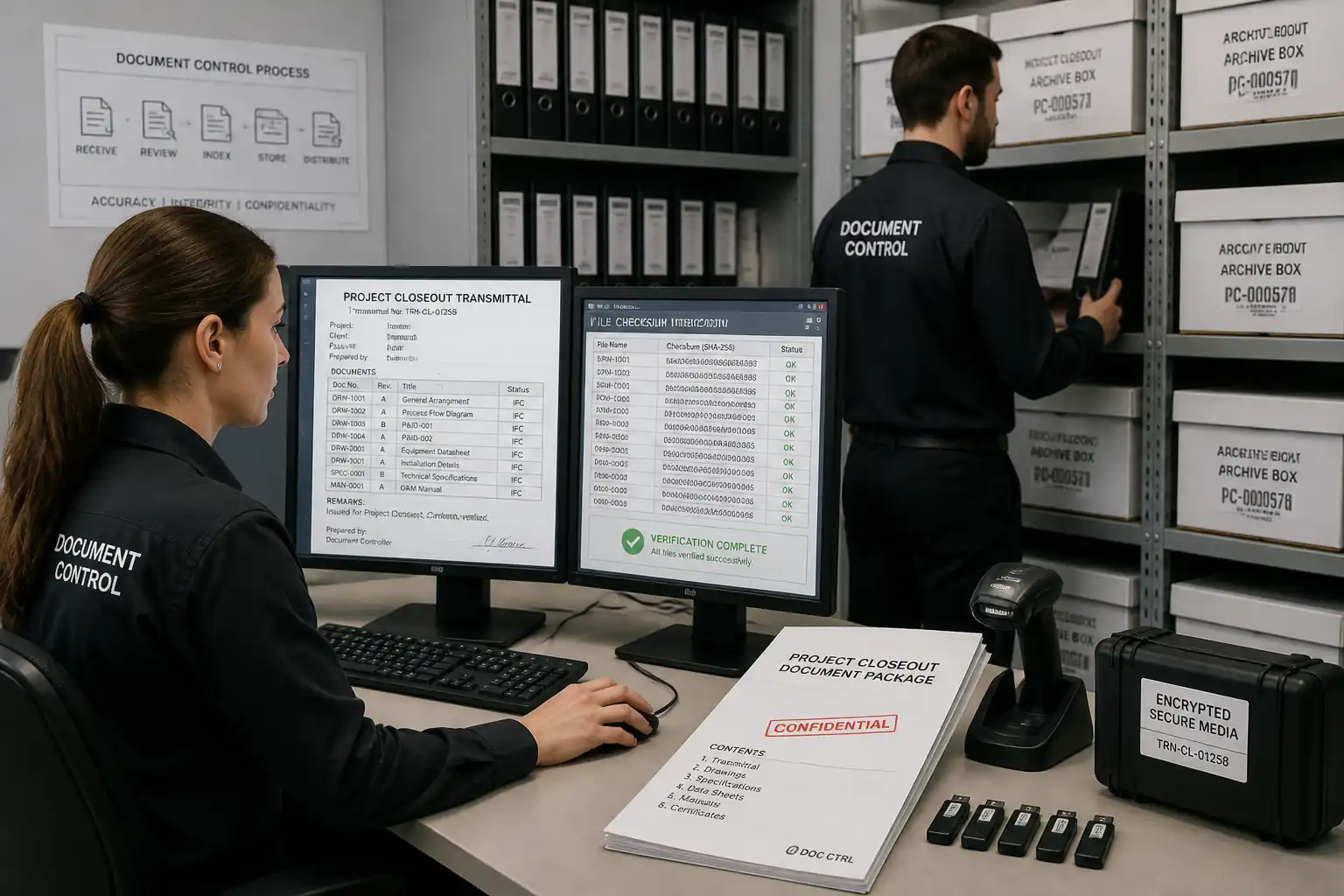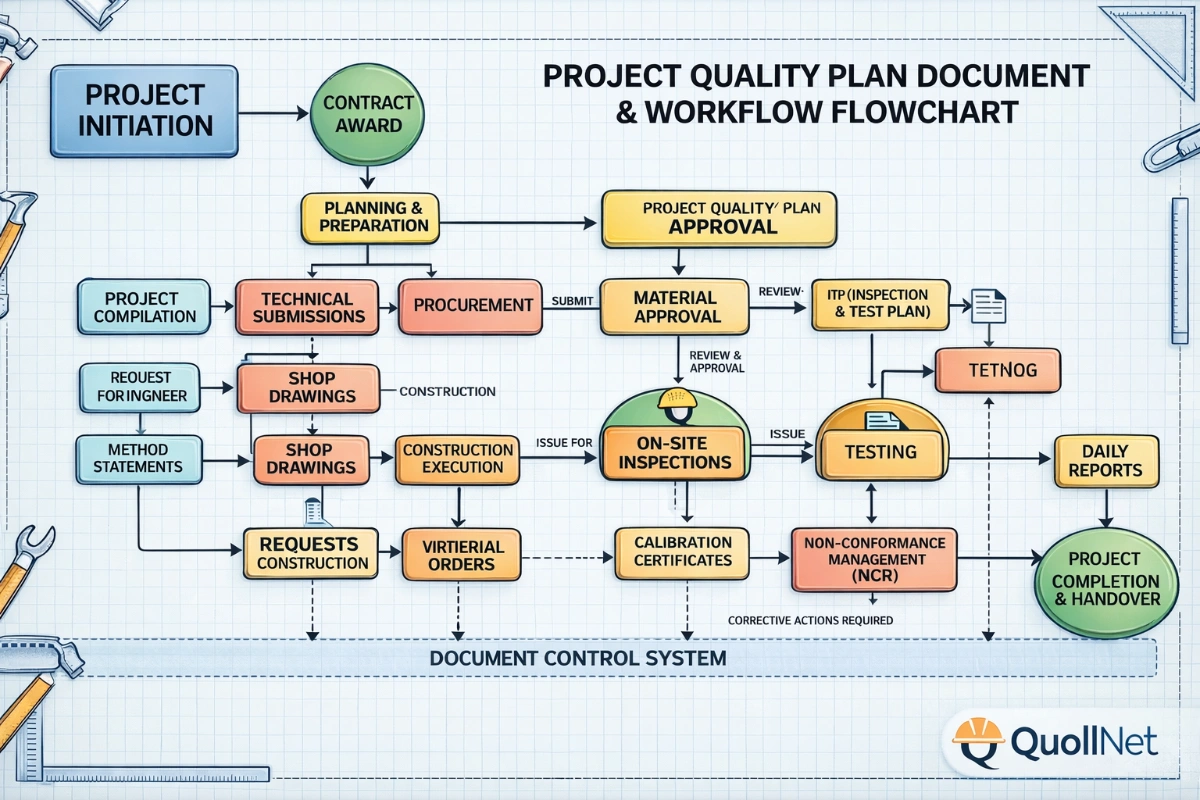

Method Statement: Calibration Certificate Compilation for Project Closeout – Method Statement
AI-assisted method statement with matching ITP, PDF download, and Excel export.
More than a static template
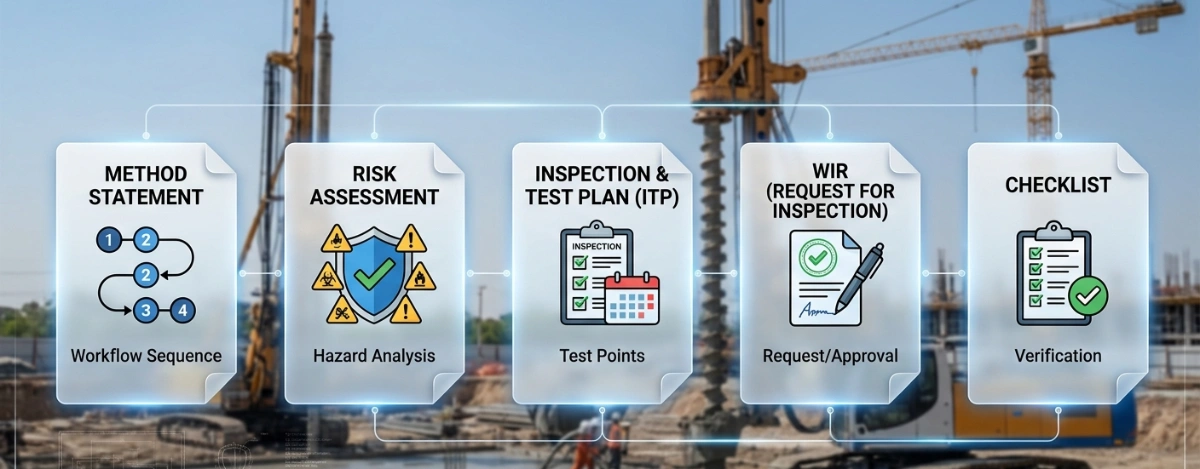
Unlike a downloadable Word or PDF template, this method statement is an AI-assisted editable starting point connected directly to a matching Inspection and Test Plan. Every section is structured, project-adaptable, and ready to export.
- AI-assisted drafting — Customize every section with AI for your specific project scope.
- Linked ITP — A matching inspection and test plan is generated alongside the method statement.
- Multiple export formats — Download as a formatted PDF or editable Excel spreadsheet.
- Editable starting point, not a final document — Review, verify, and adjust all content against your project requirements before use.
Static template vs. Quollnet workflow
| Feature | Static template | Quollnet |
|---|---|---|
| Project-specific content | Manual fill-in required | AI-assisted customization |
| Linked ITP | Separate document, no link | Matching ITP included |
| Export formats | Usually PDF only | PDF and Excel |
| Structured sections | Free-form layout | 13 standardized sections |
| Saved to your account | Local file only | Cloud-saved, reusable |
| Content accuracy | You verify everything | AI-assisted, you still verify |
| Cost | Often free but time-intensive | Free to customize and download |
What you can customize
When you save this method statement to your account, every section becomes editable. The following 13 sections are included:
- Scope — Defines the activity and its boundaries.
- References — Standards, specifications, and drawings.
- Responsibilities — Roles and accountabilities.
- Resources — Labour, plant, and equipment summary.
- Materials — Materials and compliance requirements.
- Equipment — Tools and equipment details.
- Prerequisites — Hold points and pre-conditions.
- Method sequence — Step-by-step construction sequence.
- Safety controls — HSE risk controls and PPE.
- Environmental controls — Environmental mitigation measures.
- QA/QC — Quality inspection and test requirements.
- ITP — Inspection and Test Plan table (has its own page).
- Attachments — Referenced drawings and documentation.
Why this method statement is used
This method statement is used to define and communicate the approved procedure for carrying out method statement: calibration certificate compilation for project closeout on site. It ensures the work is planned in advance, the correct resources and controls are in place, and all personnel understand responsibilities, sequence, quality requirements, and safety controls before work begins. It aligns site execution with the documented scope and acceptance expectations.
Who uses this method statement
This method statement is used by contractors, site supervisors, project engineers, QA/QC engineers, HSE officers, consultants, and client representatives. It serves as a shared reference for planning, execution, supervision, inspection, and approval of the activity on site.
When it is prepared and submitted
The method statement is prepared before the work activity starts and submitted as part of the pre-construction documentation package for review and approval.
Who reviews or approves it
The method statement is usually submitted to the client representative, consultant, resident engineer, or project management consultant for review and approval before the work commences.
Important approval note
This method statement is an AI-assisted editable starting point, not a pre-approved document. Before use on any project, all content must be reviewed and approved by the relevant parties (superintendent, principal contractor, or client representative) in accordance with your contract and project quality plan.
For example: if your specification requires a departure from a referenced standard, that departure must be documented and approved separately — this method statement will not capture that automatically. Always verify against your applicable drawings, specifications, and regulatory requirements.
Method statement content
Scope
Purpose
This method defines the end-to-end process to collect, verify, control, and compile calibration certificates for all measurement and test equipment (M&TE) that influenced inspection and test results on the project, ensuring traceability to national/international standards and compliance with contract closeout requirements.
Scope of Equipment
- All M&TE used to verify product conformity, including but not limited to: multimeters, clamp meters, torque wrenches, pressure gauges, manometers, thermometers/RTDs, data loggers, concrete compression machines, slump cones (dimension checks), rebar cover meters, NDT devices (e.g., ultrasonic testers), total stations/levels, micrometers/calipers, moisture meters, and load cells.
- Exclusions: Non-measuring tools that do not affect acceptance decisions (e.g., hand tools without measurement function) unless required by the project specification.
Outputs
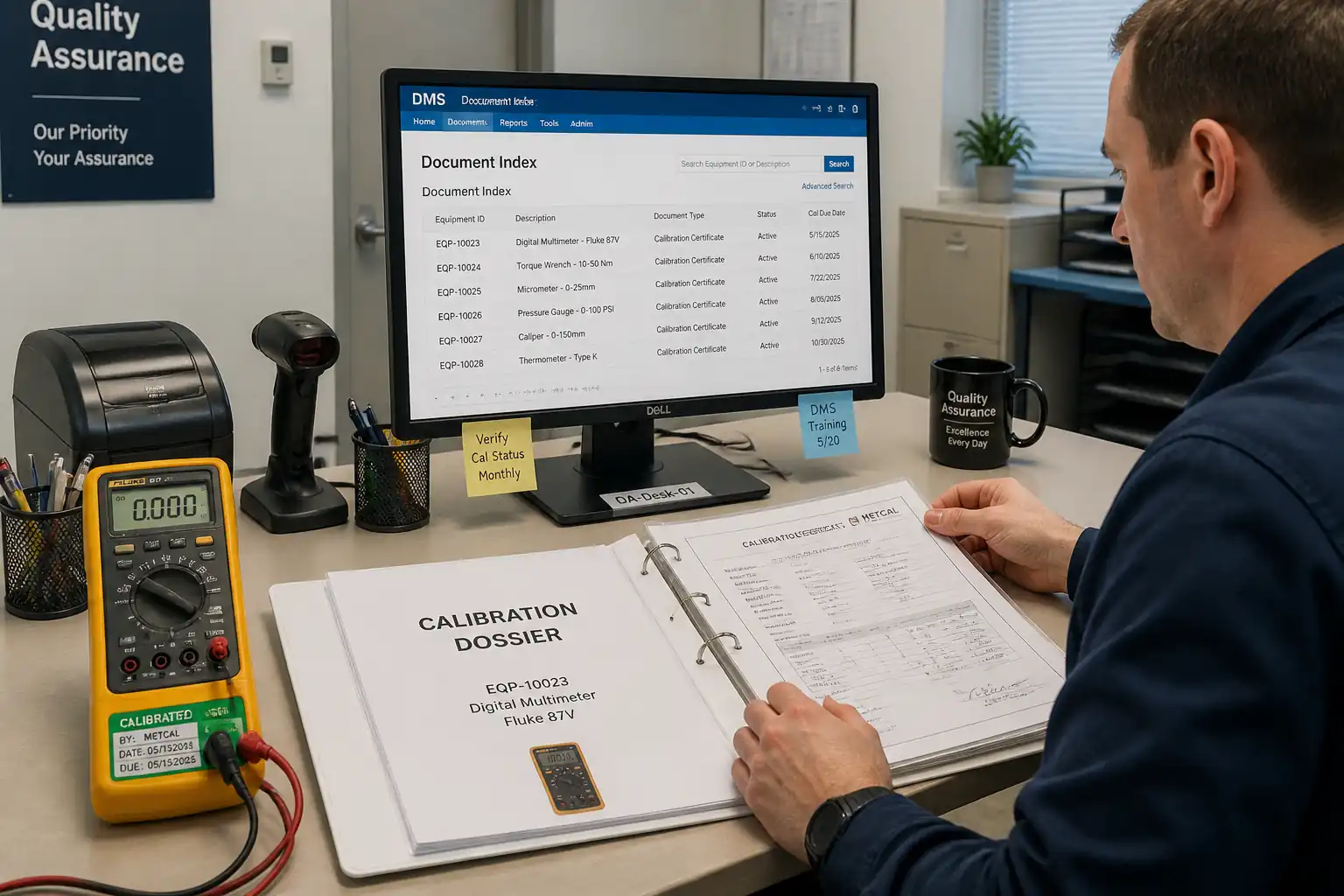
- Final Calibration Dossier: Indexed, searchable compilation of valid calibration certificates and traceability evidence.
- Cross-reference matrix linking each M&TE to ITP/ITR numbers, locations, and dates of use.
- Registers for status control, nonconformance (expired/invalid certificates), and corrective actions.
- Transmittal and approval records for client closeout.
References
| Document Type | Reference / Number | Revision | Notes |
|---|---|---|---|
| ISO/IEC 17025:2017 - General requirements for the competence of testing and calibration laboratories | Calibration certificates issued by accredited labs within accredited scope are preferred/required [Verify per project specifications]. | ||
| ISO 10012 - Measurement management systems — Requirements for measurement processes and measuring equipment | Guidance for measurement process control and equipment management. | ||
| ANSI/NCSL Z540.3 - Requirements for the Calibration of Measuring and Test Equipment | Typical criteria for measurement decision risk and TUR (Test Uncertainty Ratio) [Verify per project specifications]. | ||
| ILAC P10 / P14 - ILAC Policies on Traceability of Measurement Results and Statement of Measurement Uncertainty | Defines traceability evidence and uncertainty statements on certificates. | ||
| ISO 9001:2015 - Quality management systems (Control of monitoring and measuring resources) | Framework for controlling M&TE and records. | ||
| Project Specifications and Employer’s Requirements | Prevail for calibration intervals, lab accreditation requirements, acceptance criteria, and record formats [Verify per project specifications]. | ||
| Applicable national metrology institutes (e.g., NIST, NPL, PTB) | National standards for traceability chain to SI units. |
Responsibilities
| Role | Responsibility | Name / Party |
|---|---|---|
| QA/QC Manager | QA/QC Manager | |
| Calibration Coordinator | Calibration Coordinator | |
| Inspectors | Discipline Inspectors (Civil/MEP/Labs) | |
| Document Controller | Document Controller | |
| ISO/IEC 17025 Lab | Third-Party Accredited Laboratory | |
| Project Manager | Project Manager |
Resources
| Resource Type | Description | Quantity | Remarks |
|---|---|---|---|
| Personnel | 1 FTE [Verify per project scale] | ||
| Personnel | 1–2 [Verify] | ||
| Personnel | 1 [Verify] | ||
| Personnel | As required | For complex uncertainty/TUR assessments. |
Materials / Consumables
| Material | Specification / Grade | Quantity | Remarks |
|---|---|---|---|
| Calibration status labels | Oil/solvent resistant; readable ≥1 year [Verify]. | As required | Printed self-adhesive labels with equipment ID, calibration due date, and QR code. |
| Barcode/RFID tags | Code-128 or QR; RFID UHF optional [Verify]. | As required | Unique IDs/barcodes/RFID tags for equipment traceability. |
Equipment / Tools
| Equipment | Capacity / Type | Quantity | Inspection Required |
|---|---|---|---|
| Document Management System (DMS) | Storage per project scale [Verify]. | 1 | |
| Barcode/QR scanners | 2 | ||
| A4 Color Printer | 1 |
Prerequisites
- Contract requirements and project specifications for calibration intervals, accreditation, and record format obtained and reviewed.
- Master list of all M&TE that influenced ITRs compiled from: tool registers, lab logs, site diaries, and subcontractor submissions.
- DMS configured with controlled folders, metadata fields (Equipment ID, Serial No., Model, Certificate No., Lab, Cal Date, Due Date, Uncertainty, ITP/ITR links), and naming convention approved.
- Access to accreditation directories (ILAC MRA signatories) to verify lab accreditation and scope.
- Agreed color code/labeling standard (e.g., Green: In-cal; Amber: 30-day alert; Red: Out-of-cal) [Verify per project specifications].
- Trained personnel in certificate review, uncertainty basics, and traceability requirements.
- NCR procedure and impact assessment template available for expired/invalid certificates.
- Client/Engineer submission templates and transmittal workflows confirmed.
Method Sequence
| Step | Activity | Description | Responsibility | Inspection / Hold Point |
|---|---|---|---|---|
| 1 | Establish M&TE Master Register | Compile unique list of all M&TE that influenced acceptance decisions. Capture fields: Equipment ID, Description, Make/Model, Serial No., Range/Resolution, Location, Owner, Lab, Certificate No., Calibration Date, Due Date, Uncertainty (if stated), Status. | Calibration Coordinator | Internal QA review of completeness |
| 2 | Identify and Label Equipment | Affix durable identification and calibration status labels with Equipment ID and due date; update QR/Barcode linking to certificate in DMS. | Discipline Inspectors | Spot checks 10% or min 10 units [Verify] |
| 3 | Collect Calibration Certificates | Obtain latest certificates from accredited labs or OEMs; request missing data if incomplete. Ensure electronic PDFs are text-searchable; obtain hardcopies only if contractually required. | Calibration Coordinator | Administrative check |
| 4 | Validate Accreditation and Scope | Verify lab accreditation status and that the measurement parameter and range fall within the accredited scope at time of calibration. | QA/QC Engineer | Accreditation directory check (ILAC) |
| 5 | Check Validity Window vs. Use Dates | Compare calibration validity window to each ITR date where the equipment was used. | Calibration Coordinator | 100% desk review |
| 6 | Assess Measurement Uncertainty / TUR | Where decision tolerances are tight, confirm uncertainty or Test Uncertainty Ratio (TUR). | QA/QC Engineer | Engineering check |
| 7 | Cross-Reference to ITP/ITR | Link each equipment ID to specific ITP items and ITR numbers where used; include date, location, lot/element, and inspector signature or initials. | Discipline Inspectors | QA spot audit 10% or min 10 ITRs [Verify] |
| 8 | Expired/Invalid Certificate Control | If out-of-cal use is detected: quarantine equipment; raise NCR; conduct impact assessment of affected ITRs considering as-found data, drift, uncertainty, and tolerance; determine need for re-test/rework or retrospective validation; obtain Client disposition. | QA/QC Manager | NCR review and approval |
| 9 | Indexing and Naming | Apply controlled file naming: |
Document Controller | Administrative check |
| 10 | Internal QA/QC Review | Independent review by QA/QC not involved in compilation; sample audit of certificates and cross-references. | QA/QC Manager | Independent review |
| 11 | Client/Engineer Submission | Prepare transmittal with table of contents, executive summary, declarations of compliance, and indexes. Submit via contract DMS. Address comments and re-submit until approved. | QA/QC Manager & Document Controller | Submission tracking |
| 12 | Archive and Handover | Archive native certificates and binder in project archive; set retention per contract/local law; handover soft/hard copies as specified. | Document Controller | Closeout audit |
Health & Safety Controls
Activity-Specific Hazards and Controls
- Hazard: Manual handling of files, boxes, and equipment during verification.
- Likely consequence: Musculoskeletal strain, dropped items injuring feet.
- Engineering/procedural control: Use trolleys; limit box weight to ≤15 kg [Verify per project HSE plan]; train on safe lifting.
- Required PPE: Safety shoes when handling equipment; gloves for sharp-edged cases.
- Collective measure: Plan handling routes; keep aisles clear; store heavier items at waist height.
-
Inspection/permit/supervision: Office/warehouse housekeeping inspections weekly; supervisor briefings.
-
Hazard: Battery leakage or short-circuit from stored M&TE during ID check.
- Likely consequence: Chemical burns, fire, equipment damage.
- Engineering/procedural control: Inspect batteries; use insulated covers; segregate damaged units; follow OEM disposal.
- Required PPE: Nitrile gloves, safety glasses.
- Collective measure: Fire-rated battery waste container; spill kit available.
-
Inspection/permit/supervision: Periodic EHS inspection; waste records per local regulations [Verify per project HSE plan and local regulations].
-
Hazard: Electrical shock from powered test benches or chargers.
- Likely consequence: Electric shock, burns.
- Engineering/procedural control: PAT-tested power strips; RCD-protected outlets; no live calibration at office; de-energize before inspection.
- Required PPE: Dry gloves where appropriate; avoid conductive jewelry.
- Collective measure: Lock-out of defective outlets; signage.
-
Inspection/permit/supervision: PAT tags in date; office EHS checks quarterly.
-
Hazard: Driving to/from calibration labs or storage facilities.
- Likely consequence: Road traffic accident.
- Engineering/procedural control: Journey management; avoid peak hours; use approved couriers for equipment transport when possible.
- Required PPE: Seat belts; high-visibility vest when loading/unloading.
- Collective measure: Defensive driving policy; vehicle inspection checklist.
-
Inspection/permit/supervision: Driver authorization and license check; vehicle maintenance logs.
-
Hazard: Data protection and confidentiality breaches in DMS.
- Likely consequence: Contractual breach, legal exposure.
- Engineering/procedural control: Role-based access; encryption at rest and in transit; avoid emailing uncontrolled copies.
- Required PPE: Not applicable.
- Collective measure: Multi-factor authentication; audit logs enabled.
-
Inspection/permit/supervision: IT security audits; permissions review monthly.
-
Hazard: Office ergonomics (extended desk work).
- Likely consequence: Repetitive strain, eye fatigue.
- Engineering/procedural control: Ergonomic seating, monitor at eye level, 20-20-20 rule, task rotation.
- Required PPE: Not applicable.
- Collective measure: Ergonomic assessments for workstations.
-
Inspection/permit/supervision: HSE ergonomic checklist for staff.
-
Hazard: Paper cuts and dust from archived documents.
- Likely consequence: Minor injuries, irritation.
- Engineering/procedural control: Use document lifters; wipe shelves; minimize paper by digital methods.
- Required PPE: Light gloves if handling bulk files.
- Collective measure: HEPA vacuum for archive room as needed.
- Inspection/permit/supervision: Housekeeping and air quality checks [Verify per project HSE plan].
Environmental Controls
- Paper use minimization via digital certificates; print only where contractually required. Duplex printing by default.
- E-waste management: Segregate and dispose of damaged electronics and batteries via licensed recyclers; maintain waste transfer notes [Verify per local regulations].
- Transport optimization: Batch deliveries/collections to labs; prefer local accredited labs to reduce emissions.
- Energy efficiency: Power management on IT equipment; shut down scanners/printers after hours.
- Spill prevention: Store printer toners and cleaning solvents in secondary containment; keep spill kits accessible.
- Noise control: Limit shredding/scanning during office quiet hours; maintain equipment to reduce noise and dust.
Quality Assurance / Quality Control
Controls
- Documented procedure and approved templates for registers, traceability matrix, and checklists.
- Two-level review: Preparer (Calibration Coordinator) and independent reviewer (QA/QC Engineer or Manager).
- Sampling for independent verification: minimum 10% of certificates or 10 items, whichever is greater [Verify per project specifications].
- Metadata validation: automated DMS checks for mandatory fields and date logic (calibration date < due date; due date ≥ ITR date).
- Nonconformance management: NCR raised for any out-of-calibration use; assess impact; obtain Client disposition before closeout.
- Change control: Superseded certificates clearly marked; only current revisions in the active folder; version history retained.
- Traceability: Each certificate must link to the equipment ID and the ITR(s) influenced; hyperlinks/bookmarks maintained in final PDF binder.
- Records retention: Maintain per contract or not less than 10 years [Verify per project specifications/local law].
Attachments / Appendices
- Template: M&TE Master Register (fields and data validation rules).
- Template: Calibration Certificate Review Checklist (per ISO/IEC 17025 and ILAC P14/P10).
- Template: Traceability Matrix linking Equipment ID to ITP/ITR and dates.
- Template: NCR and Impact Assessment for Out-of-Calibration Use.
- Naming Convention Guide and Metadata Field Definitions.
- Sample: Final Calibration Dossier Table of Contents and Executive Summary.
- Example: Accreditation verification screenshot and record form.
- Example: Color-coded label standard and placement guide.
This content is a read-only public reference. Download or customize to get an editable version.
ITP preview
The first inspection activities from the linked ITP for Method Statement: Calibration Certificate Compilation for Project Closeout:
| Activity | Inspection / Test | Acceptance Criteria | Responsibility | Record |
|---|---|---|---|---|
| M&TE Master Register Preparation | Document review for completeness and unique IDs | 100% of M&TE used on ITRs listed with unique ID and serial numbers; no duplicates. | Calibration Coordinator | M&TE Register (approved) |
| Certificate Collection and Content Verification | Check certificate fields per ISO/IEC 17025 and ILAC policies | Certificates include identification, dates, uncertainty, traceability statement, accreditation details, results, signatures. | QA/QC Engineer | Certificate review checklist; Certificates (PDF) |
| Accreditation and Scope Validation | Verify lab accreditation validity and scope coverage | Accreditation valid on calibration date; parameter/range covered by scope. | QA/QC Engineer | Accreditation log (screenshots/links) |
Showing 3 of 10 inspection activities. View full ITP →
Related Inspection and Test Plan
An Inspection and Test Plan (ITP) is available for Method Statement: Calibration Certificate Compilation for Project Closeout. The ITP defines the inspection activities, acceptance criteria, hold and witness points, responsible parties, and records required to verify the work described in this method statement.
View the Method Statement: Calibration Certificate Compilation for Project Closeout ITP →Frequently asked questions
Continue with related Quollnet resources connected to this method statement.