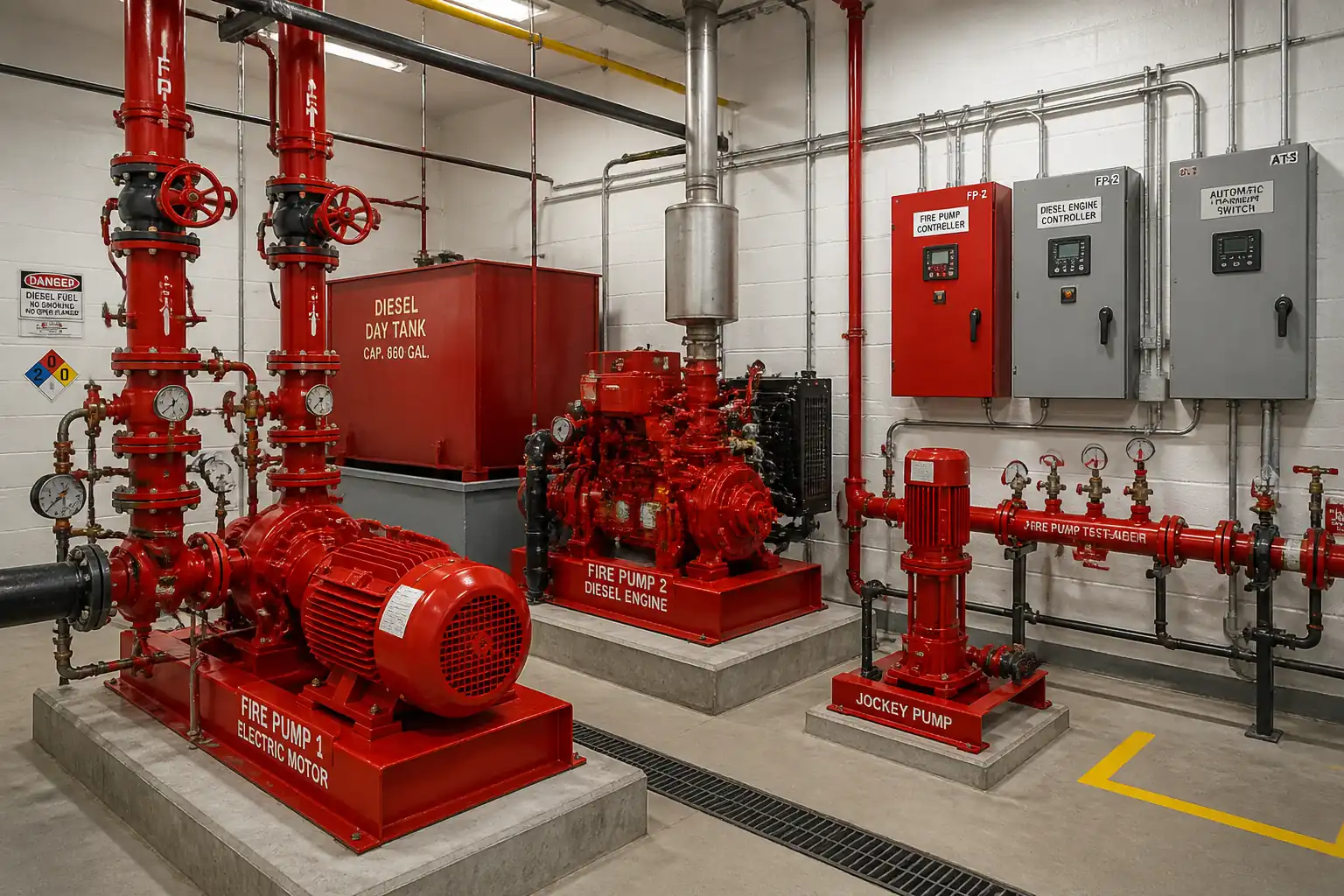

Inspection and Test Plan for Method Statement: Installation and Commissioning of Electric/Diesel Fire Pump and Jockey Pump System
AI-assisted inspection and test plan connected to a method statement, with PDF and Excel export.
More than a static template
Unlike a downloadable Word or PDF template, this ITP is an AI-assisted editable starting point directly connected to its method statement. Every inspection activity, hold point, and acceptance criterion is structured and ready to adapt to your project.
- AI-assisted customization — Tailor inspection activities and acceptance criteria to your specific project scope.
- Linked method statement — This ITP is connected to the corresponding method statement describing the work sequence.
- Multiple export formats — Download as a formatted PDF or editable Excel spreadsheet.
- Editable starting point, not a final document — Review and verify all content against your project specifications and standards before use.
What you can customize
When you save this ITP to your account, every inspection row becomes editable. You can add, remove, or modify:
- Inspection activity — Description of what is being inspected.
- Inspection type — Hold point (H), Witness point (W), Review (R), or Monitor (M).
- Responsibility — Contractor, subcontractor, engineer, or client.
- Frequency — How often the inspection occurs.
- Acceptance criteria — Referenced standard or specification requirement.
- Records — Forms, test reports, or checklists required as evidence.
Why this ITP is used
To control and verify quality at critical stages ensuring compliance with NFPA 20 and project specifications.
Who uses this inspection and test plan
Contractor QA/QC, commissioning team, vendor representatives, and the Consultant/AHJ for witnessing and approvals.
When this ITP is prepared and submitted
From material receipt through foundation, piping/electrical works, pre-commissioning, and final acceptance flow testing.
Who receives or approves this ITP
Consultant/Engineer and AHJ as required.
Inspection scope
Material verification, foundations, base/grout, alignment, piping fit-up, hydrostatic testing, electrical pre-energization, driver dry-run, operational checks, and performance testing.
Typical hold, witness, and review points
Foundation/anchors (Hold), base pre/post-grout (Hold/Witness), initial and final alignment (Hold), hydrotest (Hold), electrical pre-energization (Hold), driver dry-run (Hold), acceptance flow test (Hold).
Typical inspection records
MIRs, calibration certificates, survey and grout reports, alignment reports, hydrotest certificates, electrical test reports, dry-run and operational checklists, performance test reports with curve overlays.
Important approval note
This ITP is an AI-assisted editable starting point, not a pre-approved document. Before use on any project, all inspection activities, hold points, and acceptance criteria must be reviewed and approved by the relevant parties (superintendent, principal contractor, or client representative) in accordance with your contract and project quality plan.
Always verify acceptance criteria against your applicable drawings, specifications, and regulatory requirements. Hold points must be confirmed with the relevant authority before work proceeds past that point.
Inspection and test plan
| Activity | Inspection / Test | Acceptance Criteria | Responsibility | Record |
|---|---|---|---|---|
| Material receipt and verification | Certificates, UL/FM listings, curves | Conformity to approved submittals; no damage | QA/QC Engineer | MIR; Certificates; Photos |
| Foundation level and anchors inspection (Hold) | Survey level/position | Flatness ≤2 mm/1 m; anchors within tolerance | Site Engineer + QA/QC + Consultant | Survey Report; ITP Checklist |
| Base frame setting and pre-grout inspection (Hold) | Level check; shim locations | Levelness ≤0.2 mm/m; grout gap 25–50 mm | QA/QC + Consultant | Pre-Grout Inspection |
| Grout pour and post-cure inspection (Witness) | Visual; strength tests if specified | Full bearing; no voids; strength per spec | QA/QC | Grout Records |
| Initial alignment (Hold) | Laser/dial readings; soft foot | Within OEM/HI tolerances | Mechanical Supervisor + Vendor Rep + Consultant | Alignment Record (Initial) |
| Piping fit-up and supports | Flange alignment; nozzle strain | Zero pipe strain; correct reducer orientation | QA/QC | Piping Inspection Report |
| Hydrostatic pressure test (Hold) | Hydrotest at specified pressure/time | No leaks; pressure drop ≤5 psi | QA/QC + Consultant | Hydrotest Certificate |
| Electrical pre-energization (Hold) | IR, continuity, torque, phase rotation | IR ≥1 MΩ [Verify]; torque per OEM; correct rotation | Electrical Supervisor + QA/QC | Electrical Test Reports |
| Driver dry-run uncoupled (Hold) | Motor run/engine run; vibration; rotation | Correct rotation; vibration within ISO limit; no alarms | Commissioning Engineer + Vendor Rep + Consultant | Dry-Run Report |
| Final alignment before guarding (Hold) | Laser/dial readings | Within OEM/HI tolerances; bolts torqued | Mechanical Supervisor + Vendor Rep + Consultant | Alignment Record (Final) |
| Operational checks (Witness) | Pressures; leaks; controller logic | Stable operation; no leaks | Commissioning Engineer | Operational Checklist |
| Acceptance flow test and curve verification (Hold) | Flows at churn/100%/150%; pressure and curve overlay | Meets NFPA 20 performance tolerances; documentation complete | Commissioning Engineer + Third Party + Vendor Rep + Consultant | Performance Test Report; Curve Overlay; Calibration Certs |
This table is a read-only public reference. Download the PDF or Excel version, or customize this ITP to edit it for your project.
Frequently asked questions
Related method statement
This Inspection and Test Plan is associated with the Method Statement: Installation and Commissioning of Electric/Diesel Fire Pump and Jockey Pump System method statement, which describes the step-by-step construction sequence, resources, materials, equipment, safety controls, and environmental controls for this activity.
View the Method Statement: Installation and Commissioning of Electric/Diesel Fire Pump and Jockey Pump System method statement →