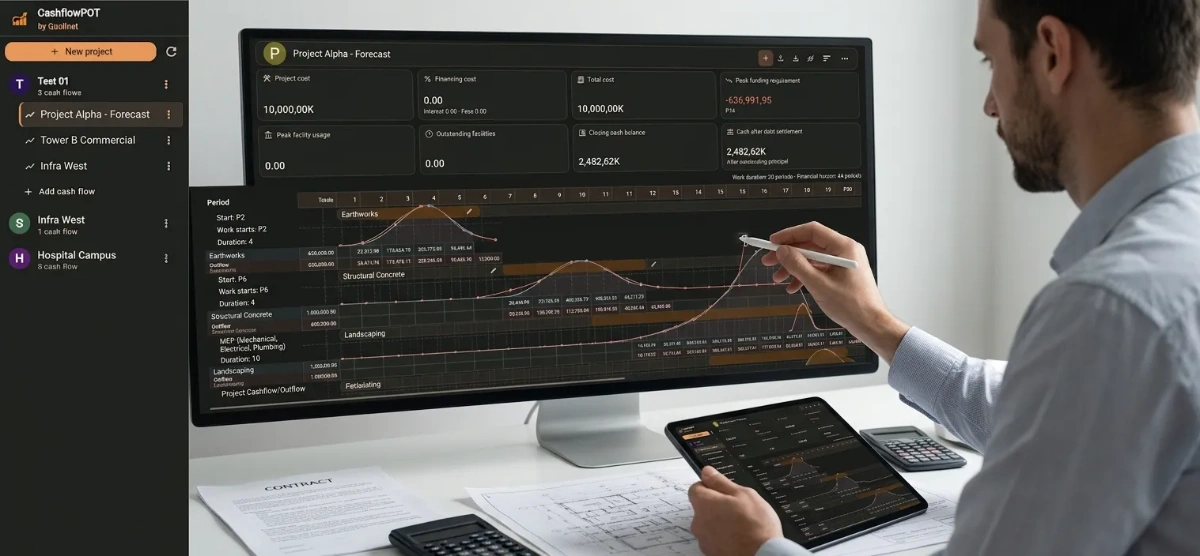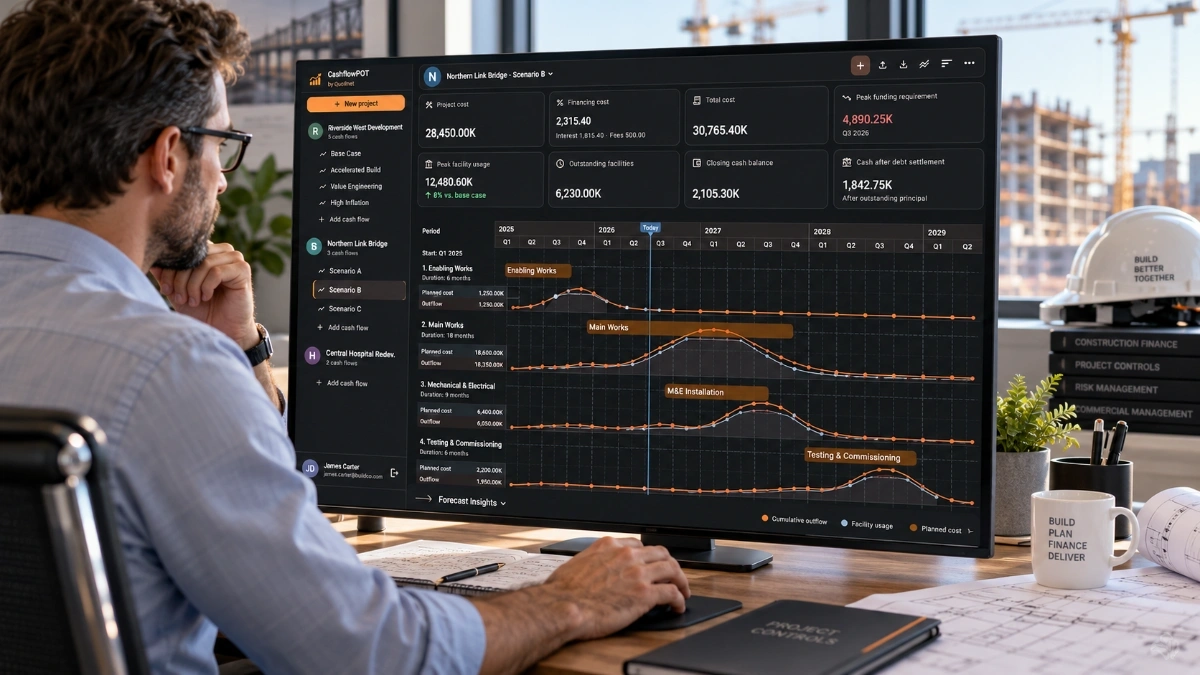
How to Build and Test a Construction Project Cash Flow in CashflowPot
This CashflowPot tutorial shows how to build a construction project cash-flow forecast from activities, contract terms, subcontract assumptions and financing facilities, then compare scenarios to identify the peak funding requirement and the commercial terms that materially change the project's cash position.
CashflowPot is designed for construction financial planning rather than detailed CPM scheduling. The basic workflow is: define the project and its activities, forecast project outflow, model client inflow, review the pre-financing cash position, add funding facilities where needed, and compare scenarios before making a tender, contract or financing decision. For the underlying financial logic, see How to Create a Construction Project Cash Flow: a Practical Guide for Contractors.
Important: CashflowPot does not require every project to be broken into thousands of planning activities. The financial model needs enough activity, cost, timing and commercial detail to represent the cash drivers that matter to the decision being tested.
1. Start With a Practical Project Activity Model
A CashflowPot scenario starts with the major project activities that drive cost and cash timing. A contractor might model preliminaries, substructure, superstructure, major equipment purchases, MEP, facade and finishes, testing and handover, and other financially material work packages.
The activity structure does not need to duplicate the full planning programme. If you already use a formal Work Breakdown Structure (WBS), it can help identify the major deliverables and work packages that should become forecast activities.
SCREEN 01 — PROJECT ACTIVITIES
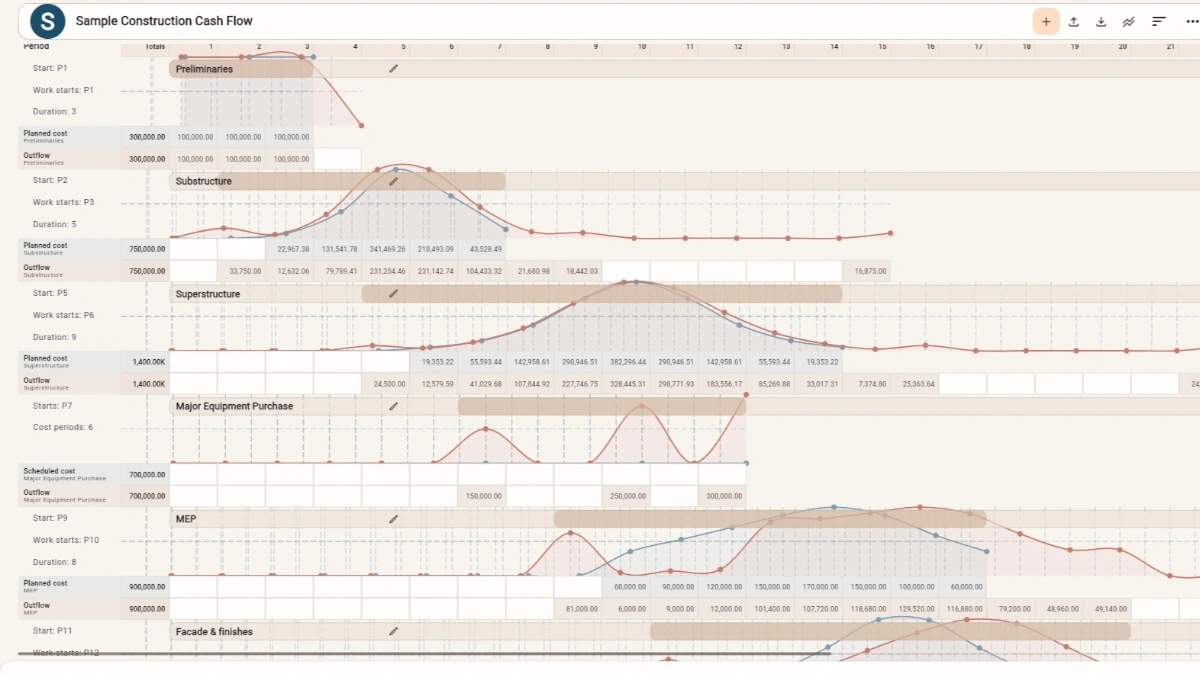
Work activities and scheduled costs solve different problems
For a normal construction activity, CashflowPot can distribute the estimated activity cost over its duration using a work profile. This is useful when the exact period-by-period cost is not yet known and must be forecast from the nature of the work.
Where the timing is already known, use a scheduled cost instead. A major equipment package, for example, may have known payment events such as a deposit, manufacturing milestone and delivery payment. In that case, entering the known schedule is more appropriate than forcing the cost into an S-curve.
If you need to decide whether an activity should be linear, balanced, front-loaded, back-loaded or manually shaped, the companion article Construction Cash Flow Prediction: How to Forecast Activity Cost and Billing Curves explains how activity type, procurement, inspection, billability and WIEB affect the forecast.
2. Define How Each Activity Creates Cost
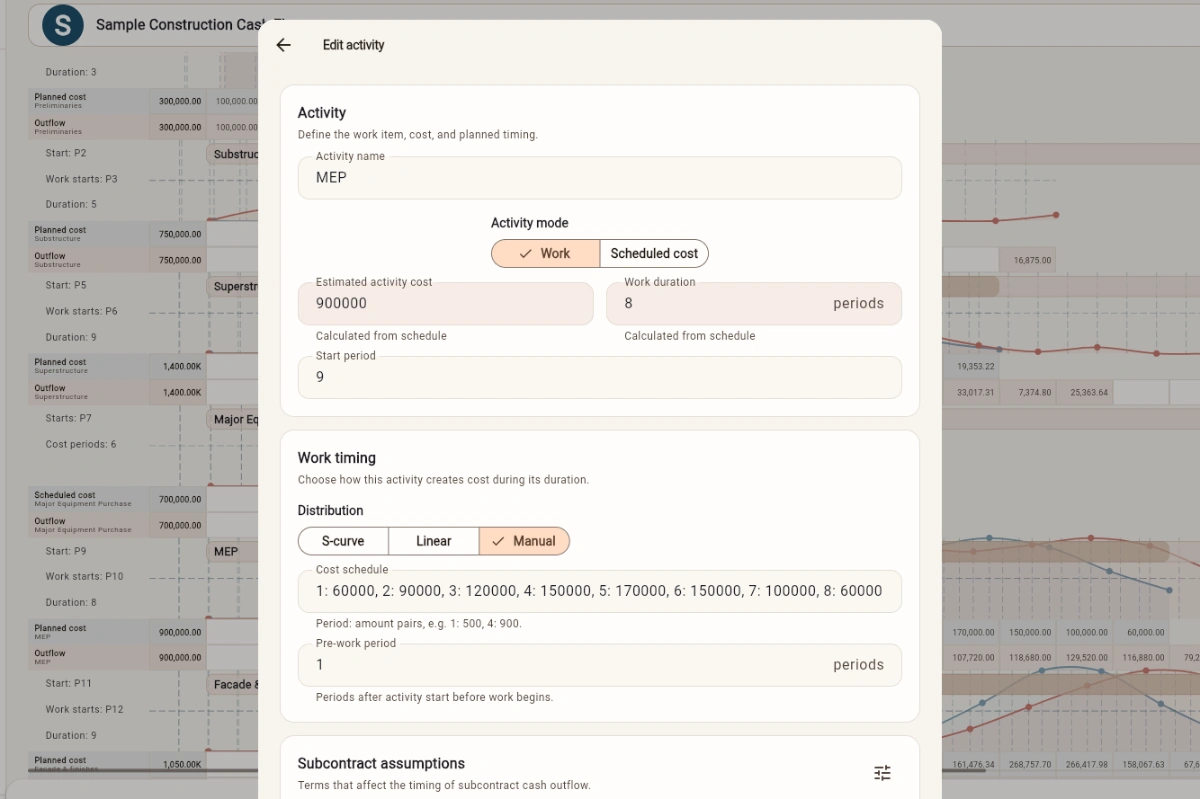
Each work activity needs three basic inputs: estimated cost, timing and a distribution assumption. The objective is not to create a perfect planning programme; it is to create a financially credible time distribution of project expenditure.
SCREEN 02 — ACTIVITY COST PROFILE
SCREEN 03 — SUBCONTRACT ASSUMPTIONS
In the example, MEP is modelled with a manual distribution because the cost is not expected to occur evenly. Early project time may be dominated by submittals, coordination, procurement and embedments; major installation expenditure occurs later. CashflowPot lets the engineer model that expected pattern instead of assuming every activity is linear.
Subcontract terms modify the activity outflow
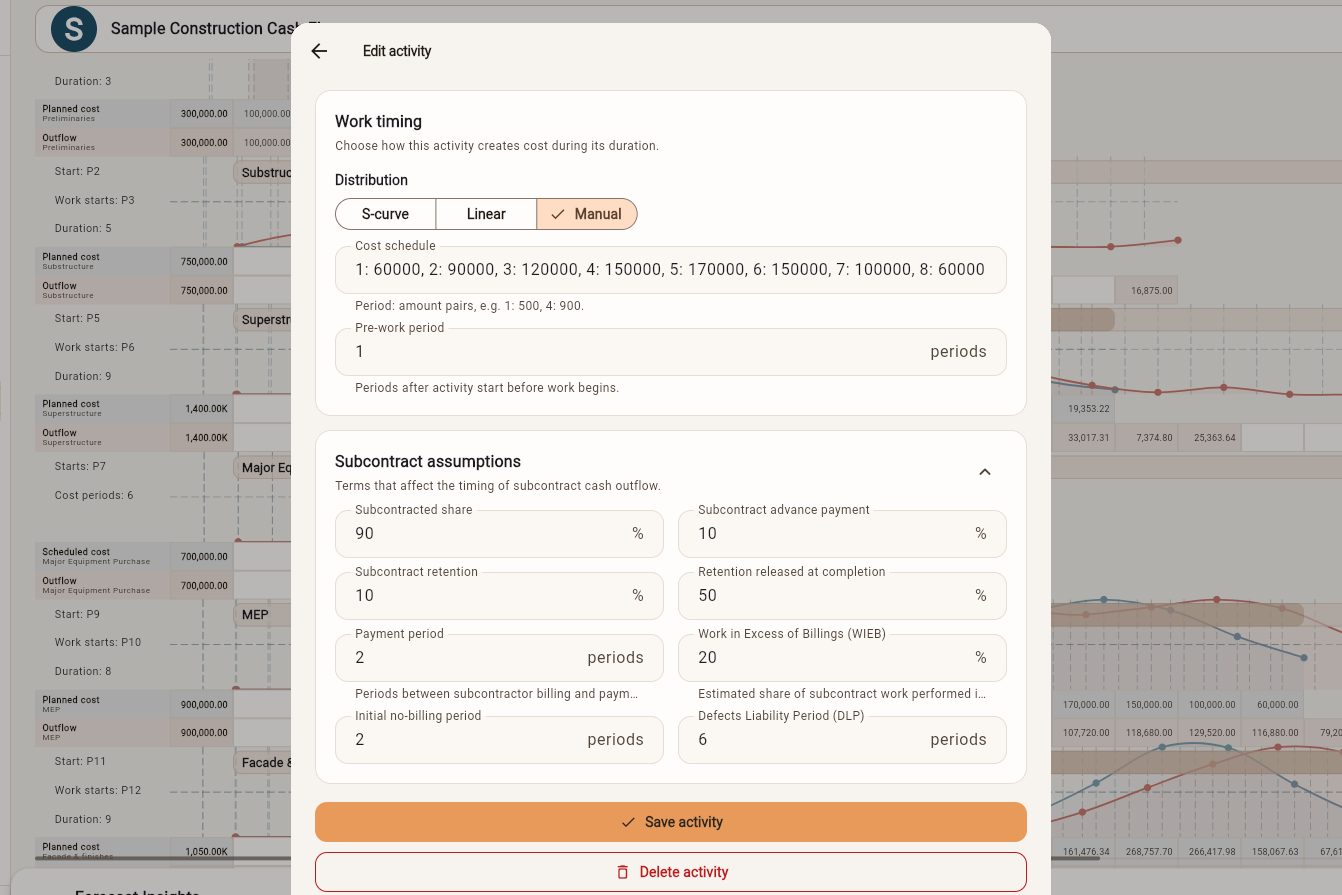
When an activity is subcontracted, its physical or planned work curve is not automatically the contractor's cash-outflow curve. Commercial terms change when the contractor actually pays. Useful activity-level assumptions include:
- Subcontracted share: the portion of the activity cost paid through the subcontract.
- Subcontract advance: cash paid before corresponding work is completed.
- Retention: the portion withheld and released later.
- Payment period: the delay between subcontract billing and payment.
- Work in Excess of Billings (WIEB): work performed but not yet billable under the subcontract's measurement, inspection or billing rules.
- Initial no-billing period: useful where early engineering, procurement or mobilization work cannot yet be invoiced.
- Defects Liability Period (DLP): relevant where retention or final payments extend beyond physical completion.
For detailed treatment of retention mechanics, see Retention in Construction: Formulas, Bonds & Accounting Guide. Advance-payment mechanics are covered separately in Advance Payment in Construction Contracts.
3. Model Client Inflow Separately From Project Outflow
The contractor's project cost curve and the client's payment curve are different financial objects. Project outflow is driven by how and when the contractor pays for work. Client inflow is driven by the main contract: how value is earned, billed, certified, retained and eventually paid.
CashflowPot therefore lets the scenario carry its own contract-value and inflow assumptions. Depending on the model, client inflow may be forecast independently from the activity outflow or linked more directly to project activity progression.
SCREEN 04 — CLIENT AND SCENARIO ASSUMPTIONS
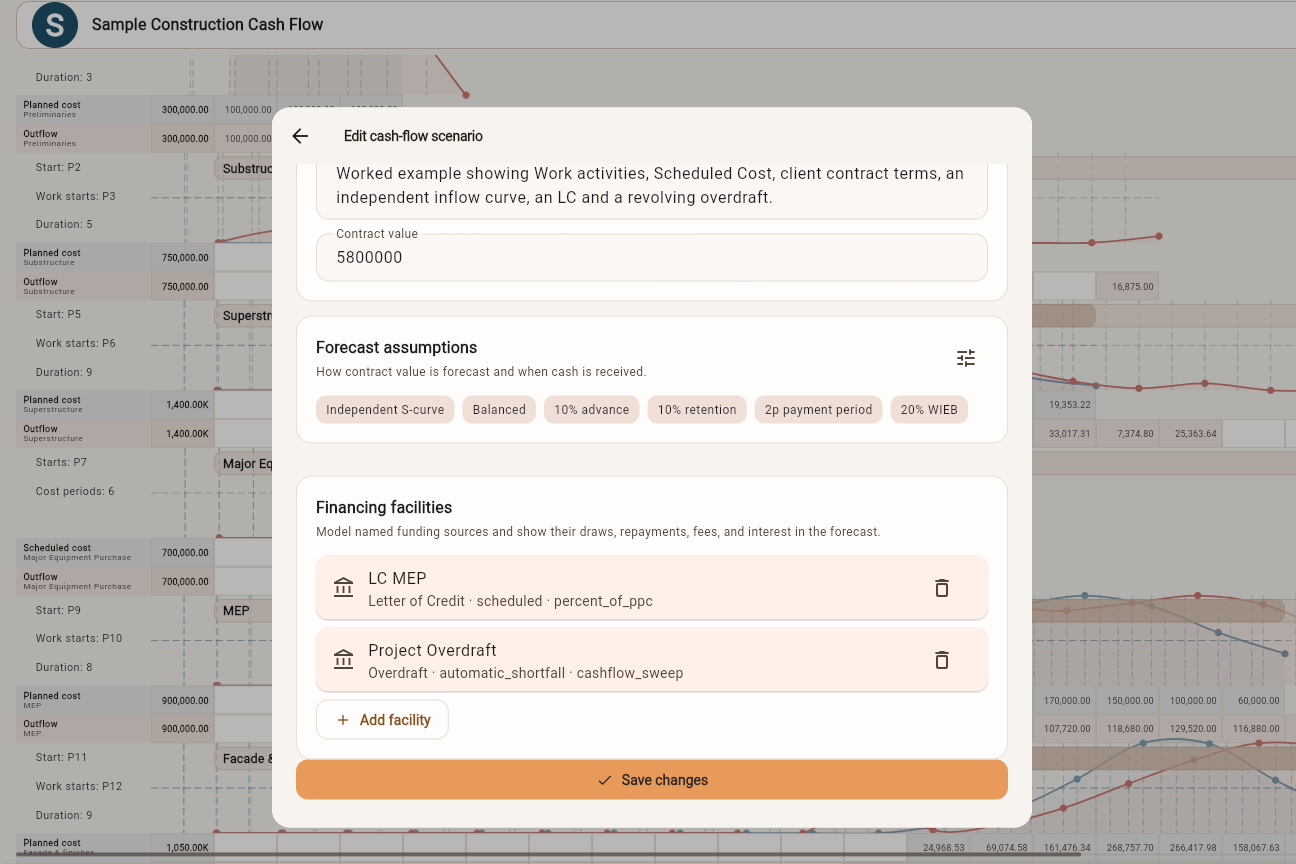
The main assumptions shown in the example are a contract value of 5.8 million, a 10% advance, 10% retention, a two-period payment delay and 20% WIEB. These are not universal values; they are scenario inputs that should reflect the actual tender or contract being evaluated.
WIEB should not be treated as one arbitrary percentage for every activity. Inspection requirements, WIR acceptance, measurement rules, billing cut-off dates, materials-on-site provisions and activity duration can all change how much completed work remains unbilled. The cash-flow prediction article explains how to estimate this more realistically.
4. Read the Project Cash Position Before Adding Financing
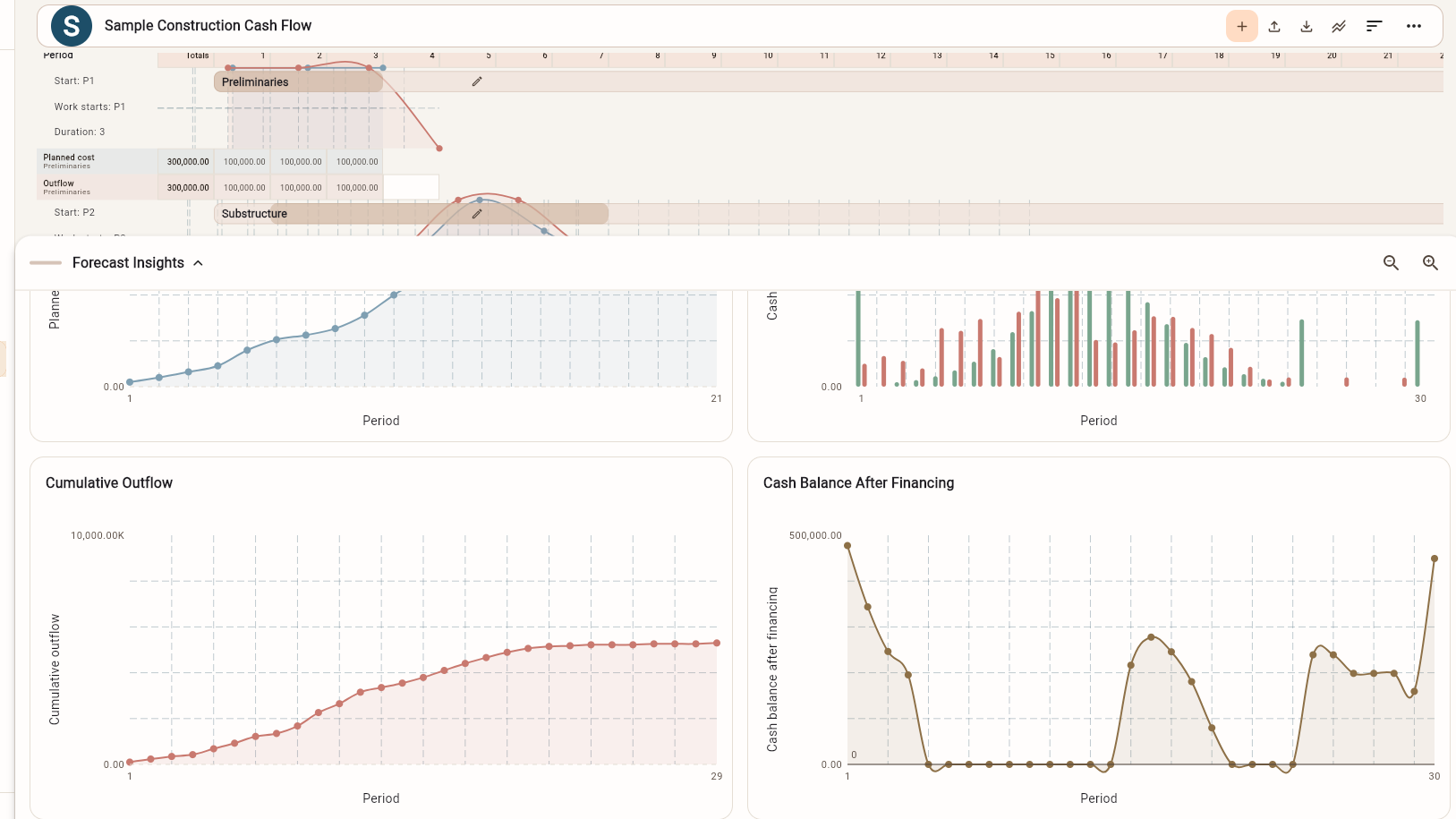
Once activity outflow and client inflow are calculated on the same time scale, CashflowPot can show the project's net cash movement and cumulative cash position. This is where the forecast becomes useful for working-capital planning.
SCREEN 05 — PROJECT CASH FLOW, FACILITIES AND CASH POSITION
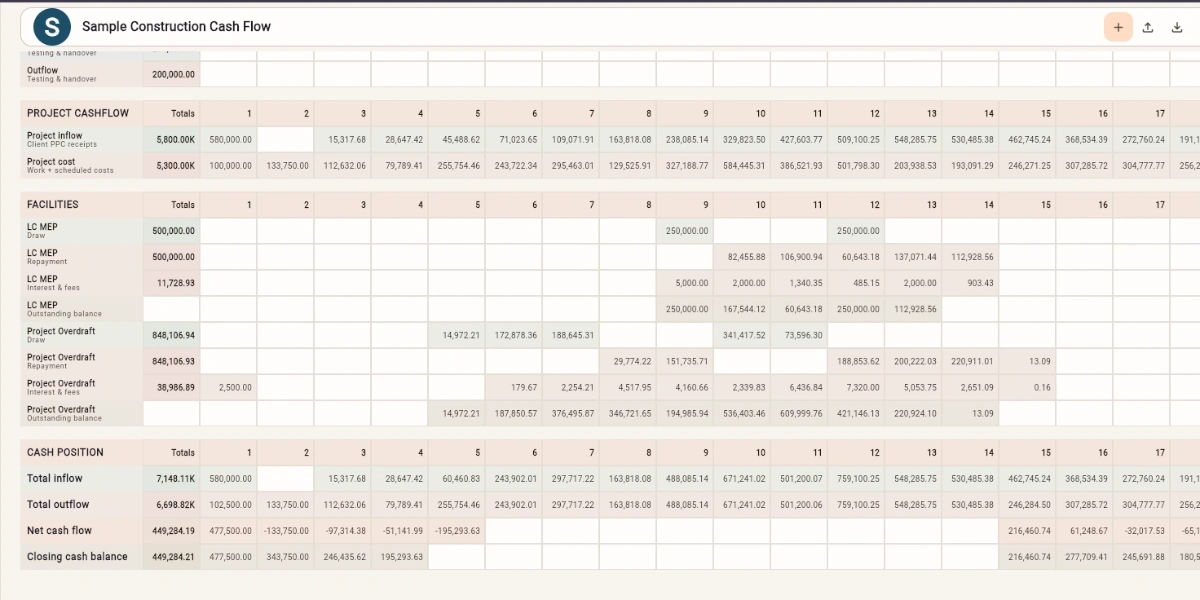
The table is intentionally divided into three financial layers:
- Project cash flow: client receipts versus project cost before financing.
- Facilities: financing draws, repayments, interest and fees.
- Cash position: total inflow, total outflow, net cash flow and the resulting closing balance.
The most important pre-financing number is the peak funding requirement: the maximum temporary funding gap created by the project's operating cash cycle before financing is layered onto the model. That number gives the contractor a practical starting point for evaluating working-capital needs and facility limits.
SCREEN 06 — FORECAST INSIGHTS
5. Add Financing Only After the Funding Gap Is Understood
Financing should be added after the underlying project cash flow has been calculated. Otherwise it becomes difficult to distinguish the project's own cash requirement from the effect of the funding structure.
CashflowPot can model named financing facilities with their own draw and repayment behavior. Depending on the scenario, these may include overdrafts, payment-certificate discounting, letters of credit, working-capital loans, equipment loans, owner contributions or other custom facilities.
SCREEN 07 — FINANCING FACILITY
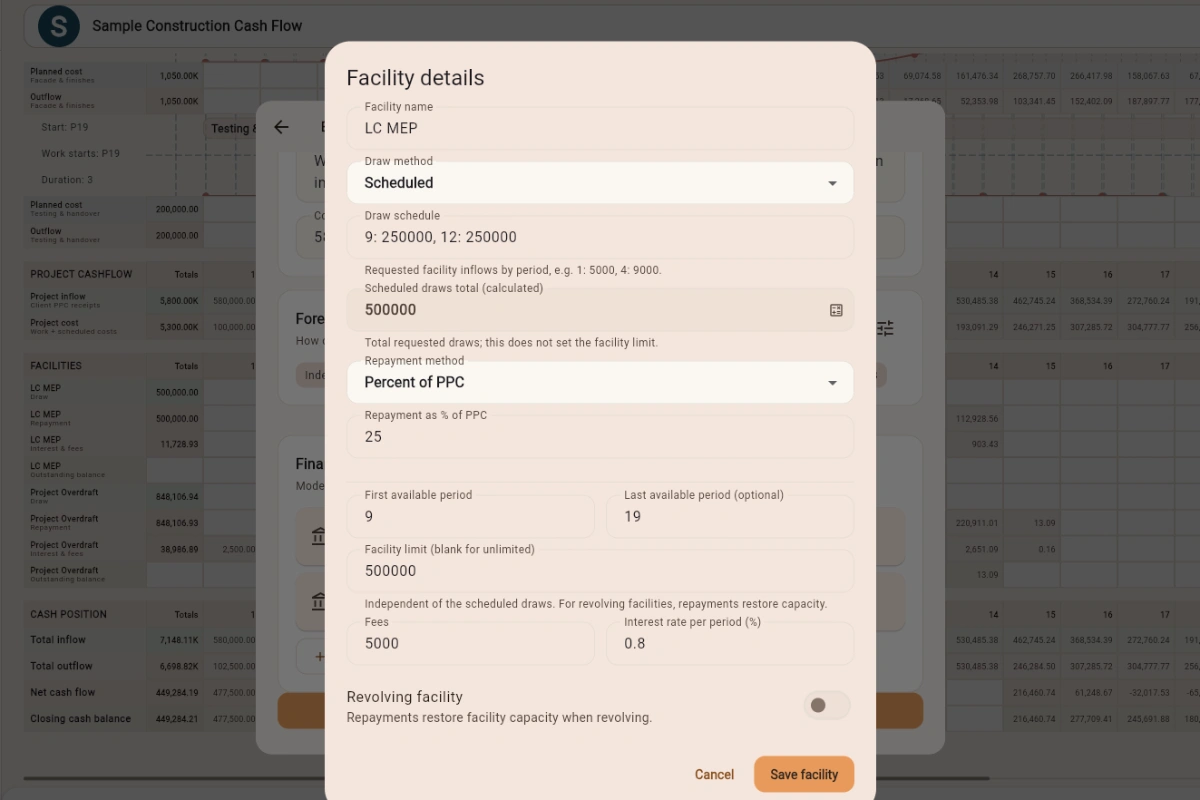
In the example, the LC has scheduled draws and a repayment rule based on a percentage of client payment certificates. The model can then show facility usage, repayment, interest and fees alongside the project cash position. A revolving overdraft can be used differently, for example by covering shortfalls and restoring capacity as repayments are made.
6. Compare Scenarios Instead of Negotiating One Clause at a Time
This is where CashflowPot becomes more than a static forecast. The same project can be duplicated into alternative commercial scenarios so the contractor can measure how proposed contract changes affect funding, facility usage and financing cost.
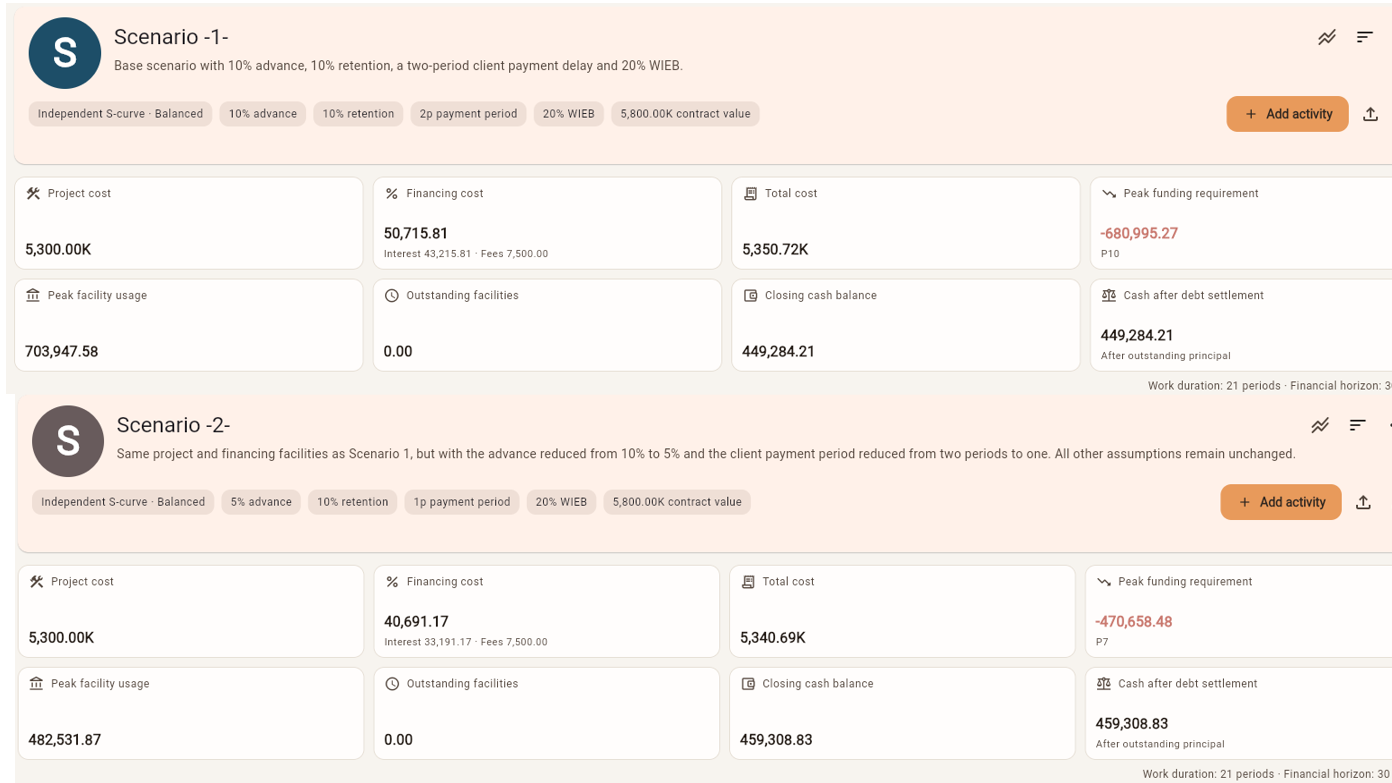
SCREEN 08 — CONTRACT-TERM SCENARIO COMPARISON
Myth: a higher advance is always the better contract deal
A larger advance generally improves early liquidity when all other terms are held constant. But contractors negotiate a package of terms, not one isolated variable. The better commercial package depends on how those terms interact over the entire project cash cycle.
In this worked example, Scenario 1 uses a 10% advance and a two-period client payment delay. Scenario 2 reduces the advance to 5% but also shortens the payment delay to one period. Retention, WIEB, project cost and financing structure remain the same.
| Metric | Scenario 1 | Scenario 2 |
|---|---|---|
| Advance | 10% | 5% |
| Client payment delay | 2 periods | 1 period |
| Peak funding requirement | 680,995.27 | 470,658.48 |
| Peak facility usage | 703,947.58 | 482,531.87 |
| Financing cost | 50,715.81 | 40,691.17 |
Despite the smaller advance, Scenario 2 reduces the peak funding requirement by about 210,337, lowers peak facility usage by about 221,416, and reduces financing cost by about 10,025. The faster recurring payment cycle is more valuable to this project's cash position than the additional five percentage points of advance.
The lesson is not that a lower advance is better. The lesson is that contract terms must be simulated together. On another project, the larger advance may be much more valuable. Without generating the cash flows, it is difficult to know which clause deserves the strongest negotiation effort.
Negotiation use: test the terms that may move cash materially—advance, payment delay, retention, WIEB, materials-on-site recognition, subcontract terms and financing structure—then focus negotiation effort where the model shows a meaningful change in peak funding or financing cost.
7. Export the Forecast to Excel
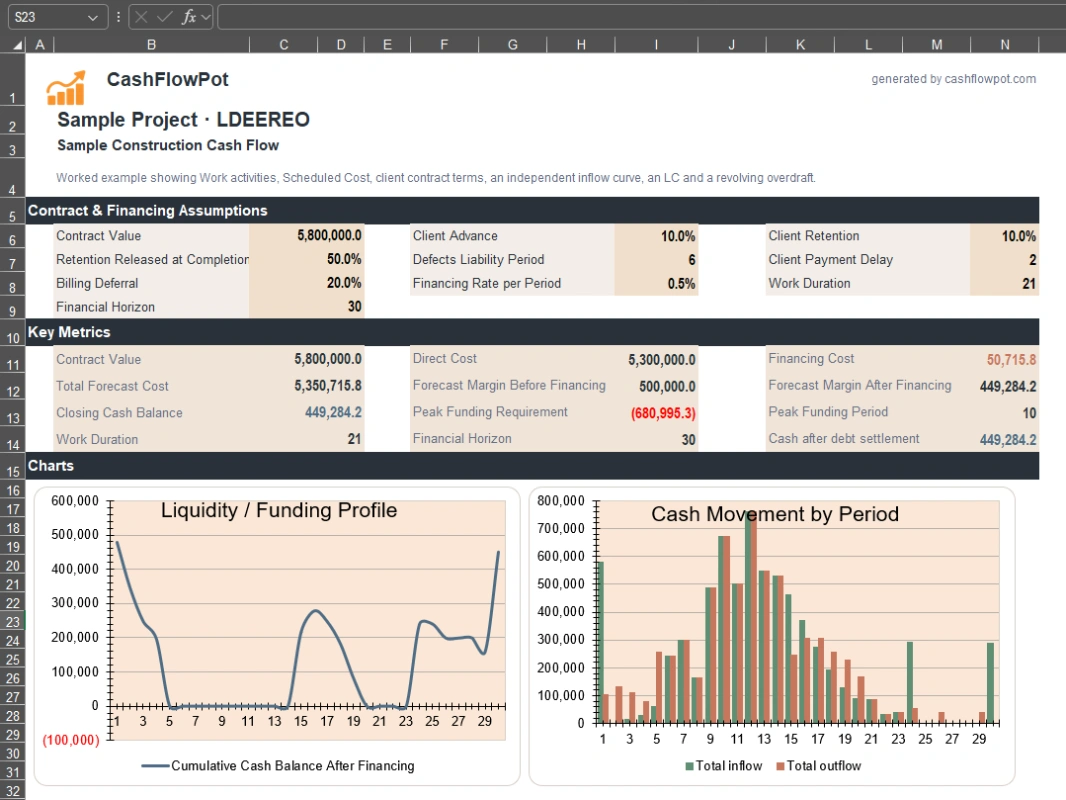
CashflowPot can export the calculated forecast to Excel for further review, presentation or handoff. The export can include the project assumptions, key financial metrics, activity schedules, project inflow and outflow, financing facilities and cash position.
SCREEN 09 — EXCEL EXPORT
8. How Different Construction Teams Can Use the Same Model
The same project cash-flow model can support different decisions:
- Tender and commercial teams: test payment terms before accepting a contract and identify which clauses materially affect funding.
- Project managers: understand when the project is expected to consume cash and how activity timing changes liquidity.
- Finance teams: estimate working-capital demand, facility usage, interest and fees.
- Lenders: review the expected timing of draws, project receipts, peak exposure and repayment behavior.
- Owners and investors: compare project scenarios and understand whether planned financing is consistent with the forecast cash cycle.
9. What CashflowPot Is Not Intended to Replace
CashflowPot is a financial planning and scenario tool. It should not be confused with software built for different construction-control functions.
- It is not a replacement for detailed CPM scheduling in Primavera P6 or Microsoft Project when logic, resources, baselines and detailed programme control are required.
- It is not an accounting system or general ledger.
- It is not a BOQ measurement system.
- It does not determine delay entitlement or replace formal delay analysis.
Its purpose is narrower: convert a practical project plan and commercial assumptions into a construction cash-flow forecast, identify the funding requirement, model financing and compare alternatives quickly.
10. A Practical CashflowPot Workflow
- Create the project and cash-flow scenario.
- Add the financially material activities.
- Choose Work or Scheduled Cost for each activity.
- Set activity timing and cost distribution.
- Add subcontract assumptions where applicable.
- Define the main-contract inflow and payment terms.
- Review project inflow, outflow and peak pre-financing funding requirement.
- Add financing facilities and review funded cash position.
- Duplicate the scenario and test alternative contract or financing terms.
- Export the preferred forecast to Excel when a portable report or further analysis is needed.
For a deeper explanation of how outflow, client inflow, cumulative cash balance and financing fit together, return to the construction project cash-flow guide. For the engineering judgement behind activity curves, skew and WIEB assumptions, use the construction cash-flow prediction guide.
Try the current application: Open CashflowPot on Quollnet and build a scenario using your own activity costs, contract terms and financing assumptions.